
Listen to this article
Executive Summary
Vibe coding delivers real velocity gains, but it carries documented security, technical-debt, and productivity risks. Professional adoption means matching the methodology to the use case, not applying it uniformly.
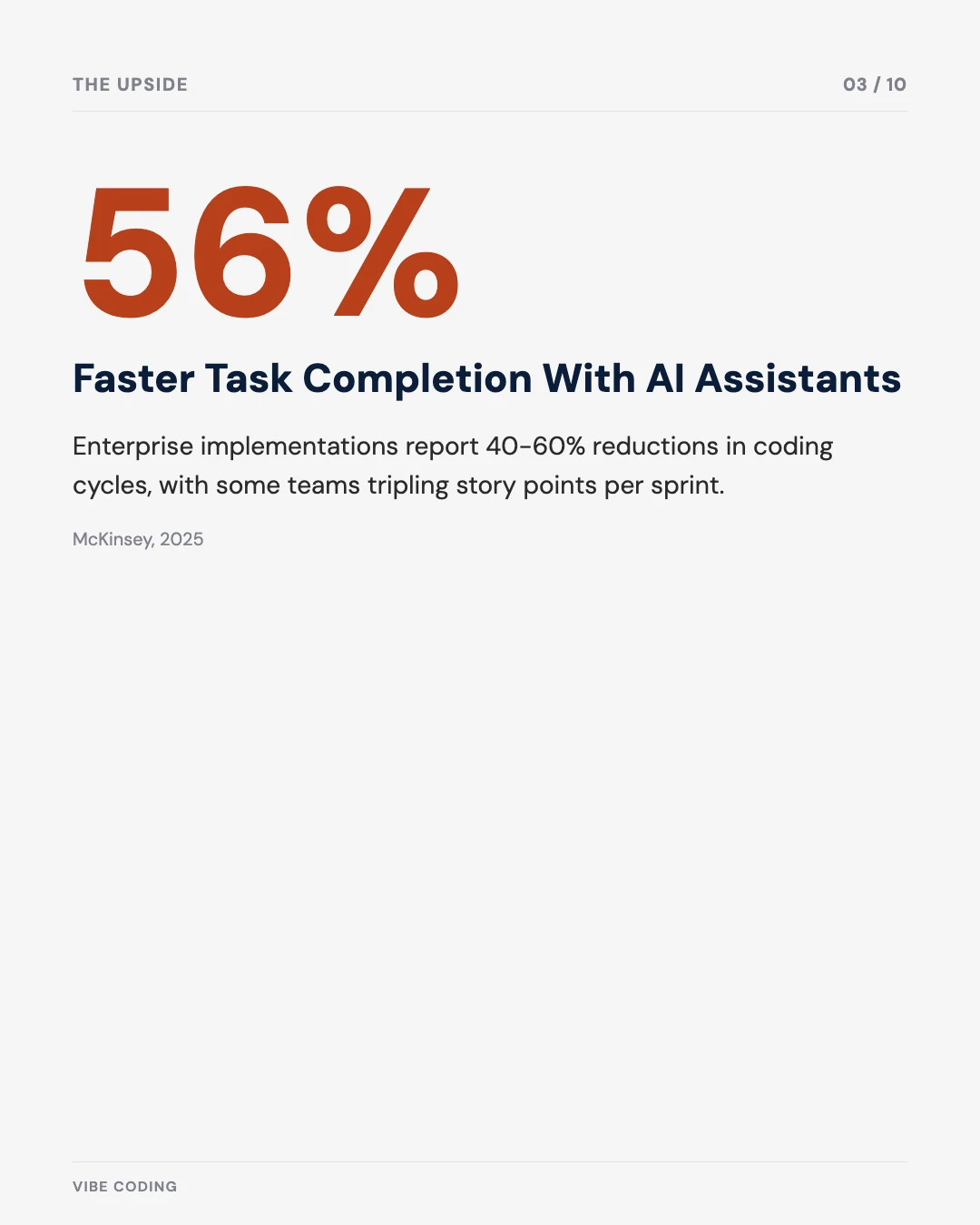
56%
faster task completion with AI coding assistants versus traditional methods, per McKinsey
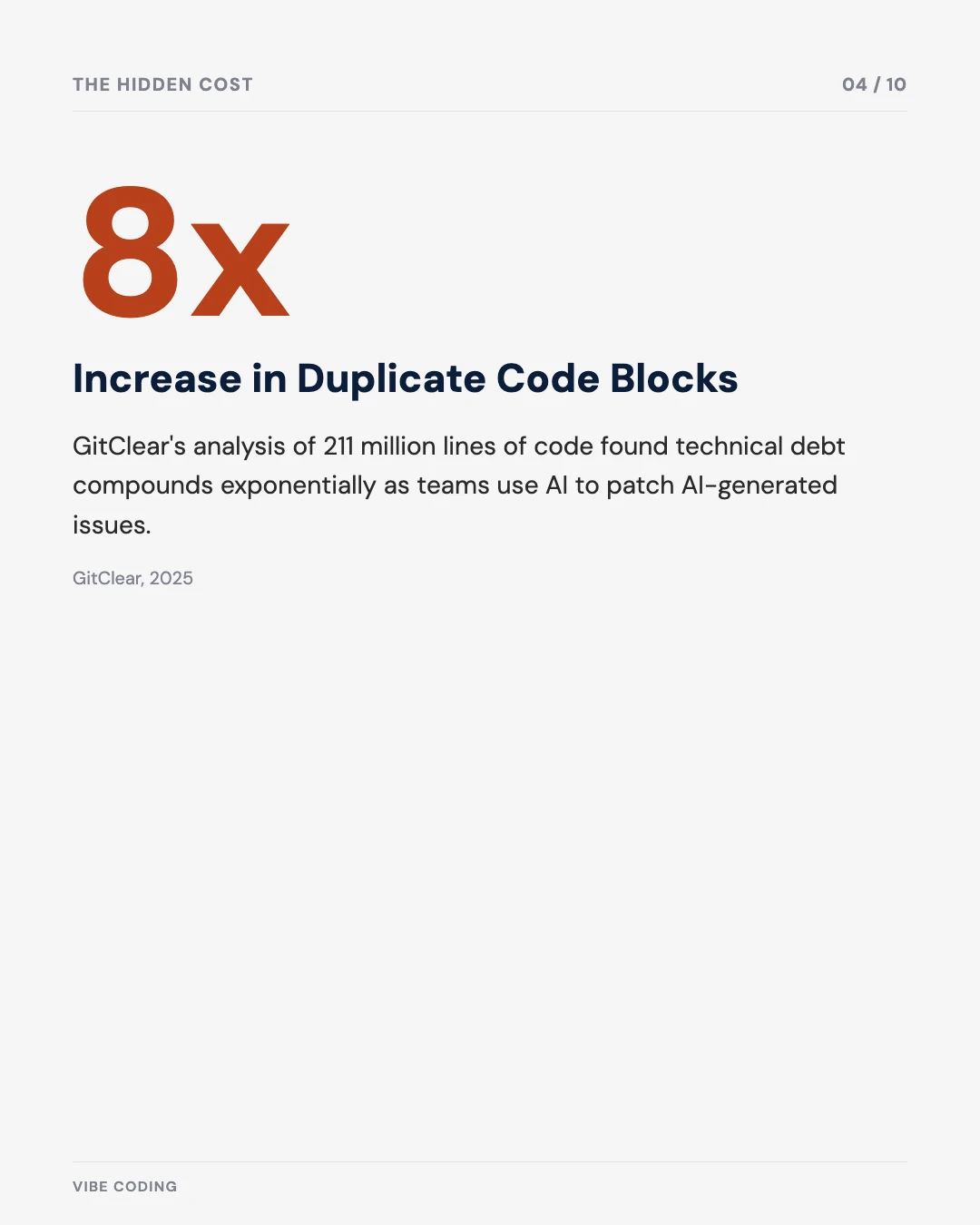
8x
increase in duplicate code blocks correlating with AI tool adoption, across 211M lines analysed by GitClear
-7.2%
delivery stability among teams using AI coding assistants, per Google’s 2024 DORA report
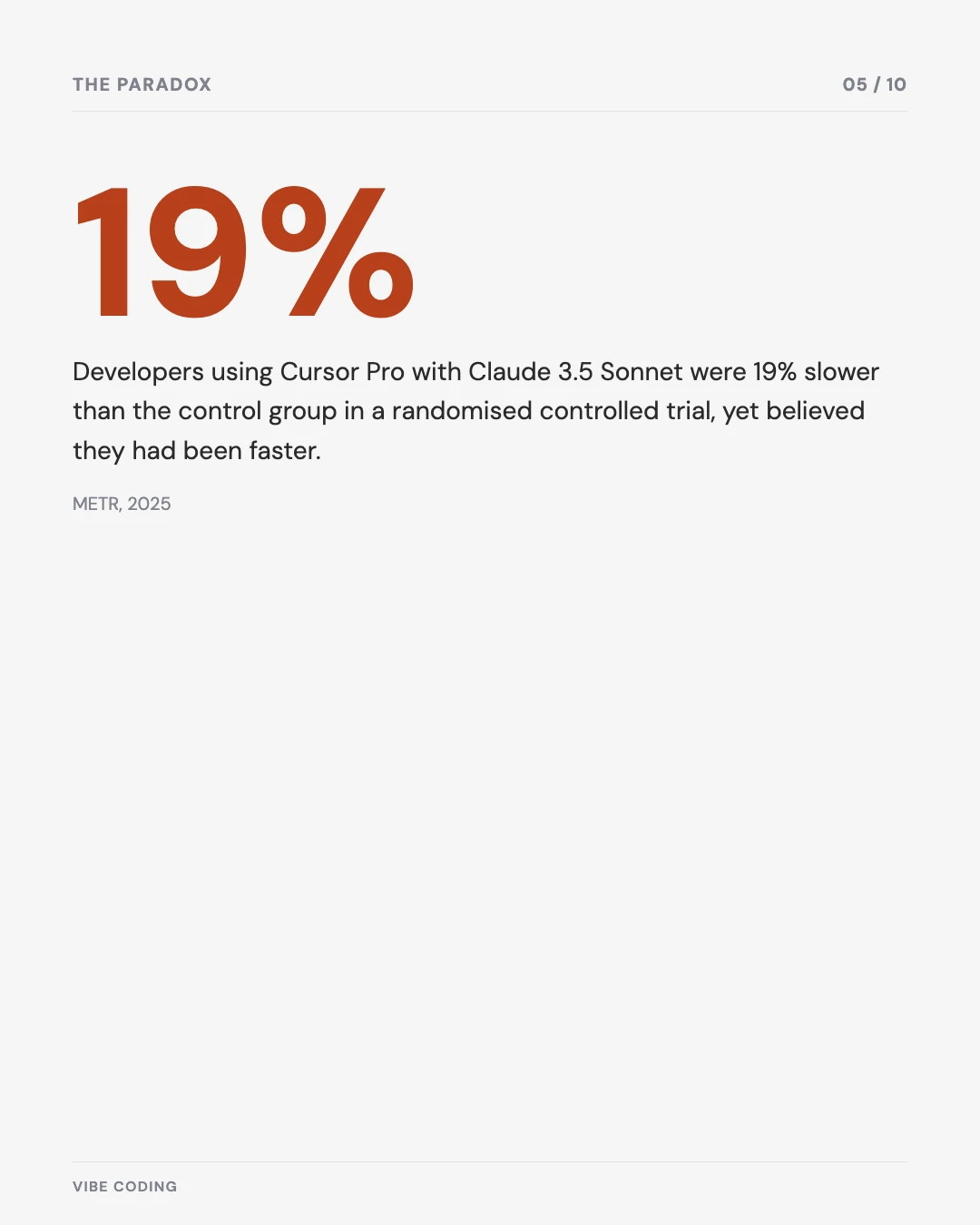
19%
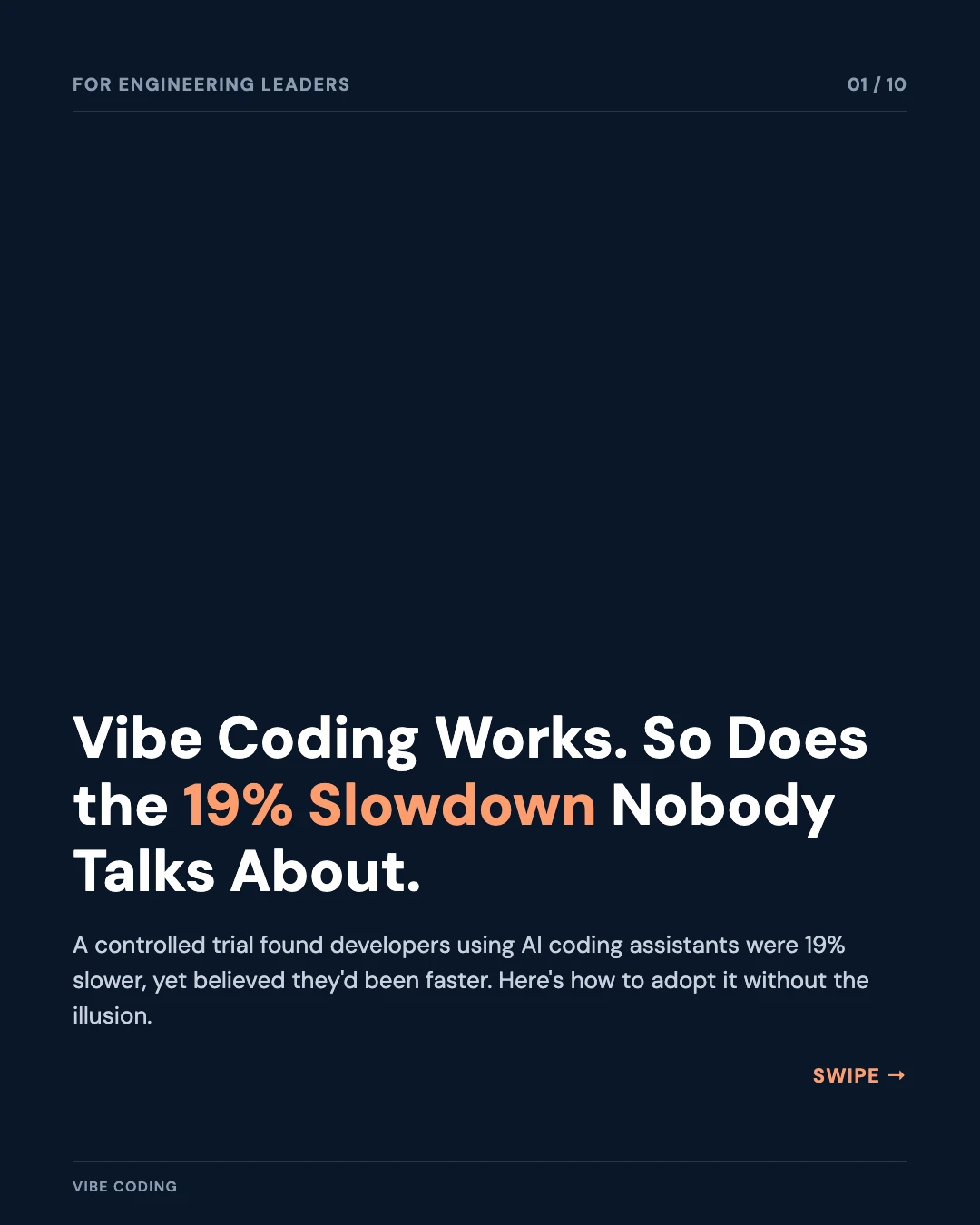
slower completion for experienced developers using AI tools, while believing they were faster (a METR randomised controlled trial)
Core conclusions
- Velocity gains are real but uneven. Prototyping and internal tools benefit most; production and security-sensitive code needs spec-driven discipline instead.
- Without mandatory security scanning and code review, AI-generated code inherits the vulnerabilities of its training data. The C.L.E.A.R. review framework and automated SAST/DAST checks are non-negotiable, not optional.
- Break-even on vibe coding adoption realistically takes three to six months; leaders should track delivered value, not lines of code or commit frequency.
The evidence, in ten slides
Save it, share it, or send it to whoever’s deciding your team’s AI coding policy.
I’ll be honest, when I first heard about “vibe coding” a few months ago, I was skeptical. The idea of letting AI write production code based on casual prompts sounded like a recipe for disaster. But as someone managing digital transformation initiatives, I couldn’t ignore the buzz. So I dove into the research, tested it with my teams, and what I found surprised me.
Vibe coding, a practice of generating functional code through natural language prompts to large language models, has emerged as one of 2025’s most polarising methodologies. Coined by Andrej Karpathy in February 2025, it’s sparked fierce debates in the engineering community. And both sides have valid points.
In this article, I want to share what I’ve learned: vibe coding isn’t the silver bullet some claim, nor is it the disaster others predict. It’s a powerful tool that requires smart guardrails. Here’s my take on how to adopt it responsibly, based on both the research and real-world experience.
Understanding Vibe Coding
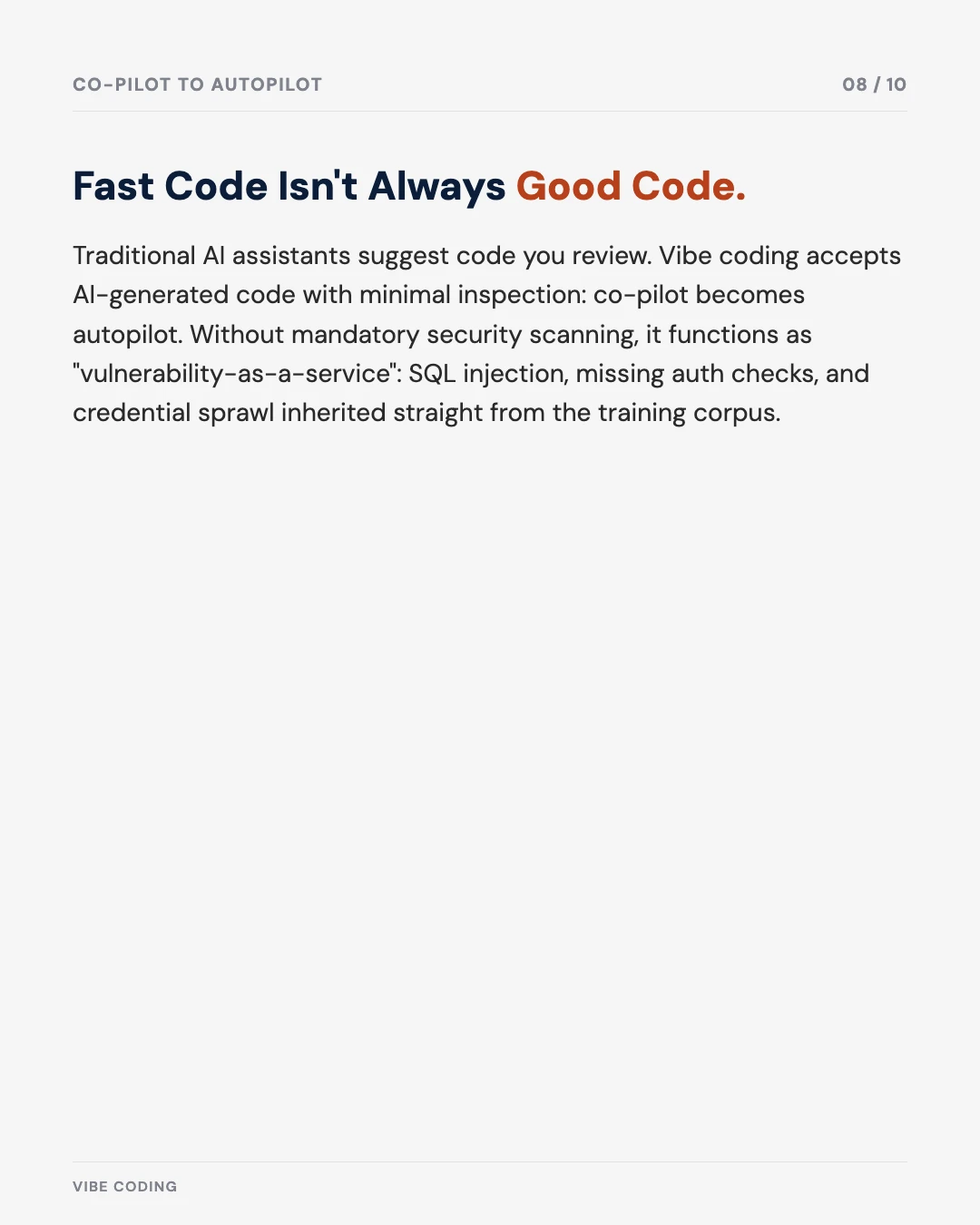
Here’s the key difference: traditional AI coding assistants (like GitHub Copilot) suggest code that you review and modify. With vibe coding, you accept AI-generated code with minimal inspection. Think of it as shifting from co-pilot to autopilot.
Your role changes from writing code to describing what you want. You tell the AI the outcome you need, and it handles the syntax, structure, and logic. Sometimes it works brilliantly. Sometimes… not so much.
This represents a meaningful departure from established practice. The developer focuses on outcomes (what the system must accomplish) rather than implementation mechanics. The AI interprets requirements, selects appropriate frameworks, configures dependencies, and produces working code, often within minutes.
Advantages
Velocity Improvements
McKinsey research indicates that developers using AI assistants complete tasks up to 56 per cent faster than those using traditional methods. Enterprise implementations report 40–60 per cent reductions in coding cycles, with some teams achieving threefold velocity increases in story points per sprint. For rapid prototyping and minimum viable product development, timelines compress from weeks to days or even hours.
The speed gains are real. I’ve seen teams build prototypes in hours that would have taken days before. But remember: fast code isn’t always good code.
Democratisation of Development
Vibe coding lowers the technical barrier for non-engineering personnel. Government agencies have deployed the approach to enable policy analysts, project managers, and citizen service teams to build custom applications without dedicated IT support. In enterprise environments, domain experts in finance, operations, and customer success independently develop workflow automation and data visualisation tools.
This democratisation extends to infrastructure-as-code workflows, where platform engineers use natural language to generate Terraform configurations, Kubernetes manifests, and cloud provisioning scripts.
Innovation Acceleration
By offloading boilerplate code generation, vibe coding allows engineers to allocate cognitive resources to architectural decisions, user experience design, and strategic problem-solving. Teams report increased experimentation velocity, as the cost of testing new concepts drops substantially.
Challenges and Substantiated Risks
Security Vulnerabilities
AI models trained on public code repositories inherit the security deficiencies present in that corpus. Common vulnerabilities in vibe-coded applications include SQL injection, missing authorisation checks, path traversal exploits, insecure authentication mechanisms, and credential sprawl. A Sola Security analysis identified unrestricted resource access, prompt injection vectors, and missing input validation as recurring patterns.
Without mandatory security scanning, vibe coding effectively functions as “Vulnerability-as-a-Service,” generating functional but fundamentally insecure systems.
Technical Debt Acceleration
GitClear’s analysis of 211 million lines of code revealed an eightfold increase in duplicate code blocks correlating with AI tool adoption. AI-generated code prioritises prompt fulfilment over architectural quality, avoiding refactoring, creating inconsistent patterns, and introducing maintenance burdens. This debt compounds exponentially rather than linearly, as teams use AI to patch AI-generated issues, creating recursive complexity.
Google’s 2024 DORA report noted a 7.2 per cent decrease in delivery stability amongst teams using AI coding assistants, despite faster initial development.
Maintainability Degradation
Vibe-coded applications frequently lack documentation, exhibit inconsistent naming conventions, and contain logic that the original author does not fully comprehend. This creates knowledge silos, elevates defect rates, and increases developer turnover as engineers struggle with unmaintainable codebases.
Productivity Paradox
Here’s the most surprising finding: experienced developers are often slower with AI tools. This shocked me when I first saw the data, but it makes sense when you think about it.
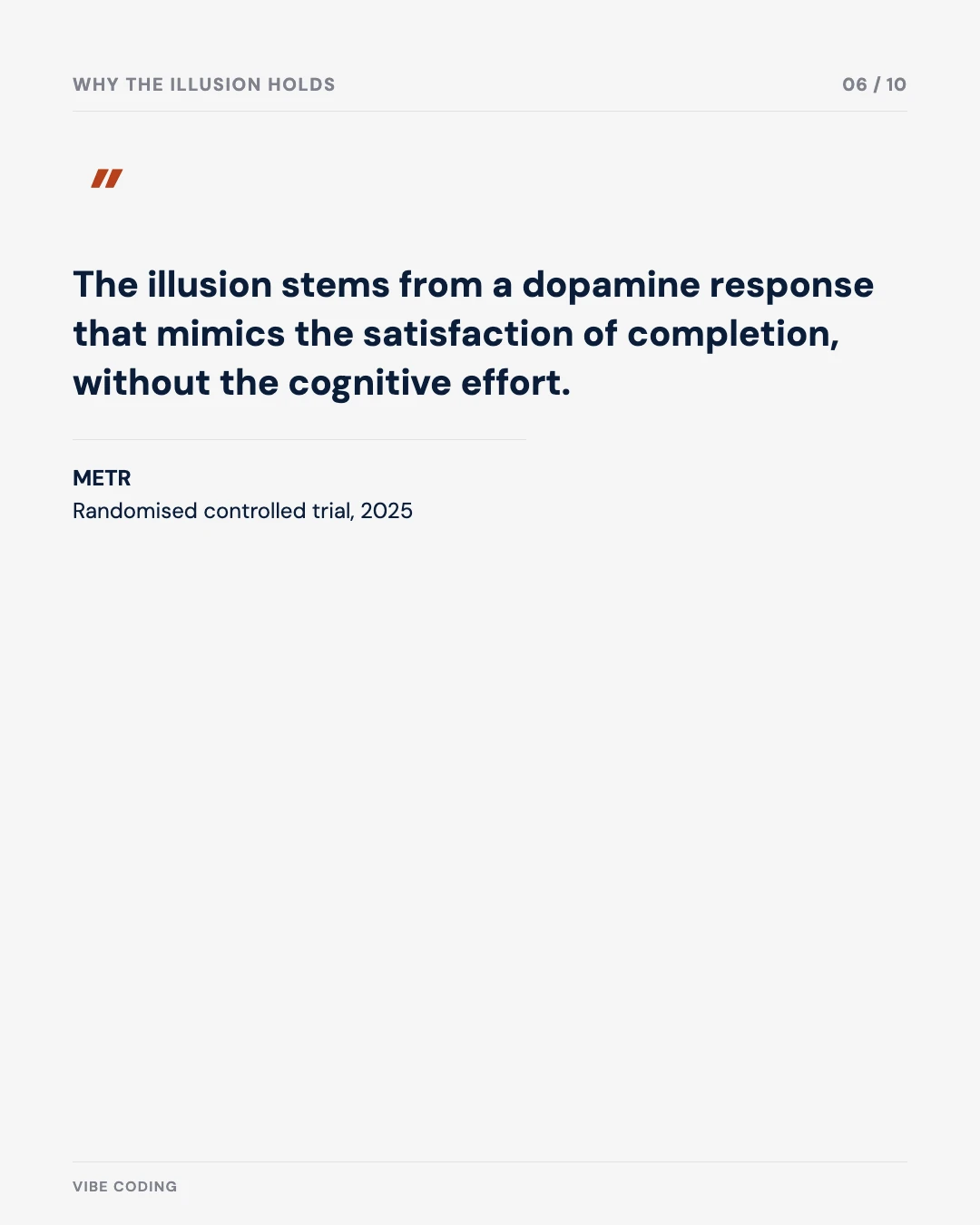
A METR randomised controlled trial found that developers using Cursor Pro with Claude 3.5 Sonnet were 19 per cent slower than the control group, yet believed they had been faster. This illusion stems from the dopamine response triggered by AI-generated output, which mimics the satisfaction of completion without the cognitive effort.
State of Software Delivery 2025 data indicates that developers spend more time debugging AI-generated code than they save in initial authoring. I have lived a version of this personally: why a 4-day project took 4 weeks once AI got involved in the revision cycle.
Framework for Professional Adoption
Responsible vibe coding adoption requires systematic controls that preserve velocity gains whilst mitigating documented risks.
Spec-Driven Development
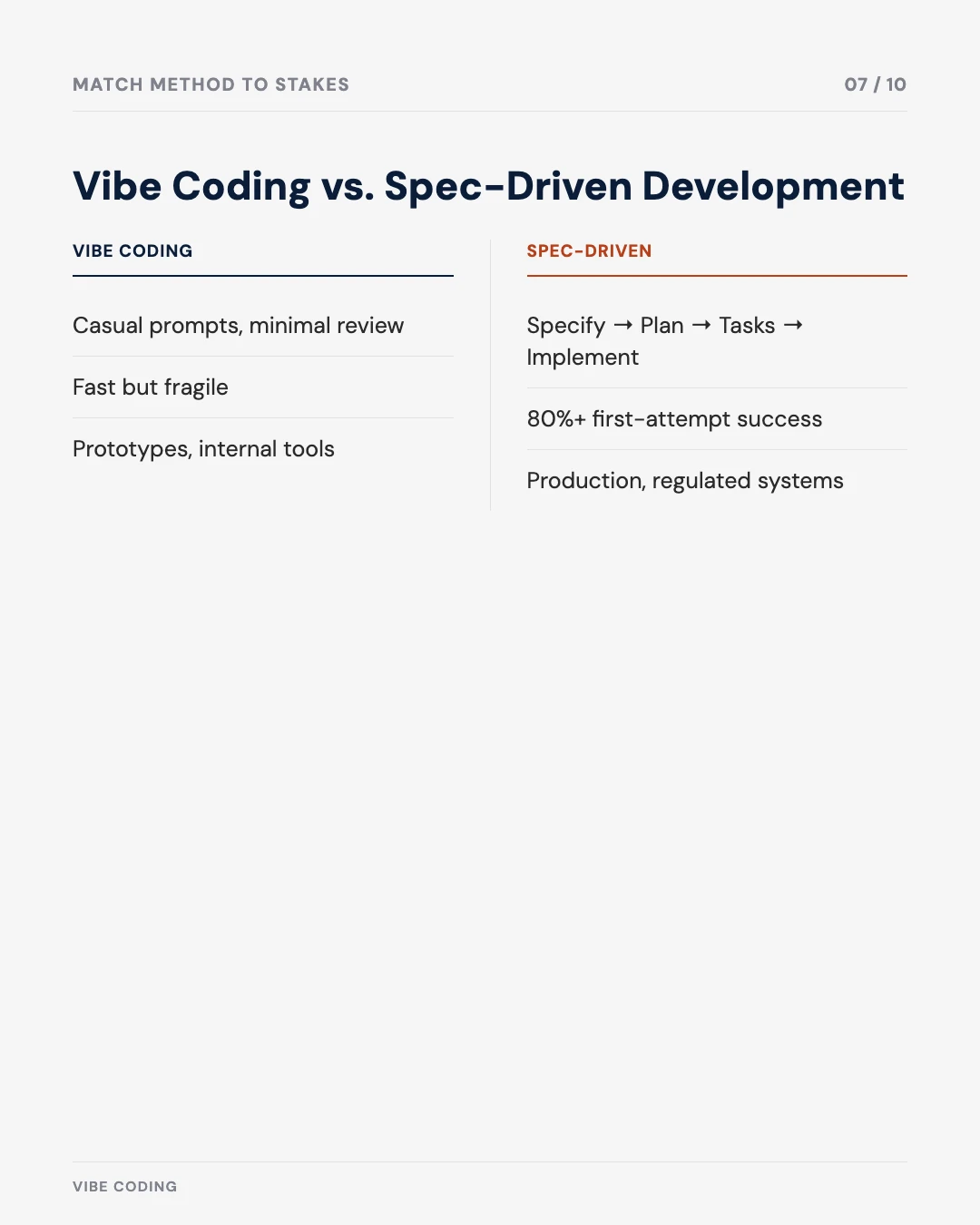
The industry is evolving from unstructured “vibe coding” towards specification-driven methodologies. Rather than iterative prompting, spec-driven development establishes formal specifications as executable blueprints. GitHub’s Spec-Kit framework implements this through a structured workflow: Specify → Plan → Tasks → Implement.
This approach achieves first-attempt success rates exceeding 80 per cent by providing AI agents with comprehensive context, architectural constraints, security requirements, and design system guidelines upfront. The specification becomes a contract between human intent and machine execution, reducing re-explanation cycles and ensuring consistency.
Mandatory Code Review Framework
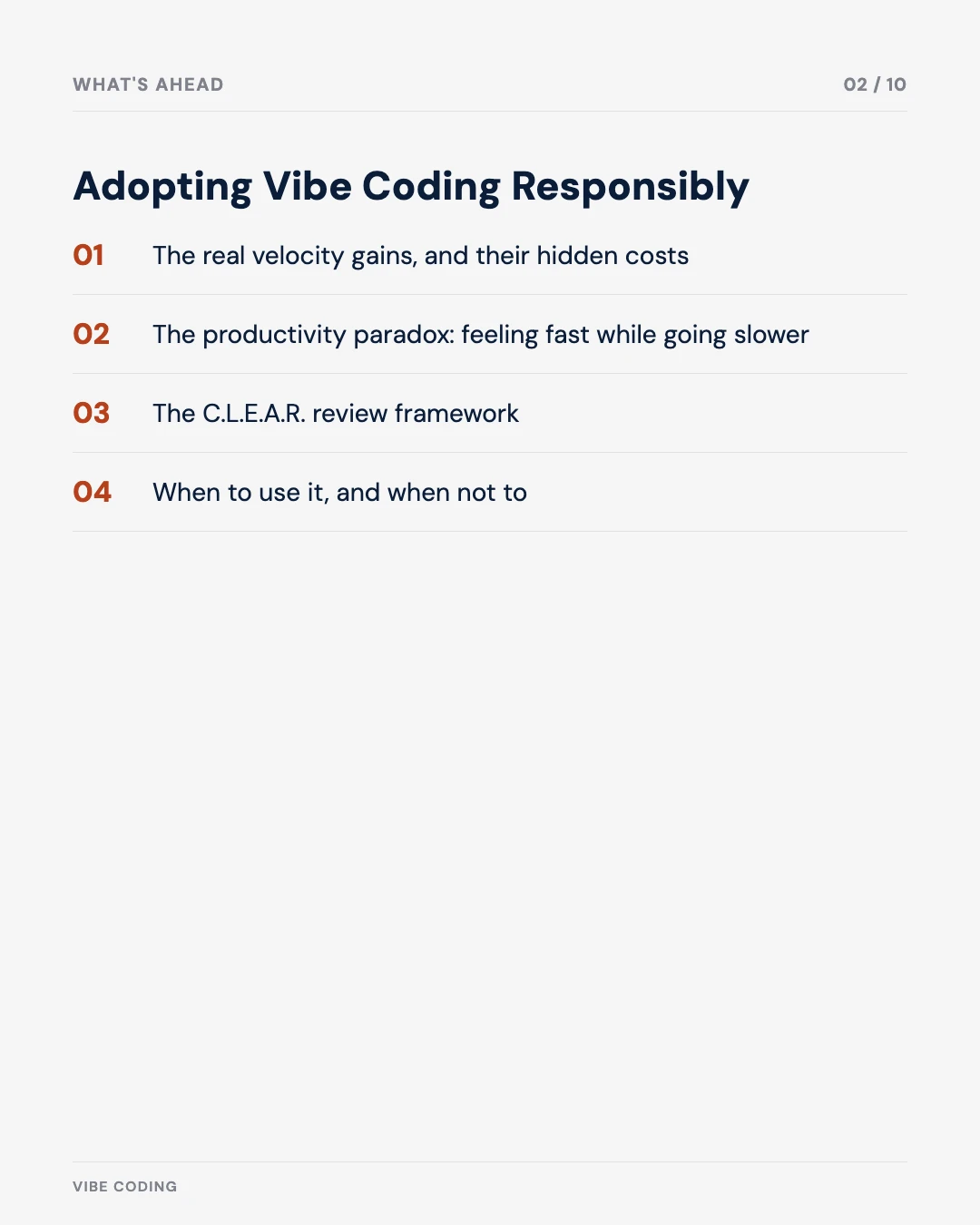
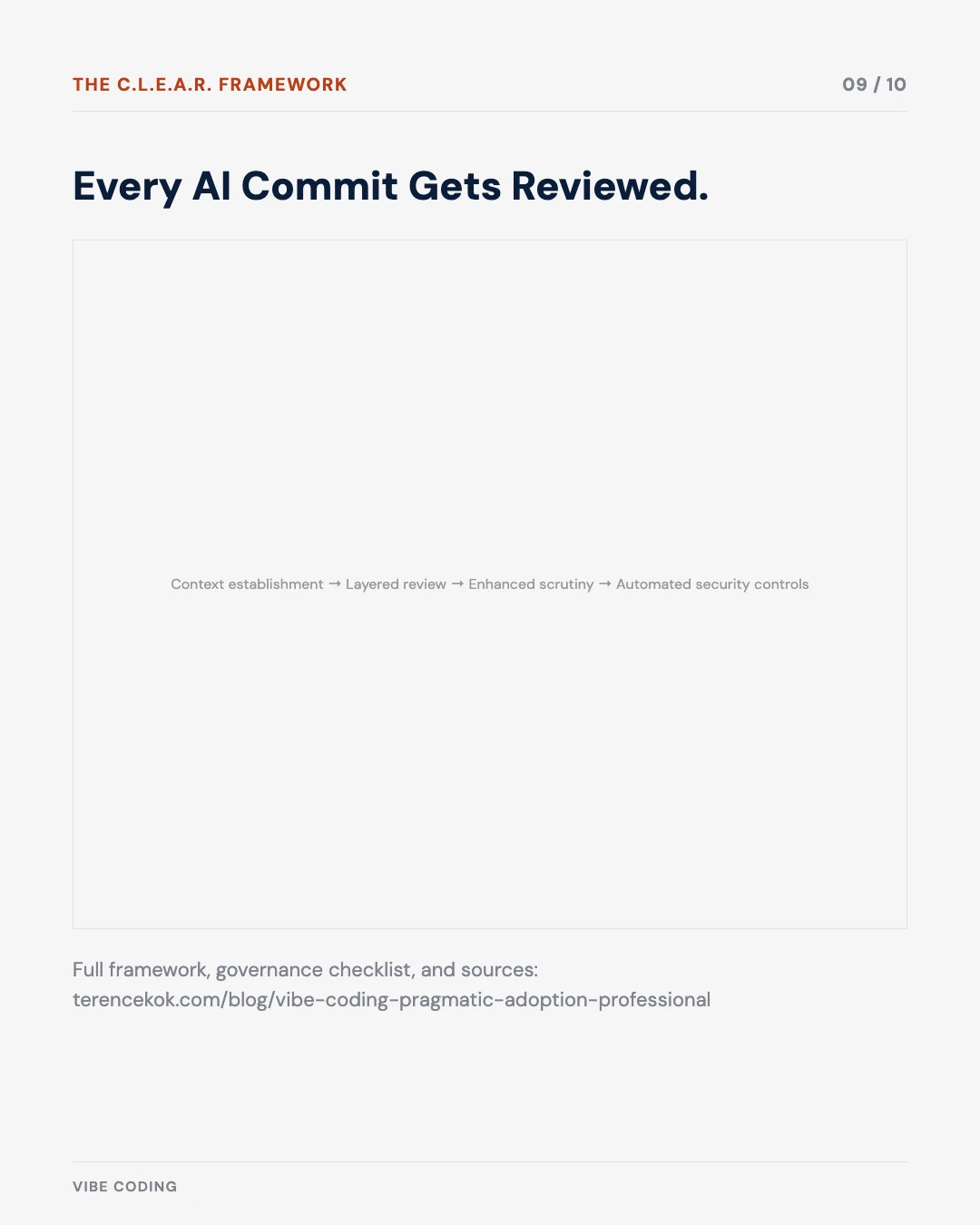
The C.L.E.A.R. review framework provides a structured approach for AI-generated code:
- Context Establishment: Review the original prompt, requirement alignment, generation history, and system integration points before evaluating code.
- Layered Review: Conduct tiered analysis across five dimensions: functionality and requirement fulfilment, algorithm correctness and data processing, security and edge case handling, performance and efficiency, and style and maintainability.
- Enhanced Scrutiny: AI-generated code demands different review focus than human-authored code. Reviewers must verify logic correctness (AI frequently introduces subtle logical errors), validate integration points with existing systems, and identify security anti-patterns that AI models replicate from training data. All AI-generated code must undergo human review before merging. No exceptions.
- Automated Security Controls: Static Application Security Testing (SAST) must run automatically in continuous integration pipelines, blocking merges when critical vulnerabilities appear. Tools such as Semgrep, Snyk Code, and SonarQube detect insecure patterns early. Runtime validation through Dynamic Application Security Testing (DAST) and API security scanning verifies that AI-generated endpoints behave securely in production environments. Secure prompt engineering reduces risk at the source. Prompts should explicitly require input validation, parameterised queries, least-privilege access controls, and proper error handling.
Hybrid Implementation Strategy
Professional adoption employs vibe coding selectively, matching methodology to use case:
- Vibe coding for exploration: Prototyping, proof-of-concept development, internal tools with limited security exposure, and workflow automation for non-critical processes.
- Spec-driven for production: Customer-facing applications, mission-critical infrastructure, systems handling sensitive data, and components requiring regulatory compliance.
- Traditional development for complexity: Distributed systems requiring intricate coordination, high-security environments with stringent audit requirements, and performance-critical code paths where optimisation is essential.
Governance Architecture
Enterprise adoption requires clear governance before deployment:
- Usage Guidelines: Define approved use cases, specify which codebases permit AI assistance, and establish approval processes for integrating generated code into production.
- Quality Gates: Mandate automated testing in CI/CD pipelines, require minimum test coverage thresholds for AI-generated code, and implement security scanning as non-negotiable checkpoints.
- Accountability Structures: Assign ownership. Developers remain accountable for all AI-generated code committed under their name, require documentation explaining architectural decisions (even when AI suggests them), and establish feedback loops where rejected AI suggestions are logged with justification.
- Training Investment: Provide prompt engineering training focused on security and quality, educate teams on AI model limitations and common failure modes, and develop internal prompt libraries encoding organisational standards. The specific principles worth training on are ones I have documented from direct experience.
Metrics for Measuring Success
Track quantitative indicators to assess vibe coding efficacy:
- Velocity metrics: Developer story points per sprint, cycle time from feature request to production deployment, and time allocation across specification, implementation, and debugging phases.
- Quality metrics: Defect density (bugs per thousand lines of code), code review duration and approval rates, and technical debt accumulation rate.
- Security metrics: Security incident frequency and severity, time to detect and remediate vulnerabilities, and compliance audit outcomes.
- Operational metrics: Mean time to recovery from incidents, infrastructure provisioning speed (for IaC use cases), and cloud resource efficiency (cost per transaction).
Realistic Expectations
Evidence suggests a realistic return-on-investment timeline of three to six months before breaking even, with substantial productivity gains emerging in year two and beyond. Initial phases may involve:
- Training overhead,
- Template library development, and
- Process refinement that temporarily reduce velocity.
Leaders should resist productivity metrics based solely on lines of code written or commit frequency. More code often indicates worse outcomes when AI generates bloated, duplicative implementations. Focus instead on delivered value where features are deployed to production, customer problems are solved, and operational efficiency gains are achieved.
Conclusion
So, here’s where I’ve landed after months of research and experimentation: vibe coding isn’t the revolution some evangelists claim, but it’s also not the disaster the skeptics fear. It’s a tool, a powerful one that can deliver real value when you use it intelligently.
My advice? Don’t jump on the bandwagon blindly, and don’t dismiss it out of fear. Take the middle path:
- Use vibe coding for prototypes, internal tools, and exploratory work
- Apply strict governance and mandatory code review for production systems
- Maintain human oversight, always
- Focus on outcomes, not lines of code
If you’re managing a digital transformation, the real question isn’t whether to adopt vibe coding. It’s how to integrate it responsibly. The organizations that get this right will combine AI speed with human judgment and disciplined validation.
The future of software development is hybrid, combining AI capabilities with human expertise. Vibe coding, when properly constrained and intelligently deployed, is part of that future.
What’s your experience with AI-assisted coding? Are you seeing the productivity gains or hitting the pitfalls I’ve described? Drop a comment. I’d love to hear what’s working (and what’s not) in your organization.
Was this useful?