
Listen to this article
Executive Summary
Access to AI tools is no longer the barrier; the willingness to run a first experiment is. The professionals and organisations pulling ahead are simply the ones who started earlier and kept iterating.
Core conclusions
- The gap between AI adopters and non-adopters is no longer about budget or tooling access. It’s the decision to begin experimenting at all.
- Fluency with AI is built through accumulated iteration, not one-off training: prompt discipline and the instinct to break down problems for AI both come from repeated practice.
- The highest leverage comes from stacking tools together, not mastering any single one: connecting an LLM output to an automation or pipeline is what separates real AI literacy from surface-level use.
The argument, in ten slides
Save it, or send it to the person next to you who’s still waiting for the “right” time to start.
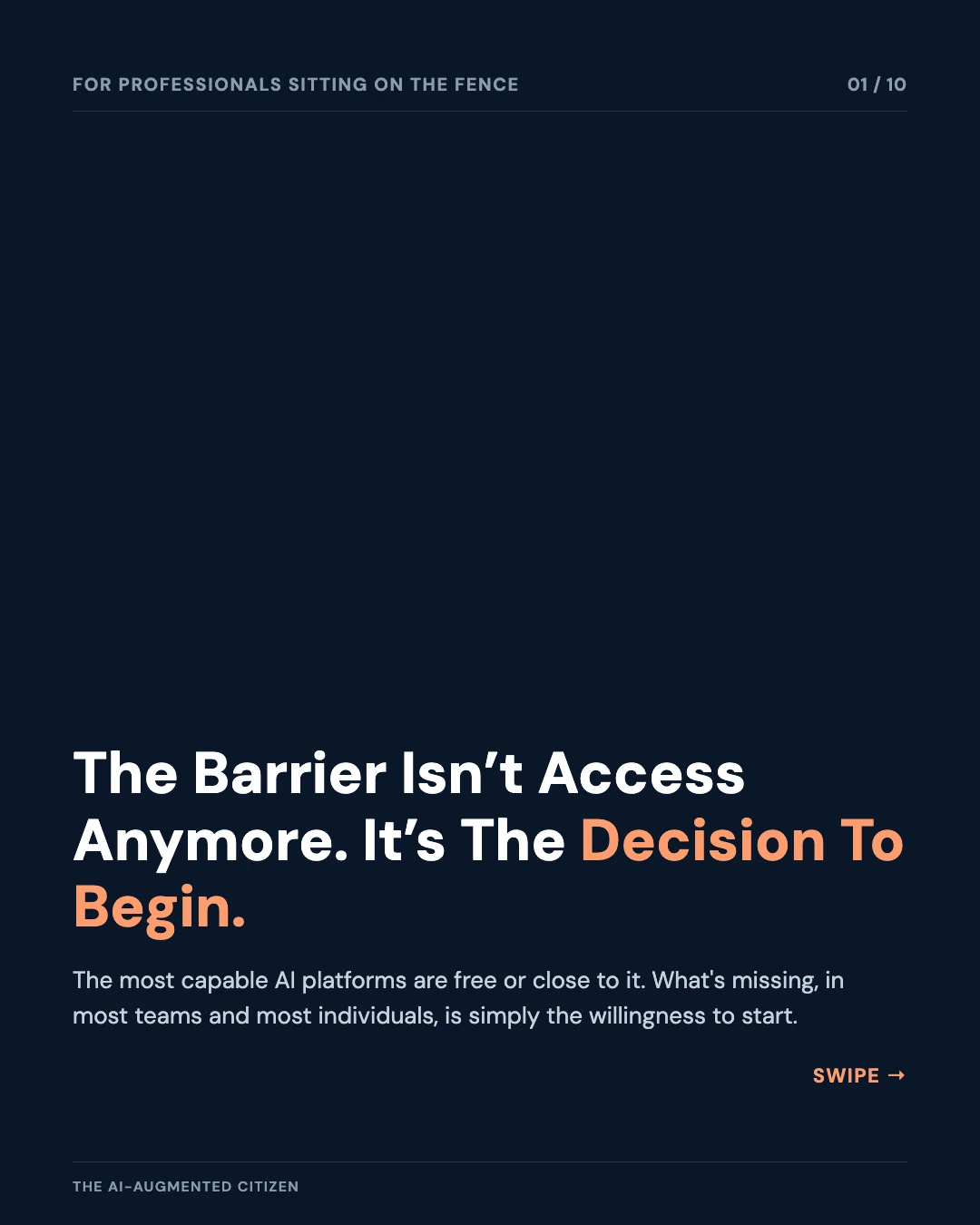
In 2026, the real barrier to AI is not access. It is the decision to begin.
Three years ago, getting your hands on AI tools was genuinely hard. Today, the most capable platforms are free or close to it. The tools are here. The documentation is everywhere. The use cases are multiplying by the week.
What is missing, in most teams, most organisations, most individuals, is simply the willingness to start.
This matters especially here in Singapore, where our national ambition on AI is real and well-resourced. At the Singapore Conference on AI for the Global Good in December 2023, then-DPM Lawrence Wong (now our Prime Minister) put it plainly: “We will aim high, we will dream big, and we will set ambitious goals. We will foster a spirit of boldness, experimentation and innovation in our next phase.”
That is not just government rhetoric. It is a direct call to professionals, to businesses, to each of us, to step up.
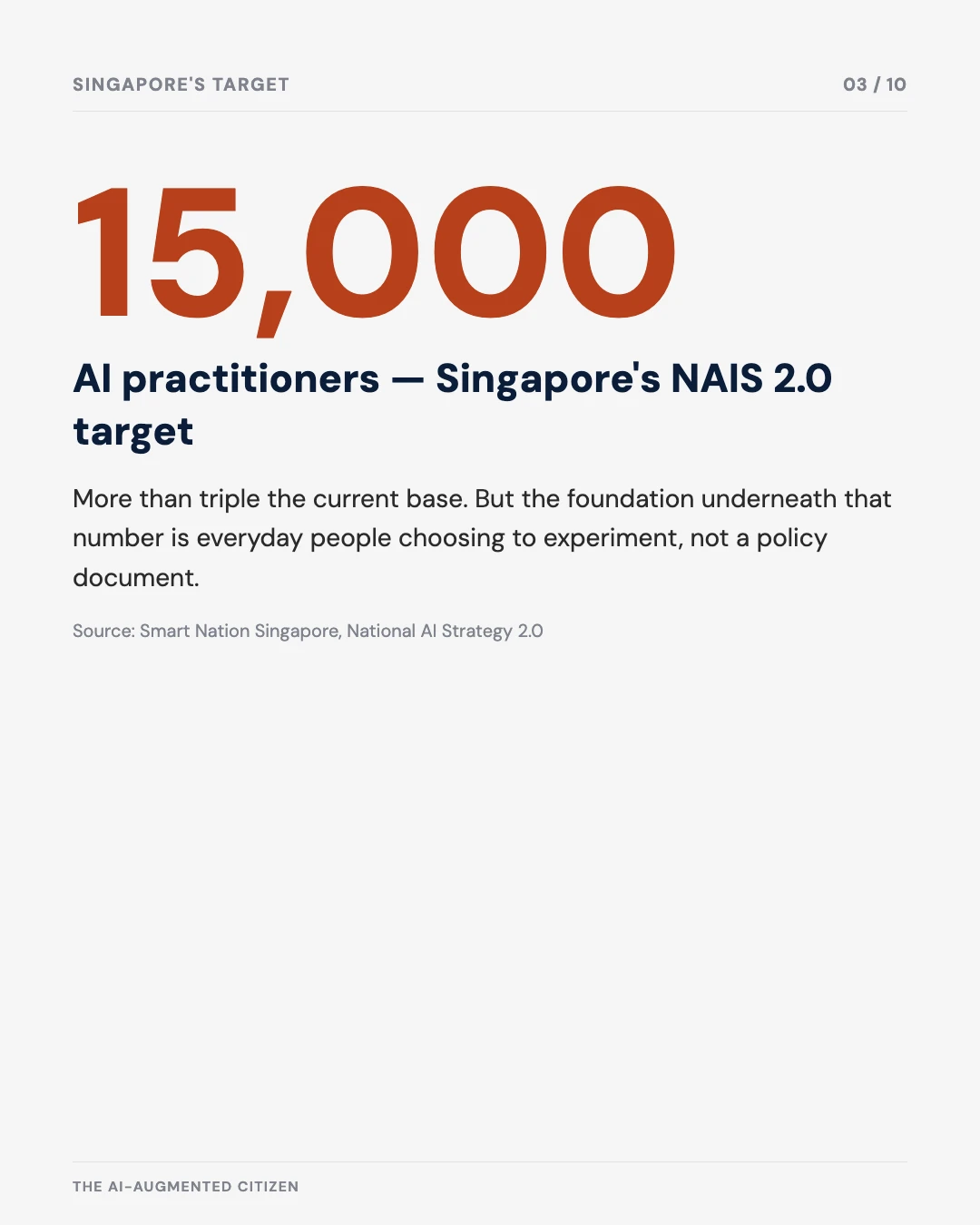
Singapore’s National AI Strategy 2.0 (NAIS 2.0) lays out a clear vision: build a base of confident AI users across enterprises and workers, “equipped to leverage AI for enhanced productivity and for more impactful work.” The strategy goes further, targeting more than triple the number of AI practitioners in Singapore, to 15,000. But the foundation underneath all of that is everyday people choosing to experiment.
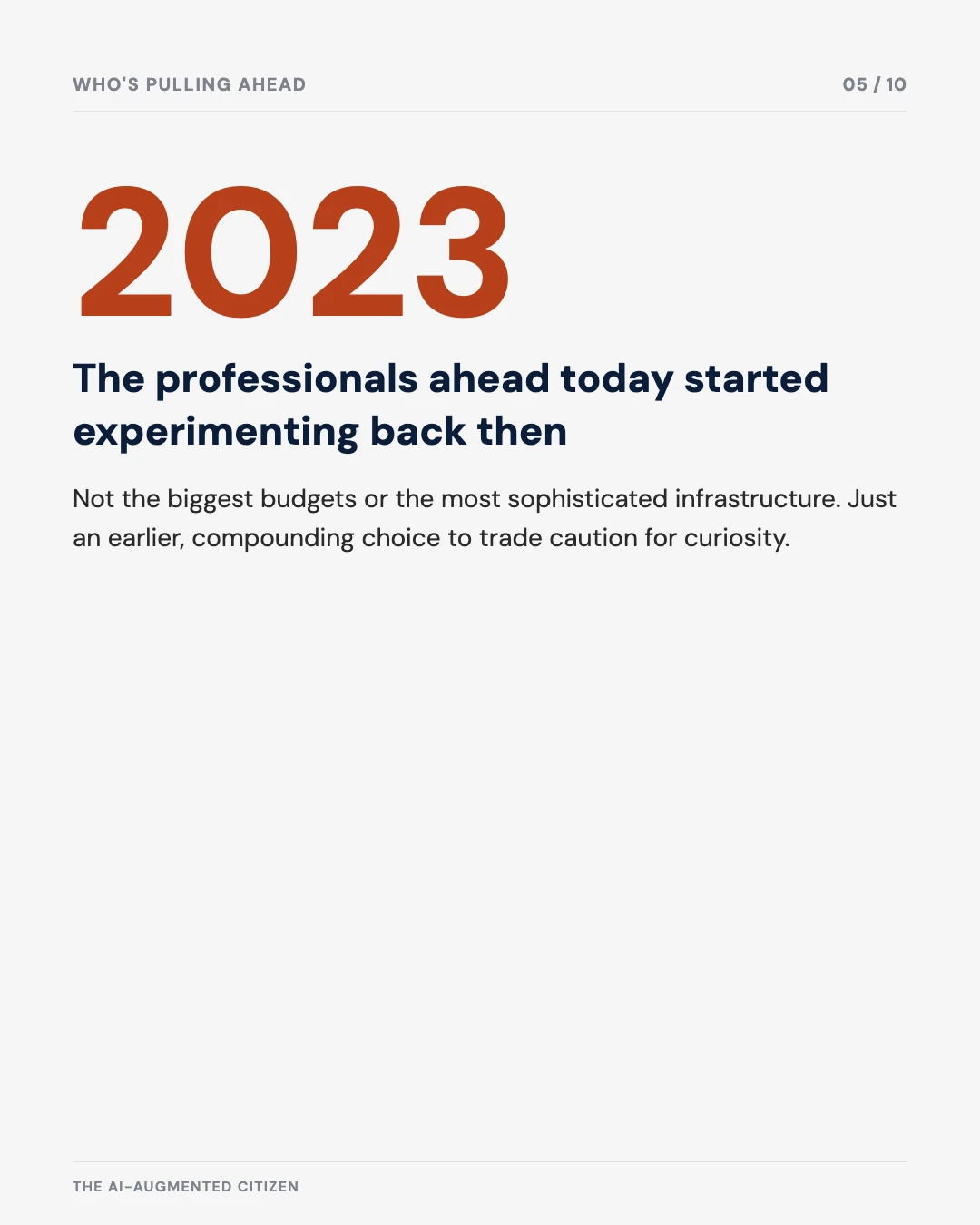
The professionals pulling ahead are not those with the biggest budgets or the most sophisticated infrastructure. They are the ones who, at some point, chose curiosity over caution, and have been compounding that choice ever since.
The Curiosity Gap
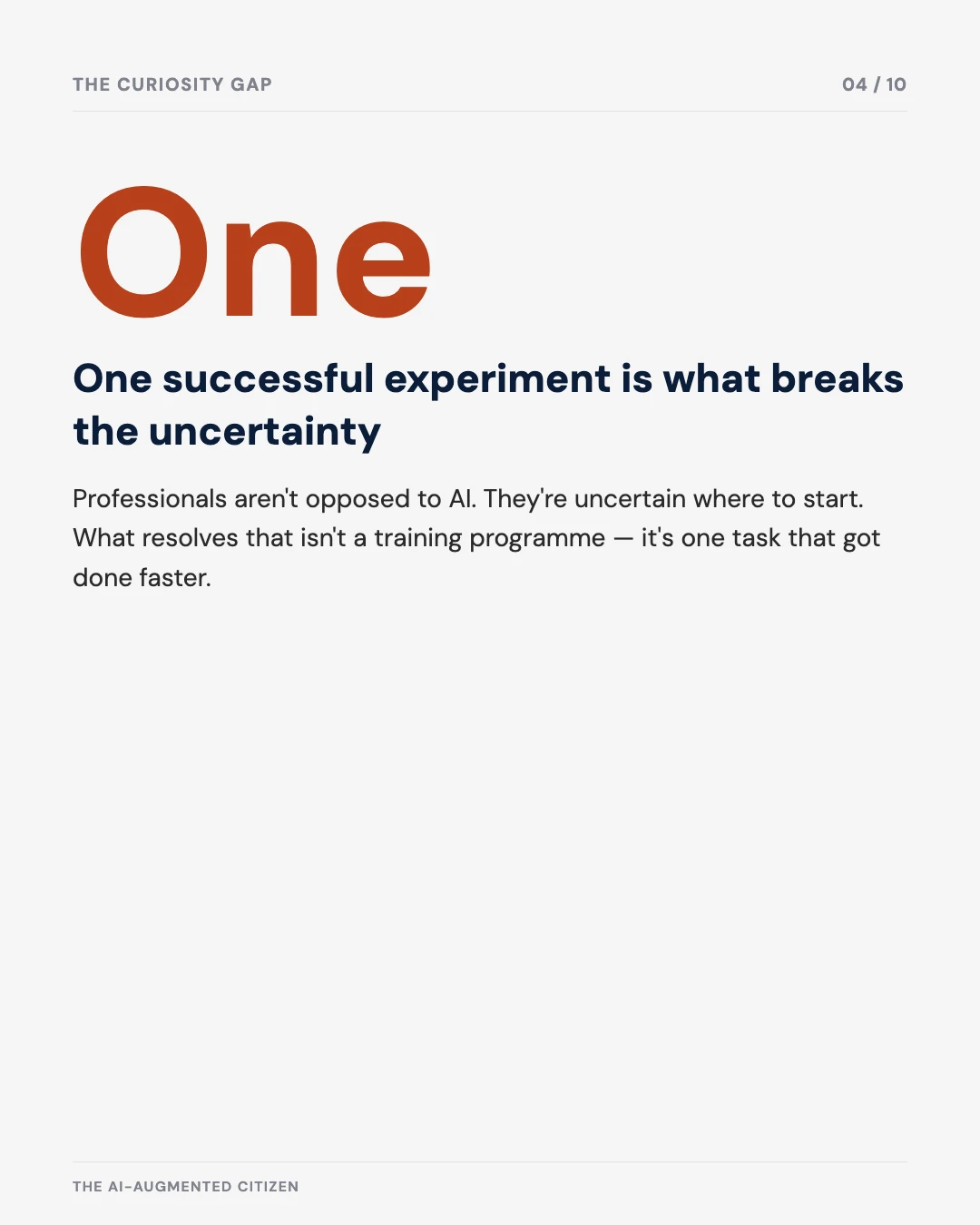
Research consistently shows that professionals are not opposed to AI. They are uncertain about where to start. And what resolves that uncertainty is not a training programme. It is one successful experiment: a task that got done faster, a draft that took half the usual effort, an analysis that would have taken a full day.
That first win is self-reinforcing. The curiosity that produced the experiment feeds on its own result.
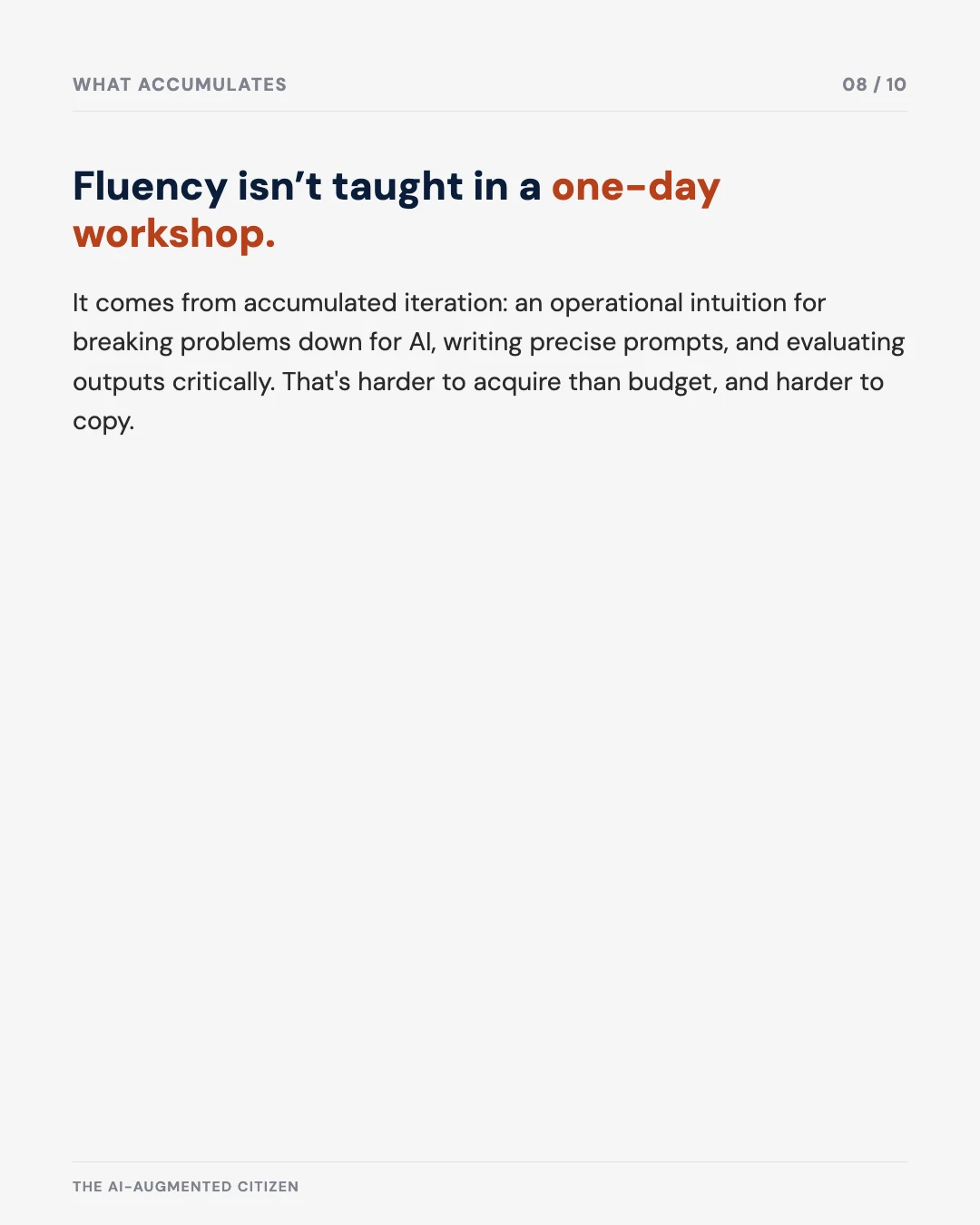
The professionals who started experimenting in 2023 and 2024 are not simply “more efficient” today. They have built something harder to acquire: an operational intuition for breaking down problems for AI, writing precise prompts, and evaluating outputs critically. That kind of fluency is not taught in a one-day workshop. It comes from accumulated iteration.
PM Lawrence Wong framed this well when he observed that Singapore cannot compete on size or fiscal scale alone, but has “a trusted eco-system where things work, and where we can make things happen.” That ecosystem advantage only holds if the people inside it are actually moving.
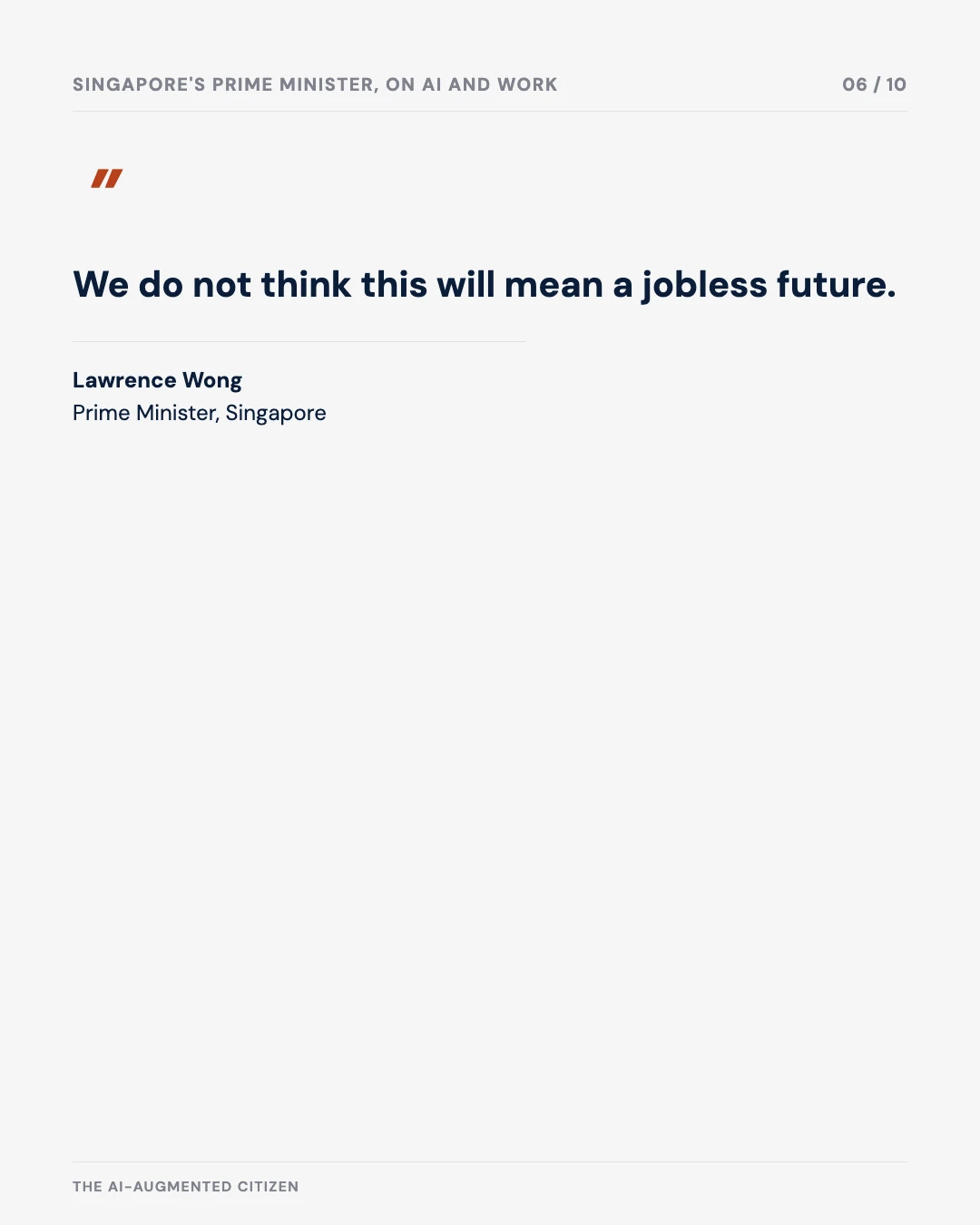
He also acknowledged the anxiety directly: “Knowledge-based work like research, coding and writing was considered safe from disruption in the past. But with AI, that is no longer the case. We do not think this will mean a jobless future.” The path forward is not avoidance. It is active adaptation.
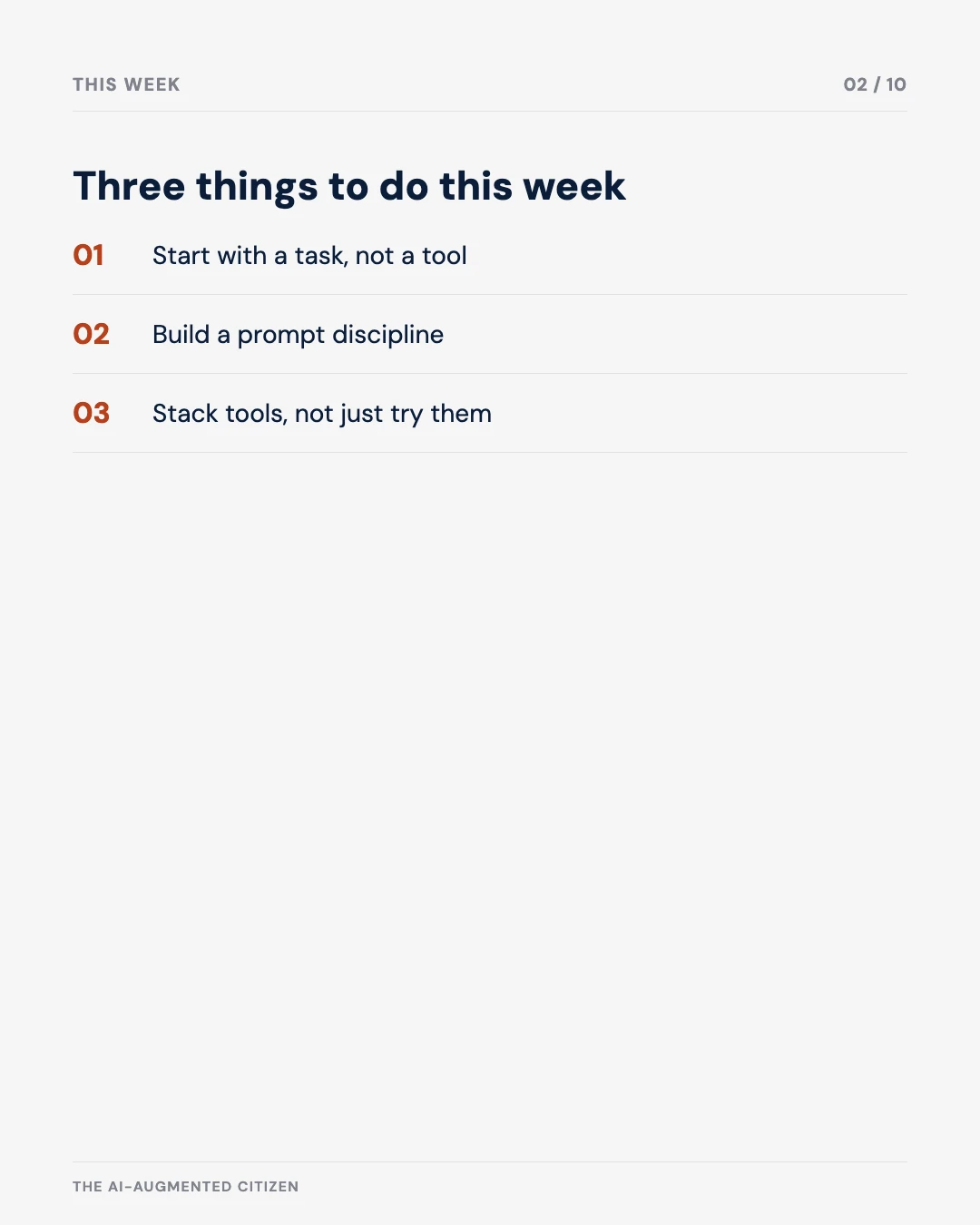
Three Things to Do This Week
Start with a task, not a tool. Identify one recurring task that costs you disproportionate time. A weekly report. A proposal structure. A data summary. Then find the AI capability that addresses it. The tool choice should follow the problem, not the other way around.
Build a prompt discipline. “Write a report” produces a generic output. “Summarise Q1 operational performance for a non-technical government audience, structured around three findings and two recommended actions, in under 400 words” produces something usable. Specificity is the skill here, and it takes only a few hours of practice to improve dramatically. I go into why this specific skill still matters in Why Prompt Engineering Matters.
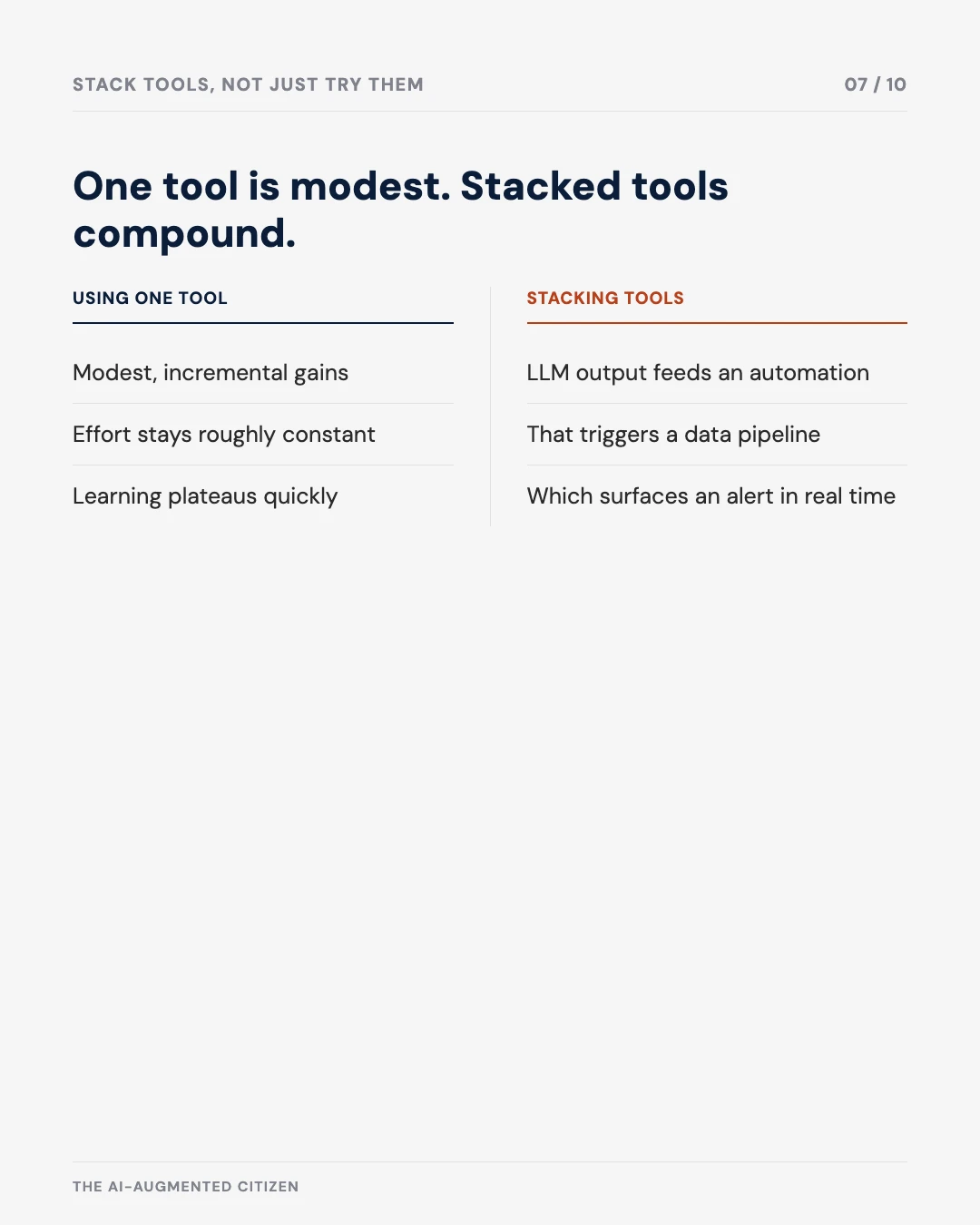
Stack tools, not just try them. Using a single tool produces modest gains. The real leverage comes when tools connect: an LLM output feeds an automation, which triggers a data pipeline, which surfaces an alert in a meeting intelligence tool. Experimenting with how two or three tools interact is the step that separates genuine AI literacy from surface-level awareness.
The Point
Singapore’s NAIS 2.0 sets the national direction. The tools are available. The access barriers are largely gone. What remains variable is the individual decision to begin: yours, and the person next to you.
The AI-enabled professional is not a future aspiration. It is a present-tense description of people who chose, at some point, to be curious rather than cautious.
The only meaningful question is: which experiment will you run this week?
Free tool
Organisational AI Readiness Quiz
Not sure where your own organisation stands before you pick that first experiment? This quiz gives a quick read on where the gaps actually are.
References
[1] Lawrence Wong, “Speech at the Singapore Conference on AI for the Global Good,” Prime Minister’s Office Singapore, 4 December 2023. https://www.pmo.gov.sg/newsroom/dpm-lawrence-wong-at-the-singapore-conference-on-ai-for-the-global-good/
[2] Smart Nation Singapore, “National AI Strategy 2.0 (NAIS 2.0),” last updated 21 May 2026. https://www.smartnation.gov.sg/initiatives/national-ai-strategy/
[3] Smart Nation Singapore, “Pair: AI-based assistant for public officers,” accessed May 2026. https://pair.gov.sg/
Was this useful?