RFID Asset and Inventory System with Self-Service Kiosk
RFID asset and inventory system with a self-service kiosk for a government logistics warehouse, replacing manual paperwork and physical searches.
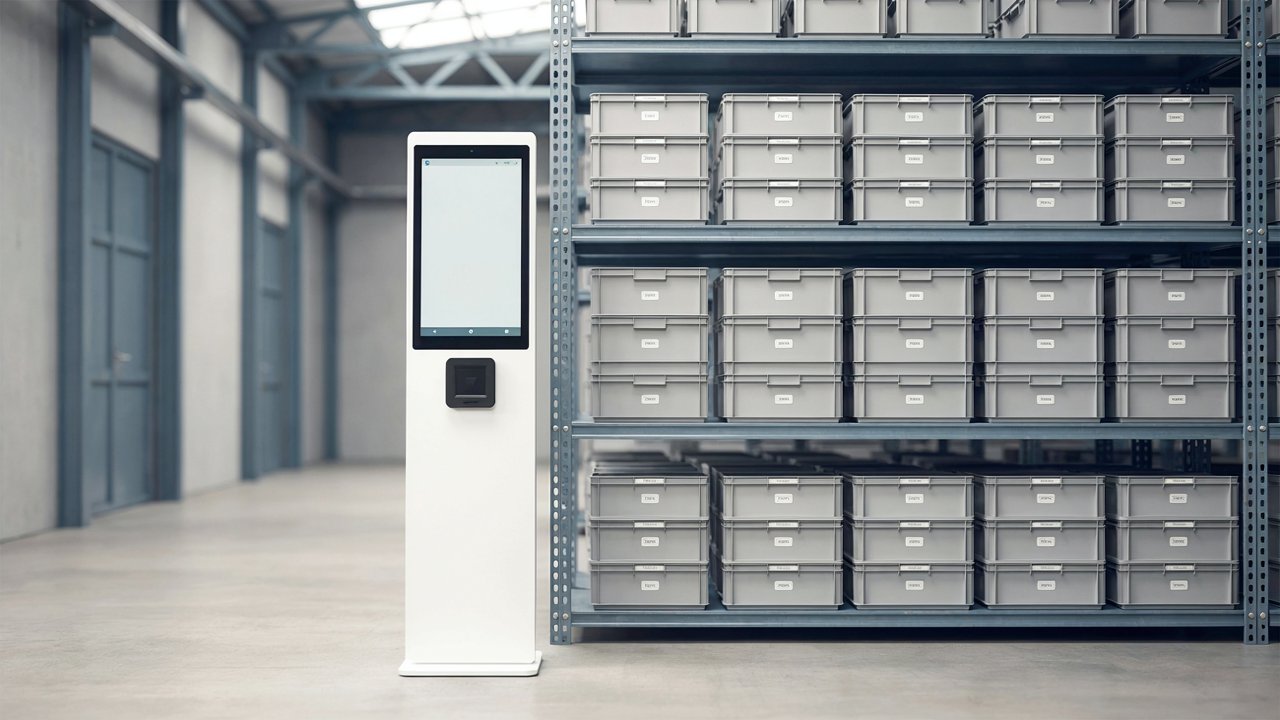
Systems architecture and interface design for an RFID-based asset and inventory system serving a government logistics warehouse. Every item is tagged at intake, so readers identify stock in bulk without contact, even in dense storage, and the record follows the item through issue, return, condition assessment and decommissioning. A self-service kiosk maps a user's measurements to the correct rack and size, authorises a loan against the item tag, the user's ID and a store manager's sign-off, and flags anything not returned inside the loan window. Returns pass through linked measurement instruments that record any change in an item's dimensions, and a real-time dashboard shows store managers what is currently on hold.
The warehouse ran on manual paperwork and physical searches. Issuing an item meant matching a person's measurements to stock by hand, loans were recorded on forms, and returns were checked by eye, so the team had no reliable view of what was on the shelf, what was out, and what had come back in a different condition.
Designed the systems architecture and the user-facing interfaces across the full operational lifecycle: measurement and inventory matching, drawdown and return, and administrative inventory control and reporting. RFID tags applied at intake give readers fast bulk identification. The kiosk supports both manual and automated measurement pathways so the process keeps working when an instrument is offline, with automated validation keeping the data clean. The administrative module covers new stock intake, condition monitoring and systematic decommissioning.
Delivered to specification and on schedule, meeting the technical and functional requirements in the project scope, and accepted by the client as the foundation for the subsequent development and implementation phases. The client's programme lead described the work as a clear understanding of warehouse operations complexity, translated into a technically coherent, user-centric design.
The mechanism is a warehouse one, but the lesson is about where paperwork lives. If your team still finds stock by walking the shelves and records loans on a form, capture identity once, at the point an item enters the building. Every later step then reads that identity. RFID is the tool here; the design decision is tagging at source, and it applies to tools, equipment, uniforms, or any multi-size stock a mid-market operation issues and takes back.
Kok, T. (2026). RFID Asset and Inventory System with Self-Service Kiosk [Case study]. terencekok.com. https://terencekok.com/projects/rfid-asset-inventory-self-service-kiosk/
The same diagnostic logic from deployments like this one, applied to your business in half a day.
Book the WorkshopDiscuss a similar programmePublic-sector buyer? See the government programmes page for procurement fit and what I supply for an evaluation.
- Client reference letter (logistics and public-sector client, December 2025) available to procurement teams on request; not published online
- Published as a case study on the Orion Five Engineering website
Other case studies.
 Enterprise AI
KELIX Enterprise AI Platform
Proprietary private cloud AI engine built for 6,000+ engineers on multi-billion dollar projects.
Read case study → Enterprise AI
Meinhardt AI Centre of Excellence
RAG platform deployed across 6,000+ engineers.
Read case study → Governance
Global AI Governance Framework
Governance standards for AI deployments across Asia and the Middle East.
Read case study →
The people who run this warehouse had been finding stock by walking the racks with a clipboard for years, and they knew every workaround. Most of the design time went into listening to those workarounds, because each one was a requirement nobody had written down. The kiosk works because it does what the experienced storeman already did in his head, only faster and with a record.
