
Listen to this article
Executive Summary
The gap between a working AI demo and a reliable production system isn’t the model. It’s the operational architecture around it. Context management, memory design, evaluation, cost optimisation, versioning, observability, and governance are what separate systems that hold up under real traffic from ones that quietly degrade.
Core conclusions
- Production systems need disciplined context and memory tiering, not just a bigger context window: poorly managed context is what causes rambling answers, hallucinations, and blown latency budgets.
- Evaluation has to be hierarchical (system, session, and node-level metrics), and roughly three-quarters of production AI agents still need human evaluation for edge cases automated metrics can’t catch.
- Treat AI releases like production software: shadow deployments, progressive rollout, and full observability, not a one-shot launch from pilot to live traffic.
The gap, in ten slides
Save it, share it, or send it to whoever owns your production rollout.
Your AI prototype is crushing it. Impressive outputs, smooth demos, and stakeholders are thrilled. Then you deploy it to production and… it starts falling apart. Response times spike. Answers get weird. Costs explode. What happened?
Welcome to the Production AI reality check. The gap between “works in demo” and “works at scale” is massive, and it’s caught many teams off guard. Let’s talk about how to bridge that gap, practically, without the fluff.
The Reality Check: When Good Prototypes Go Bad
Most enterprise AI deployments hit the same wall: what worked perfectly in testing degrades when real users and real data enter the picture. You’ll see:
- Responses that ramble because the AI is drowning in too much context
- Hallucinations because it doesn’t have enough information
- Wildly inconsistent answers to similar questions
- Response times that violate your SLAs
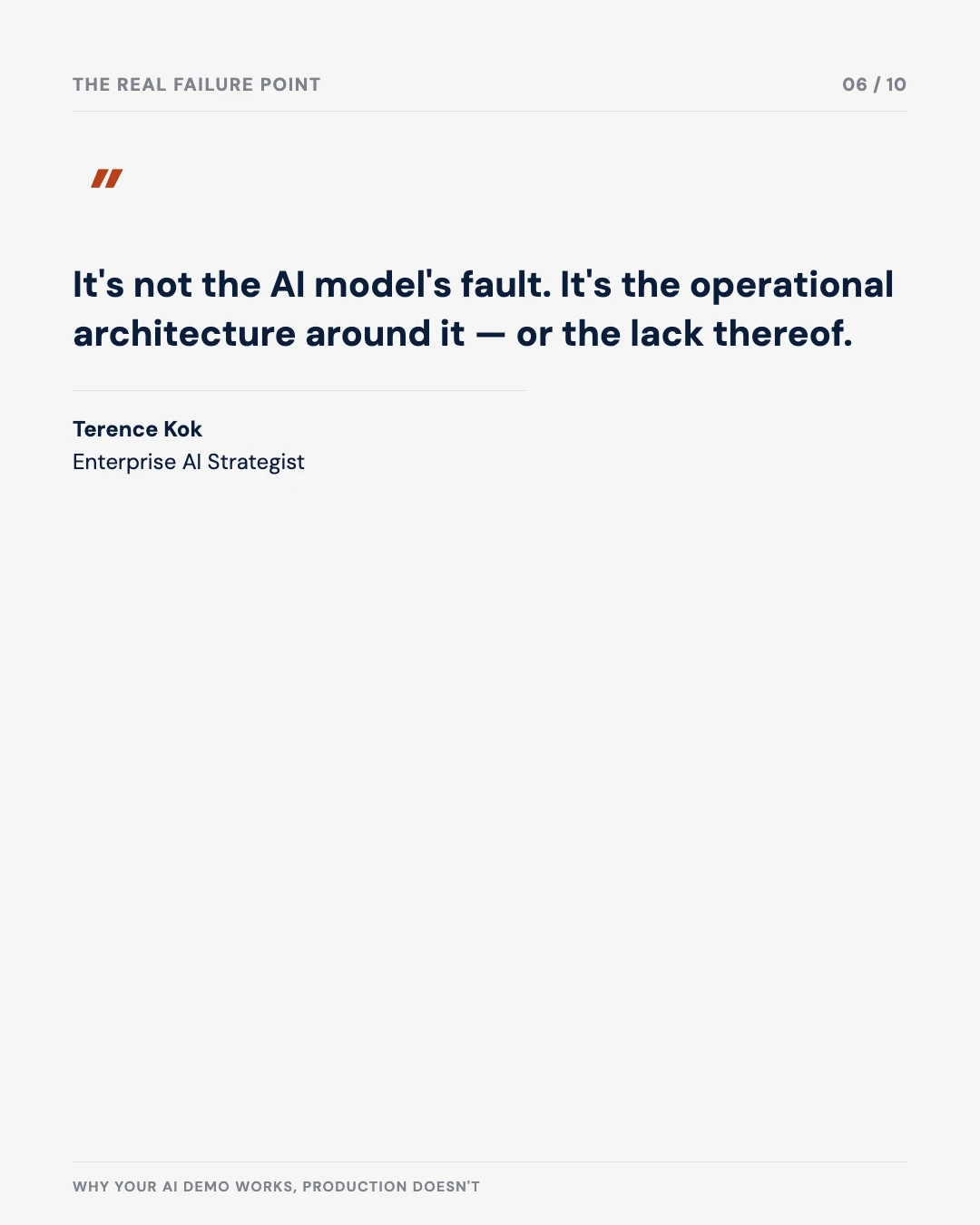
It’s not the AI model’s fault. It’s the operational architecture around it, or the lack thereof.
Why This Matters for Government & Infrastructure
If you’re running smart city systems, government services, or infrastructure operations, the stakes are higher. A chatbot giving wonky product recommendations is annoying. An AI system misallocating emergency response resources or giving wrong guidance on public services? That’s a crisis.
These systems process sensor data, incident reports, and service requests 24/7. They need to make real-time decisions that directly impact people’s lives. When AI fails here, you get misallocated resources, degraded services, and broken public trust.
In Simple Terms:
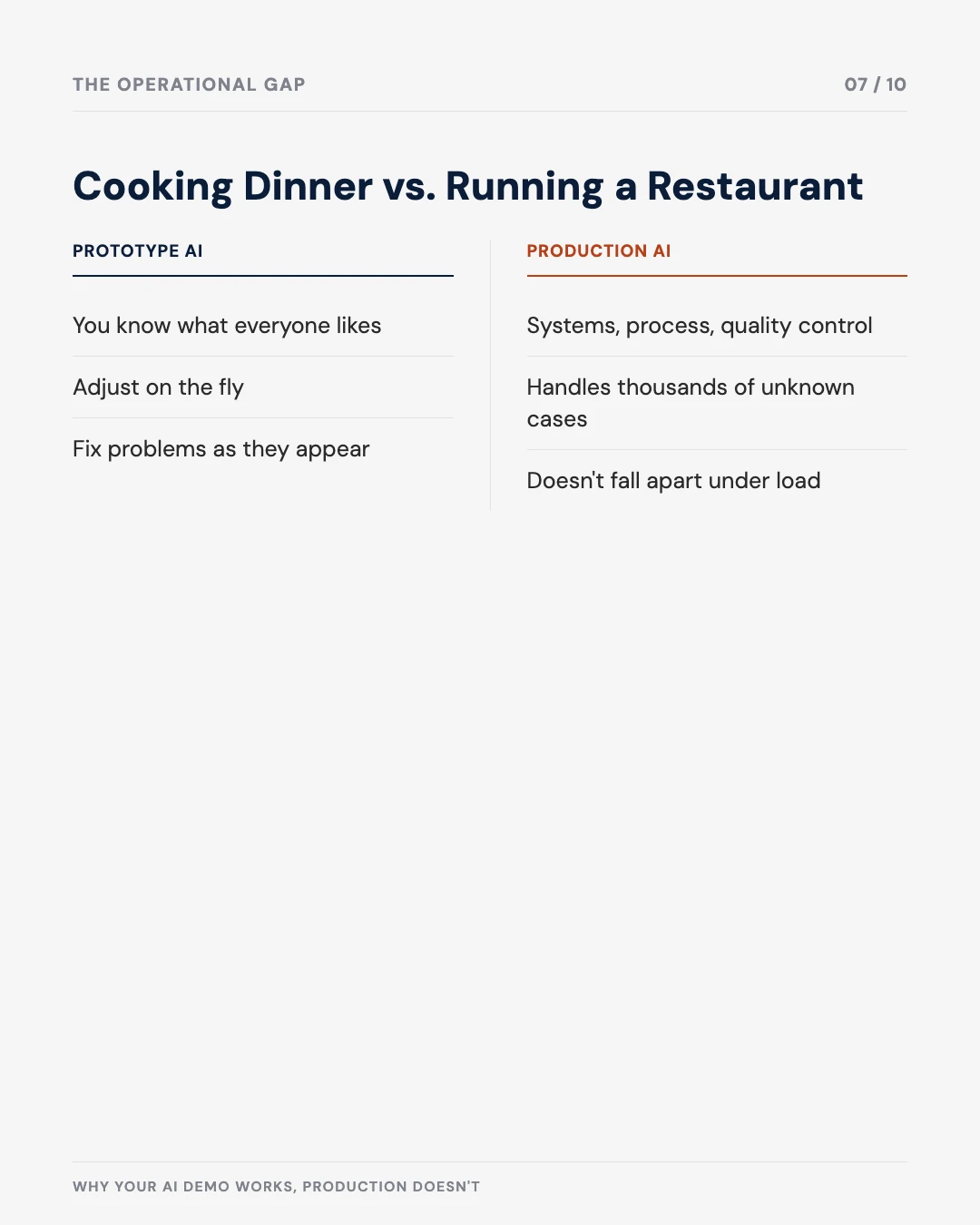
Think of it like this: a prototype AI is like cooking dinner for your family. You know what everyone likes, you can adjust on the fly, and if something goes wrong, you fix it quickly. Production AI is like running a restaurant serving thousands of people daily. You need systems, processes, quality control, and the ability to handle unexpected situations without falling apart.
Context Management: Giving AI the Right Amount of Information
Here’s where most teams trip up: context windows. Every AI model has a limit on how much information it can process at once (measured in “tokens”). Too little context and it hallucinates. Too much and it drowns in irrelevant details. I go much deeper on this specific failure mode in Context Window: Why Bigger Isn’t Always Better.
Production systems use context tiering, organising information by importance:
- Critical layer : System instructions, the user’s question, essential state (protected, always included)
- Supporting layer : Historical conversations, retrieved documents, optional metadata (loaded only if space permits)
This ensures core functionality works even when context gets tight.
Token Budget Management treats context like a finite resource (because it is). A good rule of thumb:
- Reserve 25-50% for the AI’s response
- Distribute the rest across system prompts, conversation history, and retrieved knowledge
- Adjust dynamically based on the query’s complexity
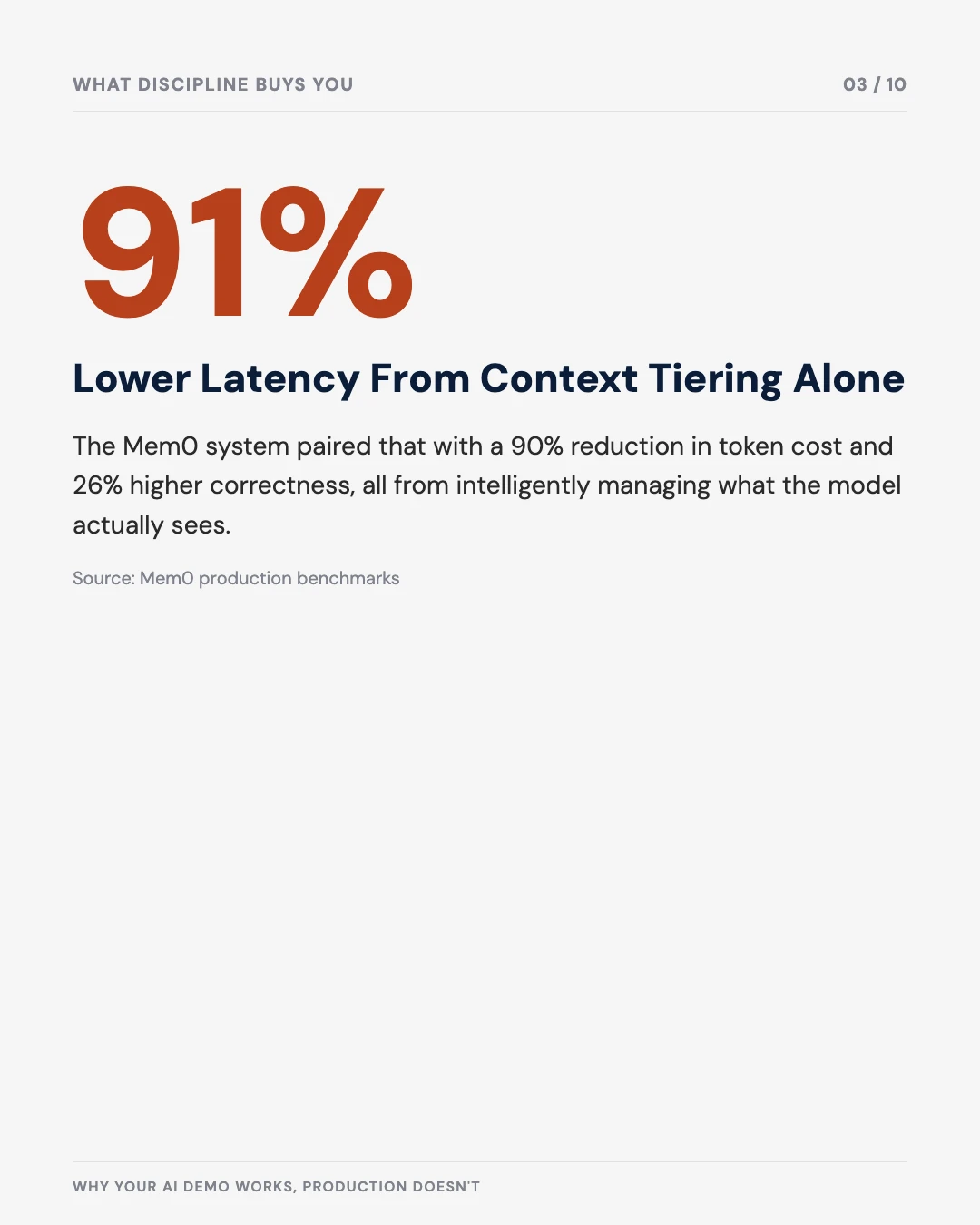
The Mem0 system demonstrated substantial performance gains: 91% lower latency, 90% reduction in token cost, and 26% higher correctness, all achieved by intelligently managing the context.
Example for the Non-Technical:
Imagine you’re helping someone fix their car over the phone. If you only tell them “there’s a problem with the engine” (too little context), they can’t help. If you read them the entire car manual (too much context), they’ll get overwhelmed and miss the important stuff. The sweet spot is giving them the specific manual section plus the most relevant troubleshooting steps. That’s context tiering.
Memory: Helping AI Remember What Matters
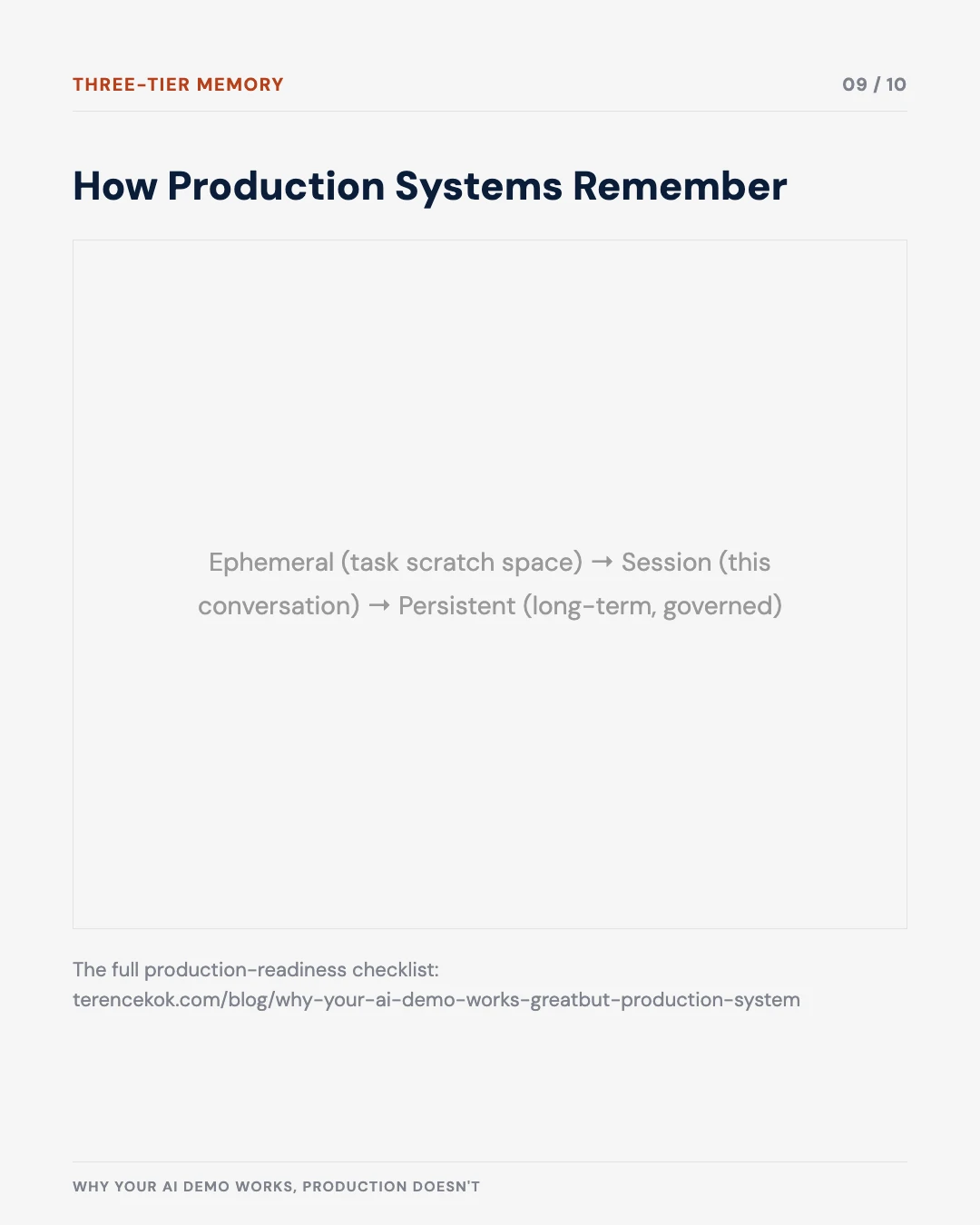
AI systems need memory, but not unlimited memory. The three-tier approach works best:
- Ephemeral State (Short-term scratch space)
- Used during active tasks: analysing documents, running calculations, chaining tool calls
- Discarded after the task completes
- Like your brain’s working memory when solving a math problem
- Session State (Conversation memory)
- Maintains context during an interaction
- Tracks the current conversation, user goals, and clarifications
- Cleared when the session ends (or summarised into long-term storage)
- Like remembering what you discussed during a phone call
- Persistent State (Long-term memory)
- User preferences, facts, and important patterns
- Kept across sessions with governance over what’s worth storing
- Retrieved efficiently using semantic search
- Like your long-term memories that inform future decisions
Graph-based memory takes this further. Instead of storing facts in a flat list, it stores them as a network of connected information. This enables complex reasoning like “Who did Sarah work with on projects related to infrastructure in 2024?” These relational queries are impossible with simple memory stores.
Real production systems like AgentCore achieve 89-95% compression while keeping retrieval fast (under 200ms), which is critical for interactive applications.
Real-World Example:
Think about how Netflix recommends shows. It doesn’t remember every single second you watched (ephemeral). It does remember what you watched in this session (session state). It maintains long-term preferences, such as “loves sci-fi, hates horror” (a persistent state). The graph-based approach would be like connecting your preferences with other users, genres, actors, and directors to make smarter recommendations.
Evaluation: Beyond “Did It Get The Right Answer?”
Most teams evaluate AI with simple accuracy metrics. That’s not enough for production. You need a hierarchical evaluation framework that checks multiple levels:
System-level metrics :
- Is it fast enough?
- What’s it costing us?
- Can it handle the load?
Session-level metrics :
- Did it complete the task?
- Is the user satisfied?
- Did it meet the goal?
Node-level metrics :
- Did it pick the right tools?
- Was the reasoning sound?
- Were individual steps correct?
When something fails, this granularity lets you pinpoint exactly where: infrastructure problem? Wrong decision sequence? Bad tool selection?
Continuous evaluation means testing constantly:
- Automated tests run on every prompt change
- Shadow deployments compare new versions against the baseline before going live
- Real traffic gets sampled and evaluated continuously
Production failures automatically become regression tests: if it broke once, you make sure it never breaks that way again.
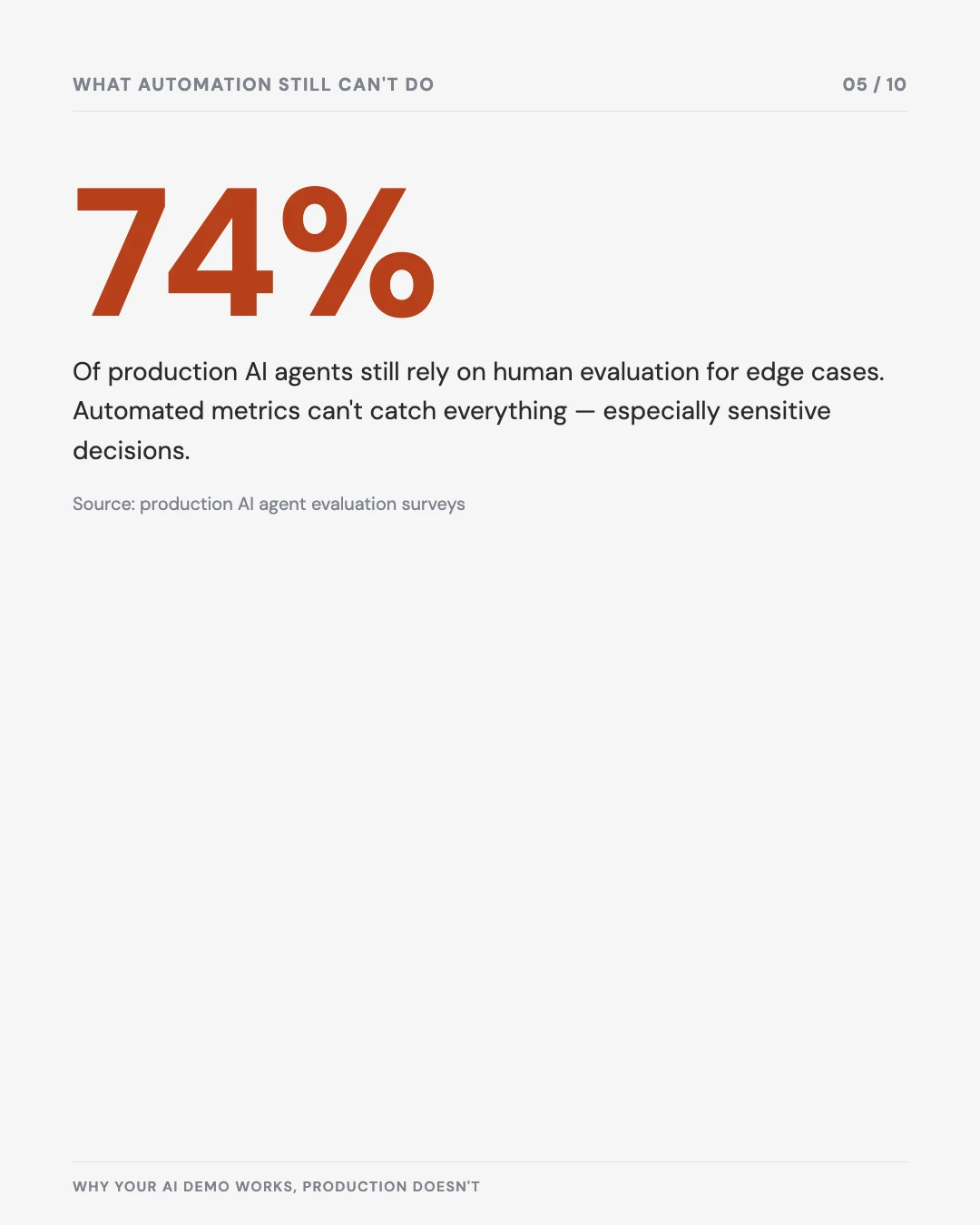
Interestingly, 74% of production AI agents still rely on human evaluation for edge cases. Automated metrics can’t catch everything, especially for sensitive decisions.
Practical Example:
Imagine evaluating a self-driving car. You wouldn’t just check “Did it reach the destination?” (session-level). You’d also measure: fuel efficiency, average speed, passenger comfort (system-level), plus every stop sign decision, lane change, and turn signal use (node-level). If it fails, you know exactly what component needs fixing.
Observability: Seeing What’s Actually Happening
You can’t fix what you can’t see.
Production AI needs visibility into:
- Distributed tracing : Following a request through model invocations, retrieval, tool calls, and response synthesis
- Real-time monitoring : Dashboards showing task success rates, user satisfaction, cost per interaction, and latency
- Automated alerts : Pattern recognition that surfaces anomalies before users complain
- Multi-agent visibility : For systems with multiple AI components, visualising how they communicate and where coordination breaks down
For multi-agent systems especially, without this visibility, debugging is like trying to solve a crime with only random witness statements. You’re piecing together fragmented information from components that weren’t designed to work together.
In Simple Terms:
This is like having security cameras, sensors, and logs in a building. When something goes wrong, you can review exactly what happened, when, and why, rather than just hearing “the system broke” and guessing at causes.
Cost Optimisation Without Sacrificing Quality
Token consumption drives costs in AI systems. Smart teams use multiple strategies: I treat this as its own engineering discipline in Token Optimisation Is an Engineering Discipline, Not a Prompt Trick.
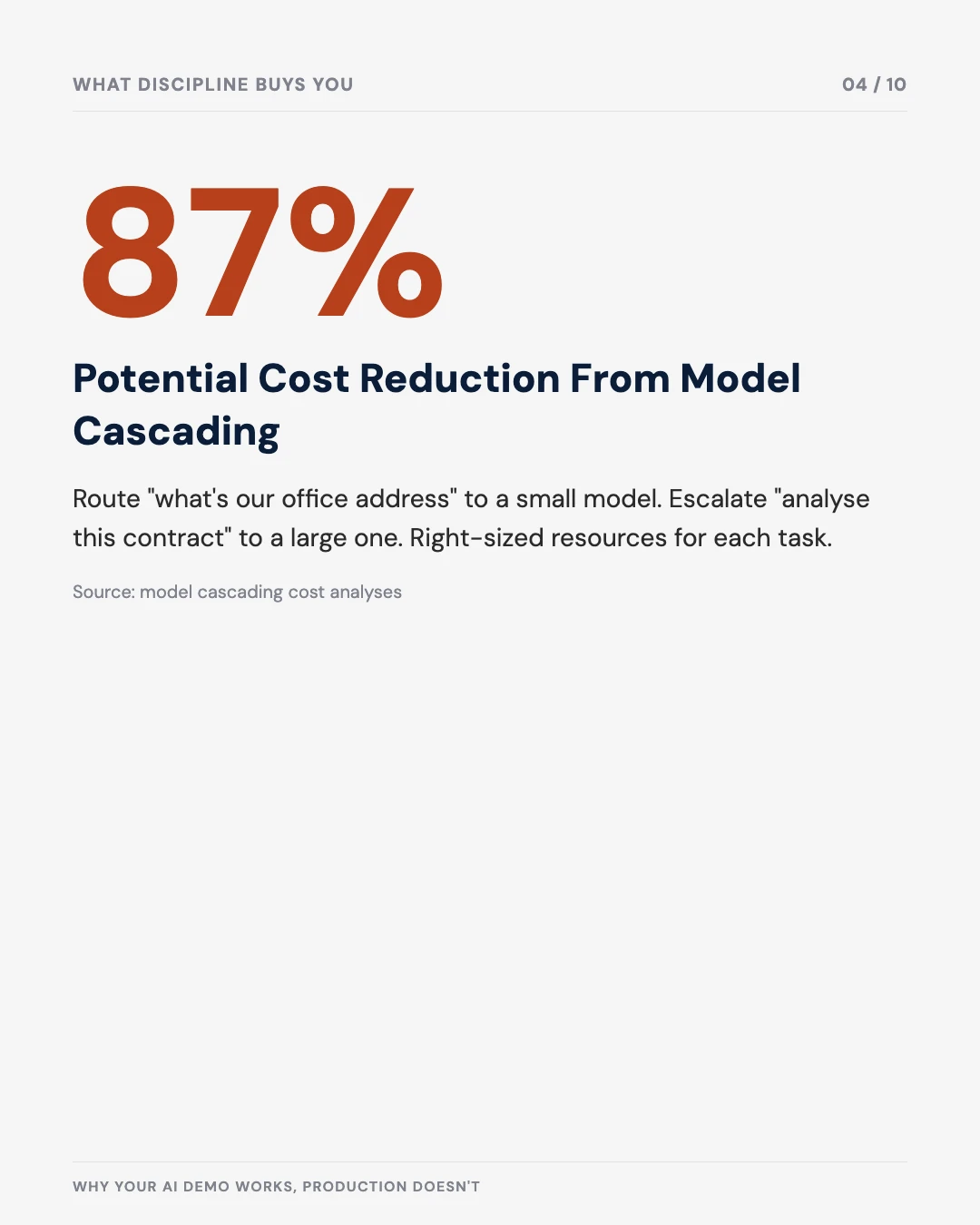
Model Cascading (87% cost reduction potential):
- Route simple queries to smaller, cheaper models
- Escalate complex reasoning to premium models
- Classification layer decides which query goes where
Simple question: “What’s our office address?” → Small model
Complex question: “Analyse this legal contract and identify risks” → Large model
Batch Processing (50%+ discounts):
- For non-urgent work, bundle requests together
- Content moderation queues, overnight analytics, data enrichment
- Trade latency for massive cost savings
Quantisation (50-75% reduction in resources):
- Reduce model precision from 32-bit to 8-bit or 4-bit
- Minimal accuracy loss, huge resource savings
- Enables deployment on consumer hardware and edge devices
Semantic Caching (30-50% cache hit rates):
- Store responses to common questions
- Return instantly without recomputing
- Automatically invalidate when underlying data changes
Example in Practice:
It’s like how airlines use different planes for different routes. You don’t use a jumbo jet for a 50-person regional flight (wasteful), and you don’t use a small plane for 300 international passengers (impossible). Model cascading applies the same logic: right-sized resources for each task.
Versioning & Deployment: Releasing Without Breaking Things
AI versioning is trickier than traditional software because you’re not just tracking code. You’re tracking:
- Model weights (the AI’s “brain”)
- Prompt templates (instructions it follows)
- Memory state (what it remembers)
- Tool integrations (what it can do)
- Behavioural baselines (how it should act)
Change any component, and behaviour changes unpredictably.
Shadow Deployment is your safety net:
- Run new and old versions in parallel on identical inputs
- Measure decision divergence
- If differences exceed thresholds (like 5% action variation), deployment fails automatically
- Only promote to production after validation
Progressive Rollout minimises risk:
- Start with 1-5% of traffic (canary cohort)
- Expand gradually: 10% → 25% → 50% → 100%
- Quality gates at each stage
- One-click rollback if issues appear
Relatable Example:
Think about how major apps update. They don’t push everyone at once. They release to a small group, monitor for crashes or complaints, then gradually expand. If problems arise, they are rolled back before most users are affected. Same principle, higher stakes with AI.
Integration With Operational Infrastructure
Production AI doesn’t live in isolation. It integrates into broader systems through:
- Containerization (Docker) : Package everything needed to run the AI into portable units that work consistently across environments
- Orchestration (Kubernetes) : Automatically scale capacity based on load, restart failed instances, and distribute requests across servers
- Edge Deployment : Run AI locally at remote locations (factories, field sites) where network connectivity or latency matters
For smart cities, this means AI interprets sensor streams, service systems, and administrative platforms, transforming raw observations into structured insights that feed decision-support tools. The data ecosystem, AI layer, and operational systems all work together.
Simple Terms:
This is like how a restaurant operates. You don’t just need great chefs (the AI). You need kitchen equipment (infrastructure), ordering systems (orchestration), quality control (monitoring), and, at times, satellite locations (edge deployment). Everything works together as a system.
Governance: Operating Responsibly
Production AI requires governance for ethical operation and accountability:
Data Governance :
- Quality standards, access controls, retention policies
- Validation checks for completeness, freshness, and accuracy
- Lineage tracking: where did this data come from?
- For government applications, every decision needs an auditable justification
- Log reasoning, sources consulted, confidence scores
- Enable human review and appeals
Bias & Fairness Monitoring :
- Test model behaviour across demographics, regions, and contexts
- Flag disparate impact requiring investigation
- Regular audits to maintain equitable operation
- Keep humans accountable for important decisions
- AI recommends, humans approve
- Prevents unchecked errors from compounding
Why This Matters:
In government and public services, AI decisions affect entitlements, tax assessments, service eligibility: people’s lives. Every recommendation needs to be explainable, auditable, and fair. Trust is earned through transparency and accountability.
Trust is earned through transparency and accountability.
From Pilots to Production: Breaking Through Paralysis
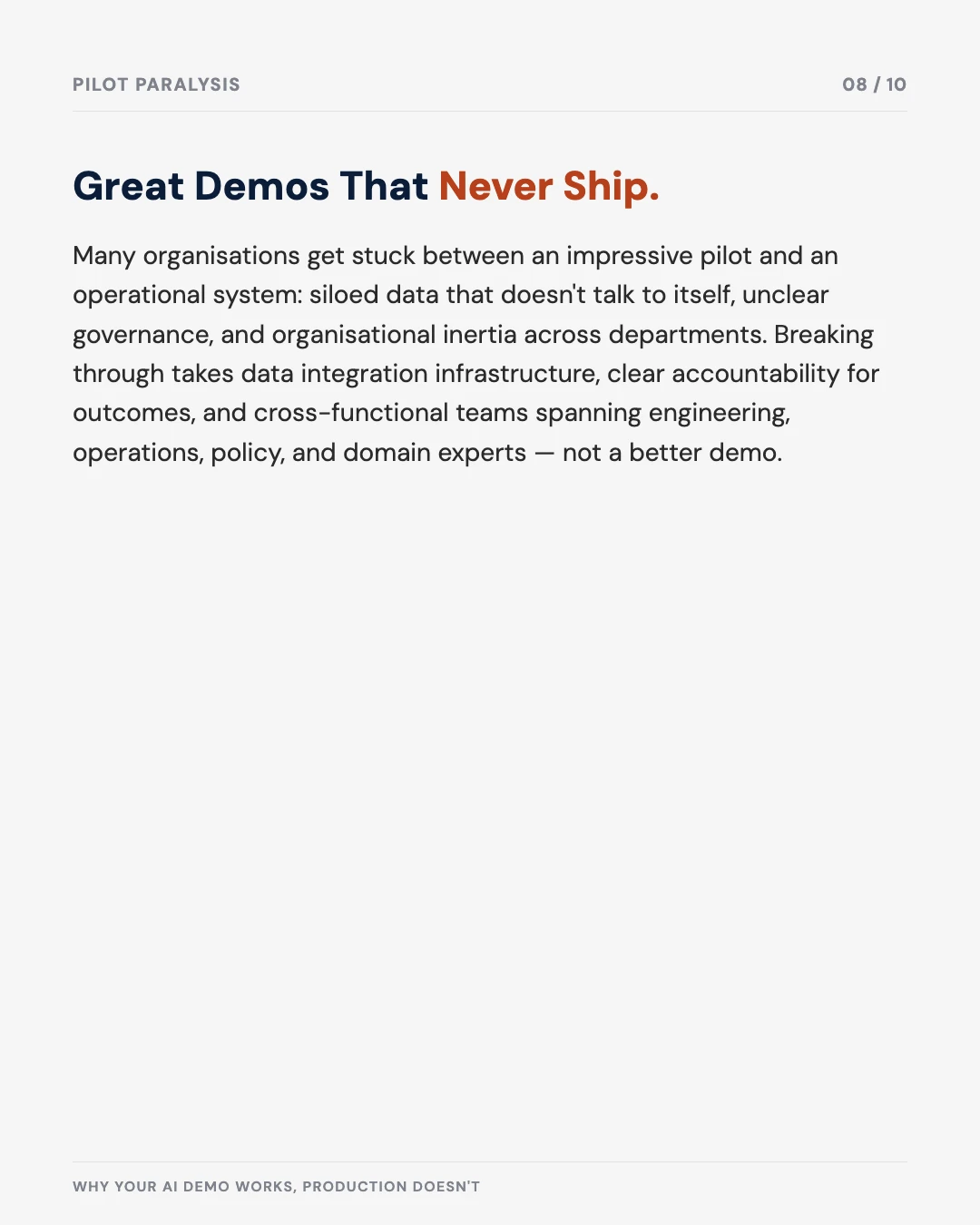
Many organisations get stuck in “pilot paralysis”: promising demos that never become operational systems. Why?
- Siloed data systems that don’t talk to each other
- Unclear governance creates uncertainty about data usage
- Organisational inertia is preventing cross-departmental collaboration
Breaking through requires:
- Data integration infrastructure (not optional, essential)
- Clear accountability for AI outcomes
- Demonstrable wins that build momentum
- Cross-functional teams spanning engineering, operations, policy, and domain experts
Production Readiness Checklist :
□ Sufficient computational resources
□ Network capacity and integration with existing systems
□ Data quality, accessibility, governance frameworks
□ Technical expertise for maintenance
□ Domain knowledge for quality assessment
□ Leadership commitment
□ Culture of iterative improvement
Real Talk Example:
It’s like the difference between home cooking and opening a restaurant. At home, you prove you can make great food (pilot). Opening a restaurant requires suppliers, staff, health permits, accounting systems, customer service protocols, and the ability to address unexpected problems at scale. Many great home cooks fail as restaurateurs because they underestimate the operational complexity.
The Bottom Line
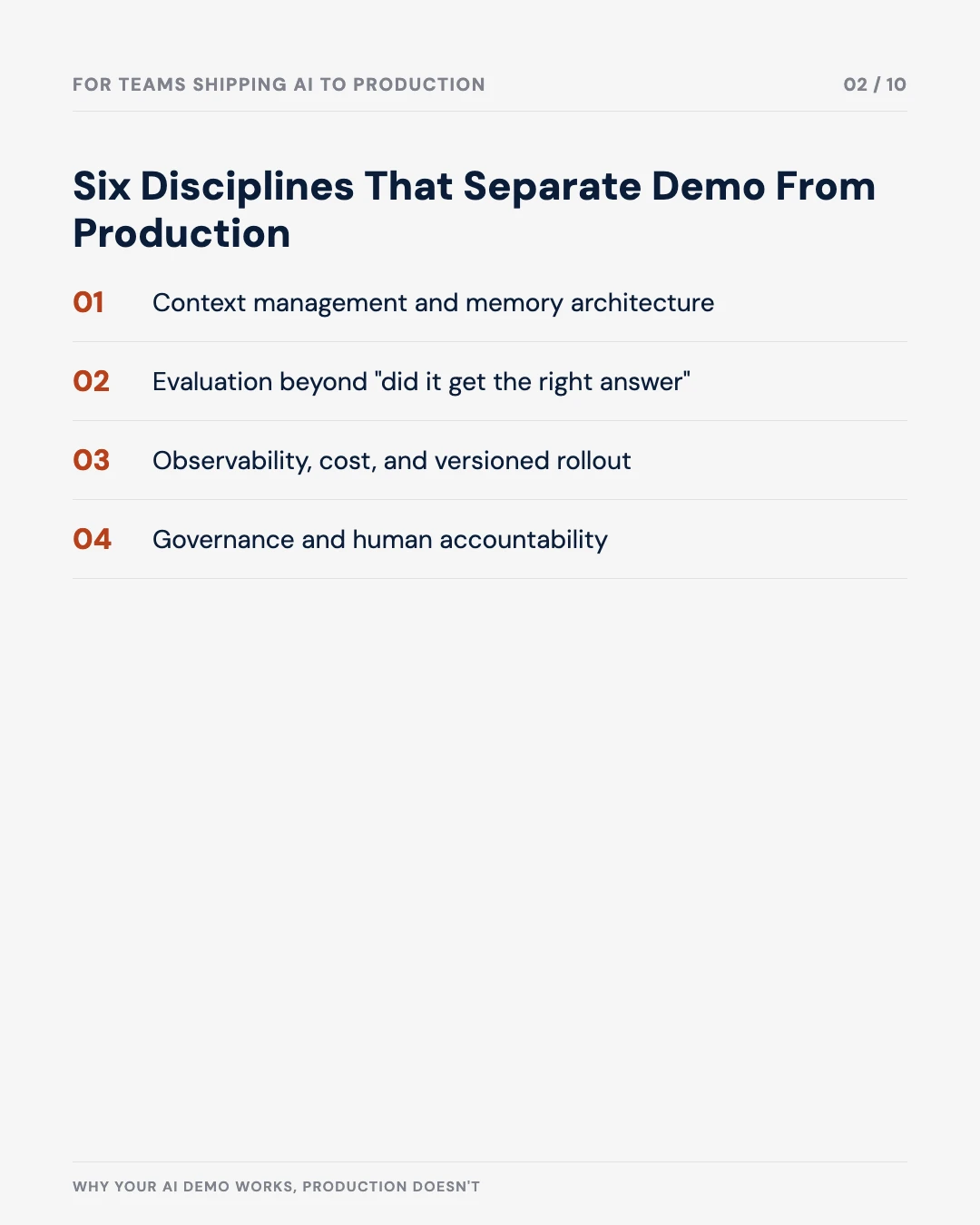
Production AI is fundamentally an engineering discipline. The technical practices we’ve covered (context management, memory architecture, evaluation frameworks, cost optimisation, versioning, observability, governance) separate reliable systems from fragile demos.
Organisations successfully deploying AI at scale treat evaluation, monitoring, and governance as core infrastructure rather than afterthoughts. They:
- Test continuously throughout development
- Maintain observability into operational behaviour
- Convert operational experience into systematic improvements
- Treat prompts with the same rigour as production code
The evidence is clear: disciplined engineering achieves 90%+ reductions in latency and cost while improving quality. It’s not magic. It’s systematic, measurable, accountable practices from day one.
The gap between production-ready and demo-ready will only widen as AI capabilities expand. Organisations that establish robust practices now will be able to deploy reliably at scale. Those that delay will face reliability failures, cost overruns, and expensive remediation, or even project abandonment.
The choice is yours: build for demos or build for production. Just don’t confuse the two.
Free tool
Model Performance & Health Dashboard
Track the drift, latency and rollback signals that separate a production-ready agent from a demo that quietly degrades.
Free tool
Human-AI Interaction & Decision Quality
Benchmark whether your human-in-the-loop checkpoints are catching the edge cases automated metrics still miss.
Was this useful?