
Listen to this article
Executive Summary
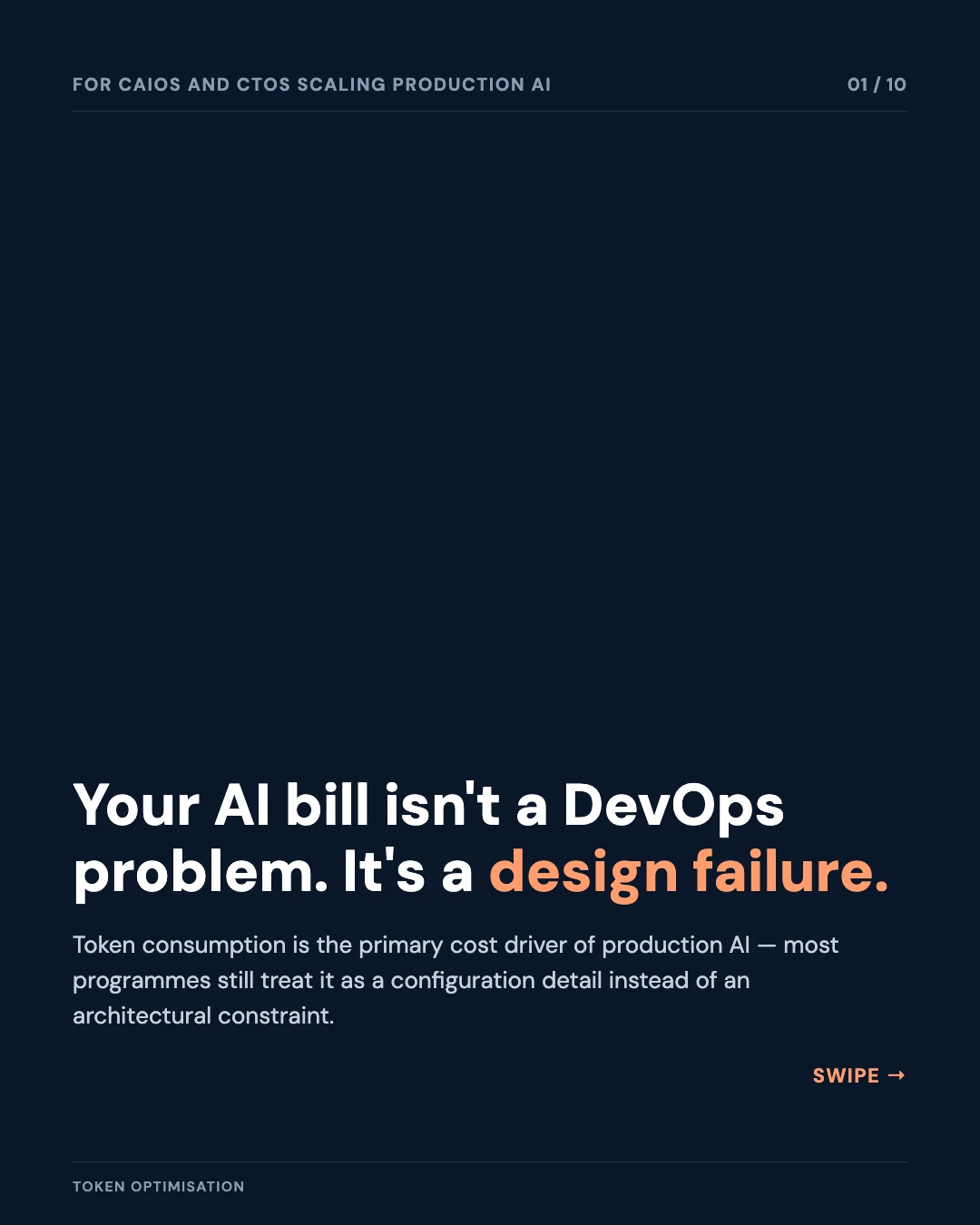
Token spend is a design constraint, not a deployment detail. Programmes that don’t engineer it in from the outset watch inference cost become the largest barrier to production ROI.
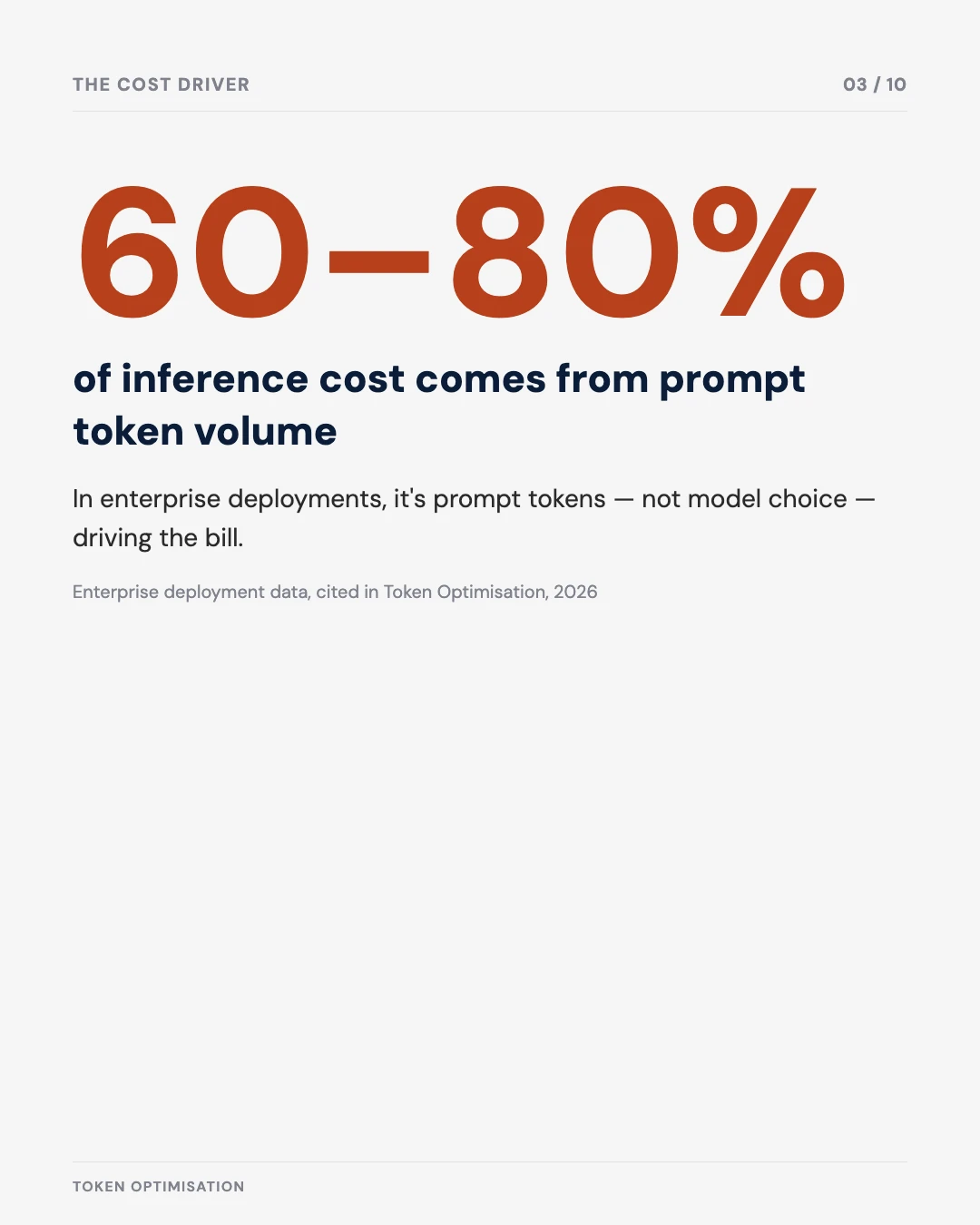
60–80%
of inference cost is attributable to prompt token volume in enterprise deployments
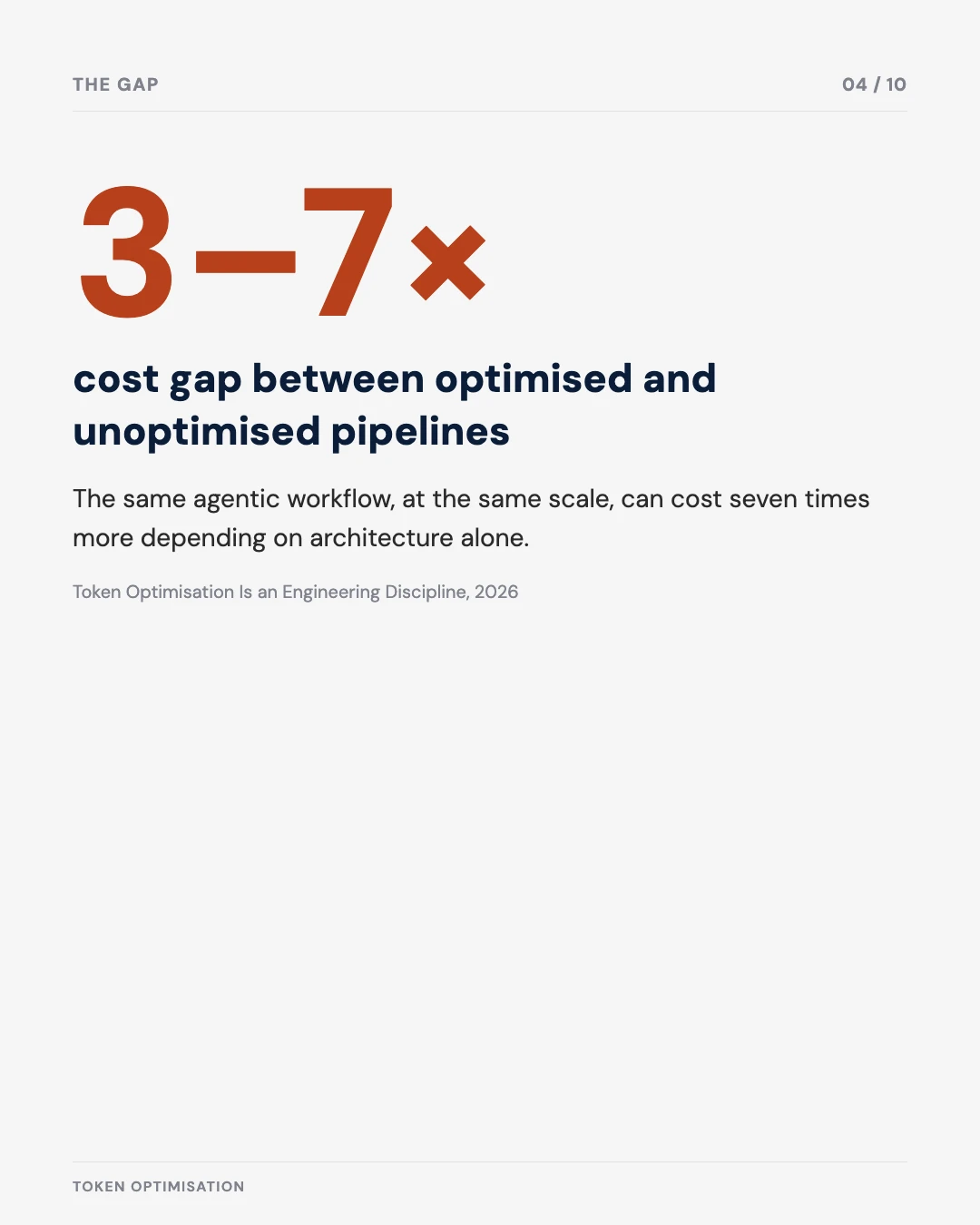
3–7×
cost differential between unoptimised and optimised agentic pipelines at scale
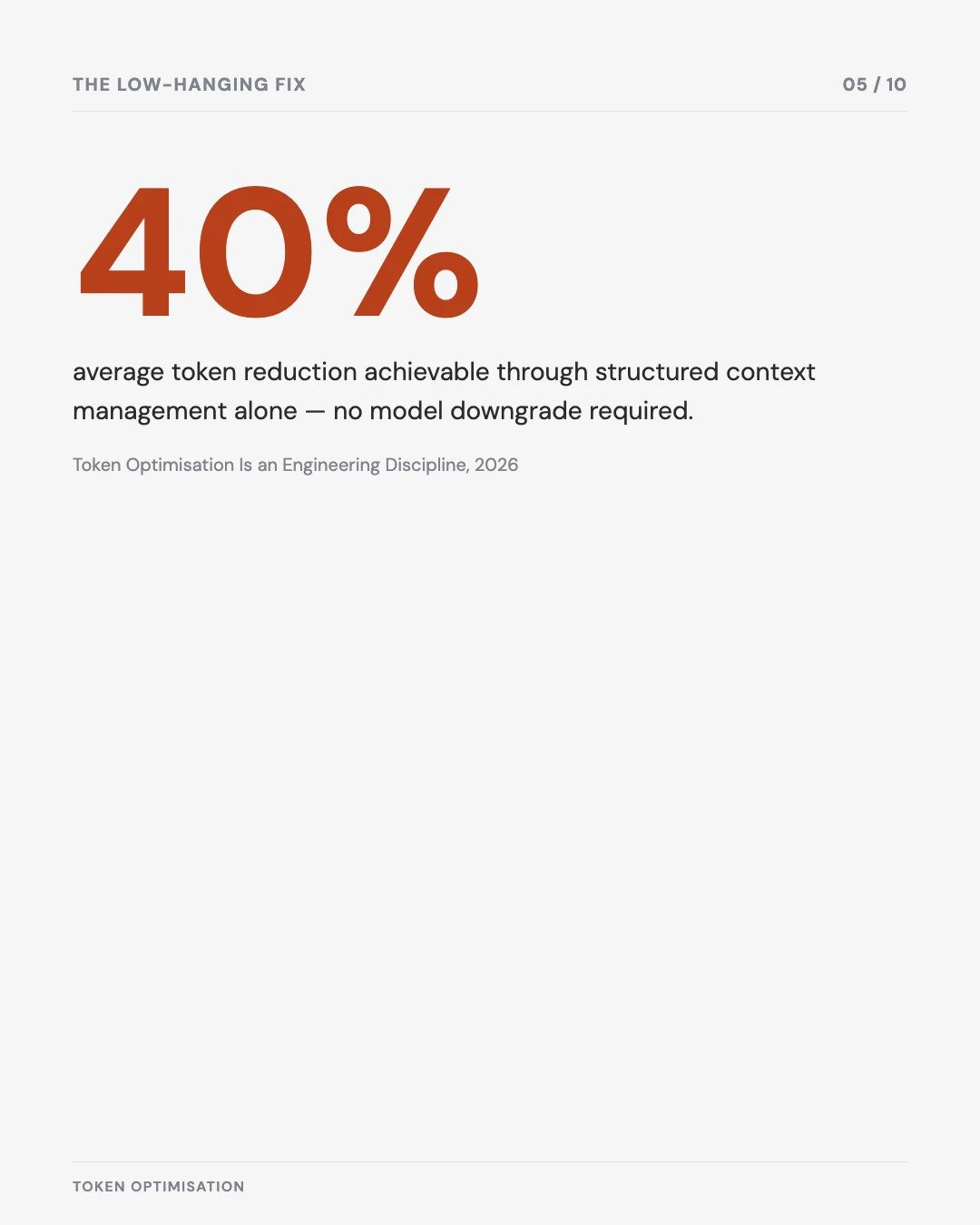
40%
average token reduction achievable via structured context management alone
Core conclusions
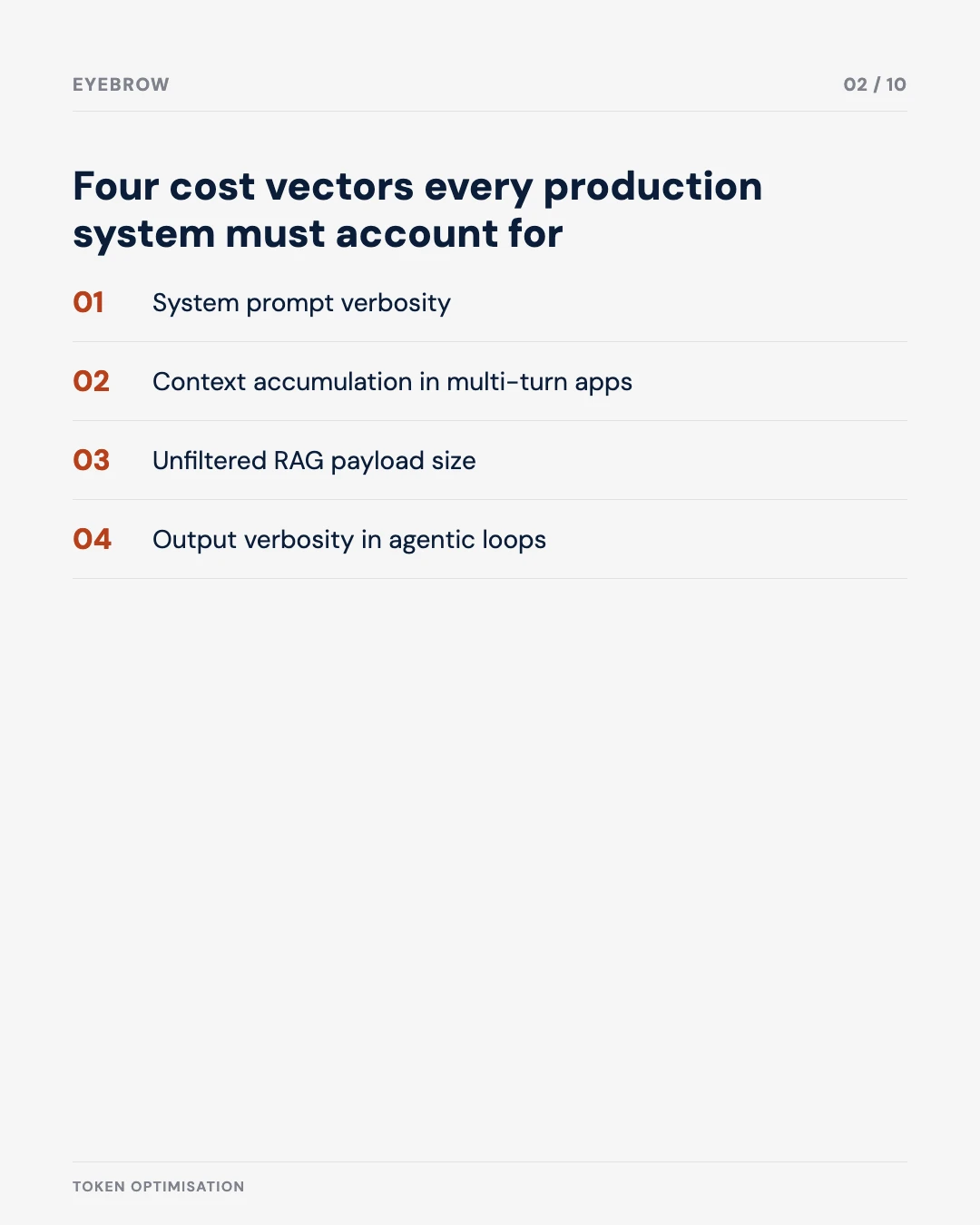
- Four cost vectors must be accounted for at design stage: system prompt verbosity, context accumulation in multi-turn applications, unfiltered RAG payload size, and output verbosity in agentic loops.
- Cascade routing by task complexity, sending routine work to smaller models and reserving frontier models for the 10-15% of requests that need them, is the highest-leverage infrastructure-level lever.
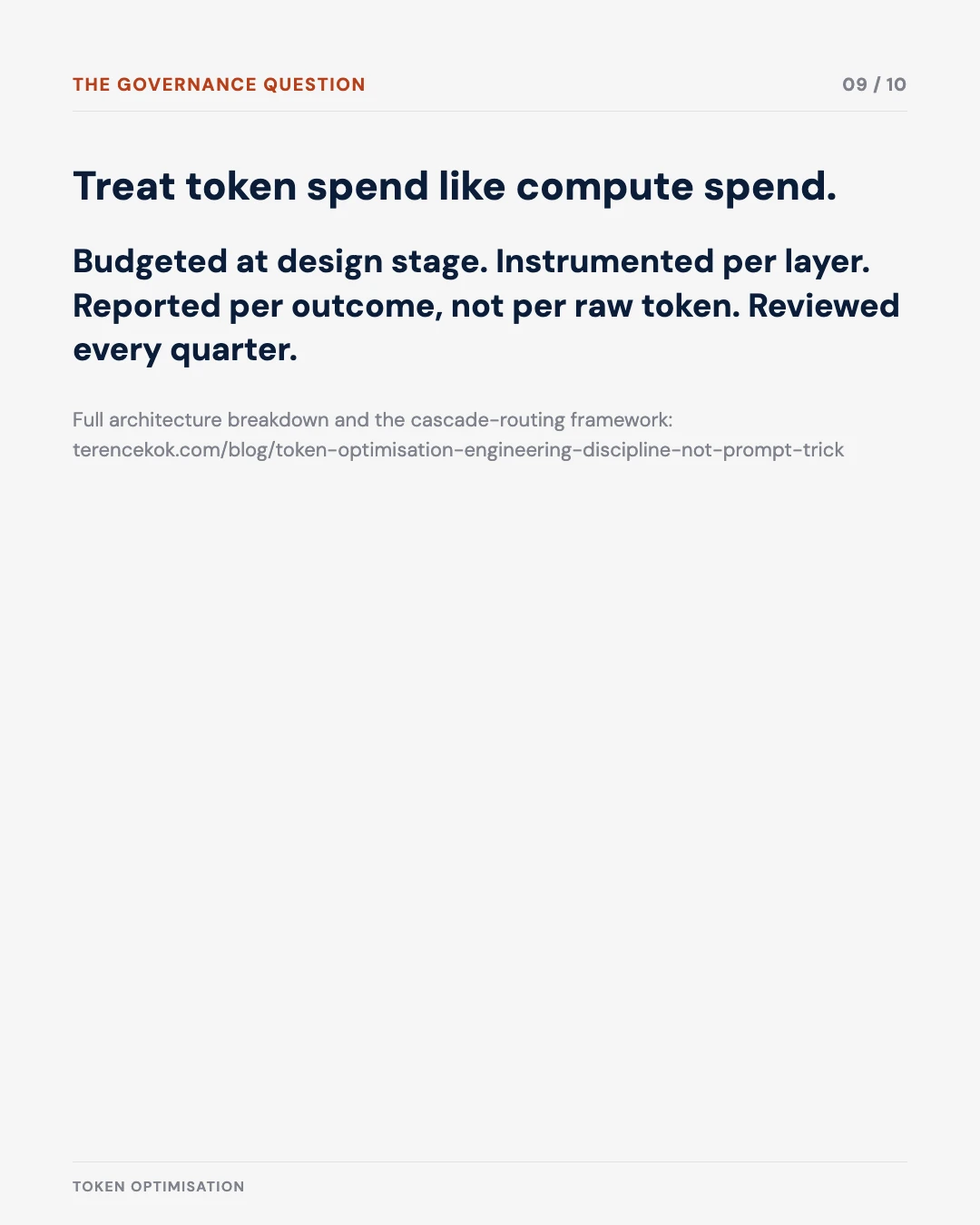
- Token budgets should be a formal governance control, reported as cost per outcome (per document, per query, per transaction), not tracked as raw aggregate spend.
The architecture, in ten slides
Save it, share it, or hand it to whoever owns the inference bill.

“Organisations deploying AI at scale are accumulating token debt at pace. Without deliberate cost architecture, inference spend becomes the single largest barrier to production ROI.”
Most AI programmes that fail to demonstrate return on investment do not fail because the models are incapable. They fail because the operational cost of running those models (measured primarily in tokens) was never engineered. Token consumption was treated as a deployment detail rather than a design constraint, and the resulting inference bills compound until programmes are quietly curtailed or descoped.
Token optimisation is a first-class engineering discipline: one that CAIOs and CTOs must embed in AI architecture from the outset, rather than retrofit once spend is already out of control.
“Token consumption is the primary cost driver of production AI. Treating it as a configuration detail, rather than an architectural constraint, is the most common cause of stalled AI programmes.”
- 60–80% of inference cost is attributable to prompt token volume in enterprise deployments
- 3–7× cost differential between unoptimised and optimised agentic pipelines at scale
- 40% average token reduction achievable via structured context management alone
Understanding Token Economics
Token cost is not a DevOps concern delegated to engineering teams. It is a programme-level financial variable that directly determines whether AI deployments remain economically viable as they scale from pilot to production. The pricing model for frontier model APIs is straightforward: cost is a function of input and output tokens, multiplied by the per-token rate. At low volumes, this is negligible. At production scale (thousands of concurrent users, multi-agent orchestration, retrieval-augmented pipelines with large context windows) it becomes the dominant operating cost.
CAIOs and CTOs should require that any production AI system account for four primary cost vectors at design stage. System prompt verbosity: system prompts are prepended to every request. A 4,000-token system prompt across 10,000 daily requests consumes 40 million input tokens per day, before a single user message is processed. System prompts must be treated as compiled configuration, not free-text documentation. Context accumulation in multi-turn applications: conversational applications that pass full message history on each turn exhibit O(n²) token growth. A 20-turn conversation with an average of 500 tokens per exchange consumes approximately 105,000 tokens cumulatively, not 10,000. RAG payload size: unfiltered retrieval, passing top-k chunks regardless of relevance score, is the most common cause of unnecessary context inflation. Chunk sizing, re-ranking, and relevance thresholds are cost controls, not just quality controls. Output verbosity in agentic loops: agentic systems that pass model outputs as subsequent inputs amplify any inefficiency in output tokens. Structured output formats constrain this; free-text reasoning chains do not.
Optimising at the Prompt Level
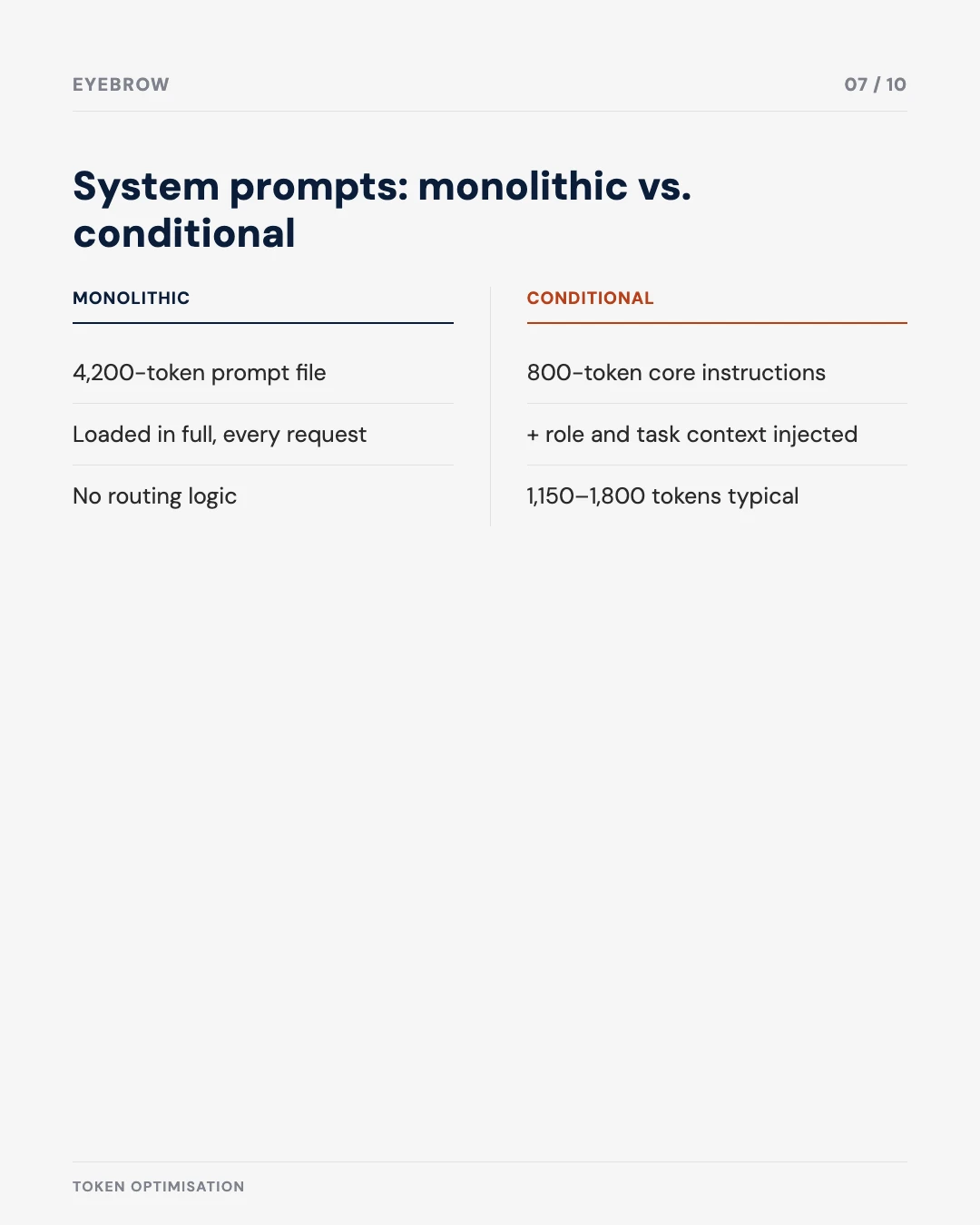
System prompt engineering is among the highest-leverage interventions available. System prompts should be audited for redundancy, repetition, and natural language filler. Prompt compression can typically reduce system prompt length by 30–50% with no measurable degradation in output quality. Systems should also be designed to inject role-relevant context conditionally, based on routing logic applied before the model call, rather than passing a monolithic system prompt that covers all cases:
# Monolithic prompt (inefficient)
system_prompt = load("full_system_prompt.txt")  # 4,200 tokens

# Conditional injection (optimised)
base = load("core_instructions.txt")            # 800 tokens
role_ctx = load(f"role_{user_role}.txt")        # 200–600 tokens
task_ctx = load(f"task_{intent_class}.txt")     # 150–400 tokens
system_prompt = base + role_ctx + task_ctx      # 1,150–1,800 tokens
Multi-turn conversation management is where most enterprise deployments incur token debt without visibility into it. Three approaches mitigate this: a sliding window with hard truncation maintains only the most recent N turns in the active context; progressive summarisation periodically compresses older turns into a running summary, with the break-even point typically reached by turn 6–8; selective memory retrieval maintains a structured memory store queried at each turn based on topic similarity, rather than passing full conversation history. This approach scales indefinitely and is the correct architecture for long-session or persistent-user applications.
Infrastructure-Level Optimisation
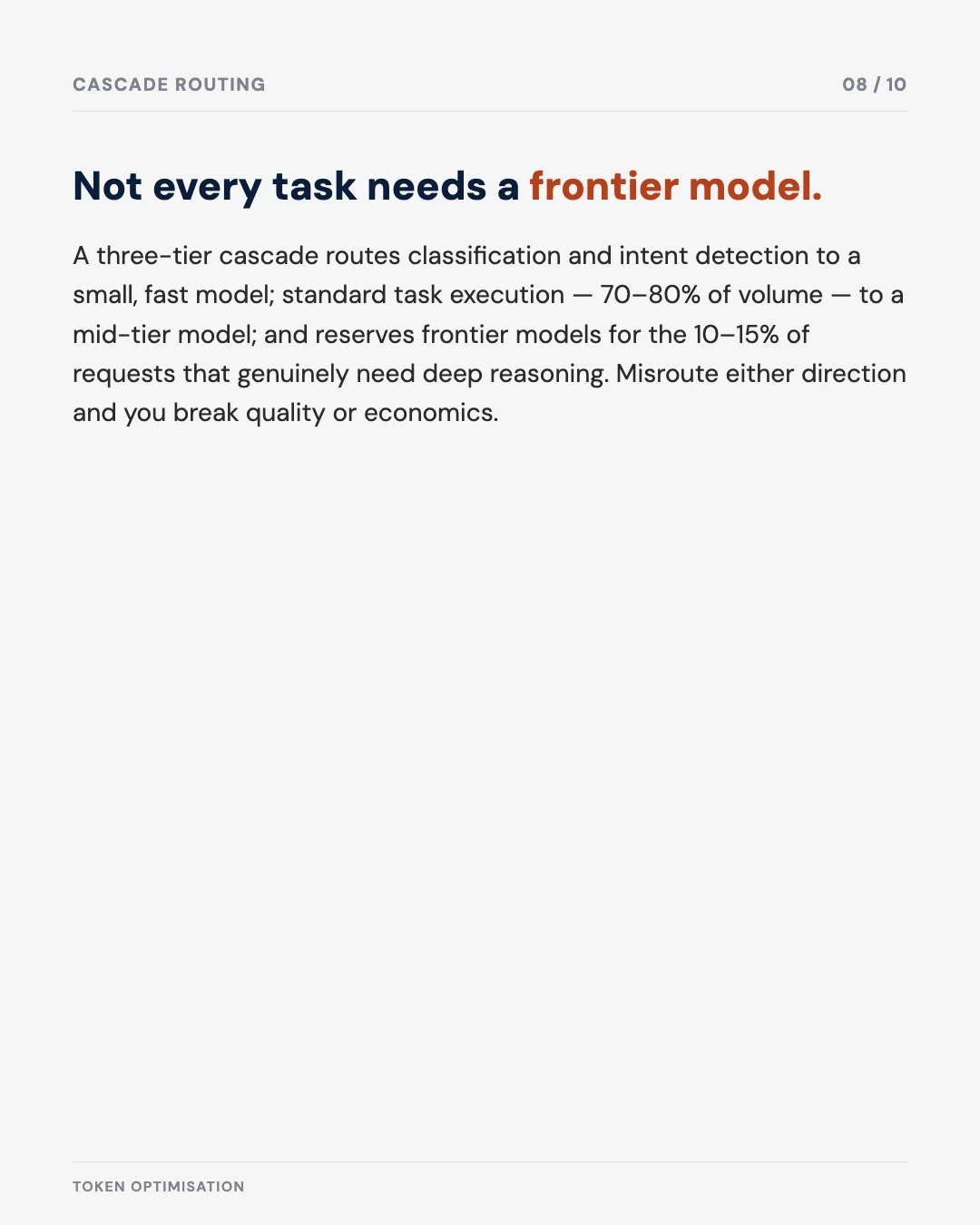
Not all tasks require frontier model capability. A cascade architecture routes requests by complexity class. T1 (classification and intent detection) routes to a small, fast model (latency under 300ms, cost under 0.1% of the frontier tier) used to determine the appropriate downstream route. T2 (standard task execution) routes to a mid-tier model for the majority of structured, well-defined tasks, covering an estimated 70–80% of production request volume. T3 (complex reasoning and synthesis) reserves frontier models for tasks that demonstrably require extended reasoning depth, no more than 10–15% of total request volume in a well-designed routing architecture. The routing classifier itself must be maintained as a production artefact with accuracy monitoring. Misrouting complex tasks to T2 degrades quality; misrouting simple tasks to T3 degrades economics.
Major model providers now offer prompt caching mechanisms that allow static context (system prompts, reference documents, tool definitions) to be cached at the infrastructure layer, with cached tokens billed at a significantly reduced rate (typically 50–90% discount relative to standard input pricing). This mechanism requires prompt construction discipline: static content must be positioned at the start of the context, before dynamic content. Systems that interleave static and dynamic content break cache coherence and forfeit the cost benefit. For RAG deployments, frequently retrieved reference chunks should be evaluated for caching eligibility: a document corpus that appears in 40% of requests represents a substantial caching opportunity if chunk retrieval patterns are sufficiently consistent.
Governance and Programme Control
CAIOs should establish token budgets as a formal programme governance control, equivalent to compute budgets in traditional infrastructure programmes. Define input and output token targets for each use case at design stage: these become acceptance criteria for production deployment. Instrument all production AI calls with token count logging at the prompt, context, retrieval, and output layers independently, since aggregate dashboards that report only total tokens obscure the source of cost growth. Report AI operational cost normalised to business outcomes: cost per document processed, cost per resolved query, cost per transaction reviewed. Raw token spend without outcome normalisation is not a useful management metric. Review token optimisation quarterly, since model providers update pricing, introduce caching, and release more efficient model tiers regularly, so token optimisation is not a one-time exercise.
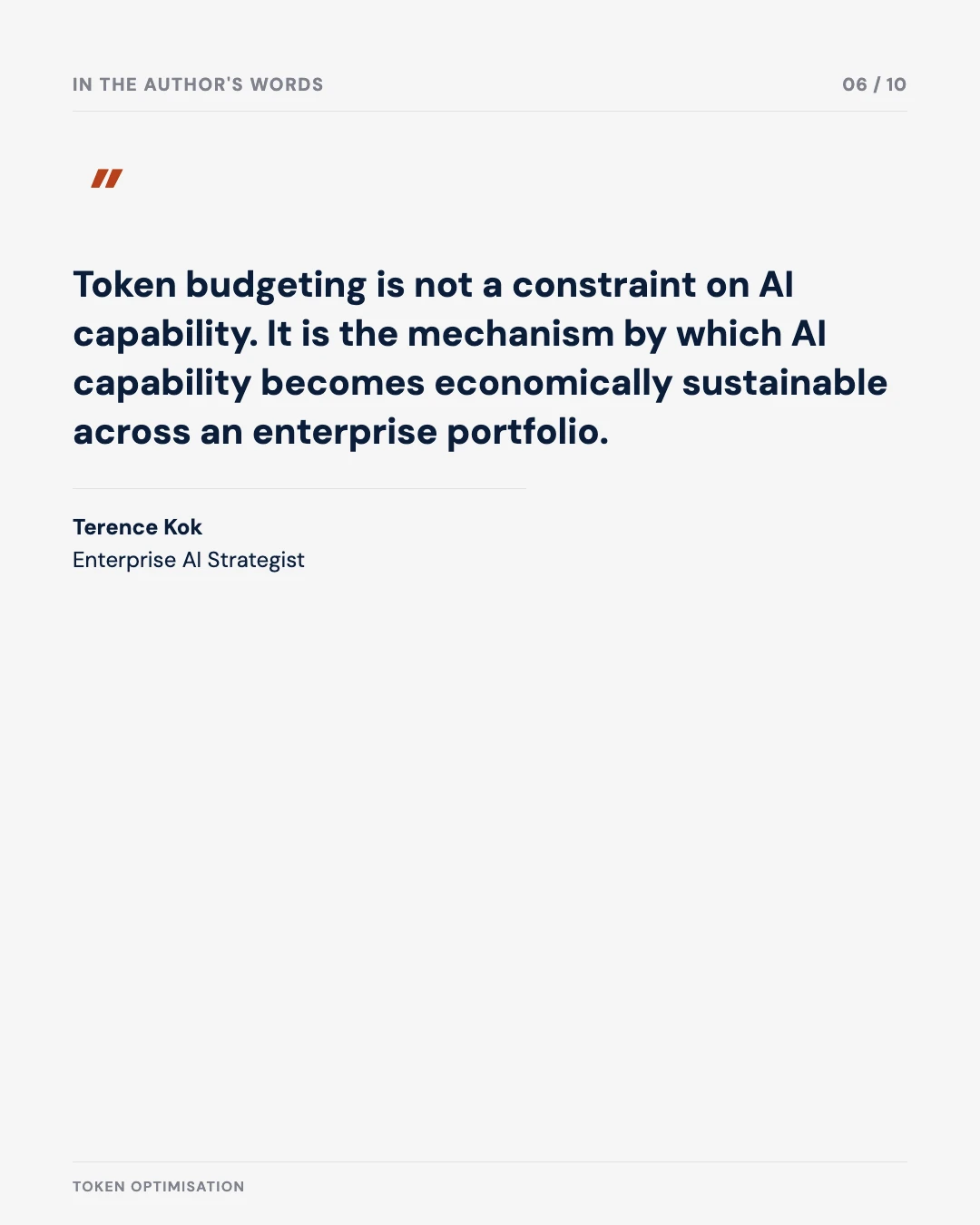
“Token budgeting is not a constraint on AI capability. It is the mechanism by which AI capability becomes economically sustainable across an enterprise portfolio.”
Token optimisation is not a secondary concern for AI engineers to manage independently. It is a primary programme variable that CAIOs and CTOs must treat with the same rigour as any other cost of goods sold line in a scaled digital operation. The organisations that will sustain AI at enterprise scale are those that design token efficiency into their architecture from the outset: establishing budgets, building telemetry, routing by capability tier, managing context deliberately, and reviewing economics on a defined cadence. The technology to do this is available. The organisational discipline to enforce it is the differentiating factor.
Free tool
Enterprise AI Value & Adoption Dashboard
Operationalise the cost-per-outcome reporting this article argues for, including TCO tracking and AI-influenced revenue by business unit.
Free tool
AI ROI Calculator
Model AI cost economics against your own team size and tech stack before token debt becomes the barrier to production ROI.
Was this useful?