
Listen to this article
Executive Summary
Bigger context windows aren’t automatically better. They raise latency, cost, and hallucination risk under quadratic attention scaling. The right target is the smallest context that fits the task, backed by RAG, compression, and model routing.
24%
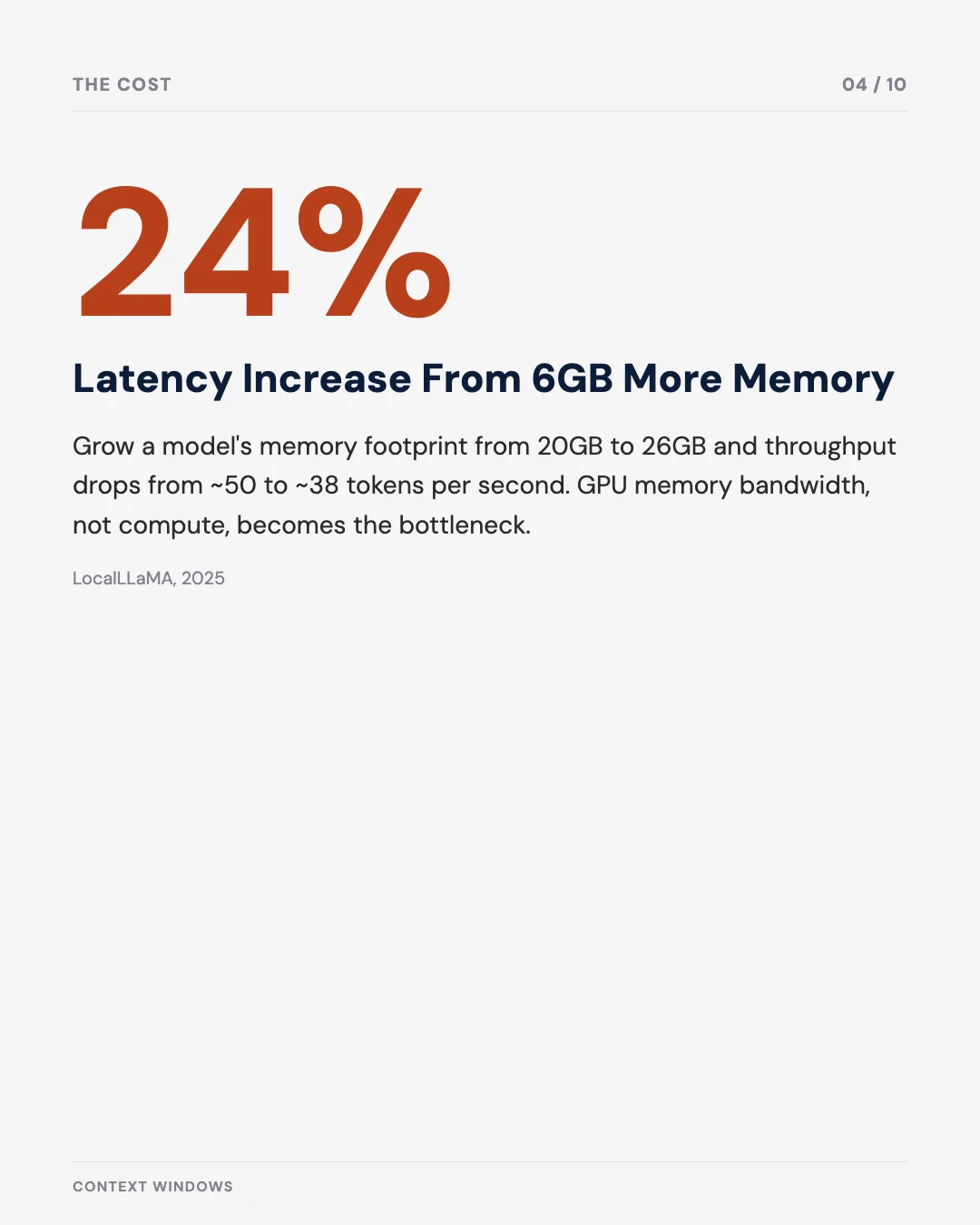
latency increase from just 6GB more memory footprint on the same GPU (LocalLLaMA)
10x
prompt compression achievable while retaining ~90% task performance (Glukhov)
40-50%
cost reduction from routing ~80% of requests to smaller models (Glukhov)
-47%
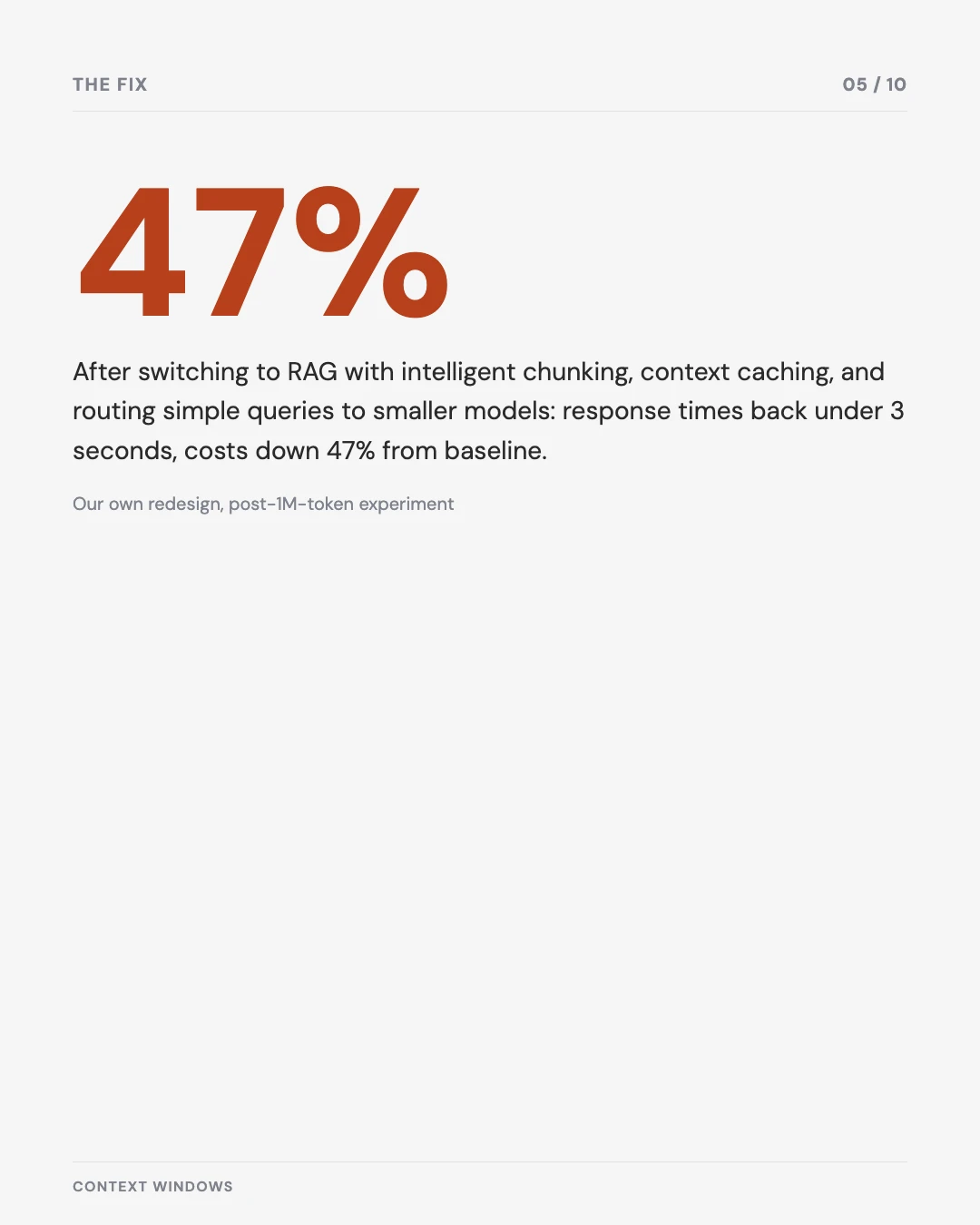
cost versus the original 1M-token baseline after switching to RAG, caching, and routing (this project’s own result)
Core conclusions
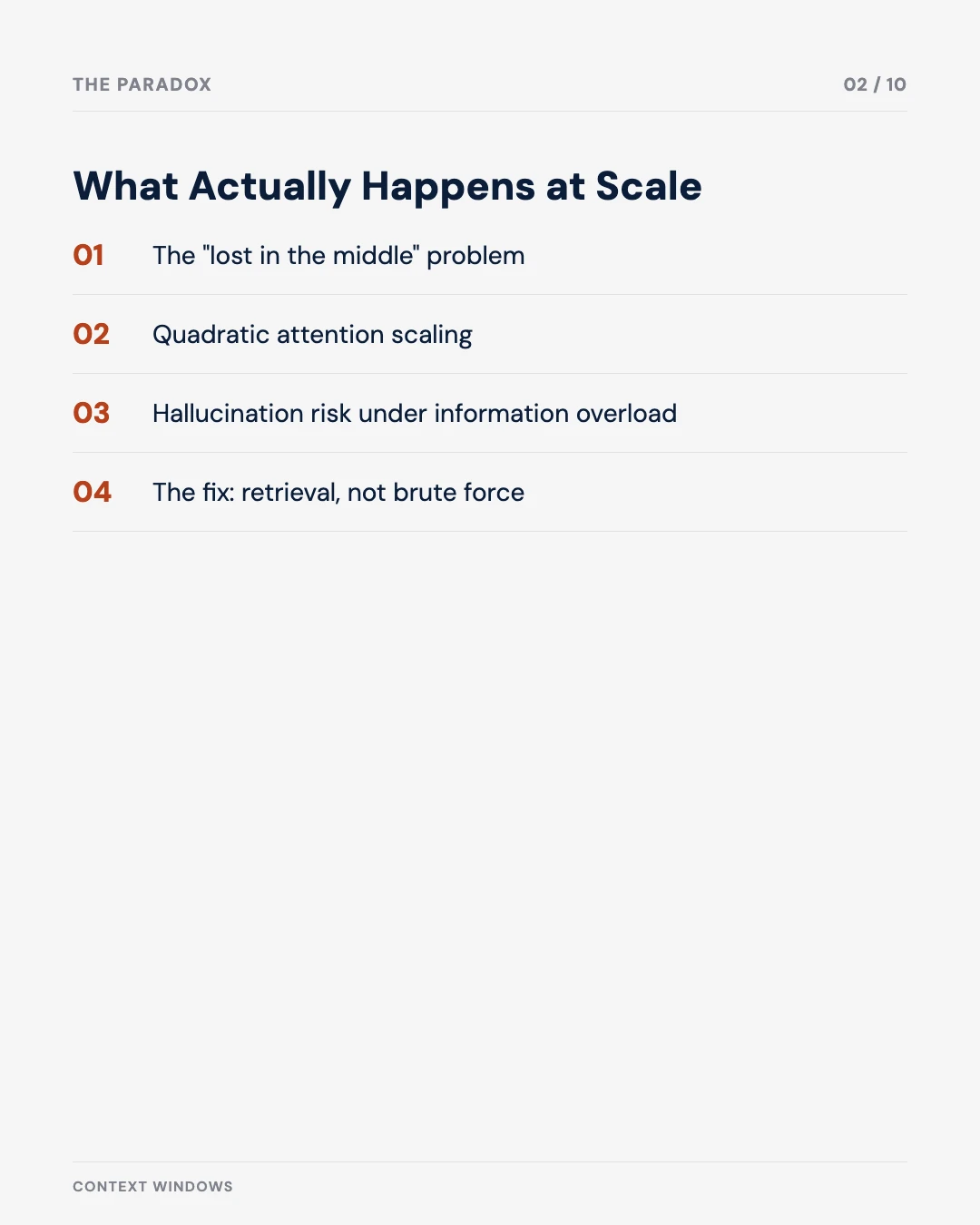
- Larger context windows introduce measurable failure modes: “lost in the middle” degradation, quadratic attention cost, and higher hallucination risk under information overload.
- Context window sizing should map to the task. Multi-turn support saturates at 8-16K tokens, strategic planning needs 64-128K, and exceeding the requirement adds cost and risk without proportional benefit.
- RAG, prompt compression, context caching, and multi-tier model routing consistently outperform brute-force maximum-context deployment on cost, latency, and accuracy.
Why bigger backfires, in ten slides
Save it, share it, or send it to whoever just asked for the largest context window available.


What Is a Context Window, and Why Should You Care?
Last month, our team was contemplating about upgrading to an AI model with a 1 million token context window. “We can throw our entire knowledge base at it!”. I was a little skeptical, but we tried it.
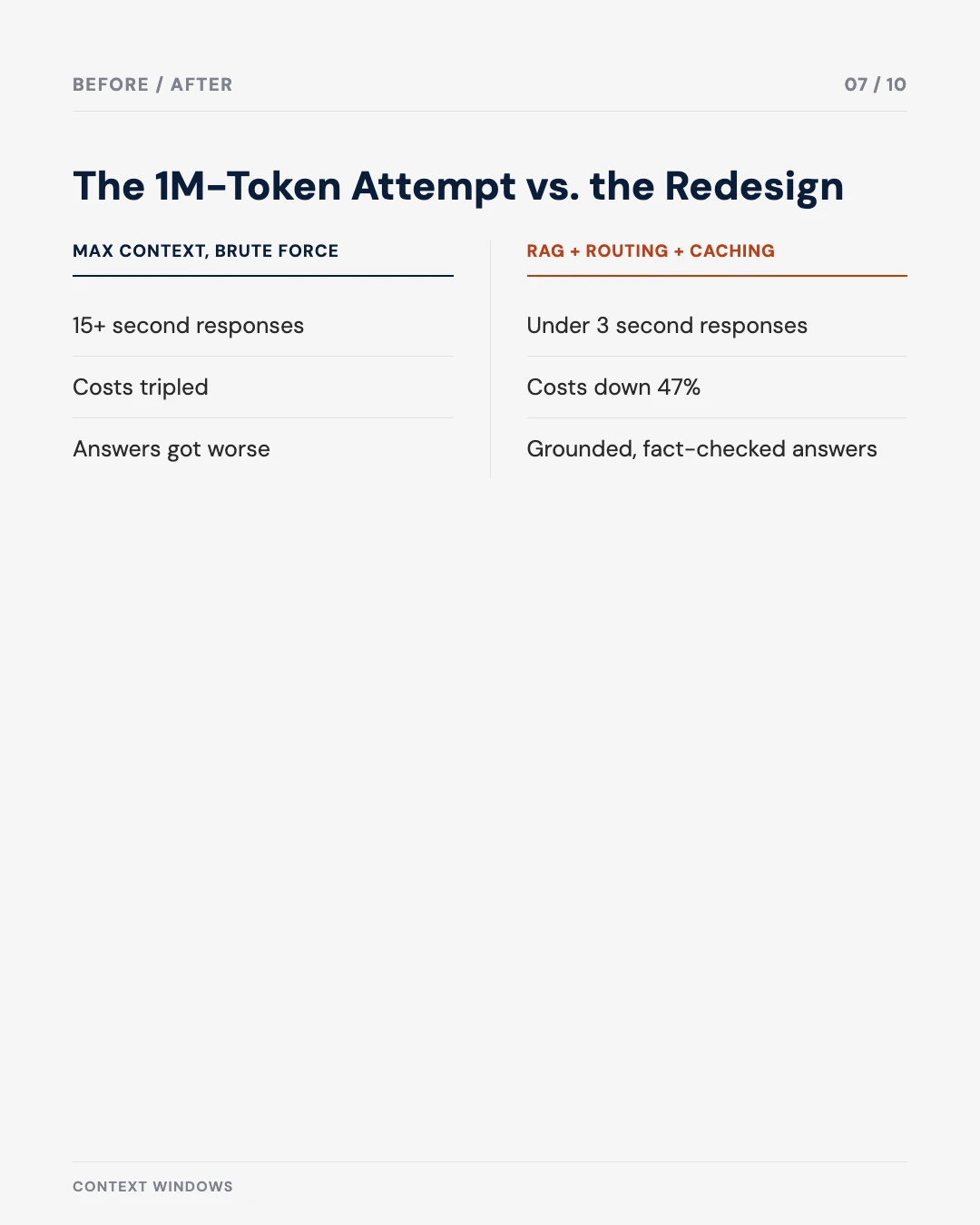
The results? Response times jumped from 2 seconds to 15+ seconds. Costs tripled. And weirdly, the AI’s answers got worse, not better.
That’s when I learned a counterintuitive truth about AI: bigger isn’t always better. In fact, it’s may often worse. Let me explain why understanding “context windows” might be the most important technical concept you need to grasp about AI in 2025.
Bigger isn’t always better. In fact, it’s often worse.
The context window is simply the amount of information an AI model can process and work with simultaneously. If you give it more information than its context window can hold, it’s like trying to cram ten pages of notes onto a single sheet of paper: something has to get left out, and that’s where problems start.
Here’s a concrete example: If you’re using ChatGPT to analyse a 50-page financial report and ask questions about it, the entire report must fit within ChatGPT’s context window for the model to read and understand it. If it doesn’t fit, the AI only sees parts of it, and that creates errors and incomplete analysis (Meibel.ai, 2025).
Why This Matters Right Now
For the past few years, AI companies have been racing to build bigger and bigger context windows. A few years ago, the best AI models could only handle about 2,000 tokens (roughly 1,500 words). Today, the latest models can handle 128,000 to even 1 million tokens: that’s an entire book’s worth of information in a single go. It sounds like progress, and it is, but it’s also created new problems that engineers, business leaders, and AI practitioners need to understand.
The paradox is this: larger context windows aren’t automatically better. In fact, they come with hidden costs: slower processing, higher costs, and unexpected performance issues (Datapro.news, 2025). At the same time, if your context window is too small, your AI will give you incomplete or inaccurate answers. Getting this balance right is critical if you’re building reliable AI systems.
What You’ll Learn
This guide walks through:
- What a context window actually does and how it works
- Real-world applications where large context windows add genuine value
- The specific ways context windows fail or degrade performance
- What happens when your context window is too small
- Practical strategies to manage context windows effectively and cost-efficiently
Whether you’re assessing AI tools for your organisation, developing AI systems, or trying to grasp why your AI occasionally provides nonsensical responses, understanding context windows is crucial. This guide clarifies the technical details and explains them in plain language (in italics) so everyone can understand more easily.
The context window represents one of the most consequential architectural constraints in modern large language models. Fundamentally, it defines the maximum quantity of tokens (discrete units of text encoding) that a model can process simultaneously within a single inference operation. Part of my job as an AI programme leader involves ensuring that these systems are scalable, cost-efficient, and operationally reliable; understanding context window dynamics is critical to achieving this.
Defining Context Window: Functional and Technical Dimensions
A context window encompasses the entire input-output sequence processed in a single forward pass: user prompts, provided documents, conversation history, and the model’s response. The term “token” typically refers to approximately four characters of text, with models often referring to their capacity in the thousands. GPT-4o processes 128,000 tokens, Claude 4 Sonnet handles 200,000 tokens, and Gemini 2.5 Pro supports 1,000,000 tokens (DevClarity, n.d.; Codingscape, 2024).
The context window functions as the model’s operational memory. Beyond this boundary, prior information is discarded unless explicitly summarised or reintroduced. This architectural choice is based on the transformer model’s attention mechanism, which computes pairwise relevance scores across all tokens in the sequence. The computational complexity scales quadratically with context length, a fundamental constraint that directly impacts inference latency, memory requirements, and infrastructure costs (LocalLLaMA, 2025).
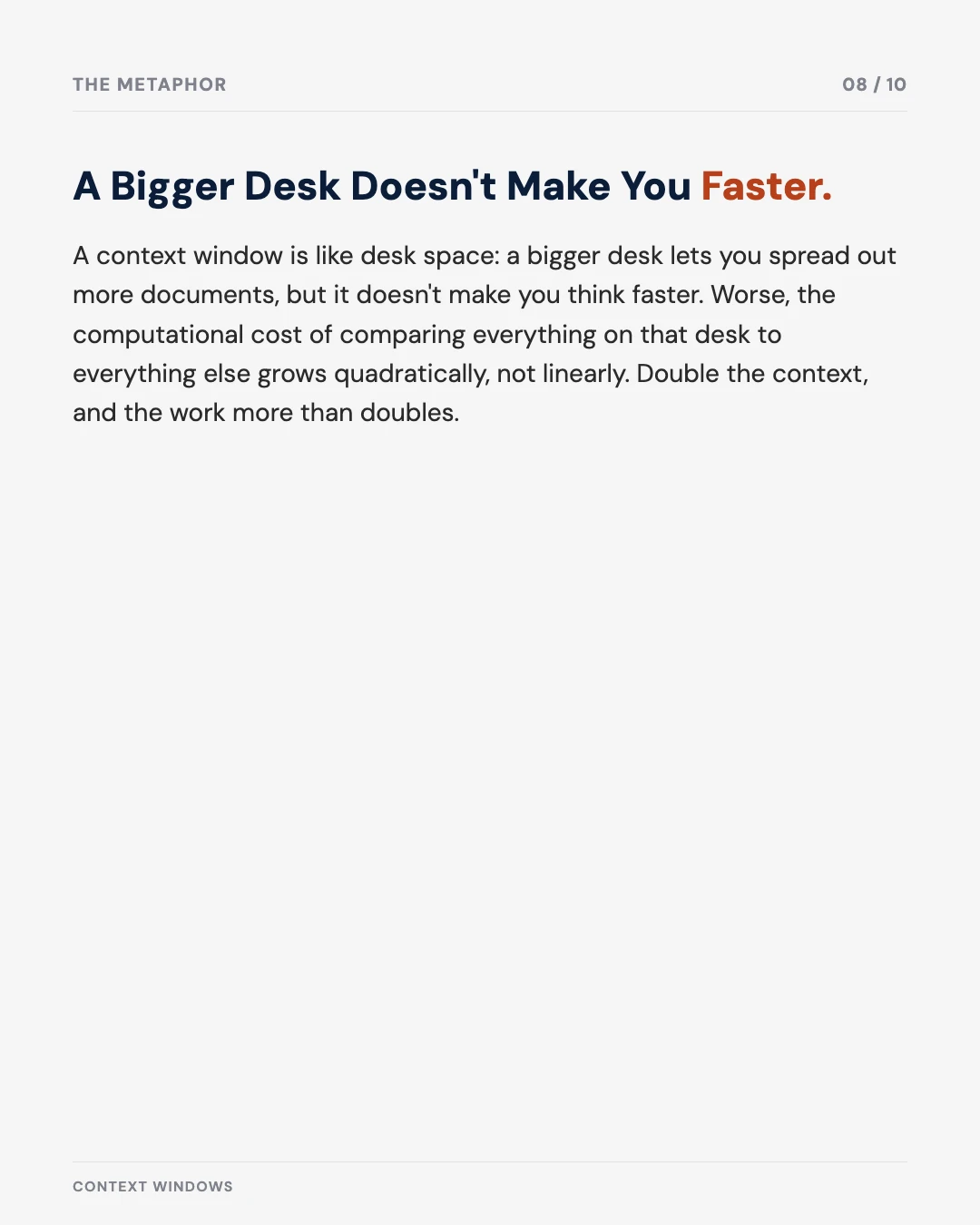
Think of a context window like the desk space in front of you while you’re working. You can only look at and reference what’s on your desk right now. When your desk is small, you can only keep a few documents visible. When it’s large, you can spread out everything. But here’s the catch: a bigger desk doesn’t necessarily make you work faster. It just means you have more stuff to shuffle through. The computer science bit (the “quadratically scaling” part) means that every time you double the context window size, the work the AI has to do doesn’t just double. It grows much faster than that. More context = more things to compare to each other = exponentially more work for the computer.
Current Applications Enabling Measurable Organisational Value
The expansion of context windows from historical limits (GPT-3’s 2,048 tokens) to contemporary scales (1 million tokens) has unlocked several high-impact enterprise use cases:
Document-Scale Analysis
Models now process entire technical manuals, regulatory filings, and research papers in single passes, enabling comprehensive analysis without retrieval orchestration. Financial institutions report simultaneously evaluating market histories, regulatory changes, and portfolio compositions, functionality that previously required manual data synthesis (Datapro.news, 2025).
Previously, if you wanted an AI to analyse a 100-page financial document, you’d have to break it into chunks, feed each chunk separately, and then manually piece together the answers. Now, you can dump the entire document at once and get a holistic analysis. It’s like the difference between reading a book chapter by chapter versus reading it all in one sitting and understanding how everything connects.
Extended Operational Memory
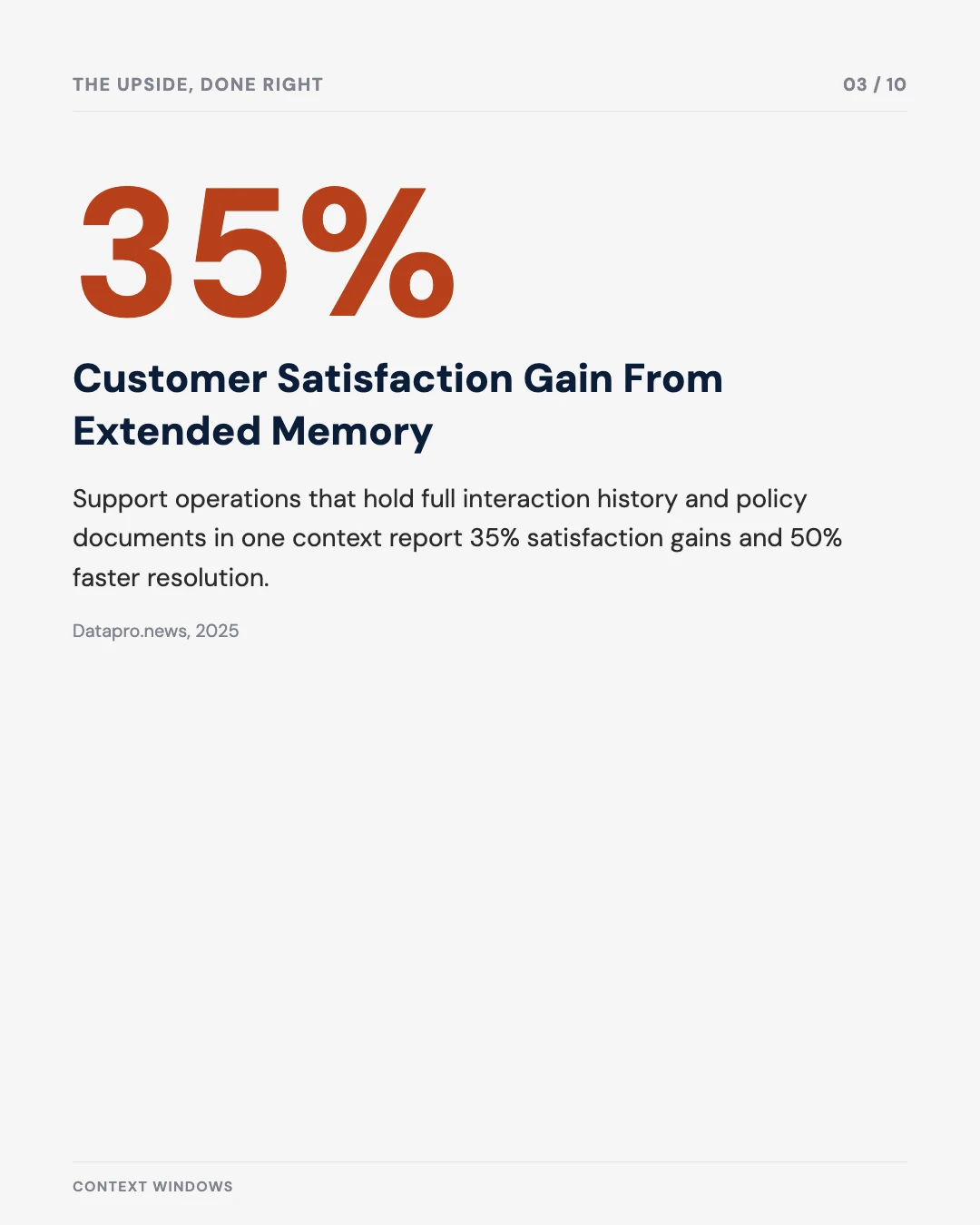
Customer service operations maintain comprehensive interaction histories, product documentation, and internal policies within a single conversational context. Reported improvements include 35% gains in customer satisfaction and 50% reduction in resolution times (Datapro.news, 2025).
Imagine a customer service agent with perfect recall. They remember every conversation you’ve ever had, your account history, your preferences, and company policies, all at once. They don’t have to ask you to repeat yourself or look things up in multiple systems. This leads to faster resolutions and happier customers.
Codebase Comprehension
Large-scale refactoring and architectural analysis on codebases exceeding 20,000 lines of code directly support software engineering productivity at enterprise scale (DevClarity, n.d.).
Software developers can now ask an AI to understand and refactor a massive codebase (say, 20,000+ lines of code) all at once. The AI can see how everything interconnects and make intelligent improvements. Before, it could only understand small snippets.
Strategic Decision Support
C-suite applications span quarterly reports, competitive intelligence, and macroeconomic data simultaneously, accelerating strategic decision cycles.
Executives can now ask an AI to analyse a quarterly report, market trends, competitor moves, and economic forecasts in a single conversation, rather than jumping between analyses. The AI understands how these pieces fit together.
Critical Weaknesses and Performance Degradation Patterns
However, expanded context windows introduce counterintuitive performance degradation mechanisms that require explicit management.
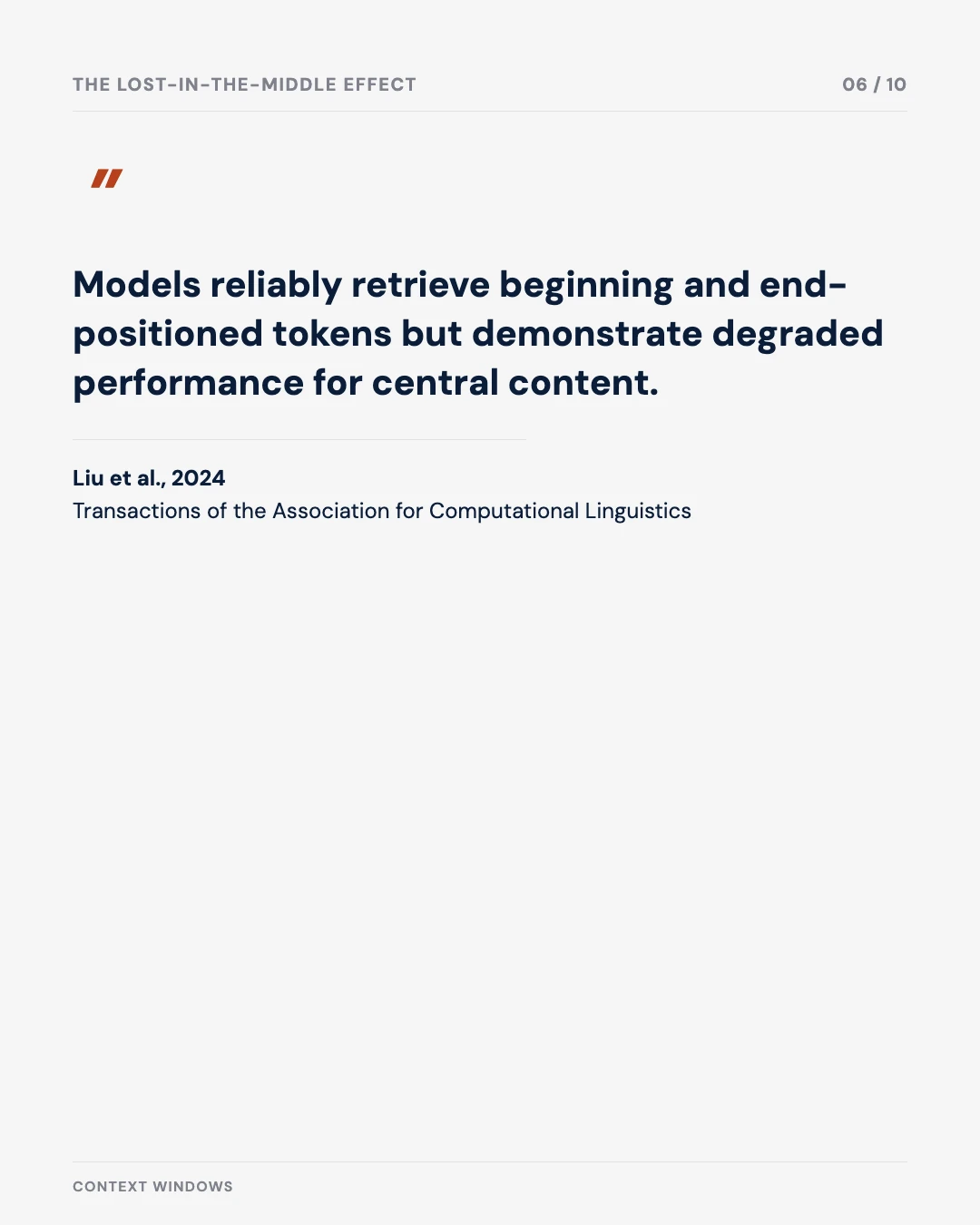
The “Lost in the Middle” Phenomenon: Large language models exhibit measurable performance reduction for information positioned in the middle of long contexts. This phenomenon mirrors primacy and recency effects in human memory: models reliably retrieve beginning and end-positioned tokens but demonstrate degraded performance for central content (Liu et al., 2024). This reflects the transformer architecture’s attention dynamics, where early tokens disproportionately accumulate attention weights (termed “attention sinks”), creating positional bias that persists across model scales and training regimens.
Models reliably retrieve beginning and end-positioned tokens but demonstrate degraded performance for central content.
Imagine you’re reading a long email with important information scattered throughout. You probably remember the first thing you read (the greeting or opening context) and the last thing you read (the closing request or signature). But the stuff in the middle? You might miss it or misremember it. The same thing happens with AI. If you put critical information in the middle of a long prompt, the AI is more likely to miss or misunderstand it. This is a real problem if your important details aren’t at the beginning or end.
Inverse Relationship Between Window Utilisation and Throughput
Processing larger contexts requires proportionally greater memory allocation for key-value caches. GPU memory bandwidth becomes the primary bottleneck. A GPU with 1,000 GB/s bandwidth achieves approximately 50 tokens per second with a 20 GB model footprint, but throughput degrades to approximately 38 tokens per second when the same model occupies 26 GB in memory, representing a 24% latency increase (LocalLLaMA, 2025). At consumer hardware scales, context utilisation beyond 4,000 tokens produces empirically observable degradation, from 30 tokens per second to approximately 5 tokens per second (LocalLLaMA, 2025).
Here’s a brutal truth: bigger context windows make responses slower. A lot slower. If you ask an AI to process a 2,000-token query, it might respond in a second. But ask it to process a 100,000-token query, and that response time might stretch to 10+ seconds. This is because the computer’s memory bandwidth (the speed at which it can move information around) becomes the limiting factor. It’s like a highway: rush hour traffic moves slower than midnight traffic, even if the highway is the same size.
Quadratic Attention Scaling
The attention mechanism’s computational cost grows with O(n²) complexity relative to sequence length. Processing four separate 32K contexts is faster than processing a single 128K context, with this performance differential becoming more pronounced at scales exceeding 256K tokens. Sparse attention mechanisms (Flash Attention, Sparse Weighted Attention) provide partial mitigation but do not eliminate this constraint (LocalLLaMA, 2025).
The AI’s core thinking process gets exponentially more complex as context grows. Processing one massive 128K context is not twice as hard as processing a 64K context. It’s much, much harder (roughly four times harder in computational terms). Some engineers have developed tricks to speed this up (like “Flash Attention”), but they only help so much. The fundamental problem remains: bigger context = exponentially more computational work.
Hallucination Risk Under Information Overload
Models saturated with contextual information exhibit increased hallucination rates, particularly in complex reasoning tasks. The mechanism reflects reduced capacity to distinguish between retrieved facts and generated inferences: information abundance paradoxically degrades discrimination capability (AI21 Labs, 2025).
Information abundance paradoxically degrades discrimination capability.
Overloading an AI with information often backfires. It’s like asking someone to make a decision while drowning them in data. The AI gets confused about what’s real information versus what it’s inferring, and starts making up facts to fill in gaps. More information doesn’t always equal better answers. Sometimes it makes things worse.
Reference Identification and Attention Non-Uniformity
Token importance distribution within large contexts becomes irregular. Information in earlier positions benefits from stronger attention signals than content appearing later, complicating reference retrieval for specific facts embedded in long sequences (Meibel.ai, 2025).
When you give the AI a lot of information, it doesn’t weigh all of it equally. Early information gets more focus and attention than later information. So if you bury an important fact deep in your prompt, the AI might skim over it without properly understanding it. This is particularly problematic when you’re trying to get the AI to reference a specific piece of information.
Risks Specific to Small Context Windows
Conversely, inadequate context windows introduce distinct failure modes:
Coherence Collapse
Models operating with context windows below 4,000 tokens fail to maintain logical consistency across documents exceeding 1,000 words. Summarisation tasks, multi-turn dialogue, and document-level question-answering degrade systematically (Riskoria, 2024).
If you’re using an older AI model with a tiny context window (think 2,000-4,000 tokens), it struggles with basic tasks like summarising documents or maintaining a coherent multi-turn conversation. The AI loses track of what it was saying and contradicts itself because it can’t hold enough context in memory.
Enterprise System Failures
In regulated domains such as financial services, healthcare, and legal, constrained context windows result in incomplete information processing. Loan applications lack complete client situation context. Medical record systems miss critical diagnostic history. These deficiencies directly impact risk and compliance positioning (Riskoria, 2024).
In high-stakes industries like banking and healthcare, small context windows are dangerous. A bank’s AI can’t see a customer’s full financial history and makes bad lending decisions. A hospital’s AI can’t review complete patient records and misses critical symptoms. These aren’t just inconveniences. They’re serious risks that can result in financial losses, patient harm, and regulatory violations.
Cascading Complexity Costs
Small context windows force complex external orchestration (retrieval systems, embedding indices, ranking algorithms) to compensate for model limitations. This infrastructure tax increases operational complexity and failure surfaces (Datapro.news, 2025).
When your AI’s memory is too small, you have to build a bunch of extra machinery around it to work around the limitation. You need retrieval systems to find relevant information, ranking systems to prioritise what matters, and indexing systems to keep everything organized. This makes your overall system much more complicated, expensive, and prone to breaking down. It’s like building a house on a weak foundation. You have to reinforce everything around it.
Mitigation Framework: Designed for Enterprise Scale
Effective context window management requires multi-layered approaches aligned to operational requirements rather than maximum capacity:
Retrieval-Augmented Generation (RAG)
RAG architectures incorporate external document retrieval, grounding responses in factual information. None of this works, though, if the underlying knowledge base is itself the problem. This approach proves superior to naive context inclusion for knowledge bases exceeding available context capacity (Prompt Engineering Guide, 2022). RAG systems maintain semantic relevance through vector embedding retrieval, substantially reducing hallucination likelihood compared to maximum context inclusion. This strategy scales effectively when knowledge bases are extensive relative to operational queries (SAS Publishers, n.d.).
Instead of dumping an entire knowledge base into the AI’s context, RAG is like giving the AI a librarian. You ask the AI a question, the librarian finds the most relevant documents, and then the AI uses only those relevant documents to answer. This way, you get accurate, grounded answers without overloading the AI with irrelevant information. It’s faster, cheaper, and more accurate than the brute-force approach of giving it everything.
Prompt Compression and Structured Encoding
Dedicated compression models achieve 10x compression ratios whilst maintaining 90% task performance. Example: identical prompting task reduced from 127 to 38 tokens (70% reduction) through redundancy elimination and structured formatting (Glukhov, 2025). JSON-based context representation consistently outperforms natural language for model comprehension.
You can squeeze more information into your context window without losing quality by removing unnecessary words and formatting information in a structured way (like JSON instead of paragraphs). Think of it like the difference between a rambling 3,000-word memo and a crisp, well-formatted 1,000-word summary. Both convey the same information, but one is far more efficient. Some AI companies have built tools specifically designed to do this compression automatically.
Multi-Tier Model Routing
Enterprise deployments partition workloads: approximately 80% of requests route to smaller models (GPT-3.5-level capability), with 20% reserved for complex reasoning requiring larger models. This architectural choice reduces costs 40-50% without proportional quality degradation (Glukhov, 2025). Token cost management deserves the same engineering discipline as context sizing, which I cover in Token Optimisation Is an Engineering Discipline, Not a Prompt Trick.
You don’t need the biggest, most expensive AI model for every task. Simple questions (like “What’s the weather?”) can be handled by a cheaper, smaller model. Only complex reasoning tasks go to the big, expensive models. This is like hiring interns for basic work and reserving senior consultants for difficult problems. Your overall costs drop dramatically without sacrificing quality.
Context Caching for Static Content
System prompts, tool specifications, and documentation segments cached after first use incur reduced token costs on subsequent requests. Enterprise implementations achieve 20-40% cost reduction through caching, with semantic caching extending savings for semantically similar queries (Dedeoglu, 2025).
If you’re repeatedly using the same instructions or documentation with different questions, you can cache (save) that static content so the AI doesn’t have to reprocess it every time. It’s like a teacher not having to rewrite the syllabus for each student. They write it once and everyone uses the same copy. This saves 20-40% on token costs.
Intelligent Chunking and Ranking
RAG implementations using 300-token chunks with top-k=3 retrieval and cross-encoder reranking outperform naive full-context inclusion, balancing accuracy, cost, and latency (Dedeoglu, 2025).
When you’re using RAG, you want to slice your documents into manageable pieces (about 300 tokens each, roughly 200 words). When a question comes in, you retrieve the top 3 most relevant chunks and let the AI work with just those. You can further refine this by using a ranking system to make sure you’re giving the AI the actually relevant information. This balanced approach gives you accuracy, speed, and cost-efficiency all at once.
Conversation State Management
Rather than accumulating unlimited history, maintain sliding window summaries. Archive older conversation turns, preserving only high-level summaries and recent exchanges. This approach maintains coherence whilst constraining token expansion across extended dialogues.
In a long conversation, you don’t need to keep every single message. Instead, periodically summarise older messages into a brief recap and discard the originals. Keep only the summary and the last few recent messages. This way, the AI maintains a sense of what was discussed earlier without being weighed down by the entire conversation history. It’s like keeping a detailed journal but only reviewing the highlights when you need context.
Hallucination Detection and Validation
Implement multi-method hallucination detection. LLM-based prompt detectors provide optimal accuracy-to-cost trade-offs. Semantic similarity detection using embeddings identifies out-of-context statements. Token similarity detectors identify most obvious fabrications with high precision (Amazon Web Services, 2025).
You can’t always trust what an AI tells you. Build in verification systems that check whether the AI’s answers are grounded in real information or made up. Use different checking methods: some check whether the answer makes semantic sense, some look for obvious made-up statements, and some ask other AI models to verify. It’s like having a fact-checker reviewing everything the AI produces before it goes out to users.
Structural Code Decomposition
For codebase analysis, split into logical modules, create abstract maps defining purpose and interfaces without full implementation, and process incrementally. This approach maintains semantic completeness whilst reducing token consumption.
If you’re analysing a huge codebase, don’t give it all to the AI at once. Instead, break it down by modules or components, create high-level diagrams showing how pieces fit together, and process it step by step. The AI gets the full picture without being buried in thousands of lines of code it doesn’t immediately need.
Enterprise Implementation Outcomes
Organisations implementing comprehensive context management strategies report measurable improvements: 30% reduction in infrastructure complexity, 25% accuracy improvement, and 35% customer satisfaction gains in support applications (Datapro.news, 2025). However, success requires explicit context strategy rather than default maximum-context-window deployments.
Critical Design Principle: Appropriate Context, Not Maximum Context
The most significant misunderstanding is equating larger context windows with superior performance. Context window selection must align with specific task requirements. Document analysis spanning entire codebases demands 200K+ tokens. Multi-turn support dialogues typically saturate at 8K-16K tokens. Customer relationship management benefits from 16K-32K context. Strategic planning across domains requires 64K-128K context.
Selecting a context window substantially exceeding task requirements increases latency, costs, hallucination risk, and infrastructure burden without proportional benefit. Enterprise success requires deliberate context engineering: treating context allocation as a resource-optimisation problem rather than defaulting to using maximum available capacity.
The context window represents your AI system’s operational constraint and opportunity. Engineering context management is now a foundational discipline for reliable, scalable, cost-efficient enterprise AI deployment.
The Bottom Line
After that painful learning experience with the 1 million token model, we completely redesigned our approach. We implemented RAG with intelligent chunking, added context caching, and used smaller models for simple tasks. The results?
• Response times: back to under 3 seconds
• Costs: down 47% from our original baseline
• Answer quality: significantly better with grounded, fact-checked responses
Here’s what I wish someone had told me at the start: context windows are like giving someone a desk to work on. A bigger desk doesn’t make them smarter or faster. It just gives them more space to get lost in.
A bigger desk doesn’t make them smarter or faster. It just gives them more space to get lost in.
The right approach? Give your AI exactly what it needs, nothing more. Use retrieval systems to find relevant information. Compress what you can. Cache what’s static. Route simple questions to smaller models.
Context window engineering isn’t glamorous, but it’s foundational. Getting this right is the difference between an AI system that drains your budget and confuses users, versus one that delivers fast, accurate, cost-effective results.
What’s been your experience with context windows? Have you hit the “too much information” problem, or are you dealing with context limits that are too small? I’d love to hear what strategies have worked (or failed spectacularly) for you. Drop a comment. I’m always learning from others’ experiences.
References
AI21 Labs. (2025, November 25). What is a Long Context Window? Benefits & Use Cases. https://www.ai21.com/knowledge/long-context-window
Amazon Web Services. (2025, May 15). Detect hallucinations for RAG-based systems. https://aws.amazon.com/blogs/machine-learning/detect-hallucinations-for-rag-based-systems/
Codingscape. (2024, October 21). LLMs with largest context windows. https://codingscape.com/blog/llms-with-largest-context-windows
Datapro.news. (2025, November 11). Have (near) Infinite Context Windows Delivered on their Promise. https://www.datapro.news/p/have-near-infinite-context-windows-delivered-on-their-promise
Dedeoglu, E. (2025, December 10). Cut LLM Costs 50%: 6 Token Optimization Strategies. LinkedIn. https://www.linkedin.com/pulse/token-per-task-economics-6-techniques-cut-llm-spend-50-ercin-dedeoglu-x1o8f
DevClarity. (n.d.). Context Window Guide. https://www.devclarity.ai/resources/context-window-for-ai-tools-and-models
Glukhov, D. (2025, October 31). Reduce LLM Costs: Token Optimization Strategies. https://www.glukhov.org/post/2025/11/cost-effective-llm-applications/
Liu, N. F., Lin, K., Hewitt, J., Paranjape, A., Bevilacqua, M., Petroni, F., & Liang, P. (2024). Lost in the Middle: How Language Models Use Long Contexts. Transactions of the Association for Computational Linguistics. https://openreview.net/pdf/c25408a58e3ac4cfd9f4d8f42820e1f1a710768f.pdf
LocalLLaMA. (2025, July 12). How does having a very long context window impact performance?. Reddit. https://www.reddit.com/r/LocalLLaMA/comments/1lxuu5m/how_does_having_a_very_long_context_window_impact/
Meibel.ai. (2025, April 23). Understanding the Impact of Increasing LLM Context Windows. https://www.meibel.ai/post/understanding-the-impact-of-increasing-llm-context-windows
Was this useful?