
Listen to this article
Executive Summary
Prompt tuning has a low ceiling because it can’t fix what a RAG system is actually reading. Fixing the underlying data (accuracy, completeness, deduplication) moved the needle further than three weeks of prompt engineering did.
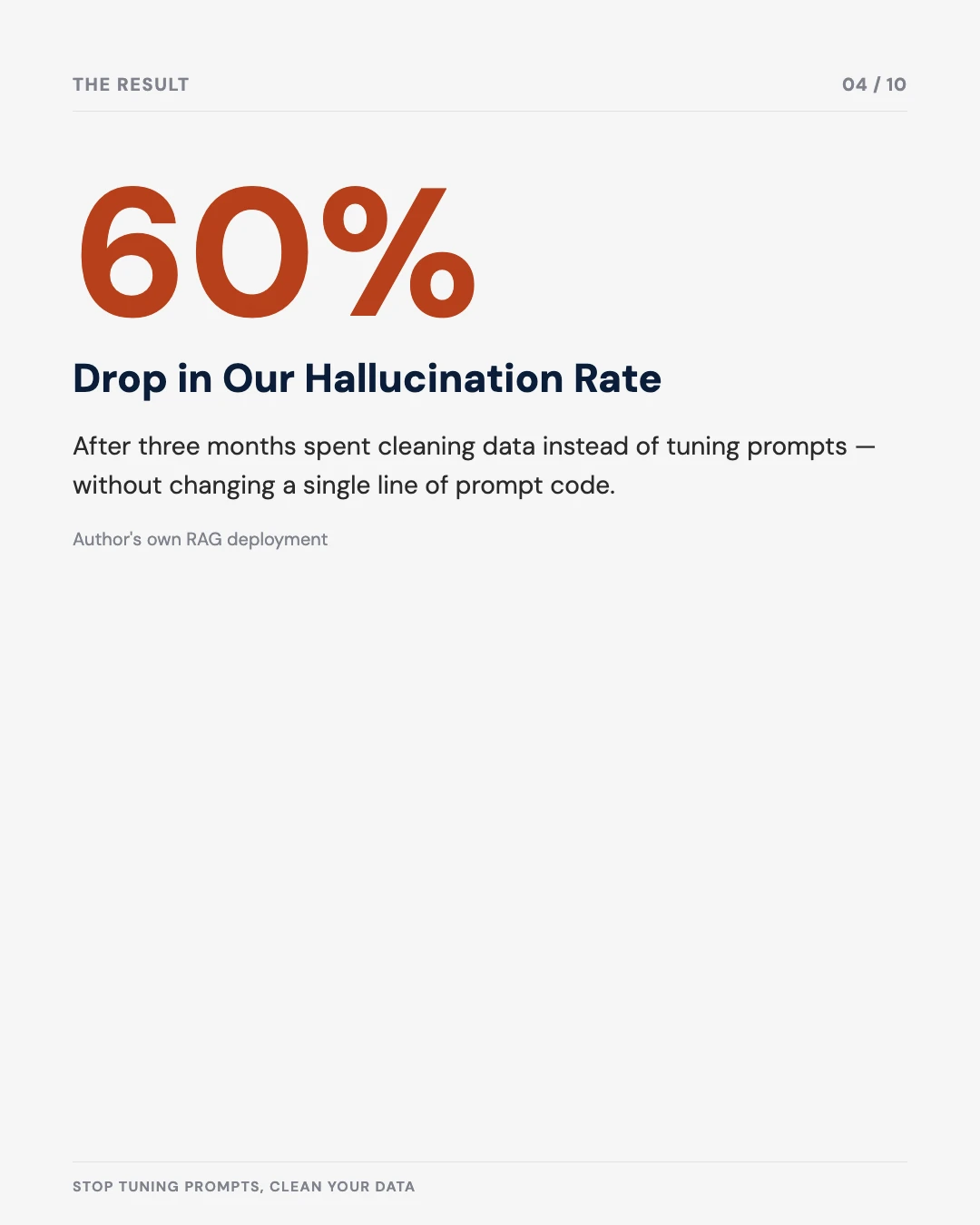
-60%
hallucination rate after cleaning the knowledge base, with zero prompt changes (this project’s own result)
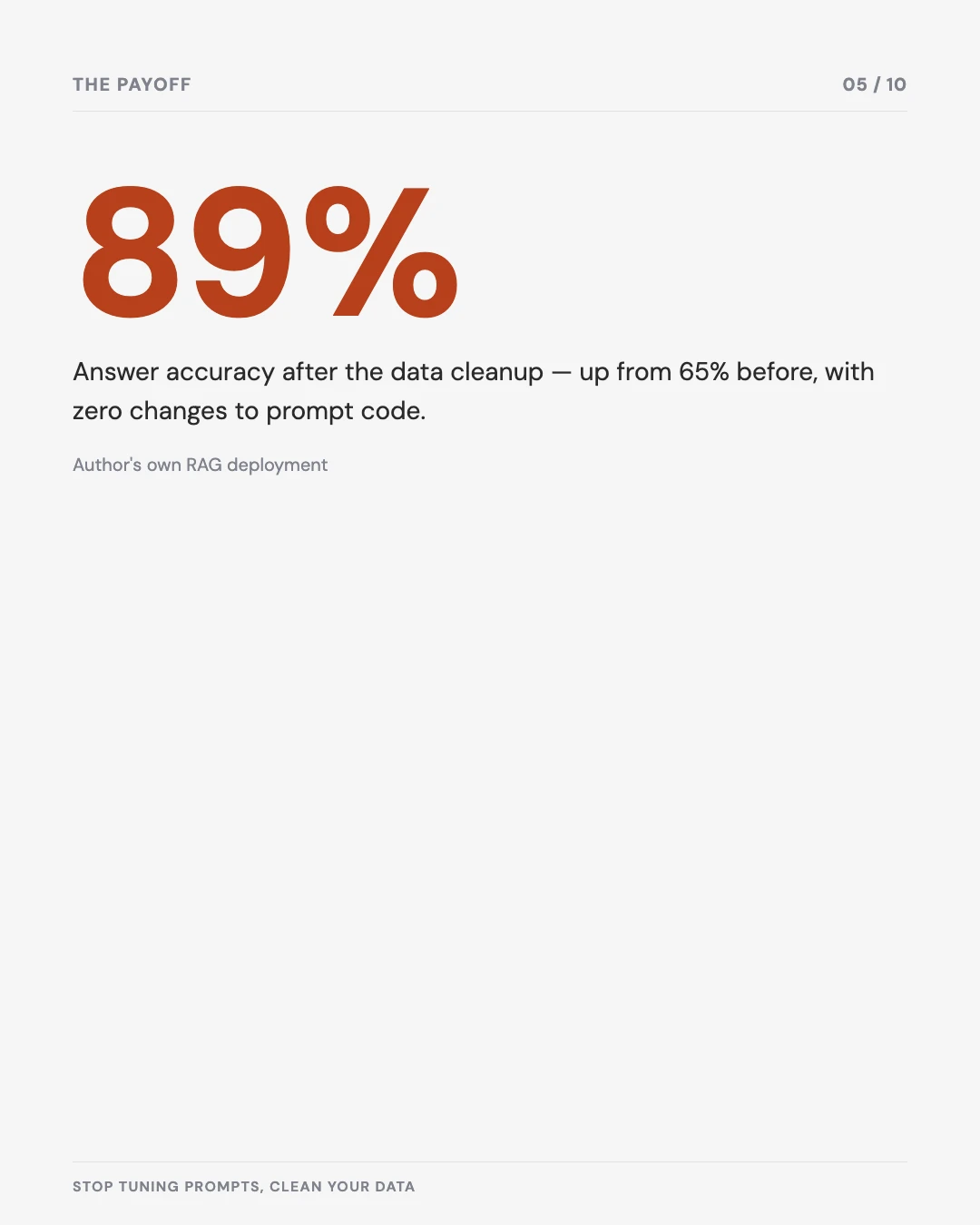
65→89%
answer accuracy before and after the data cleanup (this project’s own result)
Core conclusions
- An LLM is only as good as the data it reads. Better prompts can’t compensate for outdated, duplicate, or conflicting source documents.
- High retrieval recall doesn’t save you if the retrieved documents themselves are low quality; RAG accuracy collapses on a weak corpus regardless of the reasoning engine’s strength.
- The habits that actually work are unglamorous: treat data quality as a measurable SLA, filter at ingestion, curate a canonical source of truth, and close the loop with user feedback.
The data habits, in ten slides
Save it, share it, or send it to whoever’s still tuning temperature settings.
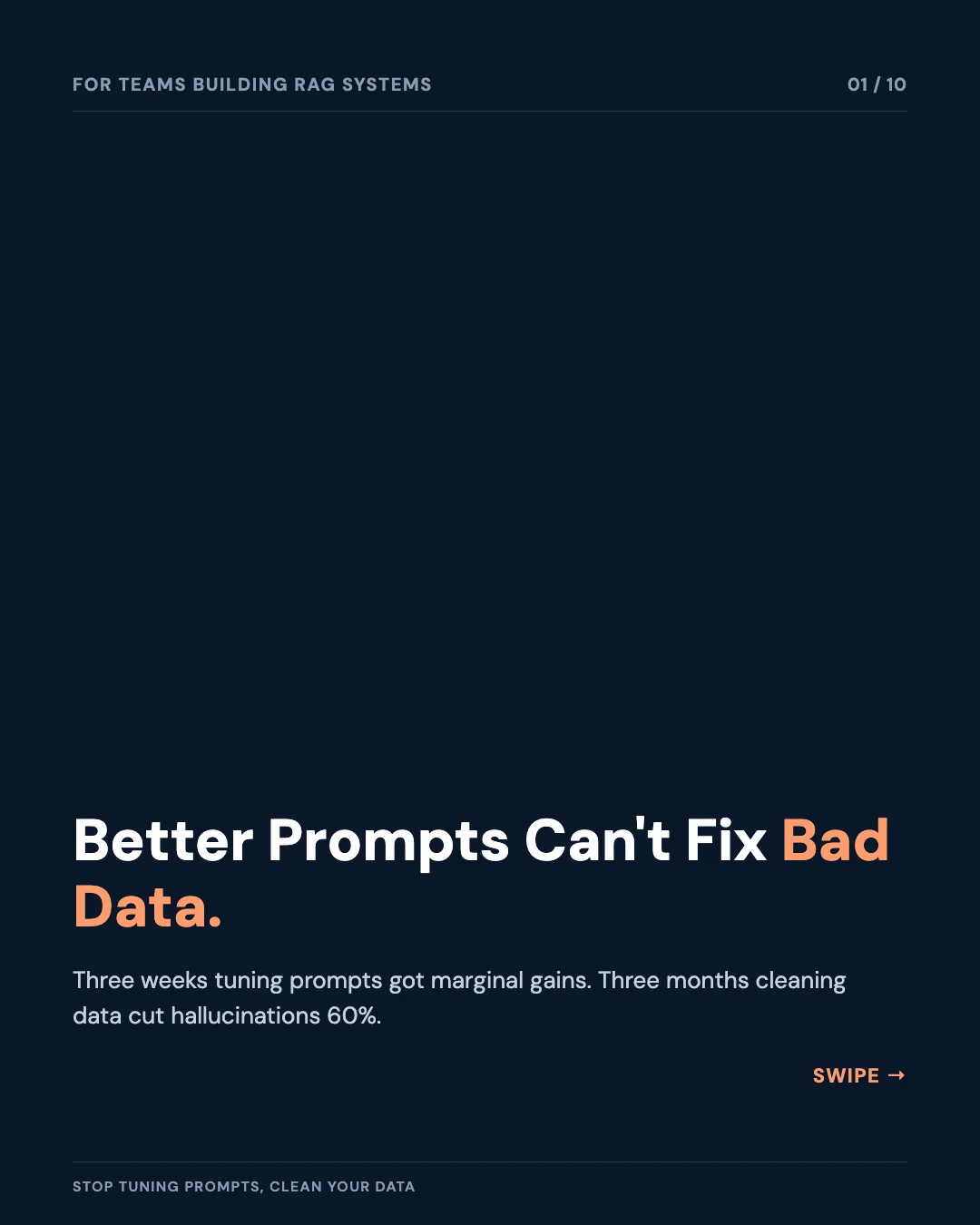
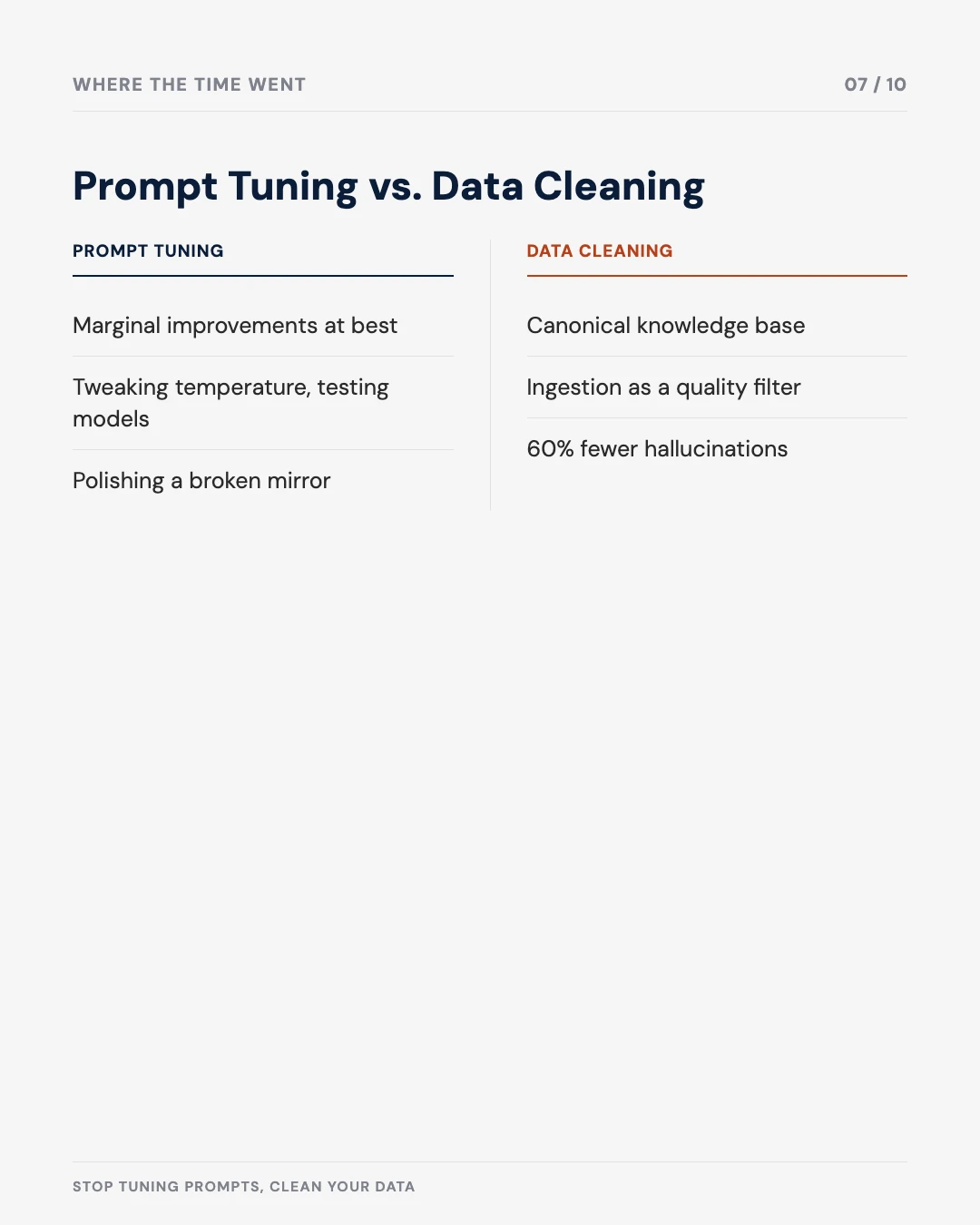

I spent three weeks fine-tuning prompts for our RAG system. Tweaking instructions, adjusting temperatures, testing different models. The results? Marginal improvements at best. Then my data engineer pulled me aside and showed me what our system was actually reading: outdated documents, duplicate entries, incomplete procedures, and conflicting information everywhere.
That’s when it hit me: we were polishing a broken mirror.
Here’s the uncomfortable truth about AI transformations: your fancy LLM is only as good as the data you feed it. Even the most advanced model will act like an unreliable intern when working with messy, incomplete, or misleading data. Better prompts can’t fix bad data.
Why bad data kills good models
Empirical work has shown that core data quality dimensions (accuracy, completeness, consistency, timeliness, uniqueness, validity) have a significant and quantifiable effect on model performance across classification, regression, and clustering tasks.
In one large‑scale study across 19 algorithms, degradation in these dimensions produced systematic drops in predictive performance, confirming that “trustworthy AI” is unattainable without disciplined data quality management.
For LLMs and RAG systems, this translates into:
- Higher hallucination and error rates when models are forced to compensate for missing, conflicting, or noisy signals in the input.
- Reduced answer accuracy even when retrieval recall is high, because the retrieved passages themselves are incomplete, outdated, or poorly structured.
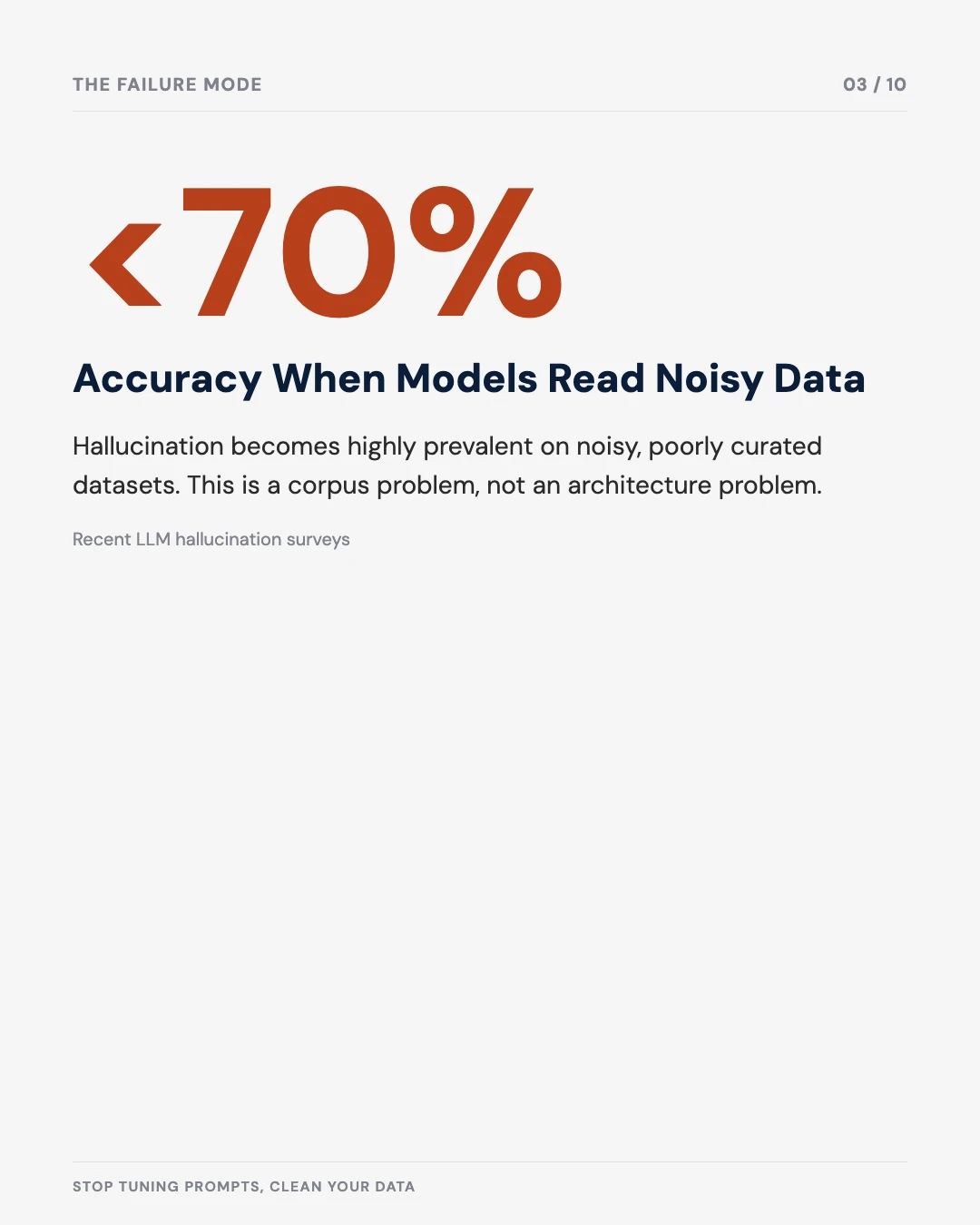
Recent surveys of hallucination in LLMs highlight that, on realistic tasks, accuracy can easily fall below 70% and hallucination becomes “highly prevalent” when models work with noisy, domain‑specific or poorly curated datasets. This is not primarily a model architecture problem; it is often a corpus curation problem that manifests as degraded reasoning.
What this means for RAG in practice
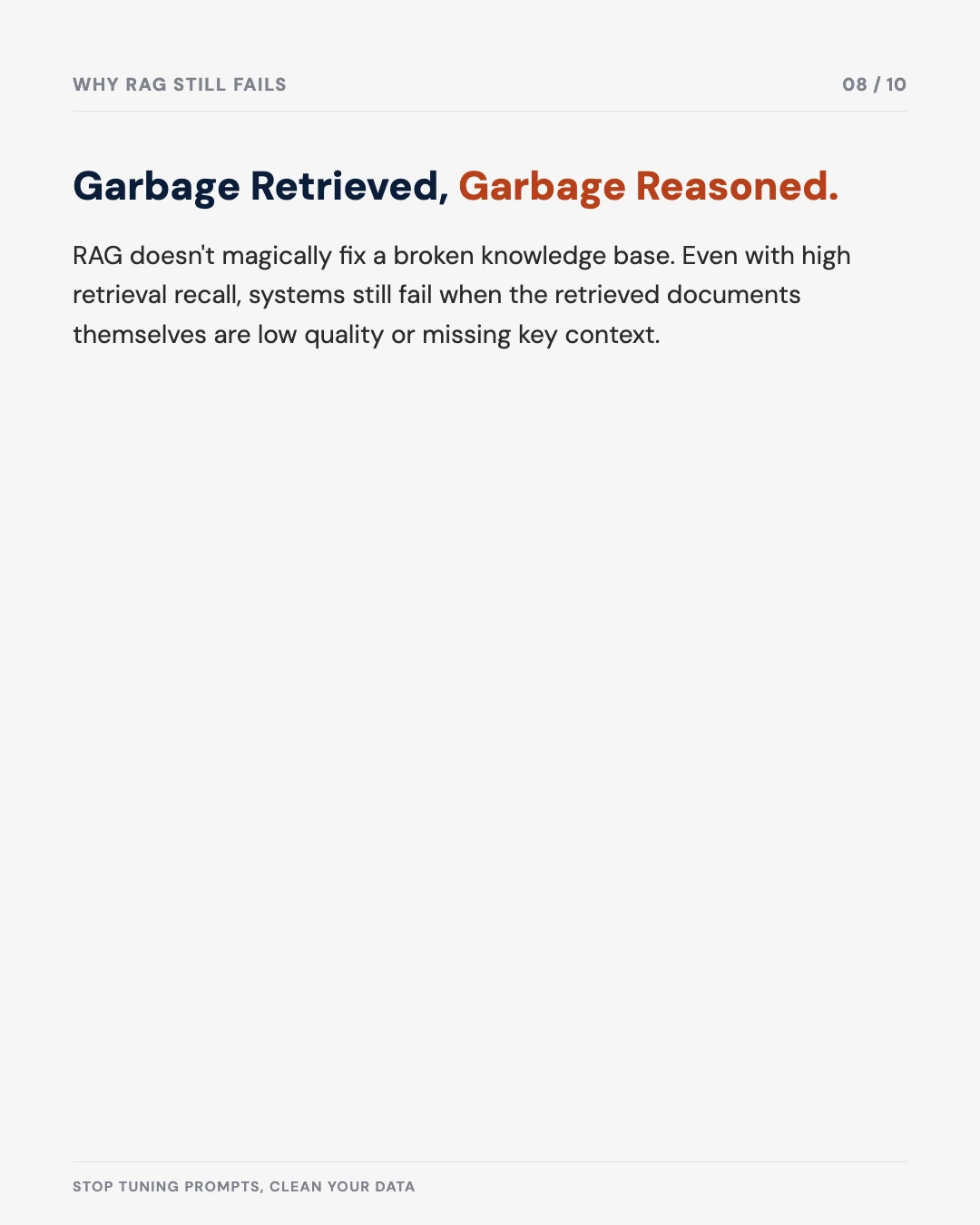
Here’s what I learned the hard way: RAG doesn’t magically fix a broken knowledge base. If you are building this for a regulated or high-stakes use case, I go deeper on what a governed RAG 2.0 build actually requires. You can have the best retrieval algorithm in the world, but if it’s pulling from outdated, inconsistent documents, your answers will be garbage. Studies confirm what we experienced:
- RAG answer quality is tightly coupled to retrieval recall and relevance; when recall is low, answer accuracy collapses no matter how capable the LLM is.
- Even with high retrieval recall, RAG systems still fail when the retrieved documents are themselves low quality or lack key contextual details.
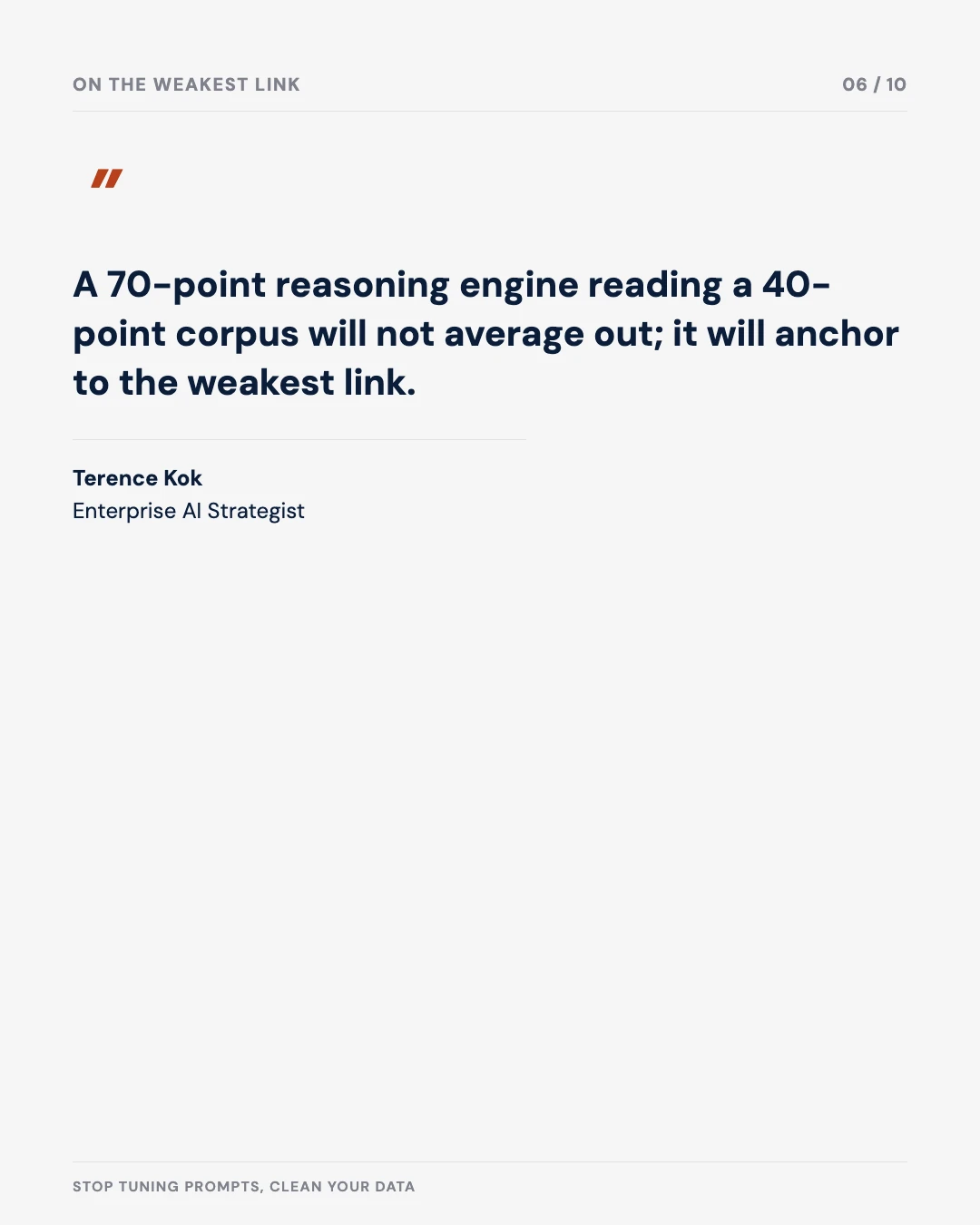
In other words, “garbage in, garbage out” becomes “garbage retrieved, garbage reasoned over”. A 70‑point reasoning engine reading a 40‑point corpus will not average out; it will anchor to the weakest link.
A 70‑point reasoning engine reading a 40‑point corpus will not average out; it will anchor to the weakest link.
Practical data quality habits that actually help LLMs
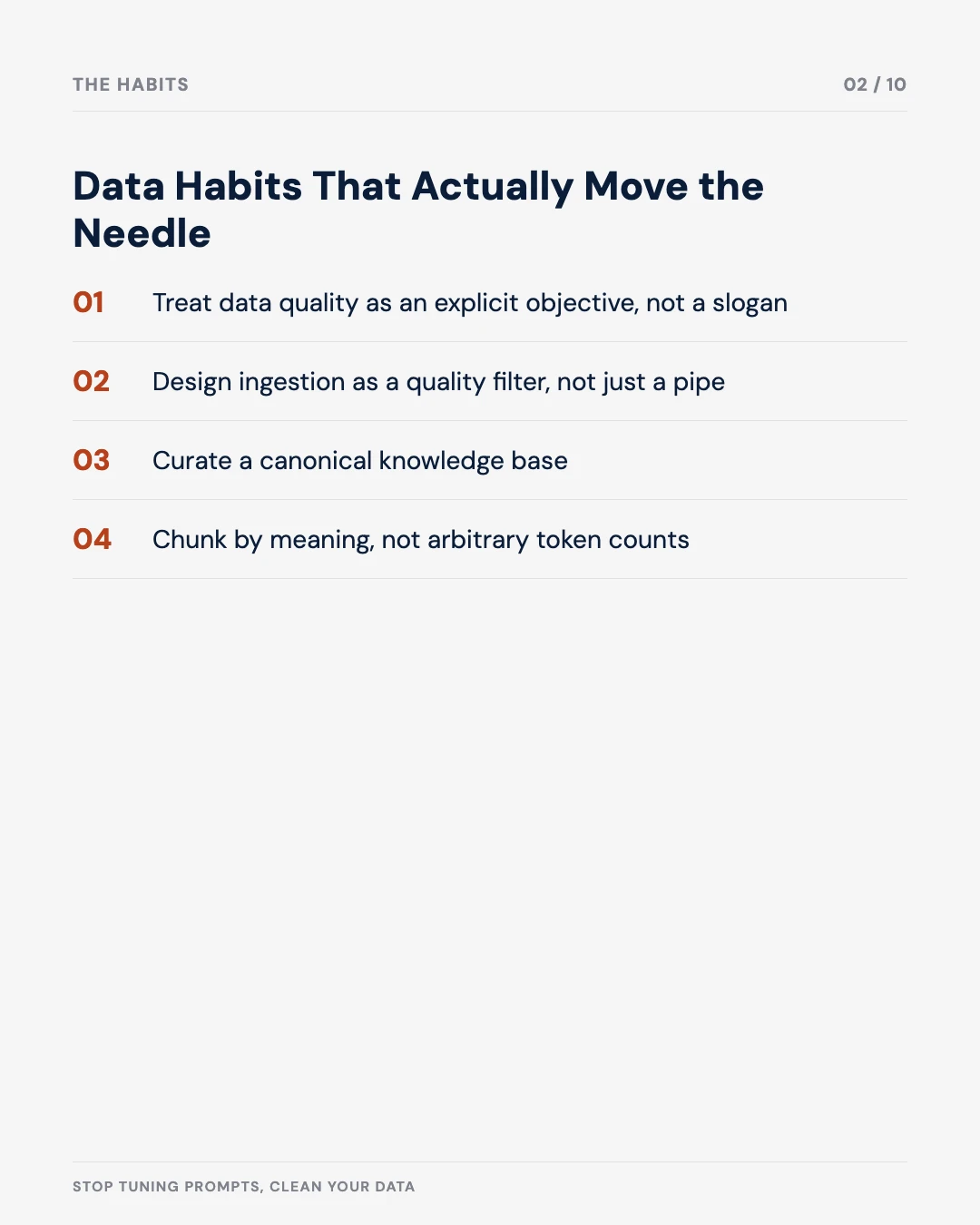
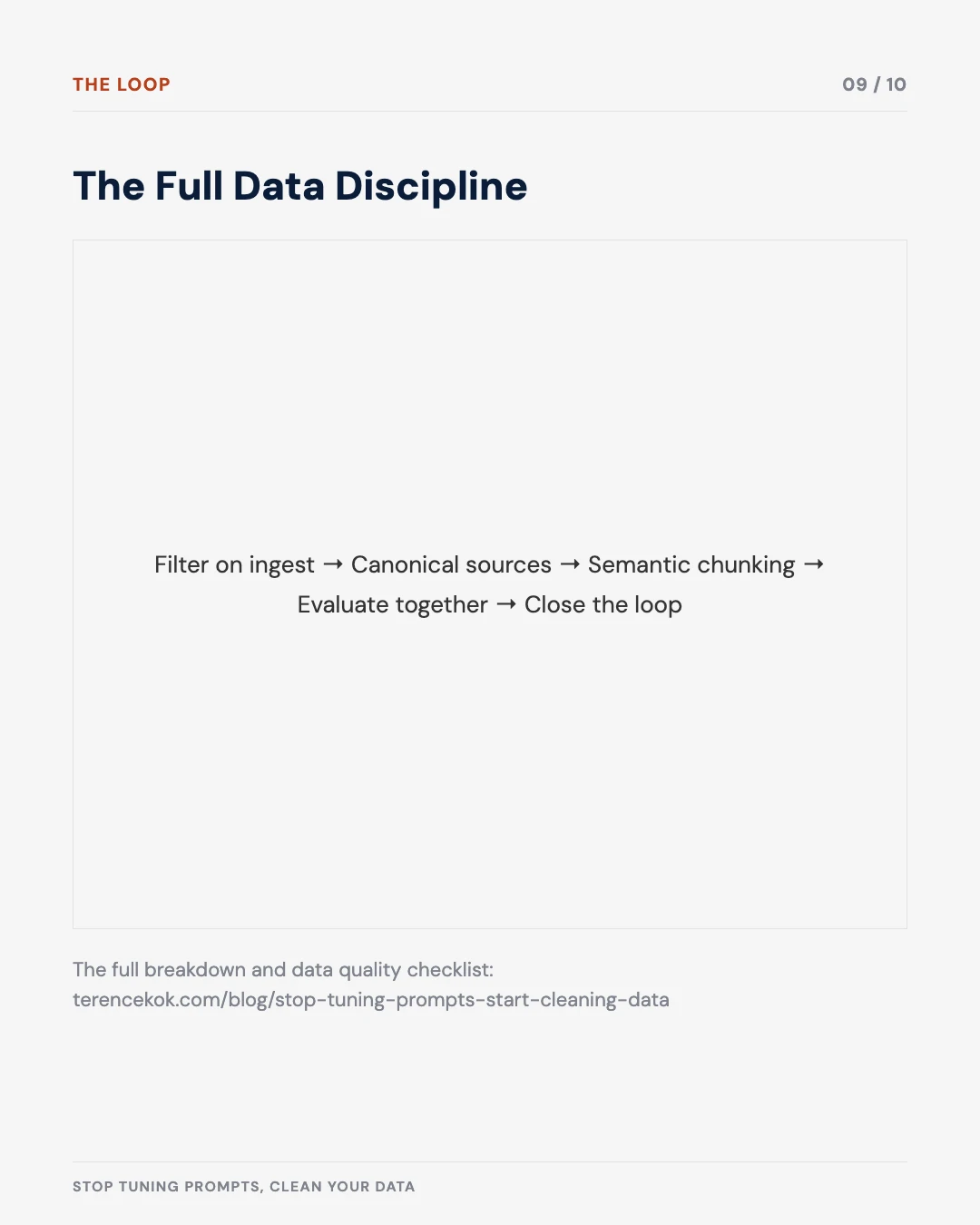
After going back to basics and cleaning up our data, here’s what actually moved the needle. These aren’t sexy AI techniques. They’re boring data hygiene practices that have empirical backing:
- Treat data quality as an explicit objective. Use dimensions such as accuracy, completeness, consistency and timeliness as measurable targets, not slogans. Define thresholds and SLAs (for example, maximum allowed missingness, freshness windows for operational content).
- Design ingestion as a quality filter, not just a pipe. Implement parsing, OCR, schema validation and metadata checks that actively reject or quarantine low‑quality content instead of silently indexing it. Track ingestion error rates and fix root causes rather than patching downstream prompts.
- Curate a canonical knowledge base. Reduce ROT (redundant, obsolete, trivial) content and converge on authoritative sources for policies, procedures, and designs. Empirical work on data quality shows that reducing redundancy and resolving conflicts directly improves downstream model robustness.
- Align chunking and structure with how humans reason. Chunk by sections and semantic units (scope, assumptions, procedure, limitations) instead of arbitrary token counts. This is closely related to a mistake I see constantly in the opposite direction: assuming a bigger context window solves what chunking discipline should. This improves retrieval relevance and reduces the risk of mixing unrelated facts in the same context window.
- Continuously evaluate retrieval and generation together. Use retrieval metrics (precision@k, recall@k, hit@k) and answer‑level factuality/hallucination metrics side by side. Recent work shows that RAG performance can vary widely even at similar retrieval recall, which means you need both high‑quality documents and high‑quality retrieval.
- Close the loop with user feedback. Capture when users flag answers as wrong, incomplete or outdated, and trace those failures back to specific documents and ingestion steps. This mirrors academic approaches that treat hallucination reduction as an iterative, data‑centric process rather than a one‑off fine‑tune.
Look, if you can’t clearly define what “good data” means for your organization, where your authoritative sources live, and how they’re maintained, then no amount of clever prompting will save you. Trust me on this one.
The best “LLM upgrade” I’ve implemented wasn’t upgrading to GPT-5 or fine-tuning a custom model. It was investing three months in cleaning our data: establishing clear schemas, curating our knowledge base, implementing strong metadata standards, and building continuous measurement loops.
Our hallucination rate dropped by 60%. Answer accuracy jumped from 65% to 89%. And we did it all without changing a single line of prompt code.
What’s been your experience? Are you spending more time on prompts or data quality? I’d love to hear what’s actually moving the needle in your RAG implementations. Drop a comment below.
Free tool
Fine-Tune vs. Retrieval-Only Data Classifier
Before you curate your canonical knowledge base, score each dataset across seven risk factors to decide what belongs in the model versus what stays behind gated retrieval.
Was this useful?