
Listen to this article
Executive Summary
AI doesn’t eliminate knowledge work. It relocates the value in it, from doing the analysis to deciding which questions and risks matter. Professionals who orchestrate AI, rather than compete with it, capture the upside.
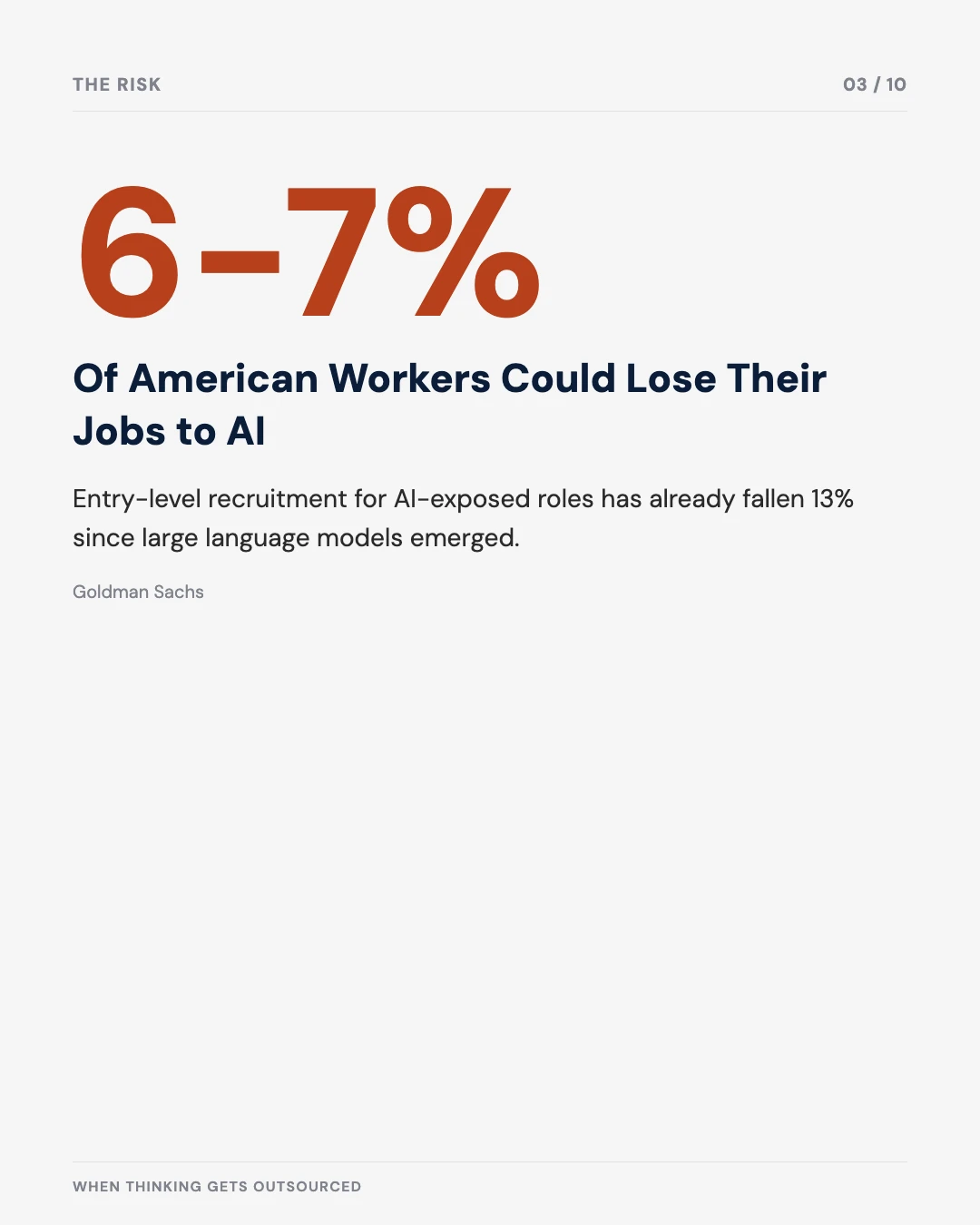
6-7%
of American workers estimated at risk of AI-driven job loss, per Goldman Sachs
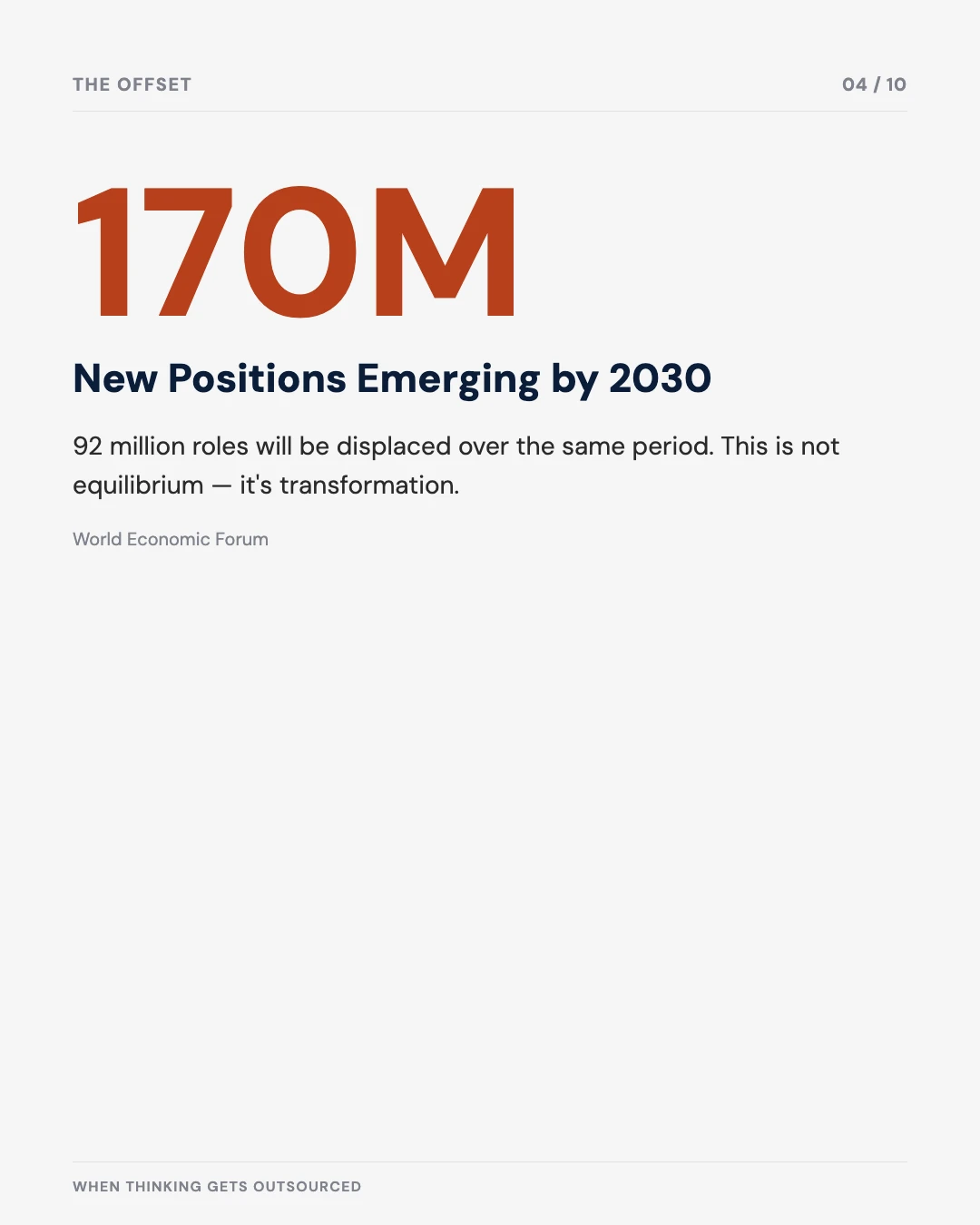
170M
new jobs projected to emerge by 2030 alongside 92 million displaced, per the World Economic Forum
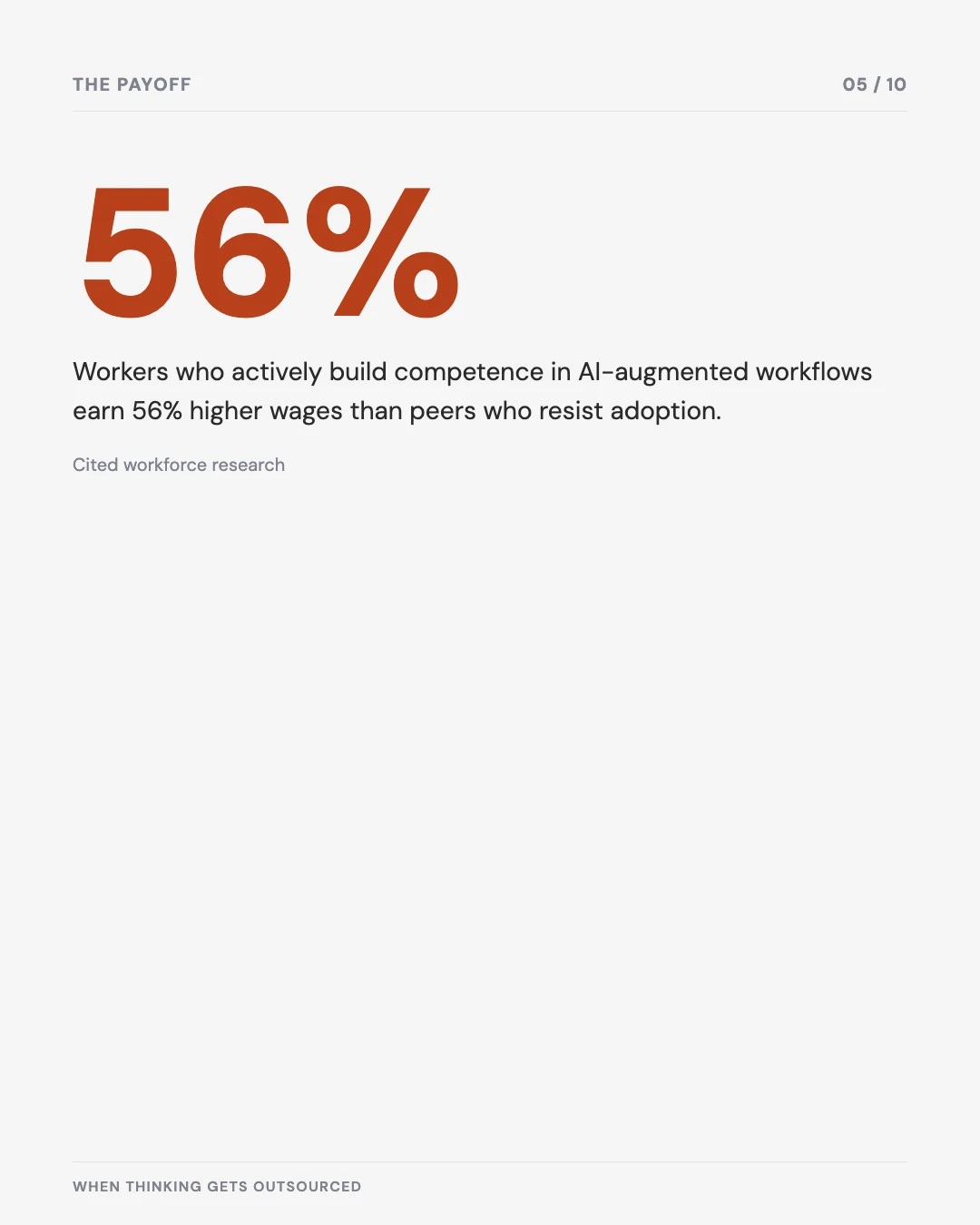
56%
higher wages earned by workers who actively build AI competence versus peers who resist
Core conclusions
- You are already outsourcing thinking: to spreadsheets, to junior staff, to assistants. AI is the next step in a trajectory that was already underway, not a break from it.
- The role that survives isn’t “the person who analyses the data,” it’s “the person who decides which questions matter.” Orchestration, not execution, is the durable skill.
- The displacement risk is real but the net effect, per the research cited here, favours those who engage with AI as a thought partner over those who resist it.
The reorientation, in ten slides
Save it, share it, or send it to the colleague who just asked if their job is safe.
Three weeks ago, a colleague of mine, someone I’ve worked with for 15 years, came into my office and quietly asked if I thought his job was safe. He’s a senior analyst, someone who built his entire career on his ability to spot patterns in data that others missed. Last month, he watched ChatGPT do in 10 minutes what used to take him two days.
He looked exhausted. “If AI can think like I think,” he said, “what am I here for?”
I didn’t have a good answer that day. But that conversation has stayed with me, because he’s asking the question that’s keeping knowledge workers up at night in 2025: What happens when thinking itself gets outsourced?
That fortress is now permeable. Artificial intelligence does not merely assist with thinking; it replicates it. And therein lies the profound anxiety that grips knowledge workers in 2025.
The statistics confirm what you may feel in your bones. Goldman Sachs estimates that 6% to 7% of American workers could lose their jobs to AI adoption. Entry-level recruitment for roles exposed to AI has declined by 13% since the emergence of large language models. McKinsey suggests that up to 30% of jobs in the United States could be significantly automated by 2030, with AI tools likely to modify 60% of existing positions. Your sector (professional services, finance, law, software development) ranks among the most vulnerable. These are not low-wage roles vulnerable to disruption. These are precisely the positions that demanded you surrender ten hours of focused cognitive work each day.
The psychological toll is not incidental. For white-collar professionals, identity and expertise are inseparable. The threat of obsolescence translates directly to a threat against self-worth, relevance, and purpose. You are experiencing not merely employment risk, but existential displacement — a specific, nameable strain I unpack in The Velocity Trap.
Yet the narrative of catastrophic disruption obscures a more complex reality. The World Economic Forum projects that whilst 92 million jobs may be displaced by 2030, 170 million new positions will simultaneously emerge. This is not equilibrium; this is transformation. 75% of knowledge workers already use AI at work, with 46% adopting it in the past 6 months. These workers report an average 66% increase in productivity, and a striking 83% report higher job satisfaction from their work.
The essential distinction is not between those who will survive and those who will not. It is between those who reconceptualise their role and those who cling to the notion that thinking can remain exclusively theirs.
The Uncomfortable Truth: You Are Already Outsourcing Thinking
Before you protest, consider this honestly: you have already begun outsourcing thinking. You delegate research to junior staff. You outsource number crunching to spreadsheets. You outsource scheduling to assistants. The question is not whether outsourcing occurs, but which thinking you will continue to monopolise and which you will surrender willingly to a more efficient system.
AI is merely the next step in this trajectory. The automation of routine analytical work (document review, pattern recognition in data, synthesis of information across multiple sources) isn’t your highest-value contribution. It never was, even if you’ve spent twenty years convincing yourself it was.
The middle-aged professional faces a particular reckoning here. You were trained during an era when access to information and the cognitive processing of that information were scarce resources. Your expertise was partly earned knowledge, partly scarcity premium. You are now watching as scarcity evaporates.
The Reorientation: From Thinking to Orchestration
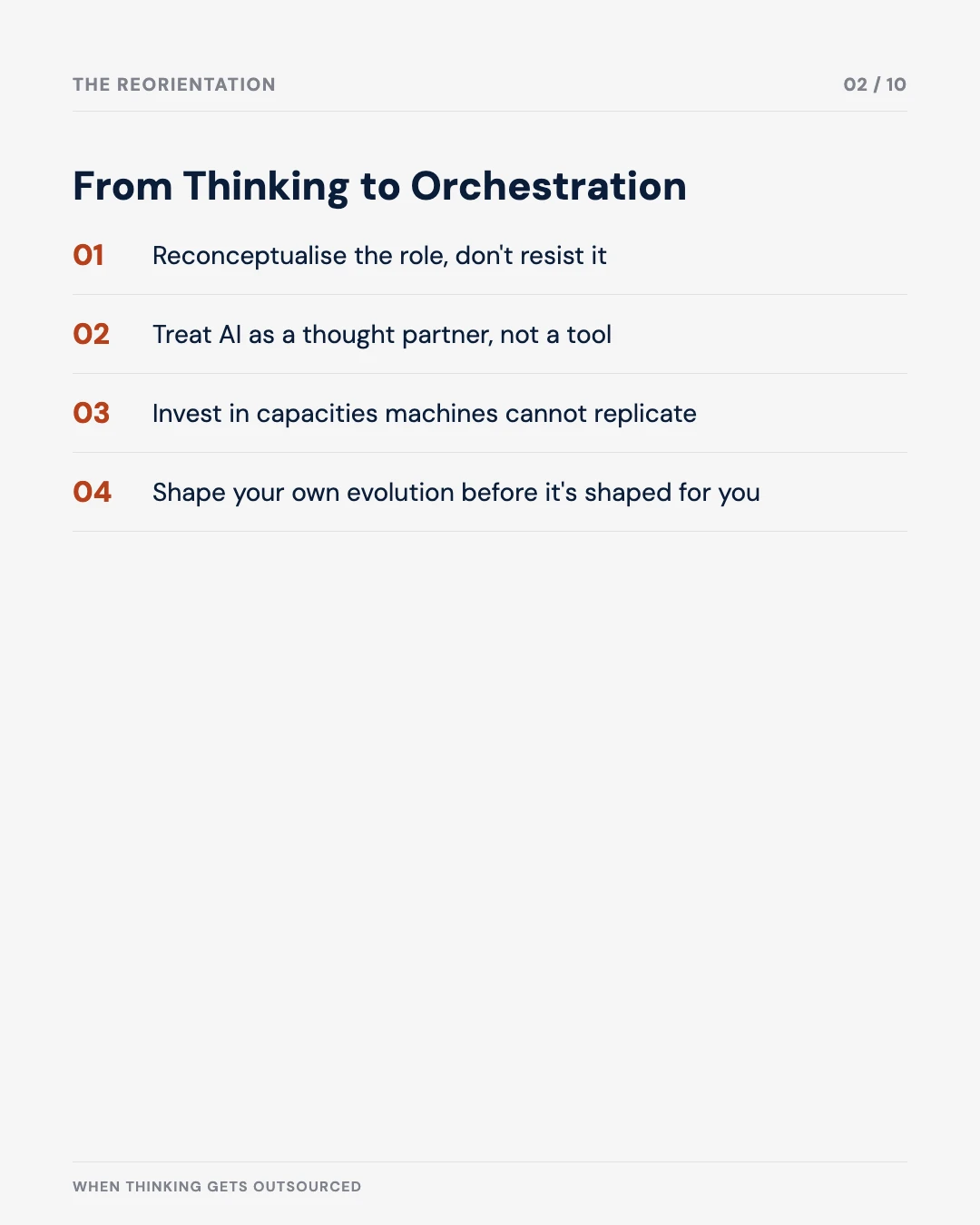
This is where the transformation begins. The future of white-collar work does not eliminate thinking; it relocates it.
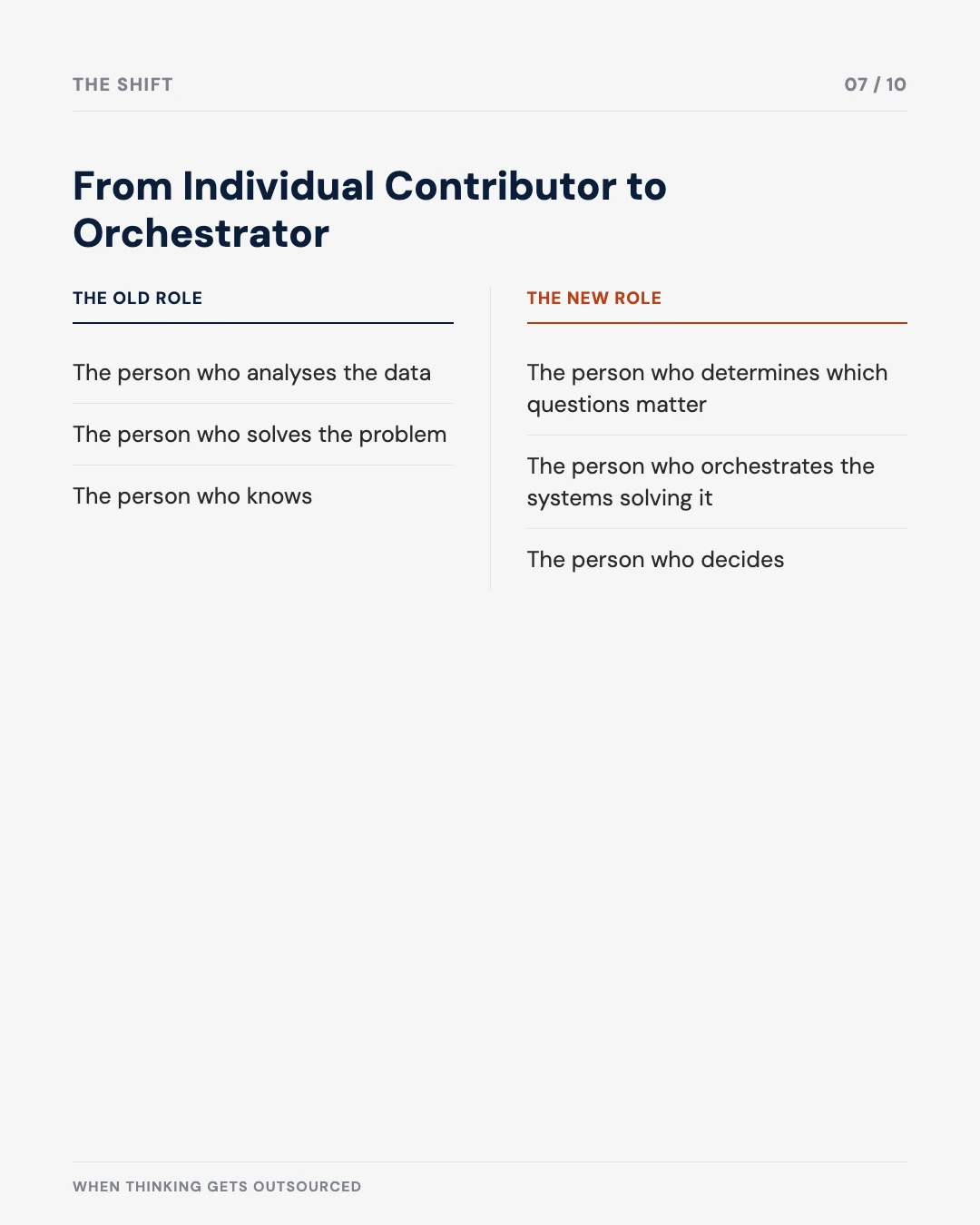
Organisations that successfully integrate AI are not replacing their senior professionals. They are redefining their roles. The transformation moves from “the person who knows” to “the person who decides.” From “the person who analyses the data” to “the person who determines which questions matter.” From “the person who solves the problem” to “the person who orchestrates the intelligent systems solving it.”
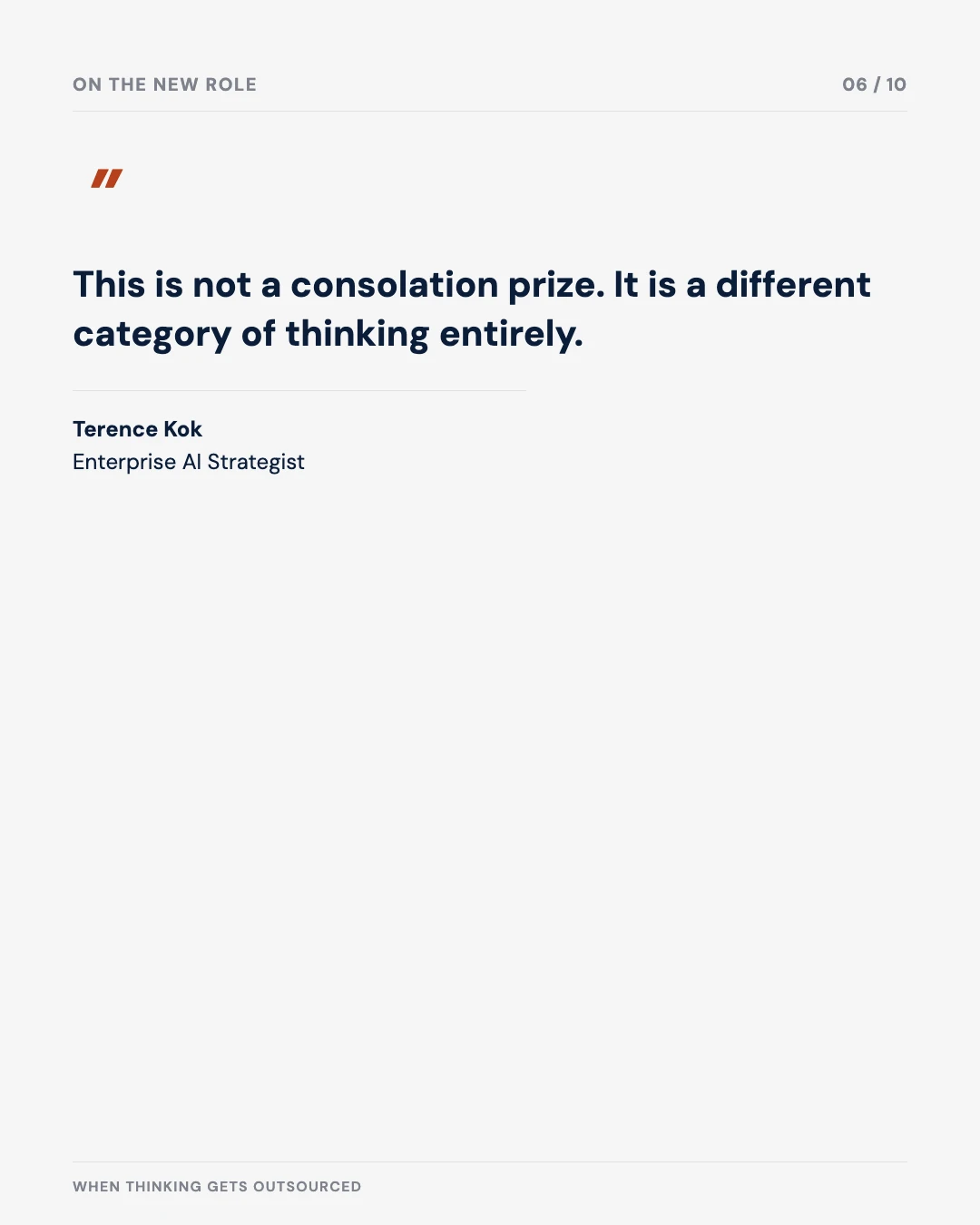
This is not a consolation prize. It is a different category of thinking entirely.
Consider what happens when you shift from individual contributor to orchestrator. Your job becomes one of context setting, intent clarification, outcome evaluation, and judgment calibration. You must prompt AI systems with sufficient specificity that their outputs prove useful. You must interpret their reasoning and identify where their literal analysis misses human nuance. You must integrate AI insights with organisational strategy, regulatory constraints, and the irreducible human dimensions of your business. You must make decisions that AI systems cannot: which risks to accept, which trade-offs serve your values, which outcomes matter beyond the optimisation algorithm.
These are not diminished demands on your intelligence. They are shifted demands.
The Identity Work: Grieving and Adapting
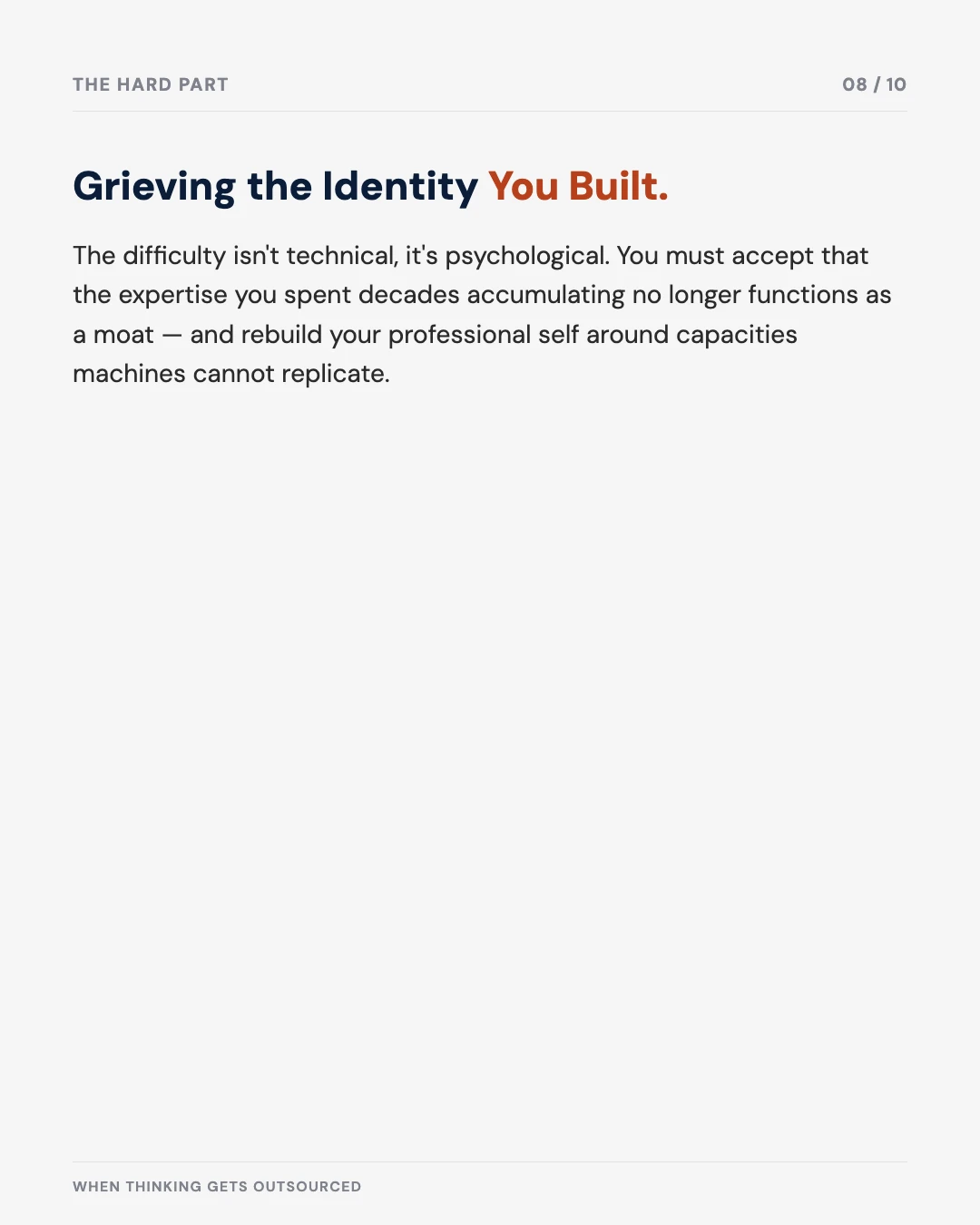
The difficulty is not technical. The difficulty is psychological. You must grieve the identity you have constructed. You must accept that the expertise you spent decades accumulating no longer functions as a moat. And you must rebuild your professional self around capacities that machines cannot replicate.
The World Economic Forum identifies three categories of future-critical skills: AI Literacy Skills, knowing how to use tools like ChatGPT and industry-specific AI platforms effectively; Uniquely Human Skills, creativity, emotional intelligence, complex communication, ethical judgment; and Adaptive Learning Capacity, the willingness and ability to continuously upskill as the landscape shifts.
Notice what is absent from this list: the technical domain knowledge you may have spent two decades perfecting. Your expertise in financial modelling, contract analysis, code architecture: these remain useful, but they’re now prerequisites rather than differentiators. The differentiator becomes your capacity to think about thinking itself. To ask better questions. To recognise where AI’s reasoning is sound and where it requires human override. To integrate mechanical intelligence with organisational purpose.
This is difficult. Many in your cohort will resist. Some will succeed anyway, coasting on reputation and institutional position. A smaller number will recognise that resistance is futile and that adaptation offers opportunity.
The Practical Reorientation: Three Concrete Steps
First, treat AI as a thought partner rather than a tool. The difference is not semantic. Tools execute your instructions. Thought partners challenge your assumptions, offer alternative framings, and force you to articulate your reasoning more precisely. Begin using AI systems daily. Learn their capabilities and limitations. Treat your interaction as collaborative dialogue rather than instruction delivery. You will discover that prompting an AI to think through a problem alongside you exposes the gaps in your own thinking.
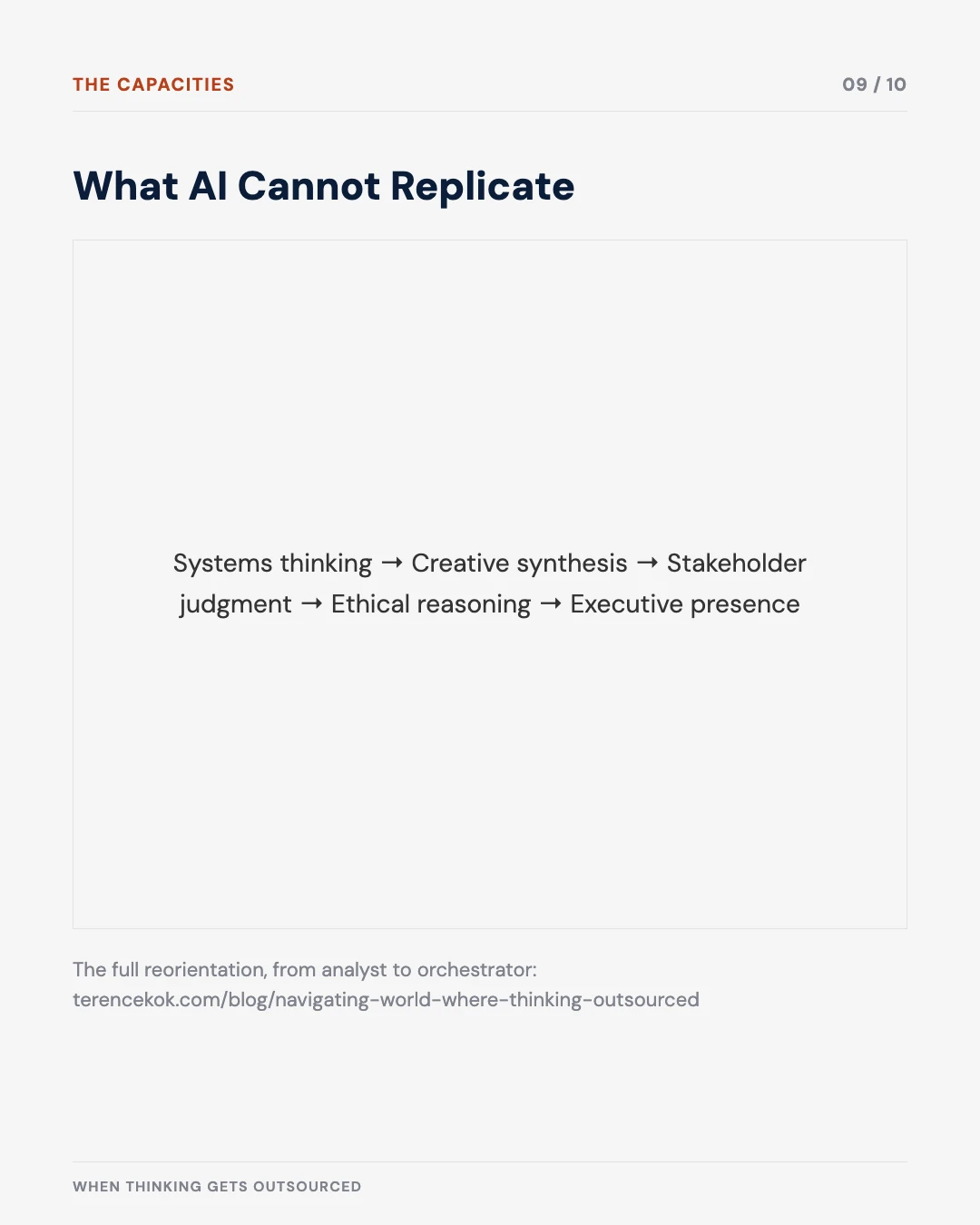
Second, invest deliberately in irreducibly human capacities. These include: systems thinking (seeing connections across domains that linear analysis misses); creative synthesis (combining disparate ideas into novel frameworks); stakeholder judgment (understanding the human dimensions of decisions that impact people); ethical reasoning (navigating decisions where multiple legitimate values conflict); and executive presence (the capacity to build confidence and alignment in organisational contexts). These cannot be outsourced to AI. They can only be deepened through practice and reflection.
Third, accept that your role will evolve, and shape that evolution rather than resisting it. The research is clear: workers who actively embrace AI adoption and build competence in AI-augmented workflows earn 56% higher wages than peers who do not. This is not a marginal advantage. Simultaneously, entry-level roles that remain AI-resistant face the highest displacement risk — though the door closing for new graduates isn’t closing everywhere. Your position as an experienced professional offers a unique advantage: you have the credibility and organisational capital to define your own evolution. Use it.
The Paradox: Why Thinking Outsourcing Might Liberate You
Here is the uncomfortable liberation embedded in all this. For decades, your career has required you to think about problems, analyse data, and generate solutions. You have done this thinking in service of organisational needs that may not have aligned with your deepest interests. You have outsourced your creativity, your strategic instincts, and your curiosity to the daily demands of execution.
AI can handle the execution. This creates unusual space. The organisations that will succeed in the next decade are those that shift their senior knowledge workers away from routine problem-solving and toward the questions that matter: What problems should we be solving? What are we not seeing? Where does our current approach rest on assumptions that are no longer valid? How do we balance efficiency with humanity? What kind of organisation do we want to become?
These questions demand the very thinking that experience provides. They reward the judgment that comes from living through change, making mistakes, and learning from them. They value the long-arc perspective that only mid-career professionals possess.
The irony is that as commodity thinking (the pattern recognition, the routine analysis, the predictable problem-solving) moves to machines, human thinking becomes more valuable, not less.
The Essential Reframe: Mortality as Motivation
This, finally, is the psychological reckoning. You are facing the obsolescence that technology eventually inflicts on every professional generation. The systems that made your expertise valuable are now rendering it less scarce. This is not unique to you. It happened to mechanical engineers when hydraulics emerged. It happened to darkroom technicians when digital photography arrived. It happens to anyone who bases their identity too narrowly on the scarcity premium of their knowledge.
The question is whether you will experience this as death or as transition.
There is real risk. Job displacement will occur. The transition will be disruptive. Some knowledge workers will not successfully navigate it. But the research suggests that the net displacement is smaller than headlines suggest and that those who engage actively with the transformation create substantial advantage.
The alternative is slower, more subtle, and ultimately more complete: the gradual erosion of relevance as you age, as your expertise becomes increasingly commoditised, as the organisation you serve discovers that AI can do what you do faster and cheaper, and as you face the choice between accepting diminished responsibility or seeking positions elsewhere.
That outcome is not prevented by resisting AI. It is accelerated by it.
The workers who will thrive in the next decade are not those who cling to the certainty that they alone can think a given problem through. They are those who accept that thinking has become distributed: between human and machine, between individual and organisation, between expertise and system. They are those who ask: Given that AI can do what I used to do, what is now my unique contribution? They are those who treat AI not as a threat to their thinking, but as an invitation to think differently.
That is not resignation. That is strategy.
So what did I tell my colleague? After weeks of thinking about it, here’s what I’ve learned:
His expertise isn’t obsolete. But his role is changing. The value isn’t in doing the analysis anymore. It’s in knowing which questions to ask, which assumptions to challenge, and which risks matter beyond what the data shows. AI can’t do that. It can only process what we give it.
I’ve watched him shift over the past few weeks. Instead of fighting with AI, he’s started using it as a thinking partner. He prompts it, challenges its assumptions, and integrates its outputs with his judgment. And you know what? He’s better than ever. Not despite AI, but because of how he’s learned to work with it.
The uncomfortable truth? This transformation isn’t optional. We’re all facing the same question he asked: What am I here for if AI can think?
My answer: You’re here to think about what thinking is needed. To ask the questions that matter. To exercise judgment where algorithms can’t. To lead, not just execute.
That’s not diminished thinking. It’s elevated thinking.
What’s your experience? Are you feeling the same anxiety? Have you found ways to redefine your value in this AI-augmented world? I’d genuinely love to hear your stories: the struggles, the breakthroughs, the questions you’re still wrestling with. Drop a comment. Let’s figure this out together.
Was this useful?