
Listen to this article
Executive Summary
Local LLM deployment is conditionally correct, not universally so. The break-even point depends on token volume, regulatory constraints, and in-house MLOps capability, and getting the conditions wrong means significant capital misallocation.
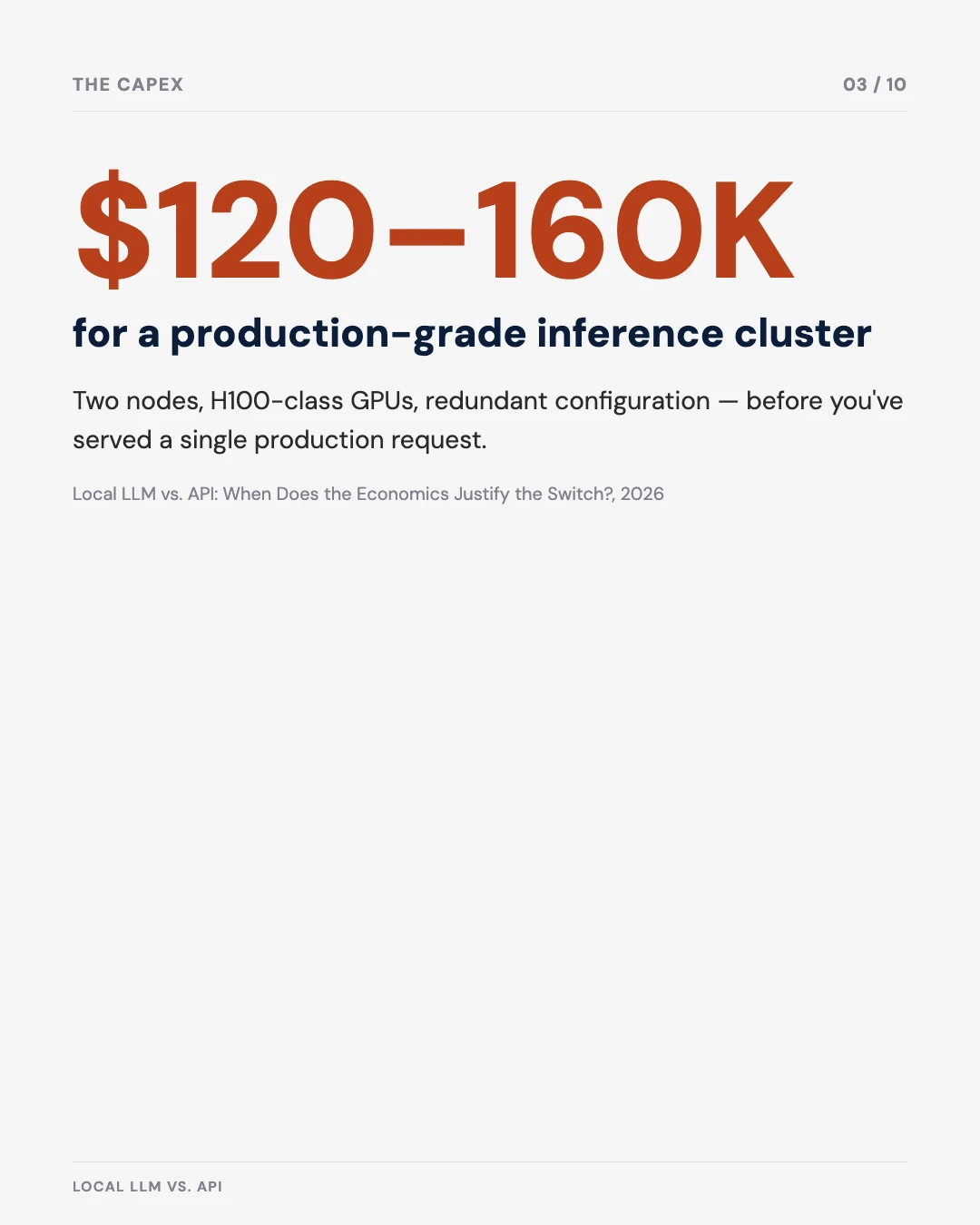
$120–160K
capital cost for a production-grade two-node, H100-class cluster running a 70B-parameter model
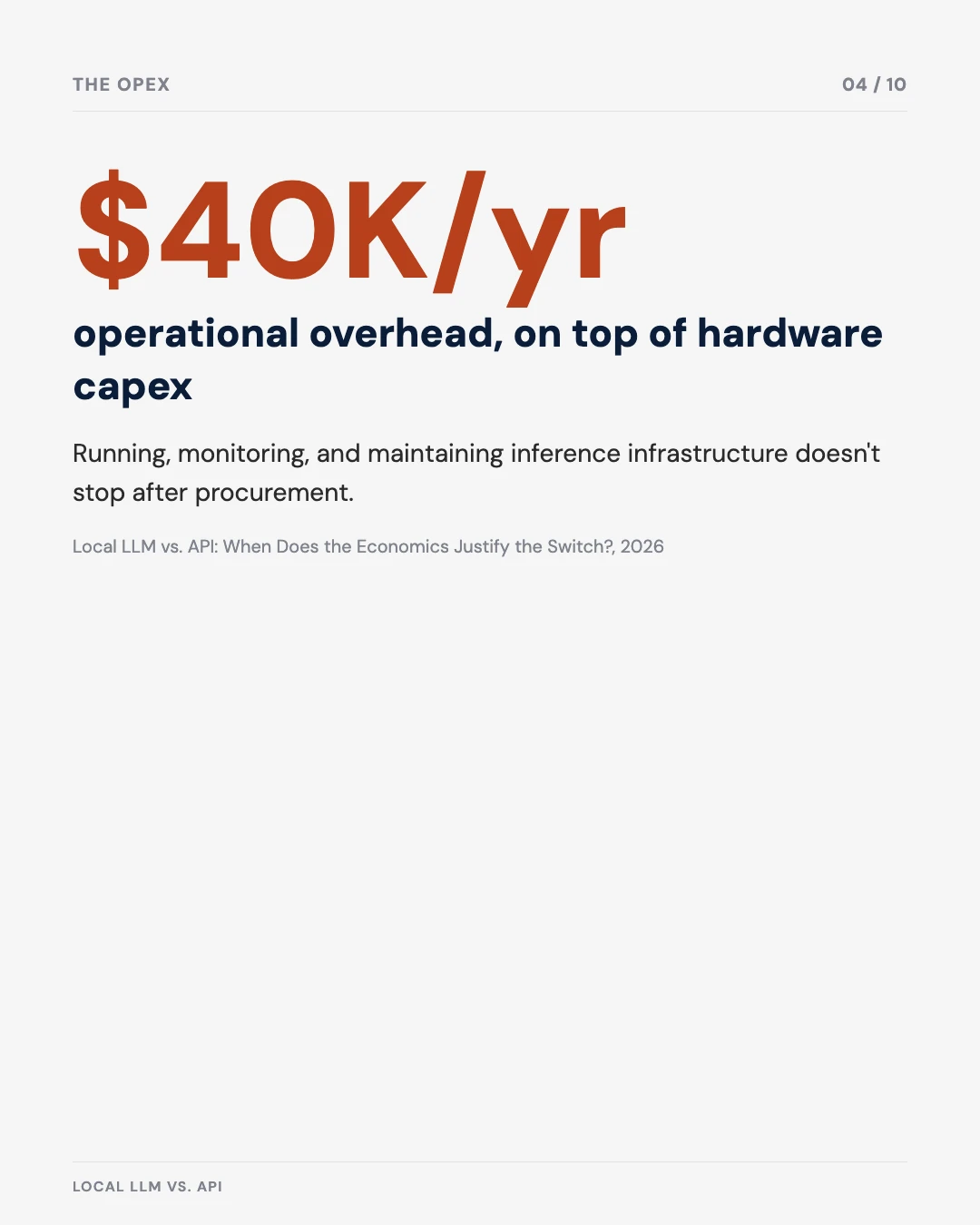
$40K/yr
approximate operational overhead on top of that capital cost
$0.003
per 1,000 tokens is the mid-tier API price this break-even math is benchmarked against
Core conclusions
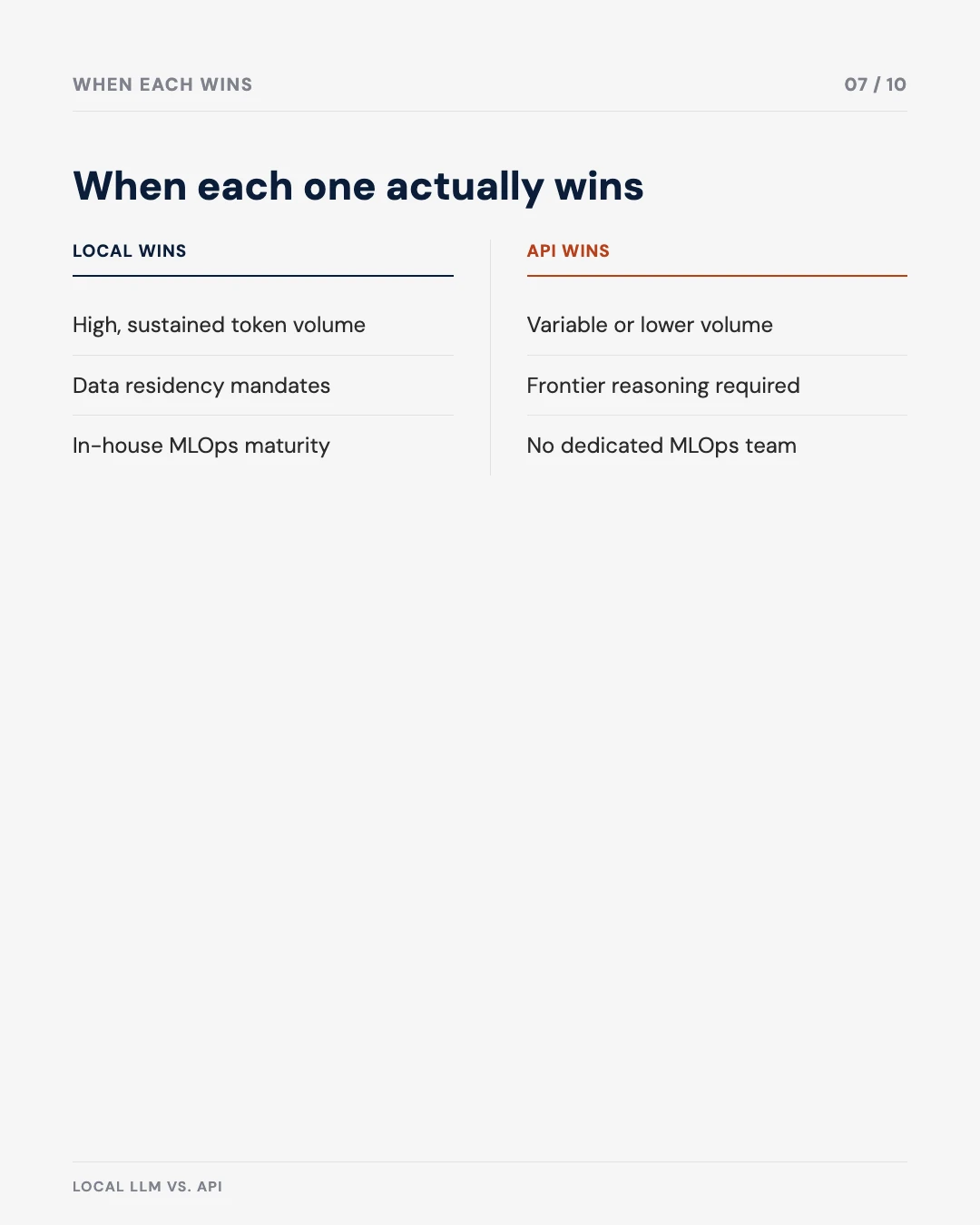
- The case for local inference holds only when several signals combine: sustained high token volume, regulatory data-residency requirements, an acceptable capability trade-off, and in-house MLOps capacity.
- A tiered routing architecture, dispatching tasks to local or API inference by complexity and sensitivity, captures the cost advantage without sacrificing capability on tasks that need frontier models.
- Local LLM infrastructure is an infrastructure investment, not an AI strategy. Below the volume threshold, managed API tiers deliver better capability per dollar.
“The move towards locally hosted large language models is gathering pace across government and enterprise. The economic argument sounds compelling, but the break-even point is more conditional than most procurement conversations acknowledge.”
As AI becomes embedded in operational workflows, we are beginning to question its dependency on frontier API providers. The conversation typically starts with a cost concern and quickly expands into data sovereignty, latency, and control.
The case for local LLM deployment is not universally correct. It is conditionally correct. The conditions are specific, and getting them wrong results in significant capital misallocation.
When the Local Deployment Argument Holds
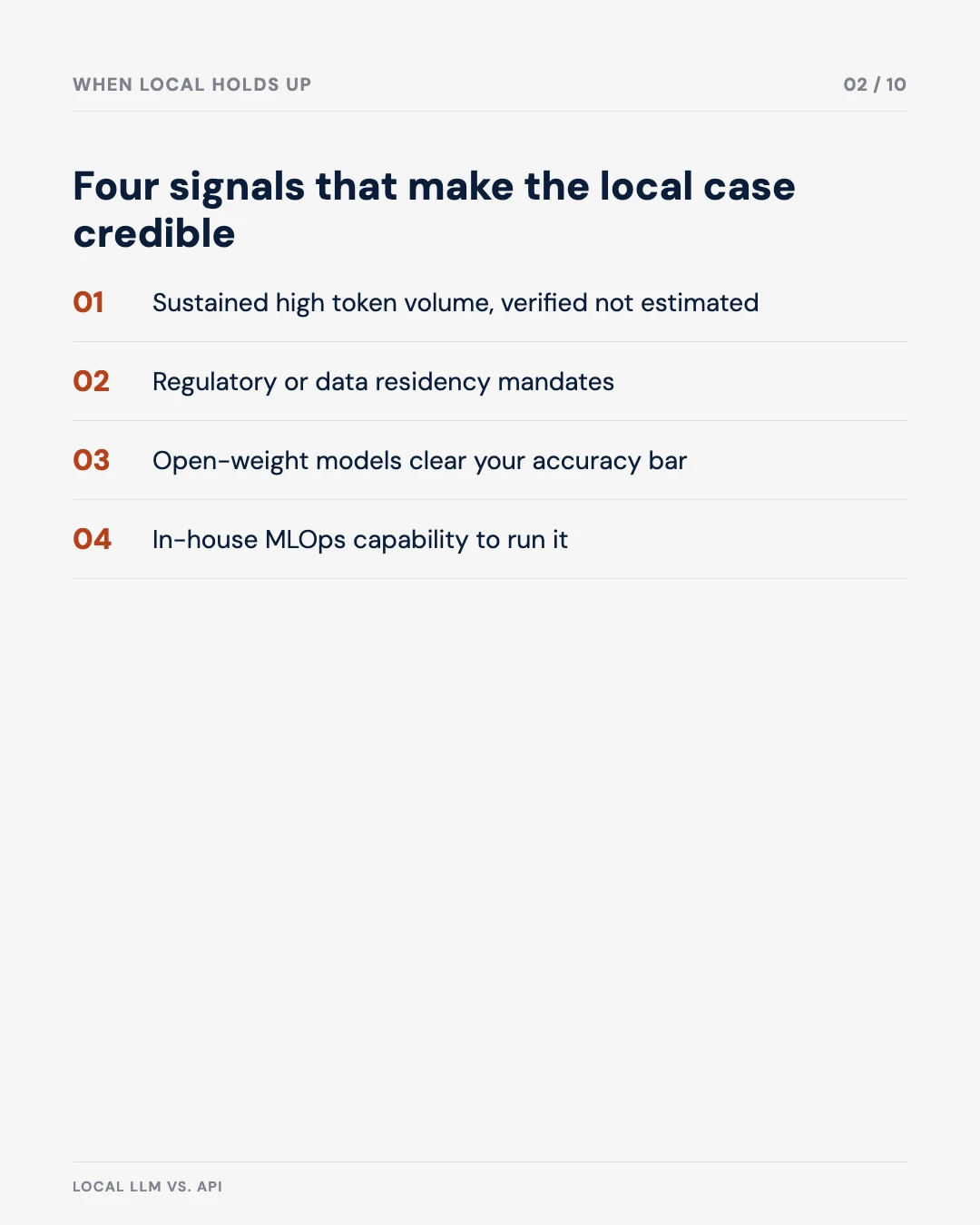
The following signals, when present in combination, indicate a credible case for local inference infrastructure:
- Sustained high token volume: Production workloads exceeding several million tokens per day, verified against actual operational data rather than headcount estimates.
- Regulatory or data classification requirements: Sector regulations or national data residency mandates that prohibit routing sensitive data through third-party APIs.
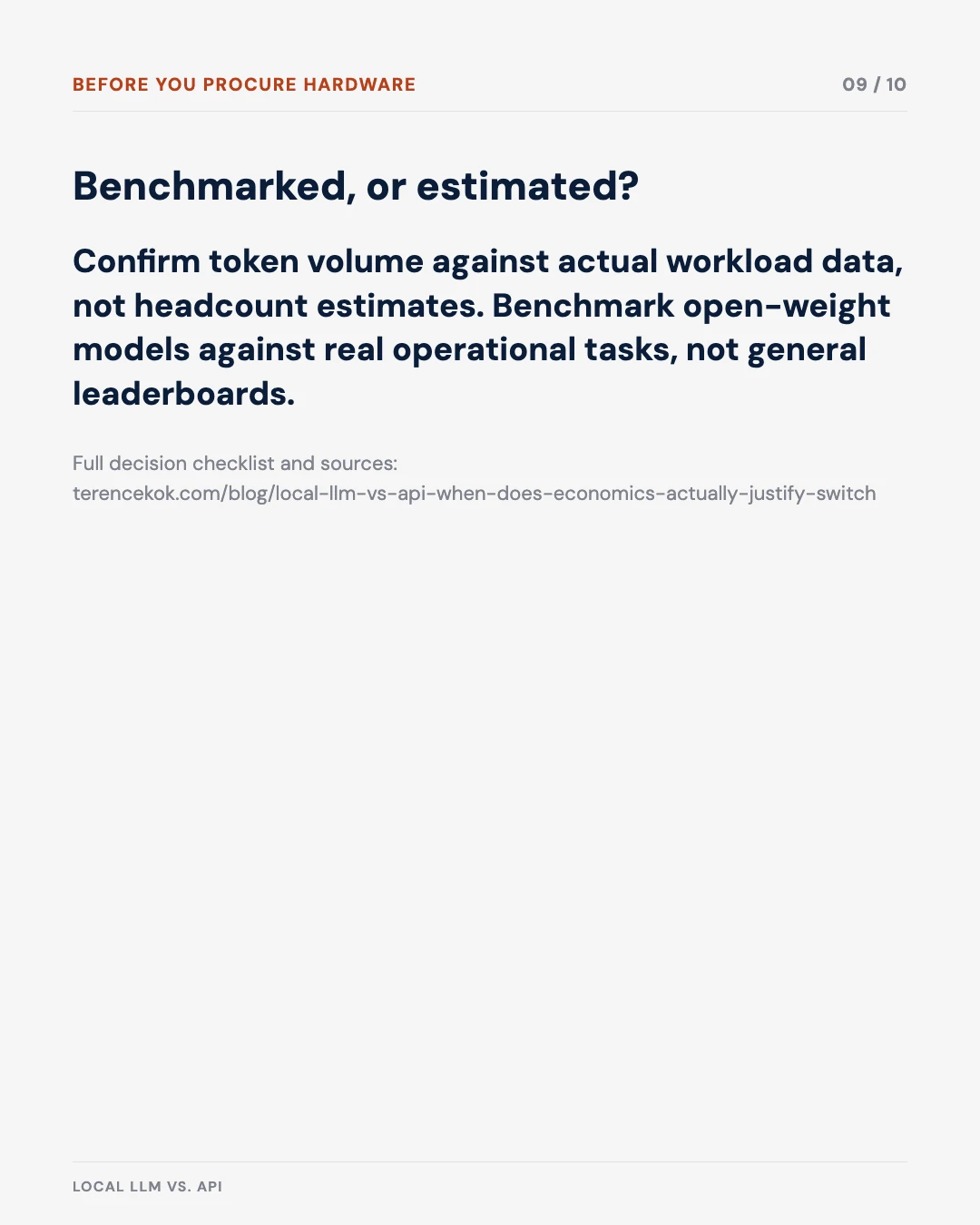
- Acceptable capability trade-off: Open-weight models meet the accuracy threshold for the specific task at the required error tolerance, confirmed by benchmark against real operational tasks, not general benchmarks.
- MLOps capability in-house: The organisation can sustain the operational overhead of running, monitoring, and maintaining inference infrastructure on a defined cadence.
The Cost Structure: Volume-Dependent Break-Even
A production-grade inference cluster capable of running a 70-billion parameter model at acceptable concurrent throughput (two nodes, H100-class GPUs with redundant configuration) carries a capital cost in the range of USD 120,000 to 160,000, plus approximately USD 40,000 per annum in operational overhead. Against mid-tier API pricing, the break-even is volume-dependent.
These figures assume mid-tier API pricing at approximately USD 0.003 per 1,000 tokens and a three-year hardware depreciation cycle. Pricing varies by provider and model tier; the ratios are illustrative of the structural relationship, not precise quotations.
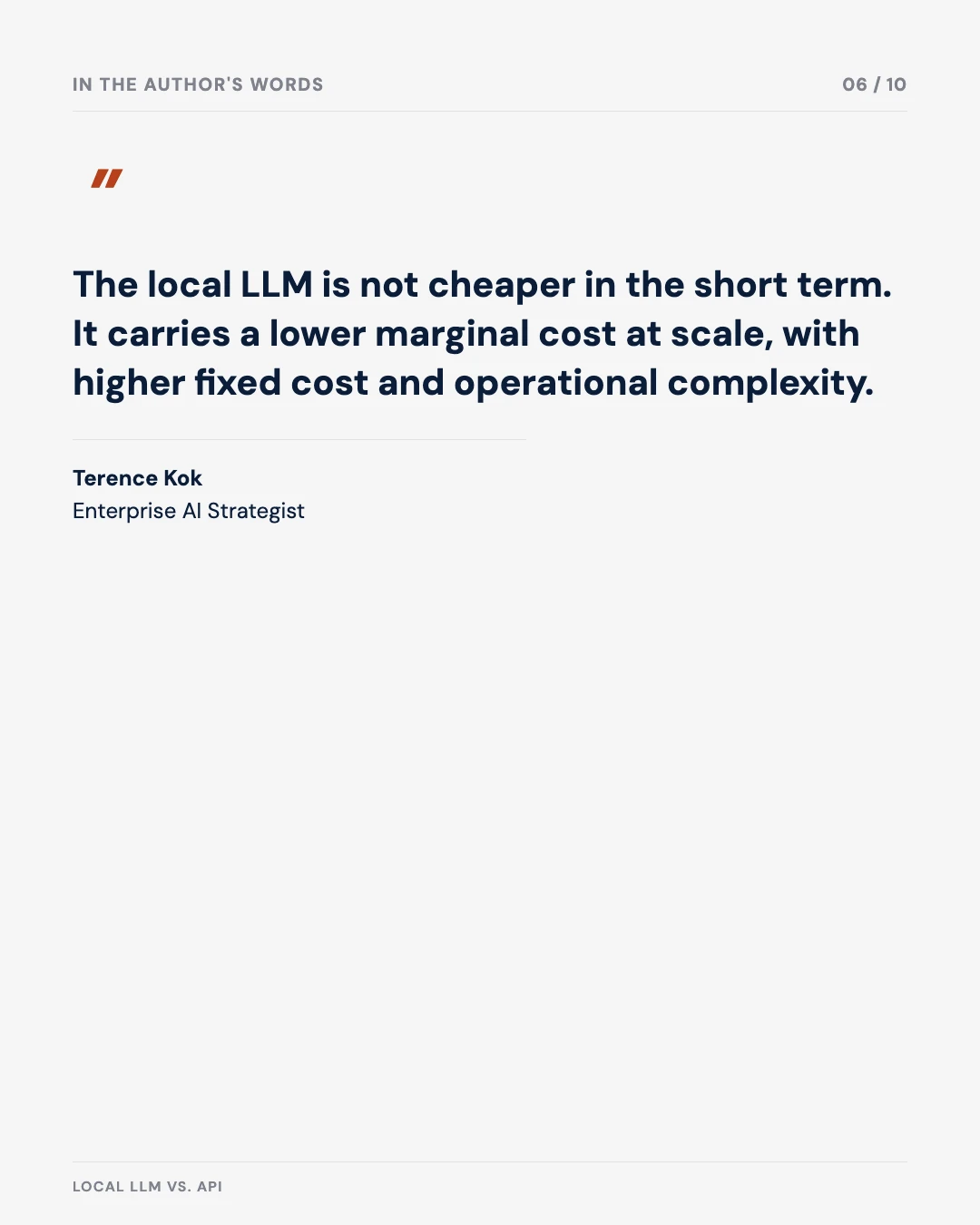
“The local LLM is not cheaper in the short term. It carries a lower marginal cost at scale, with higher fixed cost and operational complexity.”
Interactive · Break-Even Calculator
Drag the slider to your own daily token volume — local infrastructure only wins on cost past a very high threshold
View the numbers as a table
| Daily tokens | Local cluster, 3-yr | API spend, 3-yr | Cheaper option |
|---|---|---|---|
| 10M | ~$260,000 | ~$32,850 | API |
| 25M | ~$260,000 | ~$82,125 | API |
| 50M | ~$260,000 | ~$164,250 | API |
| 79M | ~$260,000 | ~$259,515 | API |
| 100M | ~$260,000 | ~$328,500 | Local |
| 150M | ~$260,000 | ~$492,750 | Local |
Assumes a $120–160K capital, $40K/yr opex two-node H100-class cluster and $0.003/1,000-token mid-tier API pricing over a three-year horizon, as set out above. Illustrative of the structural relationship, not a procurement quote — and cost is only one of the four conditions the post lays out for going local.
The Practical Path Is Tiered, Not Binary
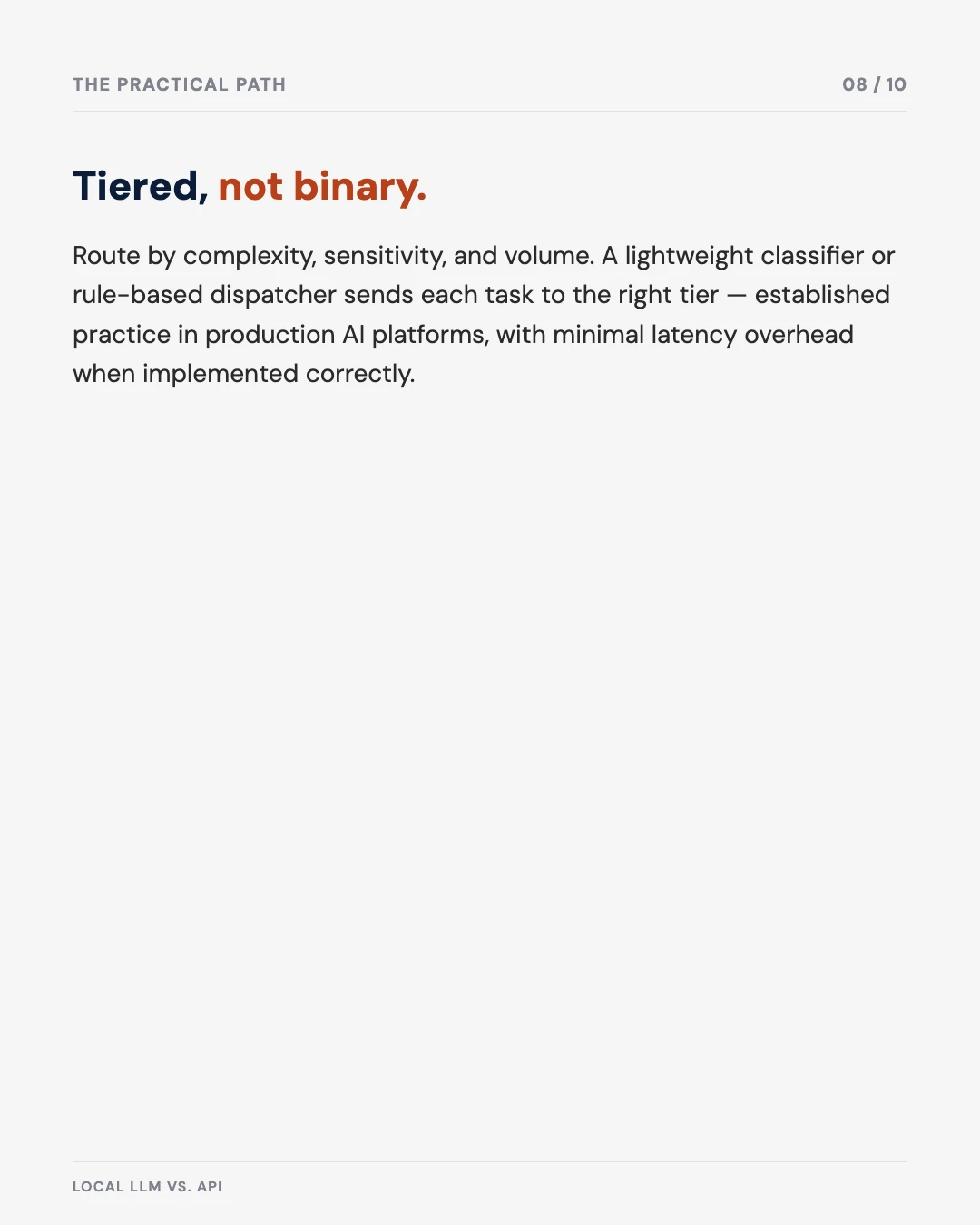
Organisations deploying AI at operational scale rarely benefit from a single-mode approach. A tiered routing architecture (in which tasks are dispatched to the appropriate inference tier based on complexity, data sensitivity, and volume characteristics) delivers the cost advantage of local inference without sacrificing capability for tasks that require it.
Routing logic between tiers can be governed by a lightweight classifier or a rule-based task dispatcher. This is established practice in production AI platforms and adds minimal latency overhead when implemented correctly.
The Model Capability Gap Is Real and Task-Specific
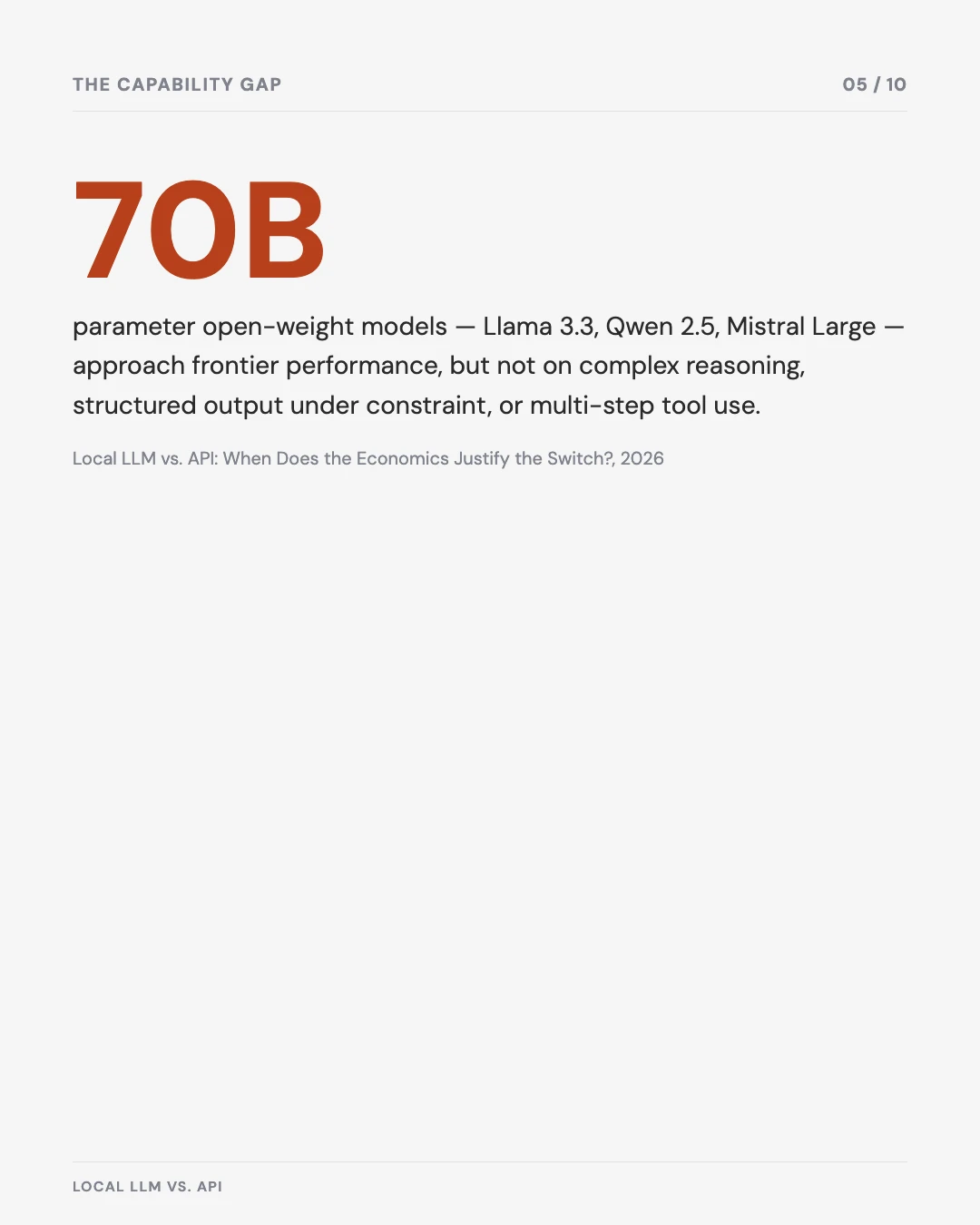
Open-weight models at the 70-billion-parameter scale (Llama 3.3 70B, Qwen 2.5 72B, Mistral Large) approach frontier-model performance across a range of tasks. They do not match it on complex reasoning chains, structured output reliability under constraint, and multi-step tool use in agentic configurations.
The relevant question is not whether the open-weight model is “good enough” in general terms, but whether it meets the accuracy threshold for the specific task at the required volume and error tolerance. This must be benchmarked against actual operational tasks before hardware procurement is initiated.
Quantisation further complicates the picture. Running Q4 or Q8 quantised models reduces VRAM requirements and extends hardware reach, but introduces measurable degradation on structured tasks. The trade-off should be validated per use case, not assumed.
Decision Checklist Before Committing to Local Inference Infrastructure
- Confirm token volume projections against actual or piloted workload data, not estimates derived from headcount or process counts.
- Assess whether regulatory or data classification requirements mandate local processing: if so, cost is a secondary consideration.
- Benchmark candidate open-weight models against representative samples of actual operational tasks at the required accuracy threshold.
- Model the full TCO inclusive of hardware depreciation, MLOps staffing, power, and model lifecycle management, not hardware cost alone.
- Design for a tiered architecture from the outset; a local-only strategy sacrifices capability on tasks that warrant frontier inference.
- Validate quantisation trade-offs for each distinct task type before selecting a serving configuration.
- Define a performance baseline and review cadence before go-live: local models require active governance, unlike managed API services.
The decision to invest in local LLM infrastructure is an infrastructure investment, not an AI strategy in itself. It is justified at scale, under specific regulatory conditions, or where agentic workflow economics make API dependency structurally unviable.
For organisations below the volume threshold, managed API tiers (including private deployment options now offered by most major providers) deliver better capability per dollar of expenditure.
The transition to local inference should be planned against confirmed operational requirements and validated model performance, not against the prospect of savings that only materialise at volumes the programme has not yet demonstrated.
The math, in ten slides
Save it before your next infrastructure procurement conversation.
Free tool
AI Build vs. Buy vs. Partner
The local-versus-API decision is a build-versus-buy decision in disguise — run it through seven criteria including data sensitivity and maintenance appetite before you procure hardware.
Free tool
AI ROI Calculator
Model the local-versus-API financial case against your own team size and tech stack before you commit to either path.
Was this useful?