
Listen to this article
Executive Summary
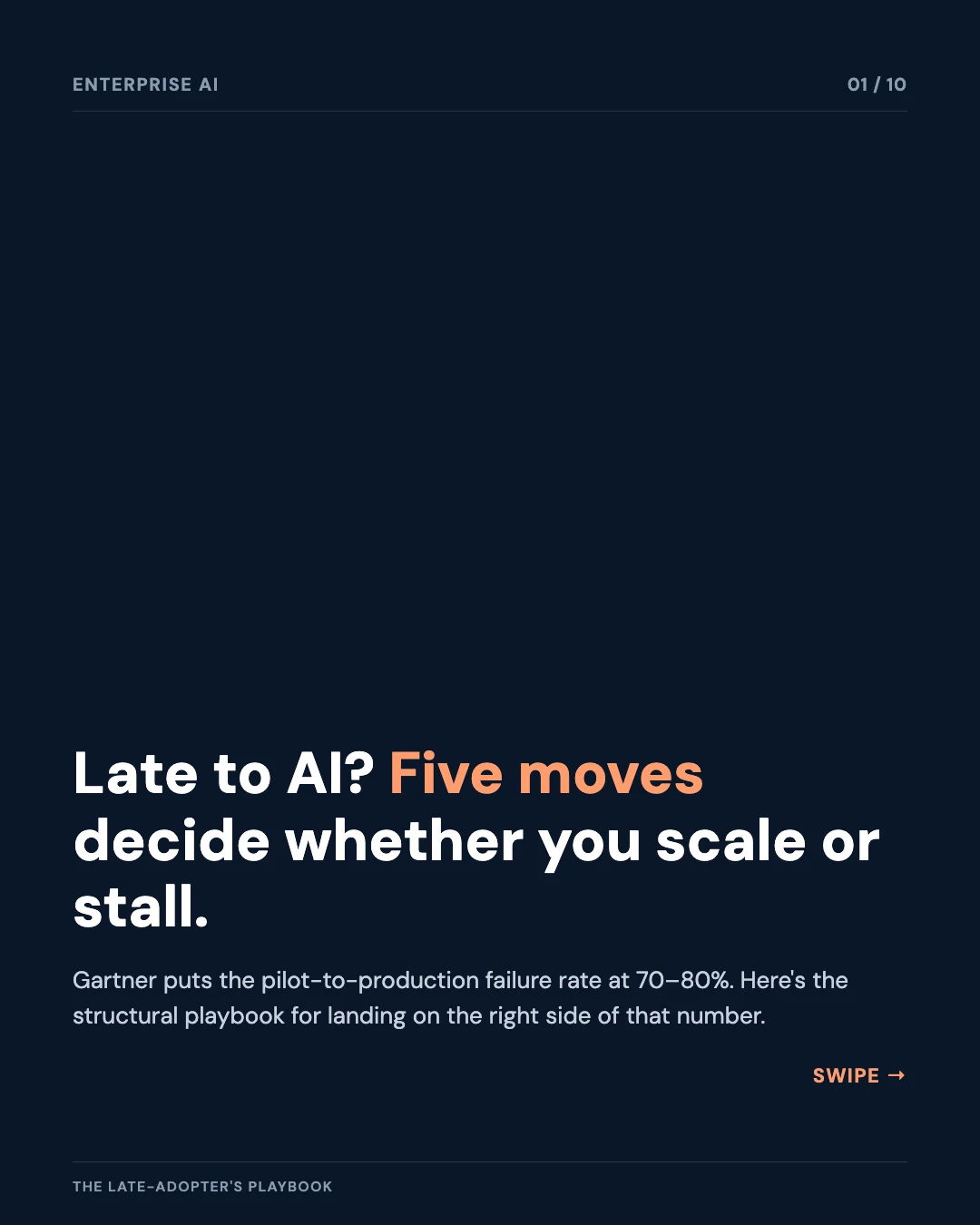
Most companies starting AI for the first time in 2026 pick their tools before they set any rules. Gartner’s data shows that this backwards order is why 70 to 80% of AI test projects never make it into real use. The fix is not a faster rollout. It is five key decisions made before you sign anything.
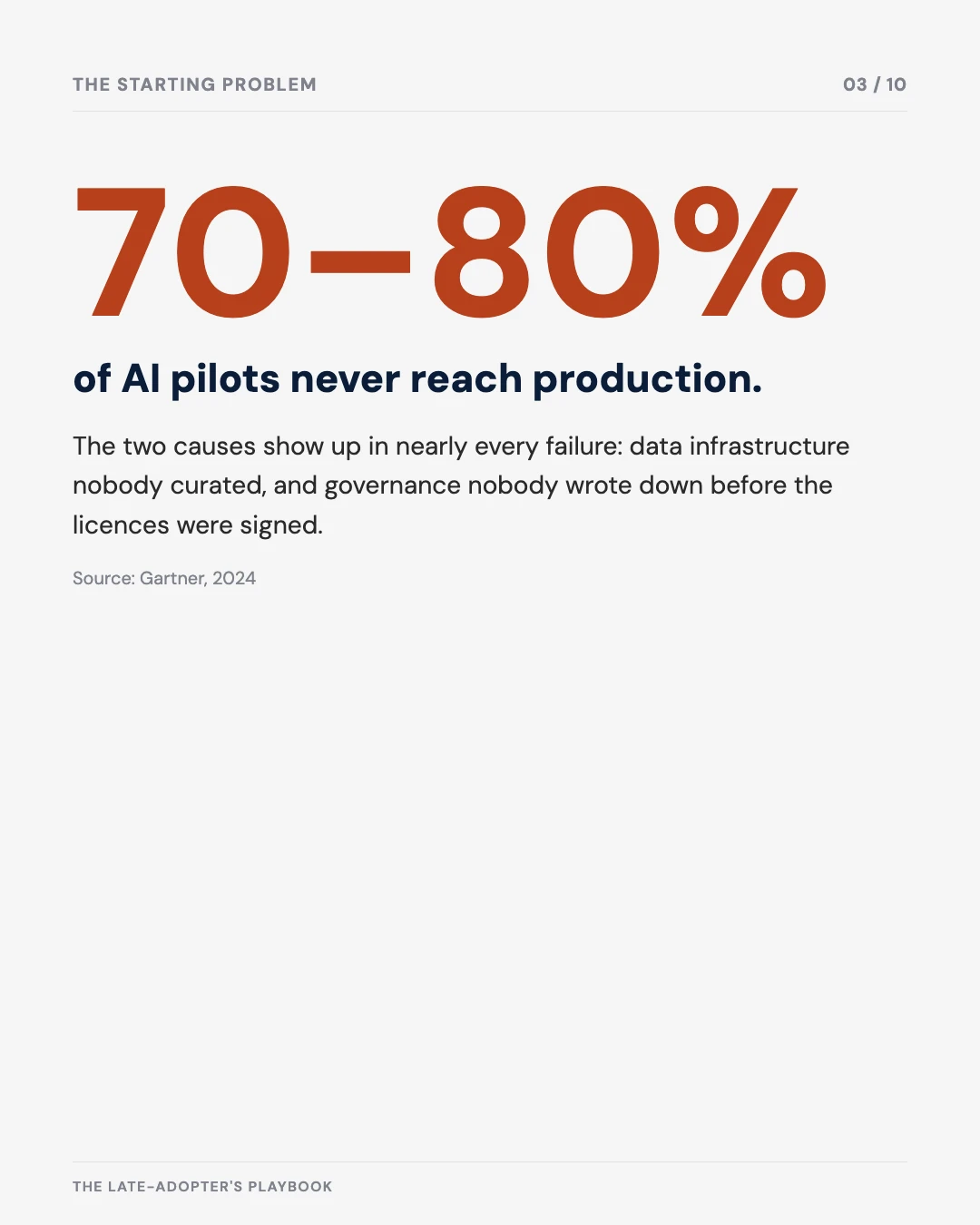
70-80%
of AI test projects fail to reach real use, because the data was messy and no rules were in place
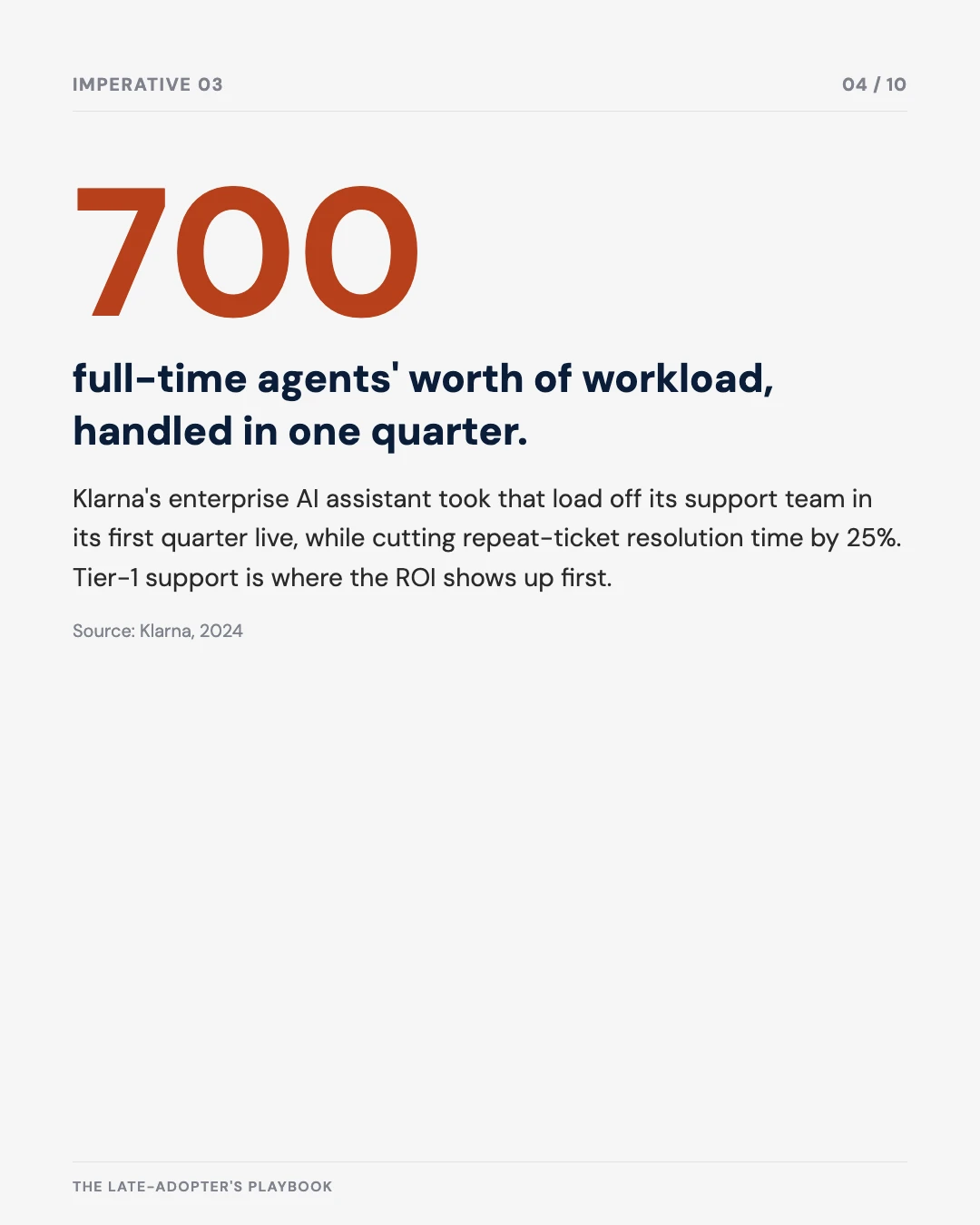
700
full-time workers’ worth of work handled by Klarna’s AI helper in its first three months live
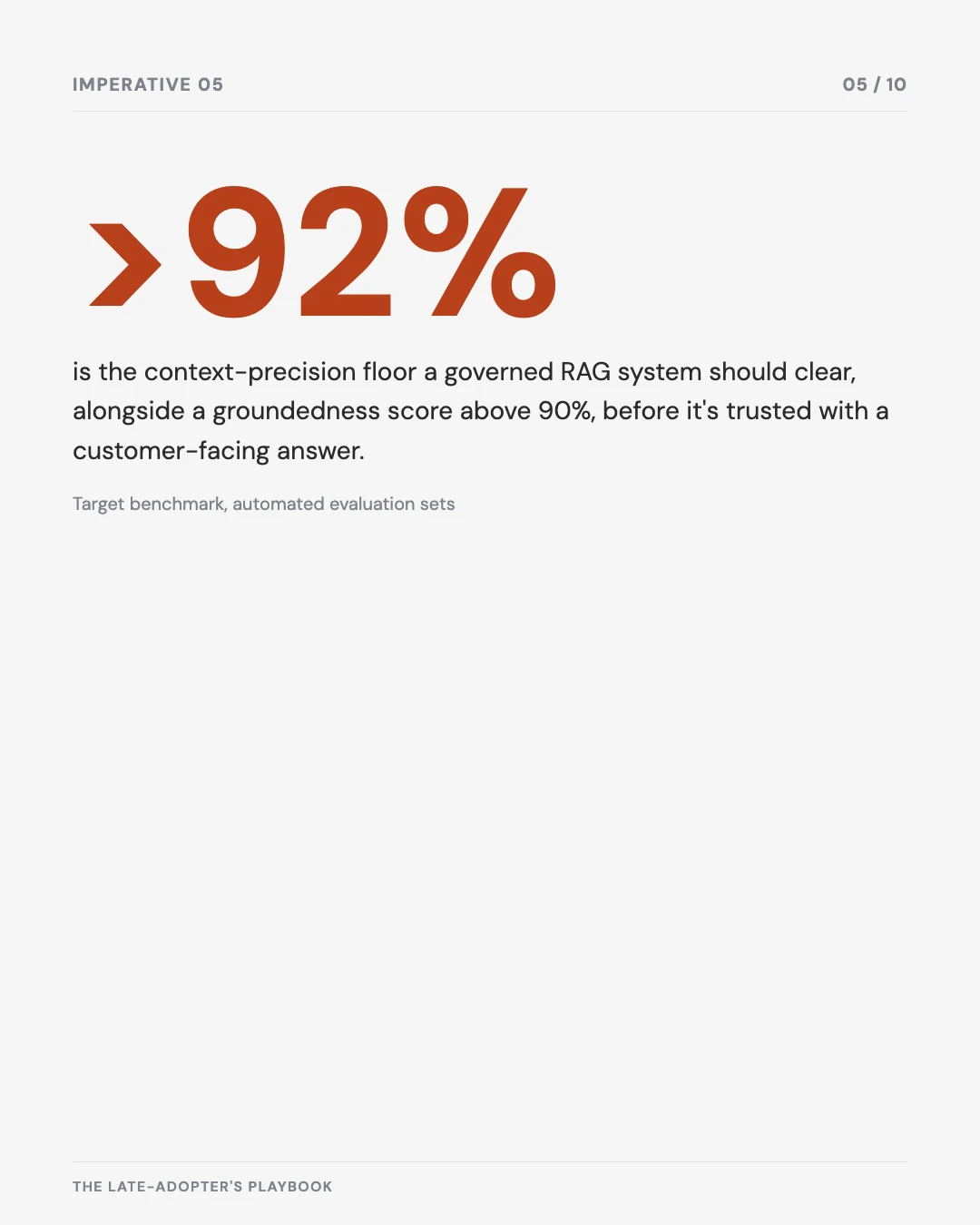
>92%
the lowest accuracy score a well-run AI search system should hit before it goes live
>90%
the target score for how well AI answers stick to real, true facts, checked across many tests
Core conclusions
- Rules and checks come before you buy anything, not after the test project is already running. Every idea for using AI should pass a formal risk check before any testing starts.
- Searching through clean, well-organised data beats retraining a whole AI model, on both cost and speed, for almost every business use. The catch: the data has to be cleaned first, and that work has to compete for budget with flashier features.
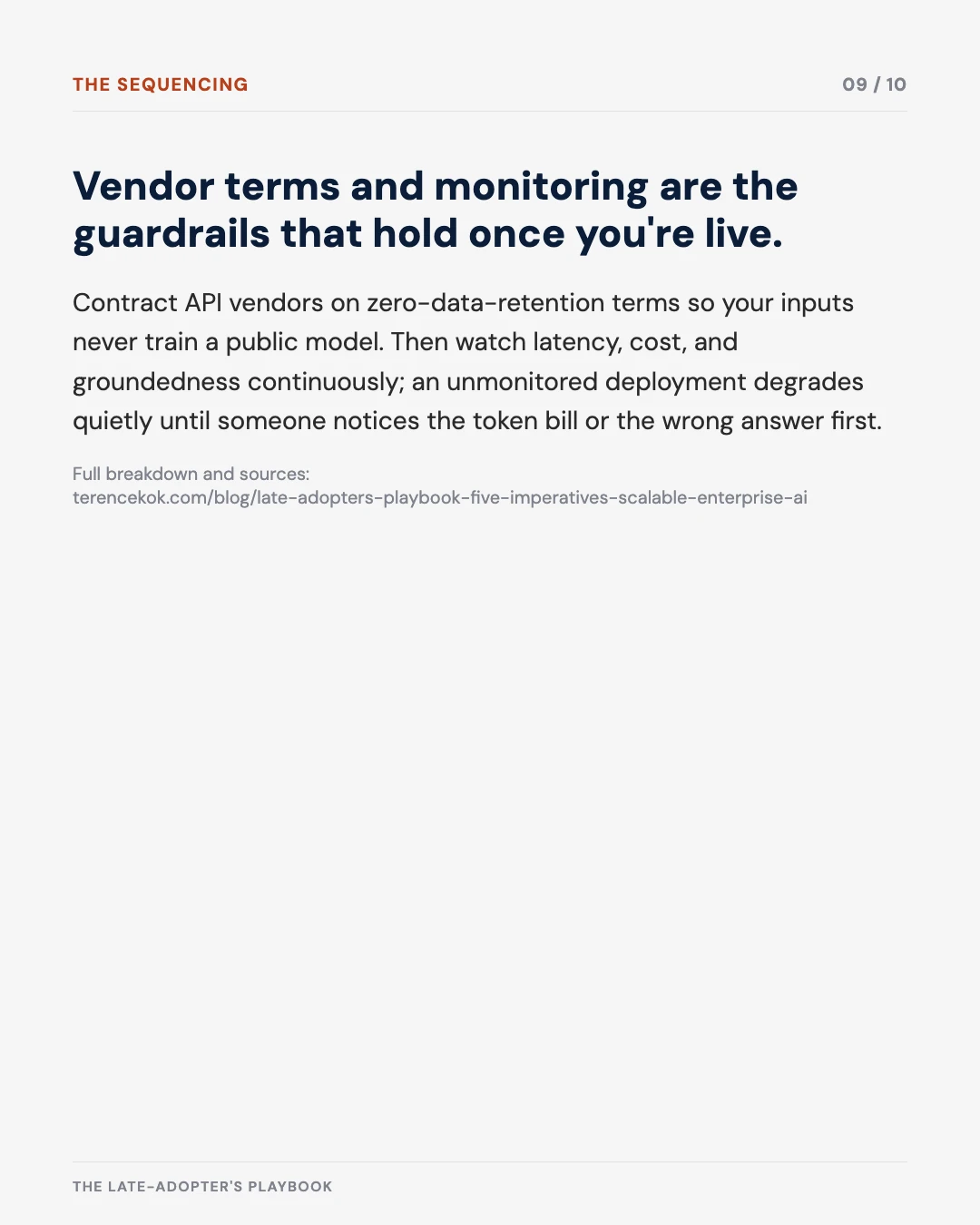
- Supplier contracts and ongoing monitoring are the safety nets that stop a working AI tool from turning into a problem six months later.
The playbook, in ten slides
Save it, share it, or send it to whoever is approving the AI budget.
The failure pattern this playbook helps you avoid
Gartner says that 70 to 80% of companies that start AI test projects in 2026 never turn them into real, working tools. Almost every failed case has the same two causes: messy data nobody cleaned up, and no rules written down before the tools arrived. If your company is starting AI later than your competitors, the natural urge is to catch up fast — buy a platform, run a quick test, show a demo. That urge points the wrong way. Late starters who jump straight into testing tools face the same 70-to-80% failure odds as everyone else who did that. The companies already ahead did not get there by moving faster. They got there by building the right structure first.
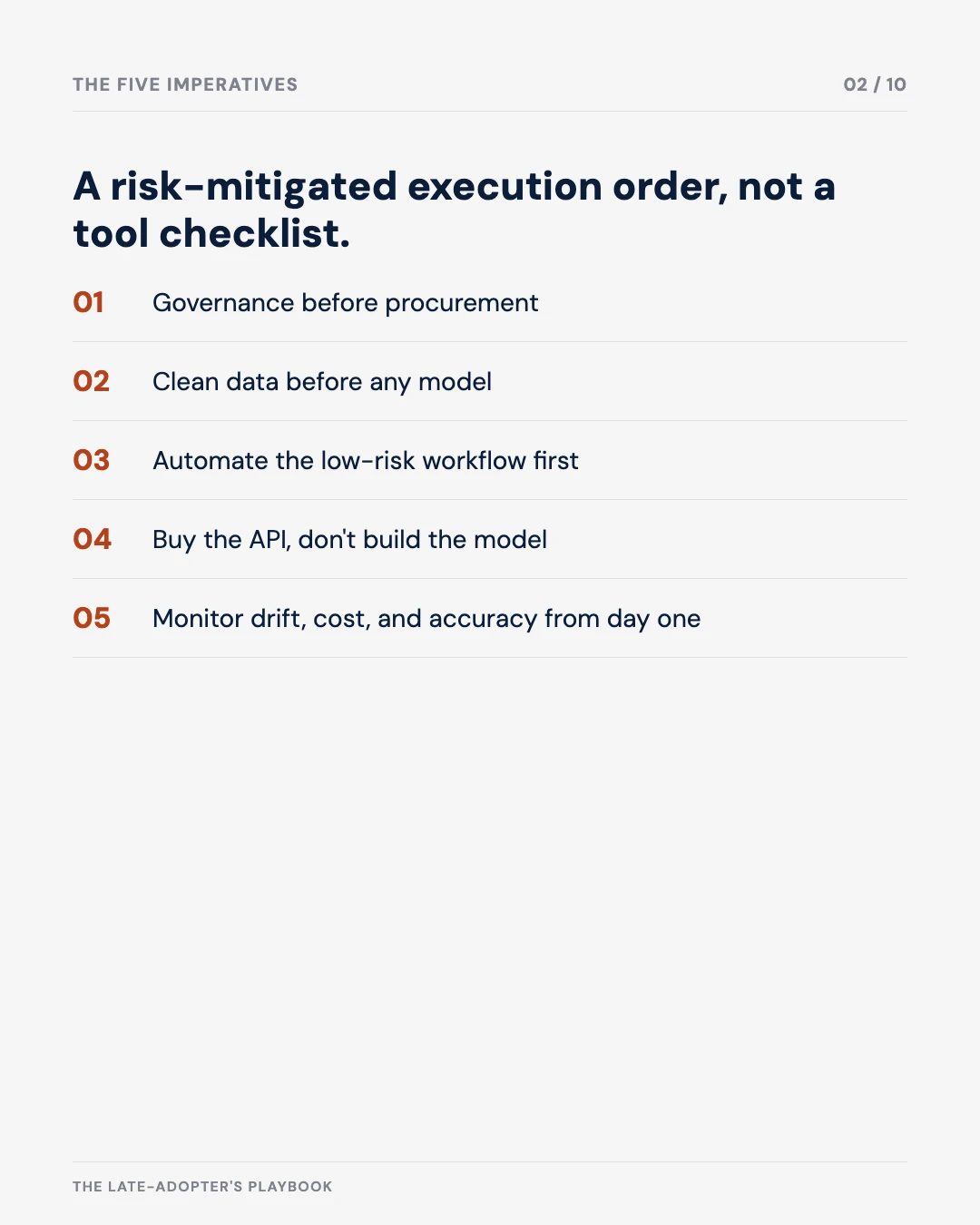
Below are five decisions that need to be made by top leadership before a single AI tool is bought — not five things to add later once a test project is already running.
1. Set the rules before you buy anything
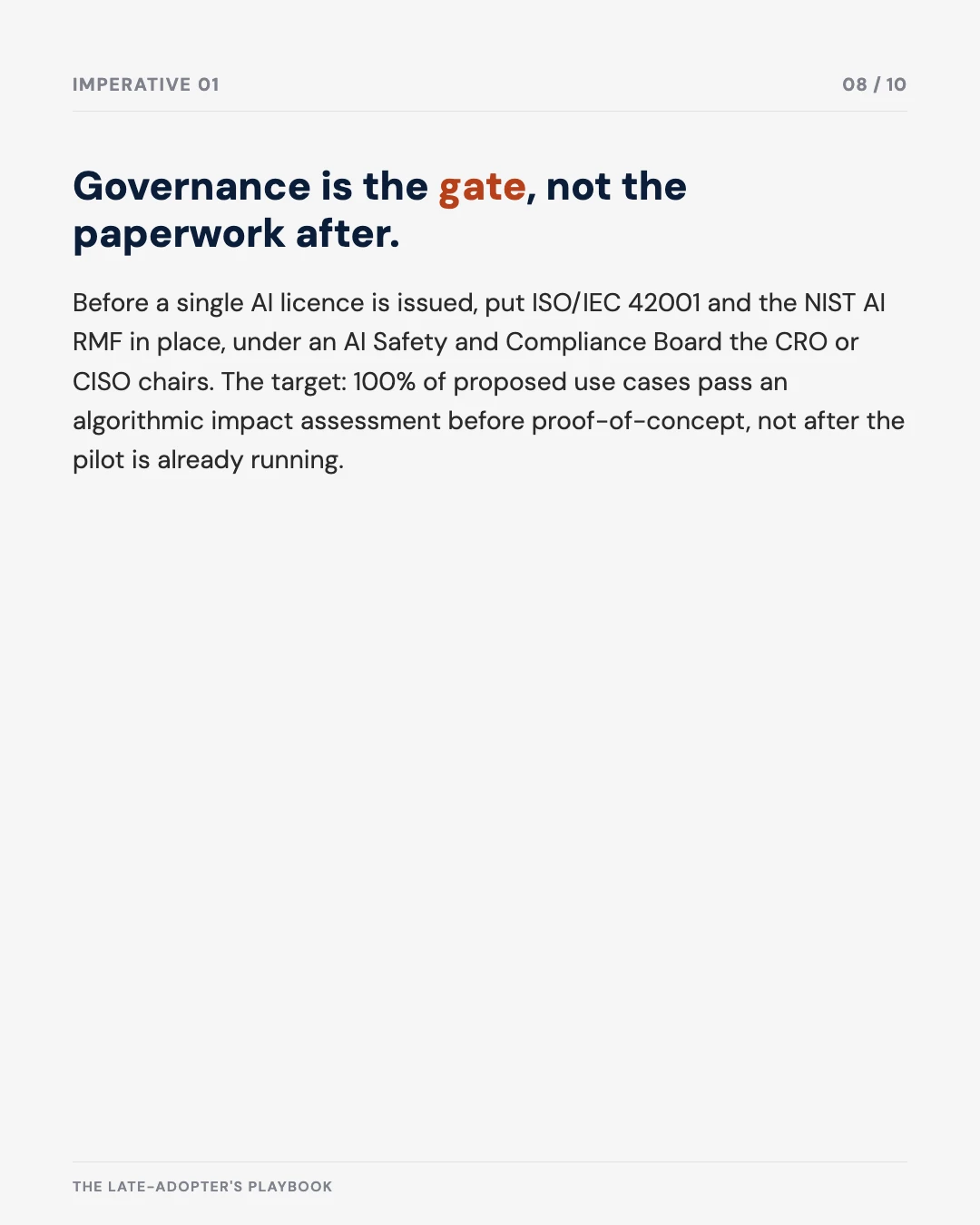
Buying AI software without safety rules already in place puts your company at legal risk under the EU AI Act (a European law, Regulation 2024/1689) and similar laws now appearing in other countries. That risk starts the moment a system goes live, not the moment someone notices a problem. This is why the rules must come before you buy the tool, not as a document written afterward.
Here is what that looks like in practice: adopt ISO/IEC 42001:2023 (the international standard for managing AI safely) alongside the NIST AI Risk Management Framework (a US government risk-management guide), and put both under an AI Safety and Compliance Board. That board should be led by the risk chief or security chief, not by the IT team. Set separate risk levels for internal tools, tools customers see, and tools that act on their own, since each carries different danger. The goal should be simple: 100% of proposed AI projects pass a formal risk check before any testing begins, with no exceptions for projects that seem too small to matter. I’ve written before about what that risk governance framework needs to contain; the ISO 42001 AIMS checklist is the practical, step-by-step version of the same idea.
2. Clean your data before you touch a model
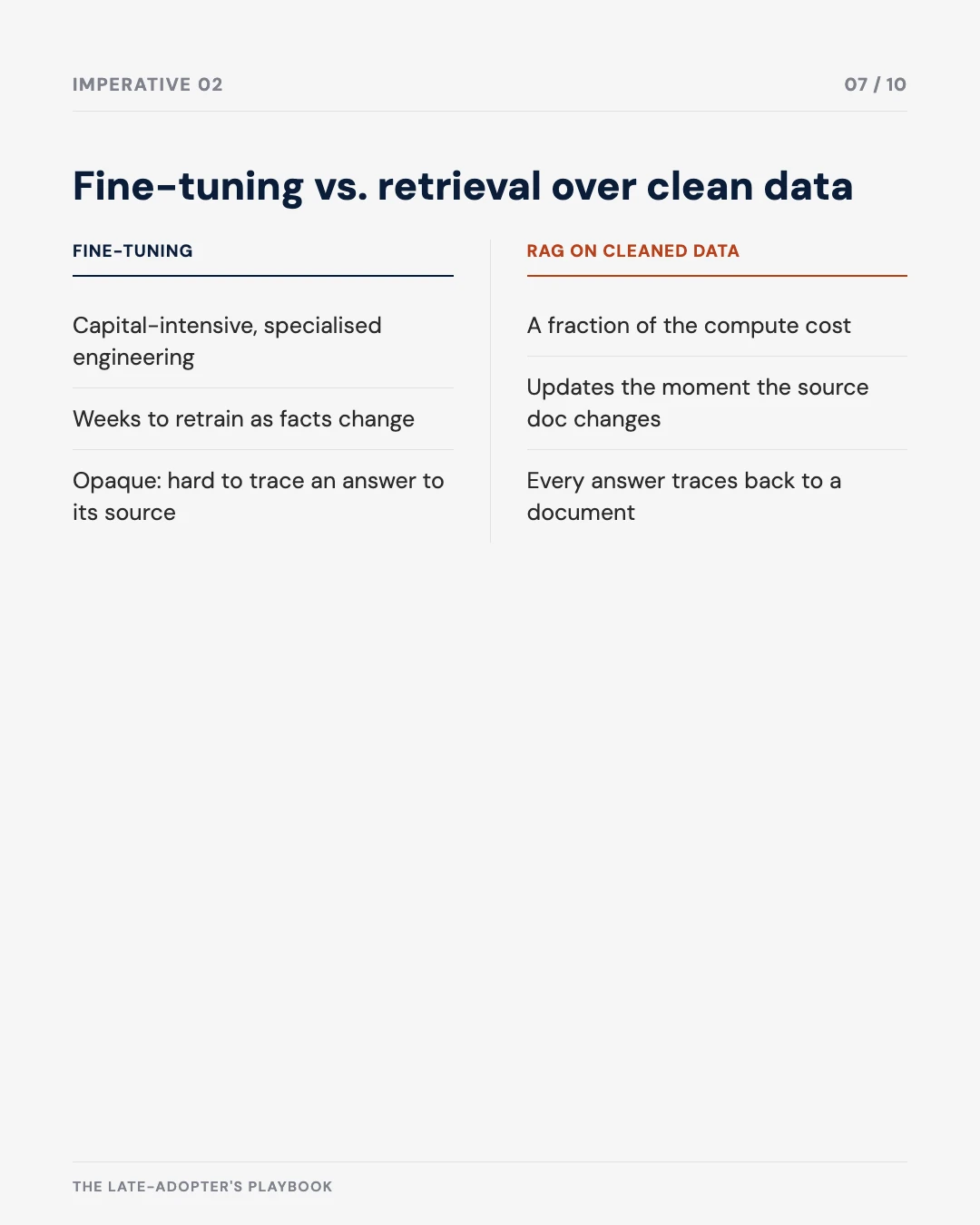
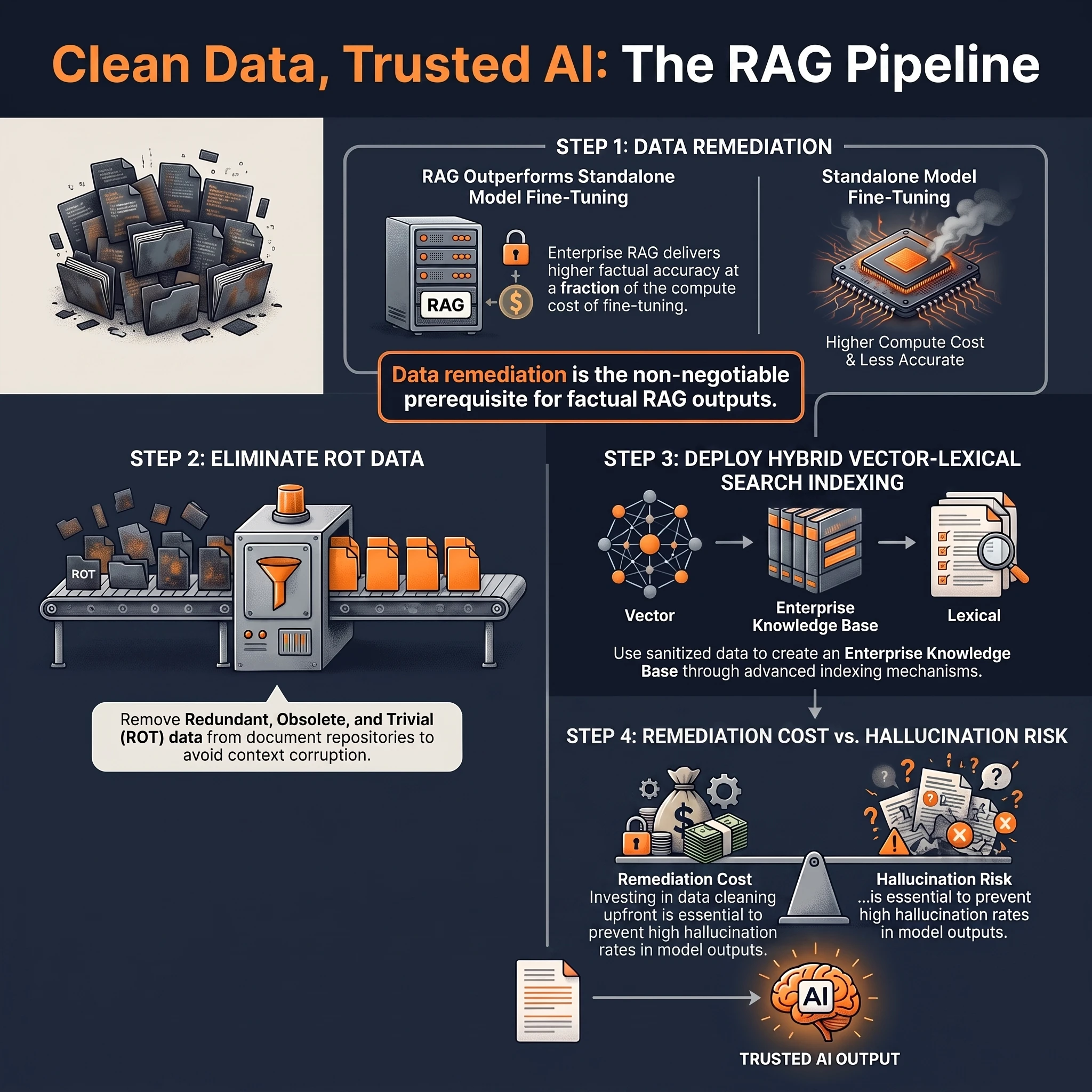
Training or retraining a custom AI model costs a lot of money, and for a company without an existing data pipeline, it is usually not the right first step. Searching through cleaned company data (a method called RAG) is consistently more accurate than retraining a model, and it costs a fraction as much to run. That makes it the better starting choice for almost every late-starting company.
The catch: this search method is only as good as the data it searches through. Sort and clean your internal files first — knowledge bases, standard procedures, customer chat logs — then organise the cleaned result so it can be searched quickly and accurately. Old, useless, or repeated data left sitting in your files does not just sit there quietly. It pollutes what the AI finds and makes it more likely to make things up. This clean-up work has to compete for budget against flashier features, and it will lose that fight unless leaders step in and decide otherwise — which is exactly why the decision belongs at the top, not left to whichever team asks first. I go into the details in Stop Tuning Prompts, Start Cleaning Data and the technical design in How to Build Governed RAG 2.0 Systems.
3. Start with the safe, high-volume task, not the flashy one
Putting AI straight into a core, money-making product feature, before your company has any hands-on experience running AI, is a big and avoidable risk. The best early results almost always come from searching internal knowledge and handling simple first-line support requests, not from the customer-facing feature that looks most impressive in a boardroom slide.
Klarna’s AI helper handled work equal to 700 full-time customer service workers within its first three months live, while cutting repeat-ticket fix time by 25%.
That is what a good first project looks like: lots of work, low complexity, and set up so a person can still check the AI’s answers without slowing everything down. Pick your first project on that basis, not on how impressive it looks.
4. Rent the AI, do not build your own
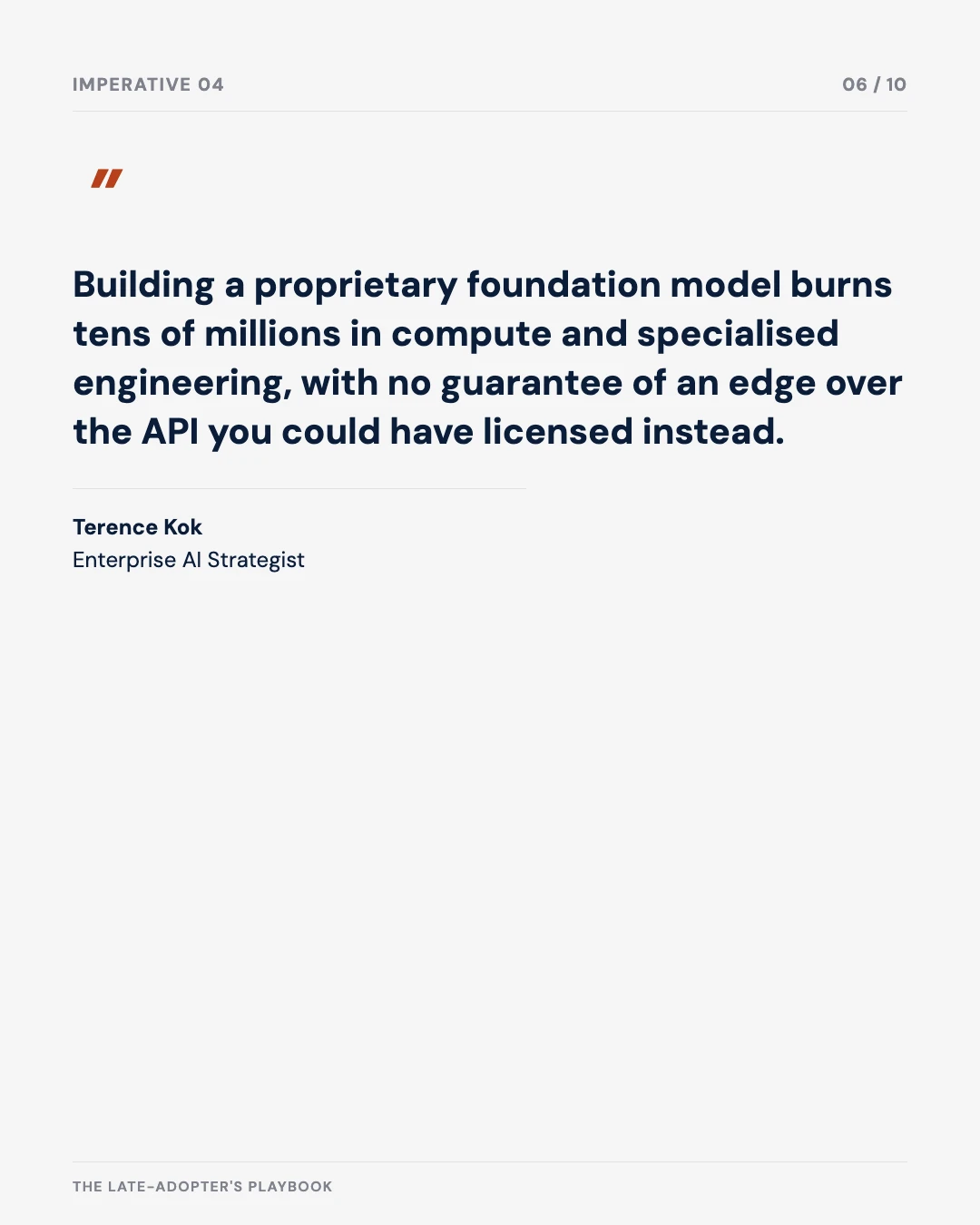
Building your own AI model from scratch costs tens of millions of dollars in computing power and specialist engineers, with no guarantee it beats a rented alternative. For a company starting late, that money is better spent on a careful supplier strategy: stick to commercial AI providers who guarantee in the contract that they will not keep or reuse your data, such as Azure OpenAI Service, AWS Bedrock, and Anthropic’s enterprise plans.
Siemens built an AI helper directly into its factory-code-writing process and cut writing time from weeks to minutes, without exposing its private engineering know-how to a public AI’s training data. The no-data-retention clause is what made that safe — it has to be a guarantee written into the contract, not just a claim in the supplier’s marketing. I cover that difference in What Your AI Vendor Contract Is Probably Missing. The vendor evaluation scorecard is the checklist your buying team should run before signing anything.
5. Watch for drift, cost, and accuracy from day one
An AI tool that nobody watches quietly gets worse over time. Its performance drifts, its instructions stop matching the data they were written for, and its running costs climb — usually unnoticed until the bill arrives or it gives a wrong answer. Live monitoring tools, such as Arize AI, TruLens, or LangSmith, need to be switched on from launch day, tracking speed, accuracy, relevance, and cost as a normal habit, not something bolted on after something breaks.
The bar worth holding your AI search system to: an accuracy score above 92% and a truthfulness score above 90%, measured across many automatic tests, not checked by hand now and then. Pair that with a hard spending limit set at the system level, so a runaway loop or a sudden spike in use hits a wall instead of showing up as a shock bill.
The order is what actually matters
None of these five steps works well on its own. Rules without clean data still produce confident, wrong answers wrapped in a compliant-looking package. Clean data without a monitored system quietly breaks down once it goes live. A well-chosen first project still fails if the supplier contract leaves your private data exposed. The order matters because each step sets limits on the ones after it: the rules set the risk levels that data clean-up and project choice must respect, and the supplier and monitoring decisions are what stop everything above them from quietly drifting off course after launch.
If you are starting late, it is tempting to treat catching up as a speed problem. The data says it is an order problem. Getting the order right — before you sign anything, not after your first test project stalls — is what separates the 20 to 30% of companies that grow their AI use from the 70 to 80% that do not.
Sources: Gartner, 2024; EU AI Act, Regulation (EU) 2024/1689; ISO/IEC 42001:2023; NIST AI Risk Management Framework 1.0; Klarna, 2024; Siemens, 2024.
Free tool
AI Trust, Risk & Governance Dashboard
See where your company actually stands against the five steps above, before you commit any budget.
Free tool
ISO 42001 AIMS Readiness Checklist
The practical, step-by-step version of imperative one above: set the rules before you buy anything, with 36 checks across the seven AIMS clauses.
The AI Governance & ROI Executive Programme applies the same approach to your own company, giving you a scored starting point and a roadmap. Details are on the workshops page.
Was this useful?