

Listen to this article
Jump to a section
In this article
Executive Summary
AI is going into production faster than most organisations can build governance for it, and that gap is where the risk sits. AI Assurance closes it by proving, with evidence, that a system does what it should and keeps doing it after go-live.
Core conclusions
- AI behaves probabilistically and can drift in production even when the code hasn’t changed, which makes continuous monitoring non-negotiable.
- Regulation is moving from guidance to enforcement, and building assurance around a standard like ISO/IEC 42001 gives you something portable across overlapping regimes instead of starting from scratch in each jurisdiction.
- Retrofitting assurance onto systems already in production costs far more than building it in from the start. The highest-risk systems need coverage now.
The case, in ten slides
Save it, share it, or send it to whoever owns AI governance.
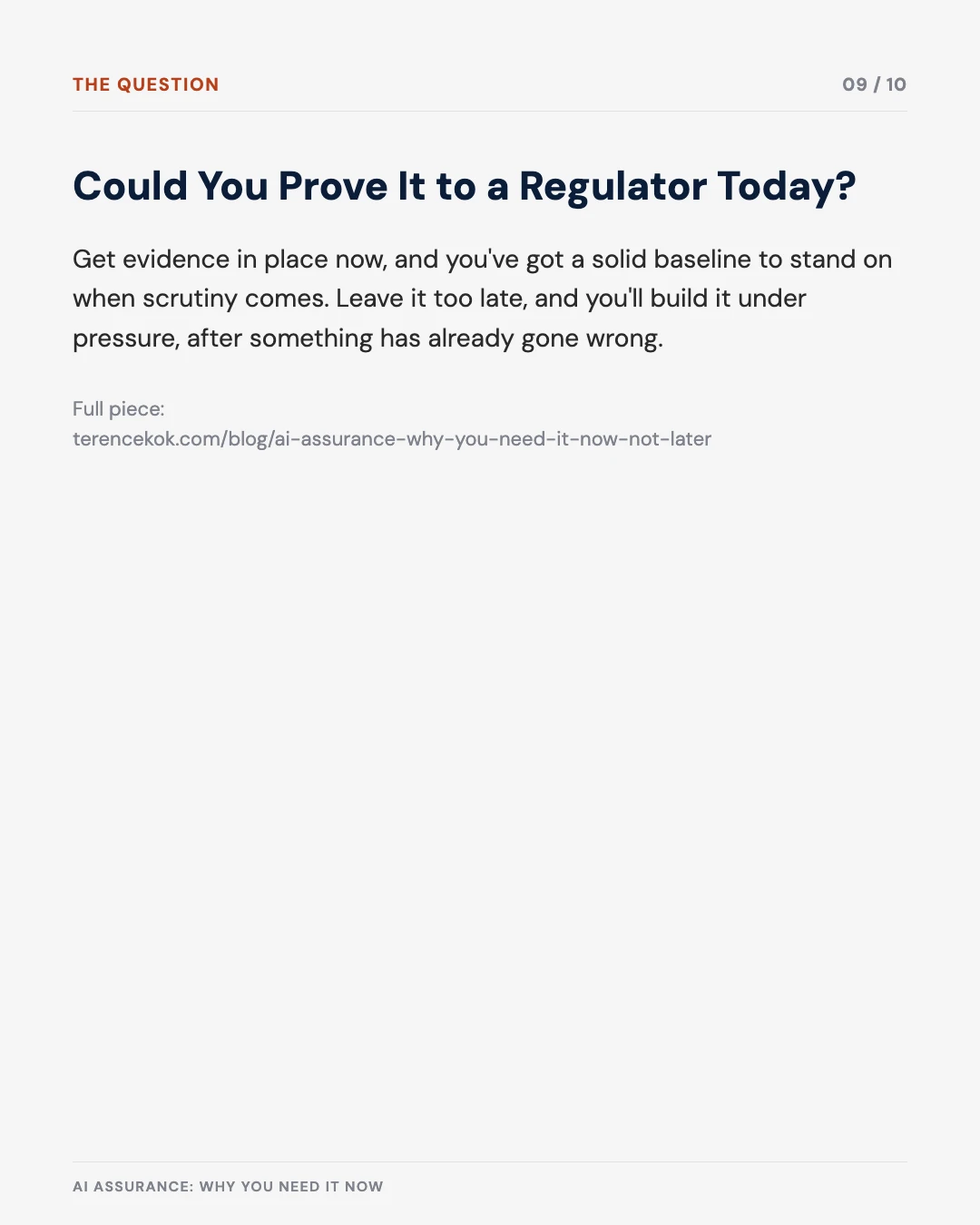
AI is going into production faster than most organisations can build the guardrails for it. That gap between deployment speed and governance maturity is where the risk sits. AI Assurance is how you close it. In simple terms, it means being able to prove, with evidence, that an AI system does what it’s supposed to do, stays within the limits you set for it, and keeps behaving that way after go-live.
What AI Assurance Covers
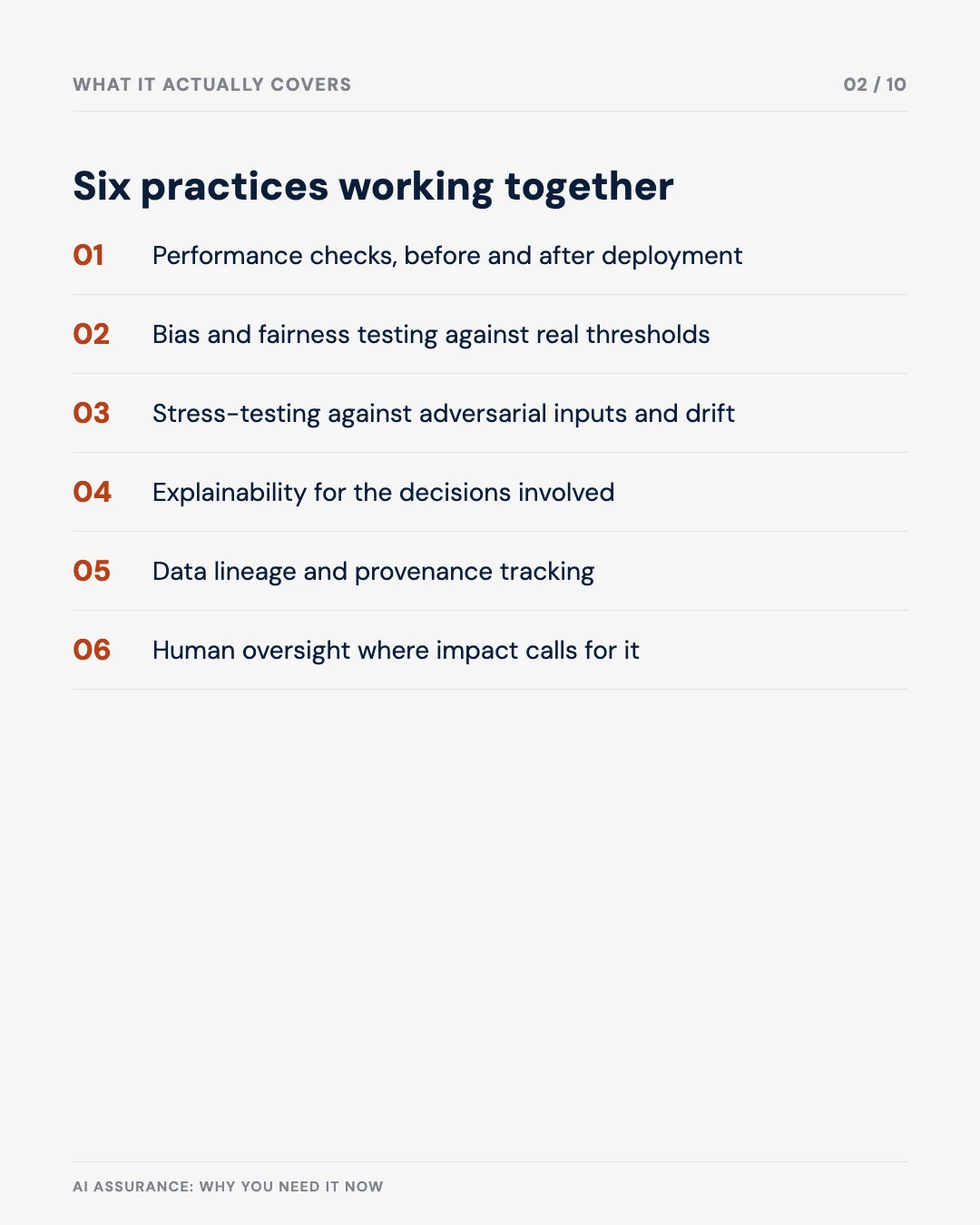
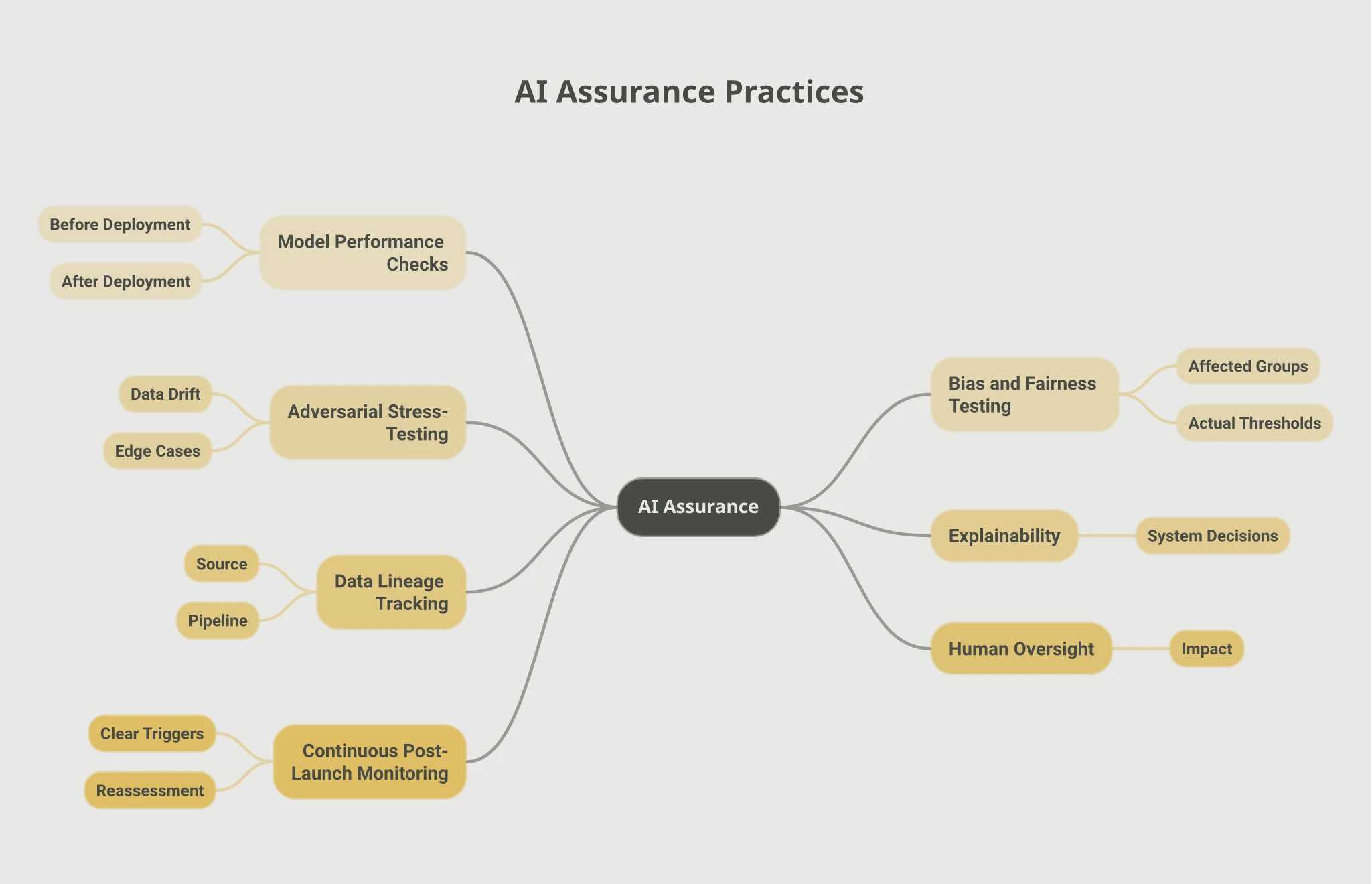
It’s not one control you switch on. It’s a set of practices working together:
- Checking model performance against clear criteria, before and after deployment.
- Testing for bias and fairness across the groups the system affects, with actual thresholds.
- Stress-testing against adversarial inputs, data drift, and edge cases.
- Making sure the system is explainable enough for the decisions it’s involved in.
- Tracking where the data came from and how it moved through the pipeline.
- Keeping humans in the loop where the impact of the system calls for it.
- Watching the system continuously after launch, with clear triggers for when to reassess.
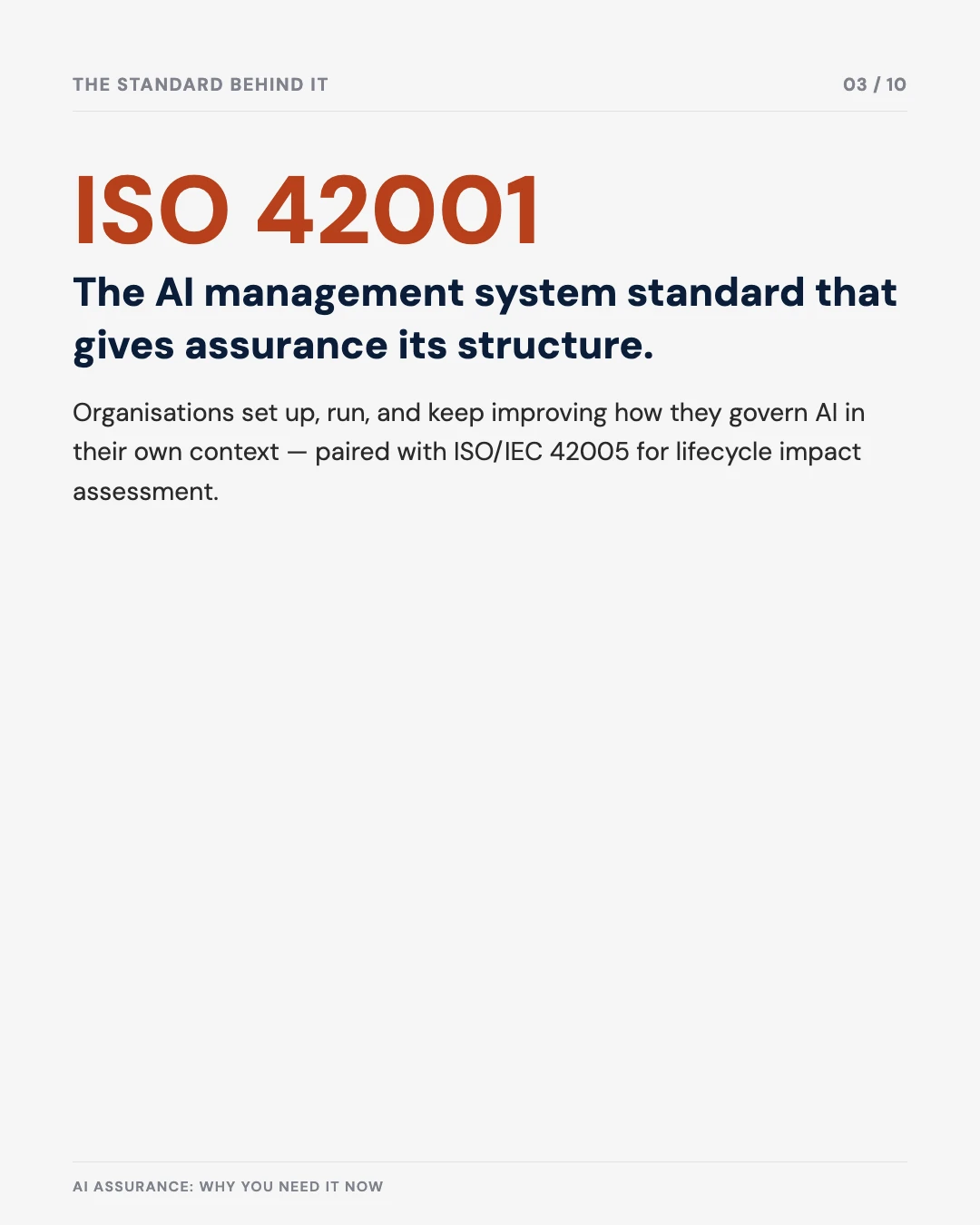
ISO/IEC 42001:2023 gives this structure through the AI management system (AIMS) approach: organisations are expected to set up, run, and keep improving how they govern AI in their own context. ISO/IEC 42005 builds on that by laying out how to assess and document the impact of an AI system on people and society across its lifecycle, tying in with related standards like ISO/IEC 38507 and ISO/IEC 23894.
Assurance in an industry that will not sit still
AI doesn’t have a stable baseline. Models, training approaches, and deployment patterns shift every few months. Three things about this environment make assurance essential.
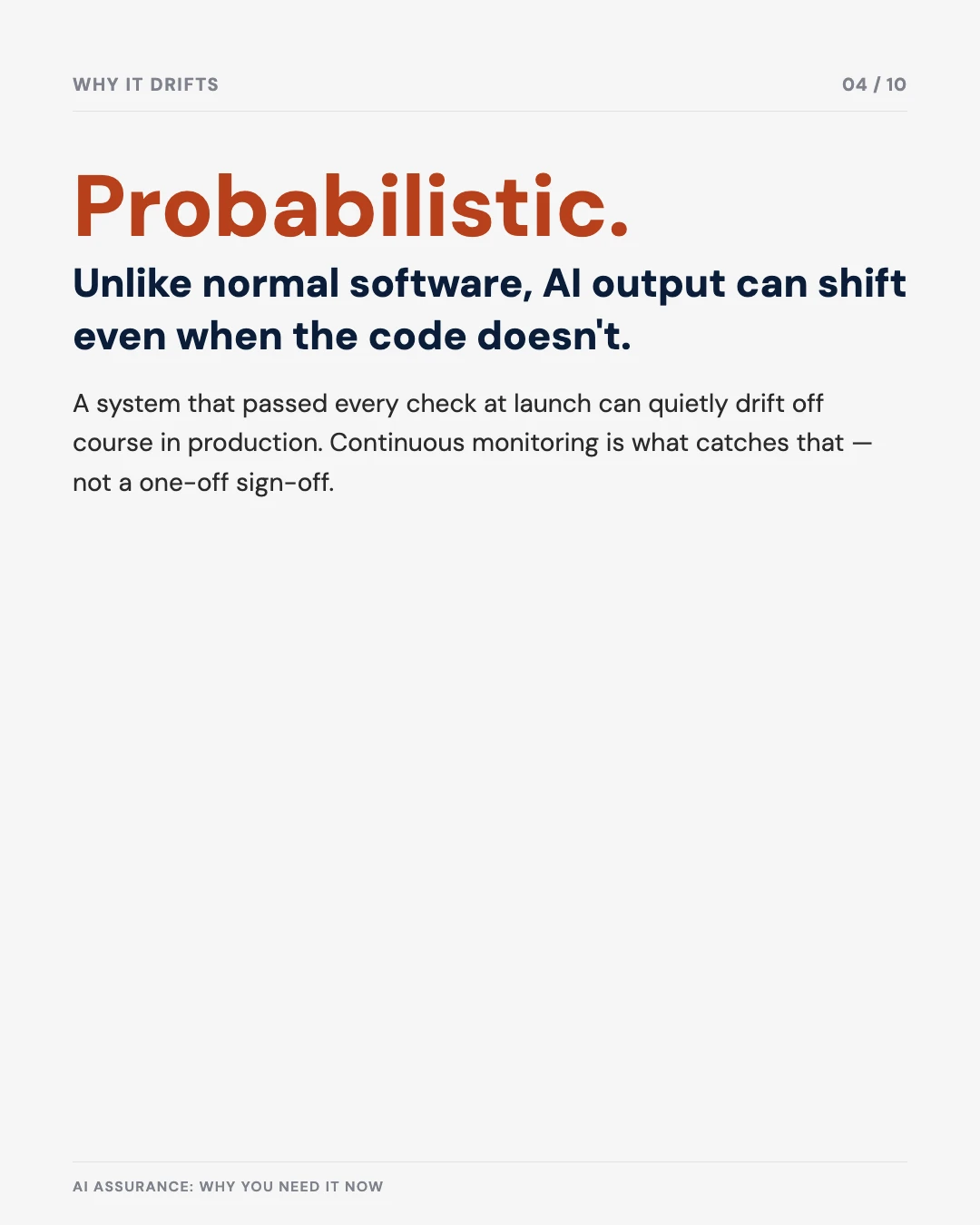
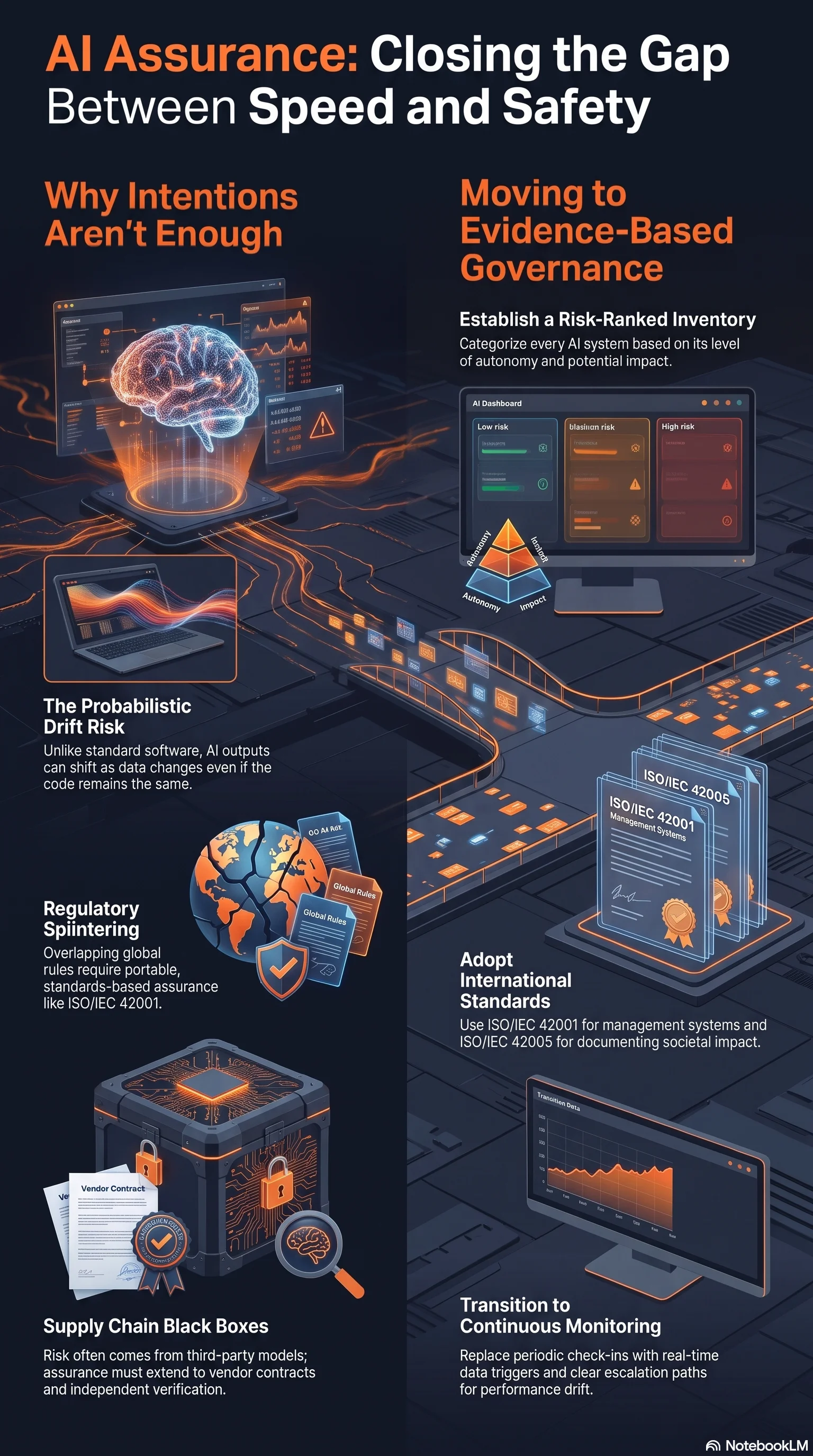
First, AI systems behave probabilistically. Unlike normal software, the output can shift when the data feeding it shifts, even if nothing in the code changes. A system that passed every check at launch can drift off course in production. Continuous monitoring is what catches that, not a one-off sign-off.
Second, regulation is spreading out and splintering at the same time. The EU AI Act, sector rules from financial and health regulators, and national AI frameworks emerging across the Gulf and Southeast Asia are all converging on the same basic expectations: risk classification, impact assessment, human oversight, and an audit trail. If you operate across borders, these requirements overlap but rarely match exactly. Building assurance around a recognised standard like ISO/IEC 42001 gives you something portable you can map to different regimes, instead of starting from scratch each time.
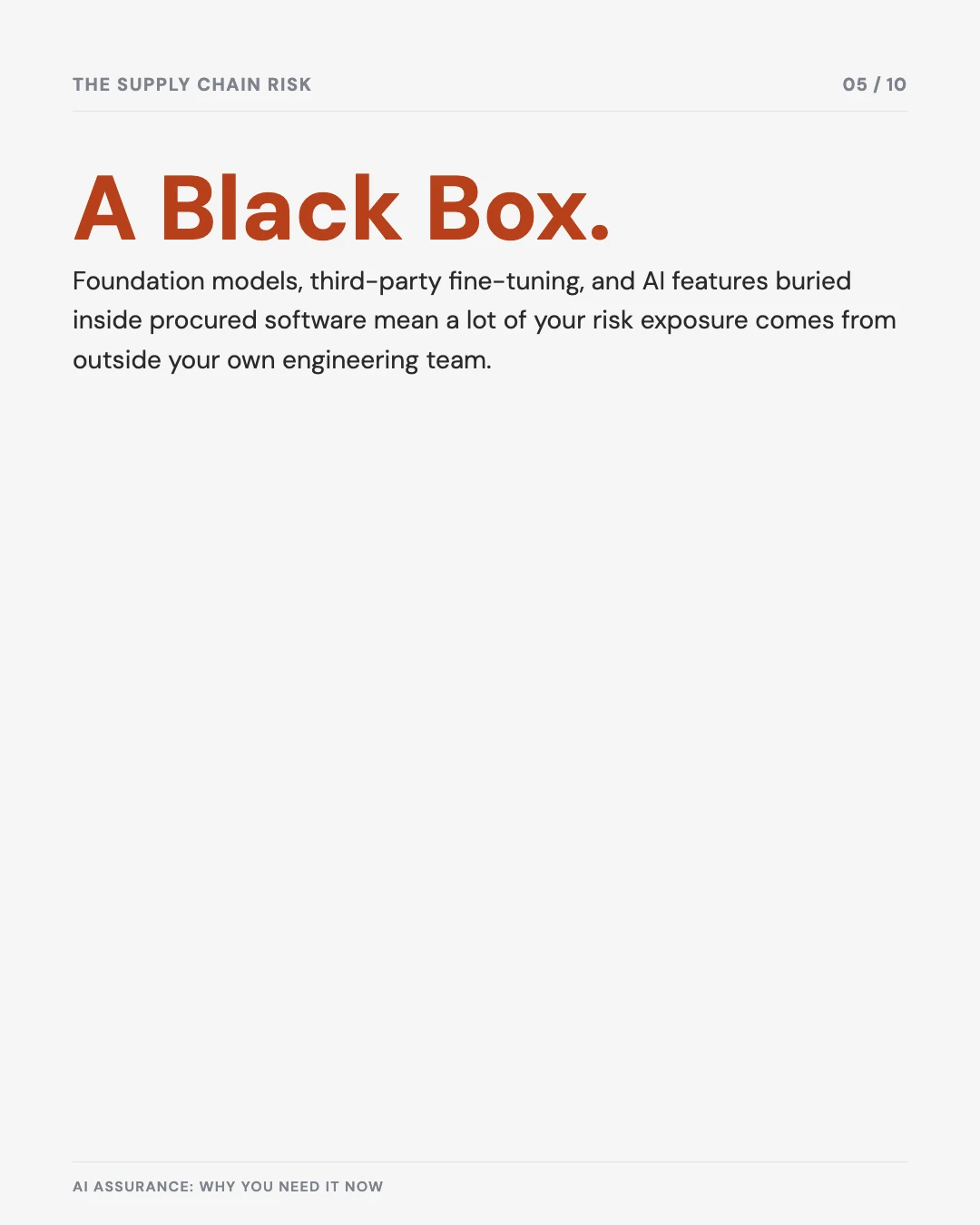
Third, most AI supply chains are a black box. Foundation models, third-party fine-tuning, and AI features buried inside procured software mean a lot of your risk exposure comes from outside your own engineering team. Assurance has to reach those vendors too, through contract requirements and independent checks.
Why the Time to Act Is Now
A few things are compressing the timeline here.
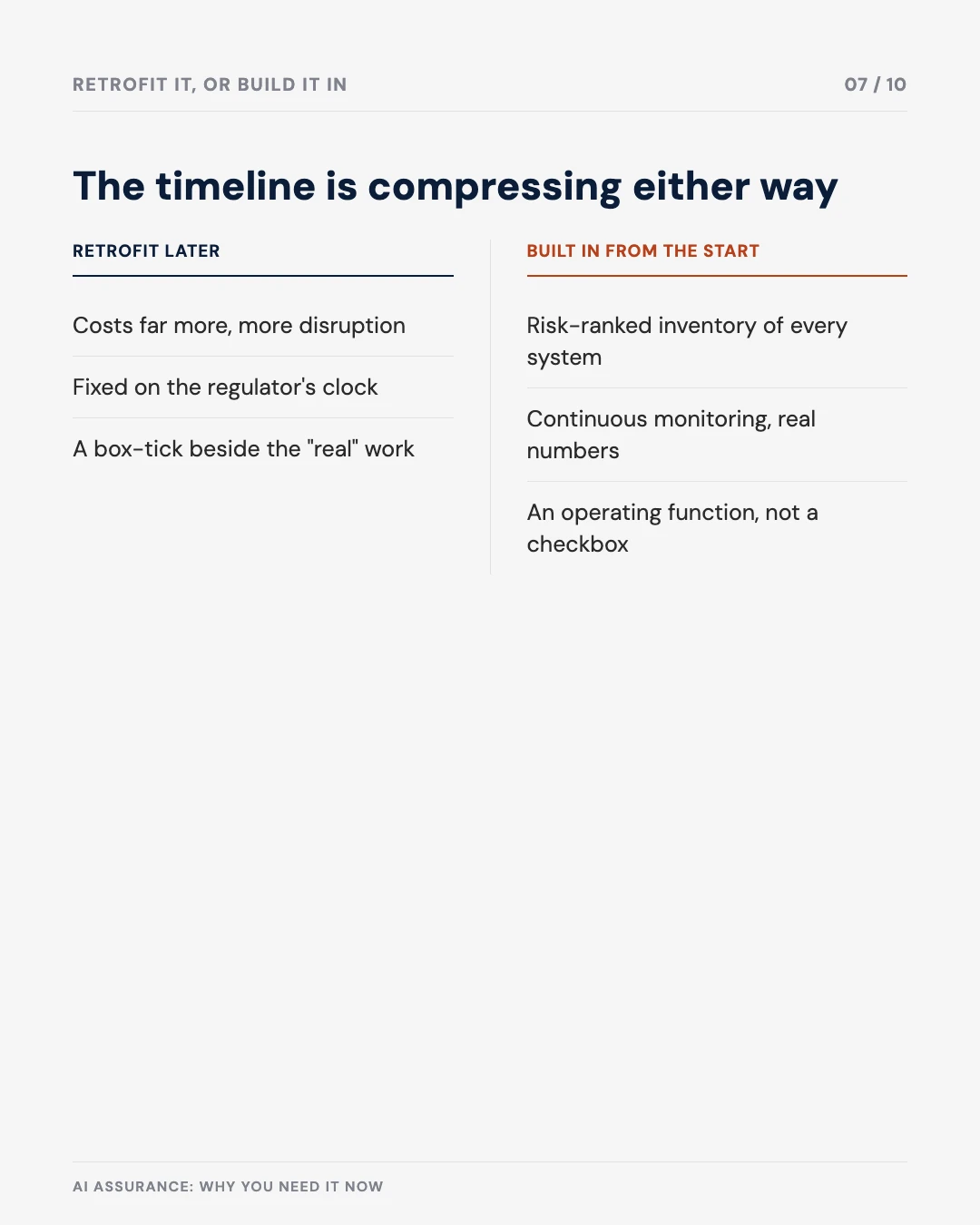
Organisations have scaled AI faster than they’ve built the governance to match it. Retrofitting assurance onto systems already running in production costs far more, and causes far more disruption, than building it in from the start.
Regulation is moving from guidance to enforcement. Rules that were optional recommendations not long ago are turning into binding requirements with real penalties attached. If you’re not assurance-ready by the time enforcement lands, you’re fixing things on the regulator’s clock.
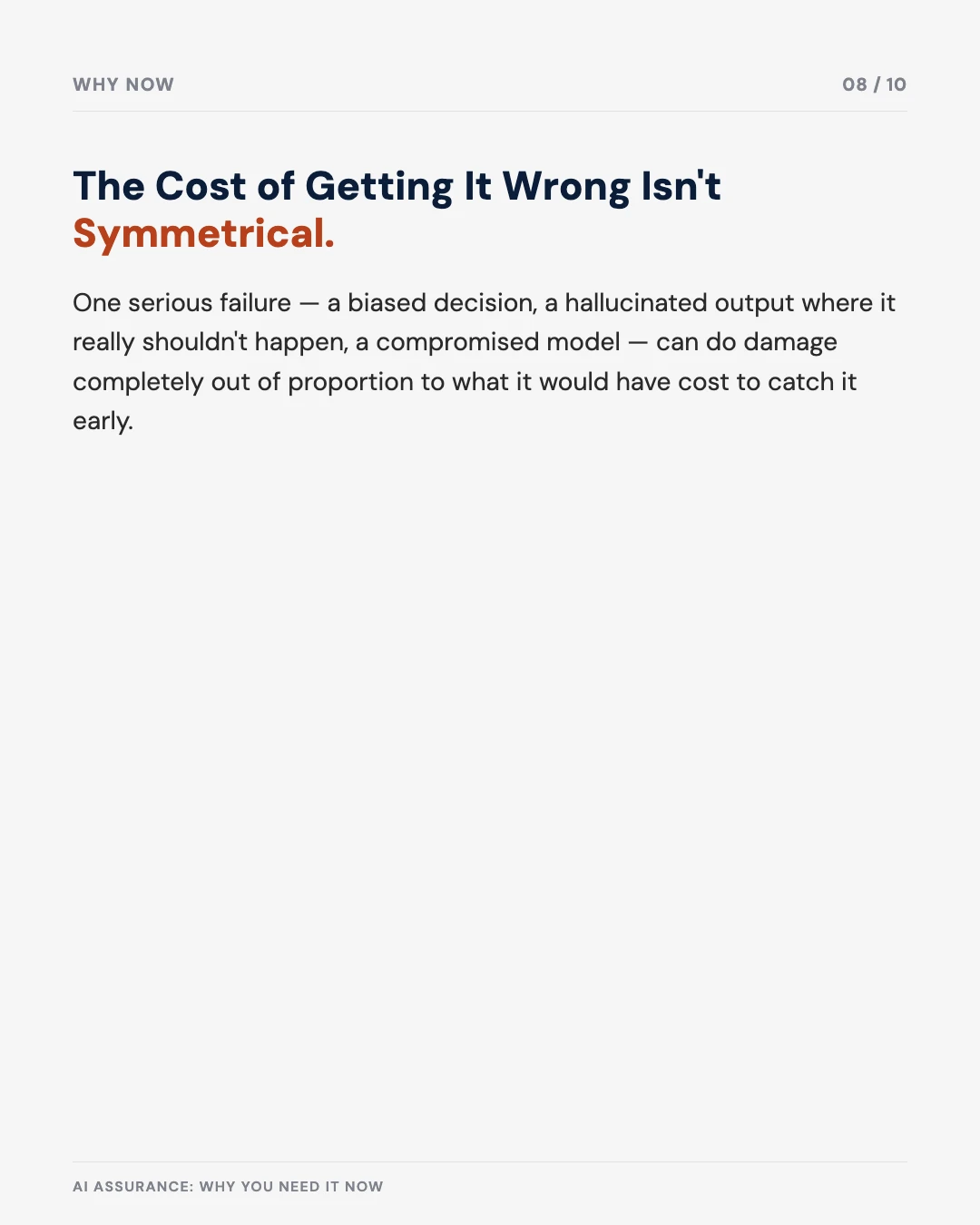
And the cost of getting it wrong is not symmetrical. One serious AI failure, a biased decision, a hallucinated output somewhere it really shouldn’t happen, a compromised model, can do damage completely out of proportion to what it would have cost to catch it early. That’s not a reason to worry about the future. It’s a reason to get your highest-risk systems covered now.
What This Looks Like in Practice
AI Assurance works best as an operating function, not a compliance box-tick sitting next to the “real” AI work. That means:
- A risk-ranked inventory of every AI system in use, based on impact and how much autonomy it has.
- Impact assessments run along the lines of ISO/IEC 42005, folded into your existing risk, privacy, and security reviews so you’re not duplicating effort.
- A management system built around ISO/IEC 42001, with clear ownership, documented processes, and regular internal audit.
- Continuous monitoring with actual numbers behind it, not just a periodic conversation, and clear escalation paths when something crosses a line.
- Vendor and third-party AI brought into scope through contract clauses and independent verification.
Get this in place now, and you’ve got a solid, evidenced baseline to stand on when the scrutiny comes, whether that’s from a regulator, a client, or your own board. Leave it too late, and you’ll be building it under pressure, after something has already gone wrong.
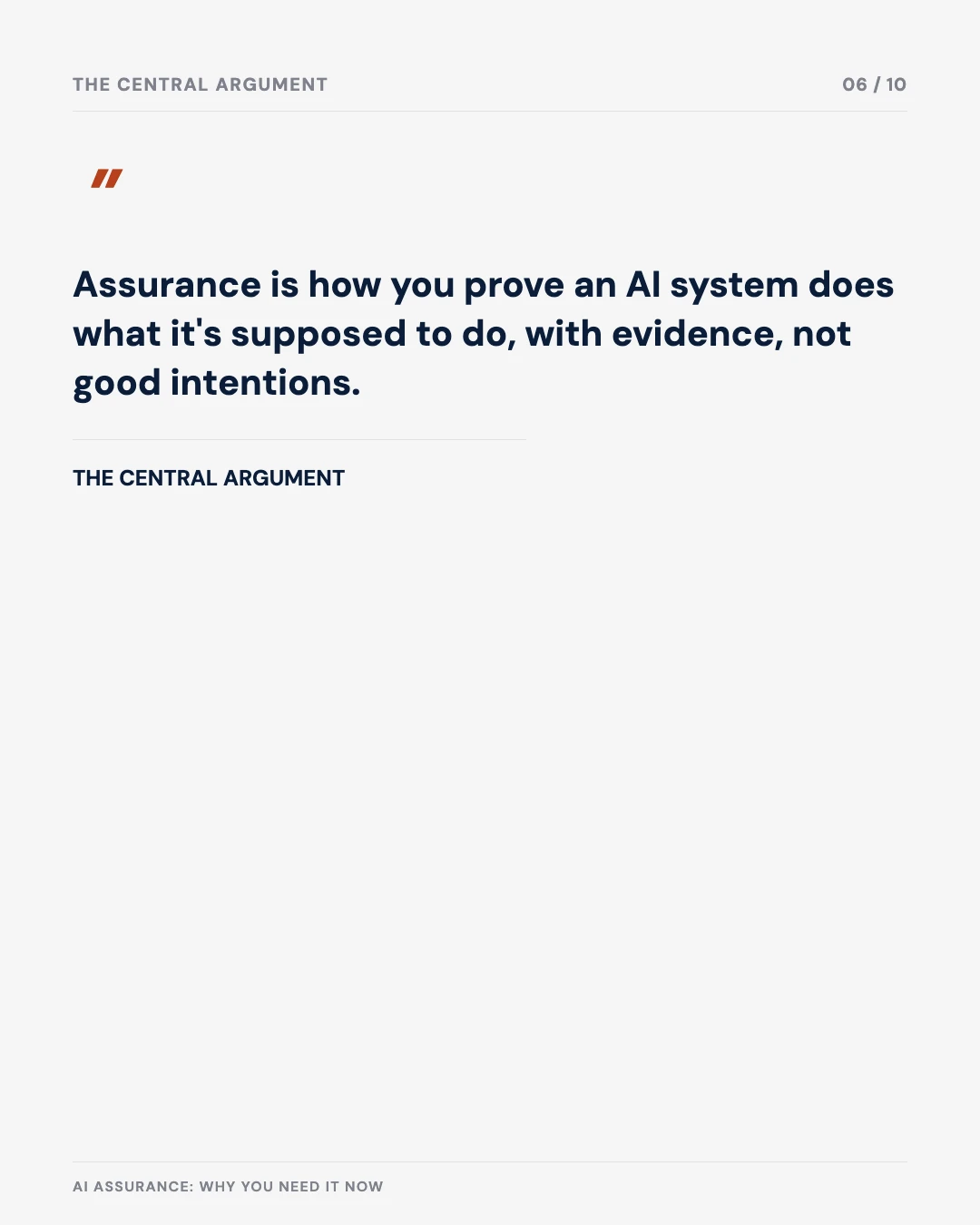
Assurance is how you prove an AI system does what it’s supposed to do, with evidence, not good intentions.
Free tool
ISO 42001 AIMS Readiness Checklist
36 checks across the seven AIMS clauses and the Annex A controls an auditor asks for first, built to flag exactly where your organisation’s evidence trail has gaps before an external audit does.
Was this useful?