
Listen to this article
Executive Summary
AI is automating tasks, not eliminating roles wholesale, and senior professionals are not immune. The professionals who stay indispensable are the ones who reposition as the human layer that governs, interprets, and directs AI-augmented work, not the ones who compete with AI on execution speed.
Core conclusions
- Senior leadership roles are seeing intensified competition, not immunity. The disruption is partly driven by employer anticipation of AI’s impact, not solely by demonstrated AI capability today.
- The practical move is an honest audit of how much of a role is task execution versus judgement, governance, and relationship management, followed by a deliberate shift toward the latter.
- Governance and orchestration competency (evaluating AI outputs, managing AI risk, translating AI outputs into accountable organisational decisions) is becoming a distinct, high-demand function at every level from team lead to C-suite.
The argument, in ten slides
Save it, share it, or send it to a senior colleague who thinks this is someone else’s problem.
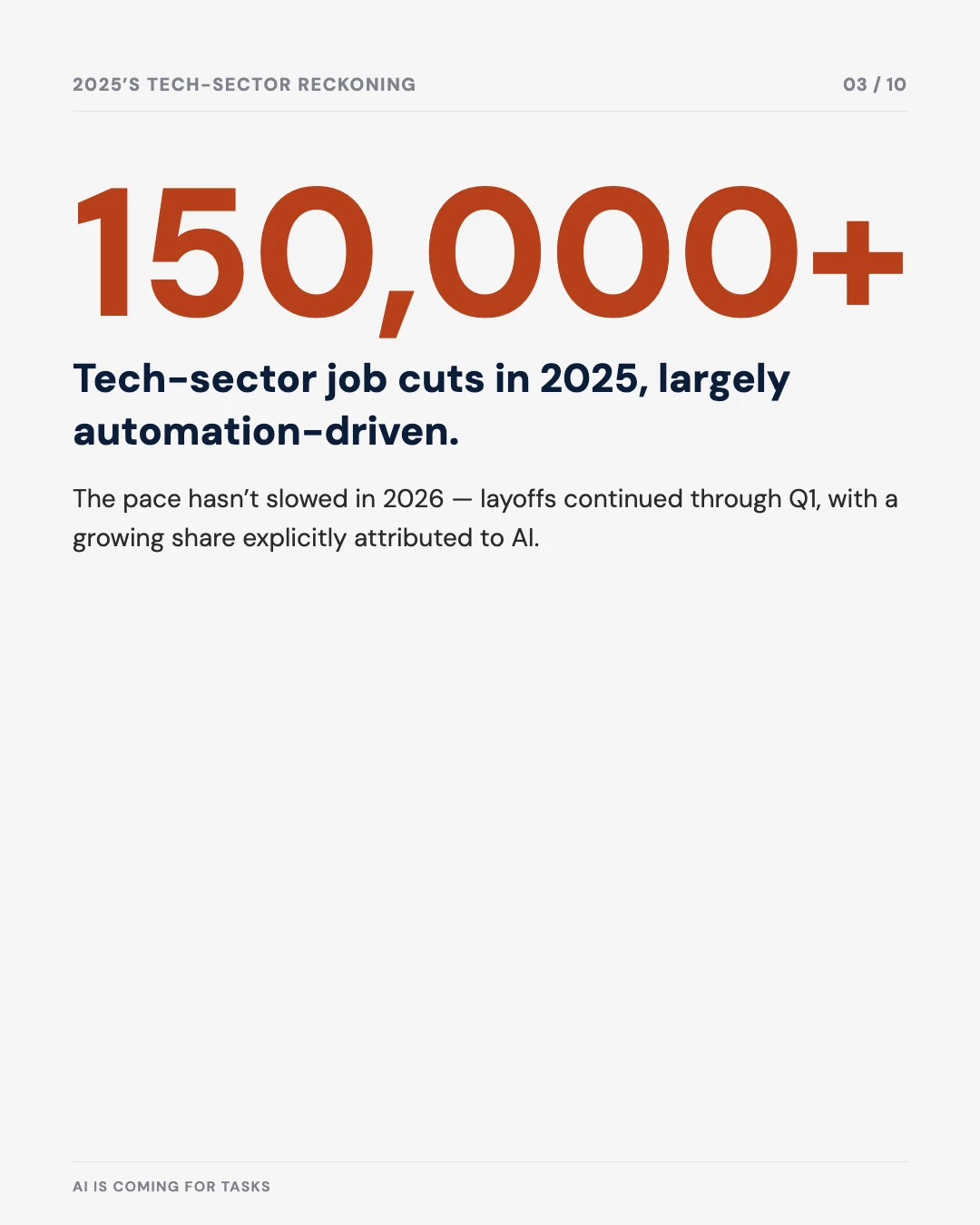
White-collar job displacement is accelerating across multiple vectors simultaneously. The technology sector recorded over 150,000 job cuts in 2025, largely driven by automation and workforce restructuring. In 2026, that pace has not abated, with tech-sector layoffs continuing through Q1 and an increasing share explicitly attributed to AI and automation.
A large majority of employers across major economies anticipated AI-driven reductions in headcount in recent surveys. The World Economic Forum projects tens of millions of jobs displaced by 2030, offset by the creation of new roles in adjacent areas, a net positive at the aggregate level. The critical caveat, however, is that aggregate net job creation does not translate to individual employment security; the distribution of displacement and new role creation is structurally mismatched.
Senior Professionals Are Not Immune
A common misconception has been that AI disruption is confined to entry-level and routine roles. The evidence in 2025–2026 contradicts this. Competition for senior leadership roles has intensified sharply, particularly in IT and sales leadership. Professional job listings in major markets have declined materially since large language models entered the mainstream. Harvard Business School research confirms that the largest reductions in job postings have been concentrated in finance and technology sectors.
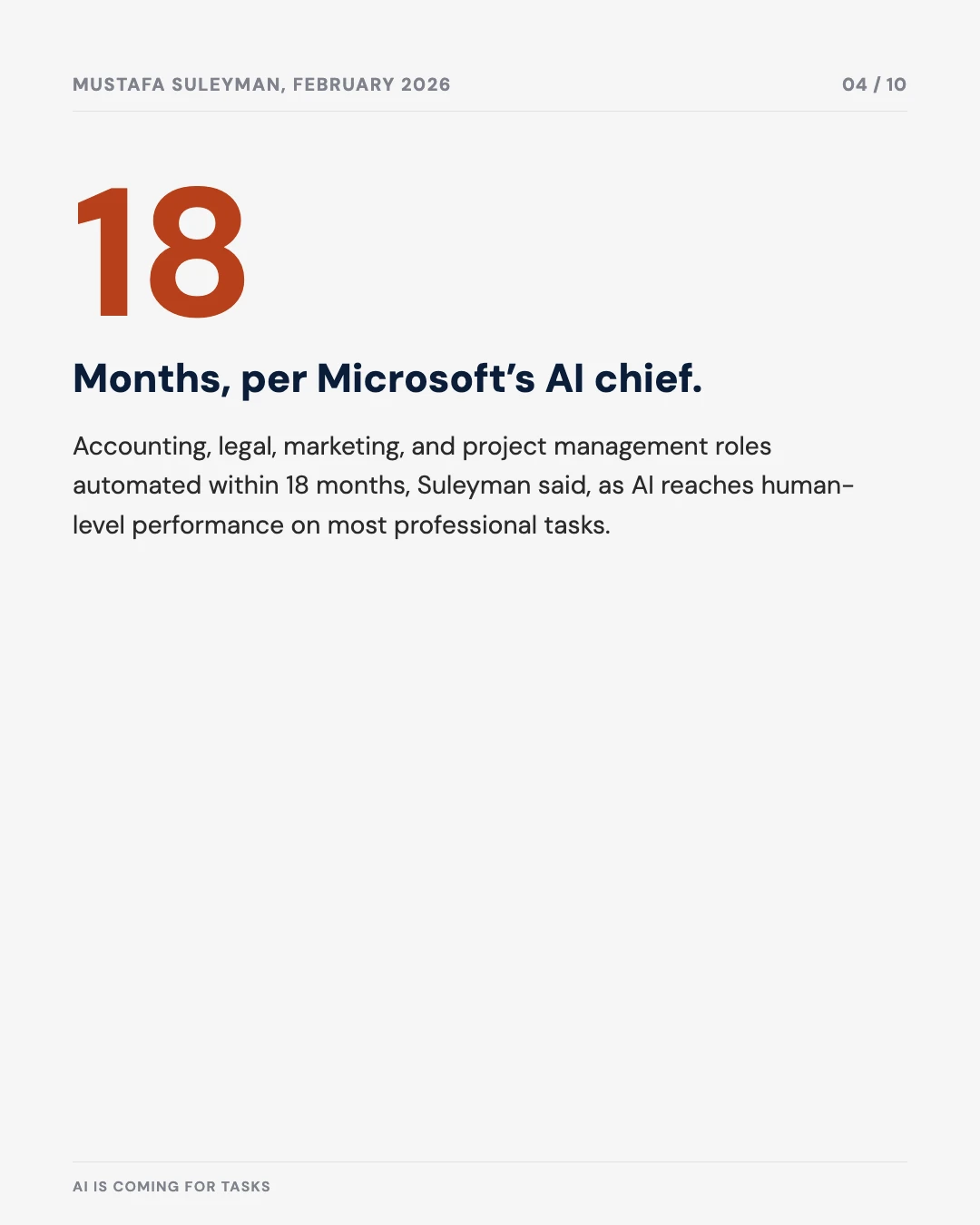
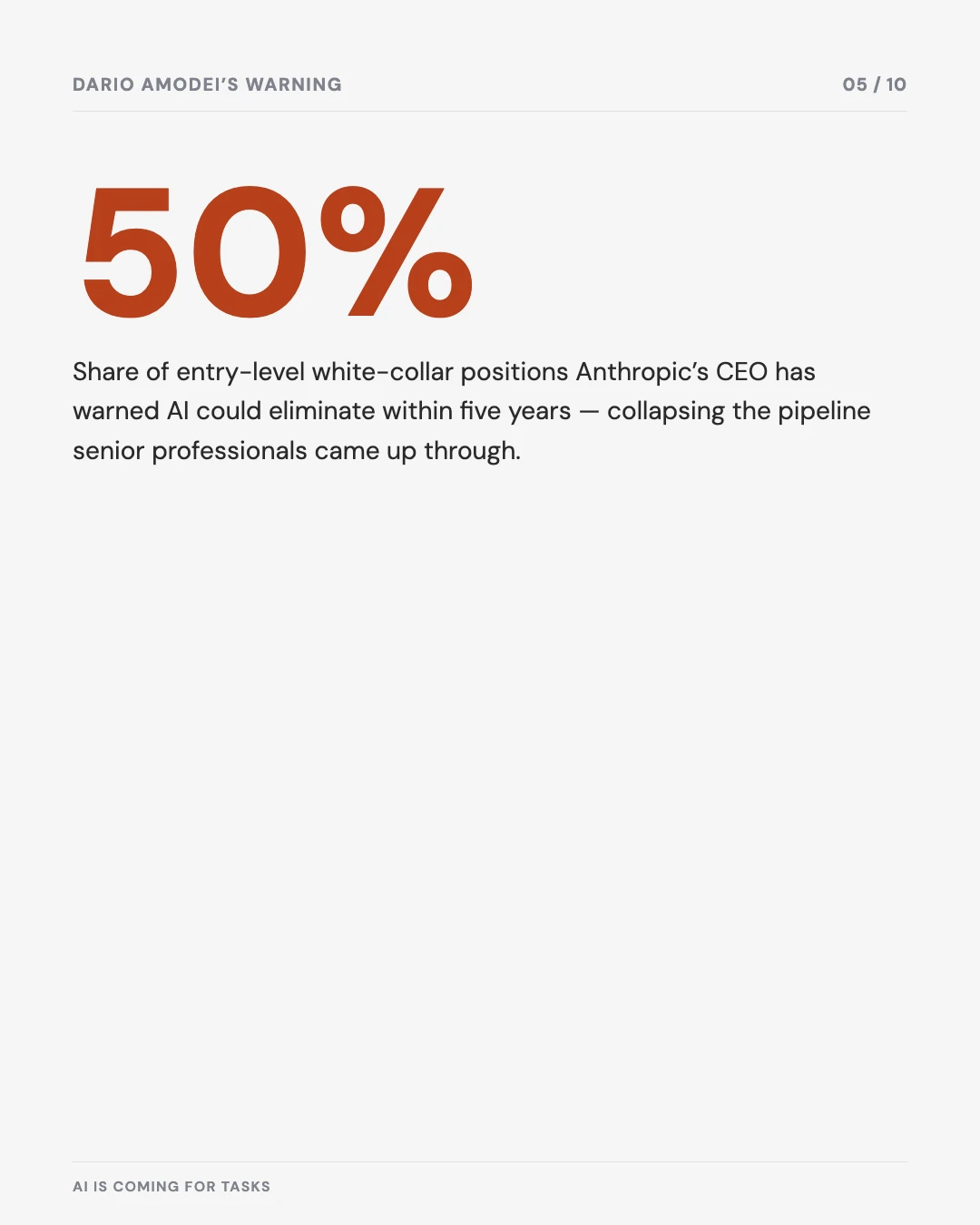
Microsoft AI chief Mustafa Suleyman publicly stated in February 2026 that accounting, legal, marketing, and project management roles will be automated within 18 months as AI achieves human-level performance on most professional tasks. Separately, Anthropic CEO Dario Amodei warned that AI could eliminate up to half of all entry-level white-collar positions within five years.
Importantly, a Harvard Business Review survey of over 1,000 global executives in late 2025 found that many AI-related layoffs are occurring in anticipation of AI’s impact, not necessarily because AI has already replaced those functions. This means the disruption is partly driven by organisational sentiment and financial restructuring logic, not solely by demonstrated AI capability.
The Entry-Level Pipeline Collapse
One underappreciated consequence is the structural collapse of the entry-level talent pipeline — though that collapse is opening a different door than the one that closed. AI is displacing roles such as data entry, basic coding, administrative coordination, and foundational analysis that have historically served as on-ramps for mid-career and senior professionals. Senior professionals who built careers through sequential skill acquisition will find that path narrowing for those coming behind them, with downstream implications for team composition and talent availability.
What Senior Professionals Must Do
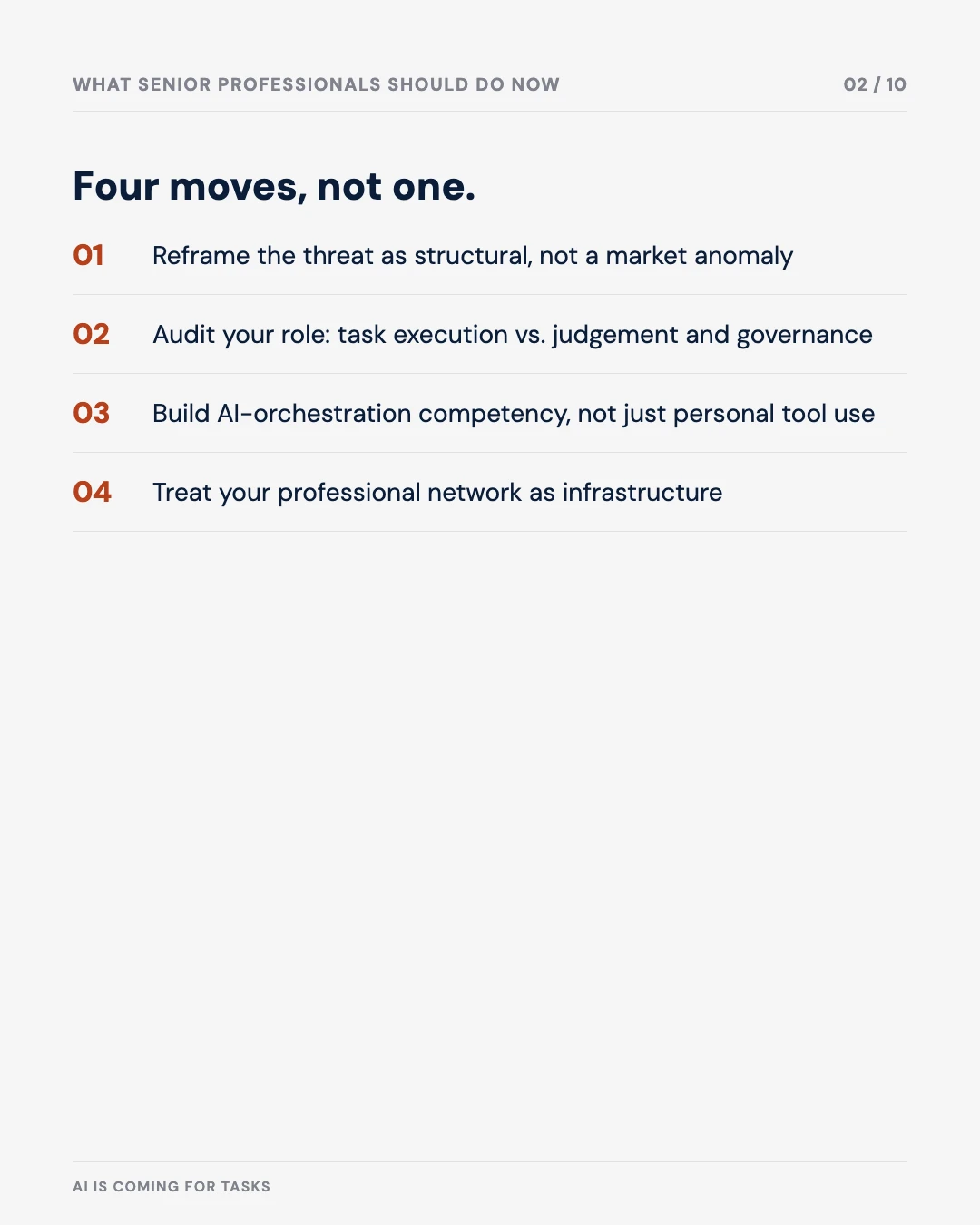
- Reframe the Threat Correctly
The most common error among professionals facing restructuring is to treat their situation as a temporary market anomaly. It is not. The structural forces at work, like agentic AI, productivity substitution, and growing employer confidence in AI, are persistent. The appropriate mental model is not “how do I survive this cycle?” but “how do I reposition my professional value for the next decade of work design?”
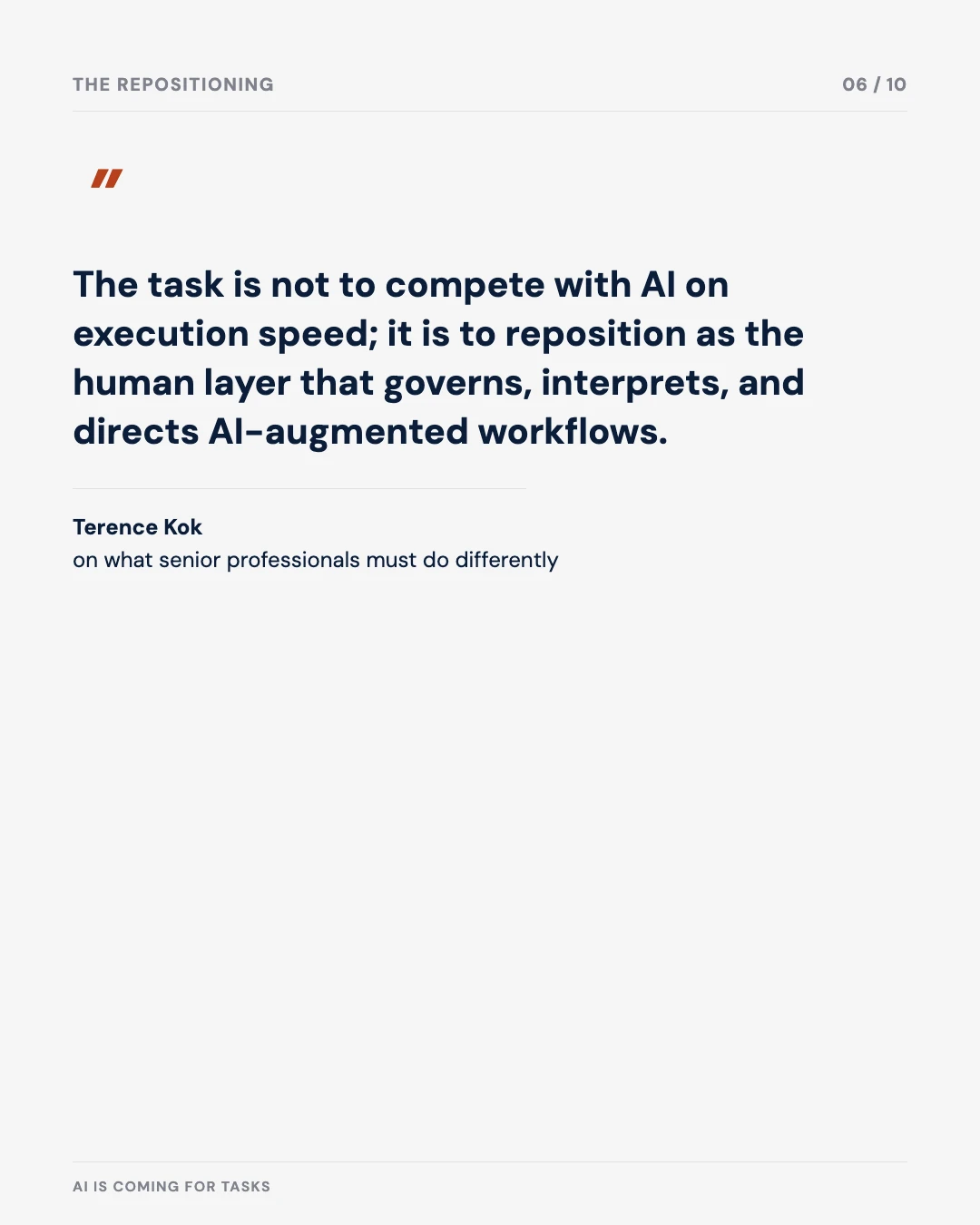
Senior professionals possess assets that AI cannot replicate: institutional memory, contextual judgement, cross-functional credibility, and the ability to navigate organisational ambiguity. I explore this same repositioning, the specific human advantage that persists, in more depth elsewhere. The task is not to compete with AI on execution speed; it is to reposition as the human layer that governs, interprets, and directs AI-augmented workflows.
The task is not to compete with AI on execution speed; it is to reposition as the human layer that governs, interprets, and directs AI-augmented workflows.
- Distinguish Between Tasks and Roles
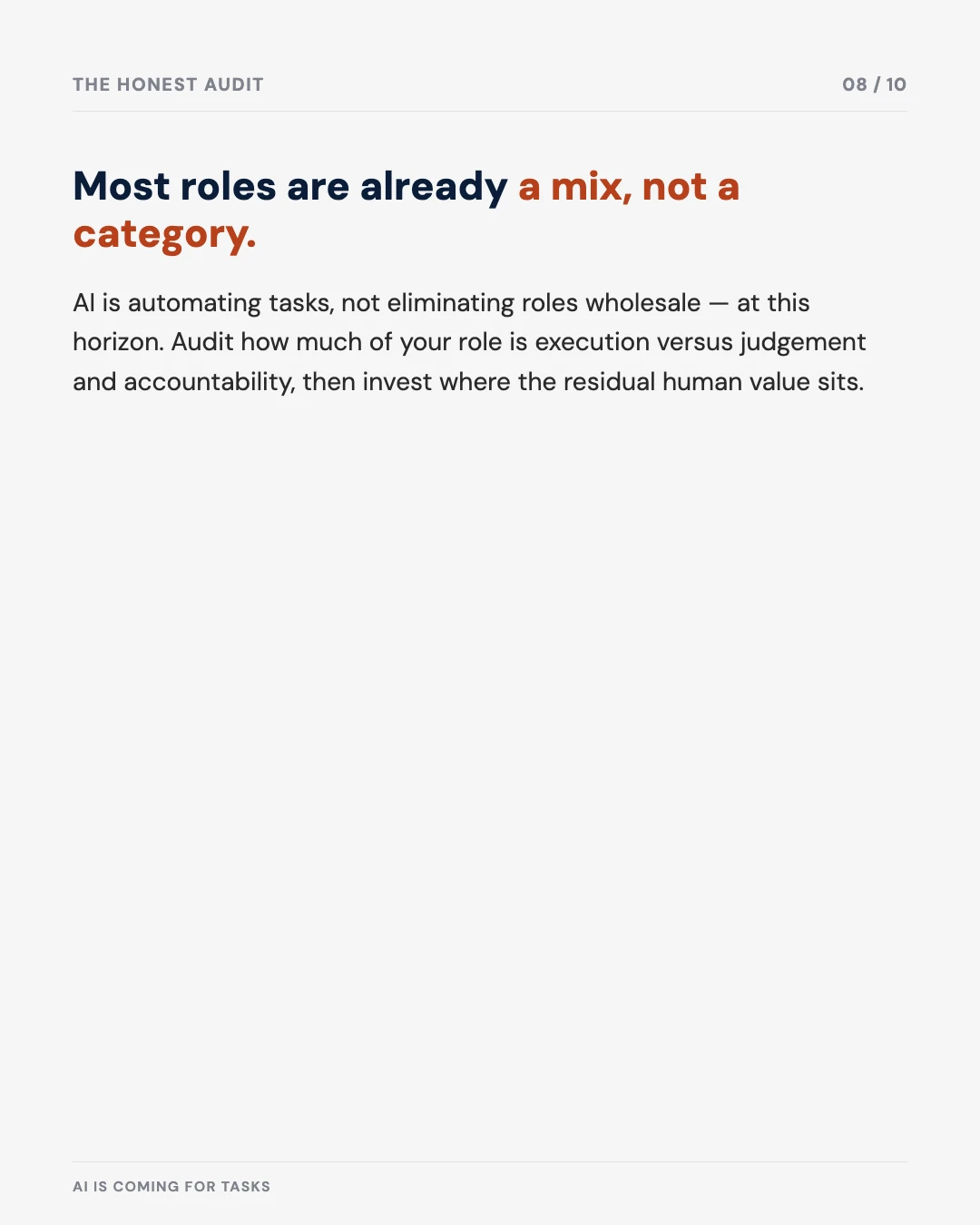
AI is automating tasks, not eliminating roles wholesale, at least at the current horizon. The shape of roles is changing faster than most professionals anticipated. Routine and repetitive tasks are increasingly automated; expectations are shifting toward higher-value thinking, analysis, and judgement. Technical literacy and AI fluency are now assumed, even in roles that never previously required them.
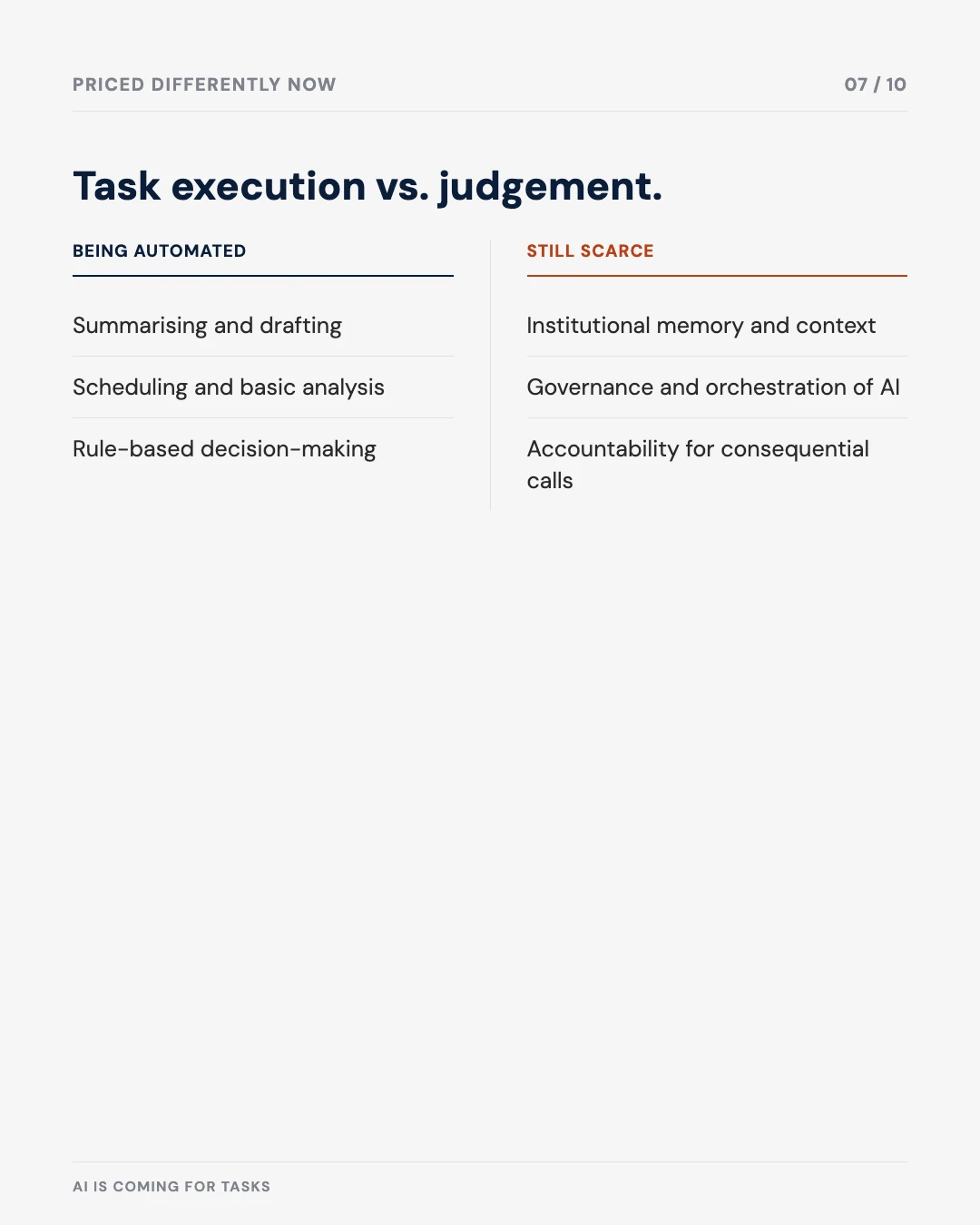
The practical implication is that senior professionals must conduct an honest audit of how much of their current role is task execution versus judgement, governance, and relationship management. Tasks that involve summarising, drafting, scheduling, basic analysis, or rule-based decision-making are being absorbed by AI tooling. The residual human value lies in the work that requires stakes, accountability, context, and ethical responsibility.
The residual human value lies in the work that requires stakes, accountability, context, and ethical responsibility.
- Develop Governance and Orchestration Competency
For many of us, the most valuable AI competency is not personal tool use, but the ability to guide and govern AI use within teams and organisations. This includes critically evaluating AI-generated outputs; identifying where AI use creates operational or regulatory risk; integrating AI into workflows without destabilising team dynamics; and maintaining accountability structures for automated processes.
We should strive to bridge the gap between AI capabilities and business processes, and translate AI outputs into organisational decisions with traceable accountability, which are increasingly in demand. This is the AI Orchestrator function, and it operates at every level from team lead to C-suite. AI governance, responsible AI frameworks, and the ability to manage AI risk are among the top competencies cited by employers in 2025 and 2026.
- Build an AI-Augmented Workflow. NOW, Not Later
Applied technology skills do not mean writing code; they mean developing integrated approaches where AI handles routine tasks while the professional focuses on nuanced, higher-order activities. The practical starting point is identifying two or three recurring tasks where an AI tool can save meaningful time, then systematically using it in those contexts.
Productivity gains from AI come from systematic integration into workflows, not from occasional experimentation. Oxford University research confirms that effective AI adoption depends on integrating AI into workflows and adapting business processes, not merely developing awareness of AI tools. Those who treat AI as an occasional aid rather than a structural component of their workflow will fall behind those who embed it consistently.
- Invest in the Skills AI Cannot Replicate
Employer surveys consistently identify the human capabilities that AI cannot replace or augment, such as ethical judgement, personalised service, team management, communication, and strategic thinking. These are precisely the capabilities that senior professionals have accumulated through career experience and that are difficult to codify or automate.
The professional who will remain indispensable is not the one with the deepest technical AI knowledge, but the one who can combine AI capability with ethical accountability, organisational influence, and the confidence to make consequential decisions that AI cannot be authorised to make alone. This requires deliberate investment in these human-centric capabilities, not passive reliance on accumulated experience.
- Treat Professional Networks as Infrastructure
Professionals with strong, maintained networks navigate career transitions significantly faster than those who rebuild networks reactively after displacement. The career resilience principle is structural: staying connected to one’s profession and community is one of the most reliable mechanisms for both achieving and maintaining career adaptability.
For senior professionals currently employed, the action is to invest in professional relationships now, before disruption arrives. For those already displaced, the priority is not to project confidence but to be genuinely useful to others navigating similar transitions.
Sharing knowledge, making introductions, and contributing to professional communities builds the social capital that translates directly into access to opportunities.
Was this useful?