
Listen to this article
Executive Summary
Adoption speed is not the same as strategic impact. Organisations that augment human skills with AI, rather than simply cutting headcount, are the ones capturing the return. The rest are stuck running pilots that never reach production.
95%
of enterprise AI pilots deliver zero measurable ROI, per MIT research
42%
of enterprises scrapped the majority of their AI initiatives in 2025
3.6x
higher three-year shareholder return for organisations that augment human skills with AI rather than replace headcount
21%
average wage growth among workers whose roles were augmented, not replaced
Core conclusions
- The real strategic question isn’t whether to adopt AI, it’s how to position it as a genuine multiplier rather than a productivity veneer.
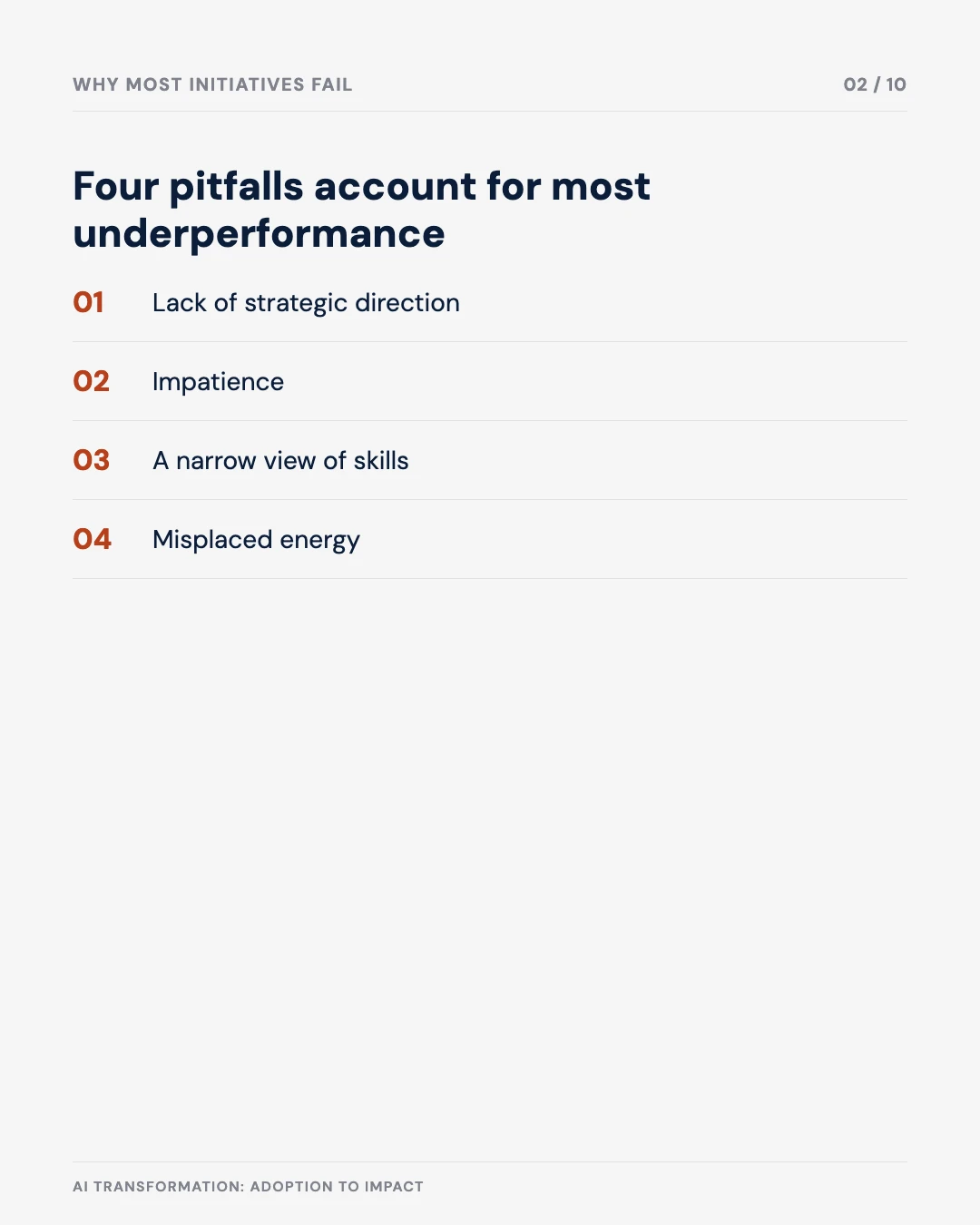
- Most underperformance traces to four consistent pitfalls: no strategic anchoring, impatience with the timeline, a too-narrow view of required skills, and misplaced energy on idea generation over execution.
- Lasting value comes from operating-model transformation, not tool deployment: shifting from static, asset-heavy structures to dynamic, AI-augmented ones across workflows, planning, capital, and pricing.
The argument, in ten slides
Save it, or send it to whoever is about to greenlight the next pilot.
The conversation around AI in enterprise has largely been shaped by two competing anxieties: the breathless pace of adoption, and the fear of being left behind. Neither extreme is a useful guide for leaders who need to make real decisions.
What the evidence actually tells us is more nuanced and more actionable.
The State of Enterprise AI Adoption
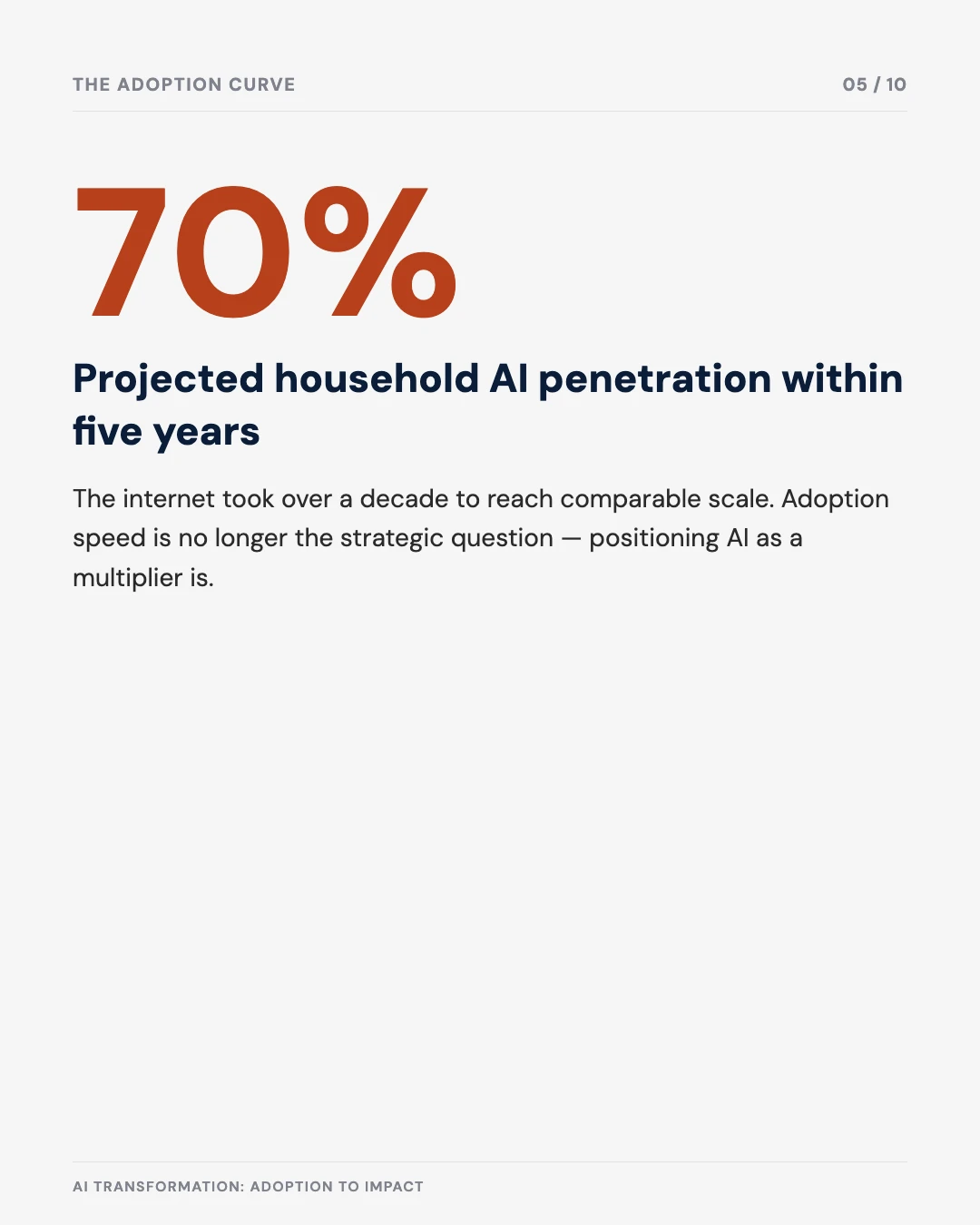
AI is being adopted faster than any technology in history, projected to reach 70% household penetration within five years of mainstream availability. For comparison, the internet took over a decade to reach comparable scale. In a recent global survey of 1,200 CEOs, technology disruption and AI integration risk ranked as the number one concern (32%), edging out talent constraints (31%) and innovation capacity (30%).
That anxiety is understandable. But the more important strategic question is not whether to adopt AI, it is how to position it as a genuine multiplier for transformation rather than a productivity veneer.
The trajectory of AI deployments tells part of the story. We have moved from reactive chatbots to proactive co-pilots, and now increasingly toward autonomous agents capable of orchestrating multi-step decisions without human intervention. The next horizon is embedded and embodied AI operating within physical systems which is already visible in infrastructure, logistics, and smart city deployments across Asia and the Middle East.
From a macroeconomic perspective, the stakes are significant. AI is projected to contribute trillions to regional GDP by 2030, with Asia alone expected to capture a disproportionate share of that value. Companies positioning AI as a transformation tool are already reflected in equity markets, where AI-integrated firms are materially outperforming broader indices.
Why Most AI Initiatives Fail
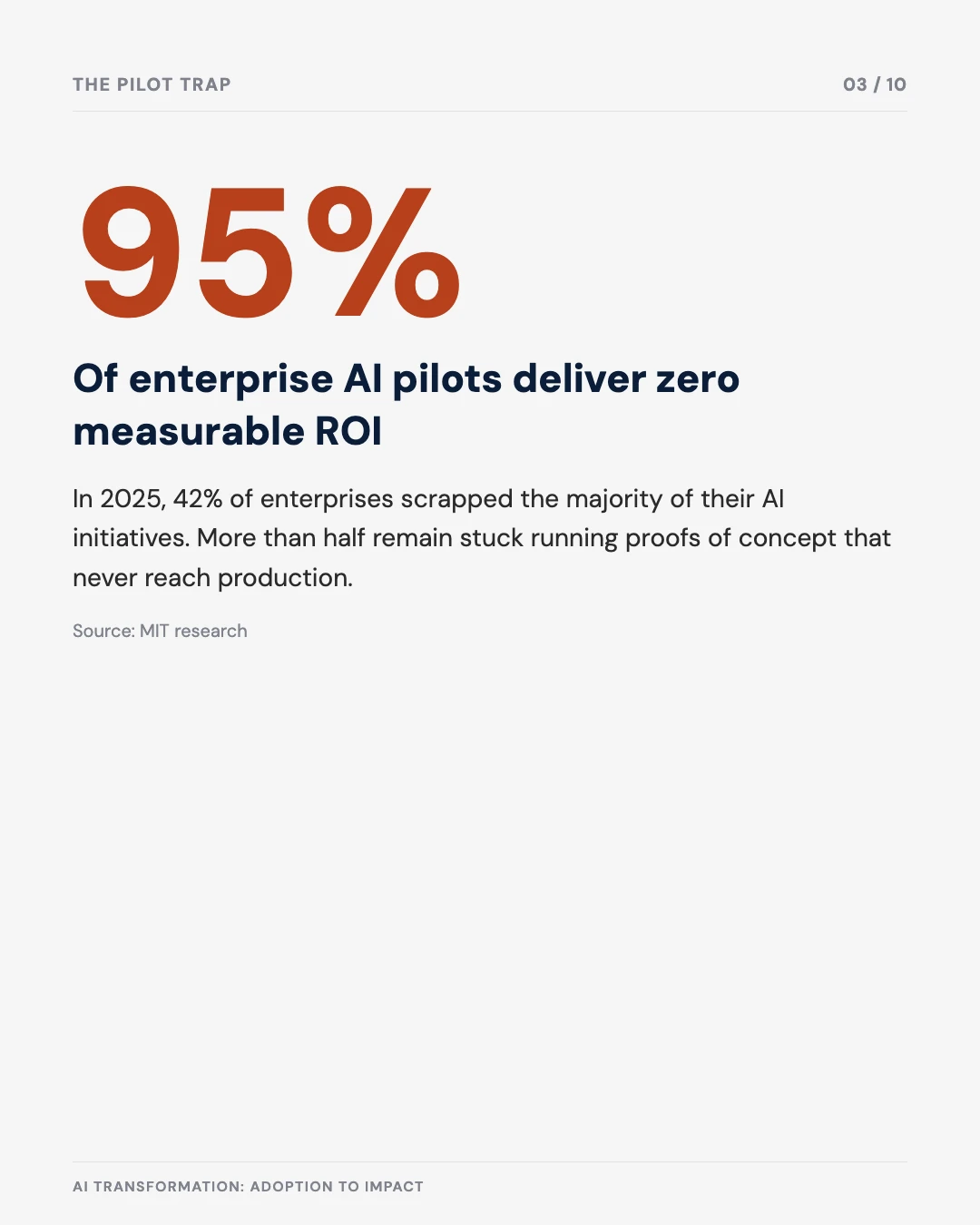
Despite the scale of investment, the results are troubling. According to MIT research, 95% of enterprise AI pilots deliver zero measurable return on investment. In 2025, 42% of enterprises scrapped the majority of their AI initiatives. More than half of organisations remain stuck in what practitioners call the “Experimenting” phase - running proofs of concept that never reach production.
The failure patterns are consistent across industries and geographies. Four pitfalls account for the majority of underperformance.
- Lack of strategic direction. Many organisations obsess over AI use cases (generating lists, running workshops, benchmarking competitors) rather than anchoring their AI agenda to the core business problems they are trying to solve. Use cases without strategic grounding become a catalogue of disconnected experiments. I break down this exact failure pattern in Why Most AI Projects Fail.
- Impatience. AI transformation is not a software rollout. Organisations that expect meaningful returns within a single quarter, without building the underlying data infrastructure, workflows, and capability, will consistently disappoint themselves and their stakeholders.
- Narrow view of skills. The discourse has focused heavily on prompt engineering, when the actual capability requirement is far broader: data literacy, ethical judgement, workflow redesign, and change management. Seventy percent of companies have trained fewer than 25% of their workforce on AI tools. That gap is not a training budget problem. It is a transformation strategy problem.
- Misplaced energy. Too much organisational effort goes into idea generation and too little into the harder work of changing culture, redesigning operating models, and rewiring workflows. Ideas are not scarce. Execution capacity is.
Rethinking AI’s Impact on Work
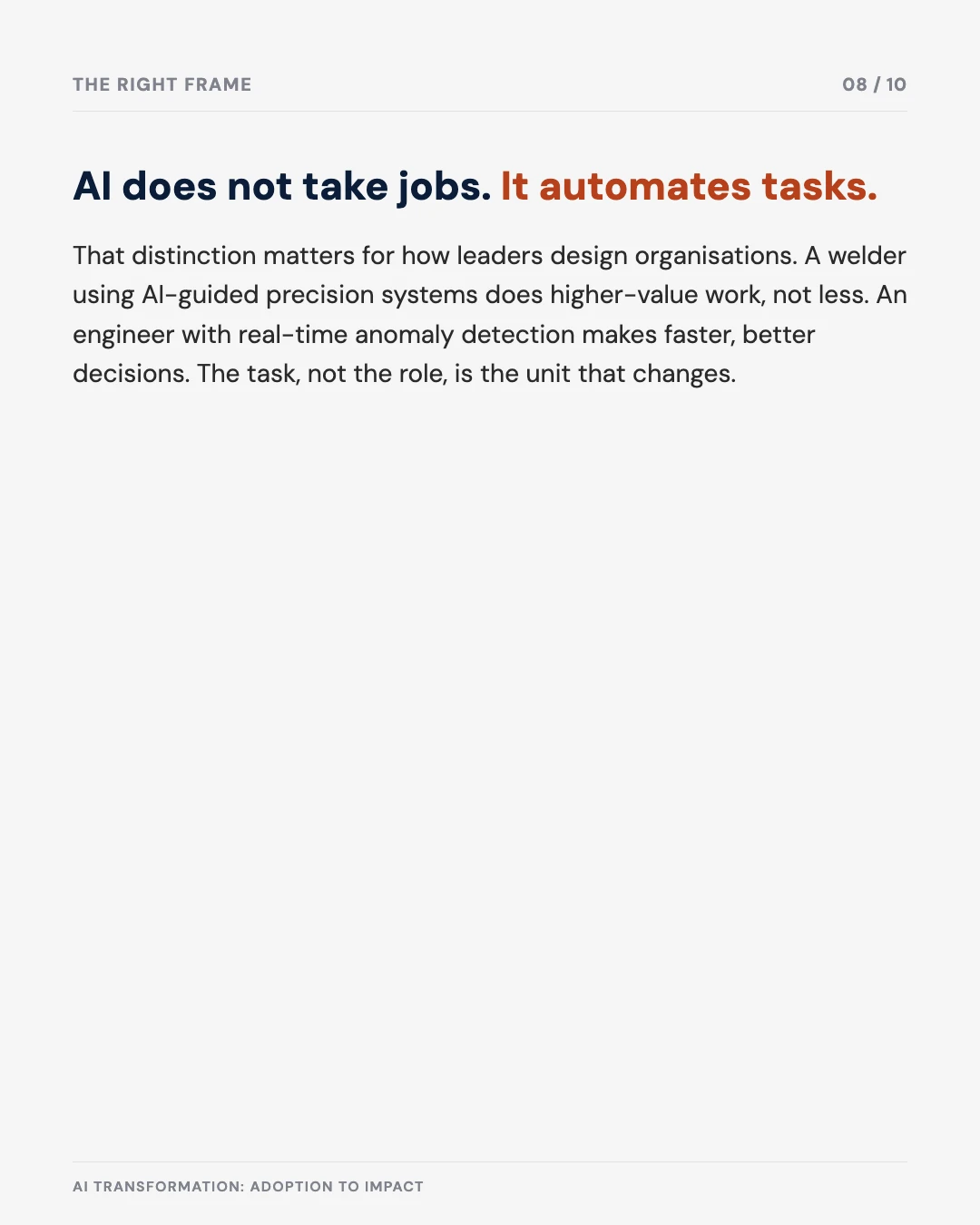
The framing of “AI taking jobs” obscures a more accurate and more useful analysis. AI does not take jobs. It automates tasks, and that distinction has significant implications for how leaders design organisations and manage workforce transitions.
AI does not take jobs. It automates tasks.
A more productive lens is task-based; breaking roles into non-routine cognitive work, routine cognitive work, non-routine physical work, and routine physical tasks. Historically, industrial robots automated routine physical tasks. Enterprise software automated routine cognitive tasks. AI is now pushing into non-routine cognitive territory: the domain of analysis, judgement, communication, and problem-solving that was previously the exclusive preserve of knowledge workers.
This creates displacement risk in some areas and augmentation opportunity in others. A welder using AI-guided precision systems does higher-value work, not less. An engineer with access to real-time AI anomaly detection makes faster, better decisions. A project manager using predictive analytics for risk mapping operates with a level of foresight that was previously impossible at their resource level.
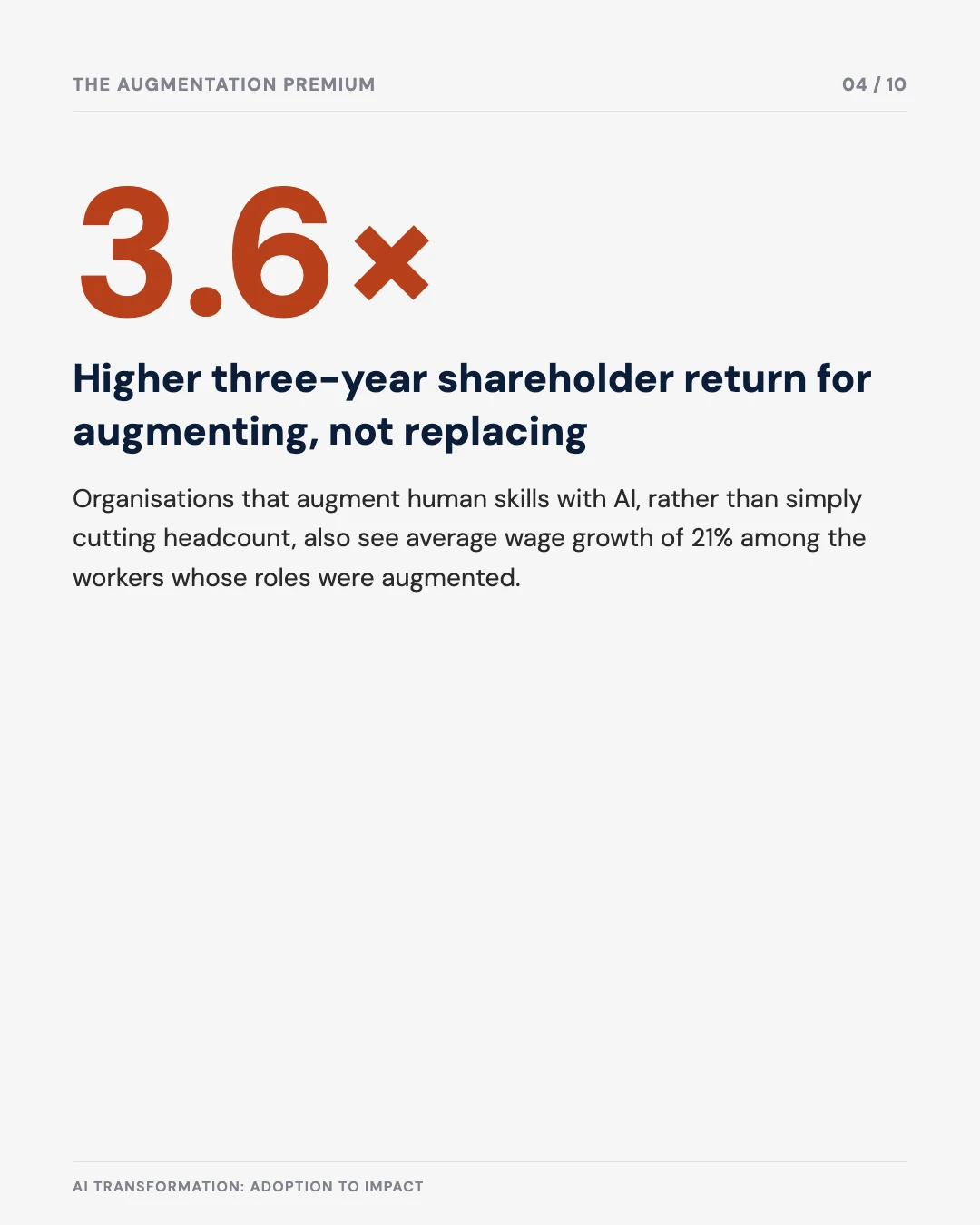
The evidence on augmentation is compelling. Organisations that augment human skills with AI, rather than simply replacing headcount, achieve 3.6 times higher three-year total shareholder return and average wage growth of 21% among affected workers.
The impact also varies significantly by sector. Consumer-facing and logistics-intensive industries are primarily deploying AI for operational productivity and back-office transformation. Information-intensive industries (financial services, media, and software) face more structural disruption, as AI challenges the core commercial models and product delivery mechanisms on which their business models are built.
From Legacy Operating Models to AI-Enabled Enterprises
The deepest transformation is not in any individual tool or workflow. It is in the operating model itself.
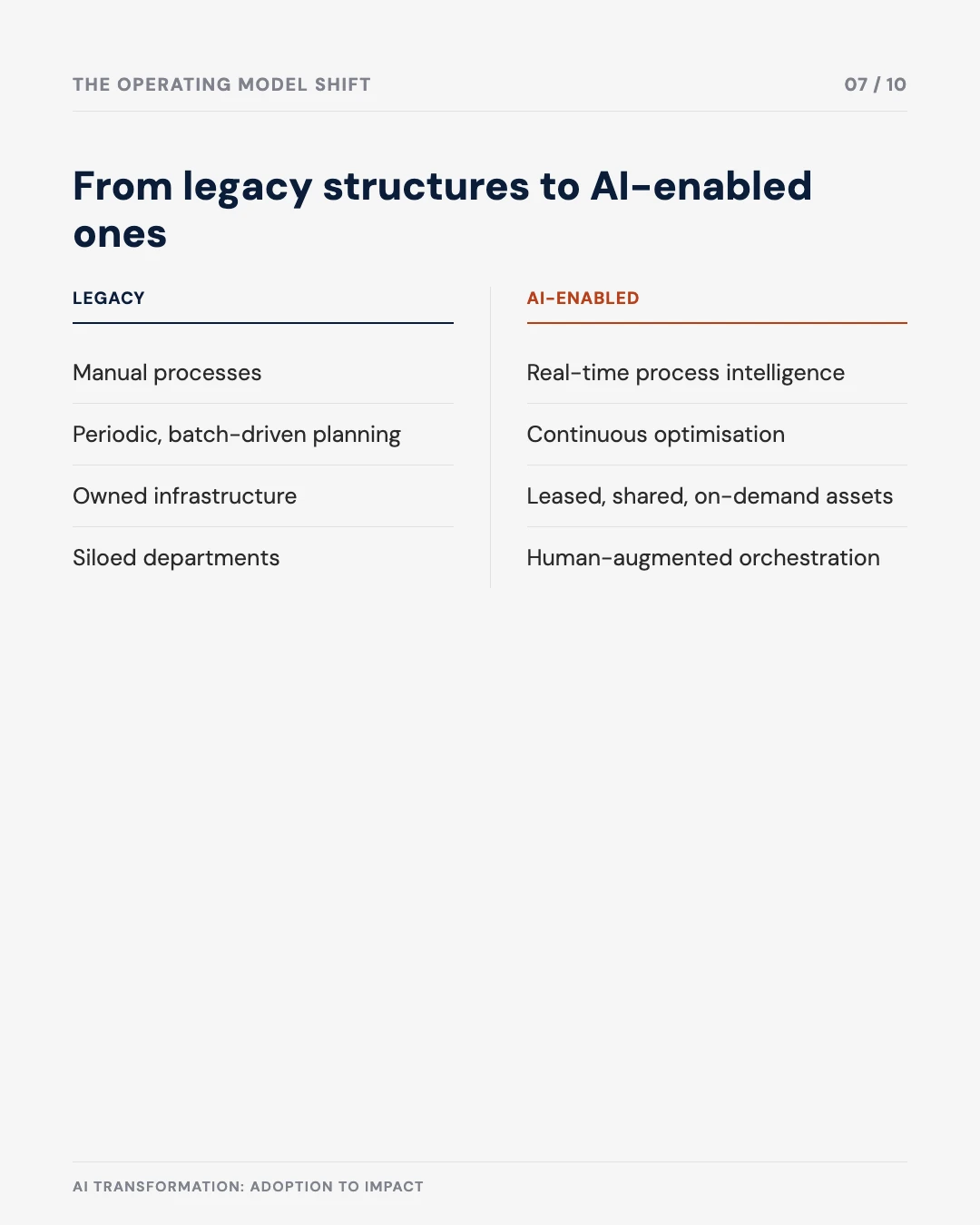
Organisations that extract lasting value from AI share a common trajectory: they shift from static, manual-intensive, asset-heavy structures to dynamic, AI-augmented, asset-light ones. This plays out across every dimension of the enterprise.
Workflows move from manual processes to AI-automated pipelines with real-time process intelligence. Planning cycles shift from periodic, batch-driven exercises to continuous optimisation. Capital structures transition from owned infrastructure to leased, shared, and on-demand assets. Organisational design evolves from siloed departments to lean, human-augmented orchestration layers. Pricing models migrate from volume-based to value-based, with outcomes-based and subscription structures becoming the norm. I make the full case for that pricing shift in The End of Billing for Time. And customer relationships shift from transactional to personalised, building what the best organisations now call relationship capital.
The logistics sector illustrates this concisely. AI is enabling order intake automation, dynamic route optimisation, asset-light business models, paperless documentation via electronic bills of lading, predictive exception handling, and real-time capital optimisation, all at once. The result is not just efficiency; it is a structurally different business.
A Systematic Path to Strategic AI
Given the complexity, organisations benefit from a disciplined, phased approach rather than a parallel-everything strategy.
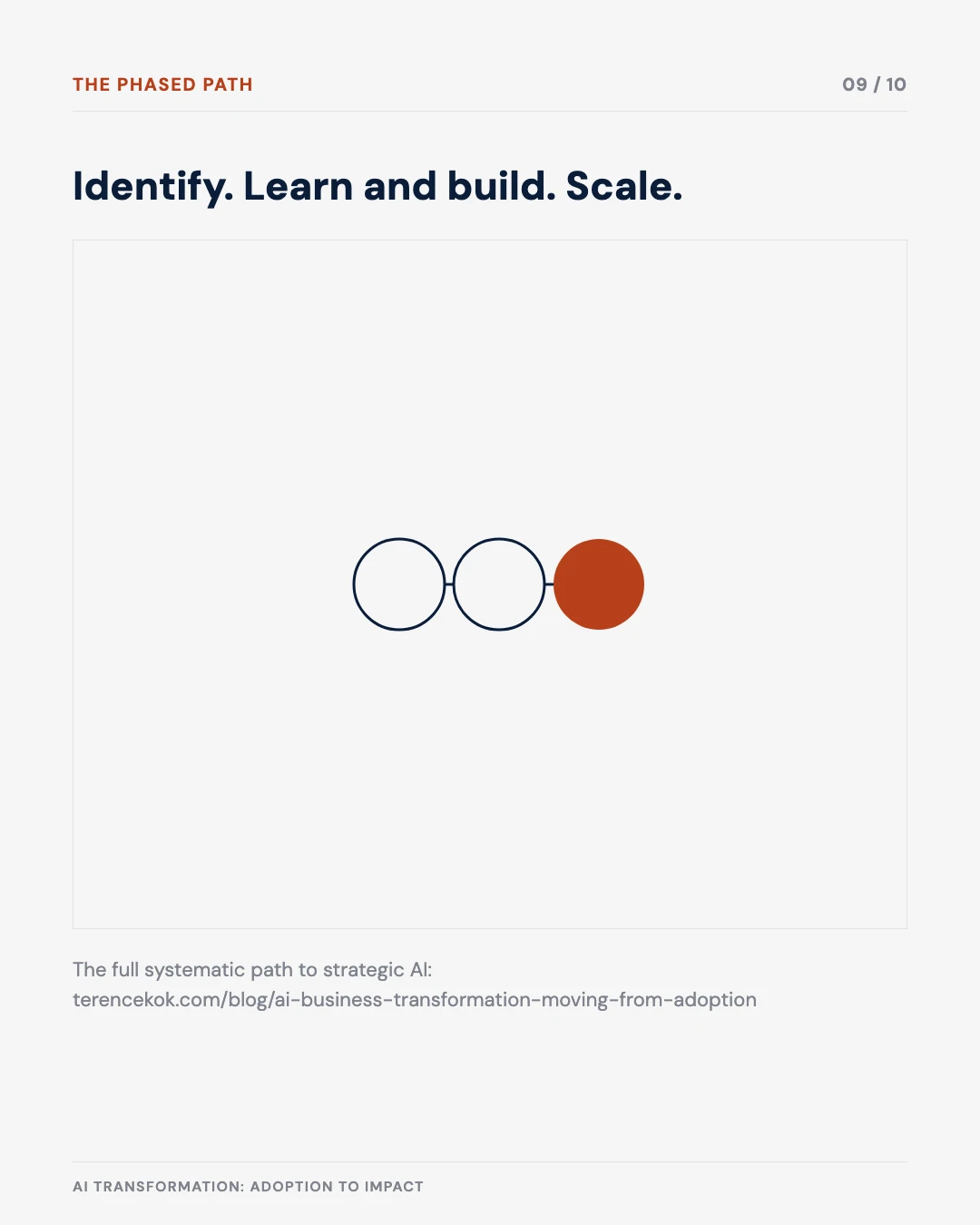
- Identification: scanning the technology landscape, mapping task groups across the organisation, and identifying where AI augmentation creates the most meaningful leverage, not just the most visible opportunity.
- Learning and building: diagnosing root causes, developing a minimum viable product, and rigorously measuring. This phase is where most organisations either build the habit of evidence-based iteration or fall back into the pilot trap.
- Scaling: developing a transformation roadmap, redesigning the operating model around AI-native workflows, and managing the cultural and organisational change that strategic AI demands.
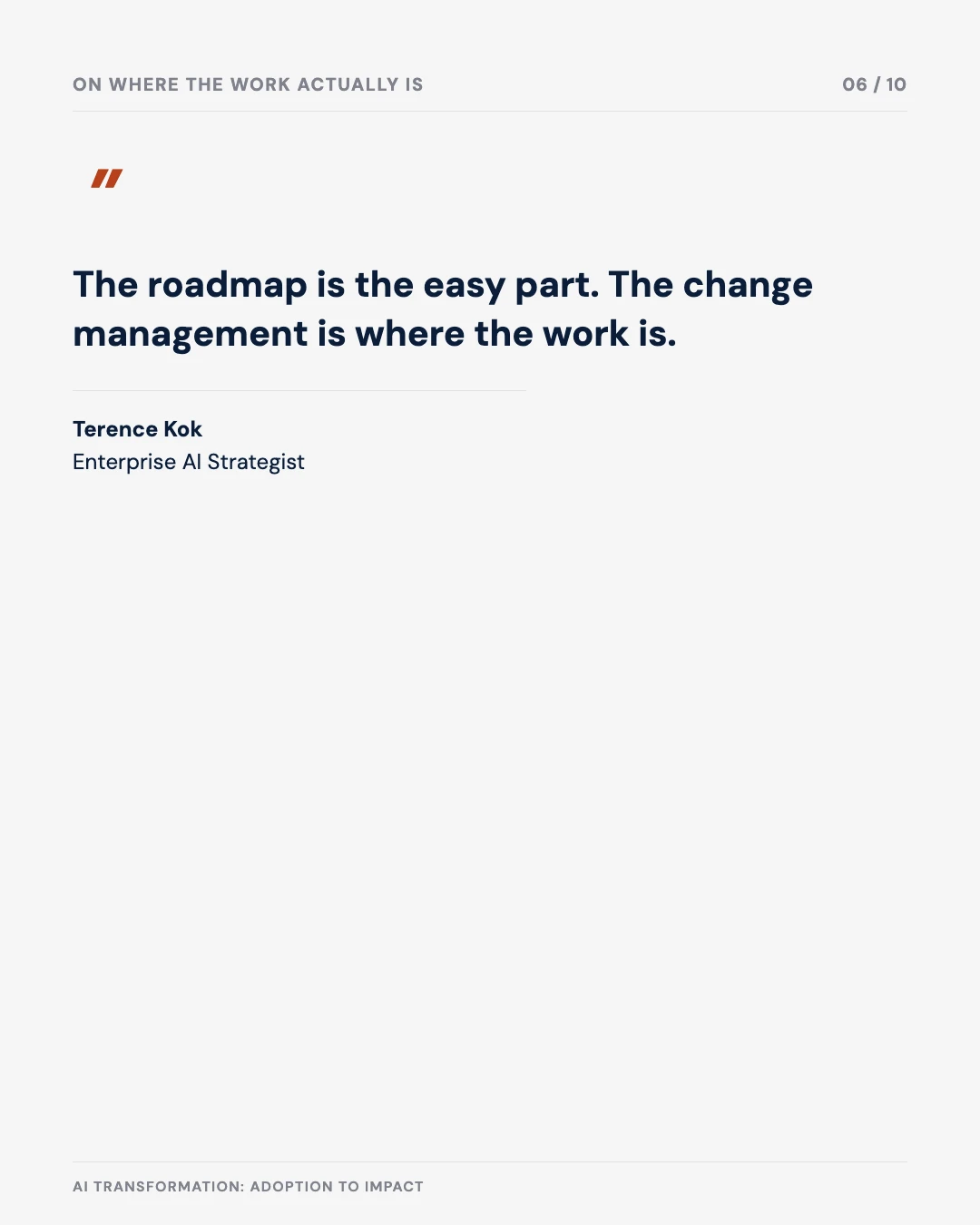
The roadmap is the easy part. The change management is where the work is.
Strategic AI transformation is not about deploying the most tools, running the most pilots, or benchmarking the highest adoption percentages. It is about making deliberate choices (which problems to solve, which workflows to redesign, which human capabilities to build) and executing with the patience and rigour that genuine transformation requires.
The organisations that get this right will not just be more efficient. They will be structurally different, and structurally advantaged, from the ones that do not.
Free tool
AI Use Case Prioritisation Matrix
The Identification phase means finding where AI augmentation creates real leverage, not just visible opportunity — score your candidates and get a ranked sequence instead of a wish list.
Free tool
AI ROI Calculator
95% of pilots deliver zero measurable ROI because nobody modelled the return before greenlighting them — build the financial case first.
Was this useful?