
Listen to this article
Executive Summary
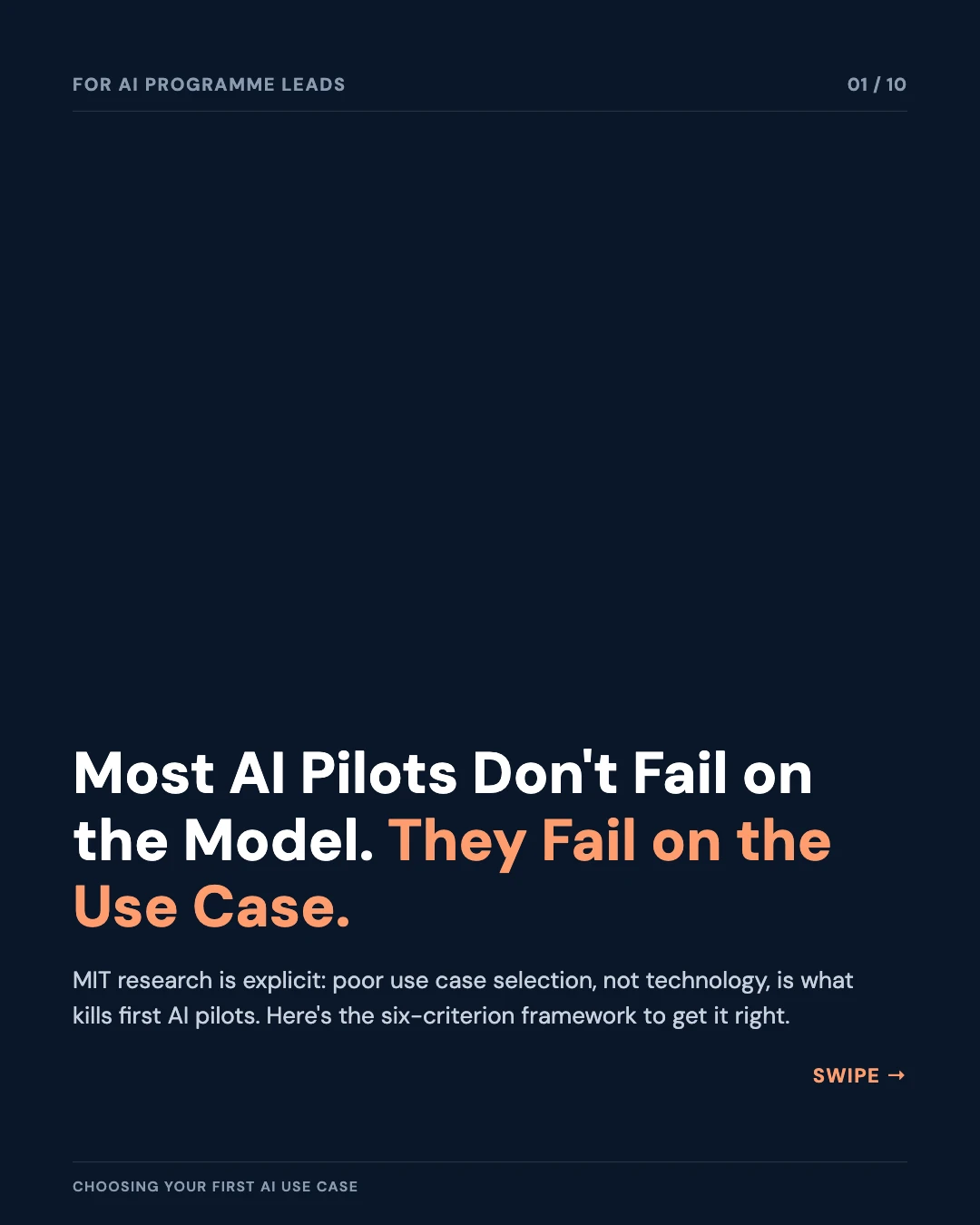
MIT research is explicit: most AI pilot failures come from poor use case selection, not model quality. The first two or three use cases in a programme carry disproportionate weight. Get the selection right and they build the coalition that carries the programme to scale.
Core conclusions
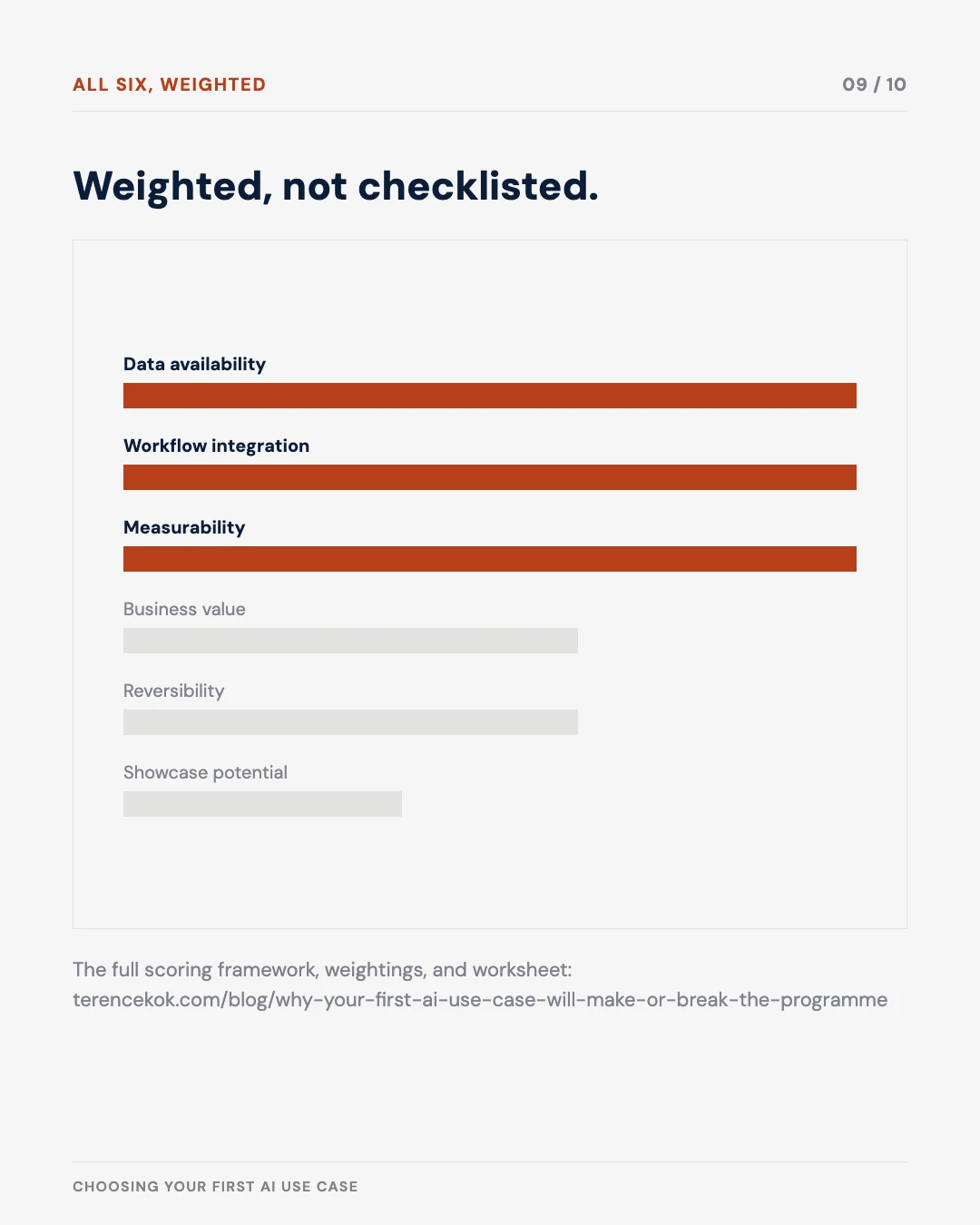
- Score candidates against six weighted criteria: data availability, workflow integration, and measurability are the high-weight gates; business value, reversibility, and showcase potential matter less but still inform the final call.
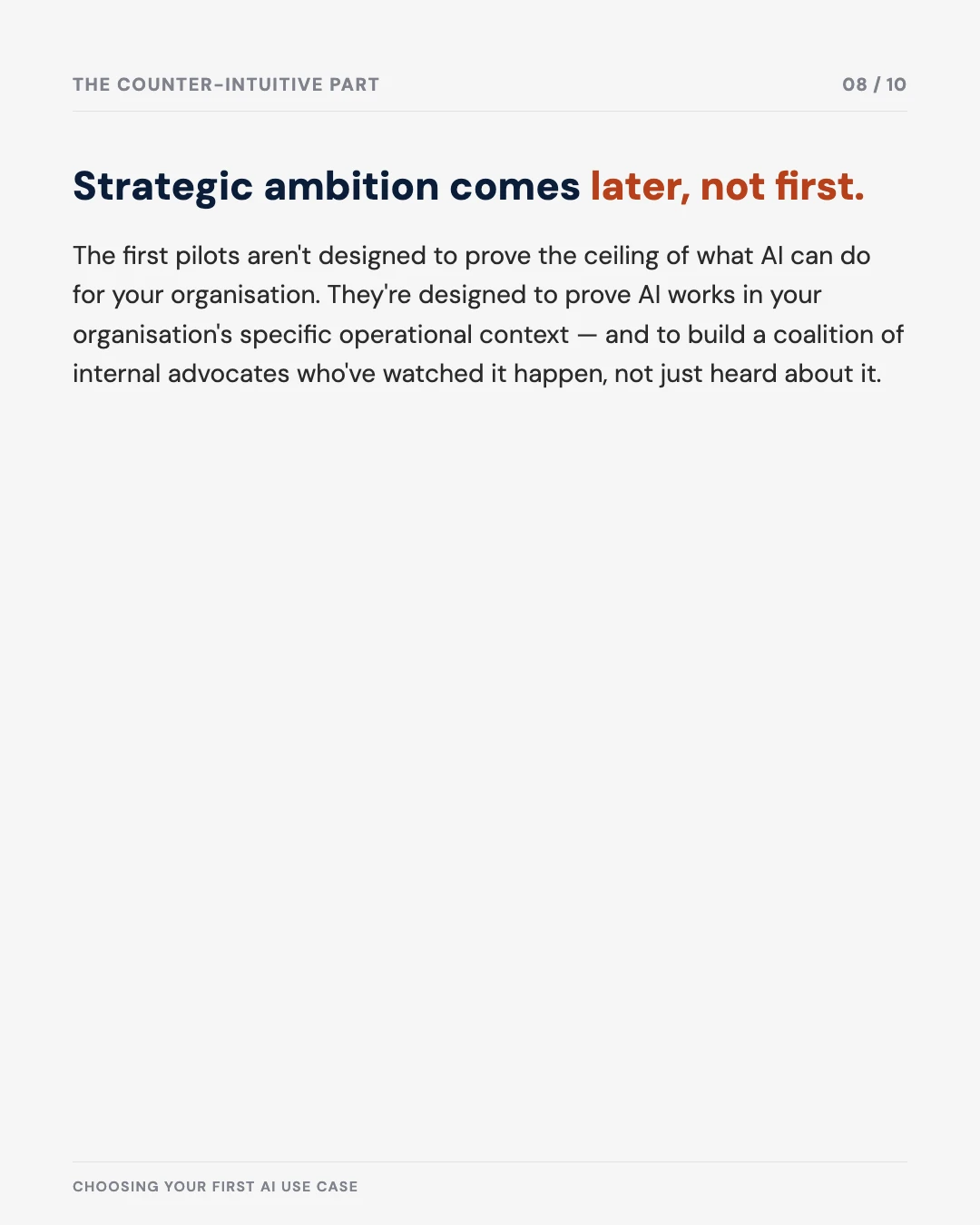
- The correct logic is inverted from instinct: first pilots shouldn’t demonstrate AI’s ceiling, they should prove AI works in your organisation’s specific operational context.
- Strategic ambition belongs in Phase 2 and 3, once the organisational capability and operational discipline exist to handle complex use cases, not in the first pilot.
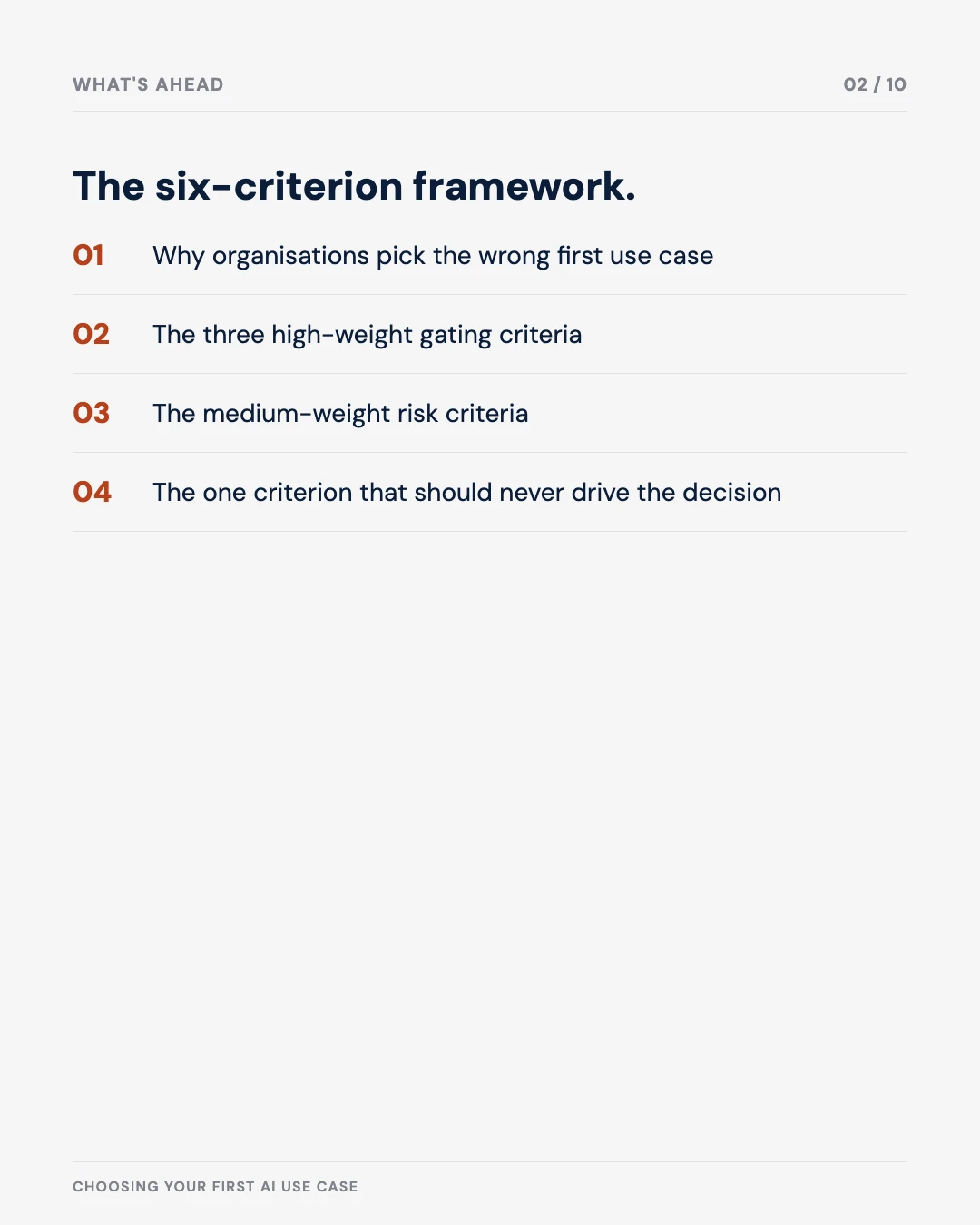
The six-criterion framework, in ten slides
Save it, share it, or send it to whoever’s picking the first pilot.
The most consequential decision in any AI transformation programme is not which model to use, which vendor to engage, or how much to spend. It is which use case to start with.
MIT research is explicit on this point: the majority of AI pilot failures are caused by poor use case selection, not by model quality or technology limitations. Organisations choose use cases that are too strategically ambitious, too technically complex, or too dependent on data that does not exist in a usable form. The model does not fail. The selection process failed before the model was ever involved.
The model does not fail. The selection process failed before the model was ever involved.
The first two or three use cases in a programme carry disproportionate weight. If they succeed, they build the internal coalition that carries the programme into scale. If they fail, they hand the sceptics evidence they will use to resist AI adoption for years.
Selecting them correctly is the highest-leverage decision you will make.
Why organisations pick the wrong use cases
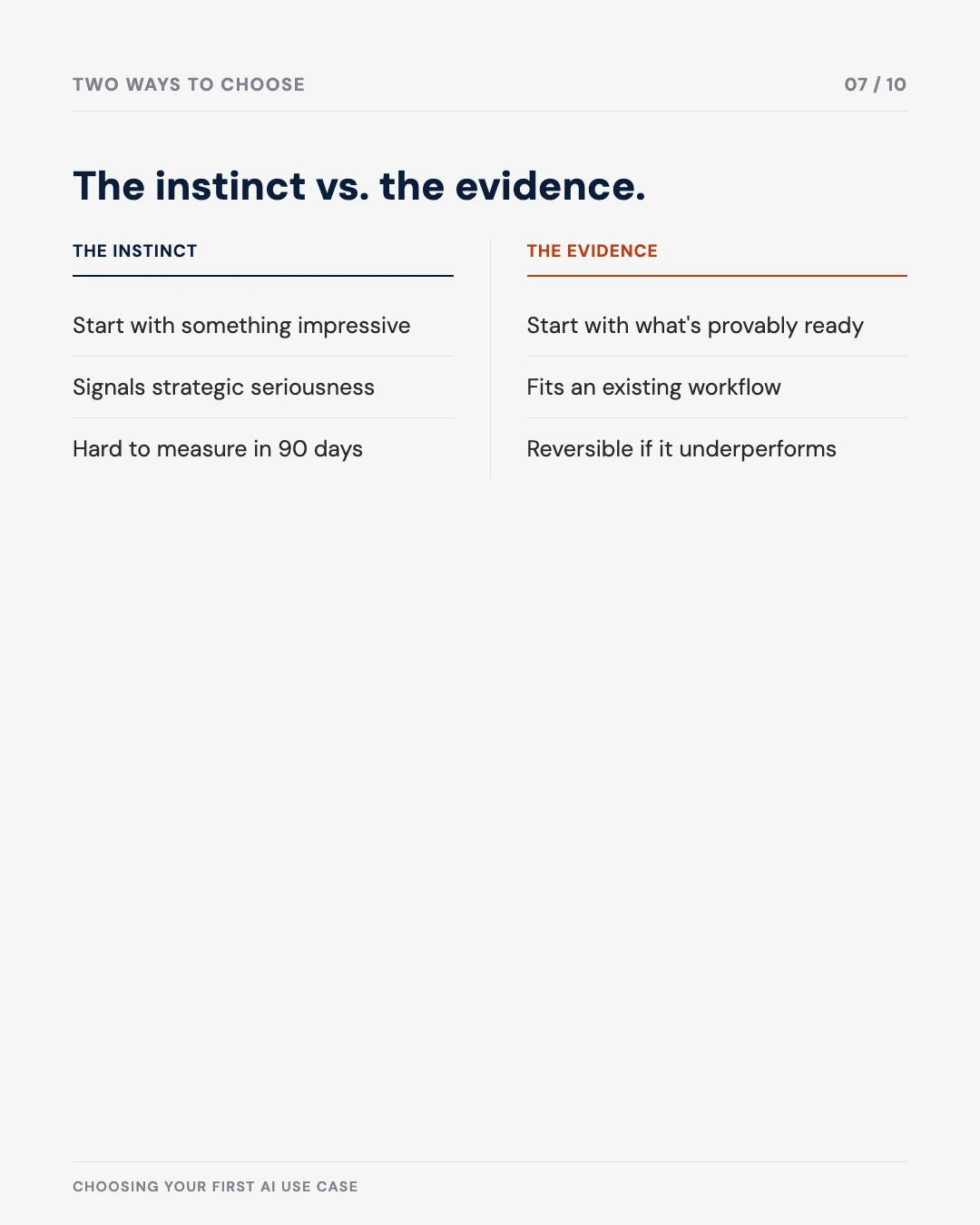
The instinct when launching an AI programme is to start with something impressive: a use case that signals strategic seriousness, demonstrates AI’s transformative potential, and generates executive attention.
This instinct produces the wrong selection.
Strategically ambitious use cases tend to be technically complex, data-dependent in ways that reveal unresolved problems, and difficult to measure on the 90-day timelines that first pilots require. They are also the use cases where failure is most visible and most damaging.
The correct logic is inverted: the first pilots are not designed to demonstrate the ceiling of what AI can do for your organisation. They are designed to demonstrate that AI works in your organisation’s specific operational context, which is a different and more useful thing to prove.
The six selection criteria
Evaluate candidate use cases against six criteria. Apply weightings, not a simple checklist: the highest-weighted criteria should be the primary gate.
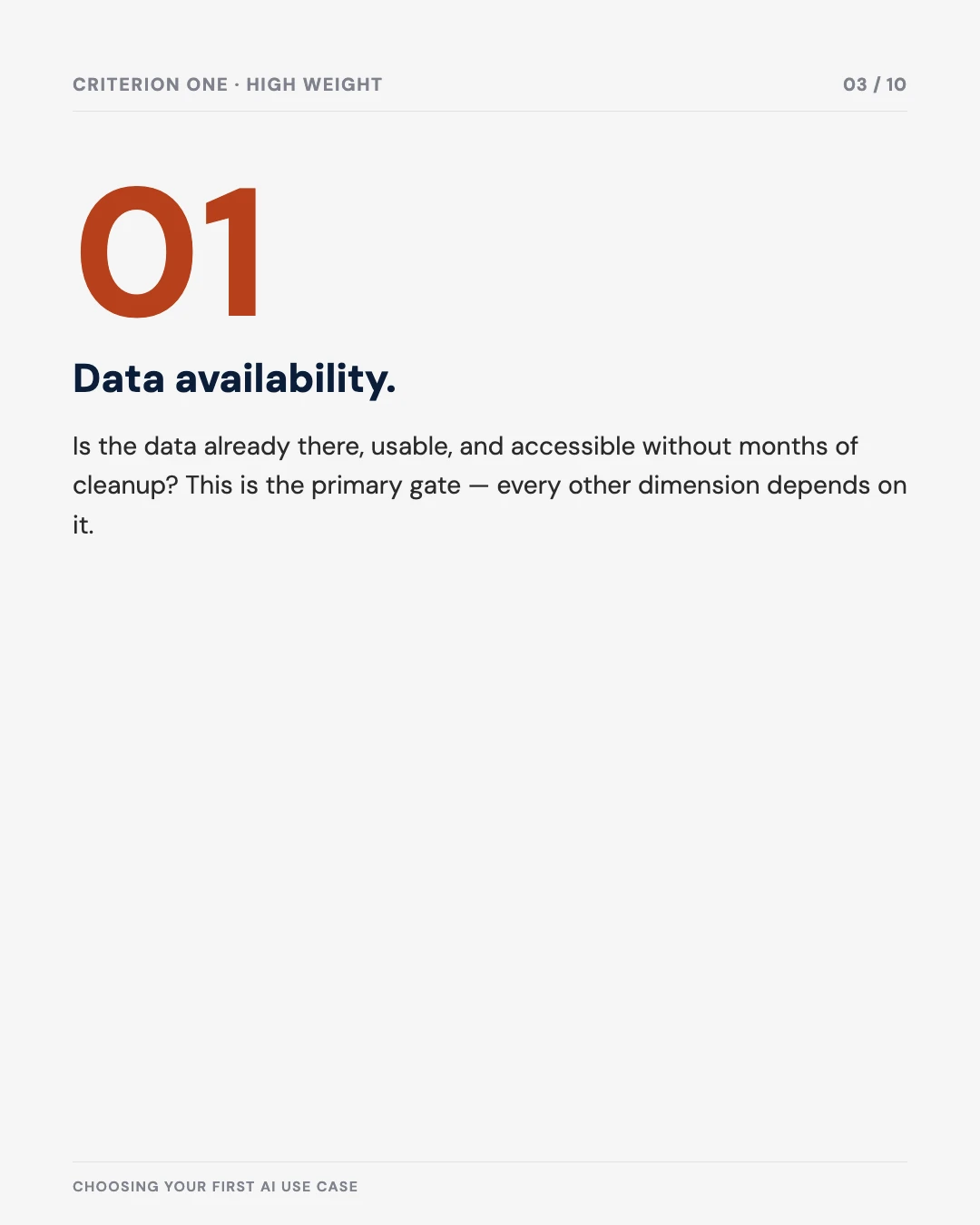
1. Data availability (High weight)
Is the data your AI system will need already available, in a usable format, and accessible without major preparation work?
This is the primary gate because every other dimension depends on it. A use case with excellent strategic value, clear measurability, and strong executive support will fail if the underlying data does not exist, is scattered across disconnected systems, or requires months of cleaning before it can be used. Data readiness problems that surface during a pilot delay timelines, consume resources, and undermine confidence, even when they have nothing to do with the AI approach itself.
Candidates that require significant data preparation before the pilot begins should be deprioritised for the first wave. They are not eliminated. They should be developed in parallel with the pilot programme. But they should not be the first thing you attempt.
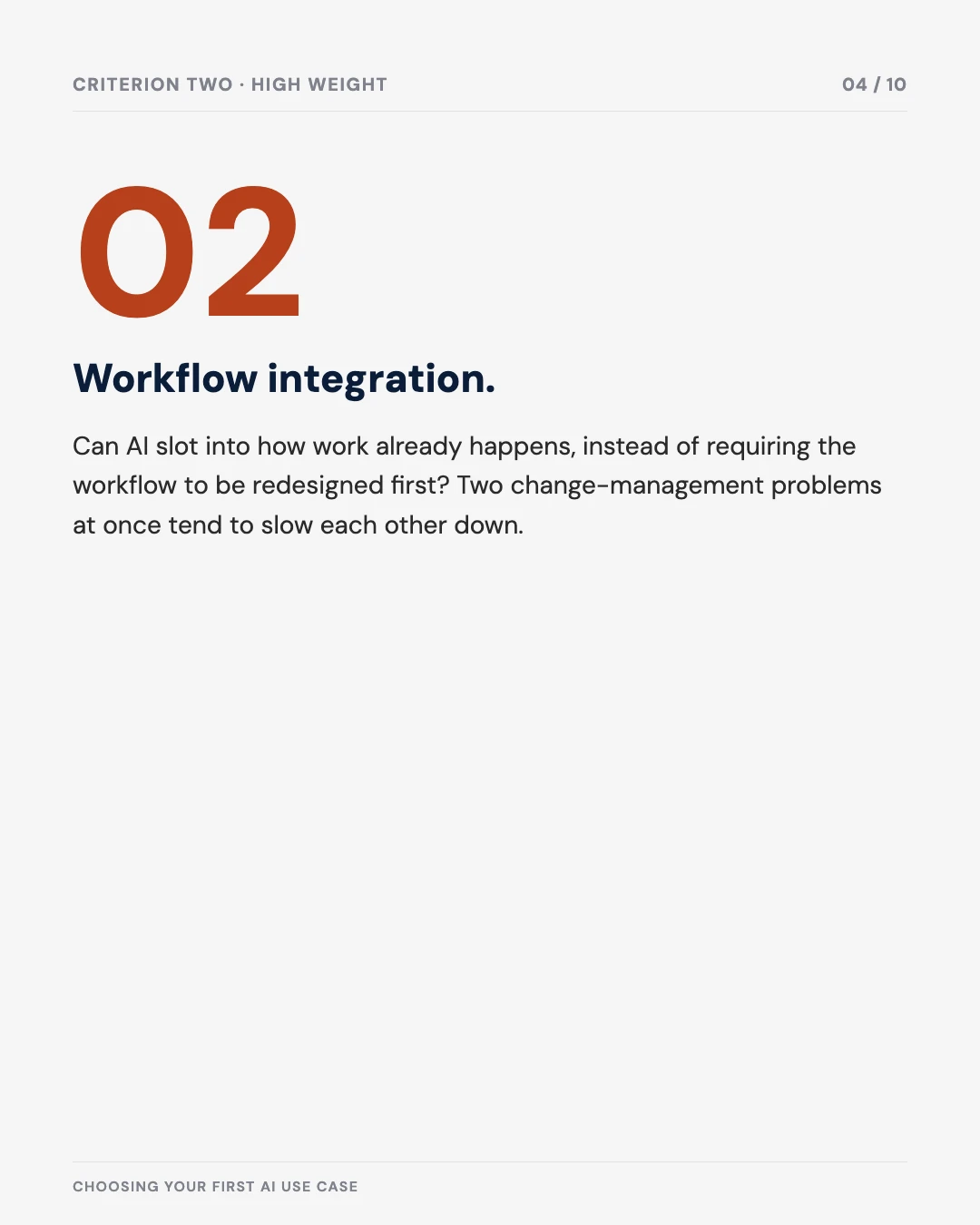
2. Workflow integration (High weight)
Can AI be integrated into an existing workflow without requiring that workflow to be redesigned first?
AI performs best when it fits into how work already gets done rather than requiring a new way of working as a precondition for adoption. Use cases that require workflow redesign before the AI can be useful introduce a second change management challenge on top of the AI adoption challenge. Both tend to slow each other down.
The cleanest first use cases insert AI at a specific decision point or task within an existing process, replacing or augmenting one step, not restructuring the surrounding system.
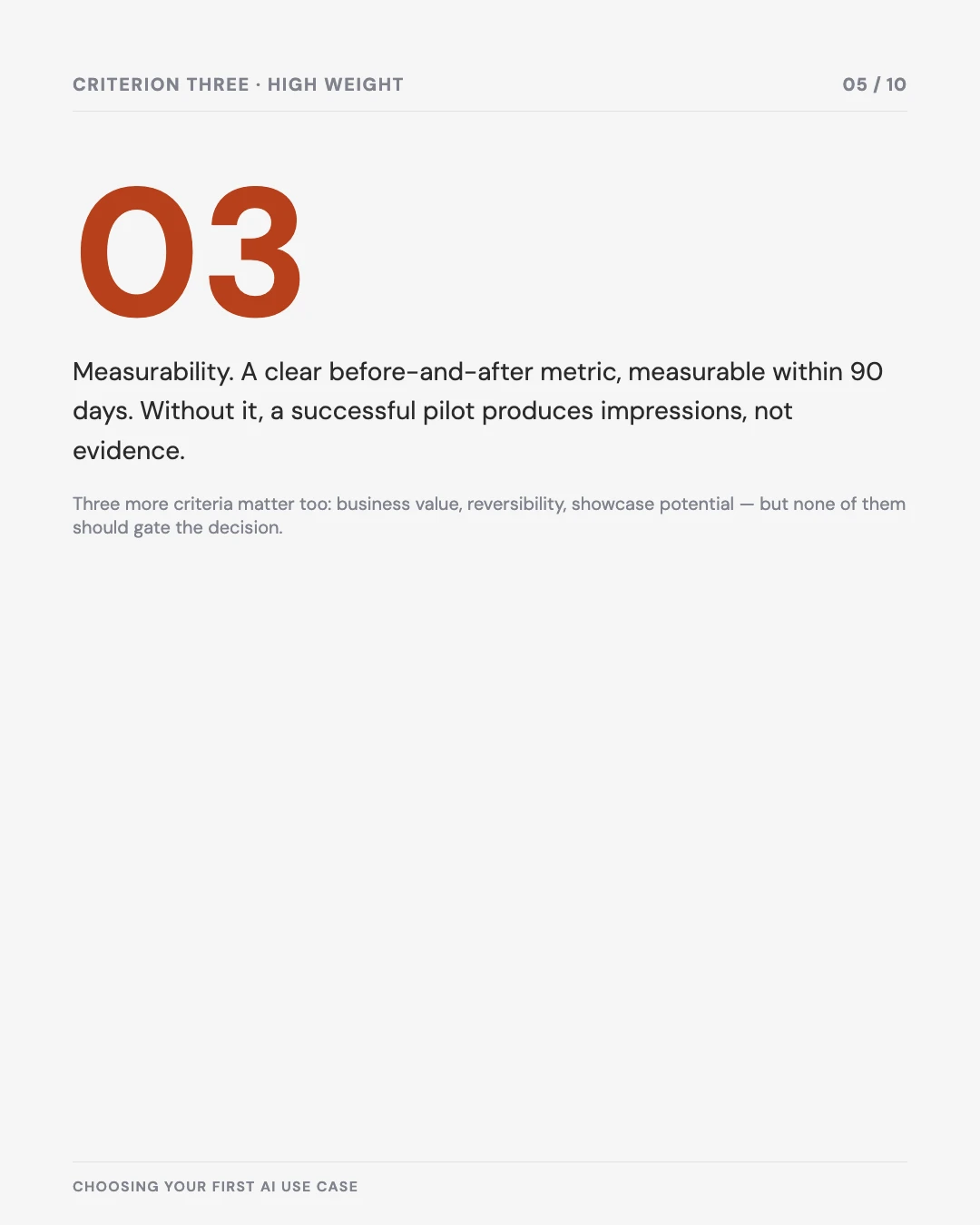
3. Measurability (High weight)
Is there a clear before-and-after metric that can be measured within 90 days?
Without a defined baseline measurement taken before the pilot begins, you will have no way to demonstrate that the AI produced the outcome you expected. Post-hoc measurement attempts are compromised by uncertainty about what the baseline actually was. The result is a completed pilot that produced positive impressions but no evidence, which is nearly useless for building the organisational case for scale.
Measurable use cases typically involve time savings, error rate reduction, or output volume. Time-and-motion baselines for the existing process, taken before the pilot begins, are the foundation of any credible business case.
4. Business value (Medium weight)
Is the value to the team or organisation material: time saved, risk reduced, quality improved?
This criterion is weighted medium, not high, because low-value use cases that are easy to deploy are still the wrong starting point. The first pilots need to be meaningful enough that success generates genuine enthusiasm, not just acknowledgement. A use case that saves 20 minutes per week per person matters. A use case that saves 20 minutes per month does not generate advocacy.
The question is whether the value, if demonstrated, would be significant enough that the team involved would actively promote the approach to their colleagues.
5. Reversibility (Medium weight)
If the AI application underperforms, can the conventional approach be resumed without disruption?
First pilots should be selected from use cases where an underperforming AI deployment can be turned off and the previous process reinstated. This is a risk management criterion, not a pessimistic one. Reversibility allows you to design pilots that fail safely, where the learning from failure is recoverable without operational disruption.
Use cases that are irreversible once AI is integrated (because the original process has been dismantled) raise the stakes of failure to a level that is inappropriate for the first wave of any programme.
6. Showcase potential (Low–Medium weight)
Will success with this use case build confidence and advocacy within the broader organisation?
This criterion is last because it should not drive selection, but it should inform the final choice between candidates that score equally well on the higher-weighted criteria. A use case whose success story travels well within the organisation (because the problem is relatable, the results are visible, or the team involved is respected) has outsized change management value beyond its direct impact.
The counter-intuitive conclusion
Use cases should be selected primarily for data availability, workflow integration, and measurability, not for strategic ambition or commercial value.
Strategic value is what the AI programme delivers across Phase 2 and Phase 3, when the organisational capability and operational discipline to handle complex use cases has been built. The purpose of the first pilots is narrower: demonstrate that AI can be deployed reliably in this organisation’s specific context, build a coalition of internal advocates who have experienced it working, and establish the operational rigour of production AI deployment.
An AI programme whose first pilots succeed on these terms (modest scope, clear measurement, genuine operational impact) is in a far stronger position to pursue strategic use cases than one that launched with an ambitious first pilot, experienced the delays and complications that complex use cases typically produce, and spent its political capital defending a difficult start.
Score your candidates honestly. Weight data availability, workflow integration, and measurability most heavily. Choose the use cases that score highest on the criteria that determine whether pilots actually reach production, not the criteria that make them sound most impressive in a board presentation.
The impressive story comes later. The foundation has to come first.
Free tool
AI Use Case Prioritisation Matrix
Score up to three candidate use cases across the same weighted criteria this article describes and get a ranked implementation sequence.
Free tool
AI Readiness Self-Assessment
Confirms whether the data and operational readiness conditions actually exist for your leading candidates before the pilot begins.
For candidate tasks heading toward agent deployment, the TRACE Agent Evaluation tool verifies structural suitability before architecture decisions are made.
Was this useful?