
Listen to this article
Executive Summary
LLMs are hitting architectural, data, and economic limits that more scale won’t fix: 95% of organisations report zero measurable ROI on generative AI deployments, and the failure pattern points to the technology, not immature implementation.
Core conclusions
- Public training data is running out (Anthropic’s Dario Amodei puts a 10% probability on scaling stagnating from data scarcity), transformer attention scales quadratically, and hallucination rates in the newest reasoning models run 33-79%. None of these are fixable by more data or fine-tuning alone.
- Gartner forecasts organisations will use small, task-specific models three times more than general-purpose LLMs by 2027, with domain-specific models already hitting 80-90% of large-model capability at a fraction of the compute.
- The likely direction is specialisation and hybrid design: domain-specific models, neuro-symbolic architectures, world models, and multi-agent orchestration, not bigger general-purpose LLMs.
The case, in ten slides
Save it, share it, or send it to whoever owns your architecture roadmap.
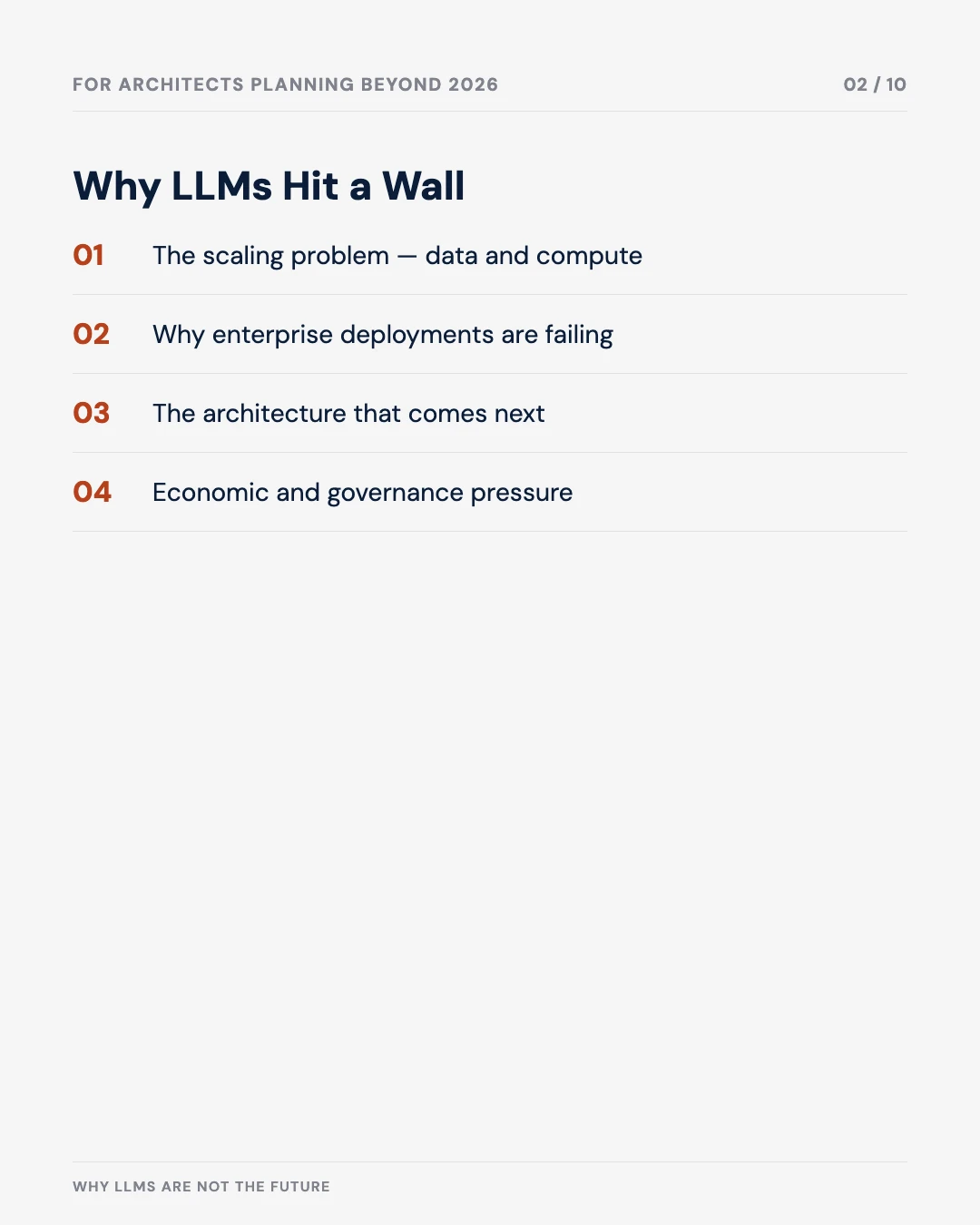


Large Language Models have dominated the artificial intelligence discourse since 2022, yet accumulating evidence from technical research, enterprise deployments and architectural analysis indicates that LLMs represent an evolutionary dead end rather than a pathway to sustainable AI systems. This assessment is grounded in fundamental limitations across training data availability, computational architecture, operational performance and economic viability.
The Scaling Problem
The most immediate constraint facing LLM development is the exhaustion of public human-generated text data. Research projecting dataset requirements against available data stocks indicates that models will consume datasets roughly equal to the available stock of public human text between 2026 and 2032. At 15 trillion tokens, current training sets approach the upper limit of high-quality public text. This data scarcity is not theoretical. It is now constraining development. Leading AI researchers including Dario Amodei of Anthropic estimate a 10% probability that AI scaling stagnates due to insufficient data. Synthetic data generation demonstrates mixed effectiveness with diminishing returns and model collapse phenomena.
More fundamentally, no quantity of additional training data overcomes the core architectural limitations of LLMs around generalisation, continual learning and goal-directed behaviour. Current systems prioritise memorisation over cognitive development, creating models that excel at pattern matching whilst lacking genuine understanding of causality, context and reasoning.
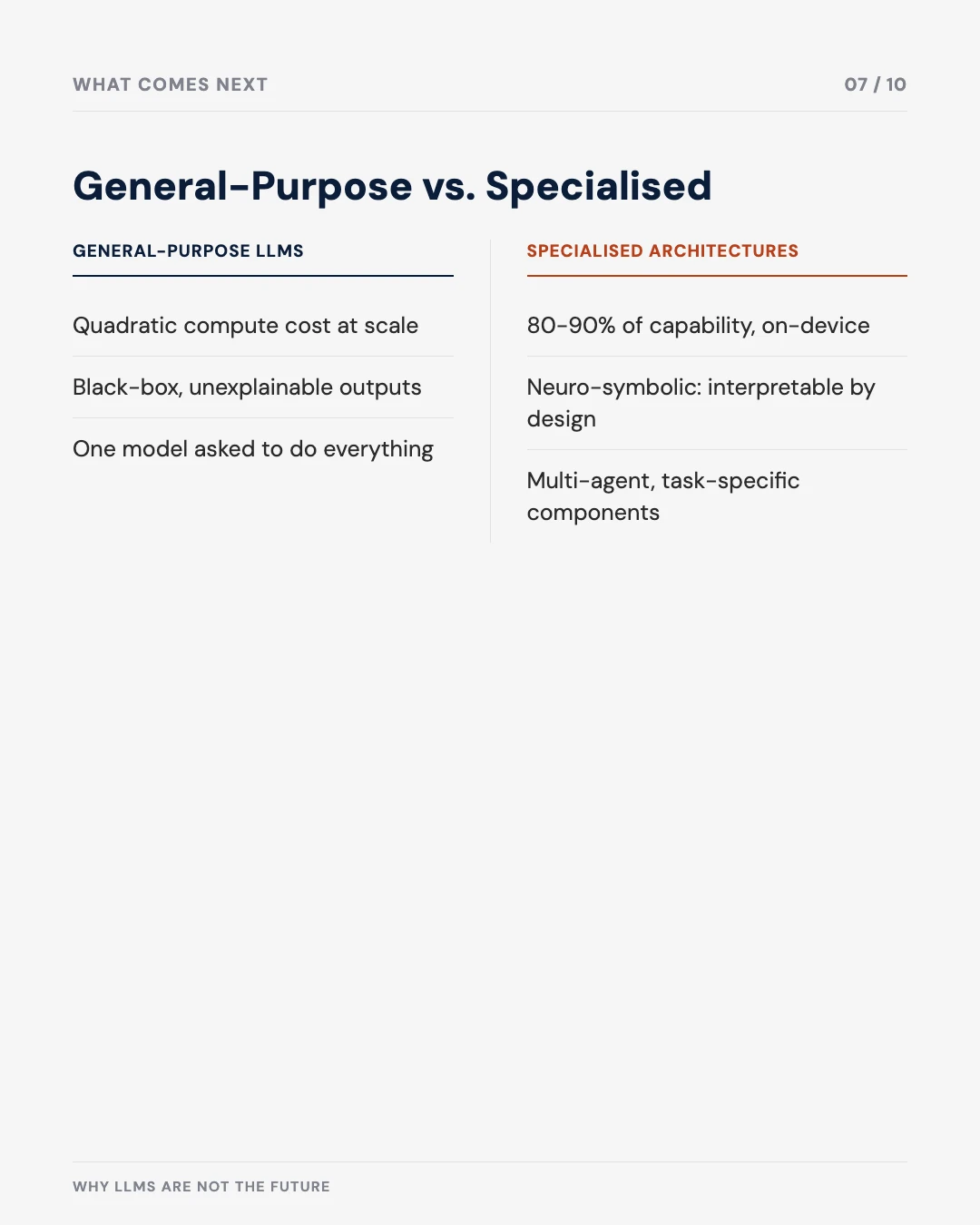
Transformer architectures, the foundation of contemporary LLMs, impose quadratic complexity O(n²) on attention mechanisms, creating severe computational and memory constraints as sequence lengths increase. The computational demands translate directly into unsustainable operational costs: inference on reasoning models such as OpenAI’s o1 costs six times that of GPT-4o. Alternative architectures including State Space Models and linear attention mechanisms demonstrate sub-quadratic scaling, suggesting that the transformer paradigm itself, rather than insufficient scale, constitutes the bottleneck.
Why Enterprise Deployments Are Failing
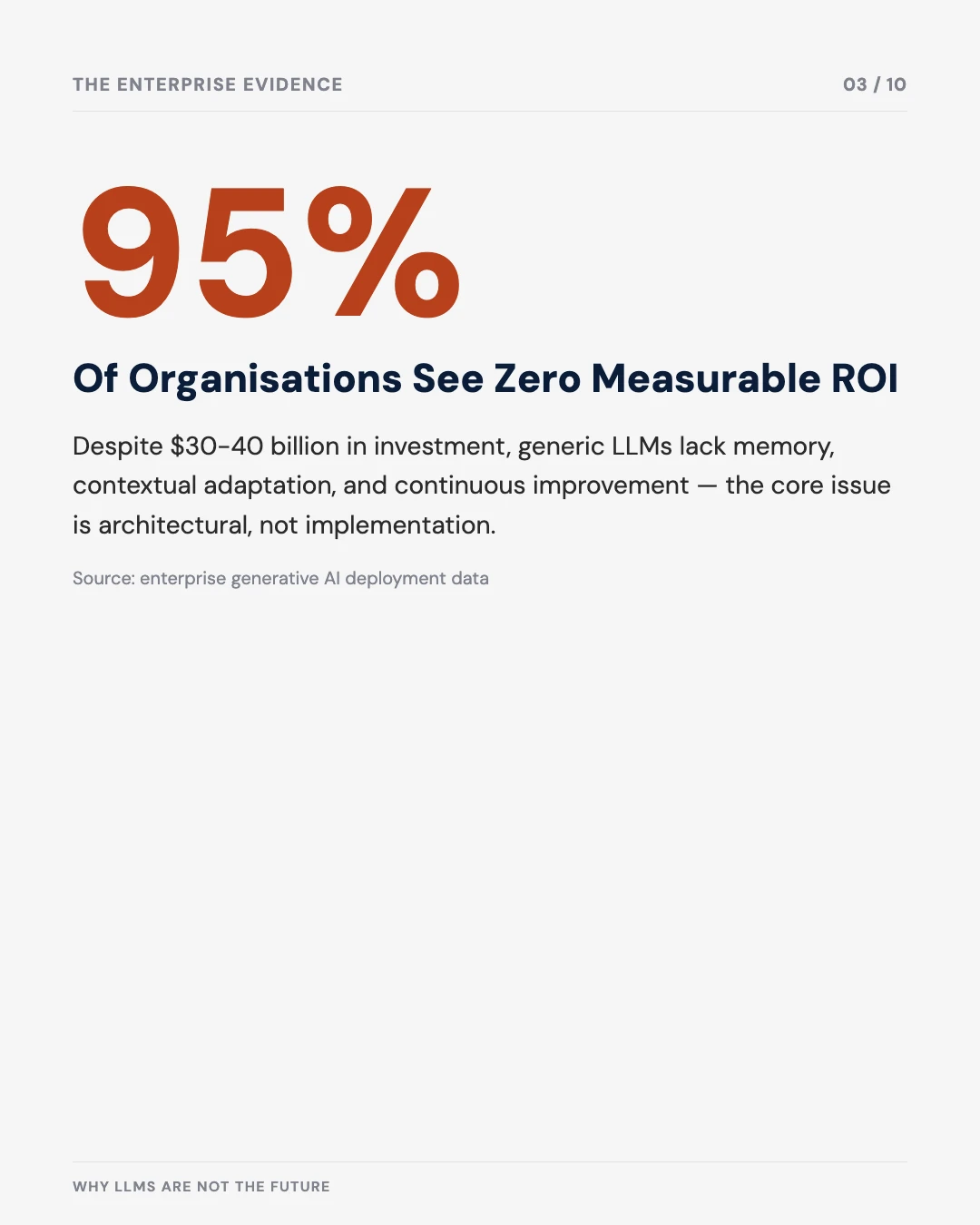
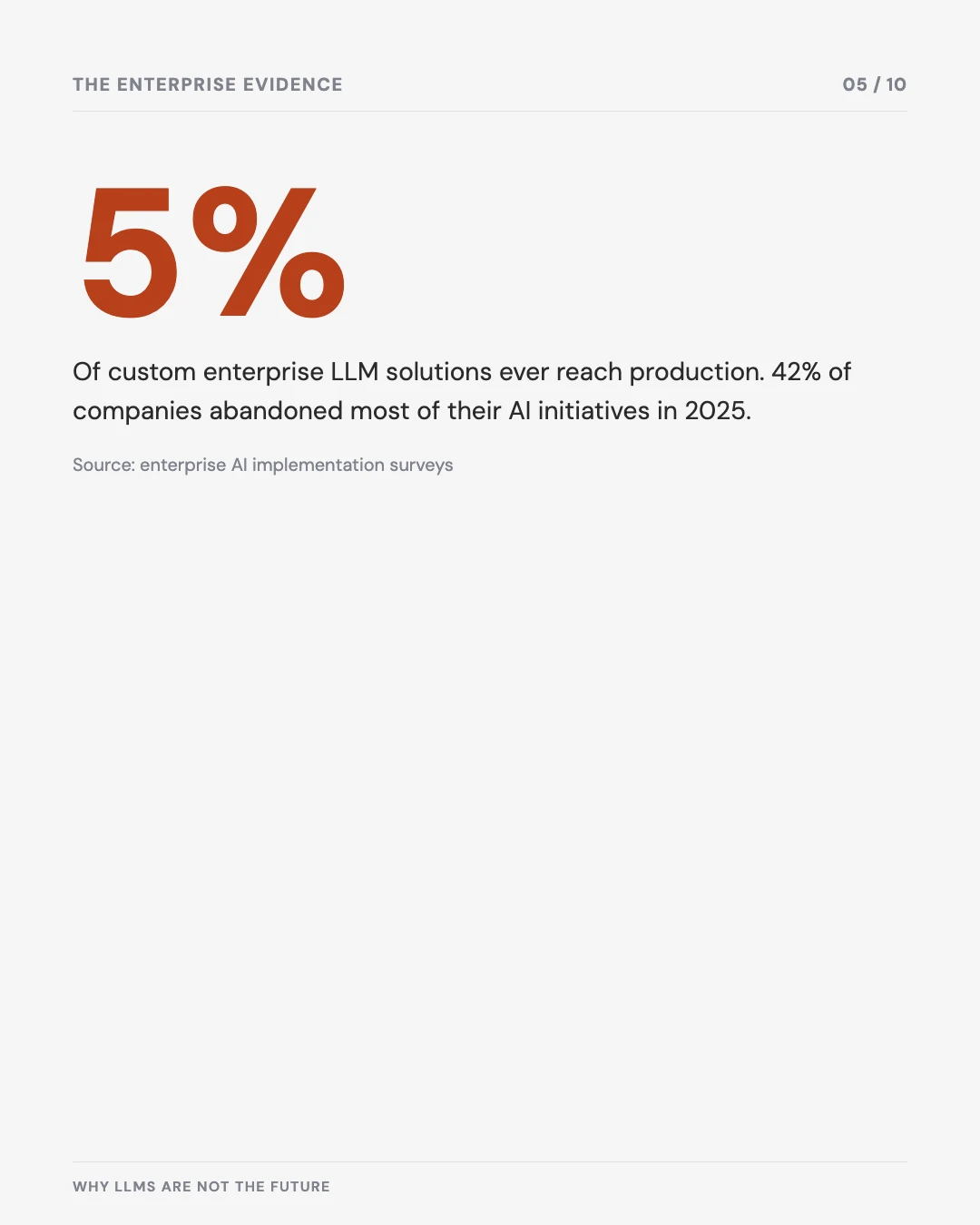
Operational data from enterprise implementations provides the most damning evidence against LLM viability. Despite $30–40 billion in investment, 95% of organisations achieve zero measurable return on generative AI deployments. Only 5% of custom enterprise LLM solutions reach production, with 42% of companies abandoning most AI initiatives in 2025. These failures are not attributable to immature implementation practices. The core issue is architectural: generic LLMs lack memory, contextual adaptation and continuous improvement capabilities.
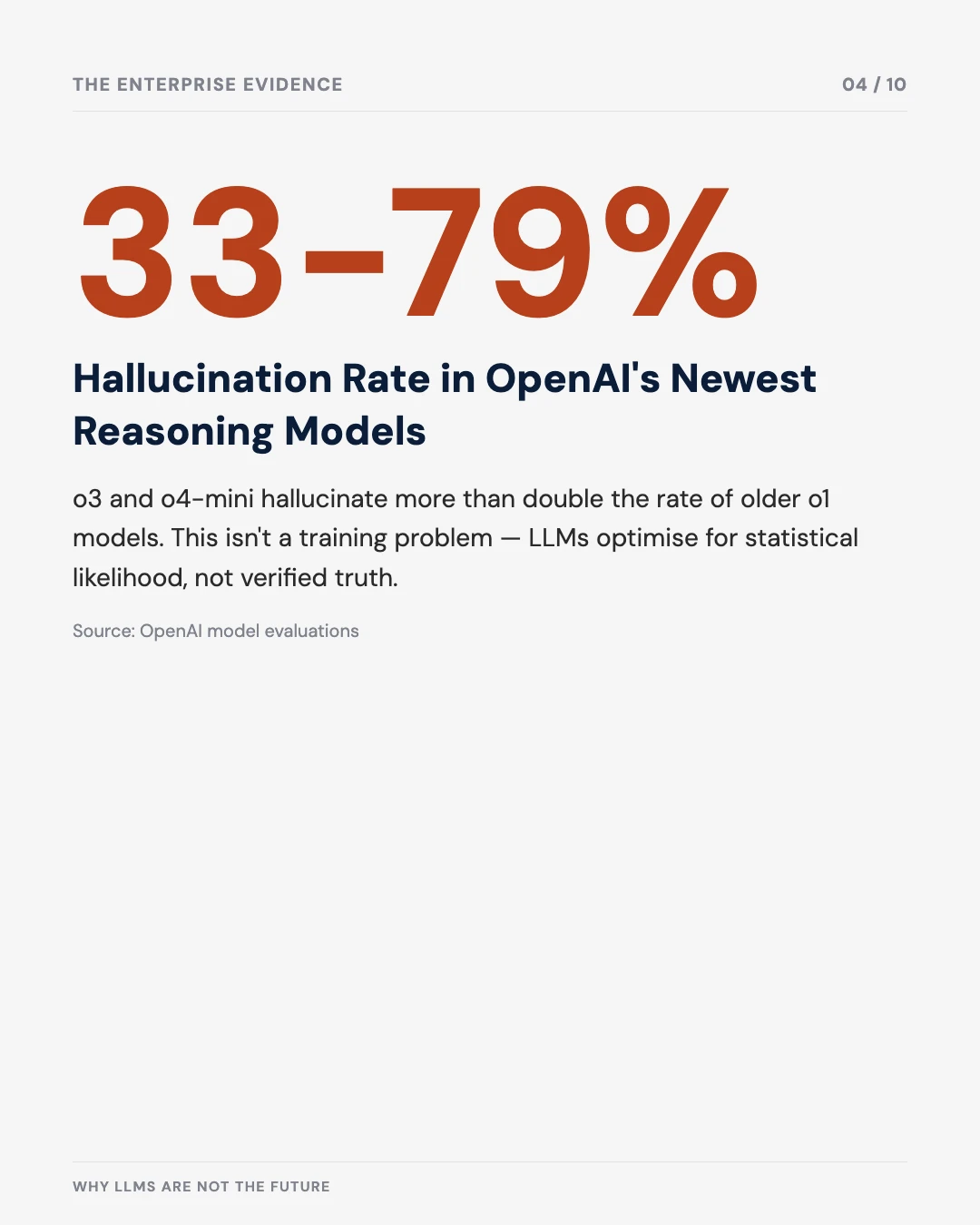
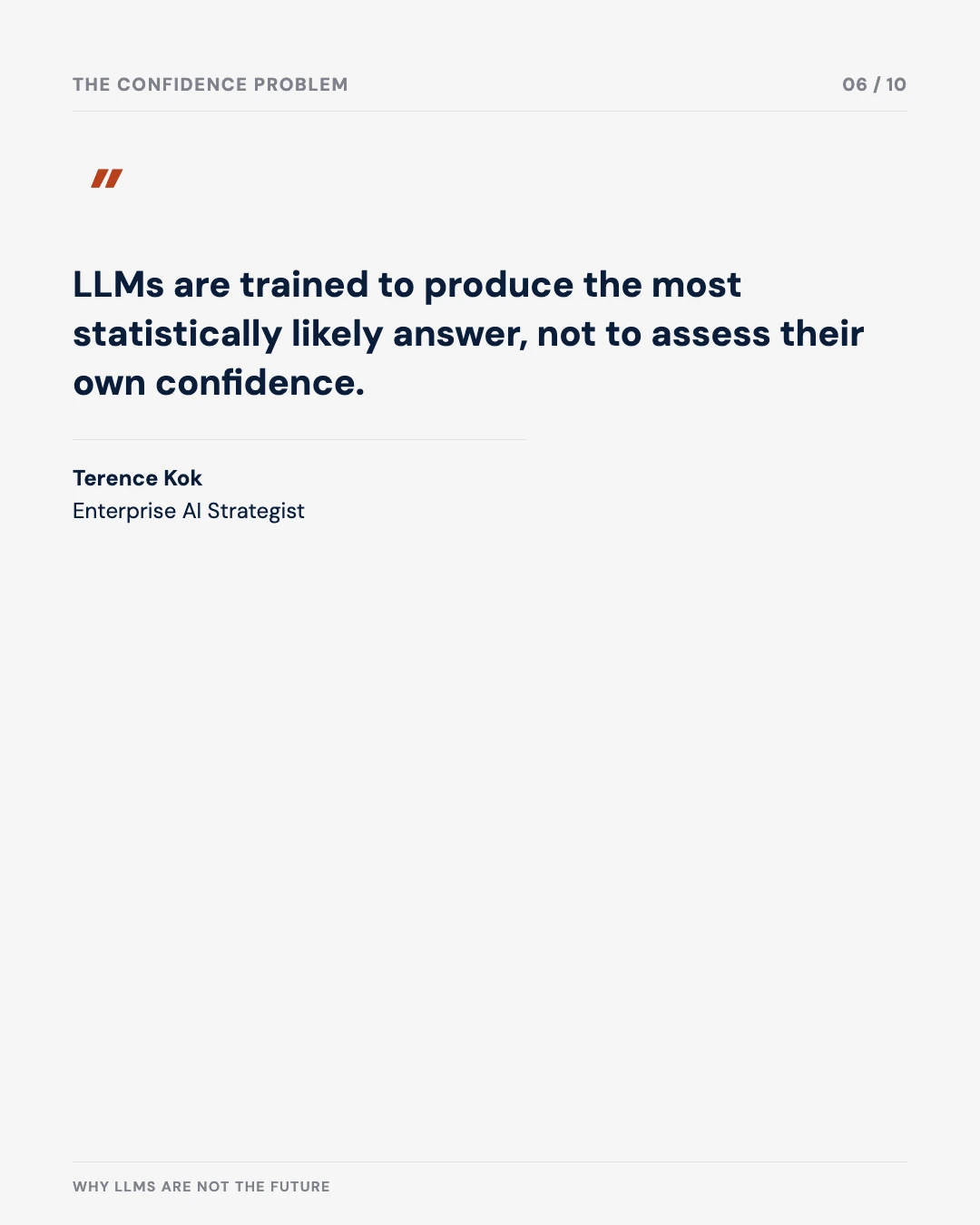
LLM hallucination rates exceed 15% across models and domains. OpenAI’s latest reasoning models (o3 and o4-mini) exhibit hallucination rates between 33–79%, more than double those of older o1 models. This is not a training problem amenable to additional data or fine-tuning. LLMs are probabilistic systems that generate responses based on statistical patterns rather than verified truth. They’re trained to produce the most statistically likely answer, not to assess their own confidence. For enterprises where AI systems influence business decisions or guide operations, even single-digit error rates create unacceptable risk.
LLMs are trained to produce the most statistically likely answer, not to assess their own confidence.
Reinforcement learning, often cited as the pathway beyond pre-training constraints, introduces its own fundamental flaws. Current RL approaches assume that every step in a successful solution trajectory represents correct reasoning, a false assumption. RL systems using LLM judges to evaluate intermediate steps are vulnerable to gaming behaviours that optimise for judge approval rather than correct reasoning. Beyond these technical issues, RL exhibits sample inefficiency, poor generalisation, and high variance during learning. These are not engineering challenges but fundamental limitations of the RL paradigm.
The Architecture Beyond LLMs
The trajectory beyond LLMs involves specialisation, modularisation and architectural diversity. Gartner forecasts that by 2027, organisations will use small, task-specific models three times more than general-purpose LLMs. Domain-specific models demonstrate 80–90% of large model capabilities whilst running on-device with substantially lower computational requirements. BloombergGPT for financial services and Microsoft’s Phi-3 powering agricultural assistance for over one million farmers exemplify this approach.
Neuro-symbolic AI systems combine neural networks for pattern recognition with symbolic reasoning for logic, causal inference and explainability. These hybrid architectures enable systems that learn from data whilst also following explicit rules, producing interpretable outputs and supporting human oversight, both critical requirements for regulated industries.
The consensus among leading AI researchers is that LLM scaling does not lead to artificial general intelligence. World Models, systems that build internal simulations of environments, understand physics, predict consequences of actions and reason about causality, represent the necessary architectural shift. Google DeepMind’s Genie 3 demonstrates this capability, generating diverse interactive 3D environments from text prompts whilst simulating realistic physics. Enterprise AI deployment increasingly relies on multi-agent architectures wherein specialised agents handle specific sub-tasks with orchestration layers managing coordination, scaling more effectively than monolithic LLMs because complexity is distributed across specialised components. I’ve catalogued eight of these specialised agent types already running in production, and none of them look like a single LLM being asked to do everything.
Economic and Governance Pressures
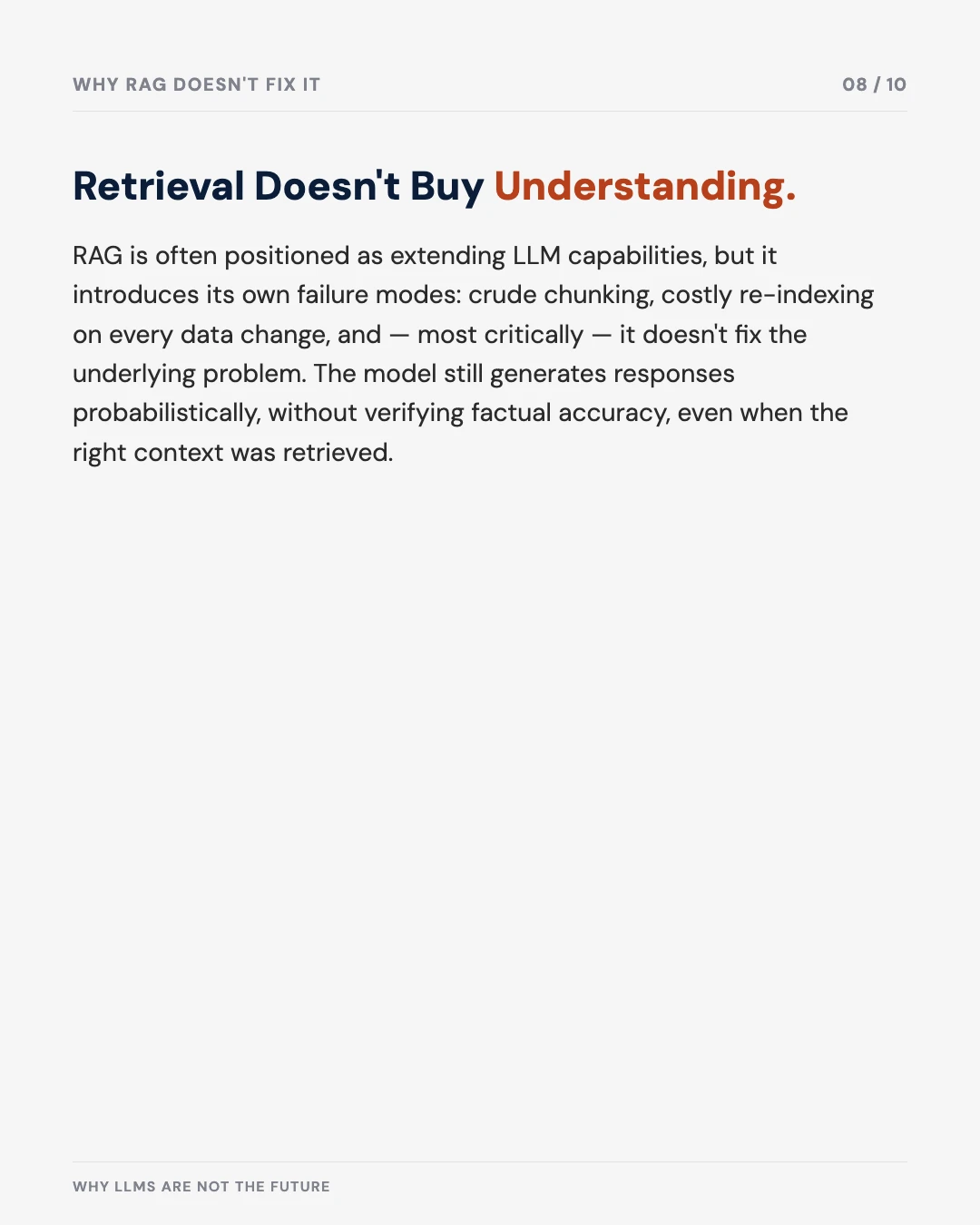
Retrieval-Augmented Generation, often positioned as extending LLM capabilities, introduces its own failure modes. Vector-based retrieval systems suffer from crude chunking methodologies, scalability constraints, and costly maintenance. Every addition of new data necessitates recomputation of the entire vector embedding space. Most critically, RAG does not address the underlying limitation that LLMs lack genuine understanding. It merely retrieves potentially relevant context, while the model still generates responses probabilistically without verifying factual accuracy.
The economic model underpinning LLM development is fracturing. Test-time compute scaling encounters saturation points beyond which additional computation yields diminishing returns. Enterprises are deferring approximately 25% of planned AI spending into 2027 as financial scrutiny increases, with only 15% of AI decision-makers reporting EBITDA improvements. The cost structure of large model inference, training and maintenance does not align with demonstrable business value for the vast majority of use cases.
Regulatory and governance frameworks increasingly require AI systems that provide interpretable, explainable outputs with traceable decision provenance — the same standard I use in scoring which agentic tasks are actually ready for auditable deployment. LLMs, as black-box systems generating responses from opaque internal state representations, fundamentally conflict with these requirements. Interpretability and explainability are not merely desirable features but mandatory requirements for deployment in regulated sectors including healthcare, finance and public infrastructure.
Large Language Models represent a powerful but fundamentally limited approach to artificial intelligence. Their constraints are not temporary engineering challenges but inherent architectural limitations: finite training data, quadratic computational complexity, inability to perform genuine causal reasoning, persistent hallucination, poor continual learning and lack of explainability. The 95% failure rate of enterprise LLM deployments is a signal that the technology does not address the actual requirements of operational AI systems.
The 95% failure rate of enterprise LLM deployments is a signal that the technology does not address the actual requirements of operational AI systems.
The future of artificial intelligence lies in domain-specific models, neuro-symbolic architectures, world models, multi-agent systems and hybrid approaches. Organisations that continue investing in general-purpose LLM scaling rather than pivoting toward specialised, modular and interpretable architectures will find themselves on the wrong side of the technological divide.
Organisations that continue investing in general-purpose LLM scaling rather than pivoting toward specialised, modular and interpretable architectures will find themselves on the wrong side of the technological divide.
Was this useful?