
Listen to this article
Executive Summary
Lately, many companies ask me the same question: “We want to build AI agents. Where do we start?” An AI agent is a computer program. It can look at a task. It can plan the steps. It can use tools. It can act on its own. It does more than answer one question and stop. Starting is not hard. But most companies start in the wrong order. That is why so many AI agent projects get cancelled before they ever help anyone.
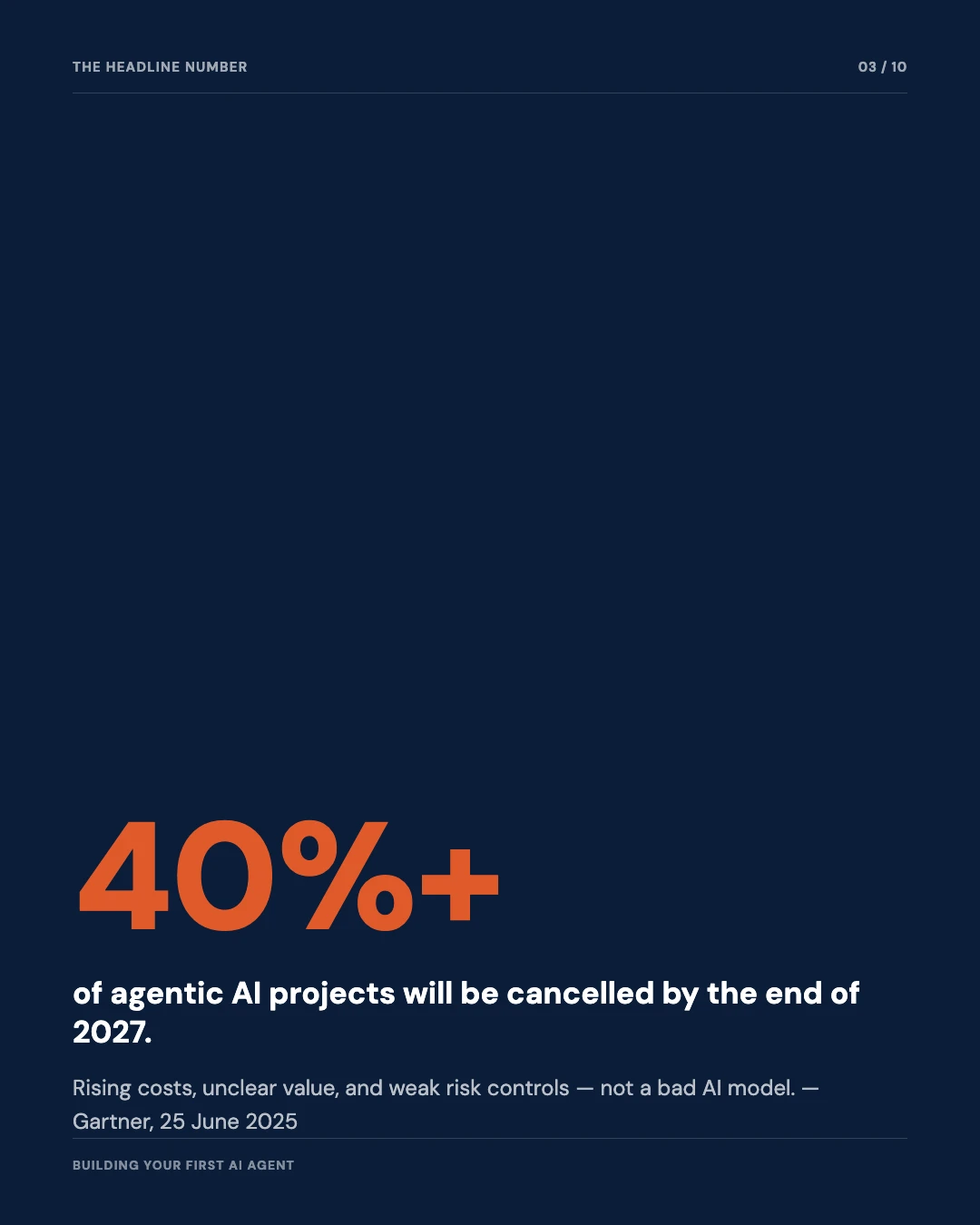
40%+
of AI agent projects will be cancelled by 2027. Costs go up. The value is unclear. Or the safety rules are too weak.
88%
of AI agent test projects never turn into a real tool that people use every day at work
21%
of companies say they have a good, ready system to keep their AI agents safe and in check
23%
of companies have grown an AI agent program across one whole part of the business, not just a test
Core conclusions
- Most AI agent projects do not fail because the AI is not smart. They fail because a team skips a step. Teams skip the boring steps: picking a task that is too big, giving the agent too many tools too soon, or not adding a human check before a risky step.
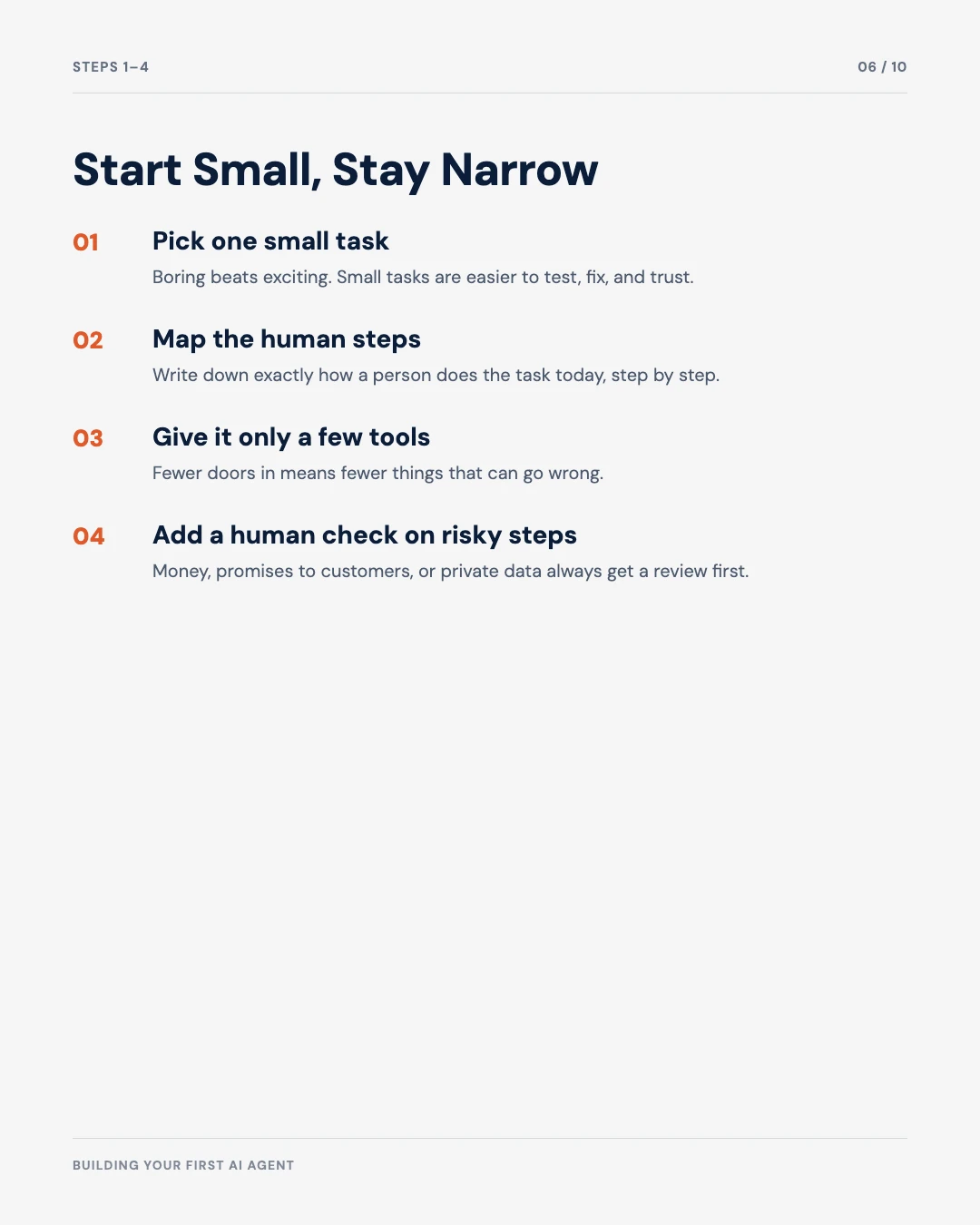
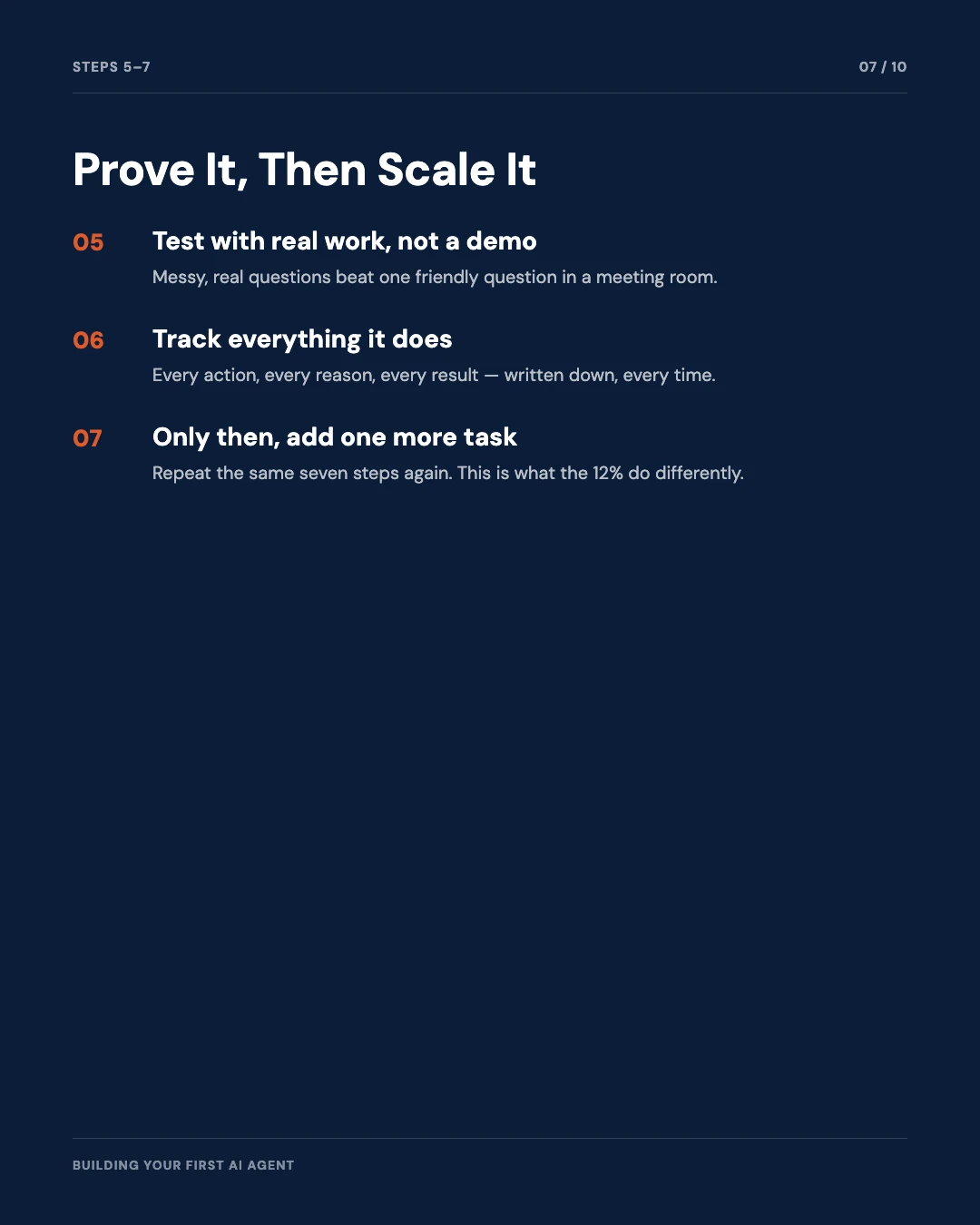
- Companies that succeed follow the same steps, in the same order, every time. Pick one small task. Write down how a person does it today. Give the agent only a few tools. Add a human check on risky steps. Test with real work. Track everything the agent does. Only then, add another task.
- Safety and rules are called “governance.” You do not add governance at the end. You build it first. Today, only 21% of companies have good governance. But most companies plan to use AI agents soon. That gap is the first thing to close, not the last.
Building your first AI agent, in ten slides
Save it, share it, or send it to whoever is asking where to start.
Why so many AI agent projects get cancelled
An AI agent is different from a normal chatbot. A chatbot answers one question, then it stops. An agent can plan many steps. It can use tools, like a search engine or a company database. It can check its own work. It keeps going until the task is done. That extra power is exciting. It is also risky if you get it wrong.
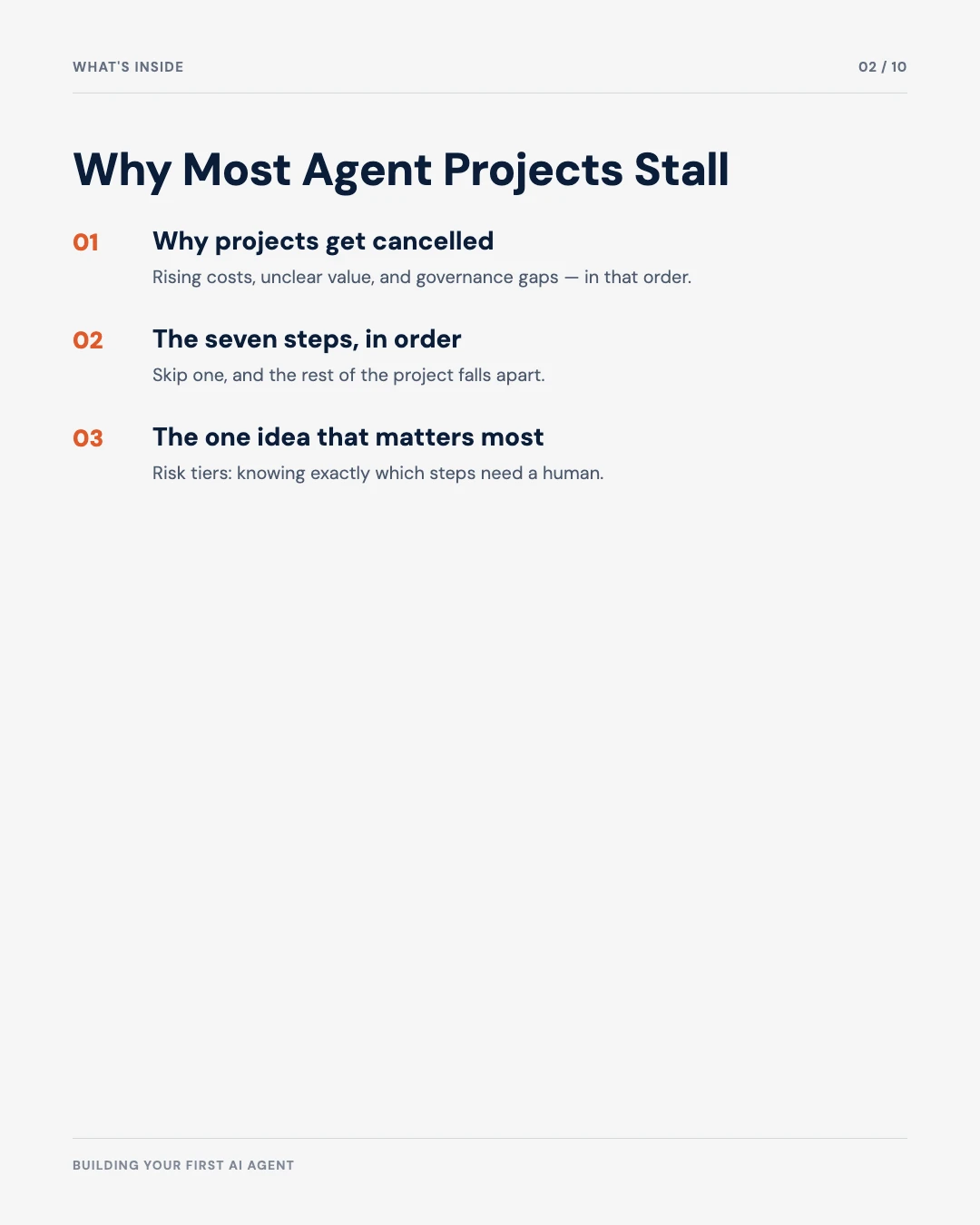
Gartner is a research firm that studies technology trends. Gartner says over 40% of agentic AI projects will be cancelled by the end of 2027. There are three top reasons: rising costs, unclear value, and weak risk controls. These problems show up when a team moves too fast. They are not really about the AI being bad. In an earlier Gartner poll of over 3,400 people, only 17% of companies said they had deployed an AI agent. But more than 60% said they planned to, within two years. That gap, between planning and doing, is where most of the trouble starts.
| Metric | Value | Source |
|---|---|---|
| Agentic AI projects expected to be cancelled by end of 2027 | 40%+ | Gartner press release, 25 June 2025 |
| Organisations that had deployed an AI agent at the time of the poll | 17% | Gartner poll of 3,412 webinar attendees, Jan 2025 |
| Organisations expecting to deploy an AI agent within two years | 60%+ | Same Gartner poll |
| Companies scaling AI agents across at least one whole function | 23% | McKinsey Global Survey on AI, Nov 2025 |
| Companies still only experimenting with AI agents | 39% | McKinsey Global Survey on AI, Nov 2025 |
| Agent pilots that never reach real production use | 88% | Forrester and Anaconda, 2026 |
The same pattern shows up in every study. Getting an agent to run once is easy. Getting it to run safely, every day, for months, is where almost everyone gets stuck.
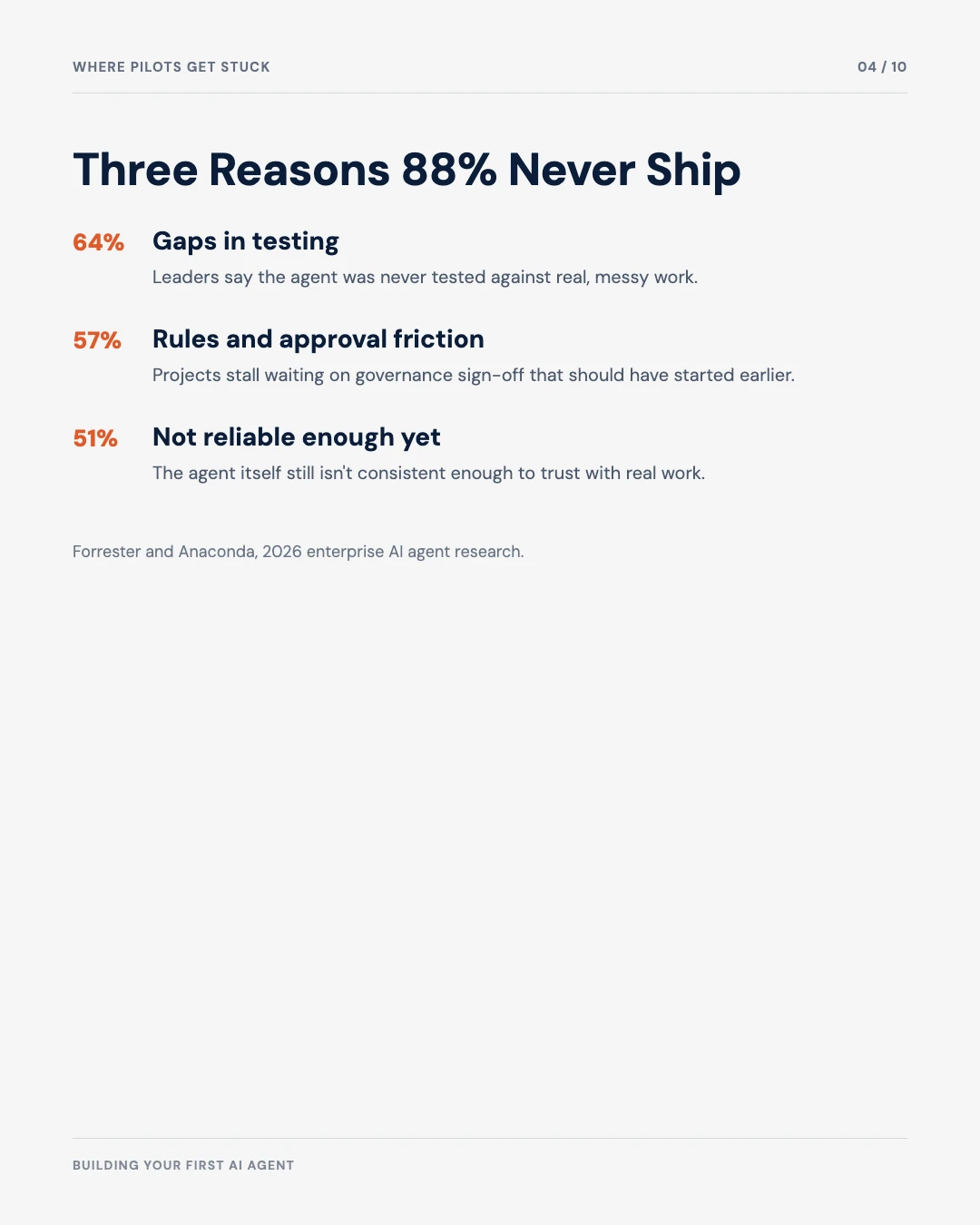
Forrester and Anaconda looked closer at that 88% number. They found the same three problems again and again: gaps in testing (64% of leaders said this), trouble with rules and approval (57%), and the agent just not being reliable enough yet (51%). None of these three problems are about the AI model being too weak. All three are about how the project was set up, before the AI was ever switched on.
Interactive · Hover a bar for its source
Starting a pilot is easy. Reaching production and staying safe is not.
The seven steps, in order
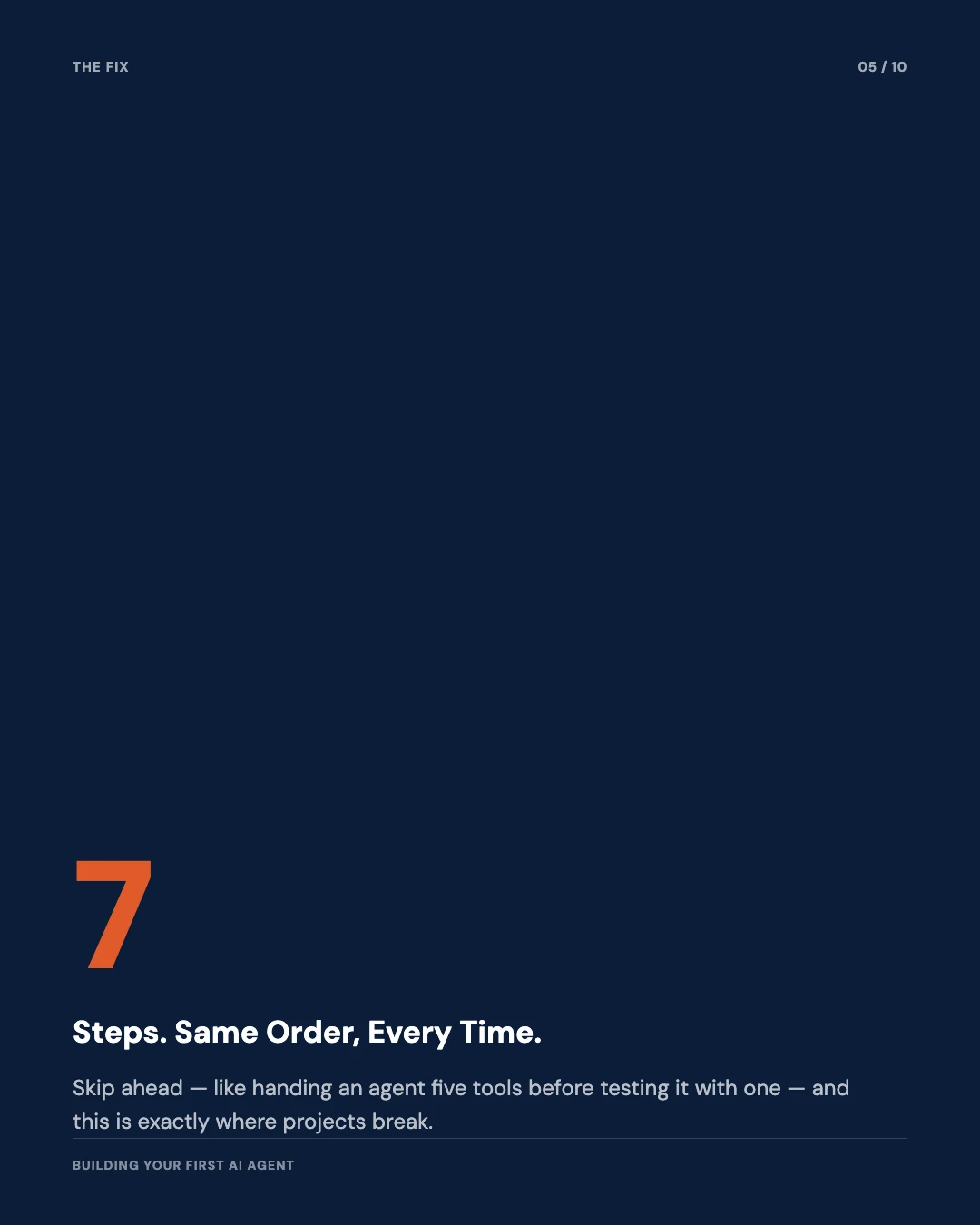
Here is the part most guides skip: the order matters as much as the steps. Each step below only works once the step before it is working. Do not skip ahead. For example, do not give an agent five tools before you test it with one. That is the single most common way these projects go wrong.
The seven steps, in order
Each step earns the right to the next one.
Pick one small task
Not a shiny demo. One real, boring task a person does today.
Map the human steps
Write down exactly how a person does that task, step by step.
Give it few tools
Only the tools it truly needs. Not every system in the company.
Add a human check
Put a person in charge of any step that is risky or costly.
Test with real work
Real people, real cases. Not just a demo in a meeting room.
Track every action
Log what the agent did, why, and what happened next.
Add one more task
Only after step 6 works well. Then repeat from step 1.
Step 1: Pick one small task
Do not start with your biggest, most exciting idea. Start with one small task. Pick a task that is a little boring. Pick something a real person already does today: answering a common customer question, filling in a form, or checking a document against a list. Small tasks are easier to test. They are easier to fix. They are safer if something goes wrong. Our free TRACE Agent Evaluation tool checks a task against five simple questions before you build anything, so you pick a task that is ready, not just exciting.
Step 2: Map the human steps
Before you write any code, write down how a person does the task today. Do this step by step. What do they look at first? What do they check? When do they ask someone else for help? This map becomes the instructions for your agent later. Most teams skip this step, and they pay for it twice: once when the agent gets confused, and again when nobody can explain why.
Step 3: Give it only a few tools
An agent’s “tools” are the systems it is allowed to use: a search tool, a database, an email sender, a calculator. Give your agent only the tools it truly needs for this one task. Do not give it every system in the company. Fewer tools mean fewer things can go wrong. It is also much easier to check an agent’s work when it only had three doors to walk through, not thirty.
Step 4: Add a human check on risky steps
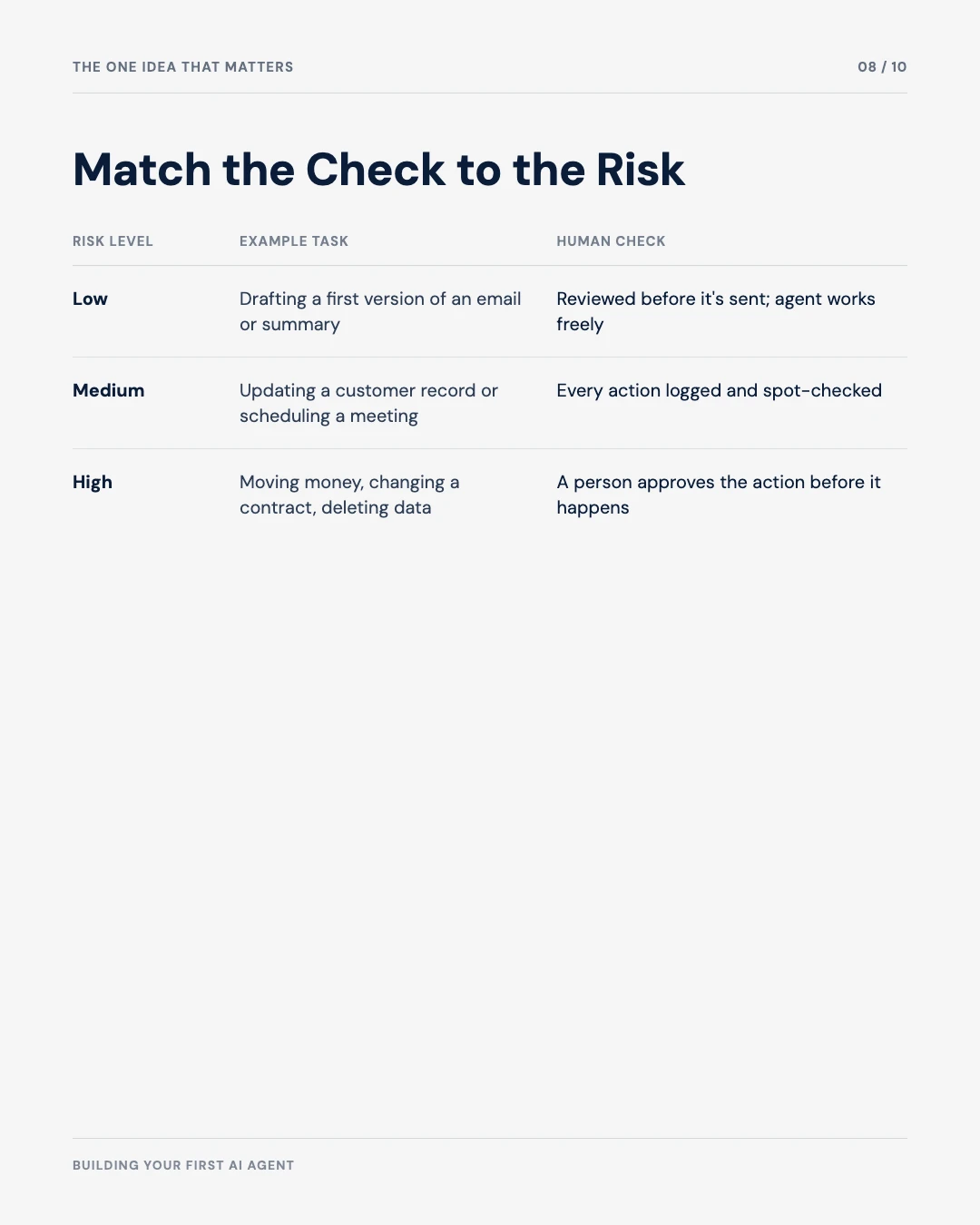
Not every action needs a person watching. But some do. Here is a good rule: if a mistake would cost real money, break a promise to a customer, or touch private data, a person should check it first. If a mistake is small and easy to fix, like a first draft of an email, the agent can move faster on its own. This is called a “risk tier,” and it is the single most useful idea in this whole guide.
| Risk level | Example task | How much a human checks |
|---|---|---|
| Low | Drafting a first version of an email or summary | Person reviews before it is sent, but the agent can work freely |
| Medium | Updating a customer record or scheduling a meeting | Agent acts, but every action is logged and spot-checked |
| High | Moving money, changing a contract, deleting data | A person must approve the specific action before it happens |
Deloitte’s 2026 survey found that leaders worry most about data privacy, legal rules, and oversight. This table is built to catch exactly those risks early.
Step 5: Test with real work, not a demo
A demo in a meeting room tells you almost nothing. In a demo, you ask one friendly, easy question. Real customers ask messy questions. Real documents have typos and missing pages. Test your agent on real, current work. Let the people who will use it every day try it first, before you trust it with anything important.
Step 6: Track everything the agent does
Write down what the agent did. Write down why it decided to do it. Write down what happened next. Do this every single time. This is called traceability. It lets a person understand a mistake and fix it, instead of just seeing a wrong answer with no explanation. Most rules and laws, like the EU AI Act, now require this for anything more than the lowest-risk tasks.
Step 7: Only then, add one more task
Wait until step six is working well, in real use, for real people, for a real stretch of time. Then you have earned the right to add a second task. Repeat the same seven steps for that task. This is slower than trying to do everything at once. But it is the difference between the 12% of pilots that reach real production, and the 88% that never do.
What good agent programmes have in common
Look across the companies that succeed. The pattern is not about which AI model they use. It is about how carefully they roll agents out.
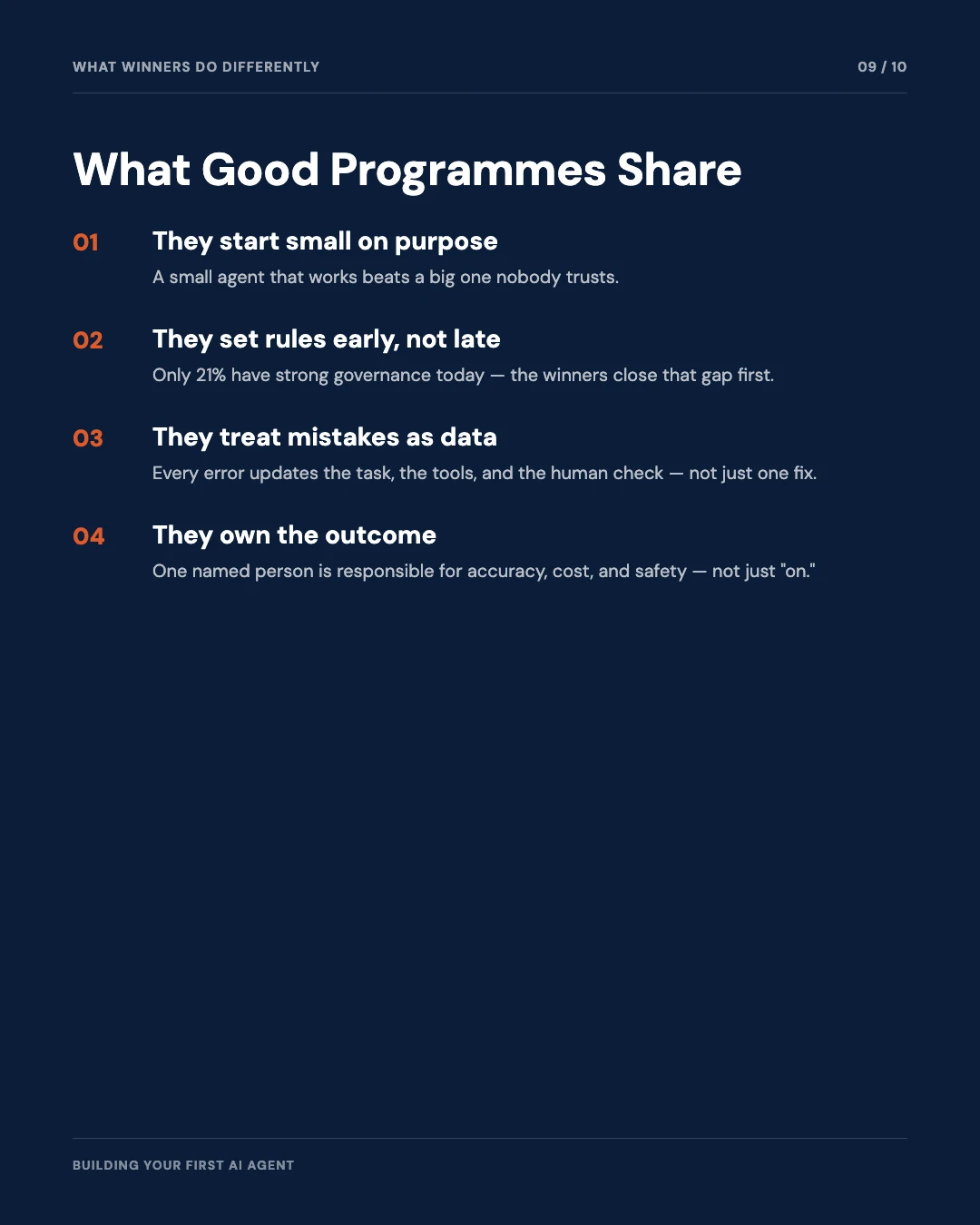
- They start small on purpose. Not because they lack big ideas, but because a small, well-tested agent that actually works beats a big, exciting one that nobody trusts.
- They set rules early, not late. Deloitte’s 2026 survey looked at 3,235 leaders across 24 countries. Close to three in four companies plan to use agentic AI within two years. But only 21% have a strong system in place to keep it safe. The companies that succeed close that gap before they scale up, not after something goes wrong.
- They treat every mistake as useful information. When an agent gets something wrong, good teams do not just fix that one case. They ask what it says about the task, the tools, and the human check, then they fix all three.
- They own the outcome, not just the tool. One named person is in charge. That person is responsible for what the agent actually achieves, its accuracy, its cost, and its safety, not just whether it is switched on.
Where to start this week
You do not need a big budget or a large team to begin. You need one small task. You need a clear map of how a person does it today. You need a plan for who checks the risky parts. That is genuinely most of the work. Our free AI Use Case Prioritisation Matrix helps you score two or three candidate tasks and pick the right one to start with, using the same thinking behind step one of this guide.
Here is the honest truth. Building an AI agent is not the hard part anymore. The tools to do it are easy to find, and they keep getting better. The hard part is the boring setup work: picking the right task, mapping it properly, and deciding in advance who checks what. That is the part almost every failed project skipped. Companies that do this boring work well are quietly becoming part of the 23% who are scaling agents today. Everyone else is still stuck, still explaining why their pilot never shipped.
Sources: Gartner, “Gartner Predicts Over 40% of Agentic AI Projects Will Be Canceled by End of 2027,” press release, 25 June 2025; Gartner poll of 3,412 webinar attendees, January 2025; McKinsey & Company, Global Survey on AI, November 2025; Forrester and Anaconda, 2026 enterprise AI agent research; Deloitte, “The State of AI in the Enterprise,” 2026 global survey of 3,235 leaders across 24 countries.
Free tool
TRACE Agent Evaluation
Score a task against five simple checks before you build anything, so Step 1 above starts with a task that is ready.
Free tool
AI Use Case Prioritisation Matrix
Score up to three candidate tasks and get a ranked, keep-or-cut order to start from.
The AI Governance & ROI Executive Programme walks your team through these seven steps against your own real tasks. You get a scored starting point and a step-by-step plan as the result. Details are on the workshops page.
Was this useful?