
Listen to this article
Executive Summary
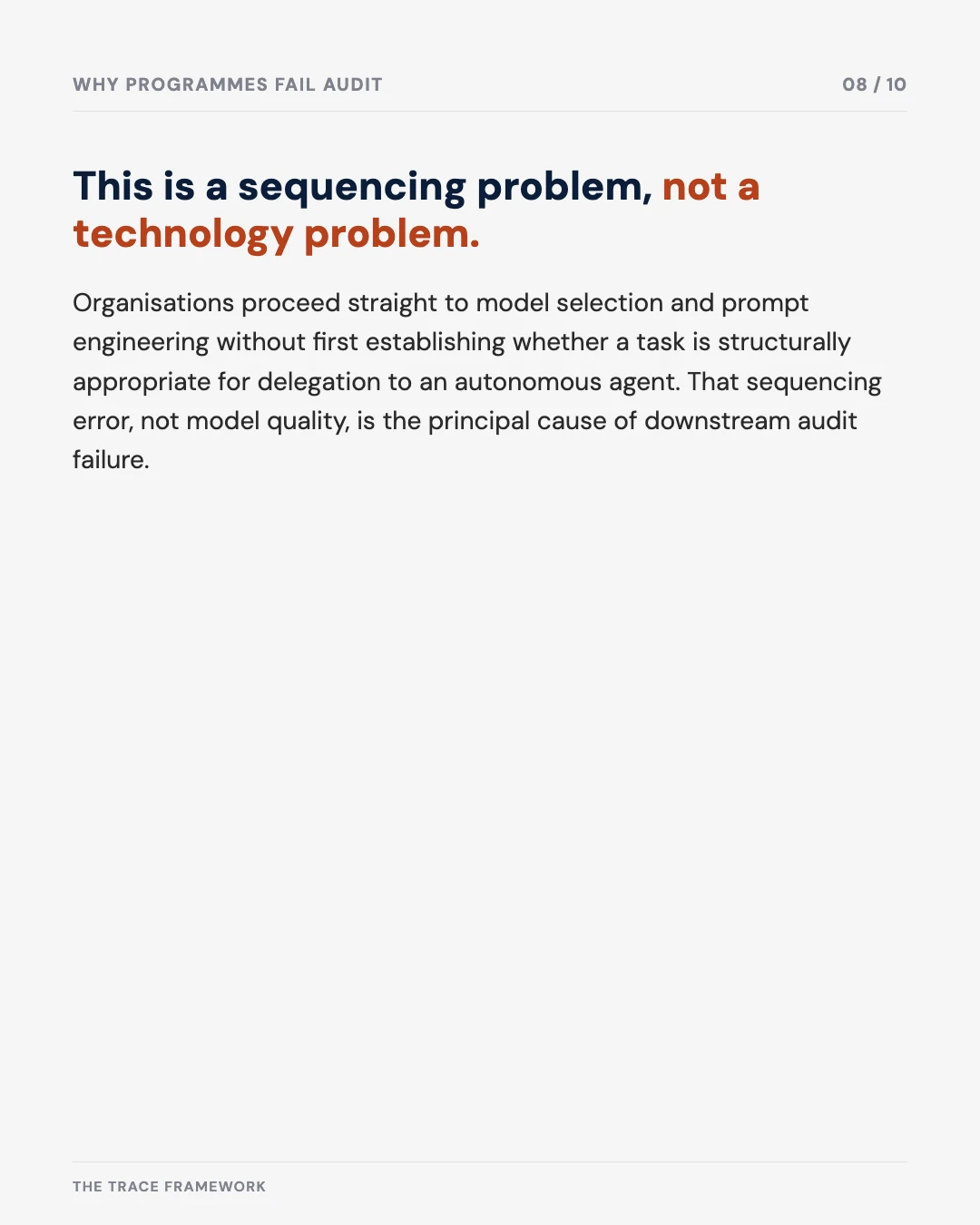
Agents are commonly commissioned before an organisation has defined what quality, traceability, and auditability mean for the task. That’s a sequencing error, not a technology gap, and it’s the principal cause of downstream audit failure.
Core conclusions
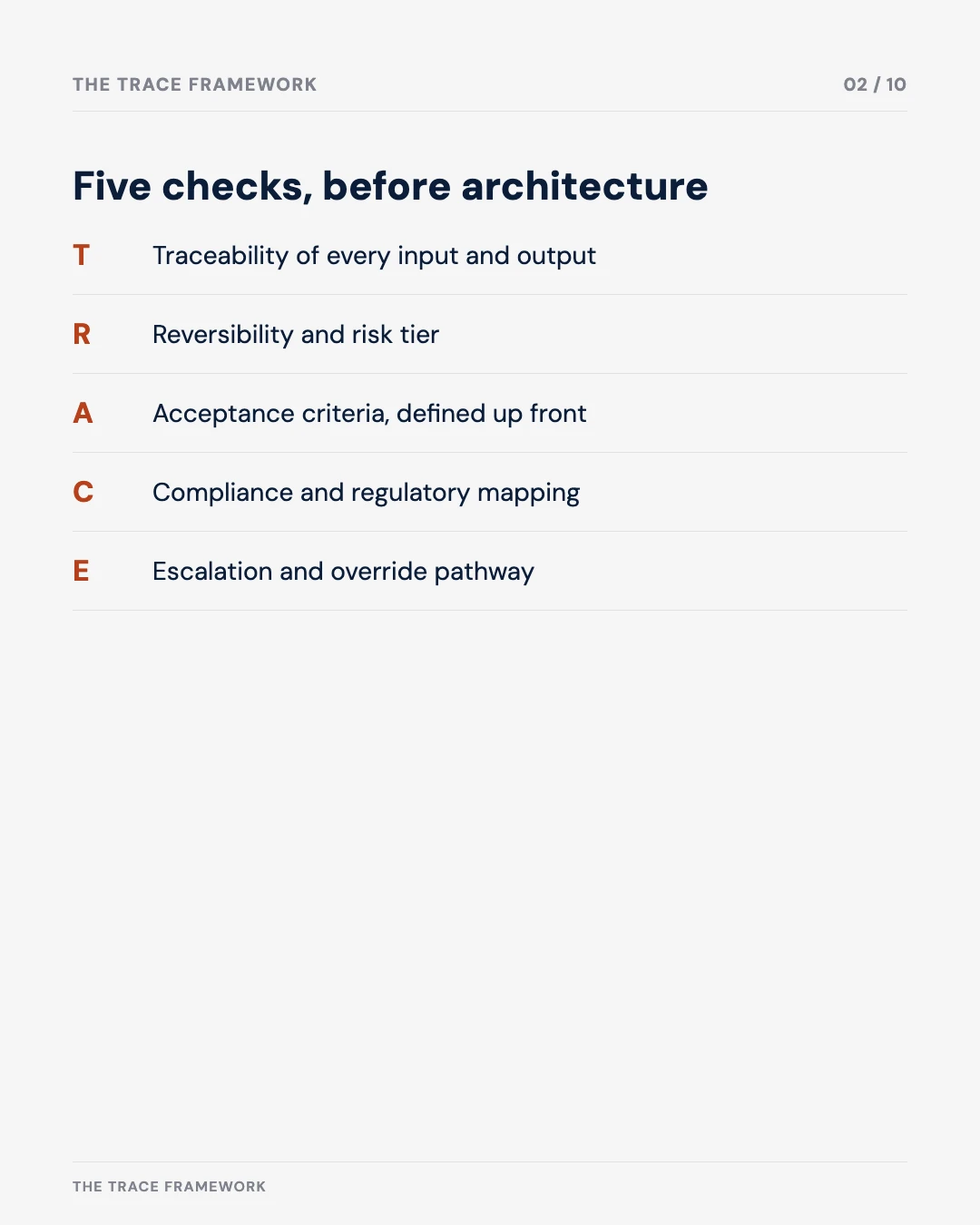
- The TRACE framework (Traceability of inputs/outputs, Reversibility and risk tier, Acceptance criteria, Compliance mapping, Escalation pathway) gives a structured pass/fail basis for whether a task is ready for agent deployment, before any model or vendor decision is made.
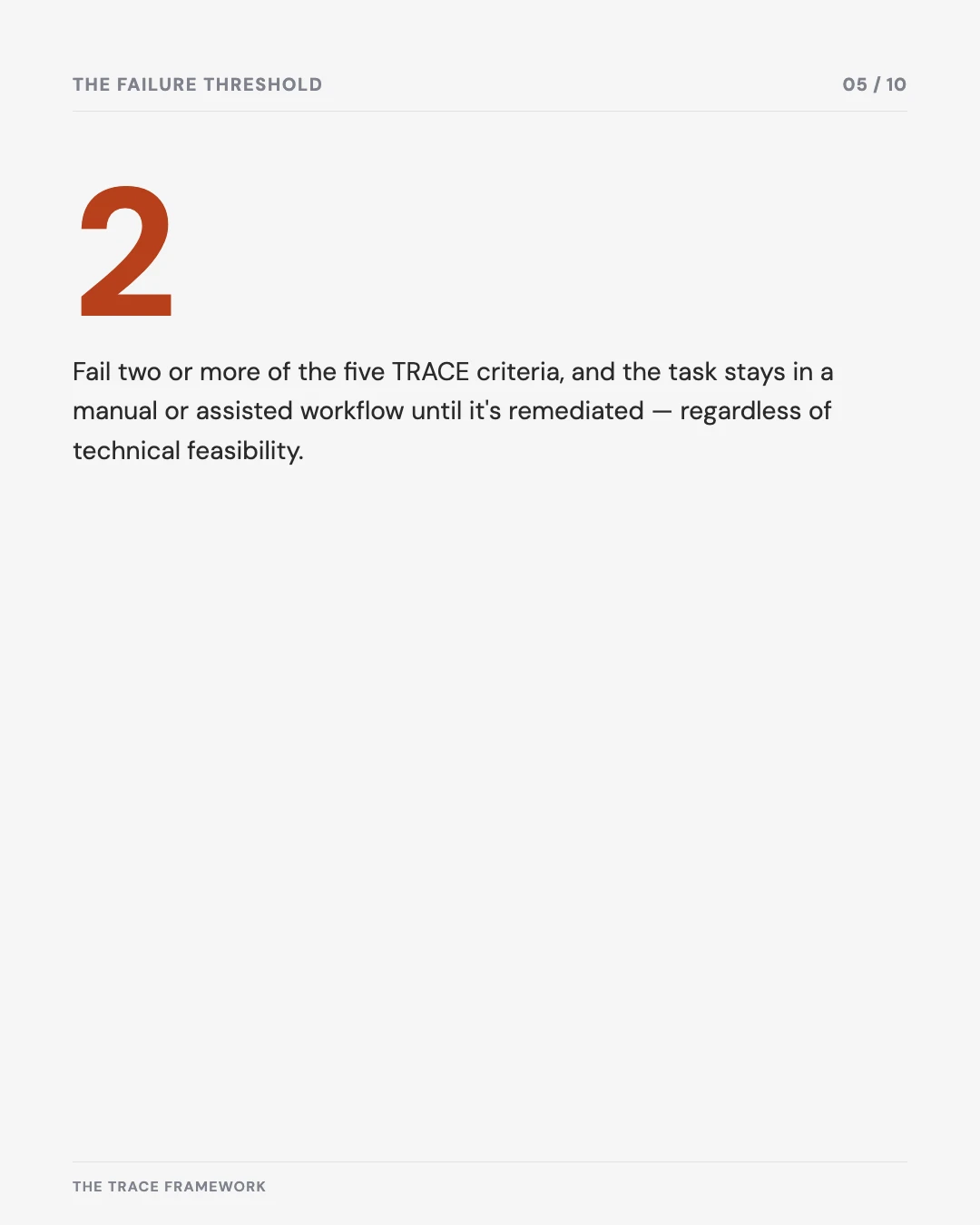
- A task that fails two or more TRACE criteria should stay in a manual or assisted workflow, regardless of how well the underlying model performs in testing.
- Leadership’s role here is chairing the risk classification for the first task cohort and mandating a fixed review interval, which turns auditability from a design-time aspiration into an operating discipline, not technical sponsorship.
The framework, in ten slides
Save it, share it, or send it to whoever is about to sign off your first agent deployment.
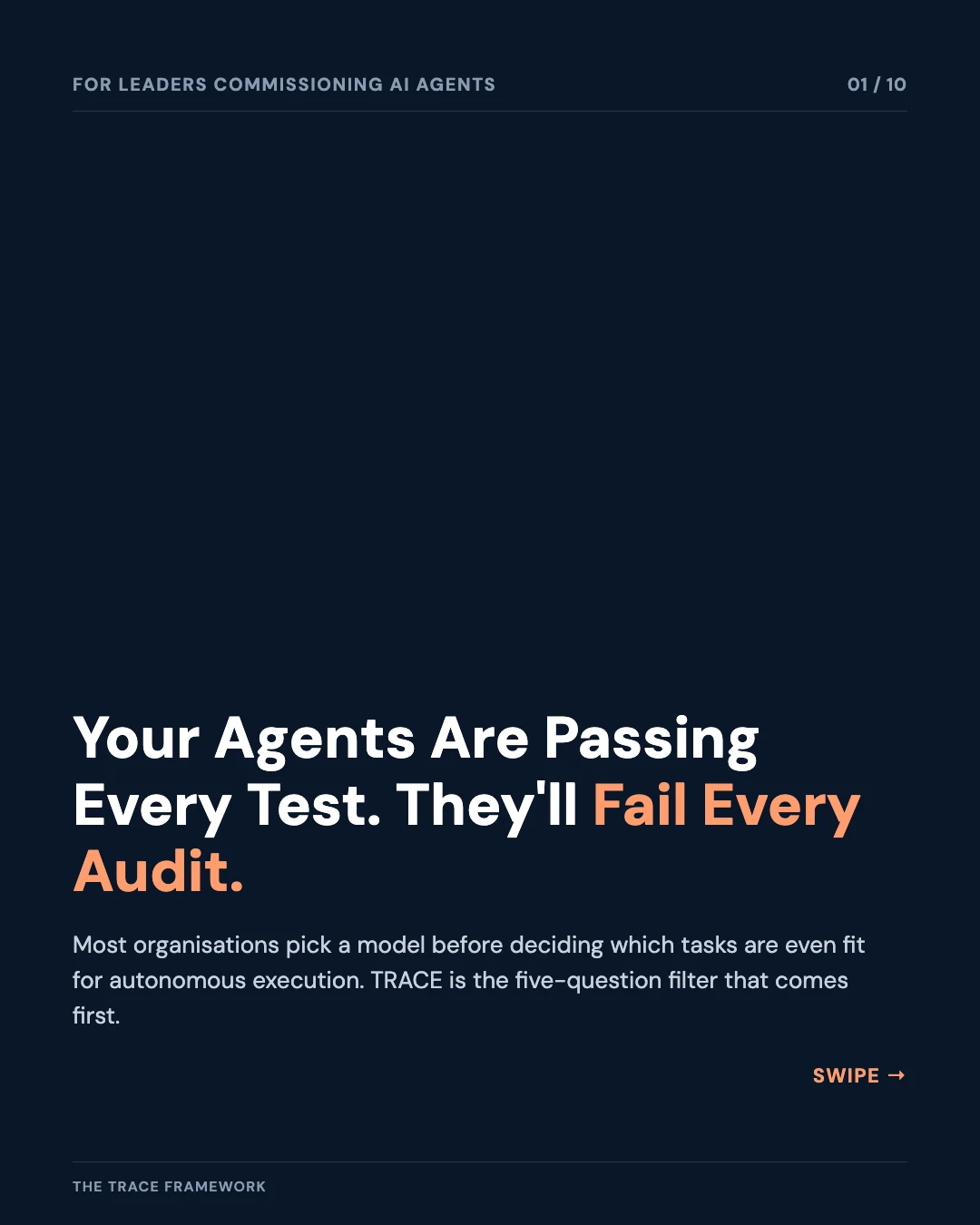

Organisations are moving from AI pilots to operational deployment. The transition exposes a recurring deficiency: agents are commissioned before the organisation has established what “quality”, “traceability”, and “auditability” mean in operational terms.
Why This Matters at the Leadership Level
An AI agent operating within a regulated or public-facing environment carries the same governance burden as any other operational system, with one distinction: its decision logic is probabilistic and may evolve through retraining or fine-tuning. Leaders are accountable for three outcomes:
- Demonstrable correctness of agent outputs against defined acceptance criteria.
- A complete decision trail sufficient for regulatory, legal, or post-incident review.
- A repeatable process for identifying which tasks are suitable for agent deployment in the first instance.
The third point is frequently overlooked. Organisations proceed directly to model selection and prompt engineering without first establishing whether a given task is structurally appropriate for delegation to an autonomous agent. This sequencing error is the principal cause of downstream audit failure.
A Framework for Task Identification
The following framework, termed TRACE, provides a structured basis for evaluating candidate tasks before agent design.
- T for Traceability of Inputs and Outputs: Determine whether every input consumed and output produced by the task can be logged, timestamped, and attributed to a specific data source or upstream system. Tasks that draw on unstructured or unverified data sources should be deprioritised until provenance controls are in place.
- R for Reversibility and Risk Tier: Classify the task by the consequence of an erroneous output: reversible with no material harm, reversible with cost, or irreversible. Irreversible-consequence tasks require human-in-the-loop checkpoints before any agent autonomy is granted.
- A for Acceptance Criteria Definition: Confirm that the task has measurable, pre-agreed success criteria independent of the agent’s own output. A task lacking an external ground truth or validation method is not yet ready for agent deployment, regardless of technical feasibility.
- C for Compliance and Regulatory Mapping: Identify which regulatory regimes, sector codes, or internal governance policies apply to the task. This mapping should occur before architecture decisions, not retrospectively.
- E for Escalation and Override Pathway: Verify that a clear, tested mechanism exists for a human operator to intervene, override, or halt the agent mid-task. Absence of this pathway disqualifies a task from autonomous execution, irrespective of model performance.
A task that satisfies all five TRACE criteria is a reasonable candidate for agent deployment.
A task that fails two or more criteria should remain in a manual or assisted (non-autonomous) workflow until it is remediated.
The TRACE Agent Evaluation tool lets you score a specific candidate task against all five criteria and get a deployment verdict with per-criterion guidance, before any architecture or vendor decision begins.
Checklist for Leaders Beginning This Journey
Before initiating agent design or vendor selection, leaders should confirm the following:
- A task inventory has been compiled and scored against the TRACE framework.
- Data lineage for each candidate task has been documented, including source system, update frequency, and ownership.
- A logging architecture exists or is planned that captures agent inputs, reasoning steps (where the model architecture permits extraction), outputs, and timestamps in an immutable or write-once store.
- Acceptance criteria and quality thresholds have been agreed in writing with the task’s business owner prior to any model development.
- A risk classification has been assigned to each task, with corresponding approval authority identified for each tier.
- Escalation and override mechanisms have been specified and tested in a non-production environment.
- Roles and accountabilities for ongoing monitoring, drift detection, and periodic re-validation have been assigned, not left implicit.
- A decision has been made on retention periods for agent logs, in line with applicable data protection and sector regulations.
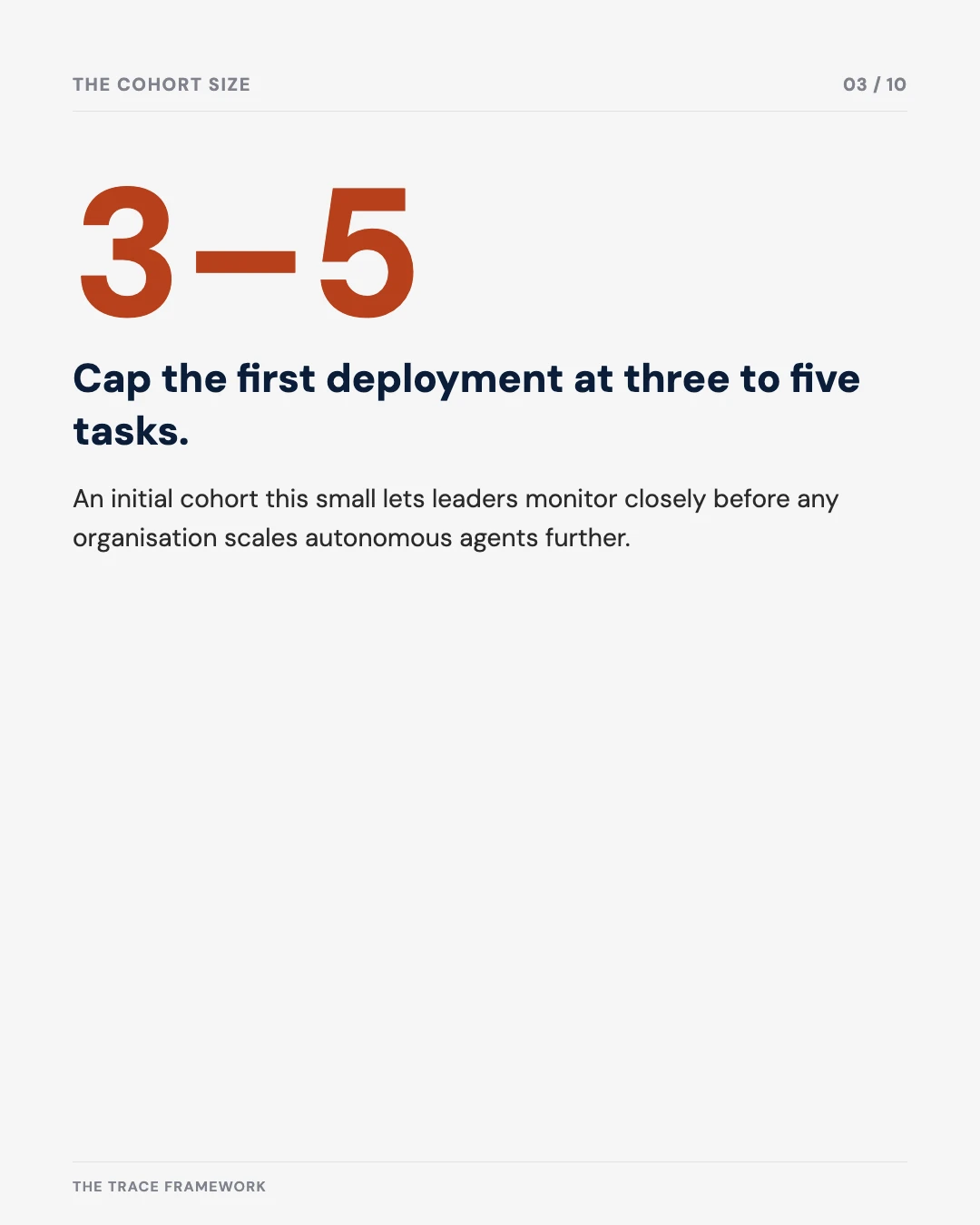
- An initial cohort of no more than three to five tasks has been selected for the first deployment phase, to permit close monitoring before scaling.
How Leaders Should Lead This Process
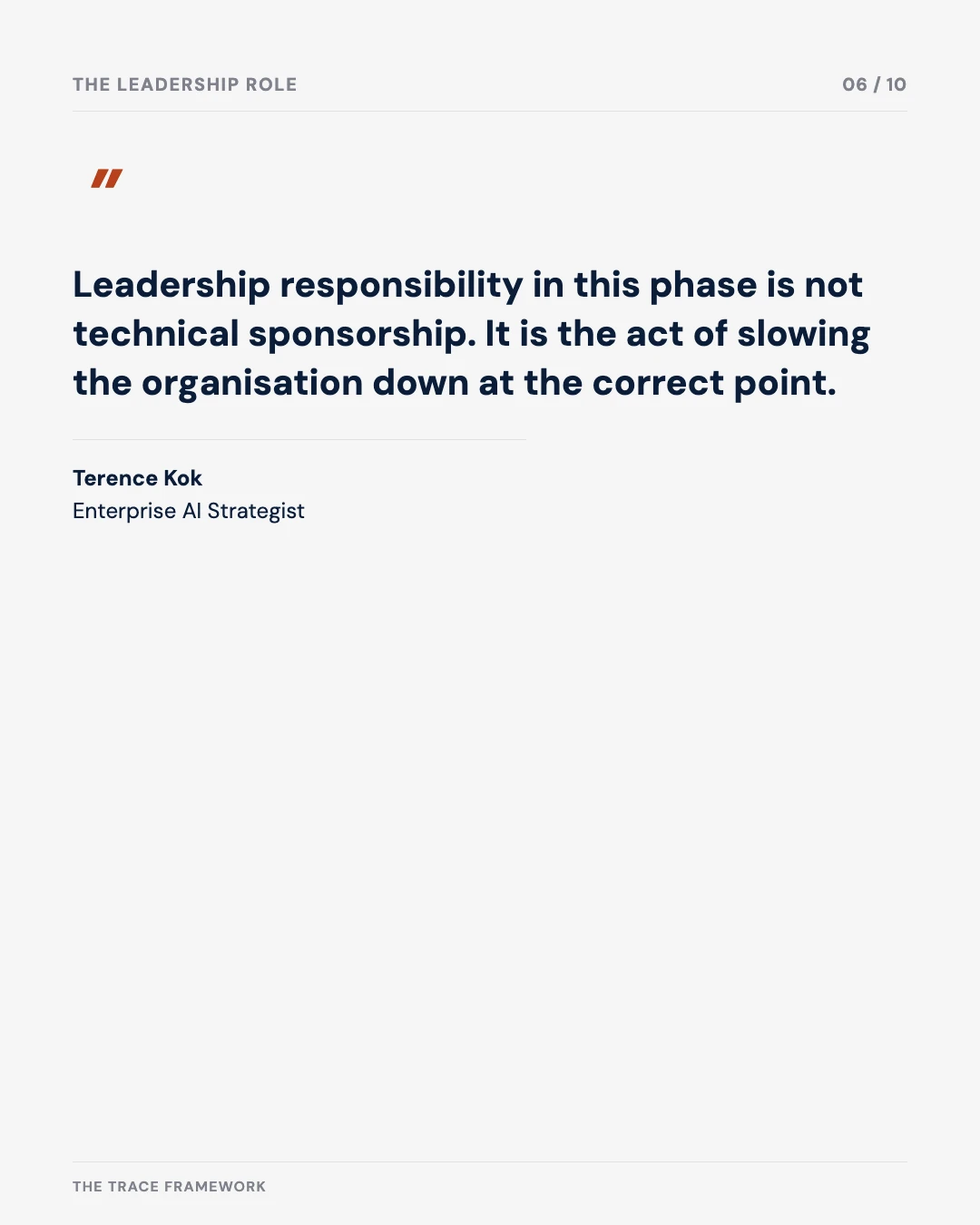
Leadership responsibility in this phase is not technical sponsorship; it is the act of slowing the organisation down at the correct point. Three actions in particular define effective leadership here:
Leadership responsibility in this phase is not technical sponsorship; it is the act of slowing the organisation down at the correct point.
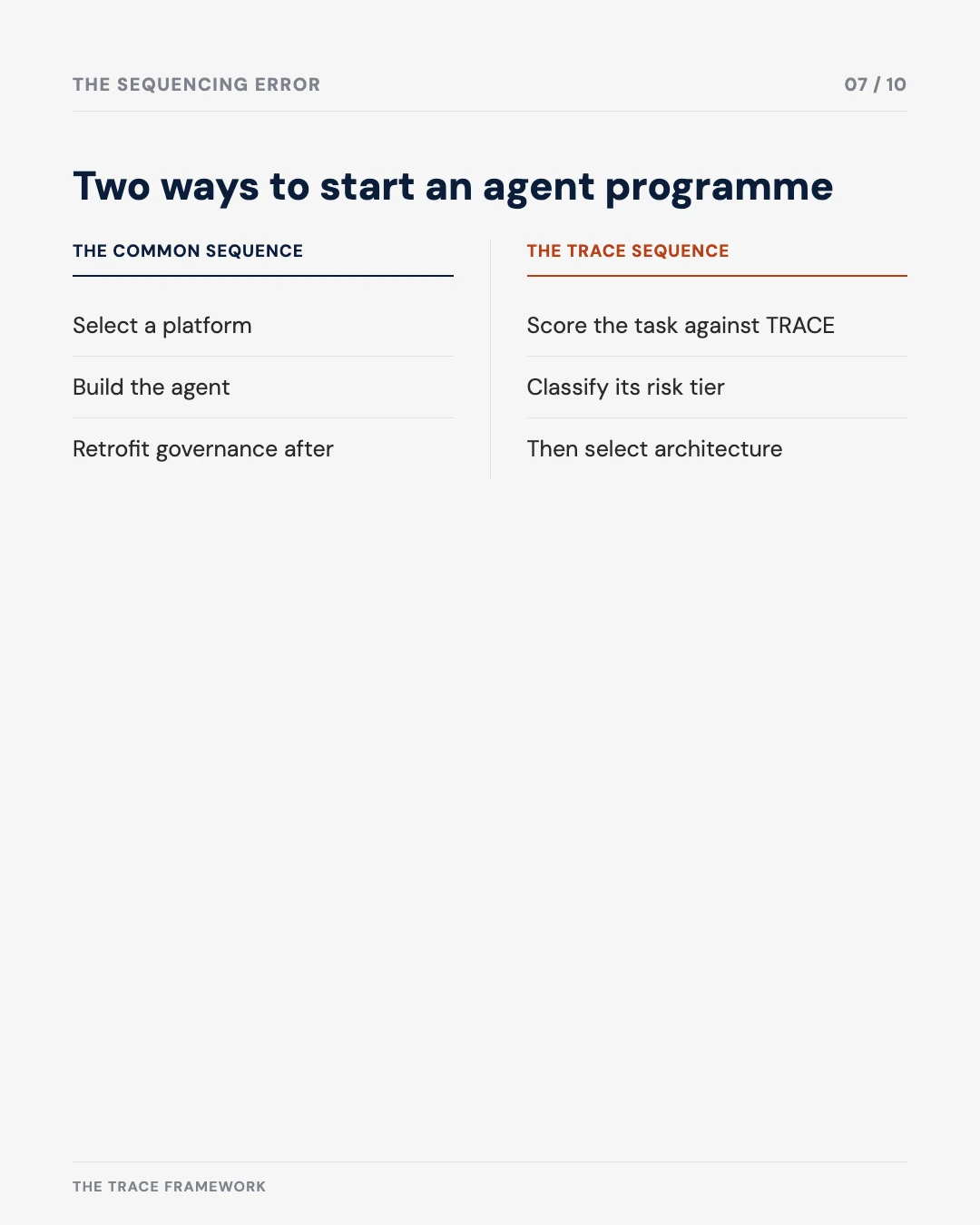
First, leaders should require that the task inventory and TRACE scoring be presented before any procurement or build decision, not after. This reverses the conventional sequence in many organisations, where a platform is selected first, and governance is retrofitted.
Second, leaders should personally chair the risk classification step for the initial task cohort, rather than delegating it entirely to technical teams. Risk tiering carries organisational and, in government or infrastructure contexts, public accountability that should not rest solely with engineering functions.
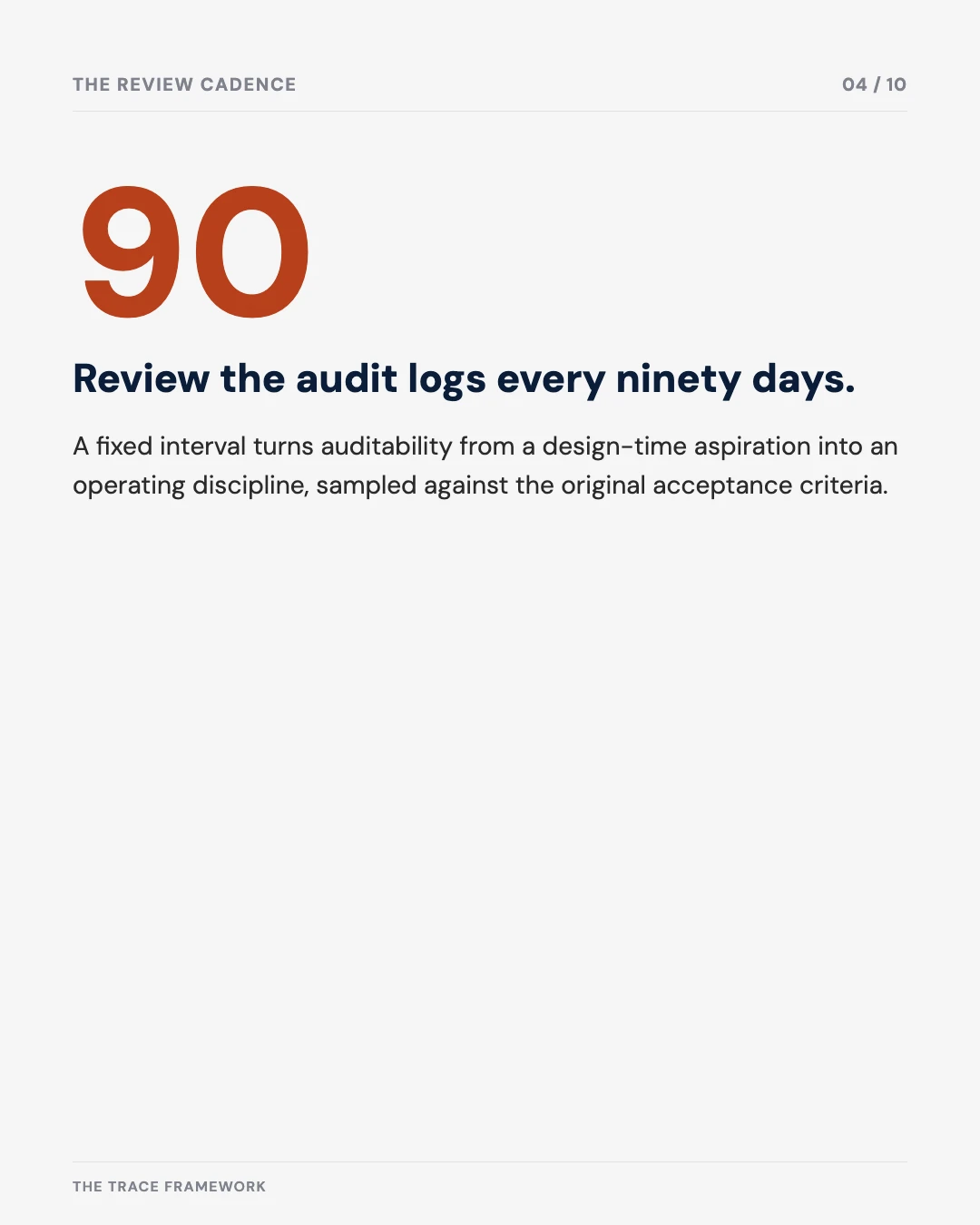
Third, leaders should mandate a fixed review interval (every ninety days, for example) at which the audit logs of deployed agents are sampled and reviewed against the original acceptance criteria. This converts auditability from a design-time aspiration into an operating discipline.
The identification of suitable tasks is the foundation of a defensible AI agent programme. Organisations that begin with model capability rather than task suitability tend to produce agents that perform adequately in testing and fail under regulatory or incident scrutiny.
The identification of suitable tasks is the foundation of a defensible AI agent programme.
Free tool
TRACE Agent Evaluation
Score a specific candidate task against all five TRACE criteria and get a deployment verdict with per-criterion guidance, before any architecture or vendor decision begins.
The TRACE framework itself is published in full on the Frameworks page.
Was this useful?