
Listen to this article
Executive Summary
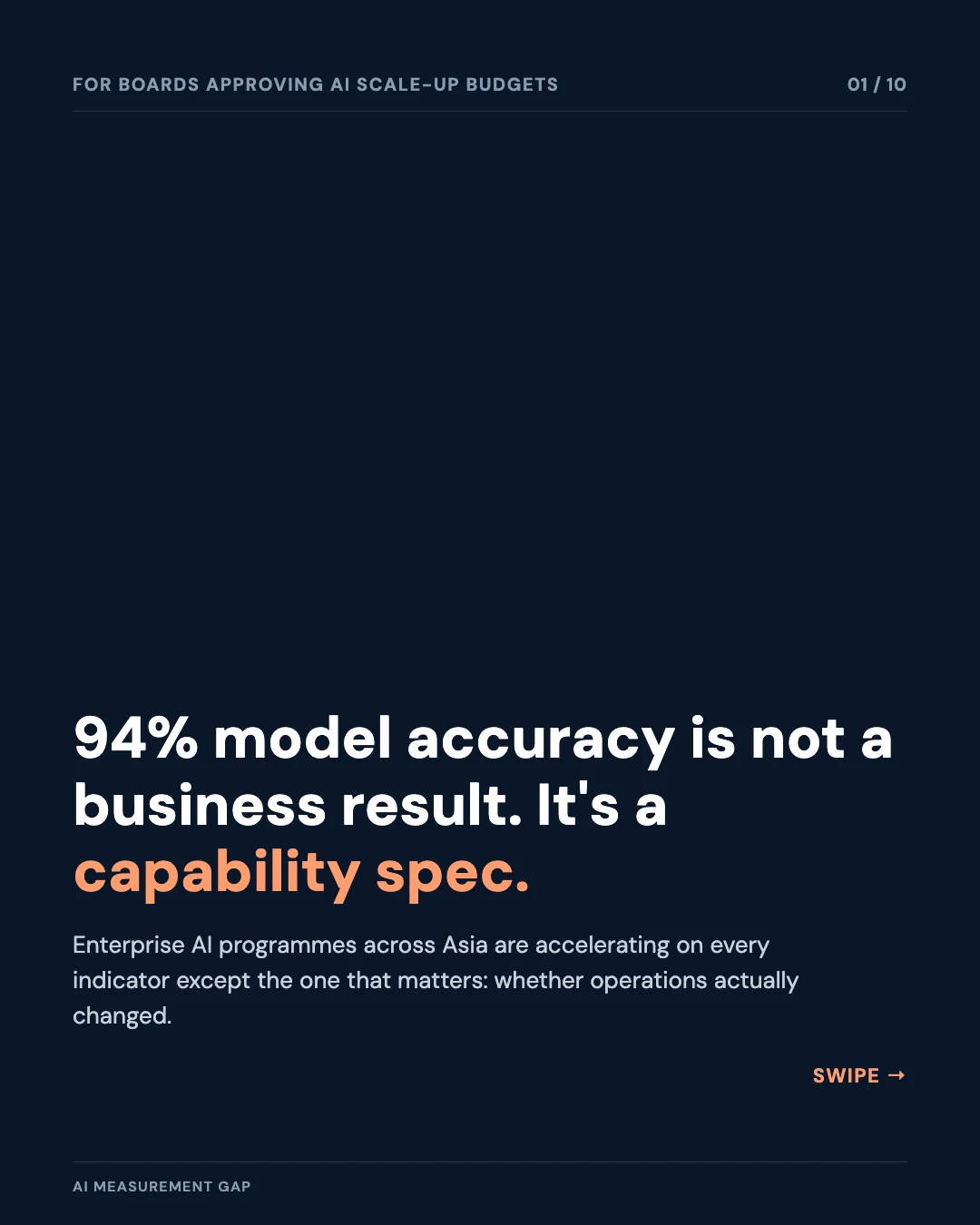
Enterprise AI programmes across Asia are measuring model performance when they should be measuring business impact. A model that’s 94% accurate is a capability specification, not proof the business has changed.
Core conclusions
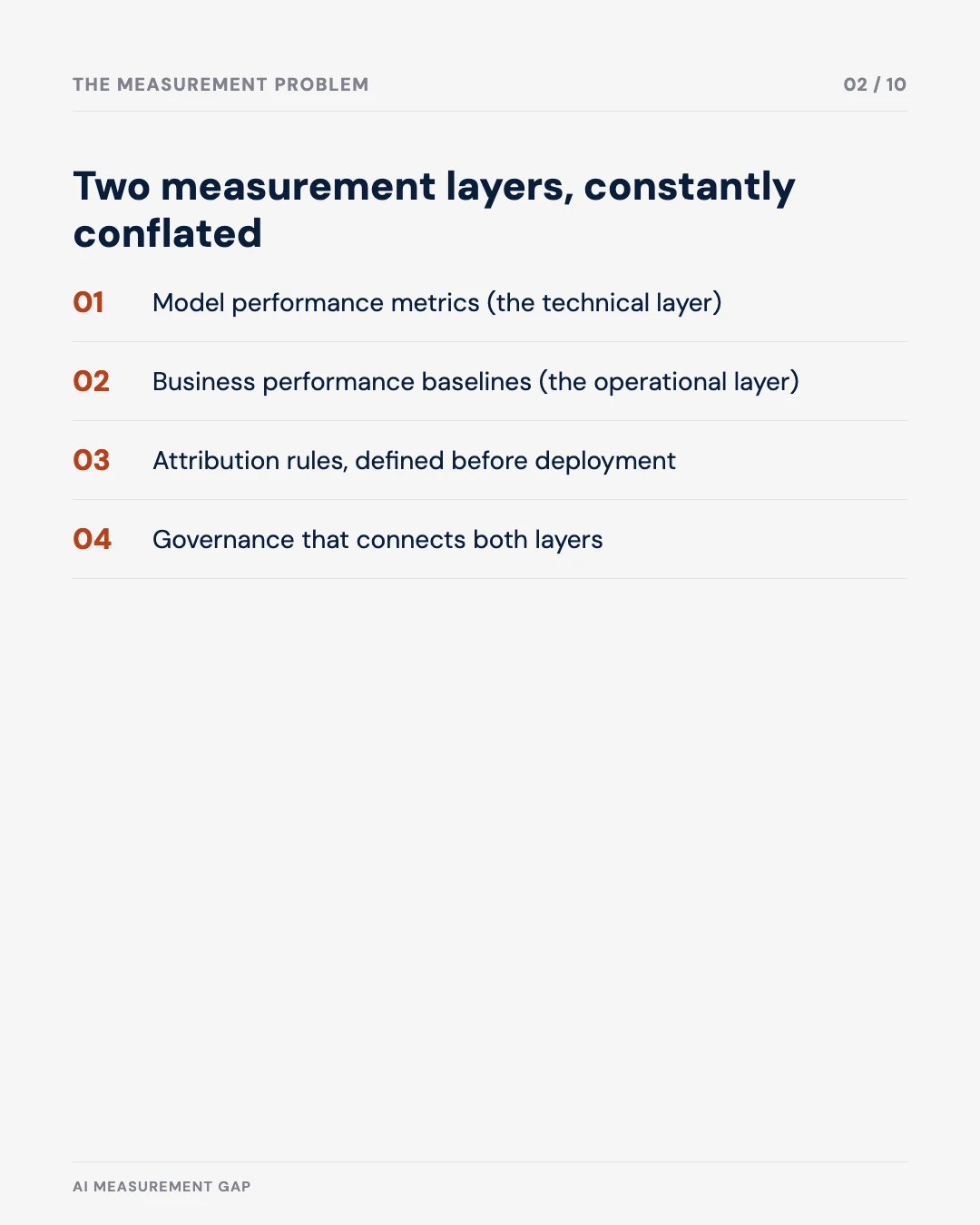
- Model performance metrics (accuracy, F1 score, latency) and business performance baselines (processing time, cost per unit, error rates) operate at different layers. Conflating them produces decisions that optimise the wrong variable.
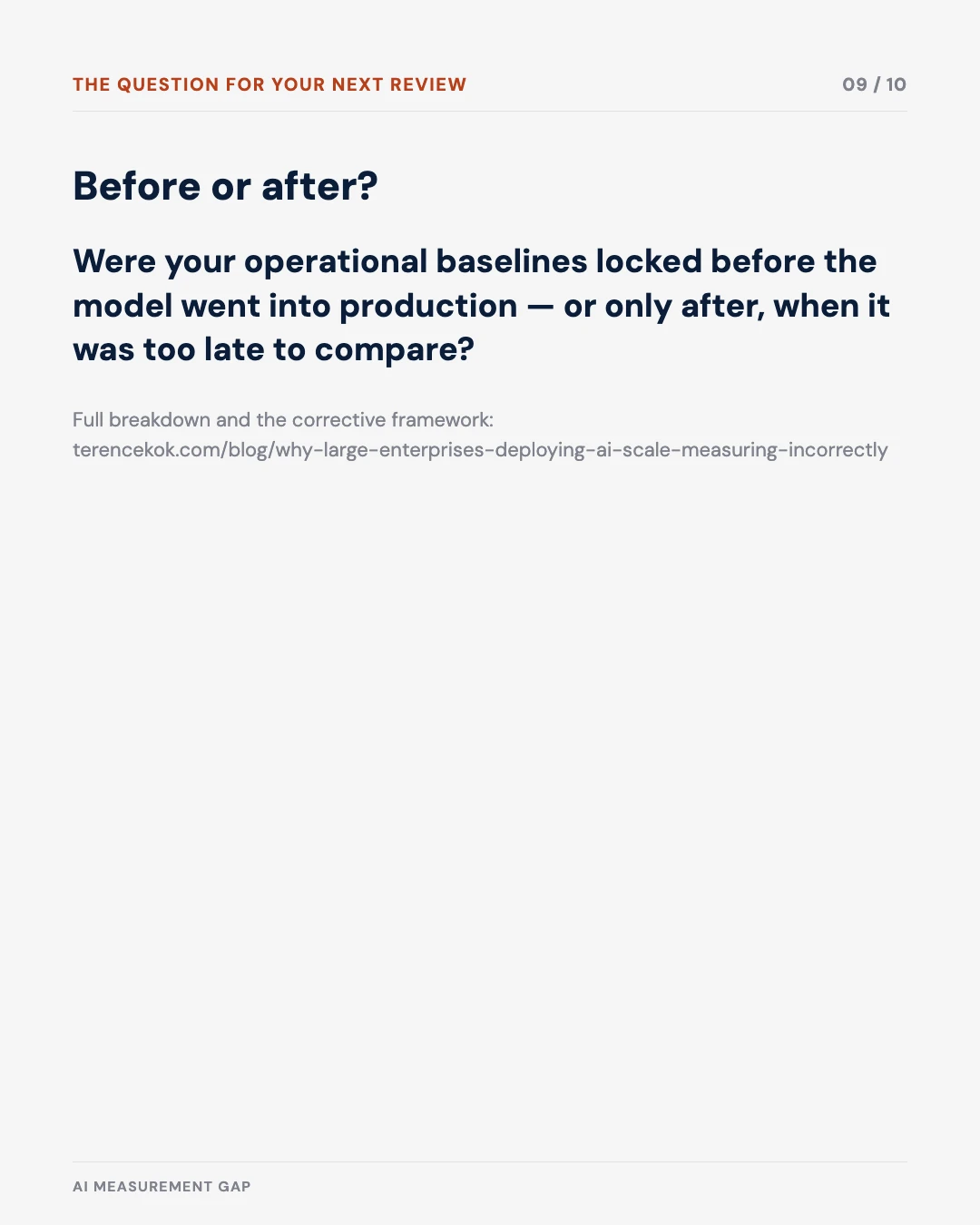
- Without an operational baseline locked before deployment, post-deployment performance changes can’t be attributed to AI at all. That’s a governance failure, not a technical limitation.
- The fix extends measurement to the operational layer, without replacing model monitoring: lock baselines before deployment, define attribution rules, instrument the workflow, and report operational impact to executive governance on a defined cadence.
The measurement gap, in ten slides
Save it, share it, or send it to whoever signs off your next AI scale-up budget.
Across the Asia-Pacific region, large enterprises are committing substantial capital to deploying artificial intelligence. The infrastructure exists, the vendor engagements are live, and the models are in production. The measurement frameworks, however, remain anchored to the wrong layer of the technology stack.
The Measurement Problem
Enterprise AI programmes in Asia are accelerating across most indicators. Capital expenditure on AI infrastructure across Southeast Asia, Greater China, and the Indian subcontinent reached record levels in 2025, and deployment timelines have compressed significantly as cloud-native tooling has matured. The models are running. The question that remains inadequately answered in the majority of programmes is whether they are producing the outcomes that justified the investment.
The source of this gap is structural. Most organisations have inherited their AI measurement practices from technology procurement and software quality assurance functions. These functions evaluate systems on technical dimensions: model accuracy, F1 scores, precision-recall trade-offs, latency benchmarks, and system uptime. These are valid engineering metrics. They are not, however, business performance metrics, and conflating the two produces an organisation that believes it is succeeding when its operations have not materially changed.
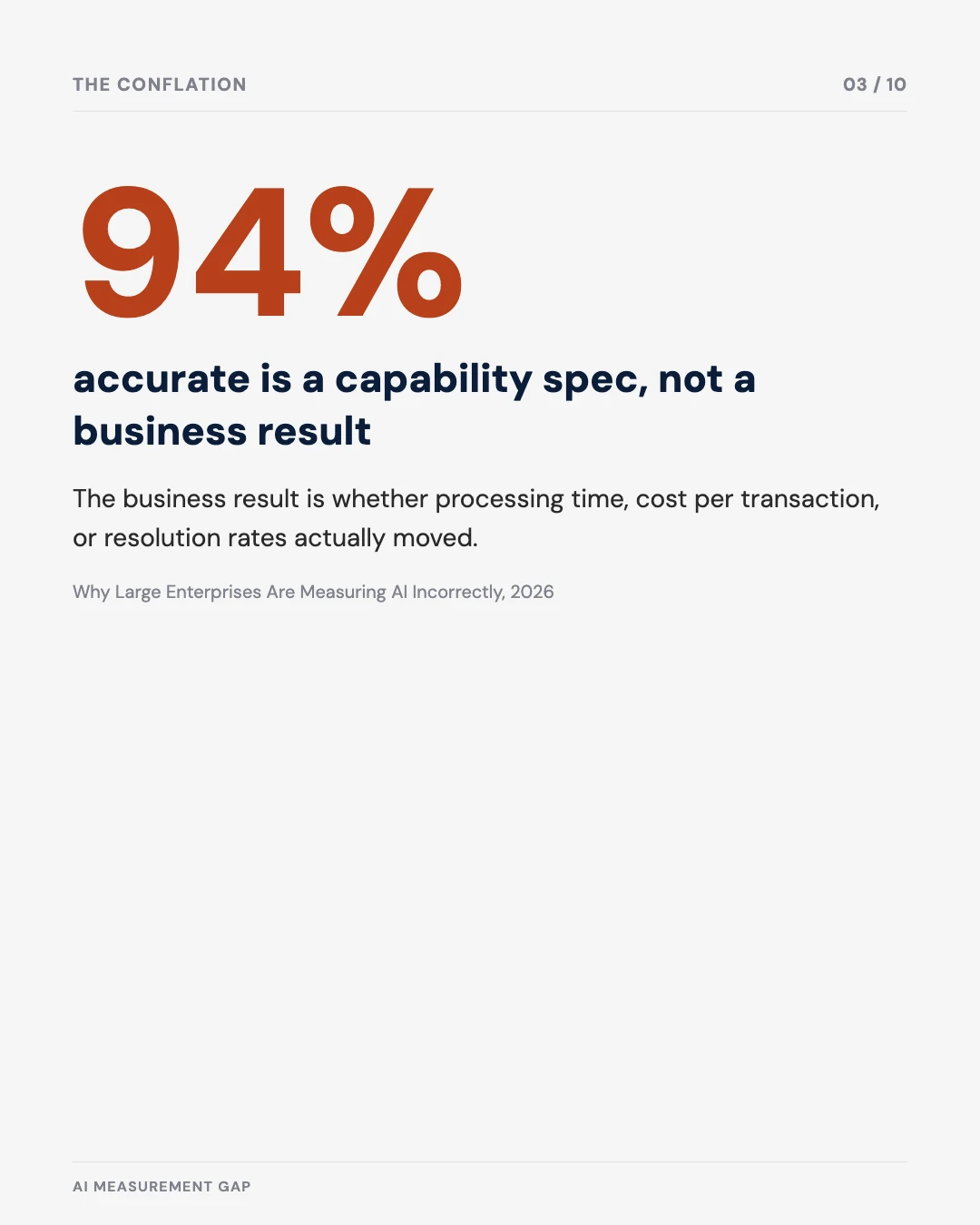
A language model that returns accurate outputs 94% of the time is not a business result. It is a capability specification. The business results are a reduction in manual processing time, an improvement in decision consistency, a measurable change in cost per transaction, or a demonstrable shift in customer resolution rates. These are distinct measurement problems, and they require distinct measurement infrastructure.
Model accuracy tells an organisation what its AI can do. Operational impact metrics tell it what the AI has done.
Model Performance Metrics vs Business Performance Baselines
The distinction between model performance metrics and business performance baselines is not a matter of preference. It is a matter of measurement layer. Conflating the two does not merely produce imprecise reporting; it produces decisions that optimise the wrong variable and obscure genuine programme risk.
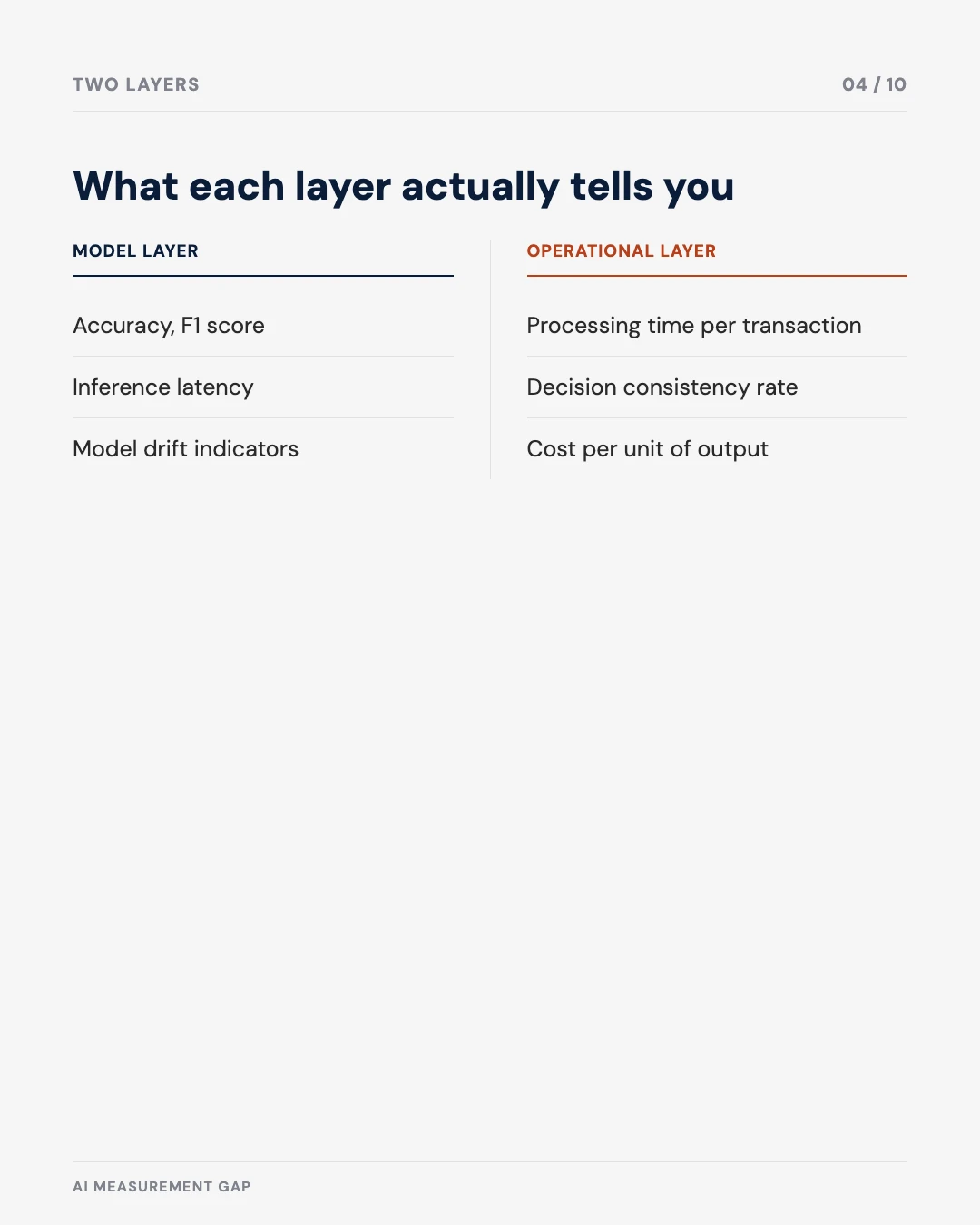
Model performance metrics operate at the technical layer. These metrics characterise the behaviour of the model itself in isolation or under controlled test conditions. Common examples include:
- Accuracy and F1 score: proportion of correct predictions across labelled test sets
- Precision and recall: trade-off between false positives and false negatives for classification tasks
- Inference latency: time taken to return an output under defined load conditions
- Model drift indicators: statistical distance between training distribution and live input distribution over time
- Token throughput and cost per inference: operational cost of running the model at scale
These metrics are essential for engineering teams managing model reliability and infrastructure cost. They are insufficient as programme-level reporting instruments because they carry no information about whether the model’s outputs are being used, whether they are improving decisions, or whether the business process they were intended to augment has changed at all.
Business performance baselines operate at the operational layer. A business performance baseline defines the state of a measurable operational process before AI deployment. It is established against specific workflows, teams, or transaction types, not against the model itself. Common baseline metrics include:
- Processing time per transaction: average and 90th-percentile time for a defined workflow step before AI augmentation
- Decision consistency rate: proportion of equivalent cases receiving equivalent outcomes under human-only processing
- Error or exception rate: frequency of downstream corrections required per unit of output
- Cost per unit of output: fully loaded cost including labour, rework, and escalation
- Throughput capacity: volume of cases processed per unit of time at baseline staffing levels
Without these baselines established prior to deployment, it is not possible to attribute post-deployment performance changes to AI. This is not a technical limitation. It is a programme governance failure. Baselines must be defined, measured, and locked before the model enters the production workflow.
Why This Pattern Is Prevalent Across Enterprise Deployments
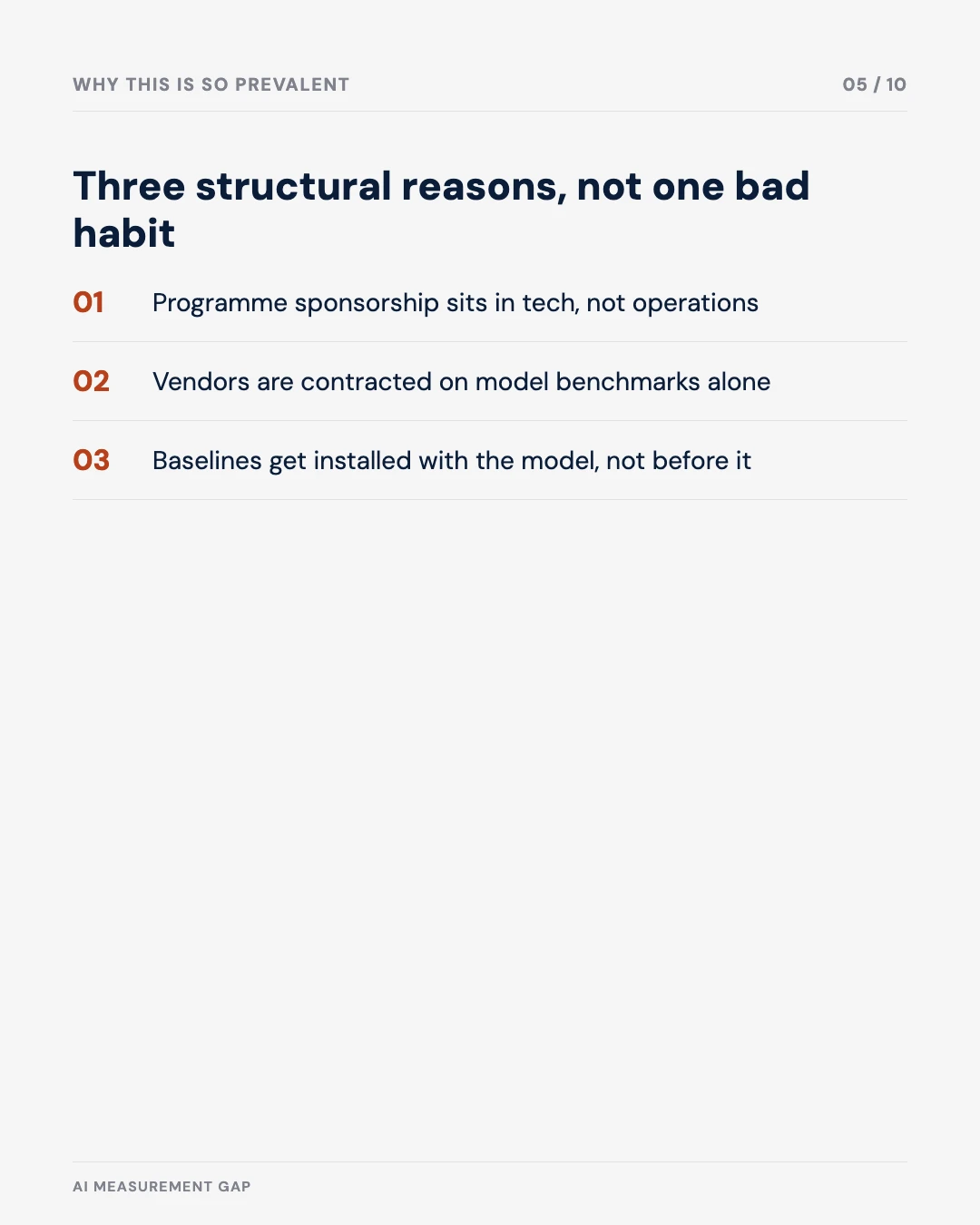
The prevalence of model-centric measurement in large Asian enterprises reflects several structural conditions that are broadly consistent across the region.
First, AI programme sponsorship in many large enterprises across Southeast Asia and Greater China is concentrated in technology functions rather than operations functions. Technology leaders are incentivised to demonstrate that the technology works. The operational counterpart, that the technology has changed something in the business, requires sponsorship from business unit leadership, which is frequently not embedded in the programme from the outset.
Second, vendor engagement models contribute to the problem. The majority of enterprise AI vendors in the region are evaluated and contracted based on model performance benchmarks. When a vendor delivers a model that meets its contractual accuracy specification, the engagement is technically complete, regardless of whether the enterprise has seen any operational change. The measurement deficit is therefore built into procurement, not just reporting.
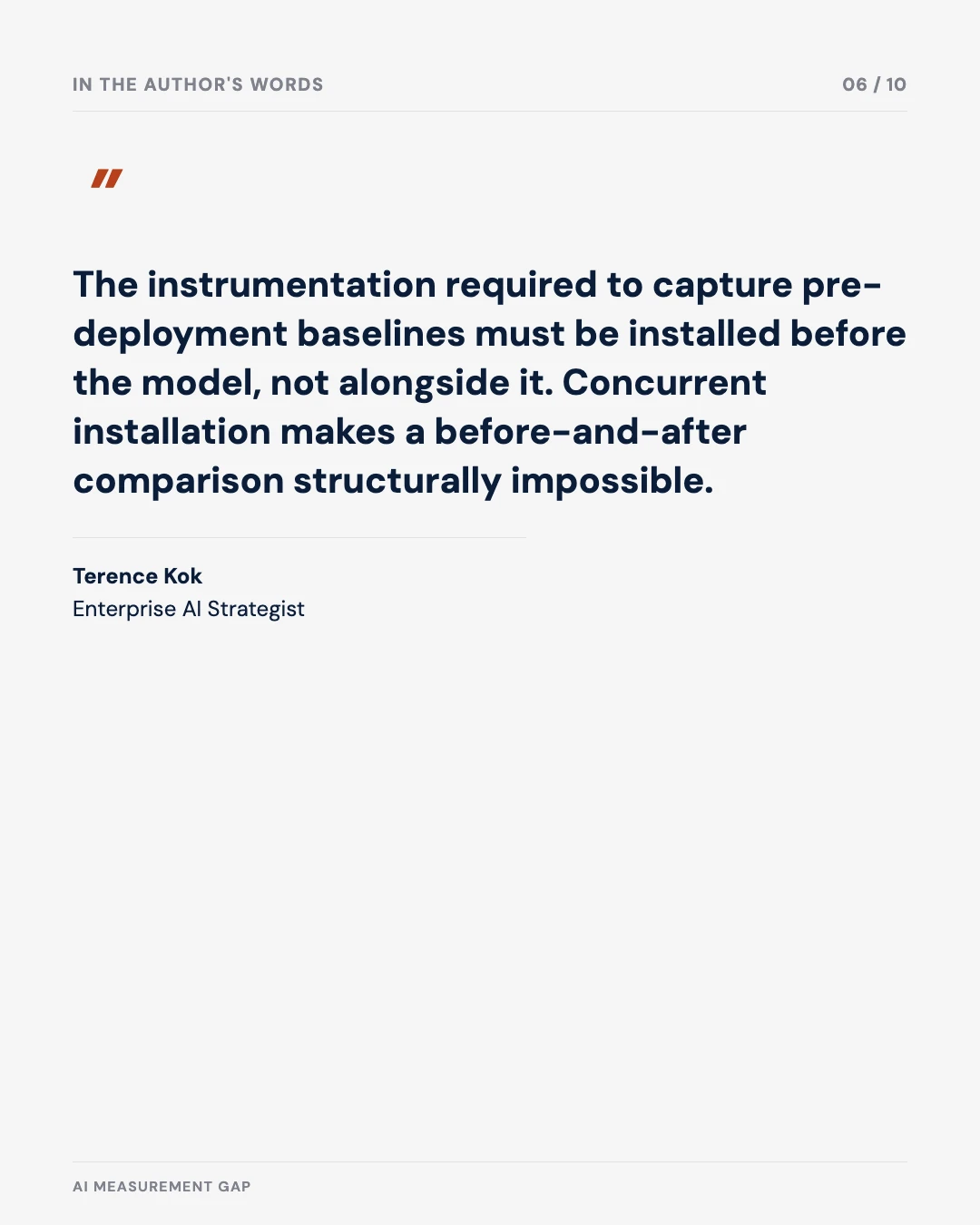
Third, the speed of deployment has outpaced the development of measurement infrastructure. Organisations have moved from proof of concept to production in compressed timeframes. The instrumentation required to capture pre-deployment baselines is, in many cases, installed concurrently with the model rather than ahead of it, which renders meaningful before-and-after comparison structurally impossible.
“The instrumentation required to capture pre-deployment baselines must be installed before the model, not alongside it. Concurrent installation makes a before-and-after comparison structurally impossible.”
The Consequences of Measuring the Wrong Thing
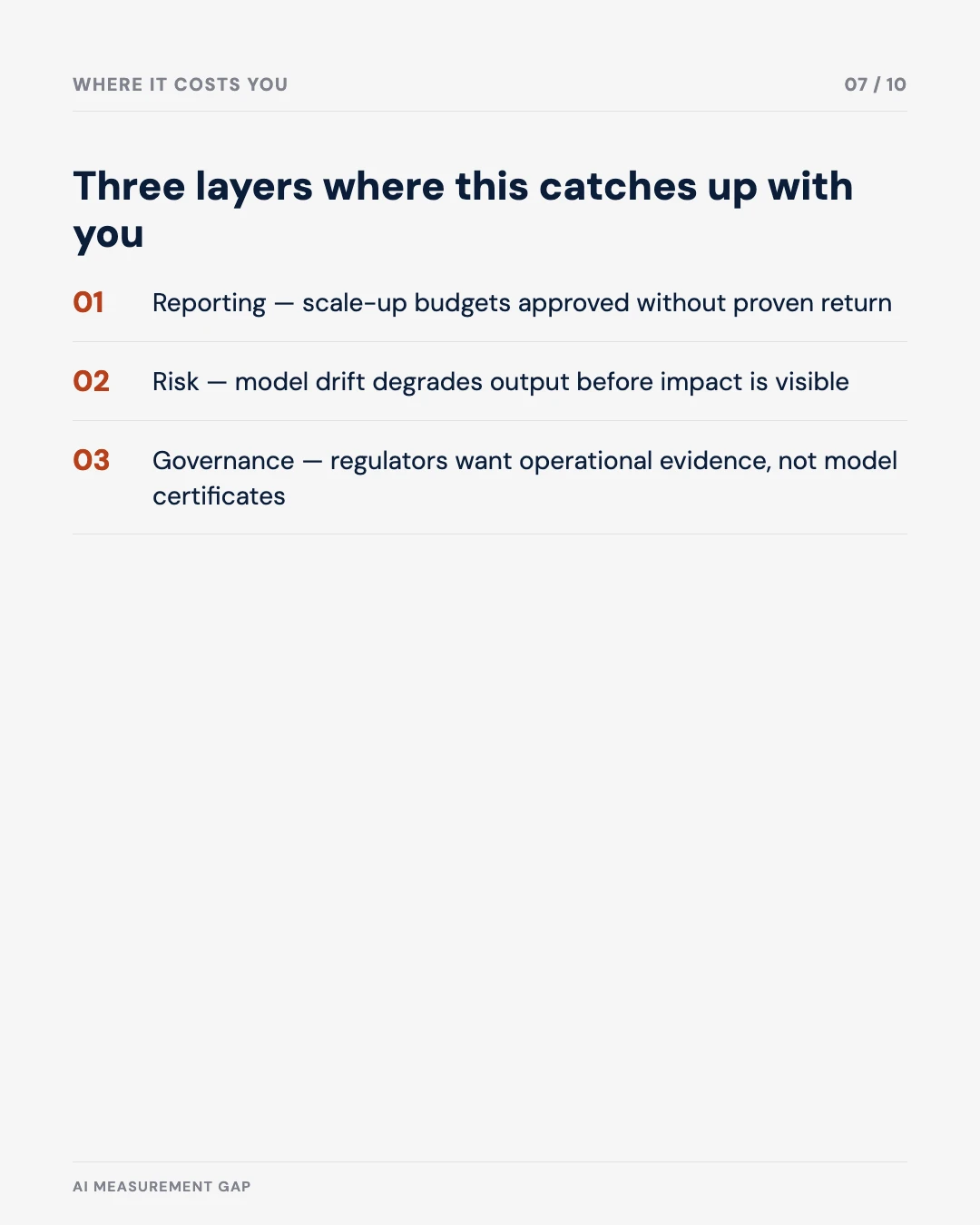
The practical consequences of model-centric measurement manifest across several dimensions over the programme lifecycle.
At the reporting layer, boards and executive committees receive assurances that the AI programme is performing well, whilst operational metrics that would surface the programme’s actual impact remain uncaptured. Scale-up budgets are approved for programmes that have not demonstrated operational return at the pilot stage.
At the risk layer, model drift (the gradual degradation of model performance as live data distributions shift away from training distributions) is a well-understood phenomenon. Without corresponding operational monitoring, a model can degrade materially before the business impact is visible. By the time degradation manifests as exception rates or manual correction volumes, the lag is significant.
At the governance layer, organisations subject to audit and regulatory oversight, particularly financial institutions and infrastructure operators under MAS guidelines in Singapore, or sectoral regulations across ASEAN, face increasing scrutiny of AI decision-making. The ability to demonstrate consistent, auditable, and bounded outcomes requires operational evidence, not model performance certificates.
A Corrective Approach: Integrating Both Measurement Layers
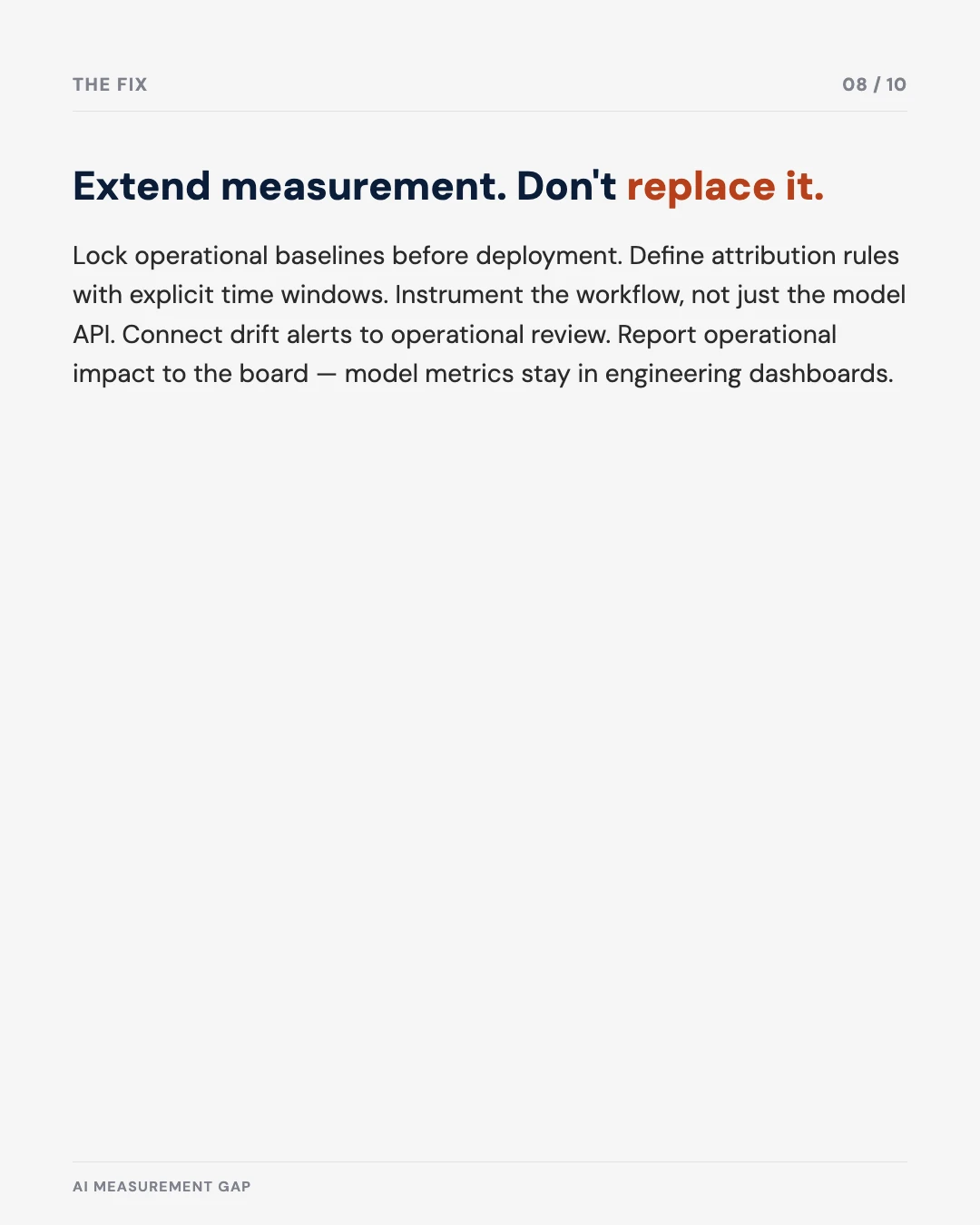
Correcting the measurement deficit does not require replacing existing model monitoring infrastructure. It requires extending measurement to the operational layer and establishing governance that connects both layers into a unified programme reporting structure.
- Define operational baselines before deployment. Identify the specific workflows the AI system will augment or automate. Measure the current state across the indicators listed above. Lock the baseline values as programme artefacts, version-controlled and accessible to programme governance.
- Establish operational KPIs with explicit attribution rules. Define which operational changes will be attributed to AI deployment, over what time window, and with what counterfactual controls. Attribution without defined rules produces contested numbers.
- Instrument the workflow, not only the model. Deploy observability at the point where model outputs enter operational processes, not only at the model API boundary. Track whether outputs are accepted, overridden, corrected, or escalated by human operators.
- Connect model monitoring to operational alerting. When model drift indicators cross defined thresholds, trigger a review of operational metrics in the affected workflows. Do not treat model and operational monitoring as separate reporting streams.
- Report operational impact to executive governance on a defined cadence. Model performance metrics belong in engineering dashboards. Operational impact metrics belong in board and investment committee reporting.
Conclusion
The enterprise AI deployment landscape across Asia is technically capable and commercially committed. The measurement infrastructure, however, has not kept pace with the deployment rate. The consequence is a growing cohort of large enterprises that can demonstrate model performance whilst remaining unable to demonstrate operational return.
This is not a problem of technology. The instrumentation required to capture operational baselines and measure post-deployment impact is available and well-understood. It is a problem of programme design and governance sequencing, specifically, the failure to establish measurement infrastructure as a prerequisite for deployment rather than a retrospective addition.
Organisations that resolve this sequencing error will be positioned to make defensible scale-up decisions, to satisfy increasing regulatory scrutiny of AI systems, and to distinguish genuine operational improvement from technical compliance. Those that do not will continue to approve investments based on metrics that cannot answer the question their boards are actually asking.
Free tool
Enterprise AI Value & Adoption Dashboard
Report the business-layer baselines this article argues for, at C-suite level, instead of the model-accuracy metrics your board is currently getting.
Free tool
Model Performance & Health Dashboard
Keep the technical monitoring layer (drift, latency, uptime) instrumented separately from operational impact, so the two never get conflated again.
I built the Measurement-Before-Prediction Architecture as the structured framework for designing measurement infrastructure before deployment begins, which is the corrective sequence this article argues for. If you’d rather move away from headcount-reduction metrics entirely, the Return on Employee framework is my alternative for capturing genuine operational impact.
Was this useful?