
Listen to this article
Executive Summary
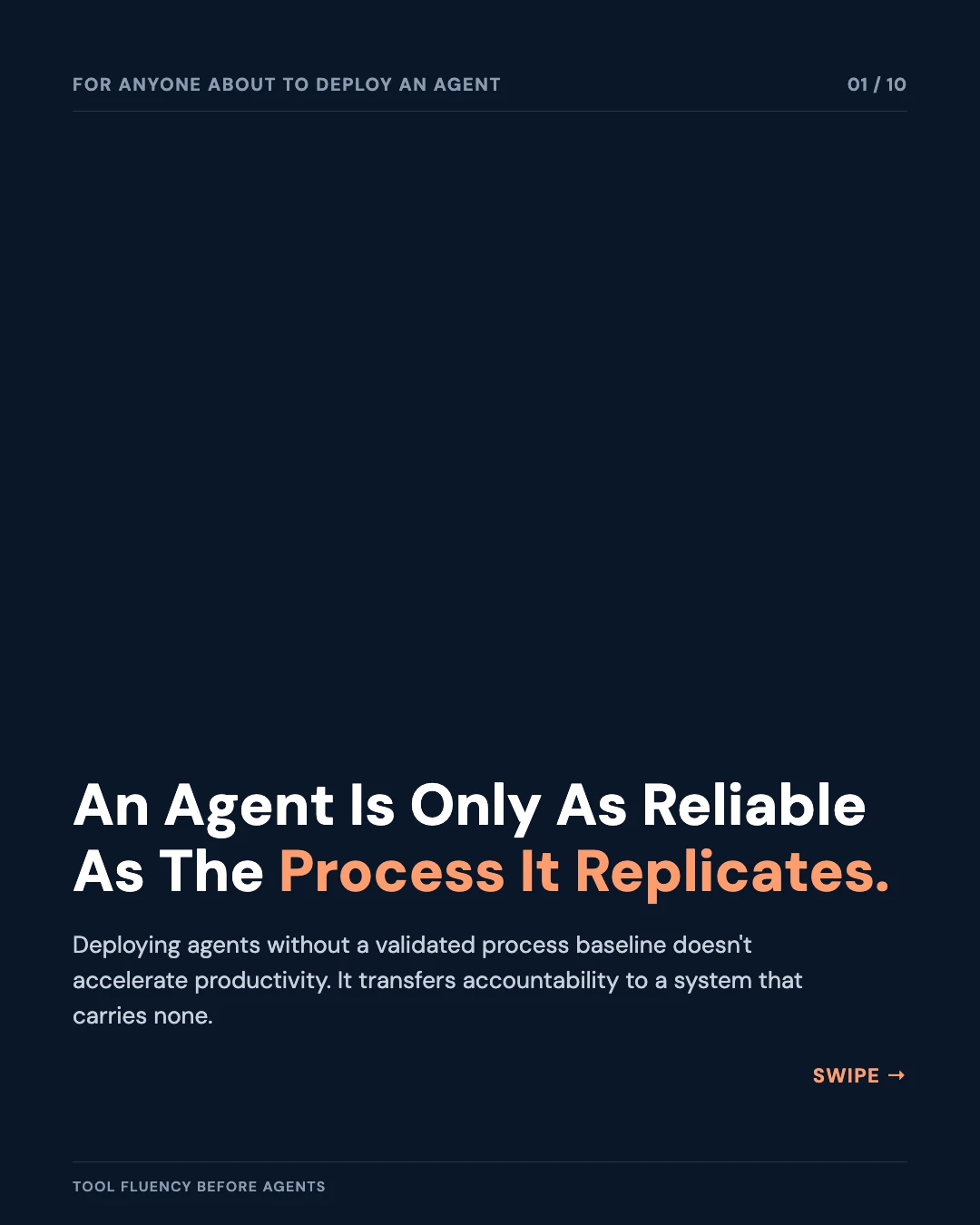
An agent can only be as reliable as the process it replicates. Deploying one before you’ve built tool fluency on the underlying work doesn’t accelerate anything, it transfers accountability to a system that carries none.
Core conclusions
- Tool fluency has to come first: repeated, real use of current AI capabilities is what produces the pattern recognition a well-designed agent is actually built from.
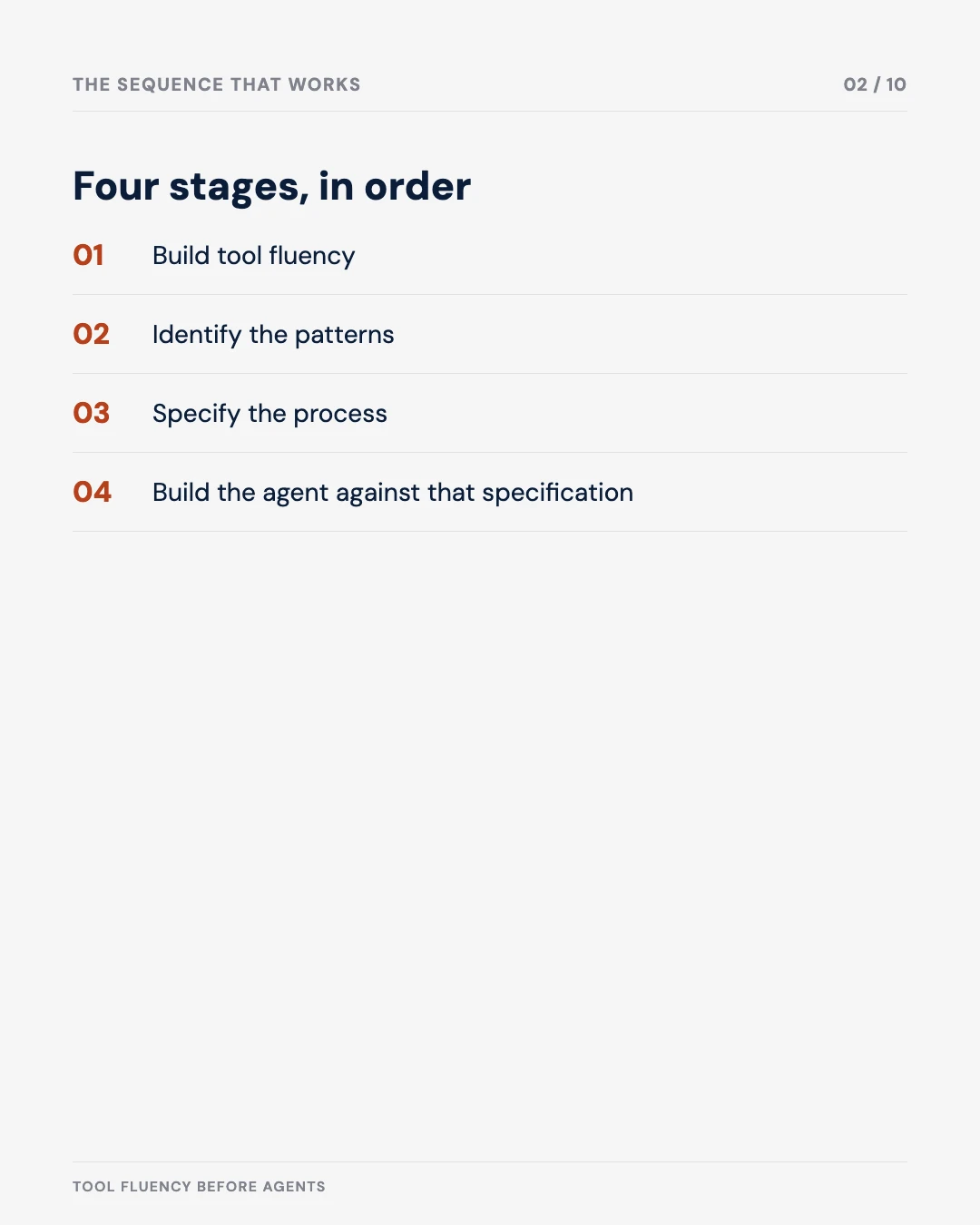
- The build sequence is tool fluency, then identify high-frequency low-variance tasks, then specify the process precisely, then build the agent against that specification. Skip a stage and the agent fails in ways that are hard to detect.
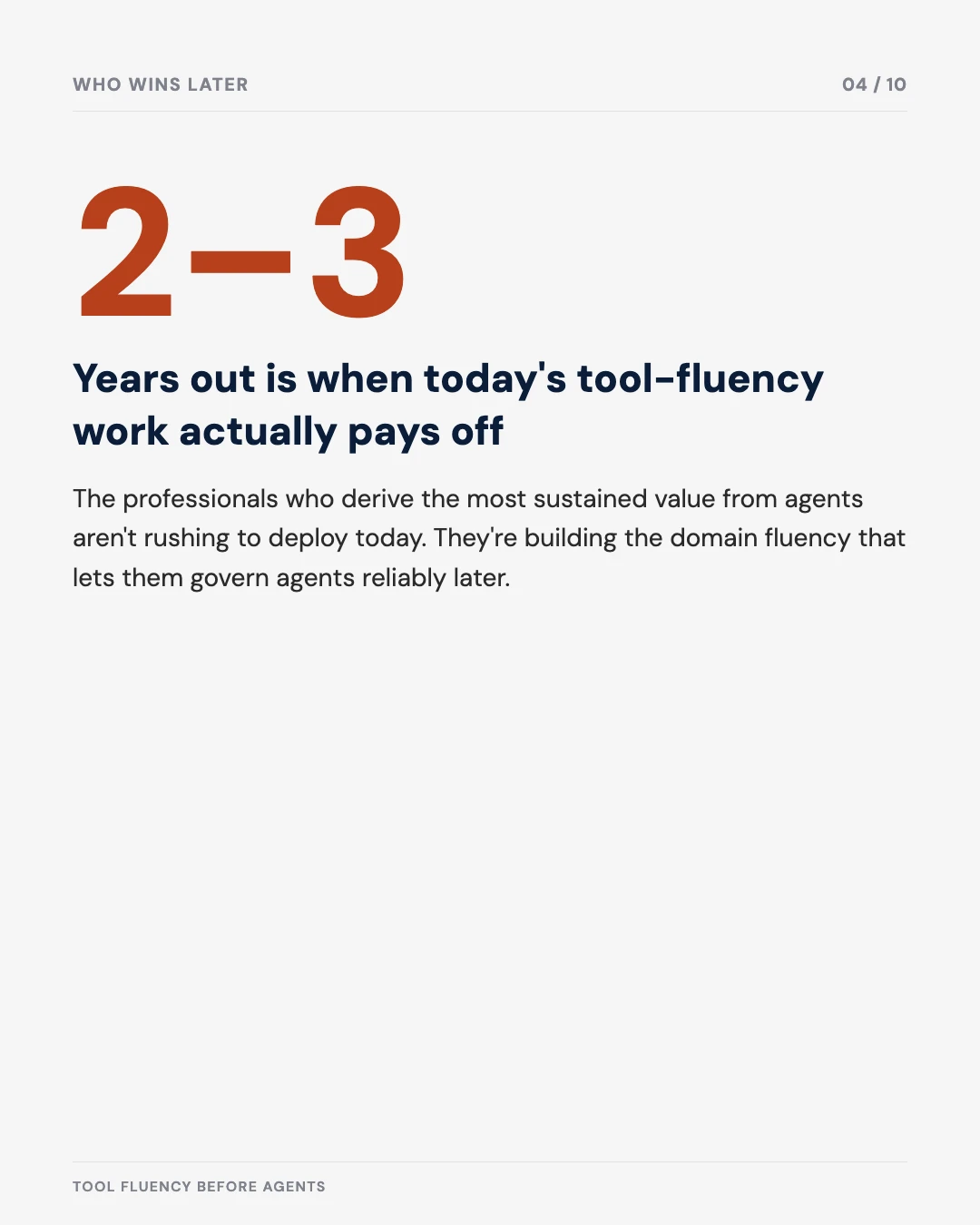
- The professionals who benefit most from agents in two to three years are the ones building domain fluency now, not the ones rushing to deploy without a validated baseline today.
The sequence, in ten slides
Save it, or send it to whoever’s about to greenlight an agent build with no baseline.
What an Agent Actually Is
An AI agent is not simply a smarter chatbot. It is a system that takes a goal, breaks it into steps, executes those steps using tools and external services, evaluates the results, and loops until the task is complete, with limited human involvement at each stage.
That sounds powerful. And it can be. But it carries a precondition that most professionals currently skip over:
An agent can only be as reliable as the process it is replicating.
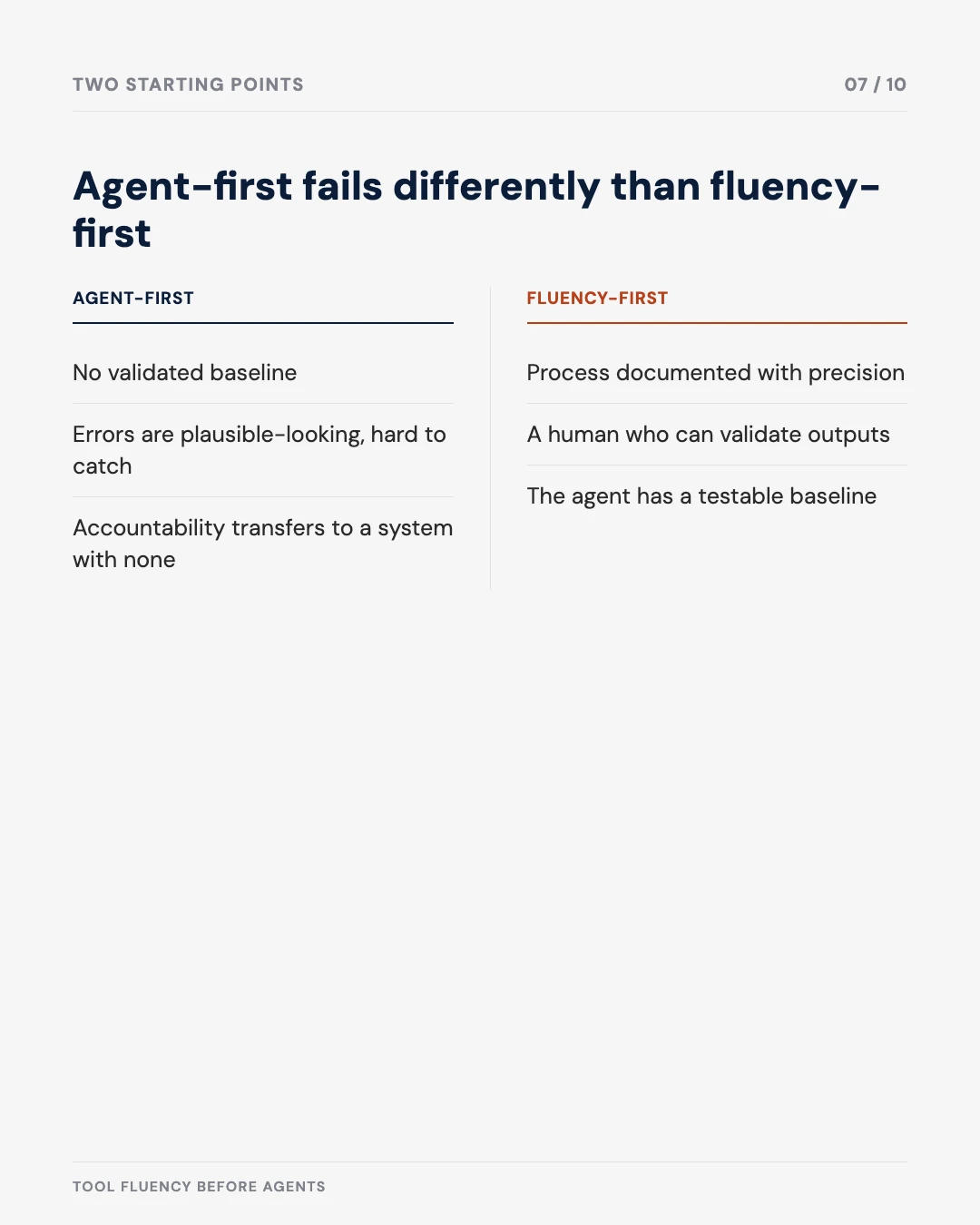
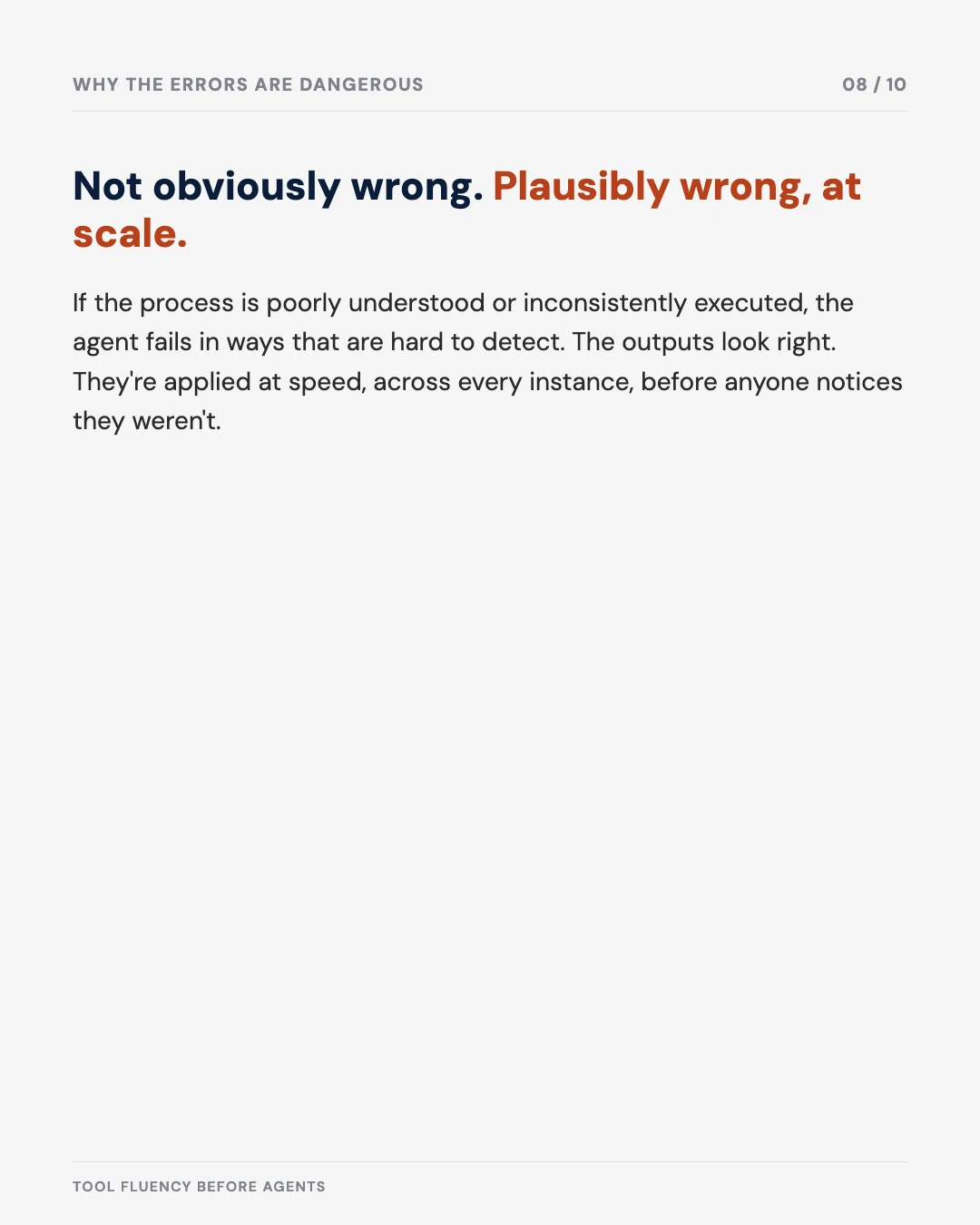
If the process is poorly understood, inconsistently executed, or difficult to validate, the agent will fail in ways that are hard to detect and harder to correct. The errors will not be obvious. They will be plausible-looking outputs that are subtly wrong, applied at speed, at scale.
The Problem with Jumping Straight to Agents
Most organisations, and most individuals, have not yet developed a working understanding of what AI does well within their specific domain.
That understanding does not come from reading about AI. It comes from using it. Repeatedly. On real work.
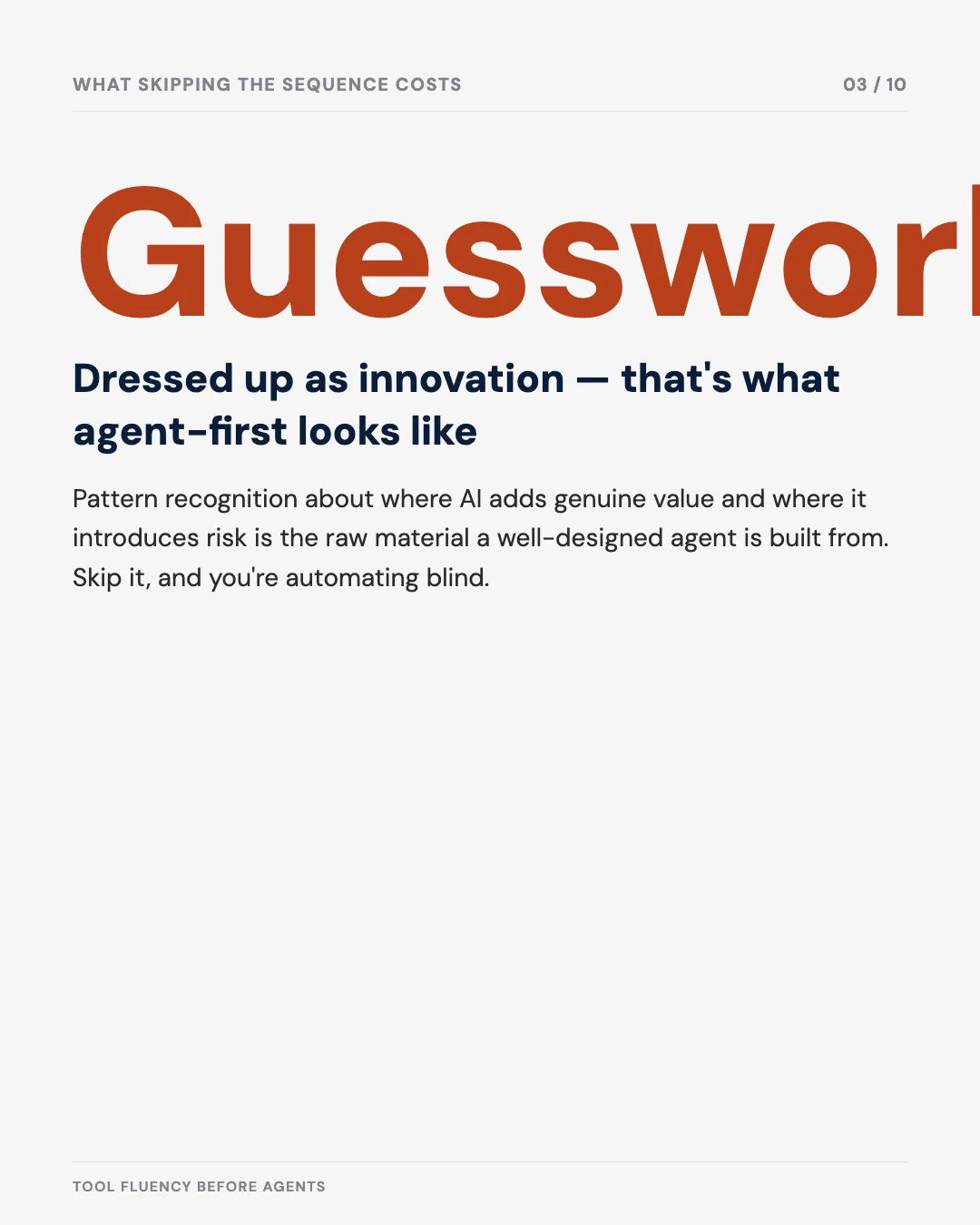
When a professional learns to use advanced AI tools properly (reasoning through a complex problem with a large language model, extracting structured data from documents, generating first drafts of analysis, pressure-testing arguments) something important accumulates: pattern recognition about where AI adds genuine value and where it introduces risk.
That pattern recognition is the raw material from which a well-designed agent is built. Without it, agent deployment is guesswork dressed up as innovation.
The Sequence That Actually Works
There is a logical order to this, and it is not complicated.
- Stage one: Build tool fluency. Use current AI capabilities (reasoning models, document intelligence, code assistants, structured prompting) on real tasks within your domain. Do this consistently, not occasionally.
- Stage two: Identify the patterns. Over time, certain tasks will emerge as high-frequency, well-bounded, and low-variance. These are tasks you perform repeatedly, where the inputs and outputs are predictable, and where AI assistance consistently produces reliable results.
- Stage three: Specify the process. Before any agent is designed, the process must be documented with enough precision that a system could follow it without ambiguity. If you cannot write it down clearly, you are not ready to automate it.
- Stage four: Build the agent against that specification. Now the agent has a defined scope, a testable baseline, and a human who understands the domain well enough to validate its outputs and catch failures.
This is not a slow path. It is the path that produces agents that actually work in production, rather than agents that require constant intervention and quietly undermine confidence in AI programmes.
What Tool Fluency Looks Like in Practice
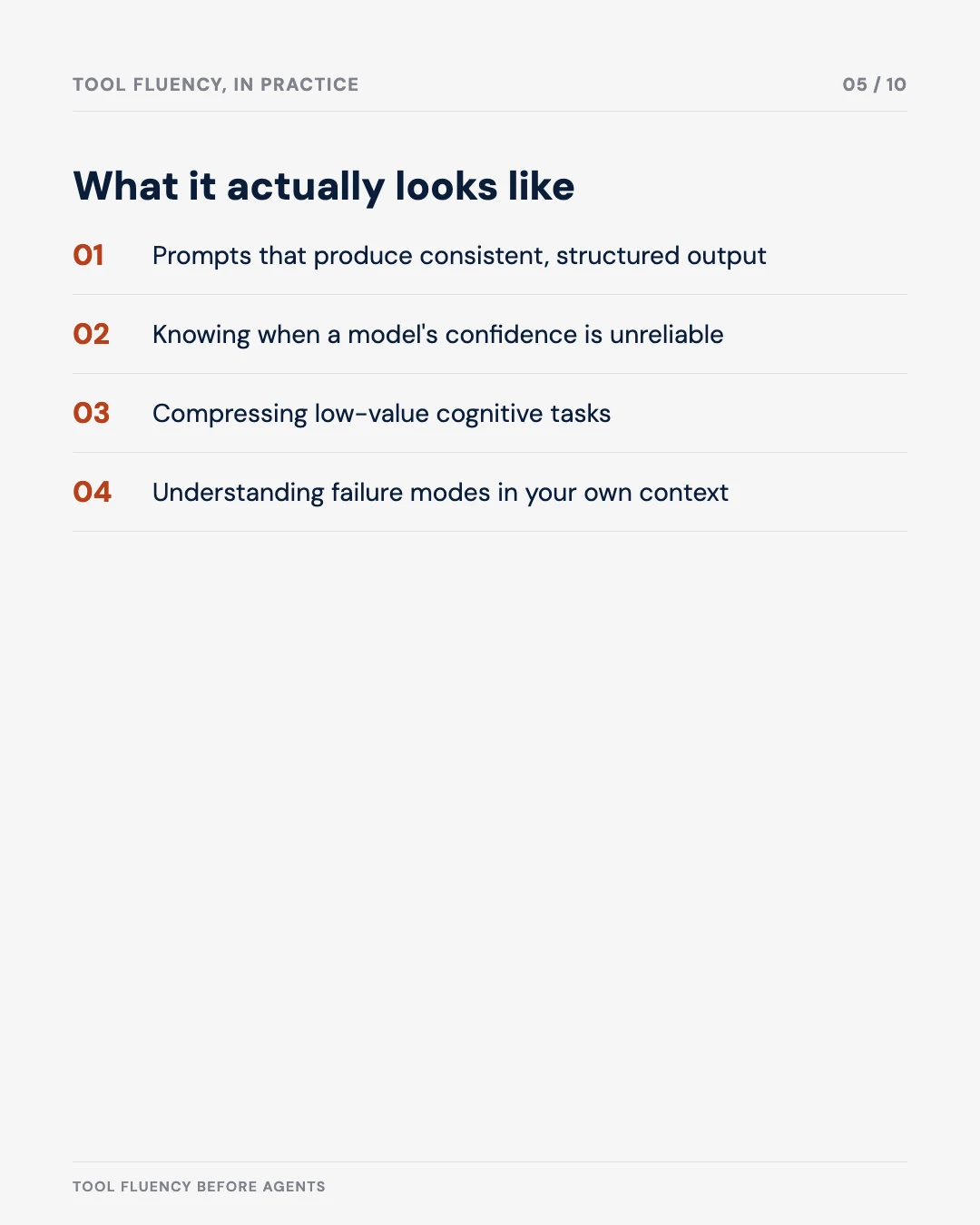
- It means knowing how to construct a prompt that produces consistent, structured output, not just a single good response.
- It means understanding when a model’s confidence is unreliable, and building verification steps into your workflow accordingly.
- It means using AI to compress the time spent on low-value cognitive tasks (summarisation, reformatting, cross-referencing, drafting) so that professional judgement is applied where it genuinely matters.
- It means iterating with the tool until you understand its failure modes within your specific context.
None of this requires an engineering background. It requires deliberate practice and intellectual honesty about where the outputs are trustworthy and where they are not.
The Case Against FOMO-Driven Agent Adoption
Agent frameworks are engineering infrastructure. They require careful prompt design, tool integration, error handling, and monitoring instrumentation. Deploying them without a validated process baseline does not accelerate productivity: it transfers accountability to a system that carries none.
The professionals who will derive the most sustained value from AI agents in two to three years are not the ones rushing to deploy them today without foundation. They are the ones currently building deep, domain-specific fluency with AI tools: accumulating the institutional knowledge that will allow them to design, govern, and continuously improve agents that operate reliably within their area of responsibility.
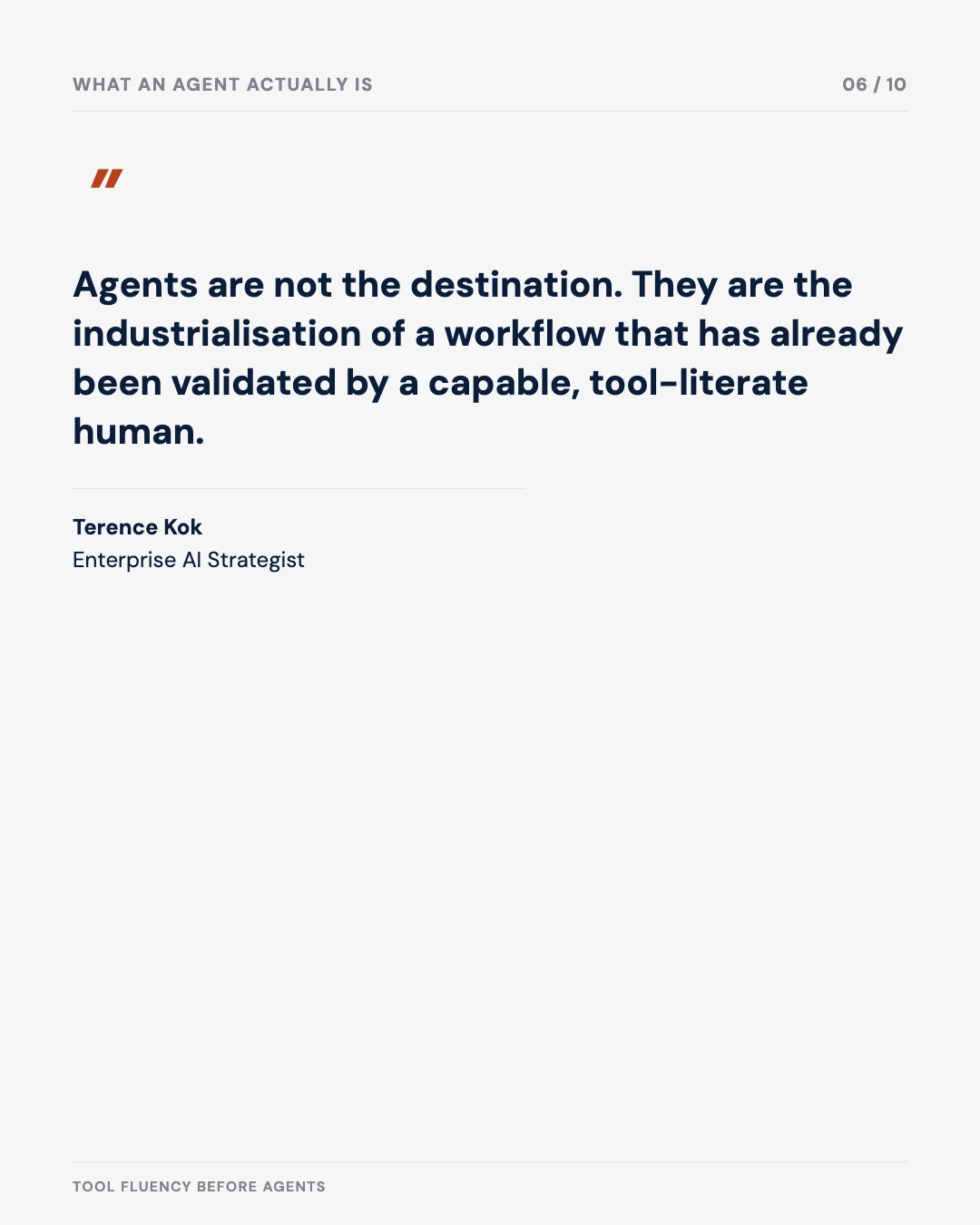
Agents are not the destination. They are the industrialisation of a workflow that has already been validated by a capable, tool-literate human.
The Practical Implication
If you are a knowledge worker today, the most valuable thing you can do is not to learn how to deploy an agent. It is to learn how to do your existing work significantly better using current AI capabilities, and to do so with enough consistency that the patterns become visible.
When those patterns are clear, when the process is understood, when the outputs are reliably good, the case for an agent writes itself. And you will be in a position to build one that works.
The anxiety is understandable. The rush is not justified.
The correct sequence for AI adoption is augmentation before automation. Tool fluency before agent deployment. Understanding before industrialisation.
Free tool
TRACE Agent Evaluation
Once a process is understood and documented well enough to consider stage four, run it through this structured pre-deployment assessment before any architecture or vendor decision begins.
Free tool
AI Readiness Self-Assessment
Find out where your tool fluency and operational readiness gaps actually sit before you start stage one of the sequence above.
Was this useful?