
Listen to this article
Executive Summary
Most modern AI systems are pattern-recognition machinery, not autonomous intelligence. Routinely treating them otherwise, through myths about autonomy, functionality, objectivity, and inevitable ROI, is what actually underpins most AI disappointments and incidents.
Core conclusions
- Four fallacies distort decision-making: assuming systems can operate autonomously, assuming deployment means functional soundness, assuming precision means objectivity, and assuming AI guarantees ROI simply by being adopted.
- For governments and infrastructure operators, these myths translate into systemic risk, not isolated project failure: ambiguous liability, policy distortion, and the hollowing out of institutional judgment.
- The corrective is technical honesty: design for error tolerance and human escalation, validate the problem construct before deploying, and embed accountability by design across the model lifecycle.
The four fallacies, in ten slides
Save it, share it, or send it to whoever is writing your AI governance policy.
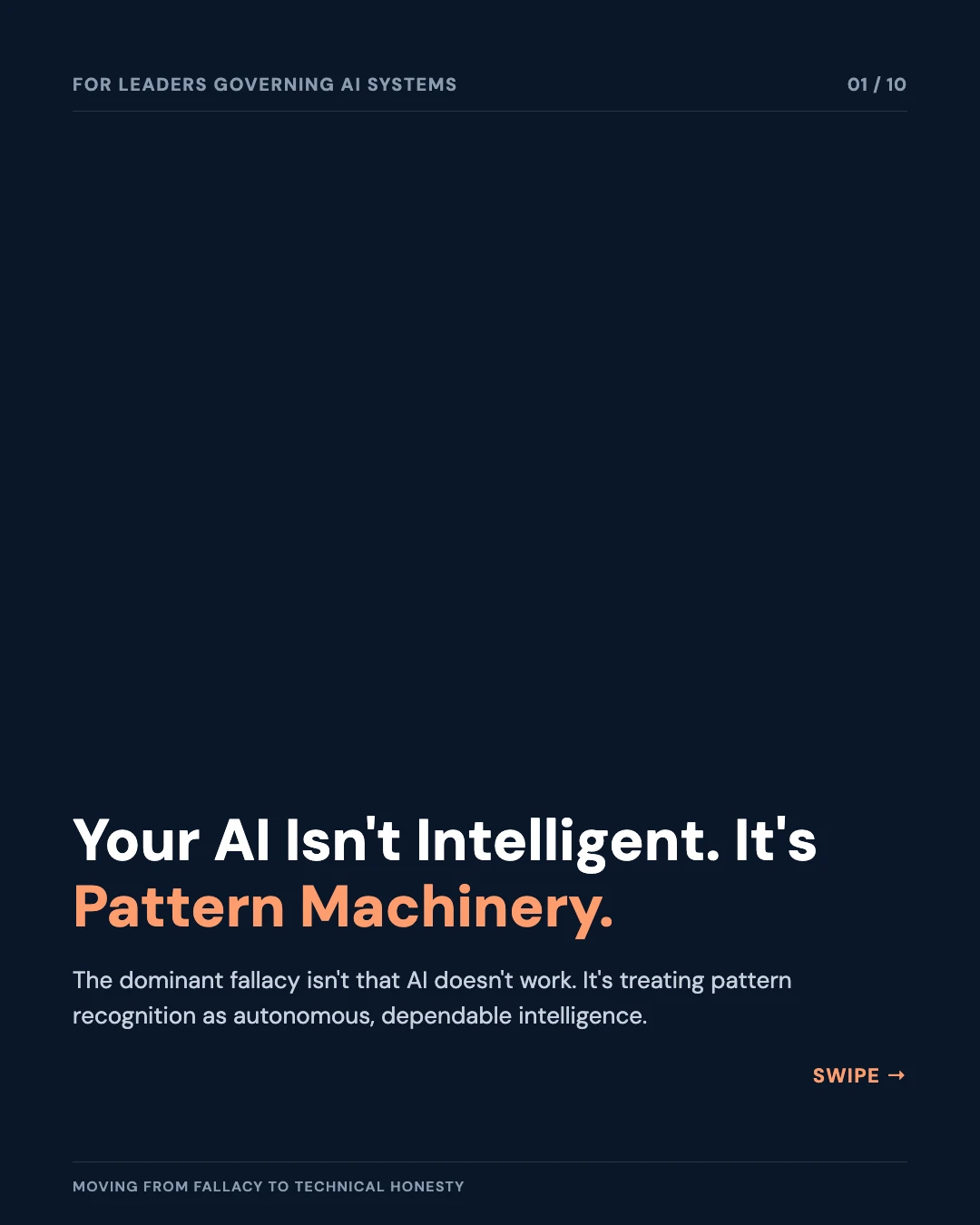
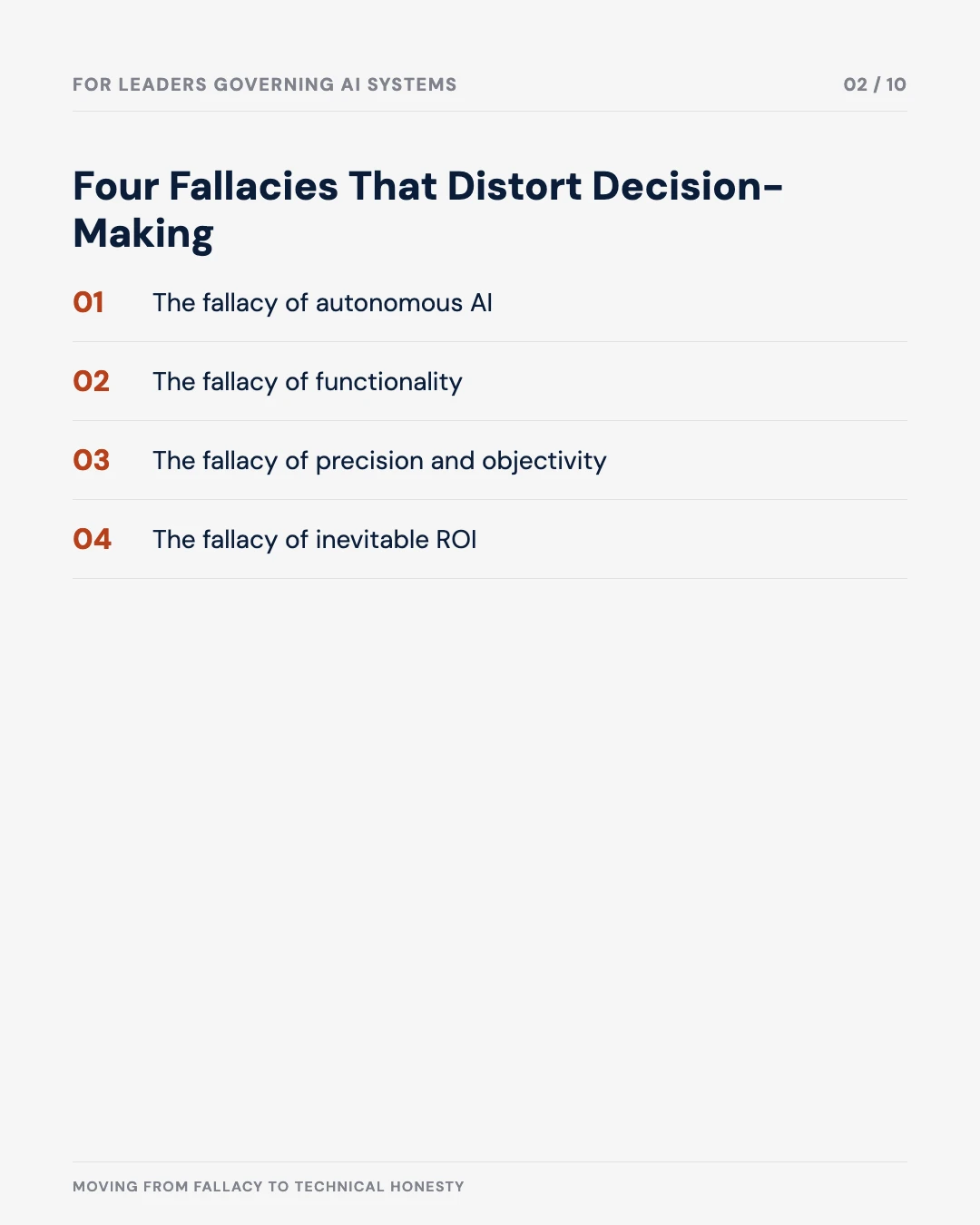
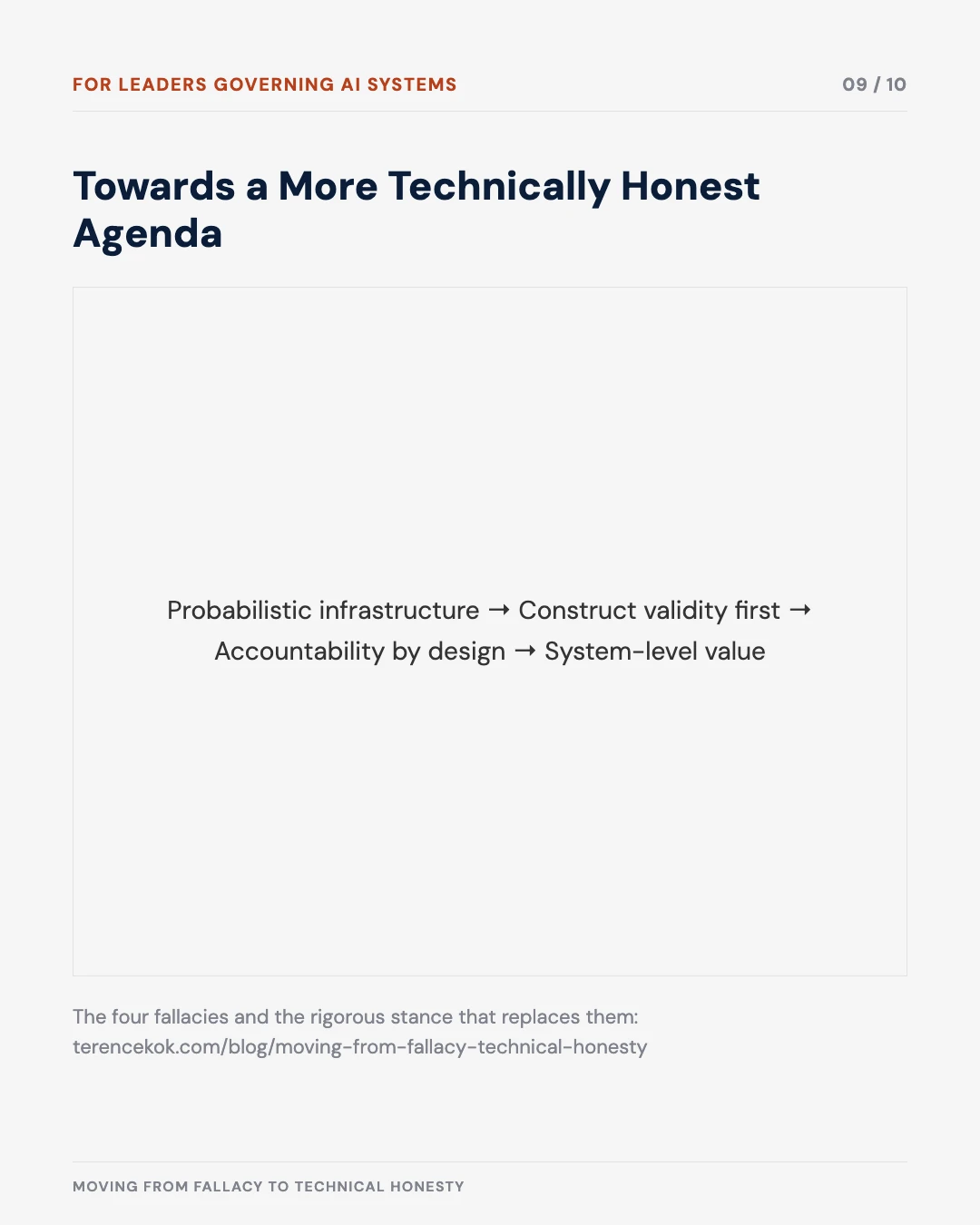
The dominant fallacy of artificial intelligence is not that it “does not work”, but that it is routinely treated as autonomous, intelligent and dependable in ways that its underlying mathematics and engineering simply do not support.
The Common Fallacy: Mistaking Pattern Machinery for Intelligence
Most modern AI systems are high-dimensional pattern recognisers, not general intelligences. They approximate functions from inputs to outputs learned from historical data, but they do not possess understanding, intention, or grounded situational awareness in the human sense.
Several consequences follow:
- Apparent “reasoning” is often interpolation within seen patterns rather than robust deduction or abstraction, which is why models fail abruptly when distributions shift.
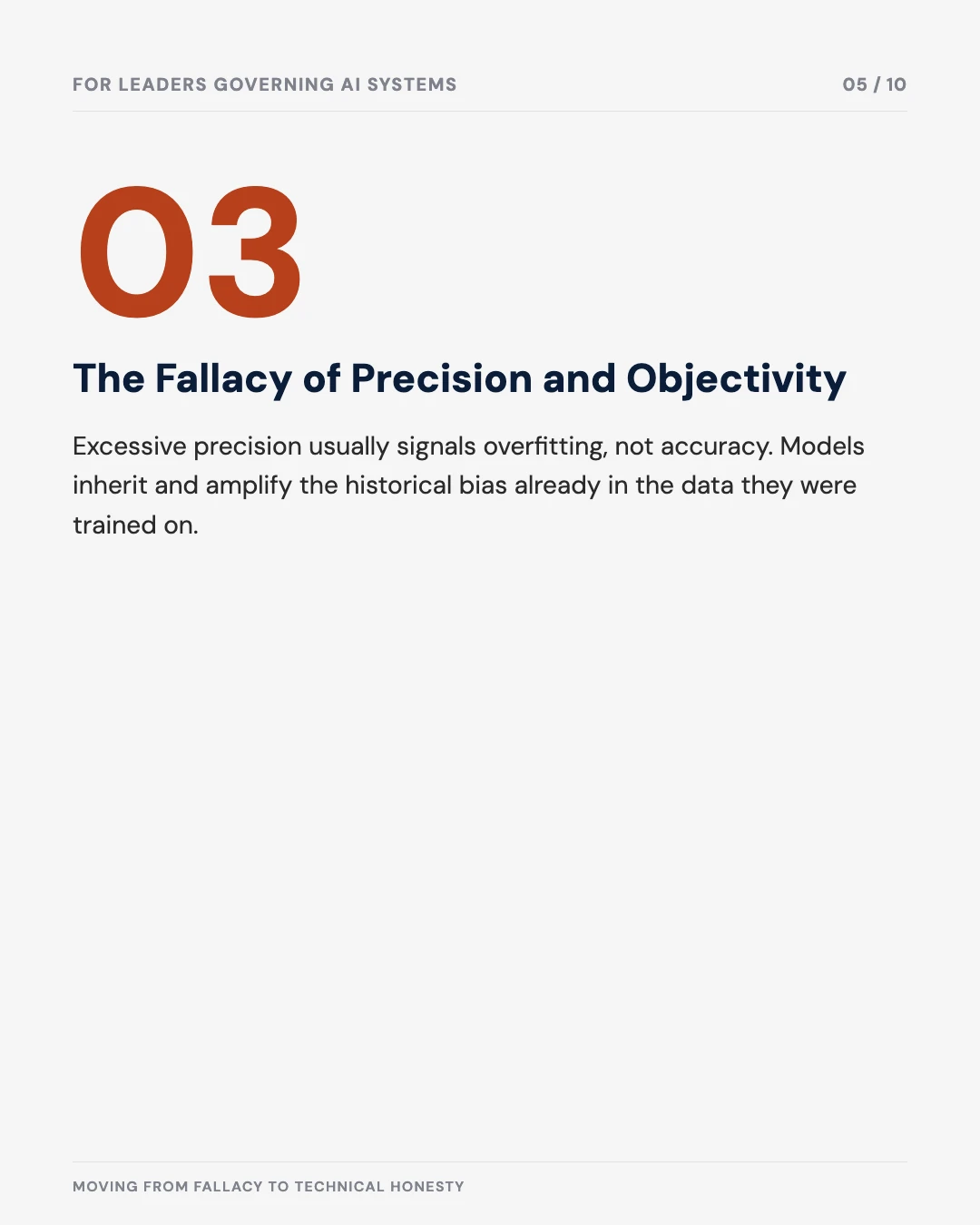
- Precision is illusory: if a model is too precise on its training distribution, it is usually overfitting rather than learning general structure.
- Any perceived creativity or meaning is projected by humans onto outputs generated by statistical processes over training data.
Treating this pattern machinery as if it were an intelligent colleague or autonomous decision-maker is the central fallacy that underpins many AI disappointments and incidents.
Four Specific Myths That Distort Decision-Making
- The Fallacy of Autonomous AI
A common narrative is that AI systems can operate as autonomous agents, reliably handling complex, socially embedded tasks with minimal supervision. In practice, even advanced models struggle with dynamic social interactions, non-stationary environments, and the implicit norms that humans routinely navigate.
- Studies show models perform poorly at interpreting multi-party, real-world social interactions, which is critical for domains such as autonomous mobility, care, and public safety.
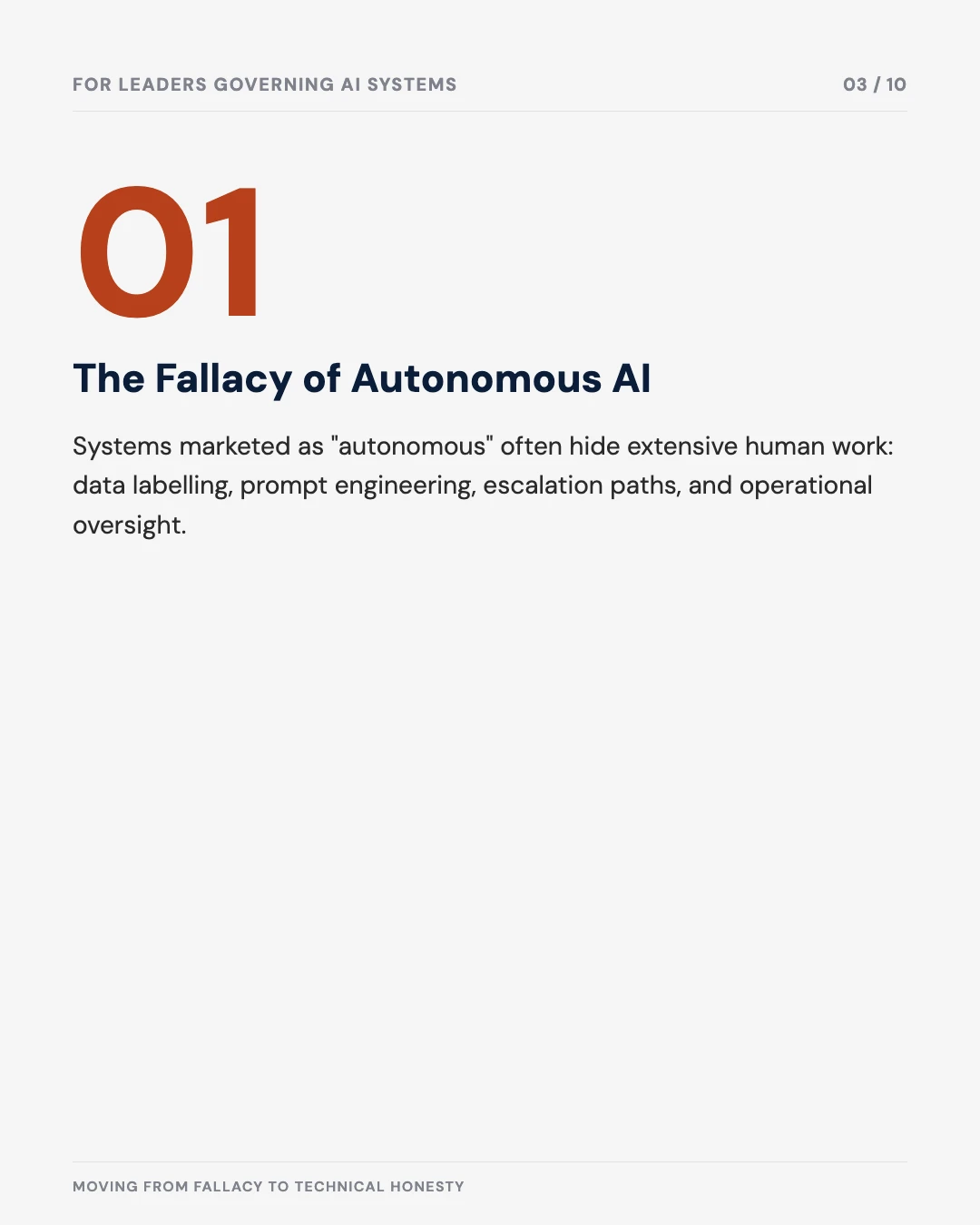
- Systems marketed as “autonomous” often hide extensive human work: data labelling, prompt engineering, escalation paths and operational oversight.
Framing these systems as autonomous invites over-delegation of responsibility and weakens human accountability in safety-critical contexts. The corrective is a disciplined screen for which tasks actually warrant autonomy in the first place: see Critical Tasks Suitable for Agentic AI.
- The Fallacy of Functionality
Another persistent myth is that if an AI system is deployed, benchmarked and integrated into workflows, it must be functionally sound for its stated purpose. Evidence from real-world deployments shows this assumption to be unreliable.
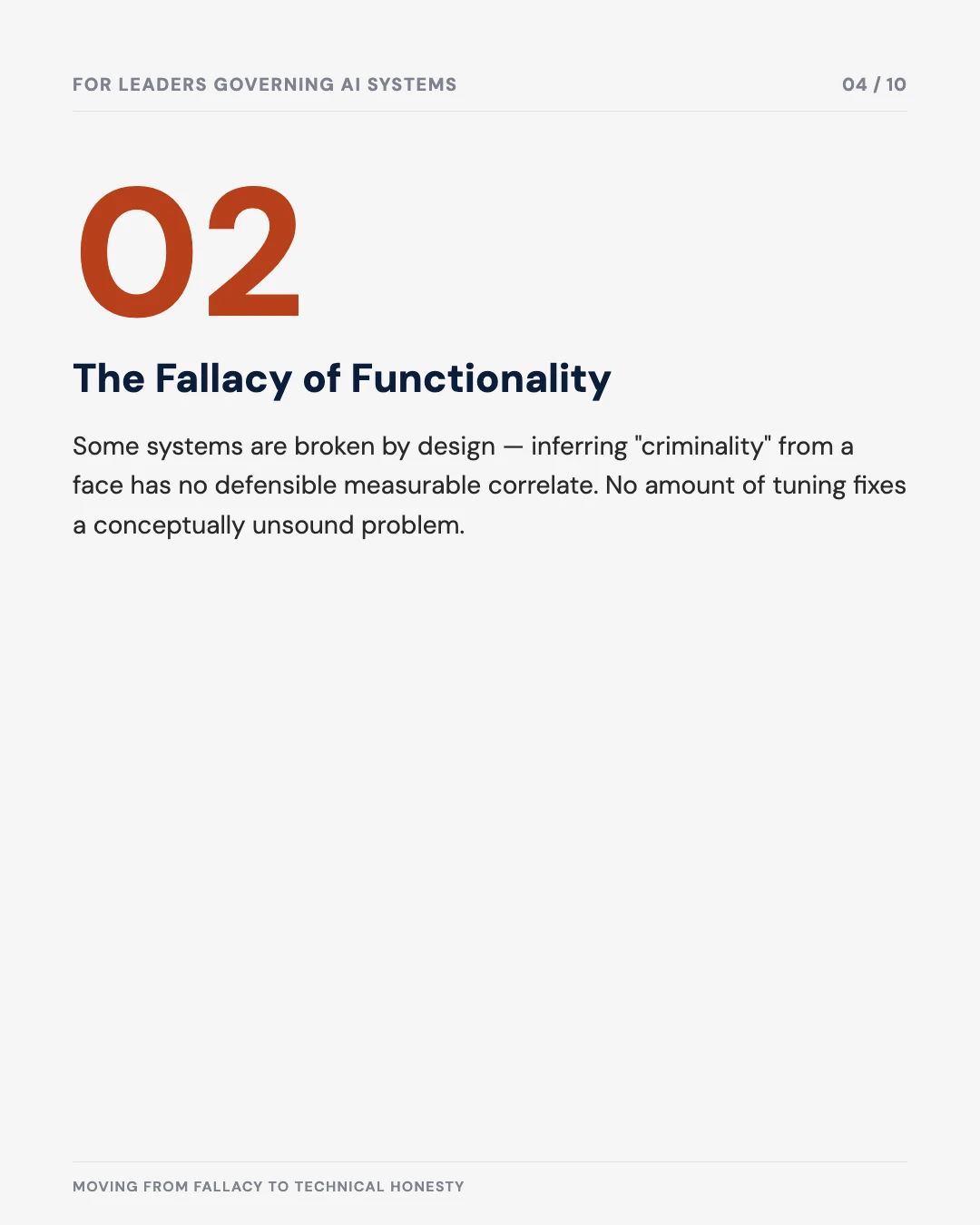
- Many AI systems are “broken by design” because their target construct has no defensible measurable correlate, such as attempts to infer “criminality” or personality traits from facial images.
- In these cases, no amount of model optimisation can make the system valid; the problem definition itself is conceptually unsound.
The practical risk is that organisations treat outputs as if they were measuring something real and actionable, building policy and operations on top of a non-existent signal.
- The Fallacy of Precision and Objectivity
There is a widespread assumption that AI is a high-precision, objective technology that will outperform human judgment simply by virtue of scale and computation.
- In reality, robust models are deliberately tolerant of error and noise; excessive precision typically indicates overfitting to historical data, reducing robustness to real-world variation.
- Objectivity is constrained by the data: models inherit and often amplify historical biases and omissions, which have been repeatedly demonstrated in hiring, credit, and criminal justice applications.
Over-trust in AI precision encourages inappropriate automation of decisions that require contextual nuance, contestability, and explicit justification.
- The Fallacy of Inevitable ROI
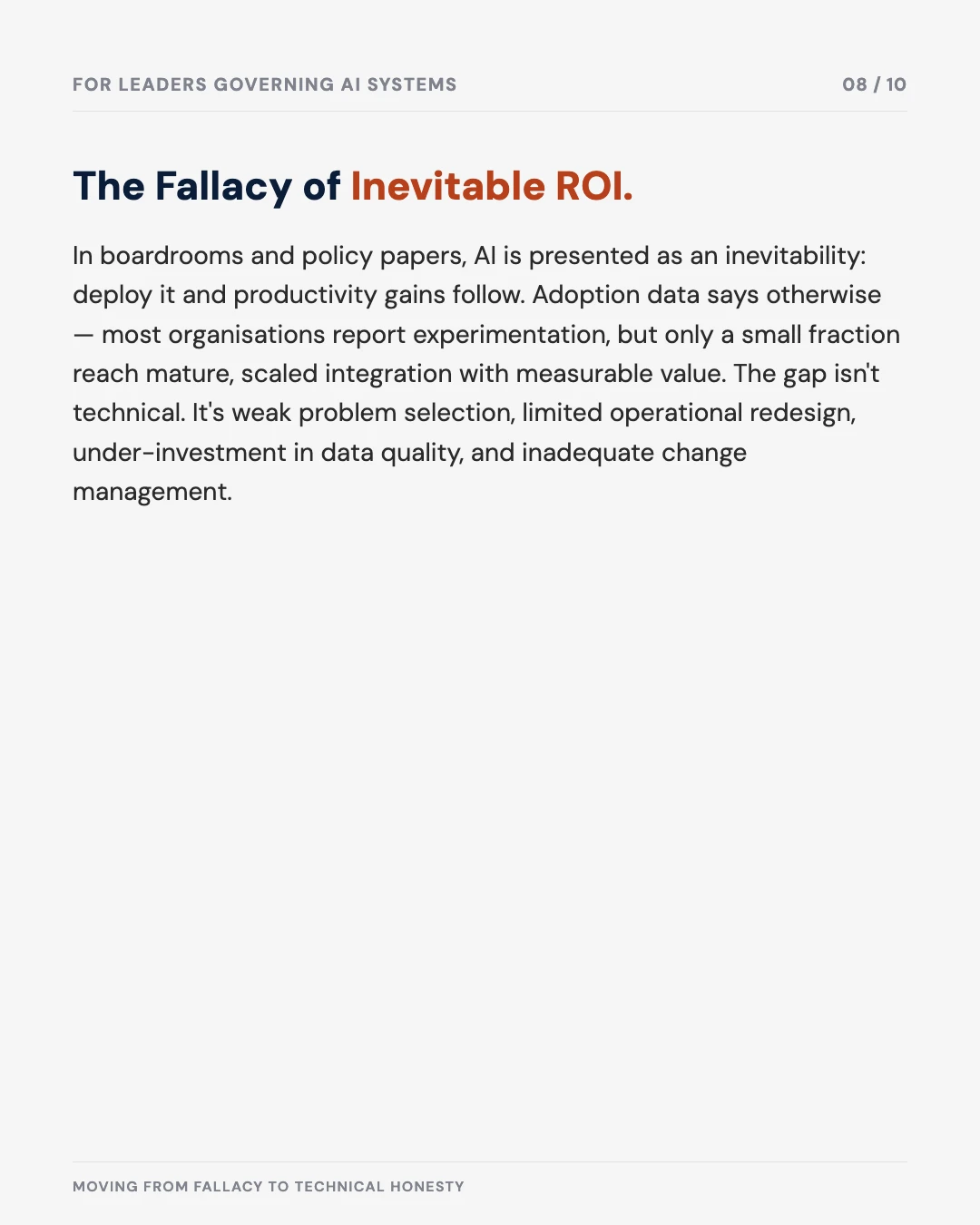
In boardrooms and policy papers, AI is frequently presented as an inevitability: deploy it and productivity gains will follow. Empirical adoption data suggest otherwise.
- Surveys show that while most organisations report some AI experimentation, only a small fraction achieve mature, scaled integration with measurable value.
- The gap is not primarily technical; it reflects weak problem selection, limited operational redesign, under-investment in data quality, and inadequate change management. I break down these specific failure patterns in Why Most AI Projects Fail.
Assuming that adding AI to existing processes guarantees productivity leads to fragmented pilots, inflated expectations, and disillusionment when structural constraints dominate outcomes.
Why This Fallacy Is Dangerous for Governments and Infrastructure Operators
For public authorities and critical infrastructure operators, these myths translate directly into systemic risk rather than isolated project failure.
- Safety and liability: Ambiguous responsibility for AI-mediated decisions creates a grey zone where neither vendors nor operators fully own failures, complicating redress when harm occurs.
- Policy distortion: Over-reliance on AI-generated insights can steer policy away from ground truth, especially in domains with scarce or biased data (informal economies, under-represented communities, emerging risks).
- Capability hollowing: If organisations outsource too much decision-making to AI, they risk eroding human analytical, operational and institutional memory, reducing resilience when systems fail, or conditions change.
In smart city contexts, this can manifest as over-automated control rooms, brittle demand forecasts, or overconfident risk scoring in policing and social services, all of which degrade citizen trust when visible errors emerge.
Towards a More Technically Honest AI Agenda
The alternative to the fallacy of AI is not technological pessimism but technical honesty about what these systems can and cannot do.
A more rigorous stance could include:
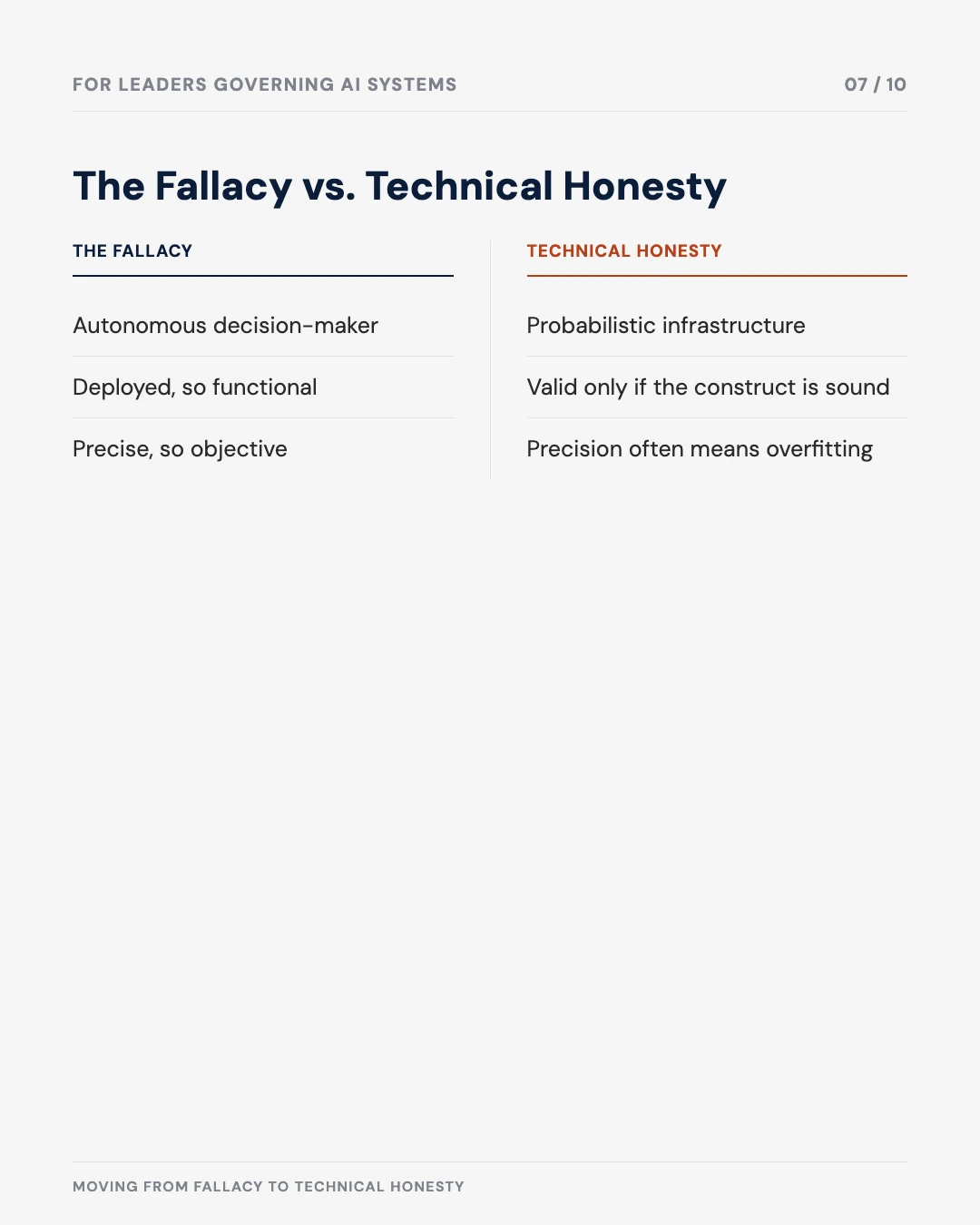
- Treating AI as probabilistic infrastructure, not autonomous intelligence: design for error tolerance, graceful degradation, and clear human escalation.
- Starting from construct validity, not model availability: only apply AI where the target signal is conceptually sound, measurable, and institutionally legitimate.
- Embedding accountability by design: specify who is responsible for model performance, data governance and decision outcomes across the lifecycle, including decommissioning.
- Measuring value in system terms: focus on end-to-end service reliability, fairness and operational resilience rather than model-centric metrics or headcount reduction.
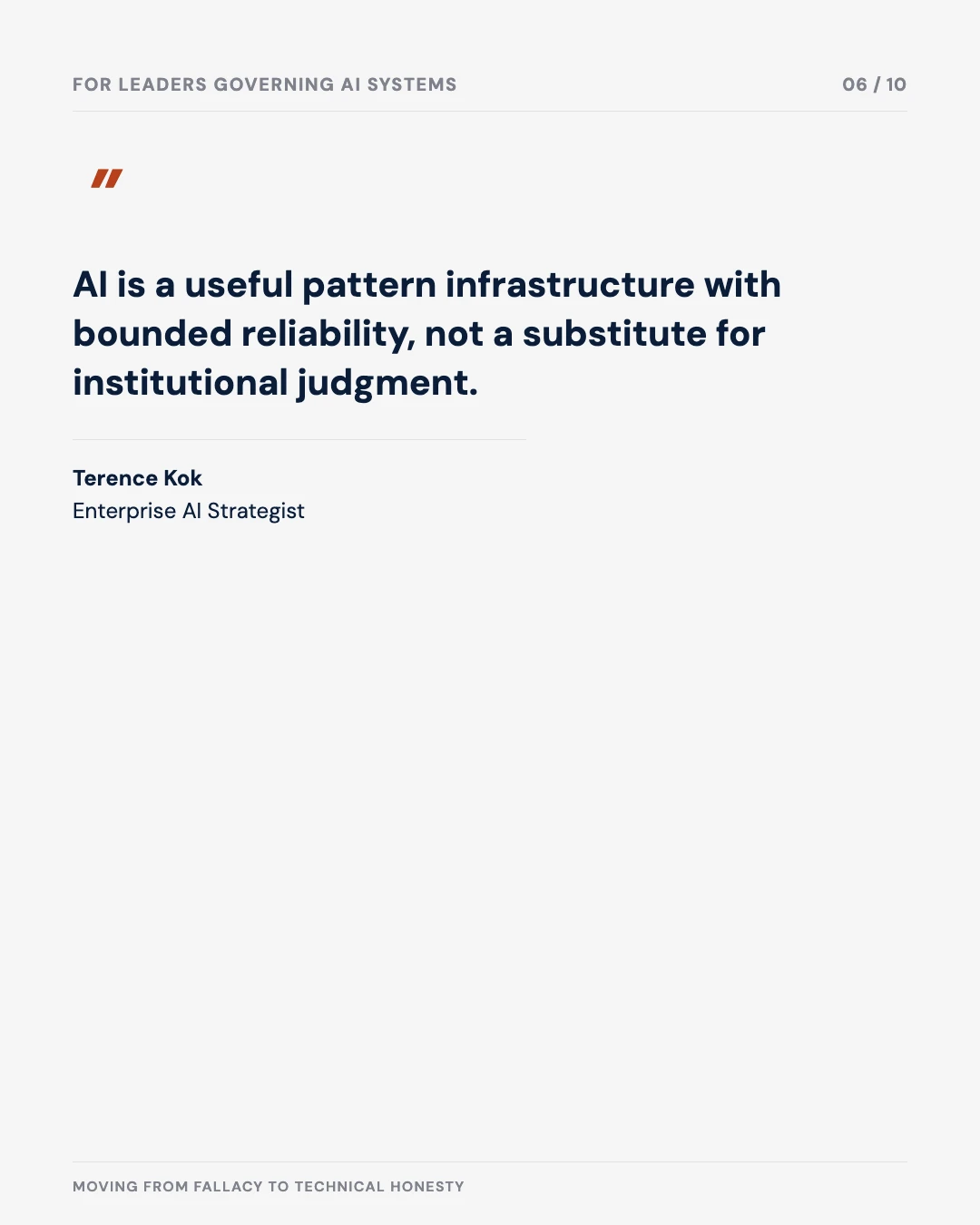
AI is a useful pattern infrastructure with bounded reliability, not a substitute for institutional judgment. Treating it otherwise is not just a technical error; it is a governance failure.
Free tool
TRACE Agent Evaluation
Score a candidate task on Traceability, Reversibility, Acceptance, Compliance and Escalation before assuming it’s ready for autonomy.
Free tool
ISO 42001 AIMS Readiness Checklist
Check whether accountability is actually built into your AI lifecycle, or just assumed the way this piece warns against.
Was this useful?