
Listen to this article
Executive Summary
Prompt optimisation is table stakes. The productivity gains that actually compound come from closed-loop AI systems: chained, recursive, self-improving workflows where the model operates as an execution engine, not a query interface.
Core conclusions
- Three layers compound: typed action chaining, a critic-scored recursive refinement loop, and persistent state that turns each iteration into working memory of the problem domain.
- A recursive loop without defined iteration bounds, convergence criteria, and an escalation path isn’t a productivity multiplier. It’s an autonomous process operating without accountability.
- The entry point is small: chain a generator and a critic call, instrument the output, measure the quality delta. That alone outperforms further prompt optimisation, before you ever add state or typed schemas.
The architecture, in ten slides
Save it, or send it to whoever’s still optimising prompts one at a time.
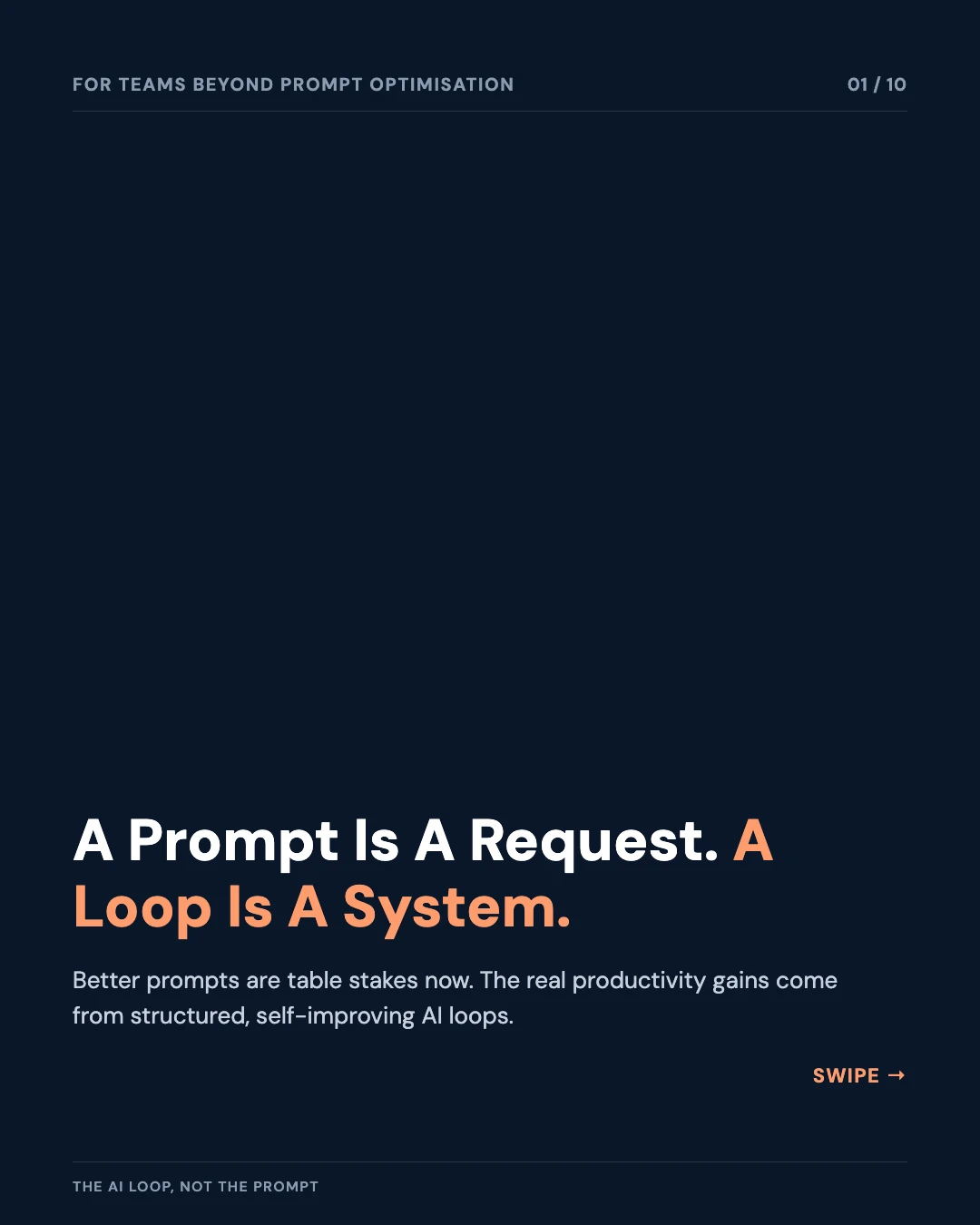

Everyone has learned to write better prompts. That is table stakes now.
We are all trying to close the gap between AI experimentation and measurable productivity gains, but it is not done with better prompts alone. Do it with structured AI loops: chained, recursive, self-improving workflows where Claude and Claude Code operate as an execution engine, not a query interface.
Here is what that architecture looks like in practice.
The Shift: From Single-Turn to Closed-Loop
A prompt is a request. A loop is a system.
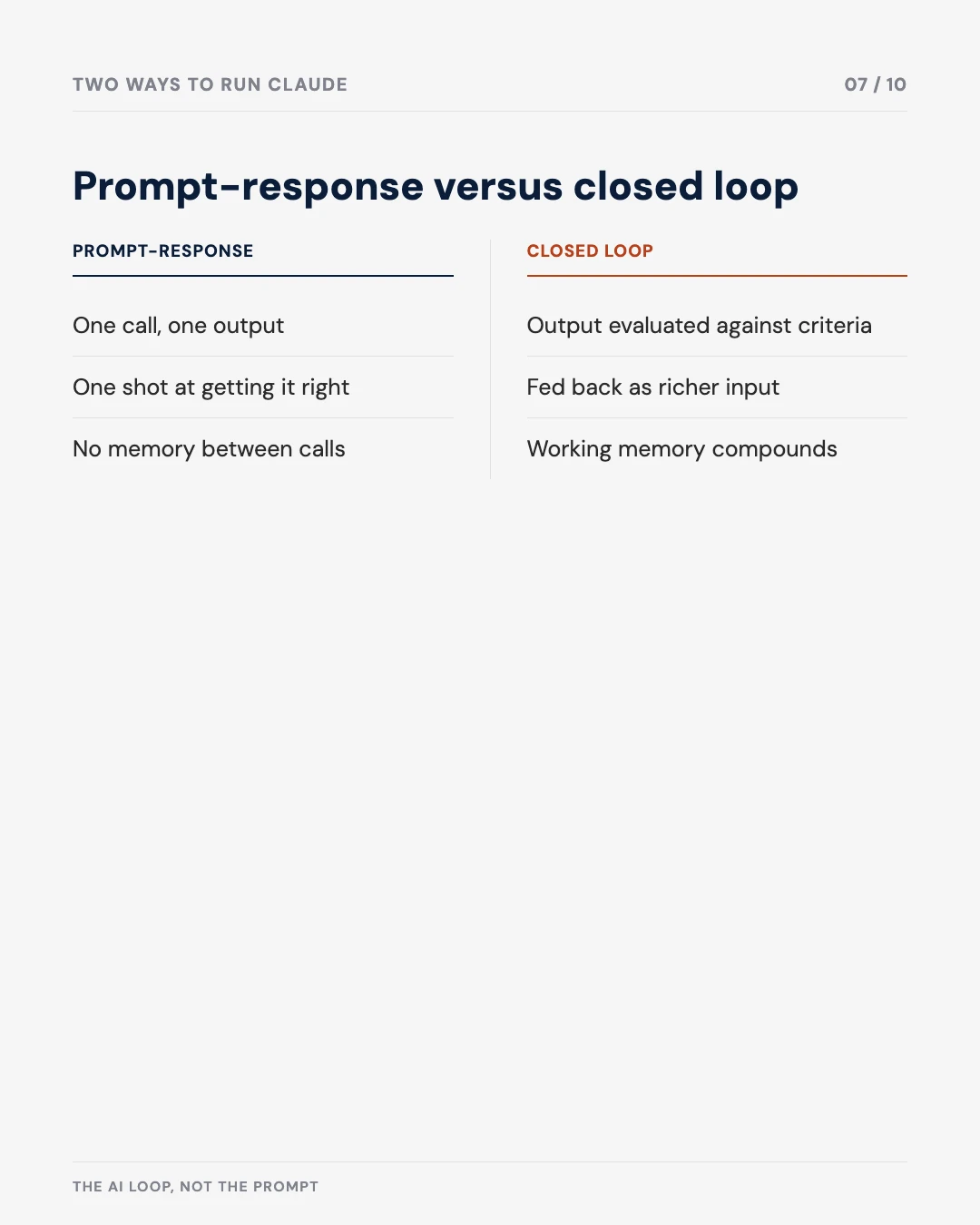
The difference: a loop takes the output of one Claude call, evaluates it against defined criteria, feeds it back as structured input to the next call, and repeats, with each iteration operating on a richer context than the last.
This is not a new concept. PID controllers have done this in industrial systems for decades. What is new is applying the same logic to knowledge work and code generation at scale.
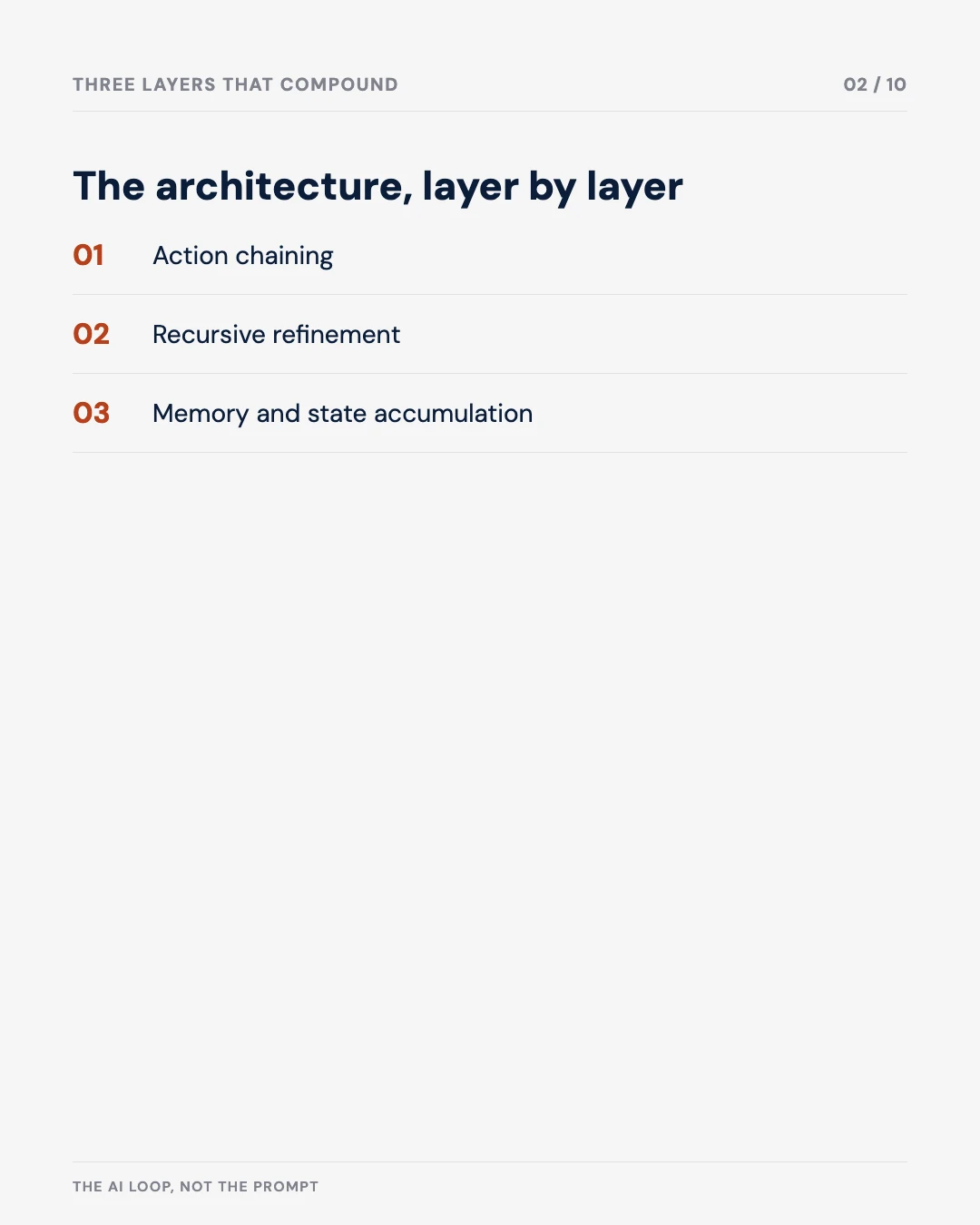
Three Layers That Compound
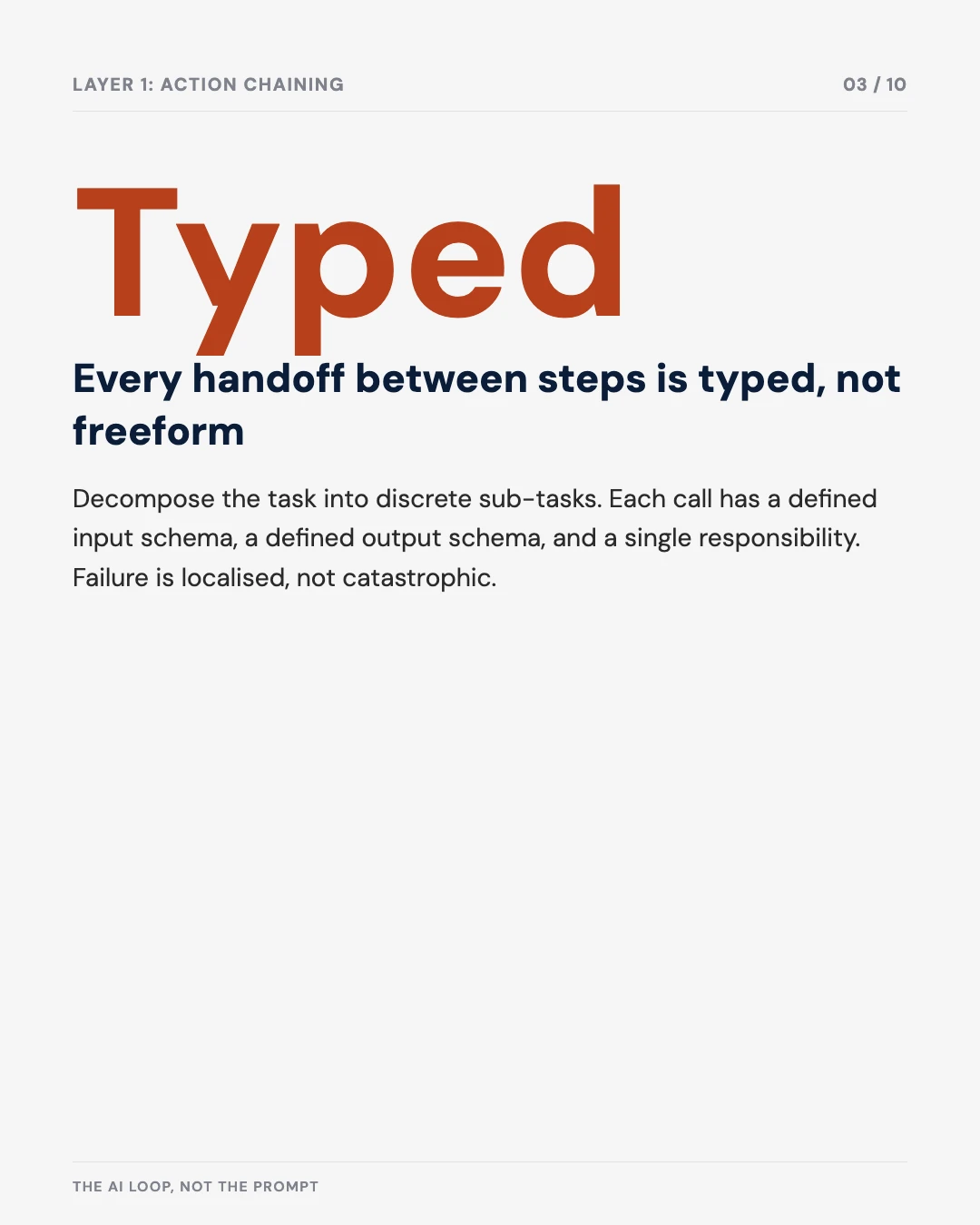
Layer 1: Action Chaining
Rather than a single monolithic prompt, decompose the task into discrete, typed sub-tasks. Each call has a defined input schema, a defined output schema, and a single responsibility.
Example in Claude Code:
Task 1 → Parse regulatory document → Output: structured JSON of obligations
Task 2 → Cross-reference obligations against system architecture → Output: gap list
Task 3 → Generate remediation specifications per gap → Output: engineering tickets
Task 4 → Validate ticket completeness against obligation schema → Output: pass/fail + delta
Each step is auditable. Each handoff is typed. Failure is localised, not catastrophic.
Layer 2: Recursive Refinement
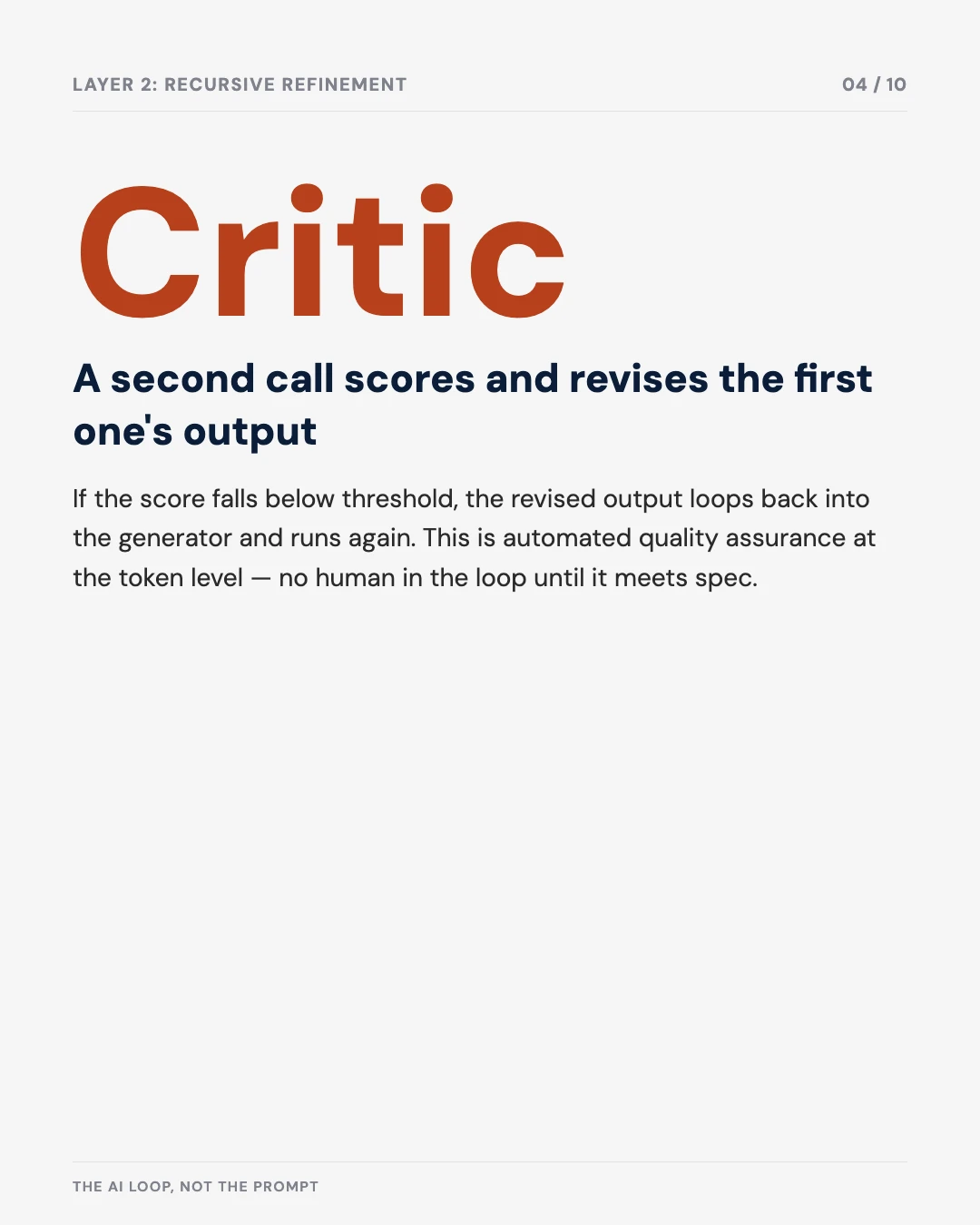
Here the loop earns its value. Take any output from Layer 1 and run it through a critic call, a second Claude invocation with an explicit rubric prompt:
System: You are a technical reviewer. Evaluate the following output against [criteria].
Return: { score: int, gaps: string[], revised_output: string }
If score < threshold → loop. Feed revised_output back into the generator as input. Run again. Repeat until convergence or max iterations.
This is not prompt engineering. This is automated quality assurance at the token level, with no human in the loop until the output meets the specification.
Layer 3: Memory and State Accumulation
The highest-leverage pattern: persist context across loop iterations using structured state objects. Each iteration writes its delta (what changed, what was resolved, what remains open) into a running state document that becomes the system prompt context for the next call.
Over time, the loop is not just refining a single artefact. It is building a working memory of the problem domain: decisions made, constraints encountered, patterns that did and did not work.
In Claude Code, this maps directly to agentic task management: the model reads its own prior outputs, updates a task graph, and self-directs next actions without requiring a human to re-specify context.
The Governance Requirement
This capability requires a control architecture, not just a technical one.
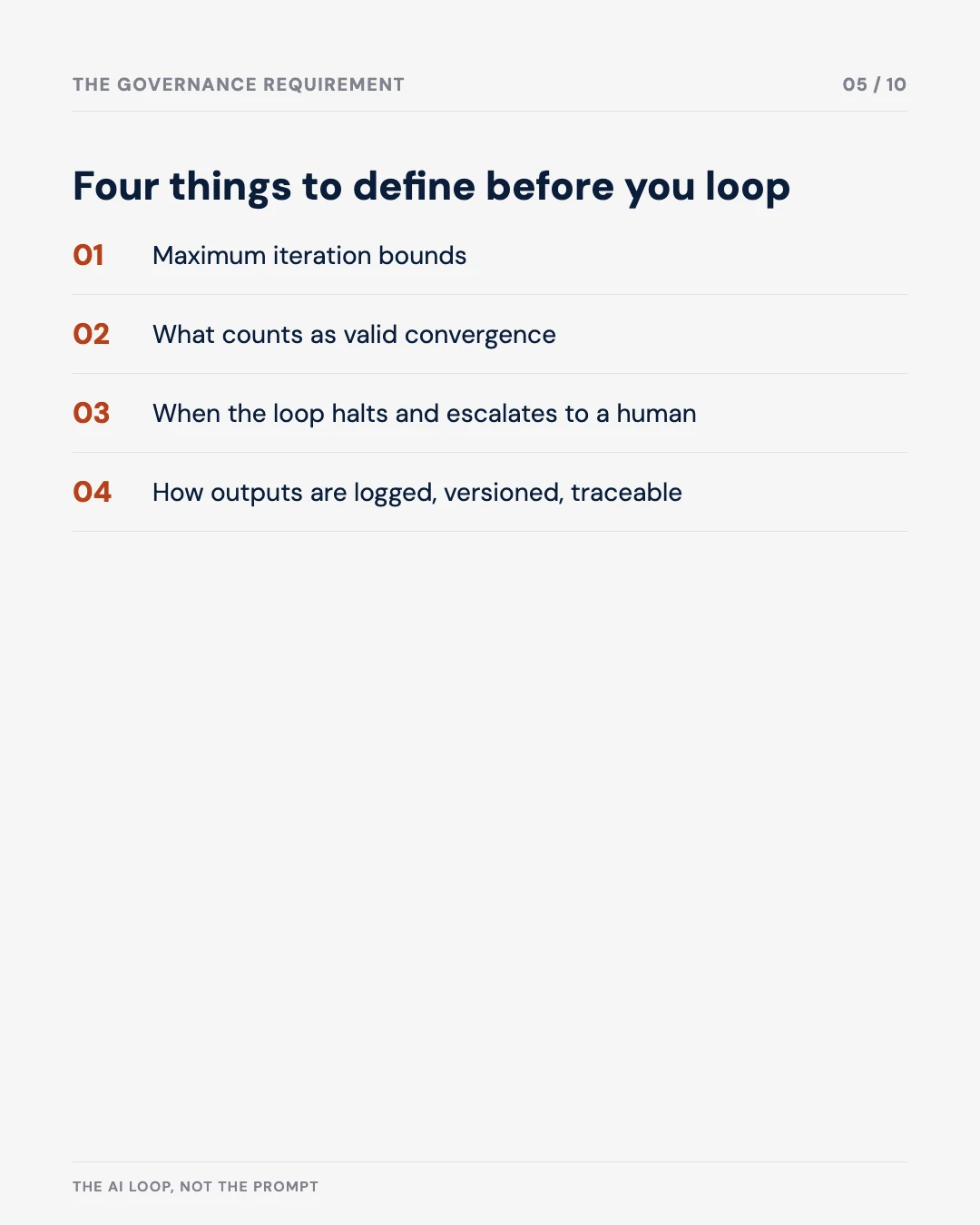
- Define: maximum iteration bounds.
- Define: what constitutes a valid convergence state.
- Define: when the loop must halt and escalate to a human decision point.
- Define: how outputs are logged, versioned, and traceable to the original task specification.
Without these, a recursive loop is not a productivity multiplier. It is an autonomous process operating without accountability.
The Practical Entry Point
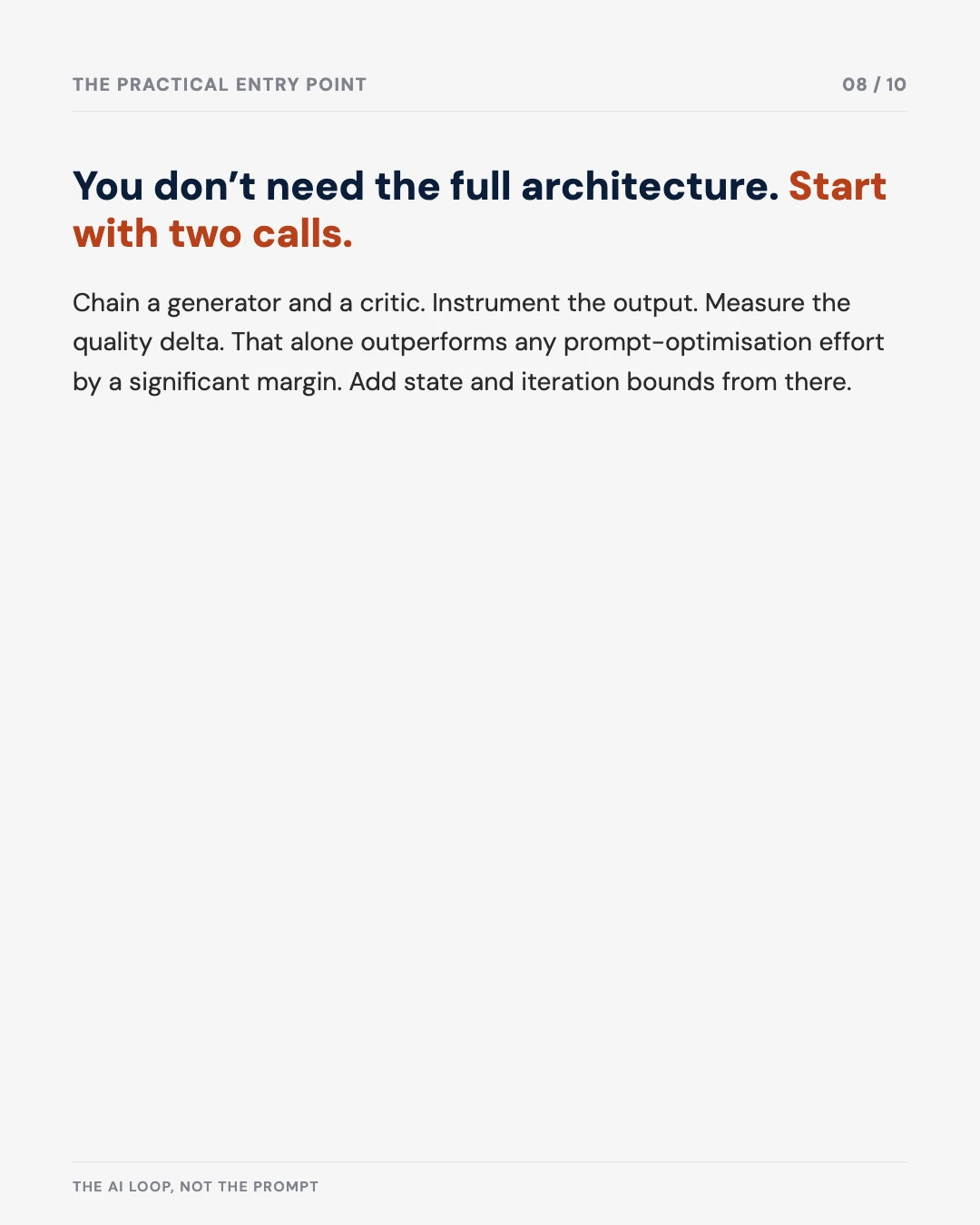
If you are operating Claude today as a prompt-response tool, the immediate step is not to build the full loop architecture. It is to:
- Chain two calls: a generator and a critic.
- Instrument the output.
- Measure quality delta.
That alone will outperform any prompt optimisation effort by a significant margin. From there, add state. Add iteration bounds. Add typed schemas at each handoff.
The loop becomes the system. The system compounds.
This is the layer beneath agentic AI that most implementation programmes skip, and the reason many pilots do not scale. The foundation is not the agent. It is the loop the agent runs inside.
The foundation is not the agent. It is the loop the agent runs inside.
Free tool
TRACE Agent Evaluation
Before you promote a loop to autonomous agent execution, check whether it has the traceability, reversibility, acceptance, compliance, and escalation pathway a defensible deployment needs.
The Four-Question Governance Baseline is the operational governance layer (who checks the output, what happens when it’s wrong) that the loop has to run inside.
Was this useful?