
Listen to this article
Executive Summary
Agentic AI adoption is accelerating faster than the governance and cost discipline needed to capture its returns. The gap between “equipped” and “stalled” organisations is set by boards, not by technology, in the next 6-12 months.
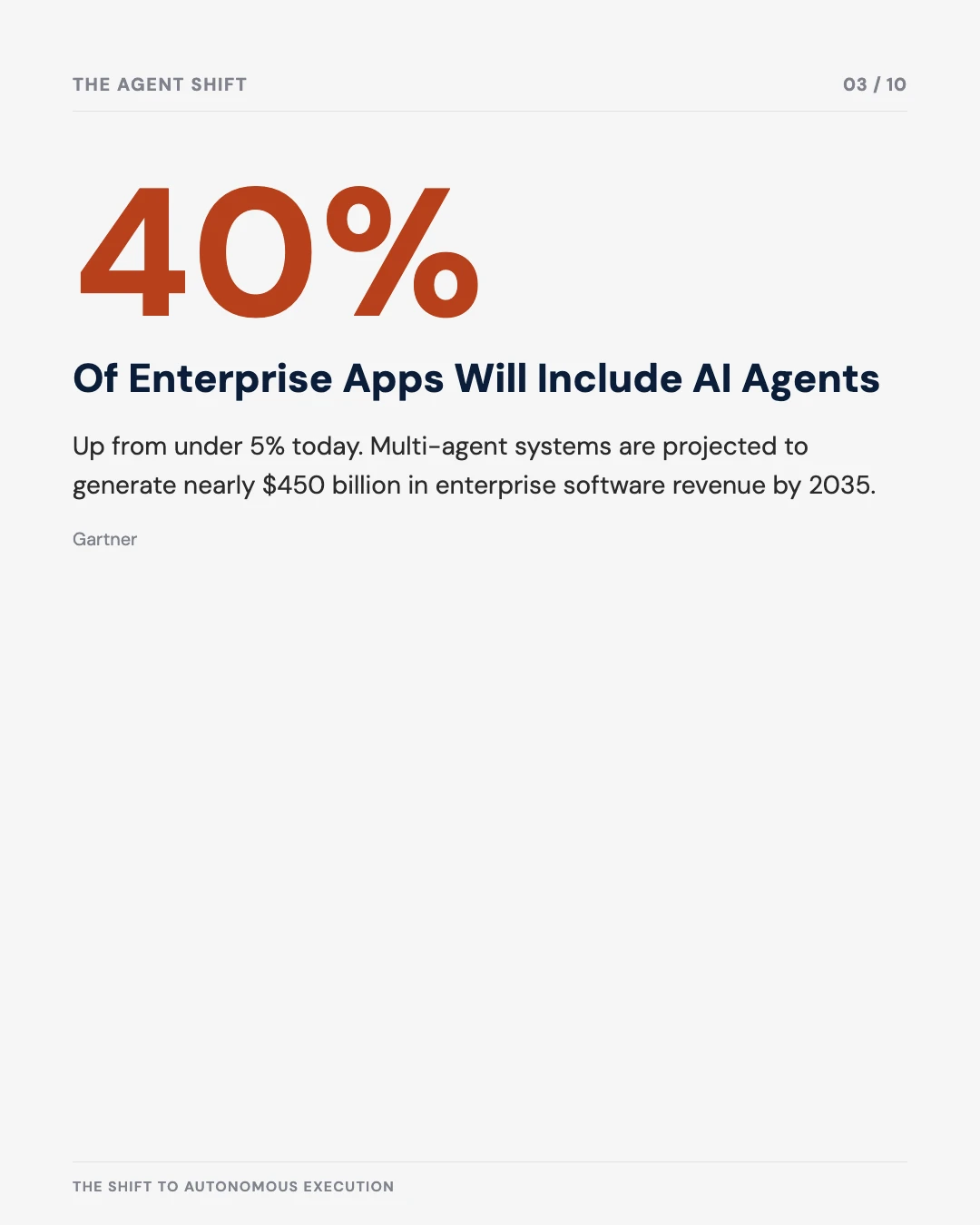
40%
of enterprise applications will include task-specific AI agents by 2026, up from <5% today
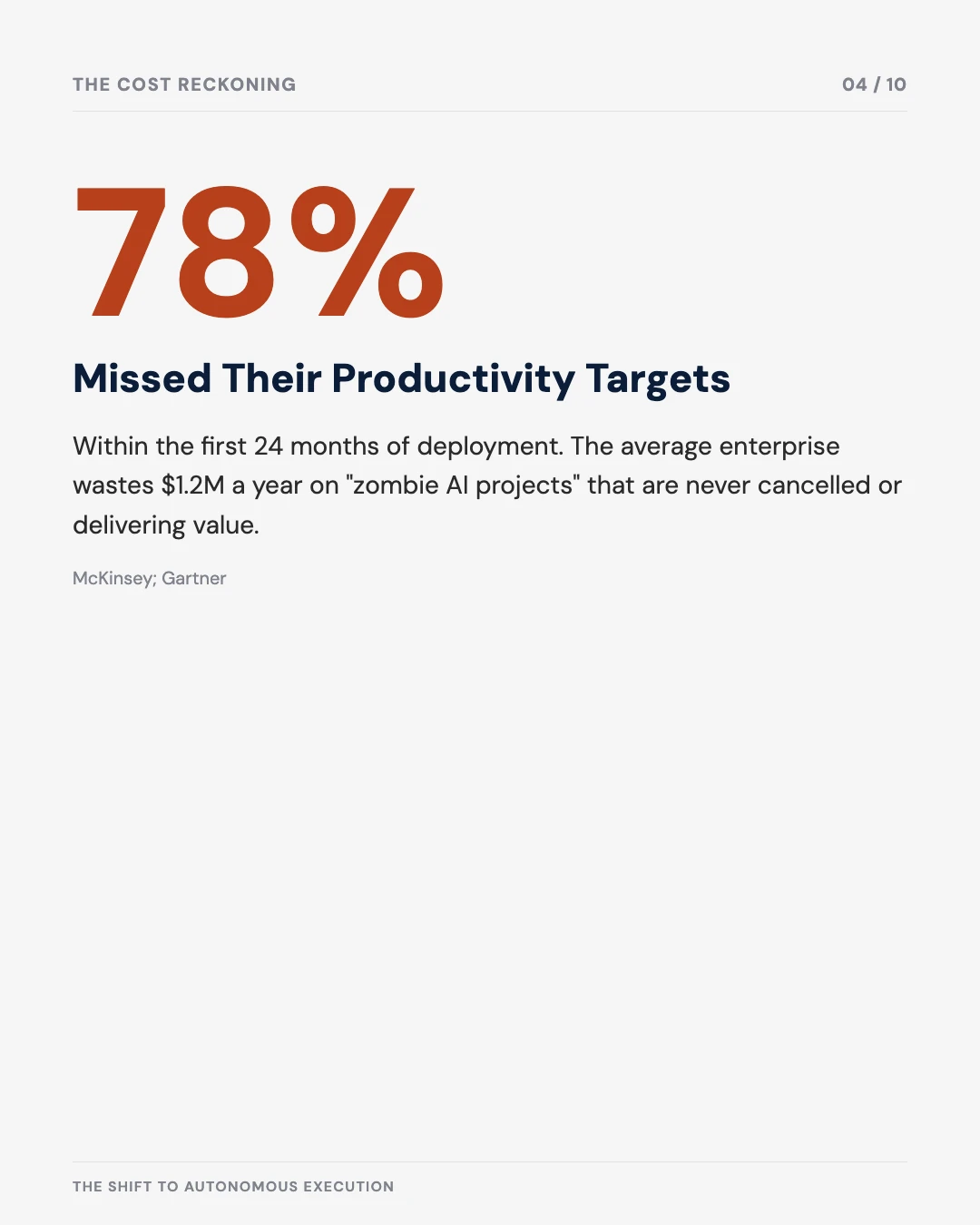
78%
of companies missed their targeted productivity gains within 24 months of deployment
39%
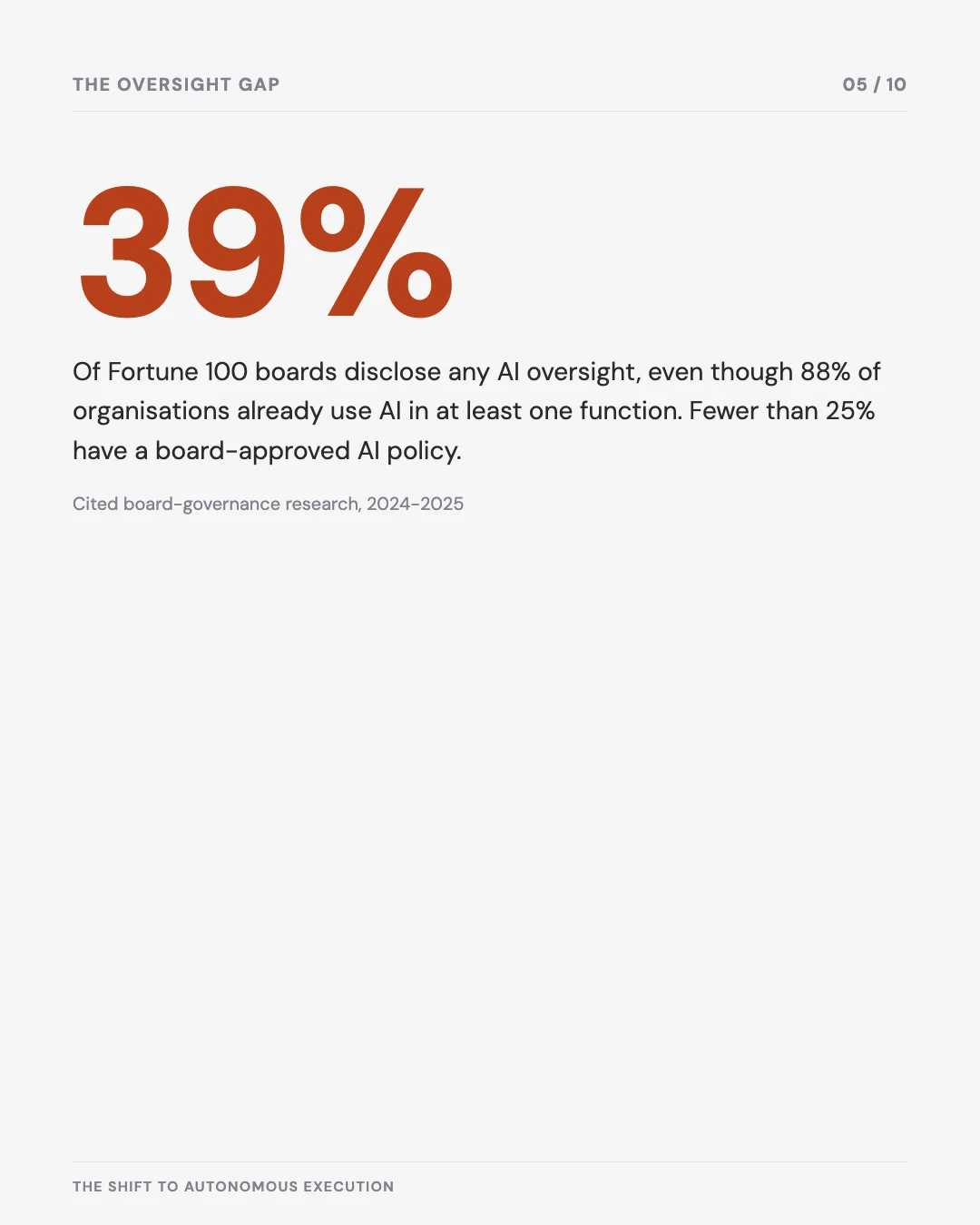
of Fortune 100 boards disclosed any board-level AI oversight as of 2024
$1.2M
wasted annually by the average enterprise on “zombie AI projects”
Core conclusions
- Agentic AI adoption is scaling fast, but return on that investment is not keeping pace. Most deployments are missing their own productivity targets inside two years.
- Accountability has moved into the boardroom: fewer than a quarter of companies have board-approved AI policies, even though AI-savvy boards measurably outperform on return on equity.
- Data governance, not model capability, is now the binding constraint on which organisations can deploy autonomous agents safely at scale.
The three shifts, in ten slides
Save it, share it, or send it to whoever sits on your board.


The three shifts, in two tables
Adoption is accelerating; ROI is not
| Metric | Value | Source |
|---|---|---|
| Enterprise applications including task-specific AI agents by 2026 | 40% (up from <5% today) | Gartner, Agentic AI Set to Reshape 40% of Enterprise Applications by 2026 |
| Organisations using AI in at least one business function | 88% | McKinsey & Company, State of AI 2025 |
| Companies that hit their targeted productivity gains within 24 months | 22% (78% did not) | McKinsey & Company, State of AI 2025 |
| Average annual spend wasted on “zombie AI projects” per enterprise | $1.2M | Gartner, Zombie AI Projects: The Cost of Underutilised AI Initiatives |
Zombie AI projects are those neither officially cancelled nor actively delivering value.
The boardroom accountability gap
| Metric | Value | Source |
|---|---|---|
| Fortune 100 boards disclosing any board-level AI oversight (2024) | 39% | McKinsey & Company, The AI Reckoning: How Boards Can Evolve |
| Companies with board-approved, structured AI policies | <25% | KPMG, Boardroom Lens 2025 |
| ROE outperformance of digitally and AI-savvy boards vs. peers | +10.9 percentage points | McKinsey & Company |
Board-level AI oversight is measured by public disclosure, not internal practice — the actual gap may be wider still.
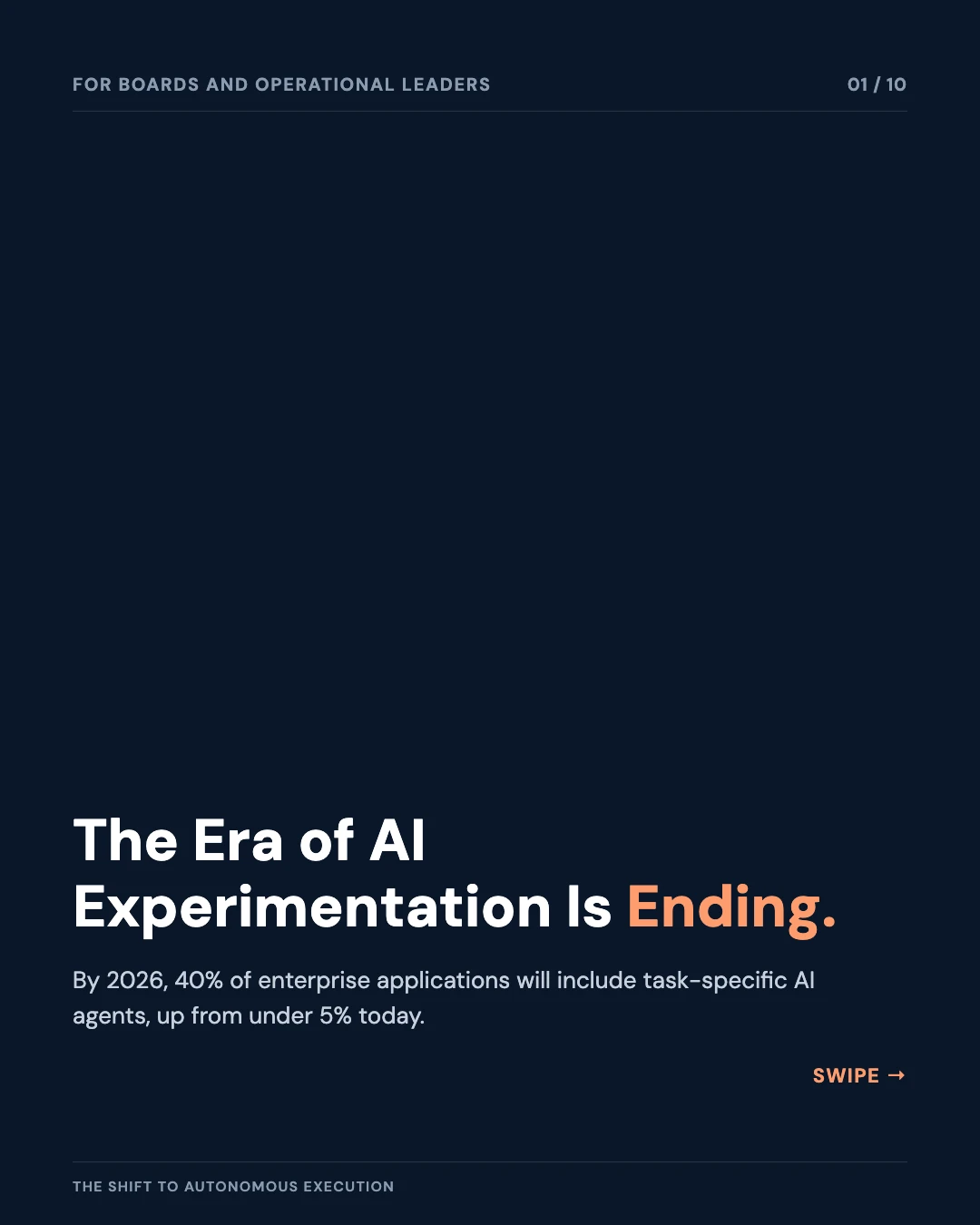
The era of AI experimentation is ending.
Here’s probably what’s happening: across companies worldwide, the approach that dominated 2023 and 2024 (pilot projects, proof-of-concept tests, and tech exploration) is shifting. Boards, investors, and operational leaders now want measurable outcomes, clear cost accountability, and AI systems that work autonomously alongside employees rather than just being tools people need to learn.
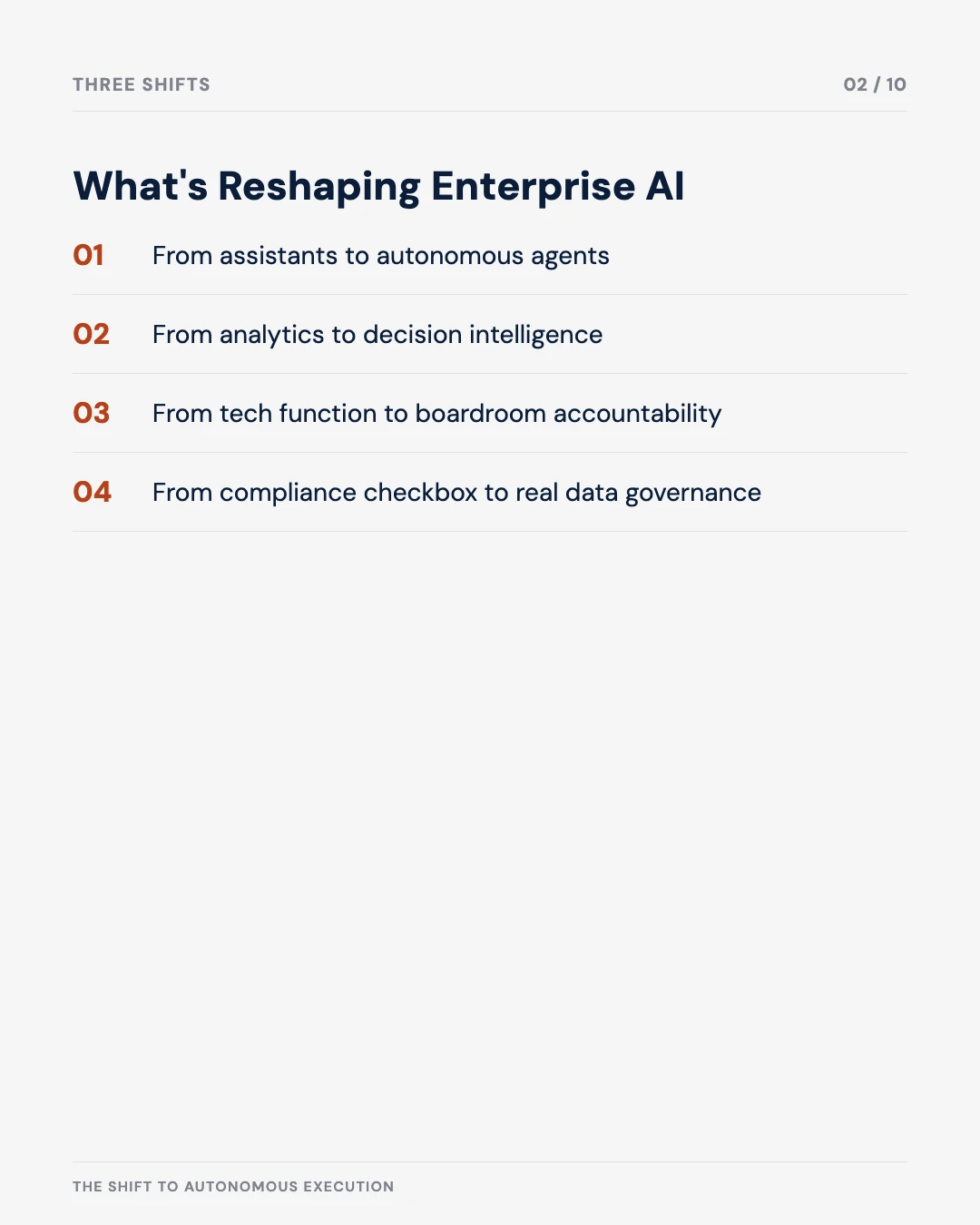
This shift will shape enterprise AI in 2026. Three major changes are underway, transforming how companies use and manage AI systems.
The Three Shifts Reshaping Enterprise AI
By 2026, Gartner predicts that 40% of enterprise applications will include task-specific AI agents, up from less than 5% today. Traditional AI assistants still require human guidance. AI agents are different. They work autonomously, automating development cycles, handling incident responses, running multi-step business processes, and pulling together and analysing data without needing someone to supervise every move. I’ve mapped eight practical types of these agents now showing up in production systems, and the differences between them matter more than the “agentic AI” label suggests. By 2029, Gartner expects multi-agent systems in which several AI agents work together, learning from live data and adapting to changes without requiring people to touch individual apps. This evolution is projected to generate nearly $450 billion in enterprise software revenue by 2035.
Alongside AI agents, decision intelligence (DI) is evolving from an analytics tool into essential business infrastructure. It combines predictive and prescriptive analytics, shifting the question from “what happened” to “what should we do next” in real time. DI platforms combine data visualisation, on-demand processing, security and compliance controls, and automated decision execution into cohesive systems. When decisions that used to need cross-functional meetings and extensive data gathering can now be made continuously through integrated DI systems, organisations can respond to competition far faster. This shift creates its own governance challenge: as AI systems move from supporting decisions to executing them, the question of accountability sharpens.
These questions have moved from the technology function into the boardroom. As of 2024, only 39% of Fortune 100 companies disclosed any form of board-level oversight of AI. Yet 88% of organisations report using AI in at least one business function. Research from McKinsey indicates that organisations with digitally and AI-savvy boards outperform their peers by 10.9 percentage points in return on equity. The accountability imperative has reinforced demand for robust AI governance frameworks, yet fewer than 25% of companies have board-approved, structured AI policies.
This accountability requirement rests on a foundation that few organisations have adequately built: data governance at scale. Autonomous agents operating across workflows require clean, auditable, lineage-tracked data. Decision intelligence systems require consistent definitions of key entities and metrics. Regulatory frameworks such as the EU AI Act require organisations to demonstrate data provenance, bias mitigation, and security controls. Organisations that invested early in data governance are moving faster into 2026. Those who treated data governance as a compliance checkbox are now hitting friction at scale, especially when an autonomous agent makes a decision based on stale or biased data.
The Cost Reckoning
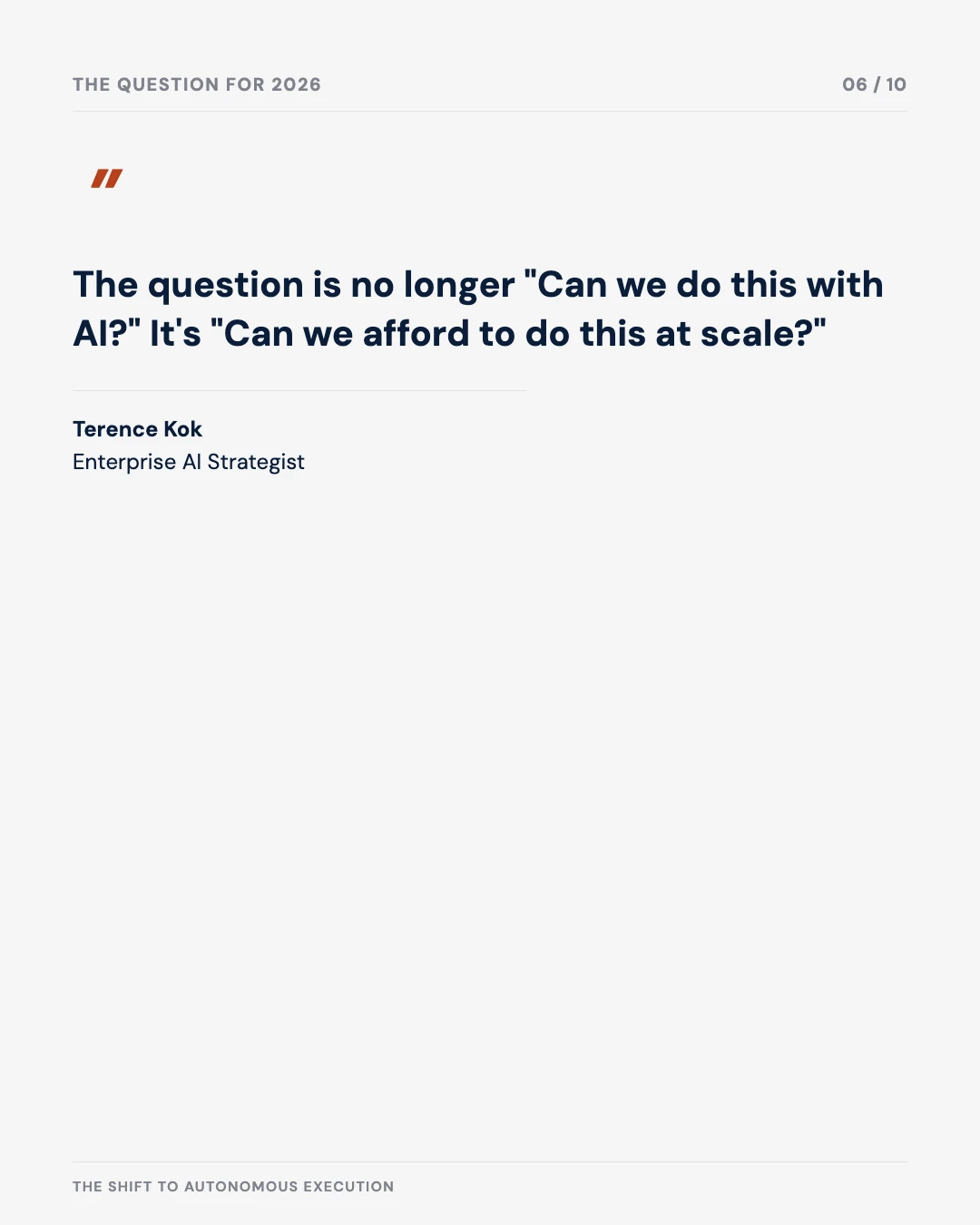
Underpinning all of these shifts is a financial reality that boards can no longer ignore: AI implementations have not consistently delivered their promised returns. McKinsey’s analysis found that 78% of companies did not achieve their targeted productivity gains within the first 24 months of deployment. Gartner estimates the average enterprise wastes $1.2 million annually on “zombie AI projects” that are neither officially cancelled nor actively delivering value. This gap between investment and outcome has reshaped board expectations. The central question in 2026 is no longer “Can we do this with AI?” but “Can we afford to do this at scale?”
The central question in 2026 is no longer “Can we do this with AI?” but “Can we afford to do this at scale?”
This cost discipline creates a filter. Organisations will prioritise agentic deployments and DI initiatives where the unit economics are defensible (automating administrative tasks, improving customer service response times, optimising scheduling), evaluated using concrete metrics: hours saved per employee, cycle-time reduction, cost avoidance, and incremental revenue contribution. Exploratory projects without clear business cases will face scrutiny or defunding. That filtering question — which tasks actually clear the bar for agentic deployment — is worth answering explicitly rather than by instinct; I set out the criteria I use to make that call elsewhere.
What This Means for Your Organisation
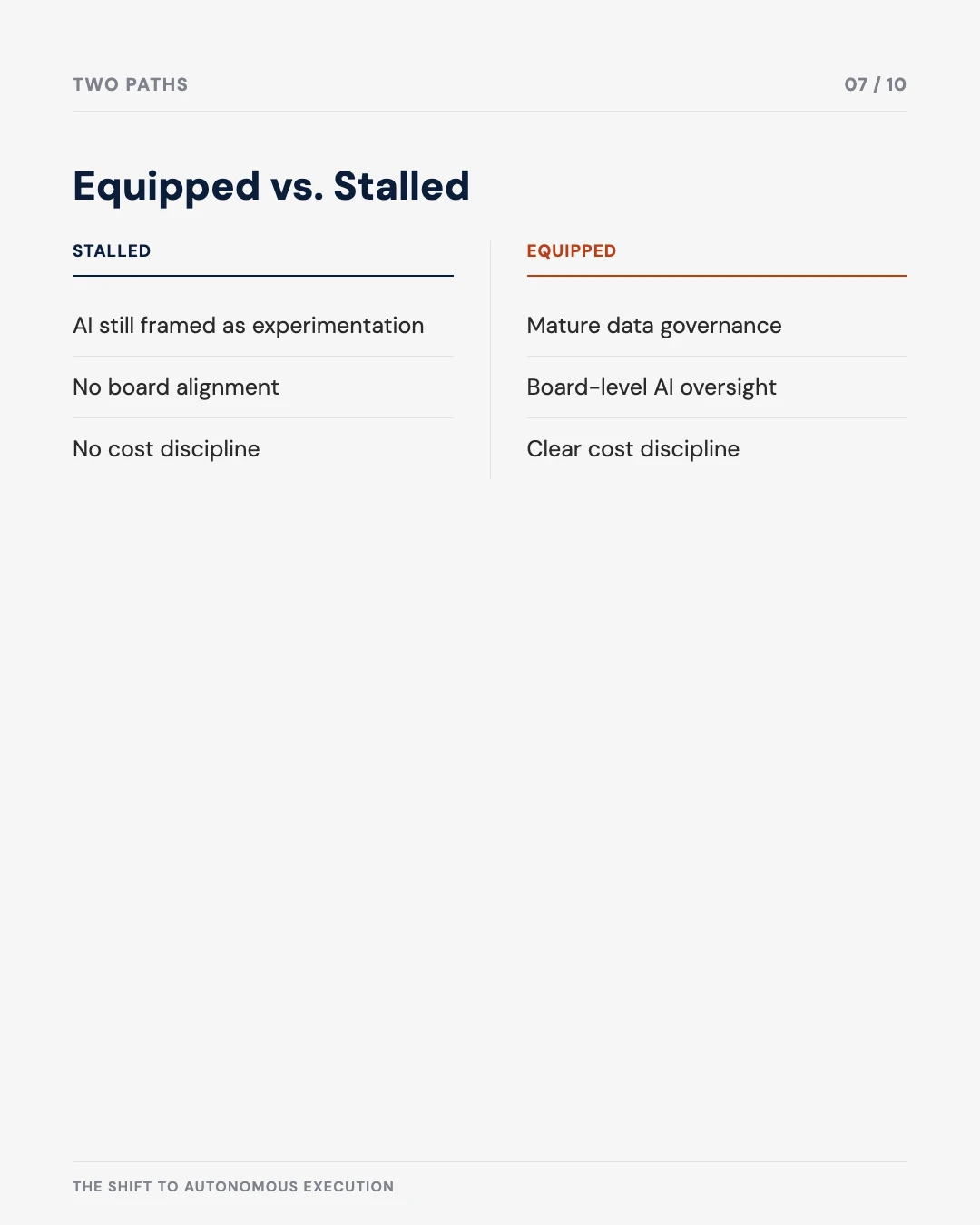
Three categories of organisations will emerge. First, the equipped: organisations with mature data governance, board-level AI oversight, and cost discipline will move faster to adopt agentic systems. Their data foundations are solid, governance policies are defined and enforced, and their boards understand AI as a catalyst reshaping competitive dynamics. These organisations will extract disproportionate value from 2026 agentic deployments.
Second, the catching-up: organisations with incomplete data governance, nascent board oversight, and tactical AI strategies will face friction as they attempt to scale. They will encounter data quality issues, governance debt, and compliance challenges in production. Progress will be measurable but slower, constrained by foundational gaps they must fill as they scale.
Third, the stalled: organisations that continue to treat AI as an experimentation function, without board alignment, data governance investment, or cost discipline, will find themselves unable to compete. Their inability to deploy autonomous agents at scale will become a compounding competitive disadvantage.
What Boards Should Do
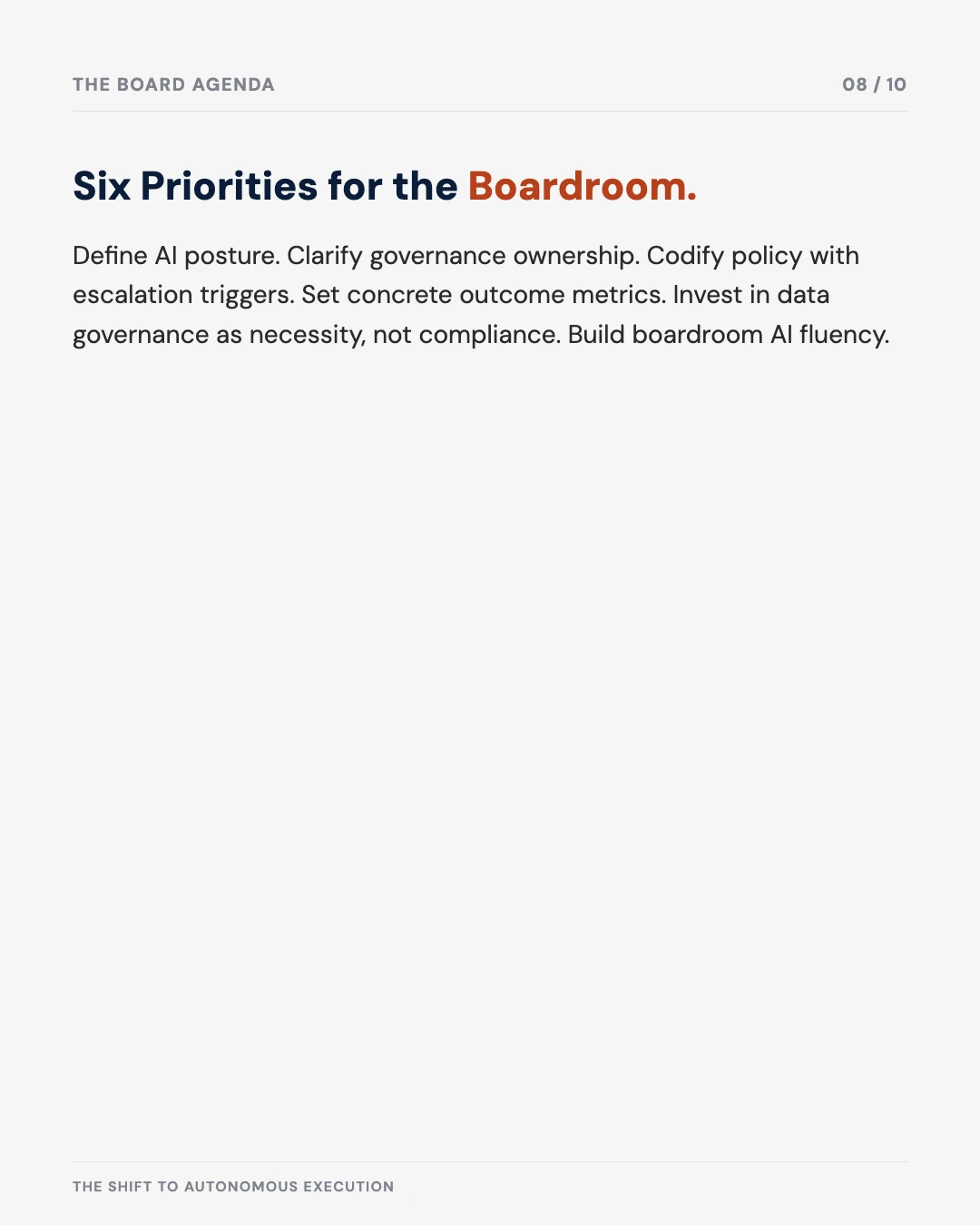
Organisations should act on six priorities: define AI posture explicitly (pioneer, transformer, functional reinventor, or pragmatic adopter); clarify governance ownership (which AI decisions belong in full-board sessions, which in committees, which are operational); codify AI governance policy with scaling rules, risk thresholds, and escalation triggers; establish concrete outcome metrics reported to the board (ROI by business unit, processes AI-enabled, resilience indicators, reskilling progress); invest in data governance as an operational necessity, not merely a compliance requirement; and build AI fluency in the boardroom through ongoing education and exposure to executives doing the work.
The move from experimentation to AI agents, decision intelligence, and embedded automation will widen the gap between companies. Those with good governance, solid data foundations, board buy-in, and cost discipline will move much faster. Those missing these pieces will face delays that slow everything down and limit the value they can capture. Companies have 6–12 months to prepare. Those who act now will be first to deploy AI agents and DI systems. Those who wait will watch the gap get wider.
Those who act now will be first to deploy AI agents and DI systems. Those who wait will watch the gap get wider.
References
Autry, P., Chen, L., & Plebani, P. (2025, December). The AI reckoning: How boards can evolve. McKinsey & Company.
CIO.com. (2025, June 1). The 3 key pillars of data governance for AI-driven enterprises.
Gartner, Inc. (2025). Agentic AI set to reshape 40% of enterprise applications by 2026.
Gartner, Inc. (2024). Zombie AI projects: The cost of underutilised AI initiatives.
KPMG. (2025). Boardroom lens 2025: AI governance and board-level KPIs.
McKinsey & Company. (2025). State of AI 2025: Enterprise deployment, ROI trends, and workforce implications.
Free tool
Board AI Oversight Checklist
Score your own board against the six oversight areas driving the 39% disclosure gap this piece opens with.
Free tool
AI ROI Calculator
Model whether your agentic AI investment clears the bar before it becomes one of the 78% missing its productivity target.
Was this useful?