
Listen to this article
Executive Summary
Over 90% of employees already use personal AI tools for work, with or without a policy in place. The governance risk isn’t the AI itself. It’s confidential data leaving your systems with no contract, no audit trail, and no control over what happens to it next.
Core conclusions
- Banning shadow AI doesn’t remove the risk, it removes your visibility into it: employees who rely on it for real productivity gains just become more discreet, not more compliant.
- The 90% adoption figure is evidence of readiness and demand, not a compliance failure. The workforce has already decided AI is useful.
- The only response that actually closes the gap is a governed enterprise alternative that is more capable and more convenient than the consumer tool it’s replacing, deployed alongside the policy, not after it.
The governance case, in ten slides
Save it, share it, or send it to whoever owns AI governance in your organisation.
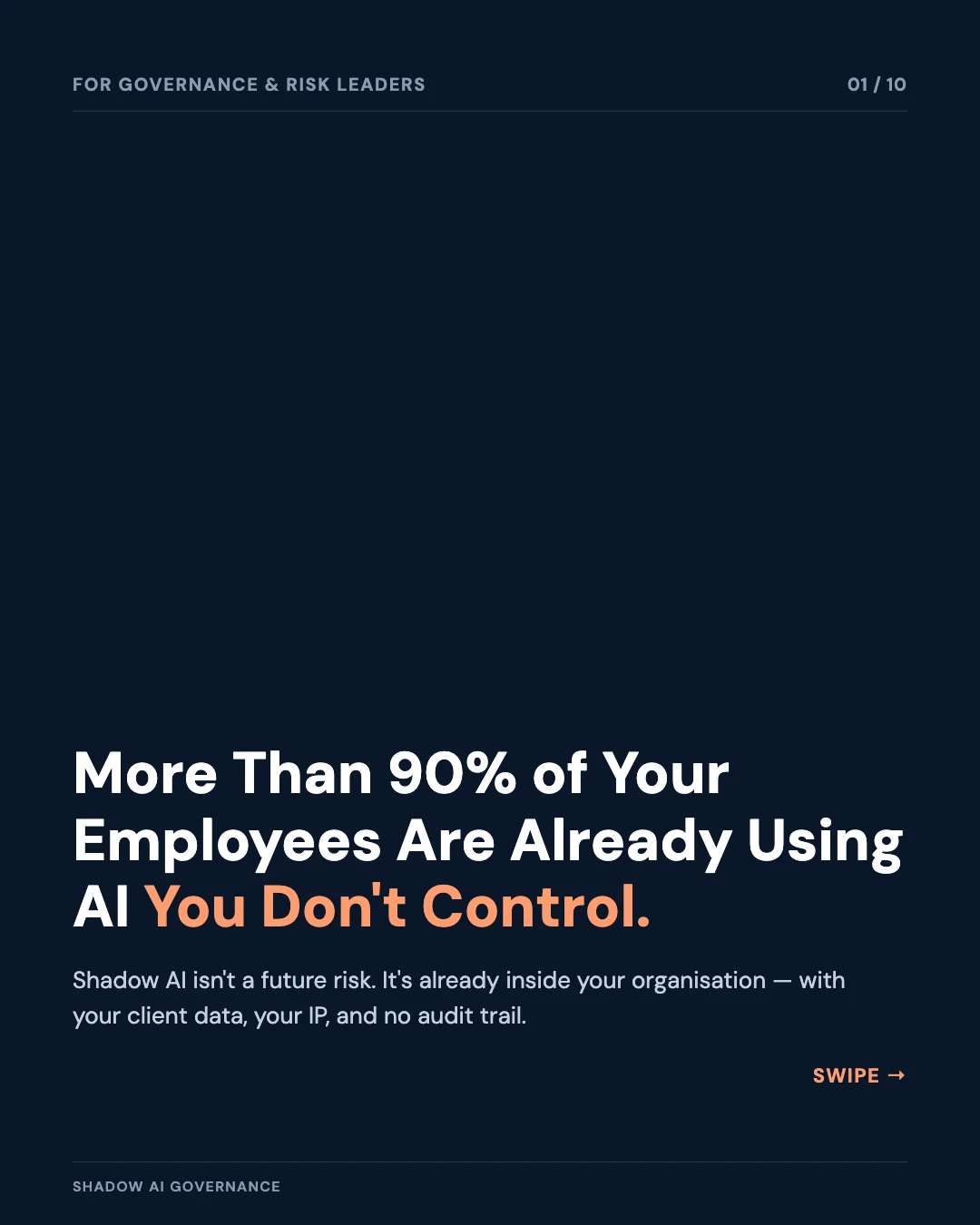
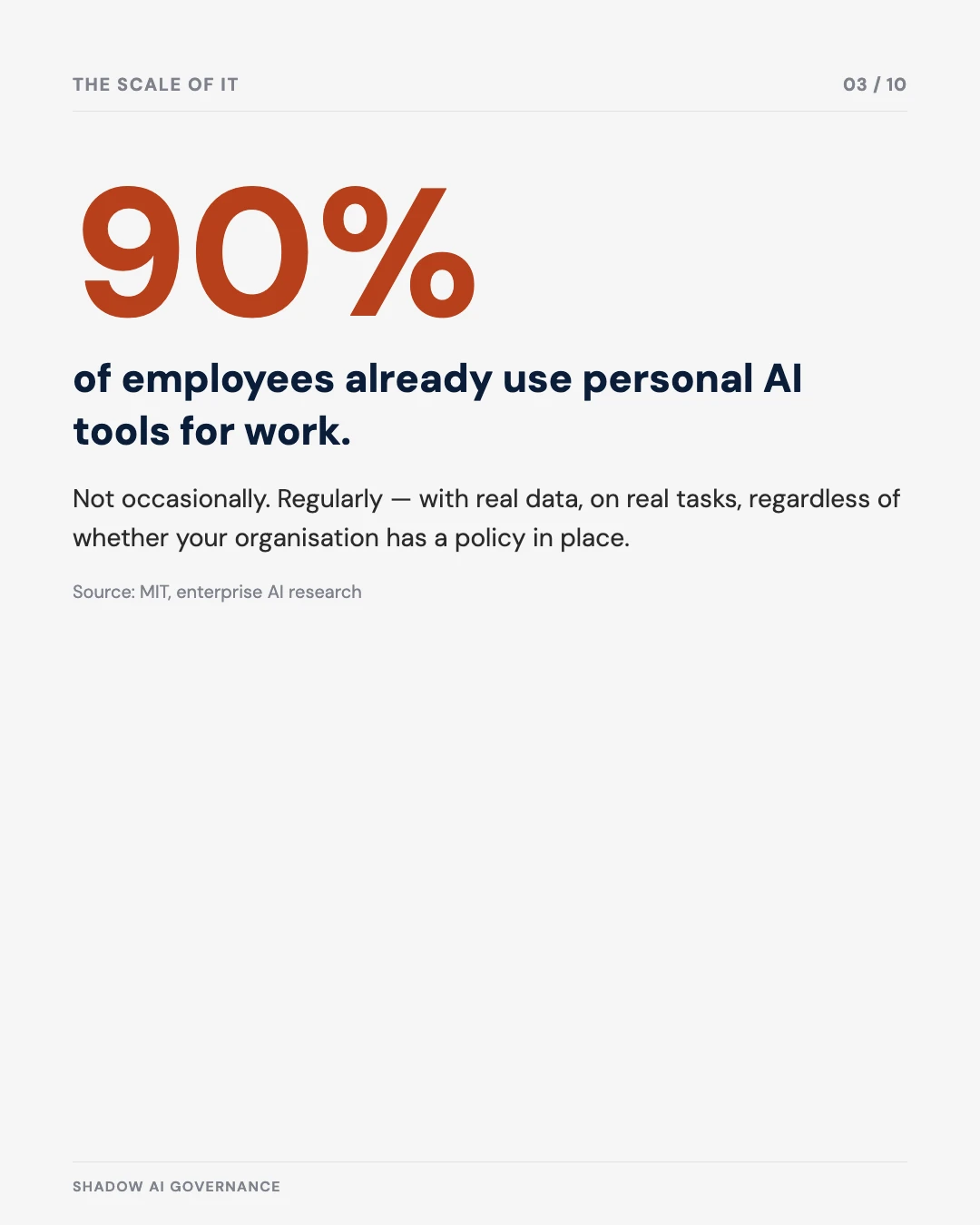
MIT’s most recent research on enterprise AI found that more than 90% of employees already use personal AI tools (ChatGPT and its equivalents) for work tasks. Not occasionally. Regularly.
This is happening in your organisation right now, regardless of whether you have an AI policy, a deployment programme, or an approved tool in place.
Most leaders I work with react to this in one of two ways. Some are surprised. Some are not surprised but have been treating it as someone else’s problem. Either way, the typical response is to either ban it or ignore it. Both responses create more risk than they resolve.
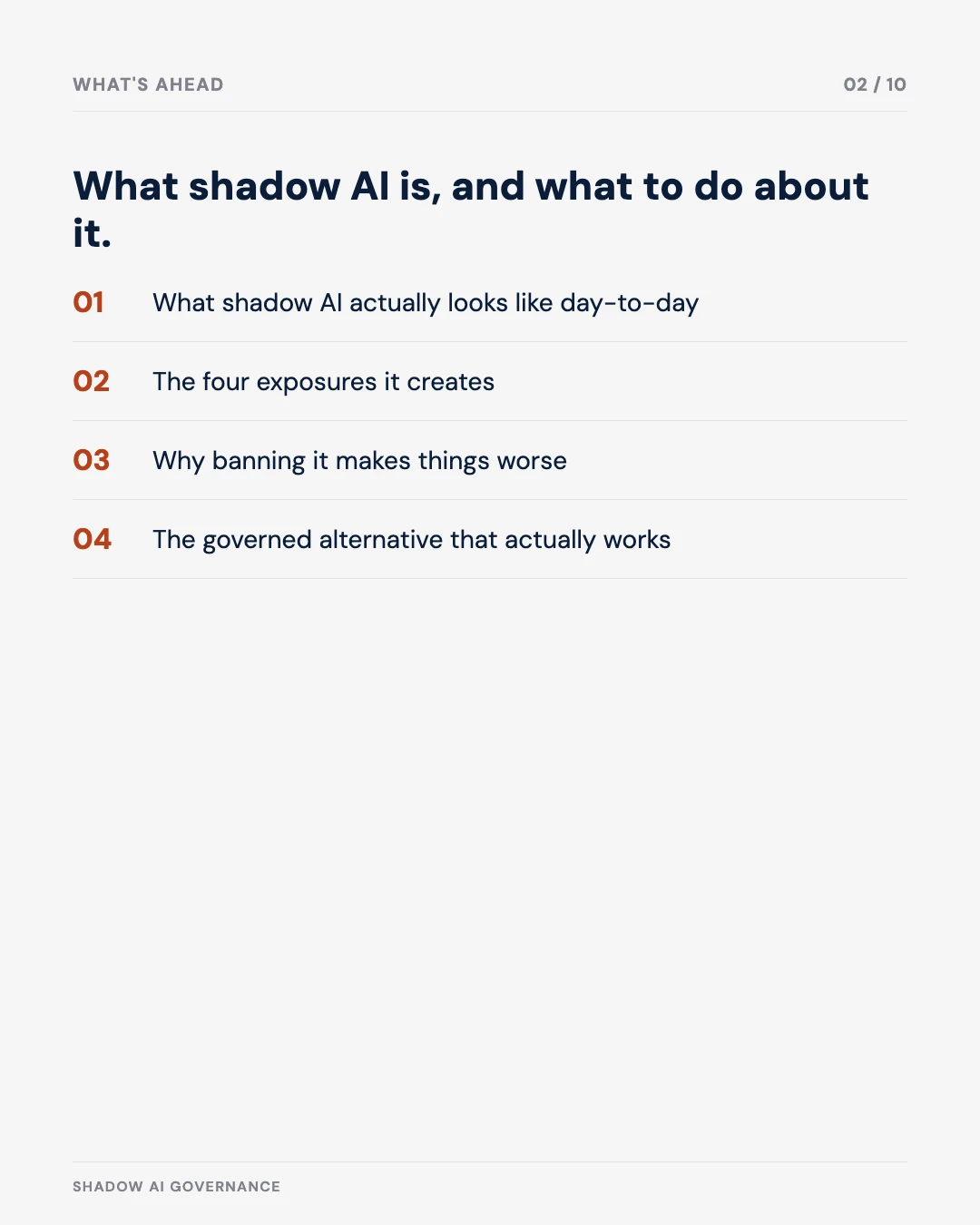
What shadow AI actually looks like
It is not employees experimenting with chatbots on their lunch breaks. It is people using personal AI accounts to do real work, with real data.
A lawyer drafts a contract clause by pasting client details into ChatGPT. An engineer summarises a confidential project specification to get a quicker answer. A finance analyst uploads a management report to get the numbers interpreted. A salesperson runs a competitor’s proposal through an AI tool to help write a response.
In each case, the employee is being productive. They are solving a real problem faster than they could without the tool. And in each case, confidential data (client data, project data, financial data, competitive information) has left your organisation’s systems and entered a third-party AI platform with no data processing agreement, no consent mechanism, no audit trail, and no guarantee about what happens to it next.
This is not a hypothetical. Most consumer AI platforms used for work tasks have terms of service that permit the provider to use inputs to improve their models. Data entered into a personal ChatGPT session is not subject to the same protections as data processed by an enterprise AI contract.
The governance risk
The risk is not that employees are using AI. The risk is that they are using it without the data handling controls your clients, regulators, and contracts require.
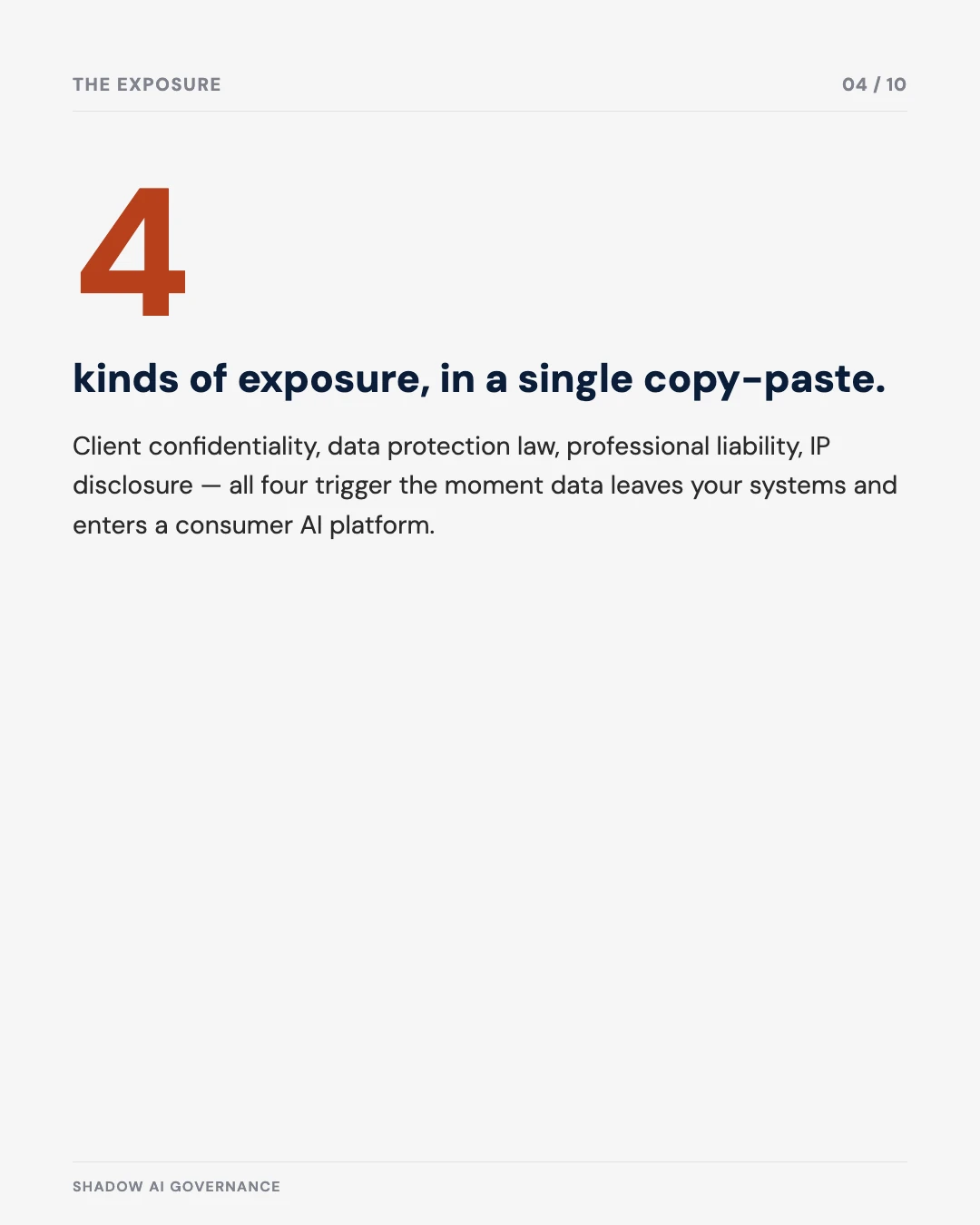
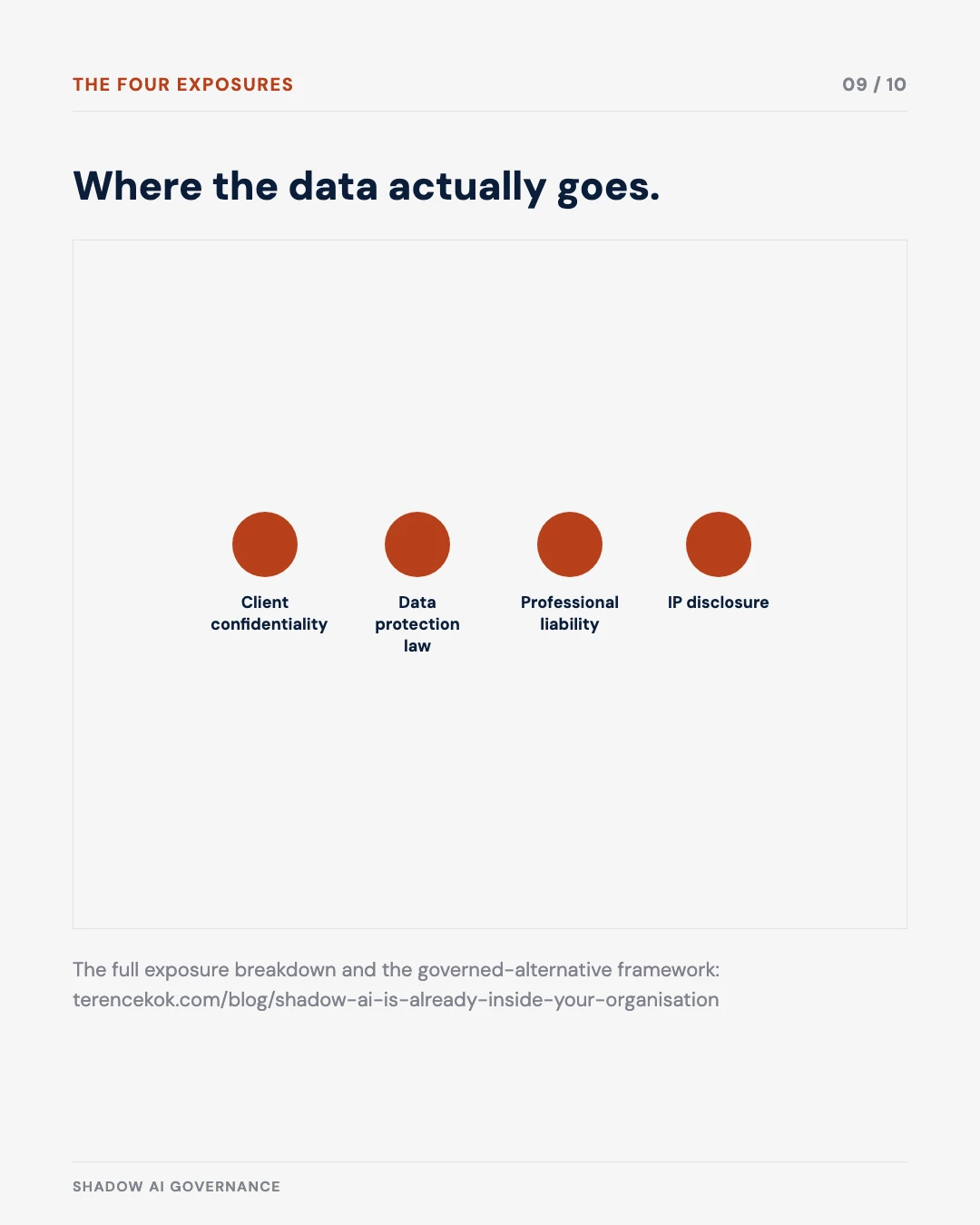
Depending on your sector and operating geography, the exposure includes:
Client confidentiality obligations. Most professional services contracts contain explicit restrictions on where client data can be processed and who can access it. Sending client data to a consumer AI platform almost certainly violates these restrictions.
Data protection regulation. Singapore’s PDPA, the EU’s GDPR, and equivalent frameworks in most jurisdictions impose obligations on how personal data is handled and transferred. Personal AI accounts are not subject to your organisation’s data processing agreements with those regulators.
Professional liability. In regulated professions (law, engineering, finance, healthcare) the standard of care for data handling is embedded in licensing and practice obligations. Breaches create professional liability exposure, not just contractual risk.
Intellectual property. Proprietary methods, designs, and processes described in prompts may be incorporated into vendor training data, creating IP disclosure risks your legal team has not reviewed.
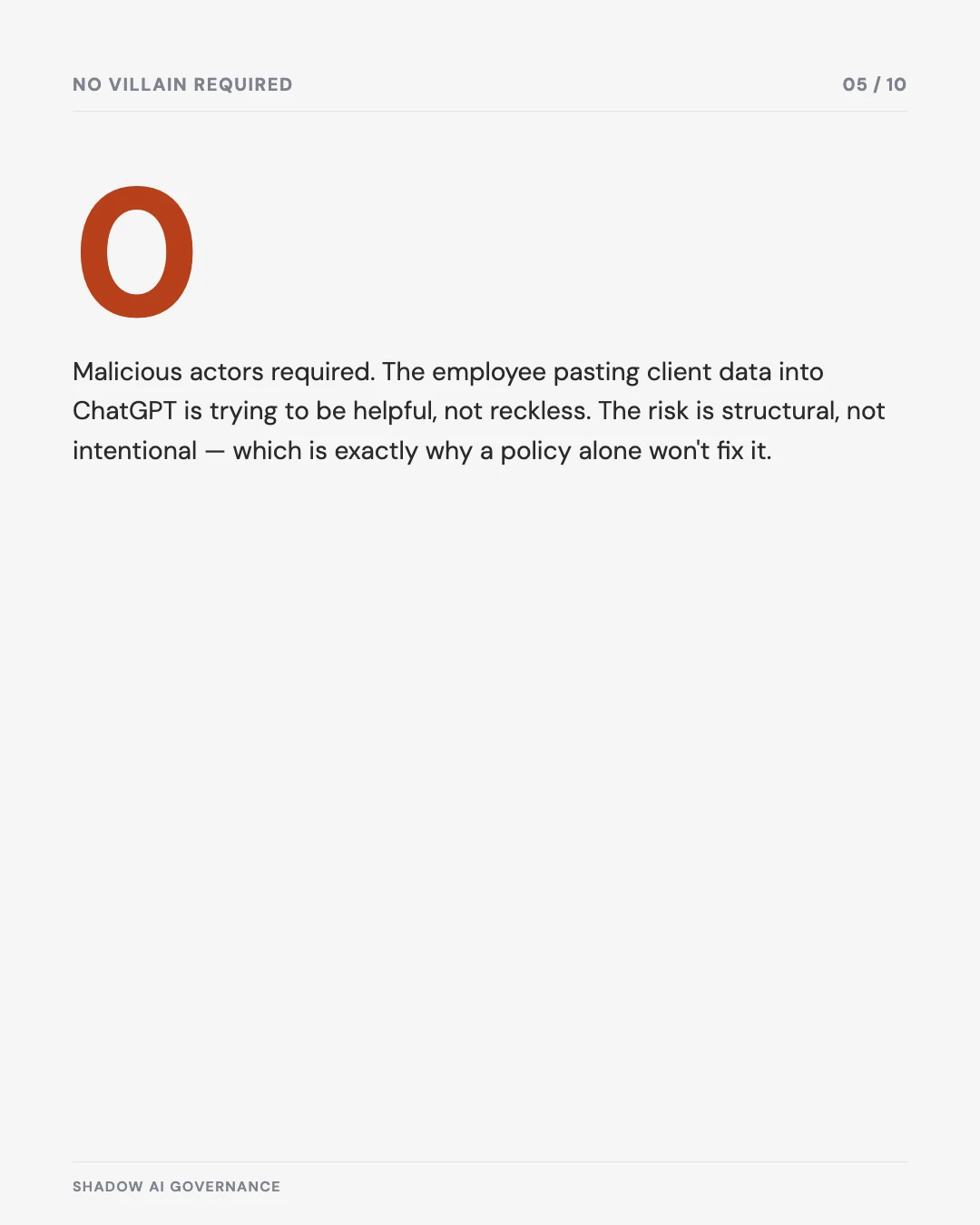
None of this requires a malicious actor. The employee doing it is trying to be helpful. The risk is structural, not intentional.
The wrong response: prohibition
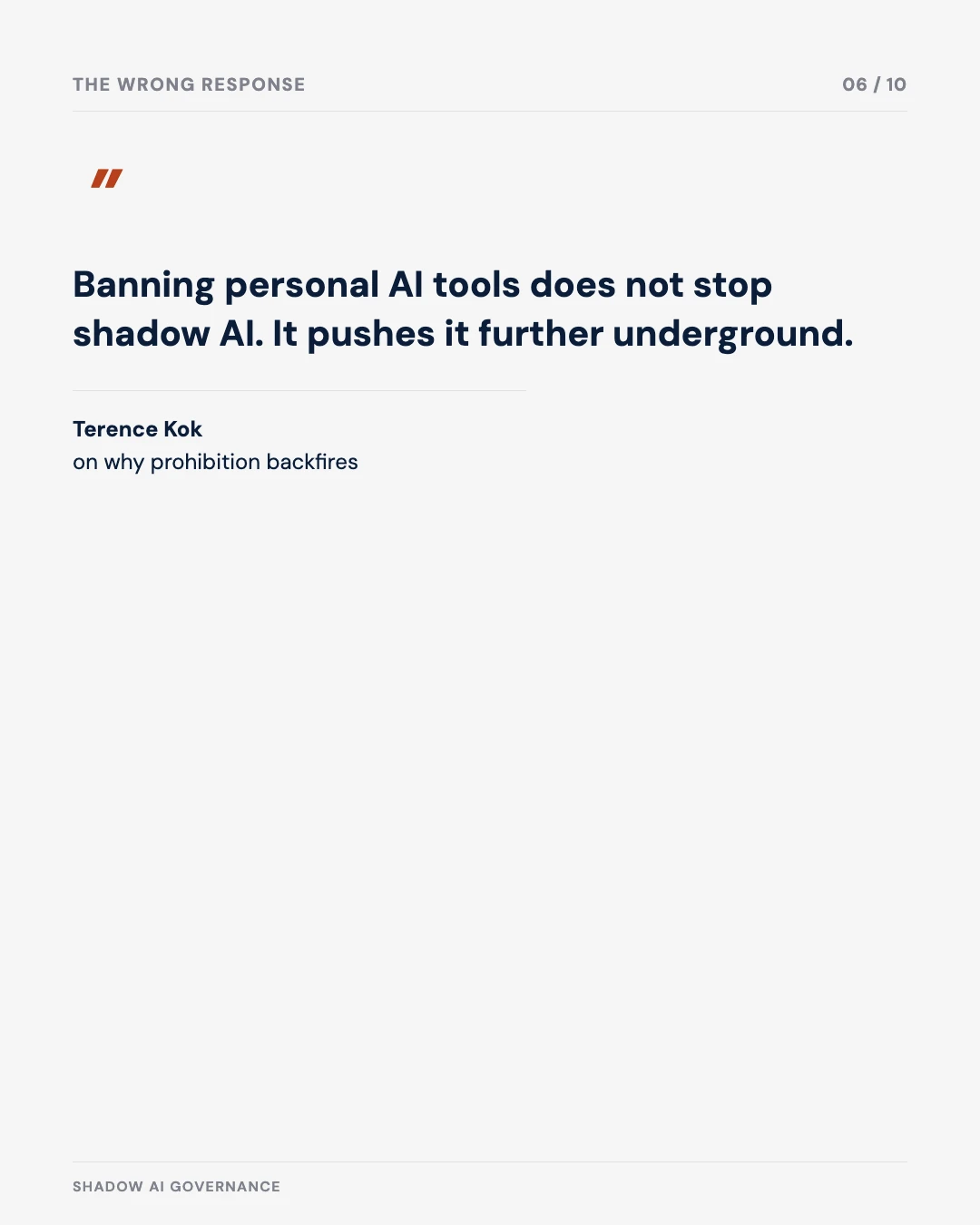
Banning personal AI tools does not stop shadow AI. It pushes it further underground.
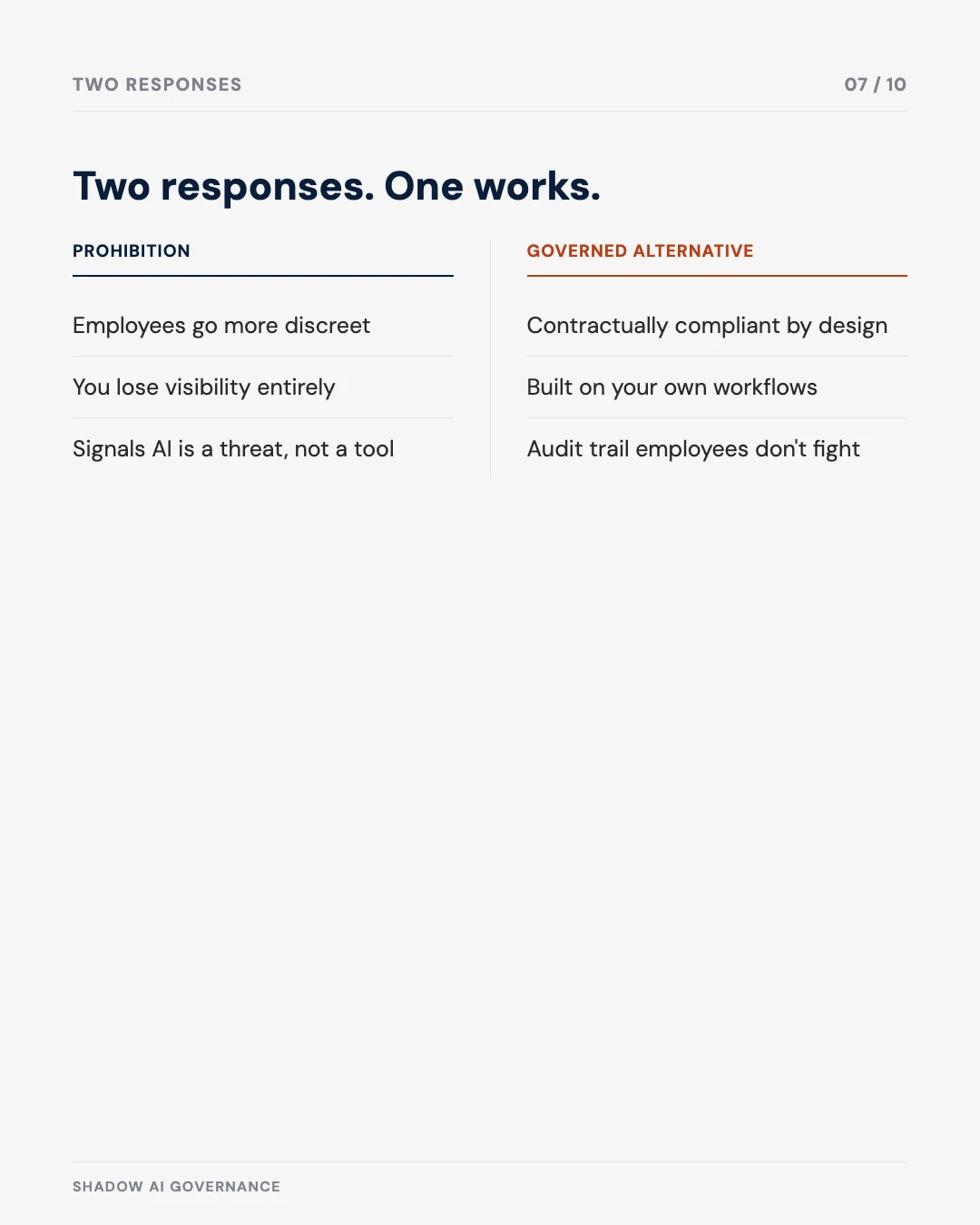
Employees who are using AI because it makes them meaningfully more productive will not stop because of a policy. They will become more discreet about it. Your data protection risk remains, but now you have also lost visibility into where the exposure is.
Prohibition also signals to your workforce that your organisation views AI as a threat rather than a tool, which is a costly signal in a talent market where AI capability is increasingly a factor in where skilled people choose to work.
The 90% figure is not a compliance problem. It is information about your organisation’s AI readiness. Most of your people are already comfortable with AI. They have self-selected into it. That is an adoption advantage, provided you channel it correctly.
The right response: governed alternatives
The goal is to make the enterprise-approved option more capable and more convenient than the consumer alternative.
This means deploying AI tools that are:
Contractually compliant. Enterprise AI agreements that include the data handling, IP, and confidentiality protections that consumer accounts do not provide. Your data stays in your systems or in systems under your contractual control.
Integrated with your workflows. Consumer AI tools are generic. Enterprise AI tools built on your organisation’s data and processes (your document archives, your project knowledge base, your standard templates) are more useful for your specific work than any general-purpose consumer platform. When the enterprise option produces better answers, employees choose it.
Capable without consumer workarounds. If the enterprise tool cannot do what employees are currently using personal accounts to do, shadow AI will persist. The governance conversation and the tool deployment conversation have to happen together.
Visible to the organisation. Enterprise deployment provides audit trails, usage data, and cost visibility that consumer shadow use does not. You can see where AI is being used, what it is being used for, and whether it is producing the outcomes you expect.
What this requires from leadership
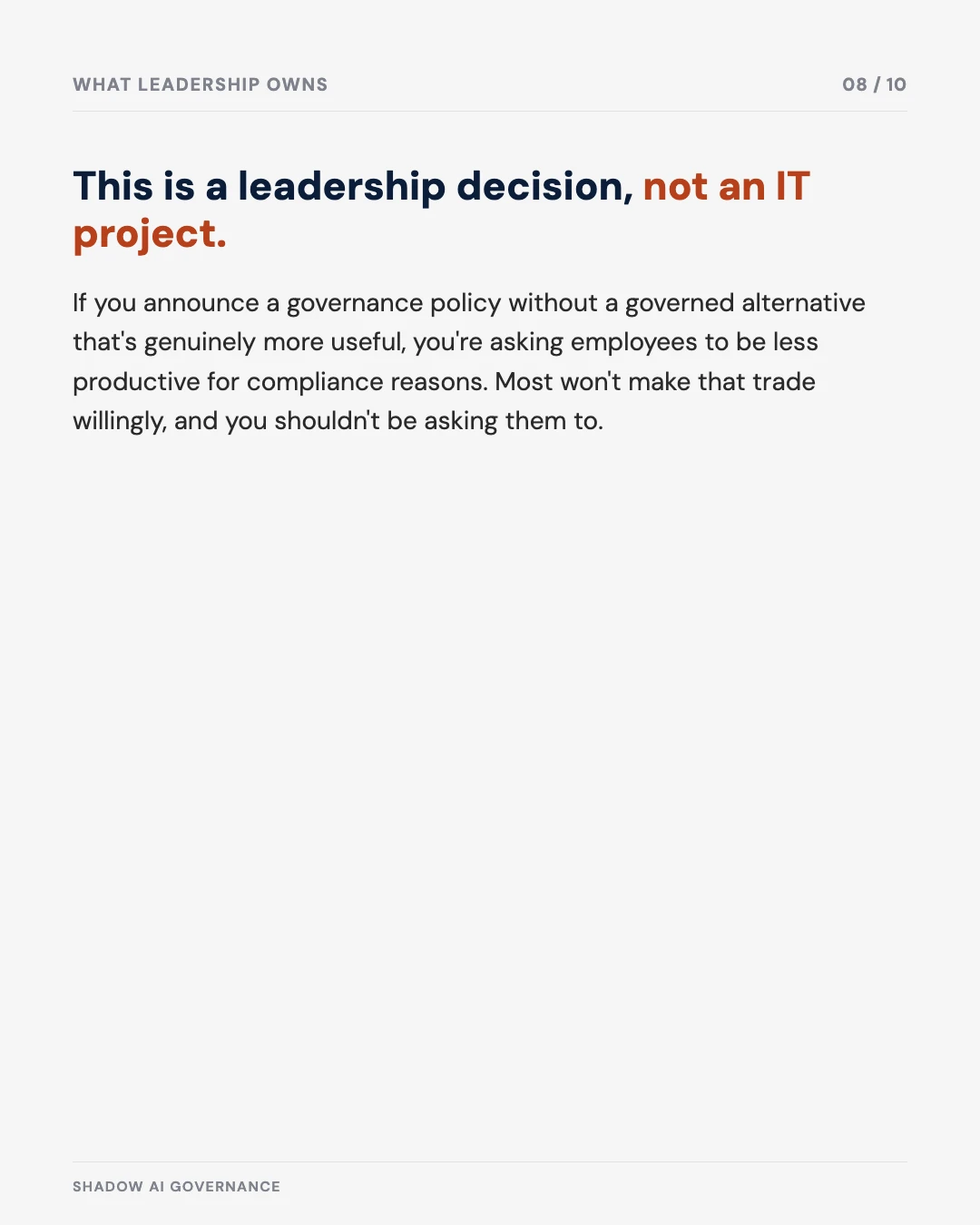
Shadow AI exists at scale in most organisations because the gap between what employees need and what the organisation has provided is too large. Closing that gap is a leadership decision, not an IT project.
The change management implication is direct: if you announce an AI governance policy without simultaneously providing a governed alternative that is genuinely more useful than what people are currently using, you are asking employees to be less productive for compliance reasons. That trade is one most employees will not make willingly, and one you should not be asking them to make.
The organisations that manage shadow AI most effectively treat it as evidence of demand. They use the intelligence about what employees are actually doing (the use cases, the workflows, the frequency) to design enterprise AI deployments that meet that demand within appropriate controls.
That sequence (understand the shadow behaviour, then design the governed alternative) is more effective than any policy approach. And it does not require employees to choose between productivity and compliance. It removes that choice by making the governed option the better option.
Ninety percent of your workforce has already decided AI is useful. The question is whether your organisation will shape how they use it, or leave that entirely to them.
Free tool
AI Trust, Risk & Governance Dashboard
Operationalises the data lineage, privacy pipeline, and threat monitoring that a governed enterprise AI alternative to shadow AI actually requires.
Free tool
AI Readiness Self-Assessment
Helps leaders understand which of the five operational conditions for a governed AI deployment are currently in place across the organisation.
The Four-Question Governance Baseline provides the structural governance questions (what can it do without asking, who checks, what happens when it is wrong, can staff still do this manually) that shadow AI governance must answer before a policy is designed.
Was this useful?