
Executive Summary
Planning-stage errors in an AI venture (market selection, team composition, data strategy, product architecture) compound at every later stage and can’t be fixed once the organisation is in motion. Ten sequential, gated steps constitute the minimum standard for planning-stage readiness.
Core conclusions
- Founder-market fit and a genuine, structural “secret” about the domain come before product or technology decisions. Without them, the correct move is to reconfigure the team or the target market, not push forward.
- Durable differentiation comes from proprietary data architecture and compounding technology design, not from access to foundation models, which every competitor shares.
- Regulatory pre-emption and outcome-based go-to-market design are strategic positions, not downstream constraints. The plan is only complete when all ten gates carry documented evidence, not assertions.
The 10-step framework, in ten slides
Save it, share it, or send it to your co-founder before you write a line of code.
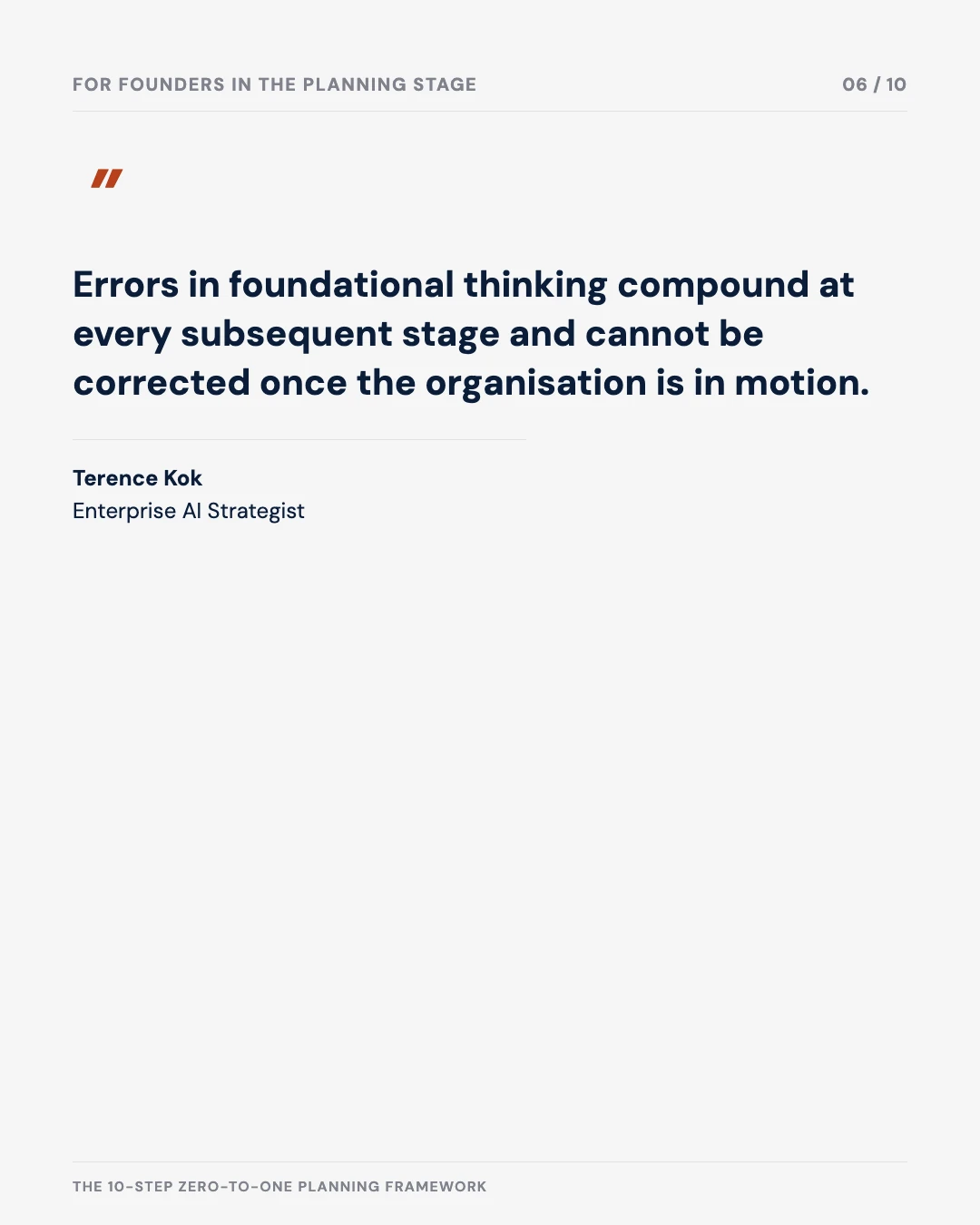
A Zero to One AI business strategy demands the creation of something genuinely new rather than the incremental improvement of an existing solution. The planning stage is the most consequential phase of the entire venture. Errors in foundational thinking, in market selection, team composition, data strategy, or product architecture, compound at every subsequent stage and cannot be corrected once the organisation is in motion.
Errors in foundational thinking compound at every subsequent stage and cannot be corrected once the organisation is in motion.
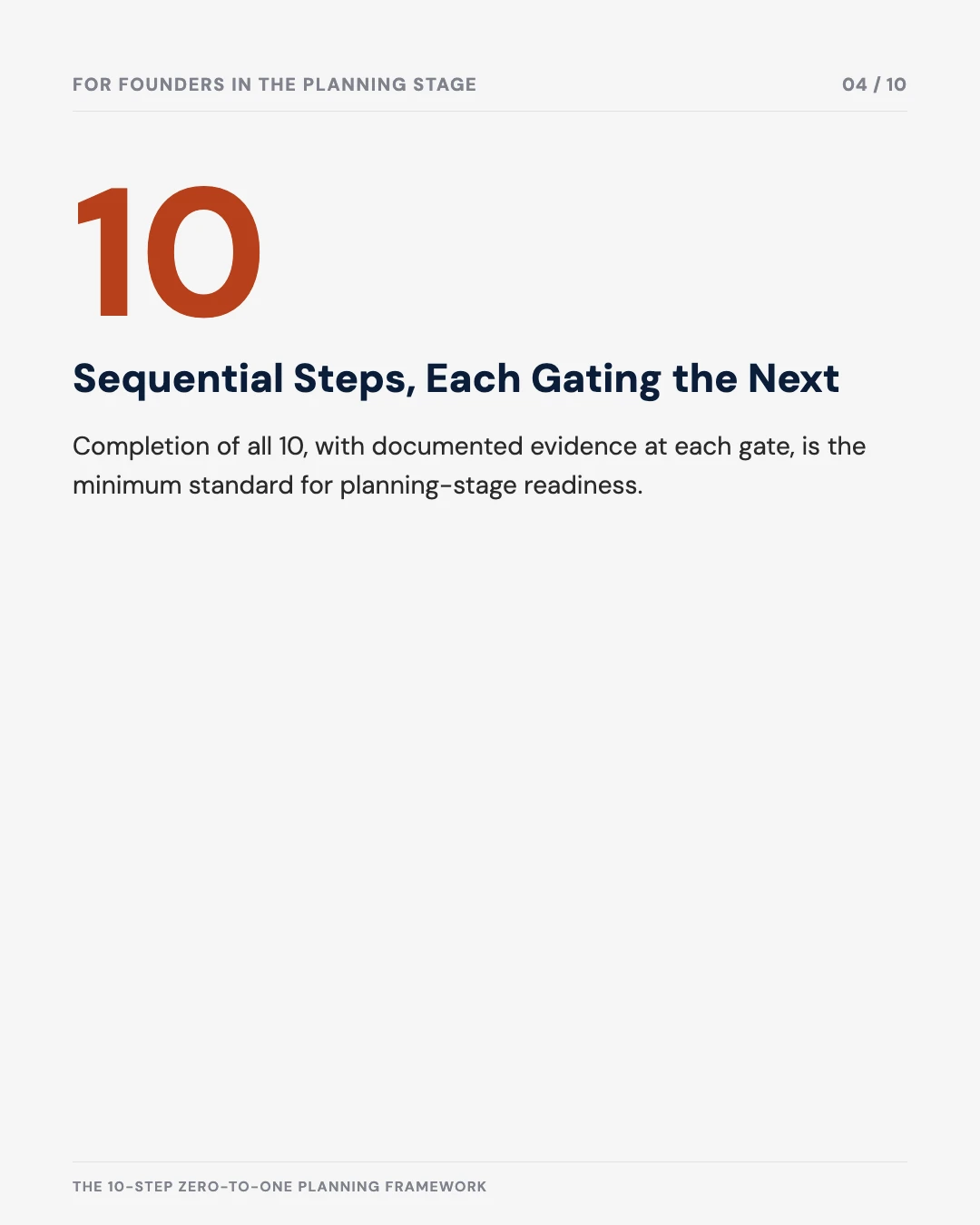
The ten steps that follow are sequential by design. Each step produces the inputs required by the next. Completion of all 10, with documented evidence at each gate, constitutes the minimum standard for planning-stage readiness.
Laying the Foundation
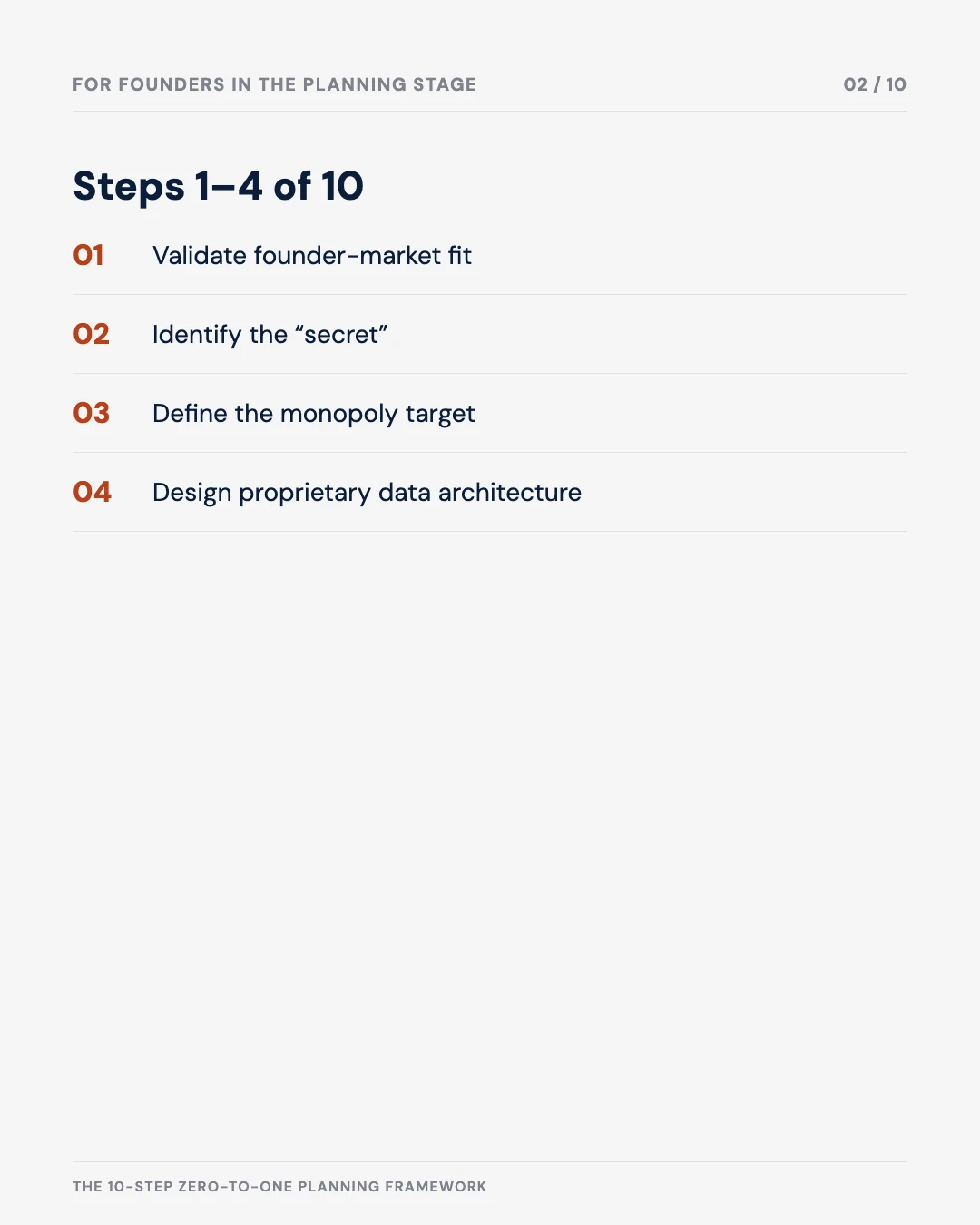
Step 1: Validate Founder-Market Fit Before Everything Else. Before defining a market, product, or technology stack, the founding team must honestly assess whether they hold genuine, non-replicable insight into the domain they intend to disrupt. The most successful AI ventures are anchored by founders who possess a competitive advantage rooted in specialised knowledge or direct operational experience. This is not a soft criterion. Conduct a structured self-assessment: does the team have direct professional or operational exposure to the target domain? Assess access to domain-specific networks: clients, regulators, data custodians, and channel partners. These relationships are an asymmetric advantage that capital alone cannot purchase. If founder-market fit is weak, the correct response is to reconfigure the team or redefine the target market.
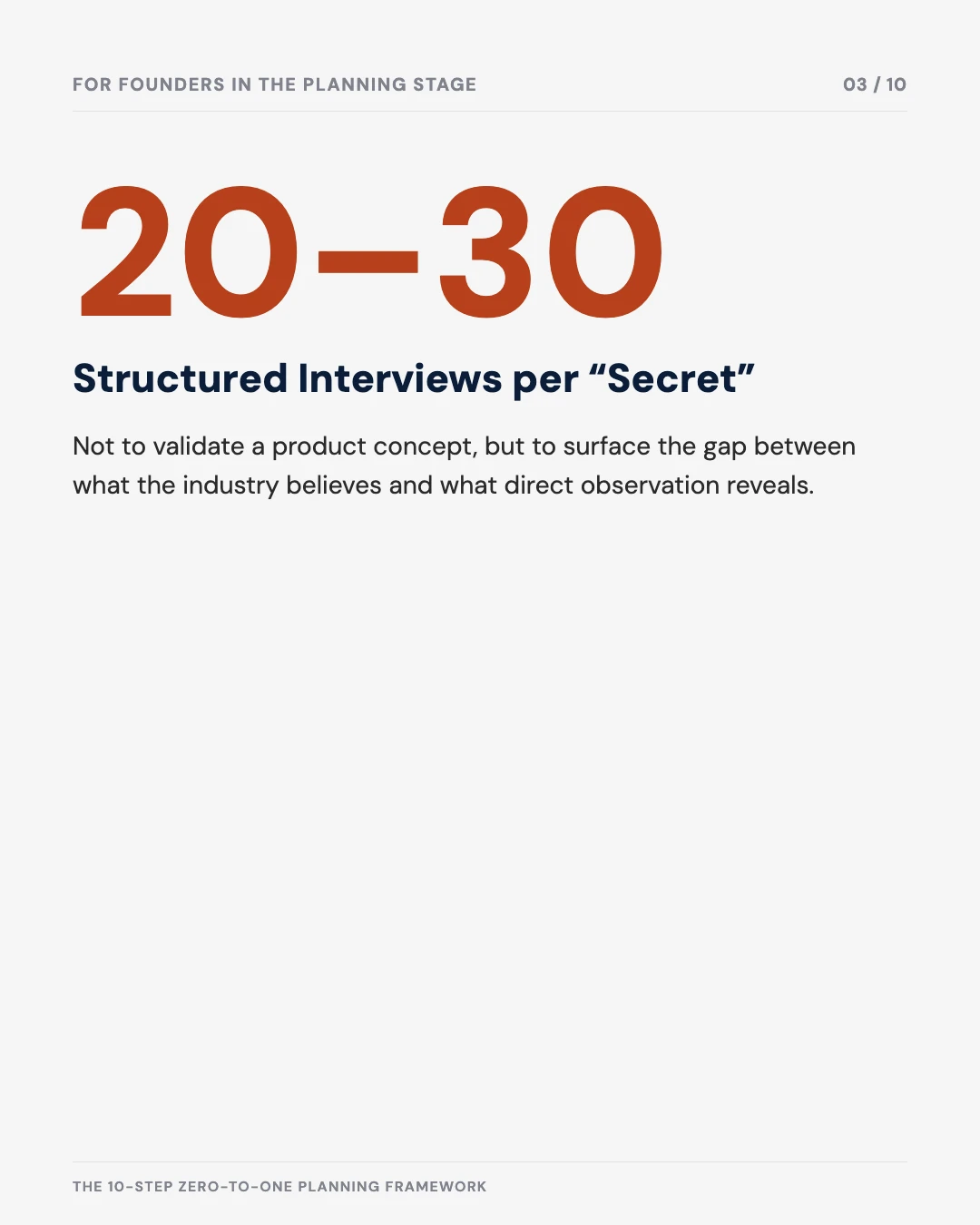
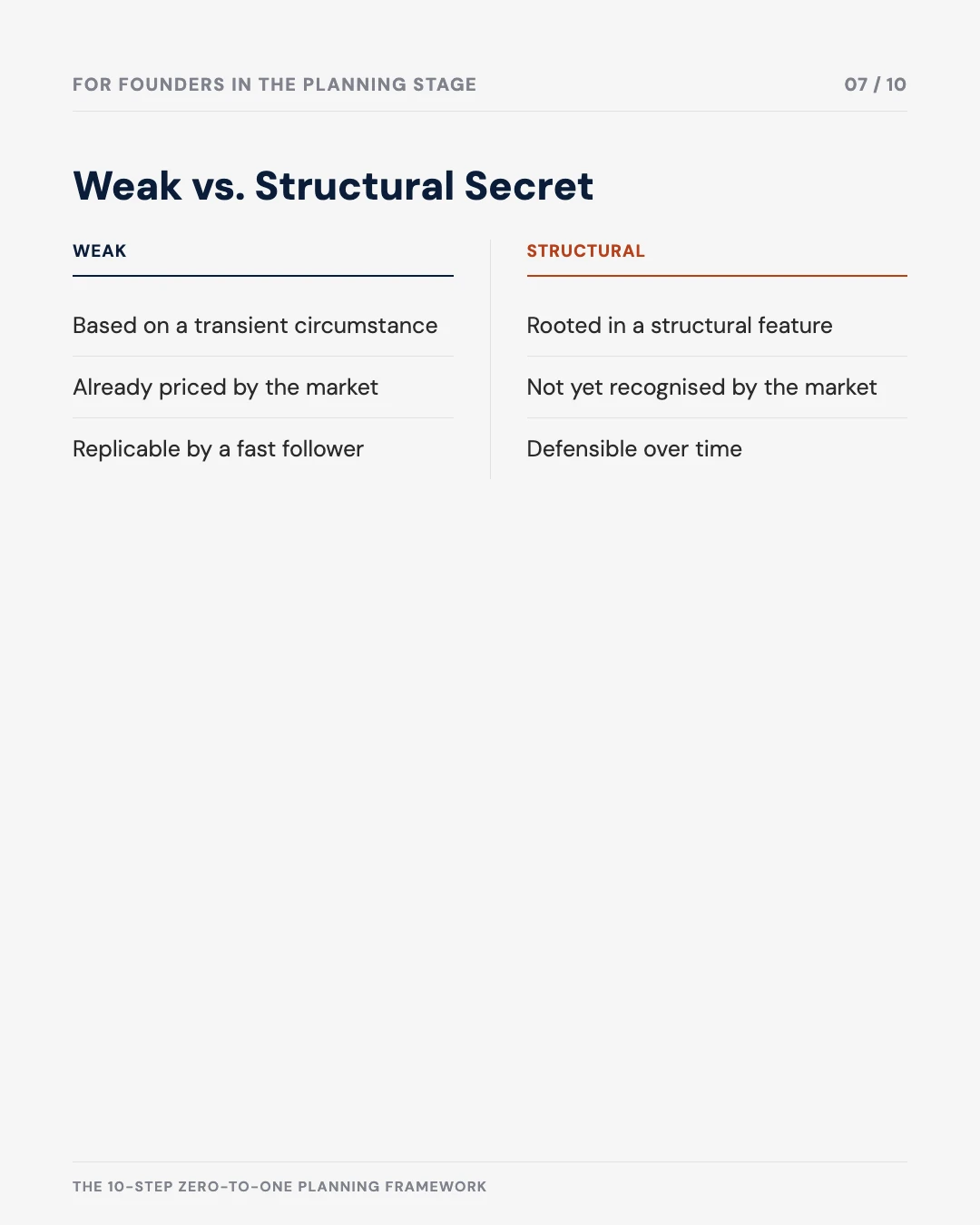
Step 2: Identify and Articulate the “Secret”. The concept of the “secret” is the single most important analytical construct in the planning stage. A secret is a fact about the target domain that is true but not yet recognised or priced by the market. The most defensible secrets are experiential and interpretive: insights derived from direct operational observation, cross-domain pattern recognition, or real-world phenomena not yet captured in structured digital datasets. Conduct 20 to 30 structured interviews with domain practitioners, not to validate a product concept, but to surface the gap between what the industry believes is true and what direct observation reveals. Test the secret’s durability: is it based on a structural feature of the domain or a transient circumstance? Only structural secrets are worth building a business upon.
Step 3: Define the Monopoly Target: Narrow, Deep, Expandable. Thiel’s monopoly logic prescribes dominance of a small, precisely defined market first, followed by deliberate expansion into adjacent markets. The most commonly observed planning error is targeting a large market too early. Identify the specific customer segment where the AI solution delivers a step-change in outcome, not marginal improvement, but an order-of-magnitude improvement relative to the existing alternative. Confirm that the beachhead has a compounding mechanism: each customer interaction should either generate data that improves the model, create switching costs that increase over time, or expand the network’s value for subsequent users. Without one of these mechanisms, the monopoly position cannot be sustained.
Building the Core
Step 4: Design the Proprietary Data Architecture. In a market where foundation models and cloud AI APIs are accessible to all competitors at comparable cost, the only structurally durable differentiator is proprietary data. Map every data source accessible to the venture, including data that exists in analogue or siloed formats within partner organisations, and classify it by exclusivity, volume, and inferential value. Design the data acquisition strategy as a core business mechanism, not a technical afterthought. Every commercial agreement, every pilot, and every deployment should be structured to generate proprietary training and inference data. Establish data governance, lineage, and access control frameworks before any model training commences.
Step 5: Construct the Technology Architecture for Compounding, Not Just Function. A Zero to One AI business is not defined by its launch architecture. It is defined by whether that architecture compounds in value over time. The planning stage must answer a fundamental question: is the system designed to improve continuously through operational feedback, model retraining, and iterative deployment, or does it deliver a static product that depreciates as competitors develop equivalent capability? Model ownership versus API dependency deserves serious attention. A business built entirely on third-party foundation-model APIs has a structural ceiling on its ability to differentiate. Feedback loop instrumentation should be treated as a non-negotiable design requirement: every user action, model output, and operational outcome should be instrumented from day one.
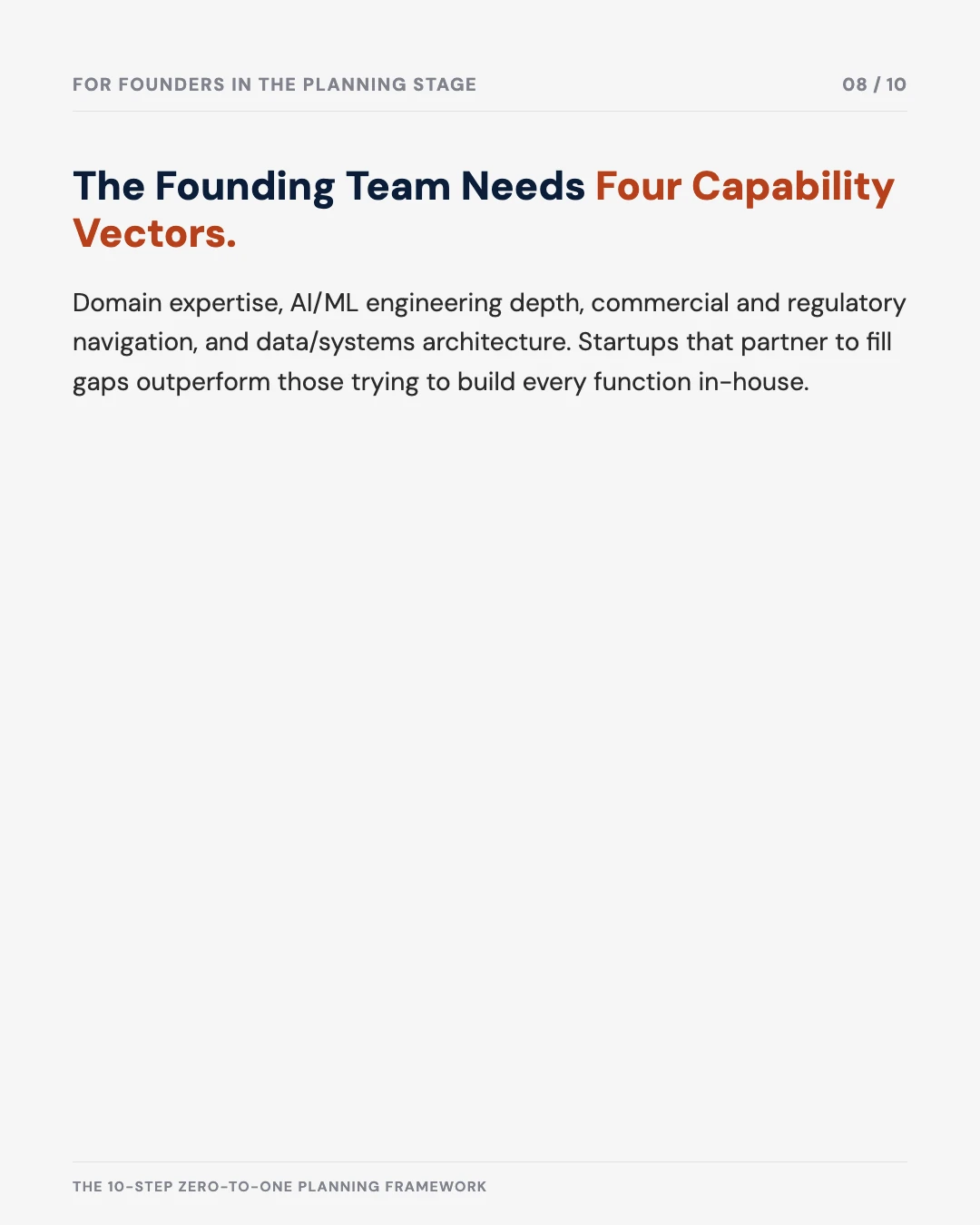
Step 6: Assemble the Founding Team with Complementary Asymmetric Capability. The founding team is the most consequential non-technical decision in the planning stage. For an AI venture in government, infrastructure, or smart cities, the team should include four capability vectors: domain expertise (at least one founder with practitioner-level understanding), AI and ML engineering depth, commercial and regulatory navigation, and data and systems architecture. Startups that structure partnerships with domain experts to fill capability gaps demonstrate materially higher success rates than those attempting to build every function in-house.
Going to Market
Step 7: Define the Go-to-Market and Distribution Strategy. Distribution is not a downstream consideration. Direct versus partner-led distribution is a foundational decision: direct distribution provides faster feedback loops and full control of the customer relationship, critical during the beachhead stage. Land and expand must be defined with precision: what is the minimum viable commercial engagement that generates operational data, validates the model, and creates the proof point for larger deployments? Pricing model design should not be left to the sales cycle. In government and infrastructure contexts, outcome-based pricing, where fees are linked to measurable performance improvements, creates alignment with the client’s accountability structure and removes the procurement barrier of undefined ROI. I make the broader case for this pricing shift in The End of Billing for Time.
Step 8: Establish Regulatory Pre-emption as a Strategic Position. In government, infrastructure, and public sector AI deployments, regulatory compliance is not a constraint to be managed after market entry. It is a competitive moat available to the first mover who proactively maps their system to regulatory requirements. Map the applicable regulatory frameworks across all target jurisdictions. Engage regulators as stakeholders during the design phase, not as approval authorities after the fact. Structure the AI system’s explainability, audit trail, and human oversight mechanisms to satisfy the most stringent applicable regulatory standard. The TRACE framework is a useful structured starting point for scoring exactly this. Establish data residency and sovereignty architecture before any government client engagement.
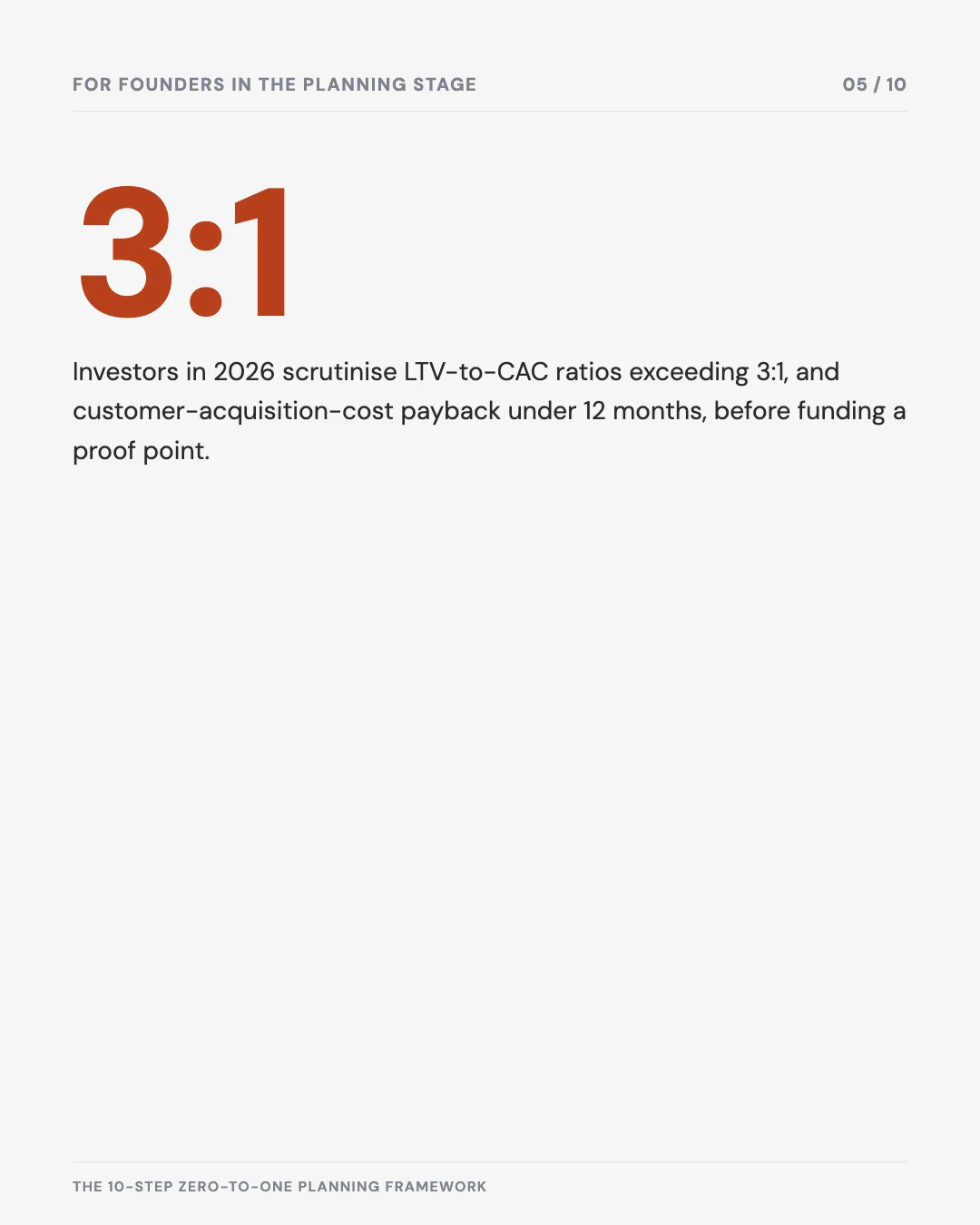
Step 9: Validate the Financial Architecture and Funding Readiness. Before approaching institutional investors, establish a financial model grounded in evidence-based assumptions, not projections derived from analogy with broadly comparable market categories. At pre-seed stage, AI ventures are evaluated on a solid proof of concept, a well-articulated problem statement, technical credibility of the founding team, and evidence of customer validation. Investors in 2026 specifically scrutinise model performance stability, go-to-market efficiency with customer acquisition cost payback under 12 months, LTV to CAC ratios exceeding 3:1, proprietary data ownership, and demonstrated demand validation. Define the minimum funding required to reach a validated proof point, not a fully scaled platform.
Execution Readiness
Step 10: Instrument for Measurable Outcomes from Day One. The final imperative in the planning stage is to define the performance measurement framework before the first deployment. An AI venture that cannot demonstrate quantified, traceable improvements in client outcomes will be reclassified as a pilot: structurally blocked from operational scale regardless of the technical quality of the system. Define, in advance of each deployment, the baseline metrics against which AI-driven improvement will be measured. Instrument the system to capture these metrics automatically and continuously. Establish a continuous optimisation loop: model performance baselines are not static benchmarks but starting points for compounding improvement. Include the outcome reporting framework in the client contract as a transparency obligation.
The ten steps above are designed to be completed in sequence, with each producing the documented inputs required by the next. The planning stage is complete when all ten gates have been passed with substantive evidence, not assertions.
The planning stage is complete when all ten gates have been passed with substantive evidence, not assertions.