
Executive Summary
Prompt engineering is an interface-design discipline, not a creative one. Treating prompts as versioned API contracts, backed by eight concrete principles, turns AI operations from a cost sink into a reliable production system.
$8,000
burned in a single quarter on API costs from vague, unstructured prompts (this project’s own result)
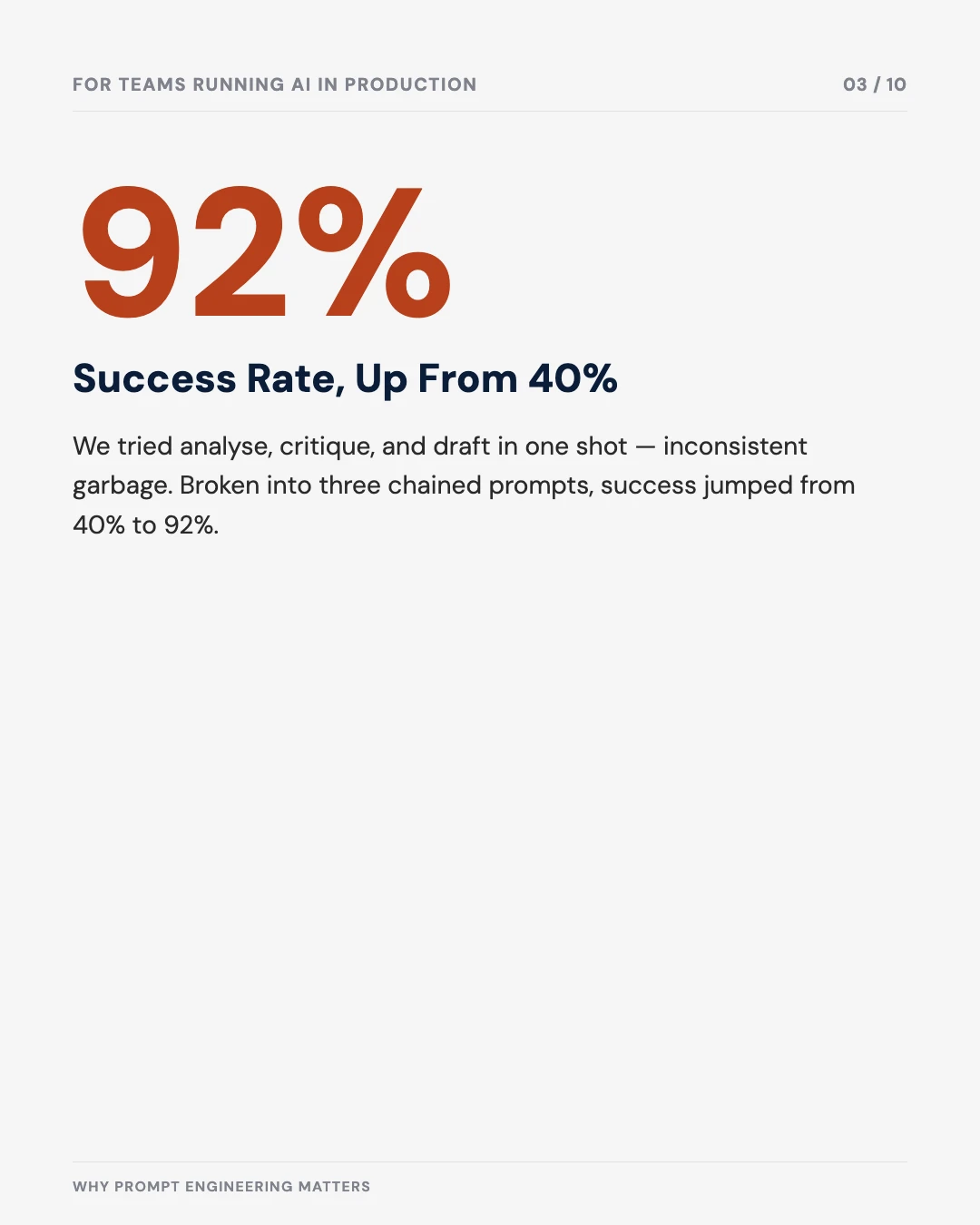
40→92%
success rate before and after breaking one prompt into three chained steps (this project’s own result)
-73%
AI cost reduction after applying the eight principles (this project’s own result)
Core conclusions
- Vague prompts don’t just produce weaker output. They directly inflate accuracy risk, hallucination risk, and processing cost.
- Complex tasks are more reliable when decomposed into explicit, chained steps rather than attempted in a single shot.
- Prompts should be versioned and tested like interface contracts, especially once their output feeds downstream automation.
The 8 principles, in ten slides
Save it, share it, or send it to whoever is burning through your API budget.
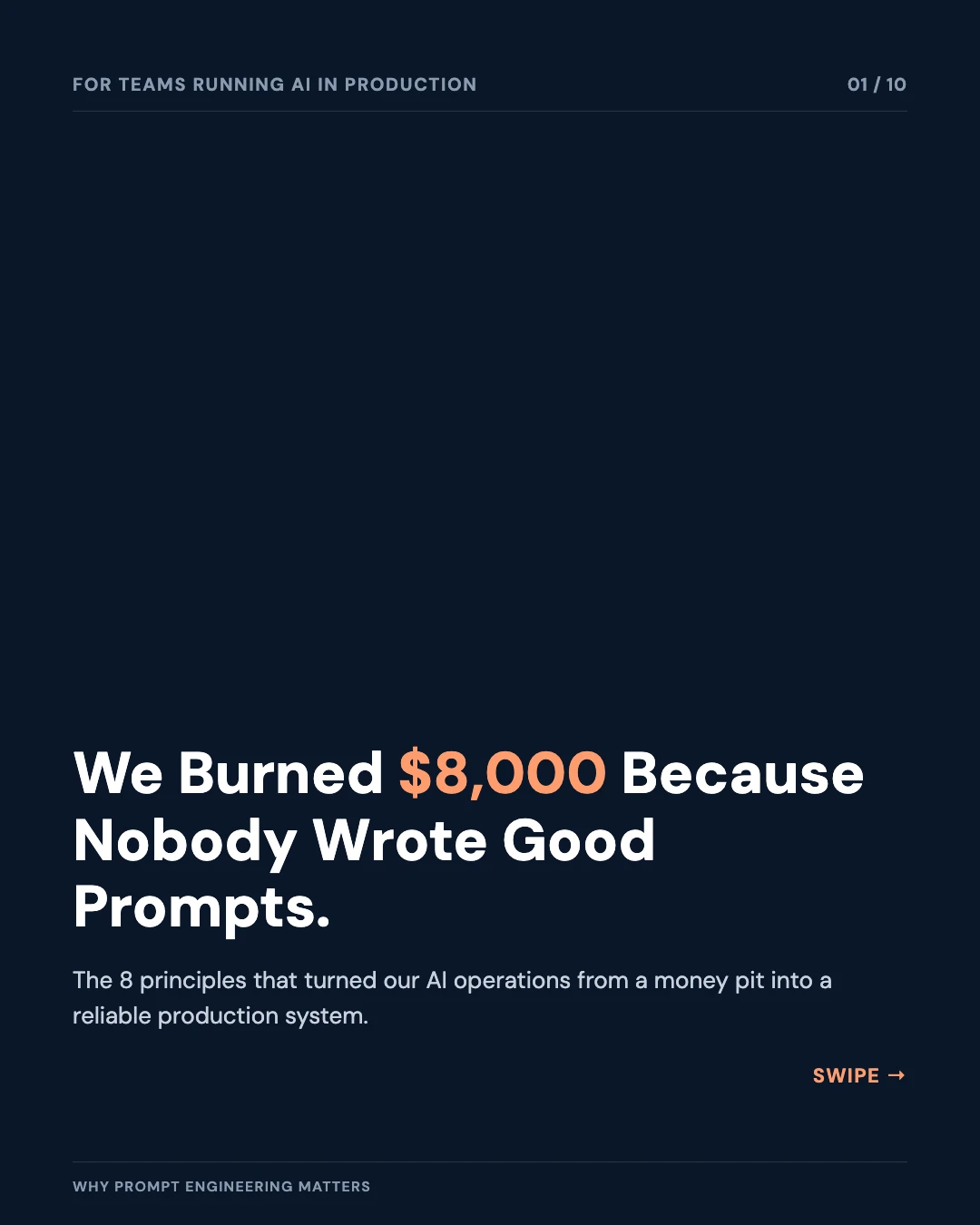


Last quarter, I watched our team burn through $8,000 in API costs because nobody bothered to write good prompts. We were getting useless outputs, running the same queries multiple times, and manually fixing what the AI should have gotten right the first time.
Everyone’s talking about which AI model to use, but almost nobody’s talking about how to actually use them effectively.
Prompt engineering isn’t some mystical art. It’s the practical discipline of turning vague intent into precise instructions that reliably produce useful outputs. For most of us working in data-driven environments, it’s an interface design problem, not a creative writing exercise. And when done right, it directly impacts your accuracy, hallucination risk, processing costs, and time-to-output.
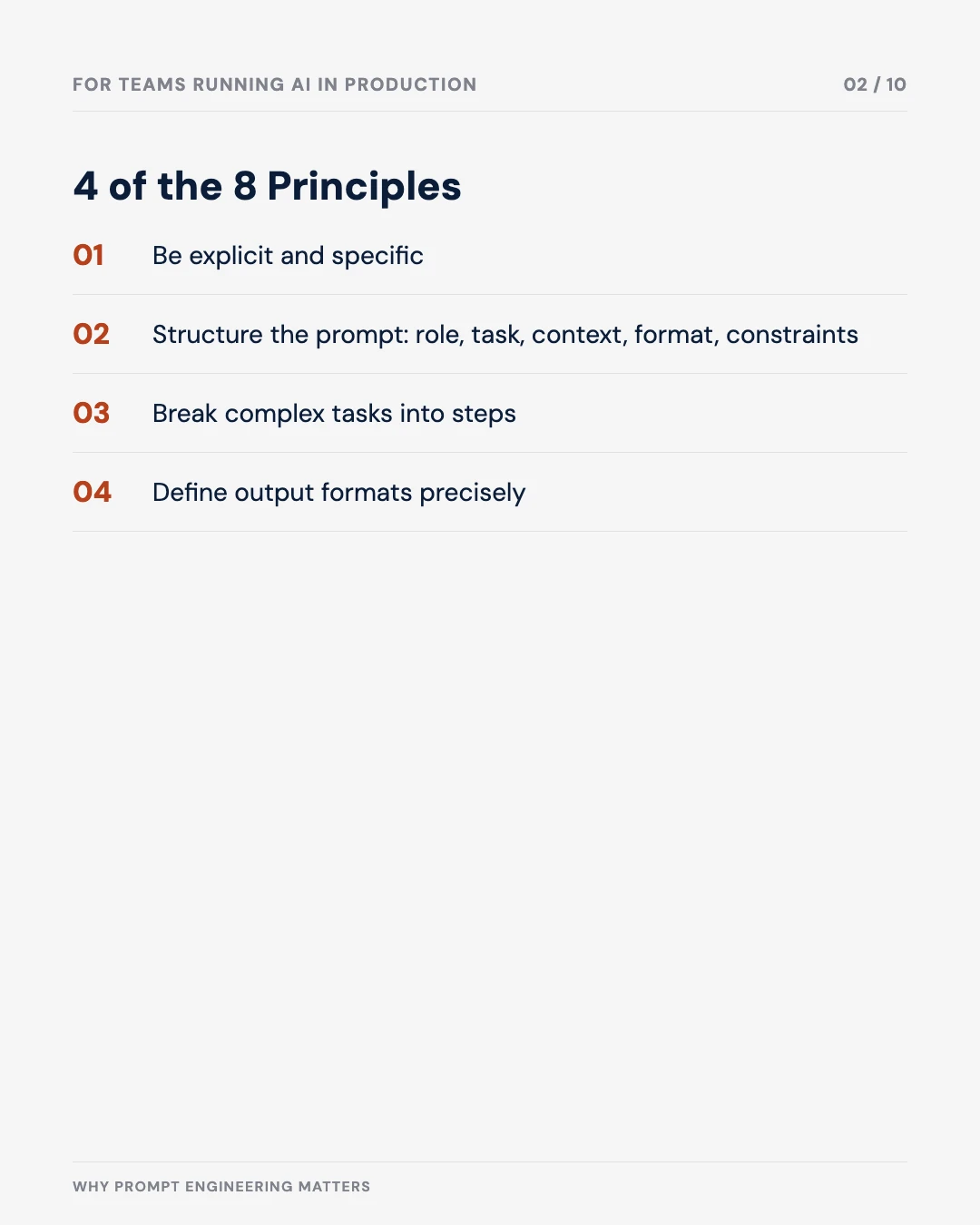
Here are the 8 principles I wish I’d known when we started. These turned our AI operations from a money pit into a reliable production system:
Being Clear About What You Want
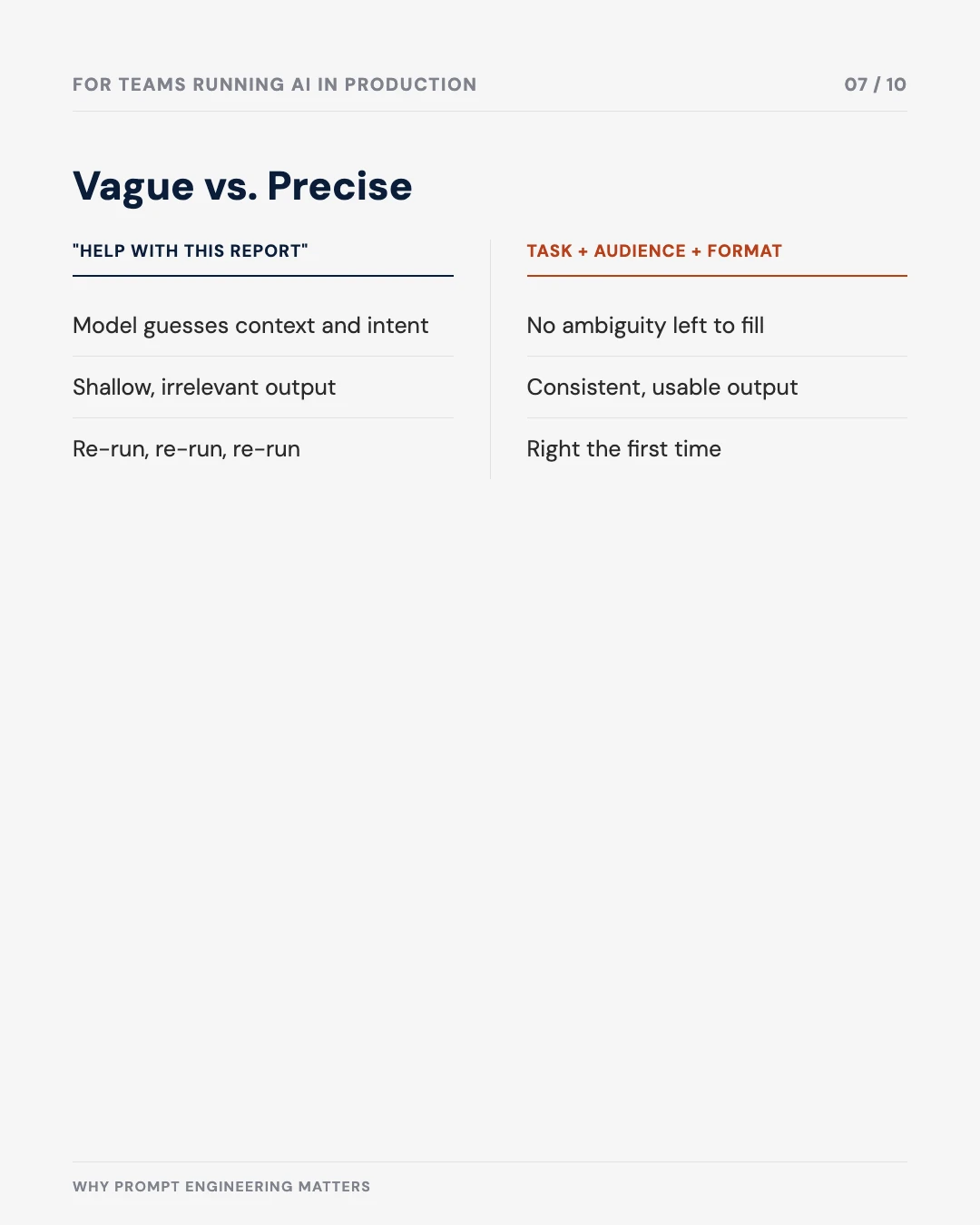
Principle 1: Be Explicit and Specific. Effective prompts minimise ambiguity by stating exactly what the model should do, in what order, and with which constraints. Vague requests such as “Help with this report” force the model to guess context and intent, increasing the chance of irrelevant or shallow responses. Instead, specify task, audience, domain, scope, and constraints, for example: “Summarise the following policy into five bullet points for senior non-technical stakeholders, focusing only on impacts to budget, risk, and regulatory compliance.” This level of specificity consistently improves the relevance and structure of responses.
Principle 2: Structure the Prompt. Large language models respond better to clearly structured instructions than to long, free-form paragraphs. A robust pattern is: Role (define who the model is acting as), Task (state the primary action using an action verb), Context (provide only the necessary background), Output format (specify the exact structure required, such as “Return a markdown table with three columns: Risk, Likelihood, Mitigation”), and Constraints (set boundaries such as word count, style, jurisdiction, or time horizon).
Breaking Down Complex Tasks
Principle 3: Break Complex Tasks into Steps. Complex reasoning or multi-stage outputs are more reliable when decomposed into smaller prompts or explicit steps. I learned this one the expensive way. We tried to get our AI to analyse, critique, AND draft final recommendations in one shot. The results were inconsistent garbage. When we broke it into three separate prompts, our success rate went from 40% to 92%. Request a structured analysis or outline first, refine or challenge that outline second, and generate the final deliverable from the agreed structure third. This approach, sometimes called prompt chaining, reduces hallucinations and makes review and governance easier because each step is auditable and independently verifiable. Taken further, this is the same logic behind structured, chained AI loops that go beyond single prompts entirely.
Principle 4: Use Examples and Constraints. Few-shot prompting (providing one or more examples of the desired input–output relationship) can substantially improve consistency when generating repetitive content such as emails, summaries, or templates. Showing a model a “good” risk register row and then asking it to generate more rows in the same format improves alignment more than abstract instructions alone. Examples should be tightly scoped and paired with explicit constraints such as “Do not introduce new frameworks or methodologies; reuse only those present in the example.” This combination supports controlled variability within a governed pattern.
Controlling Outputs and Handling Uncertainty
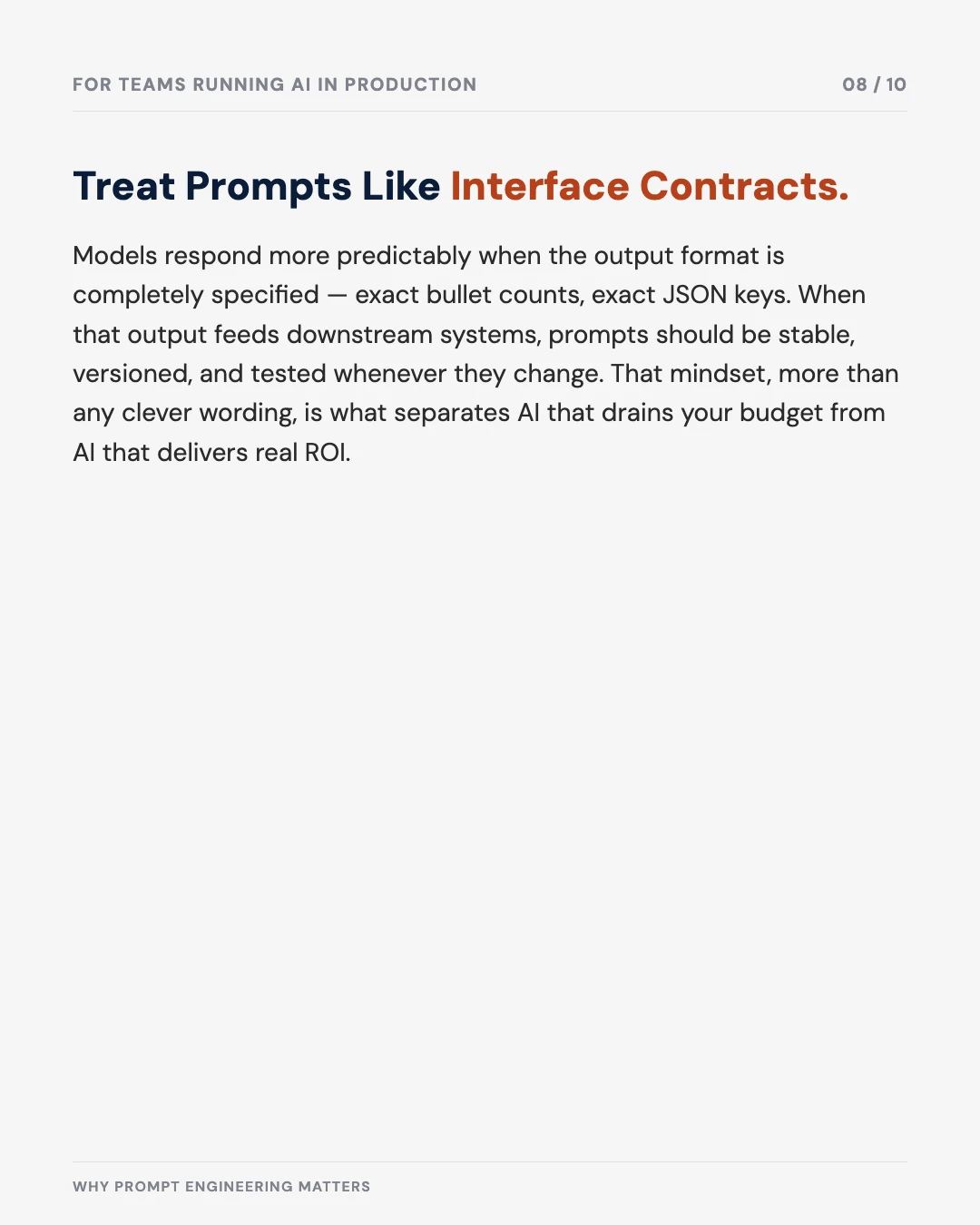
Principle 5: Define Output Formats Precisely. Models respond more predictably when the desired output format is completely specified. Instead of “Summarise this”, more robust instructions would be: “Return exactly three bullet points, each under 20 words,” or “Return a JSON array of objects with keys: ‘risk_id’, ‘description’, ‘likelihood’, ‘impact’, ‘mitigation’.” This is particularly important when AI output is being passed into downstream systems for automation or analytics. Prompts should be treated like interface contracts: stable, versioned, and tested whenever they change.
Principle 6: Manage Ambiguity and Negative Instructions. Ambiguous prompts encourage speculative responses. Effective prompt engineering explicitly removes ambiguity by declaring what the model must not do (“If required data is missing, state ‘insufficient data’ instead of guessing”) and specifying how to handle unknowns (“If you are not certain, list assumptions separately before answering”). Negative instructions are essential for governance in regulated sectors, where hallucinated content can create compliance or safety risks. These patterns can be standardised into organisational prompt templates for risk-sensitive use cases.
Context, Roles and Testing
Principle 7: Use Roles and Domain Context. Assigning a domain-specific role improves alignment with the expected reasoning style and vocabulary: examples include “transport planner”, “enterprise architect”, “cybersecurity auditor”, or “policy drafter for public-sector procurement”. Coupling roles with jurisdiction or sector (“public-sector digital policy advisor in Singapore”, “GCC critical infrastructure resilience consultant”) allows the model to surface more appropriate assumptions, frameworks, and terminology. This is particularly useful in smart city and infrastructure contexts where regulatory, operational, and technical constraints need to be balanced in a single response.
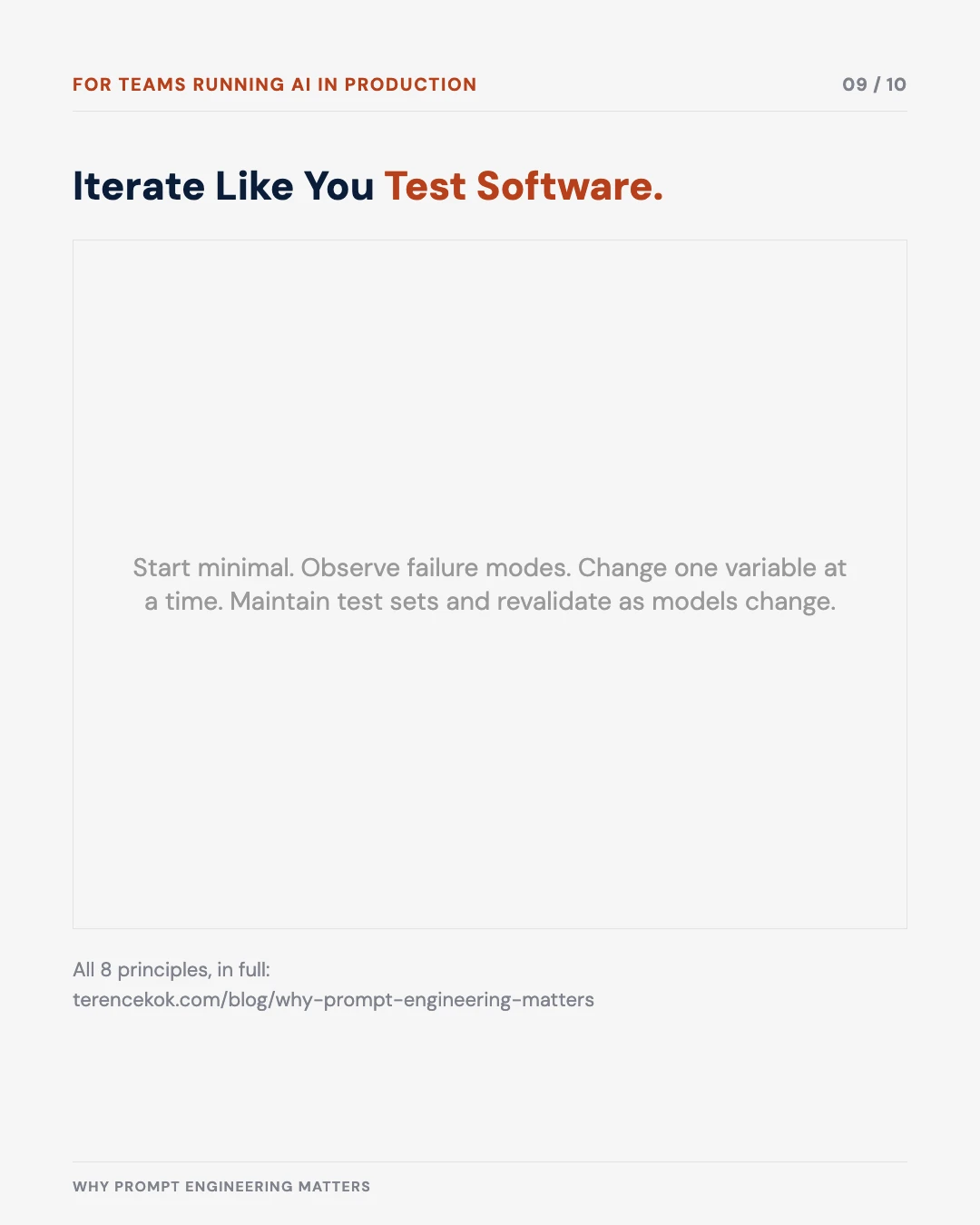
Principle 8: Iterate and Test Systematically. Effective prompt engineering is empirical. Rather than assuming a single “perfect” prompt, practitioners should start from a minimal but explicit prompt, observe failure modes (missing constraints, hallucinated metrics, incorrect tone), and refine the prompt to address those issues, changing one variable at a time. For workflows that are run repeatedly, maintain test input sets and expected output characteristics, then periodically revalidate prompts as models or configurations change. This mirrors software testing practices and supports stable performance in production environments. Just be honest about the ceiling here: past a certain point, no amount of prompt refinement fixes a bad underlying knowledge base.
The Bottom Line
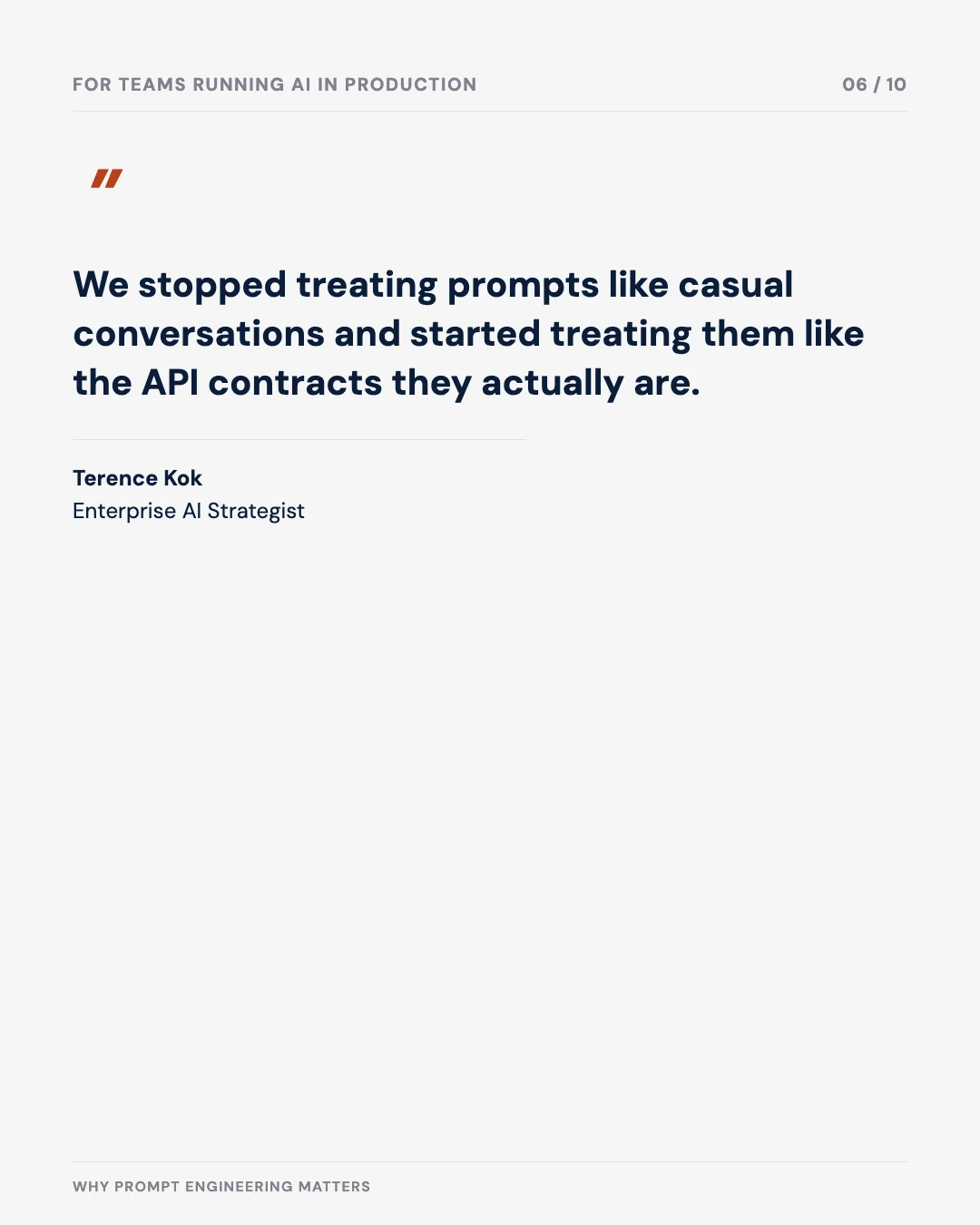
These 8 principles cut our AI costs by 73% and improved output quality from “sometimes useful” to “production-ready.” The difference? We stopped treating prompts like casual conversations and started treating them like the API contracts they actually are.
We stopped treating prompts like casual conversations and started treating them like the API contracts they actually are.
Prompt engineering isn’t glamorous. It won’t get you conference speaking slots. But it’s the difference between AI that drains your budget and AI that delivers real ROI.
What’s been your experience with prompt engineering? Which of these principles has made the biggest difference for you? Or are there other patterns you’ve found that work better?
Drop a comment. I’m always learning from what others are discovering in the field.