
Executive Summary
You can see what AI could do for your part of the business. You can also see competitors starting to use it. The person you report to blocks every proposal, sometimes politely and sometimes not. Arguing harder rarely works, and going around them usually backfires. What works more often is to treat the blocking as fear, build a case in the language your boss is afraid in, start inside your own remit, and set yourself a deadline for deciding whether this is a place you can stay.
Core conclusions
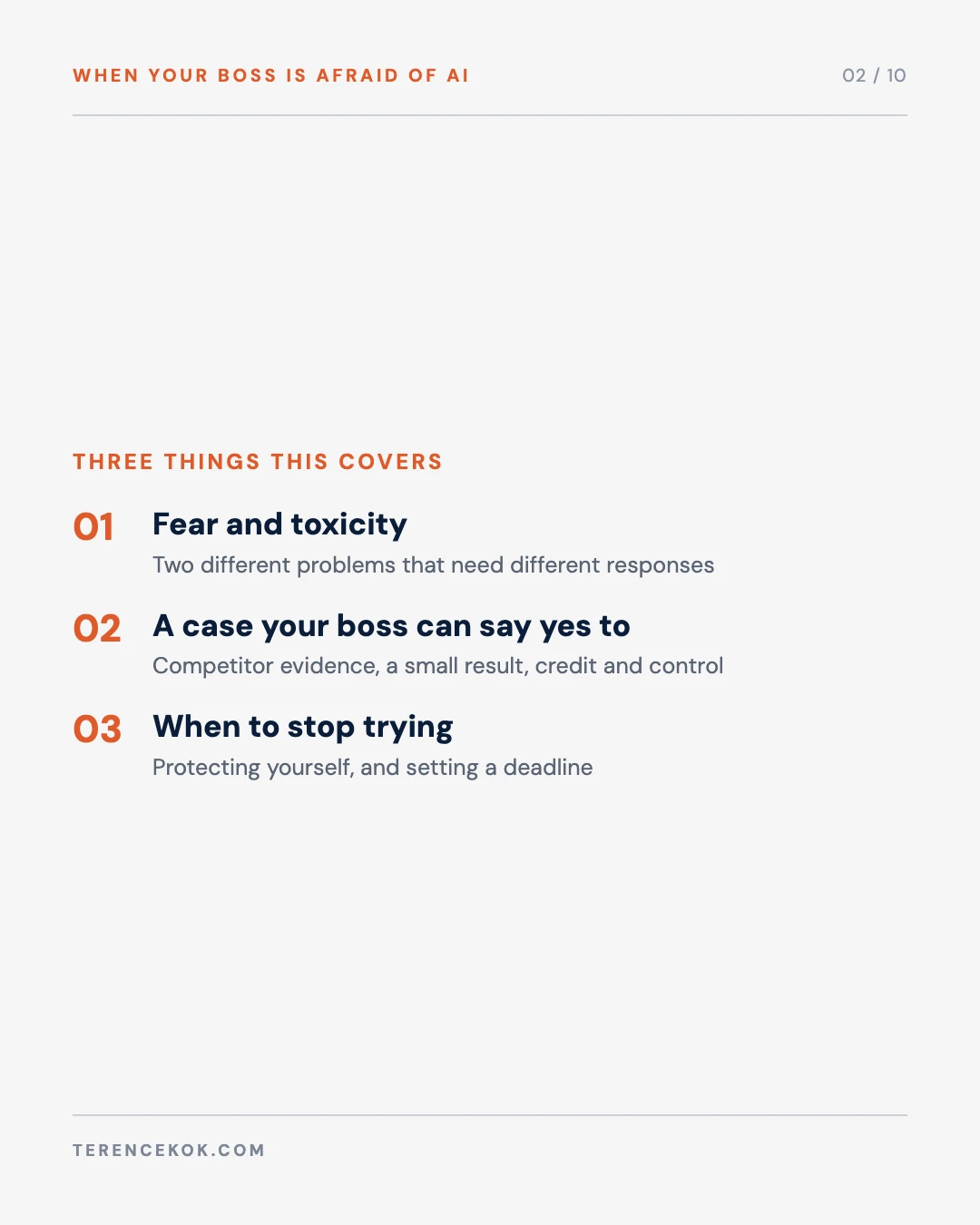
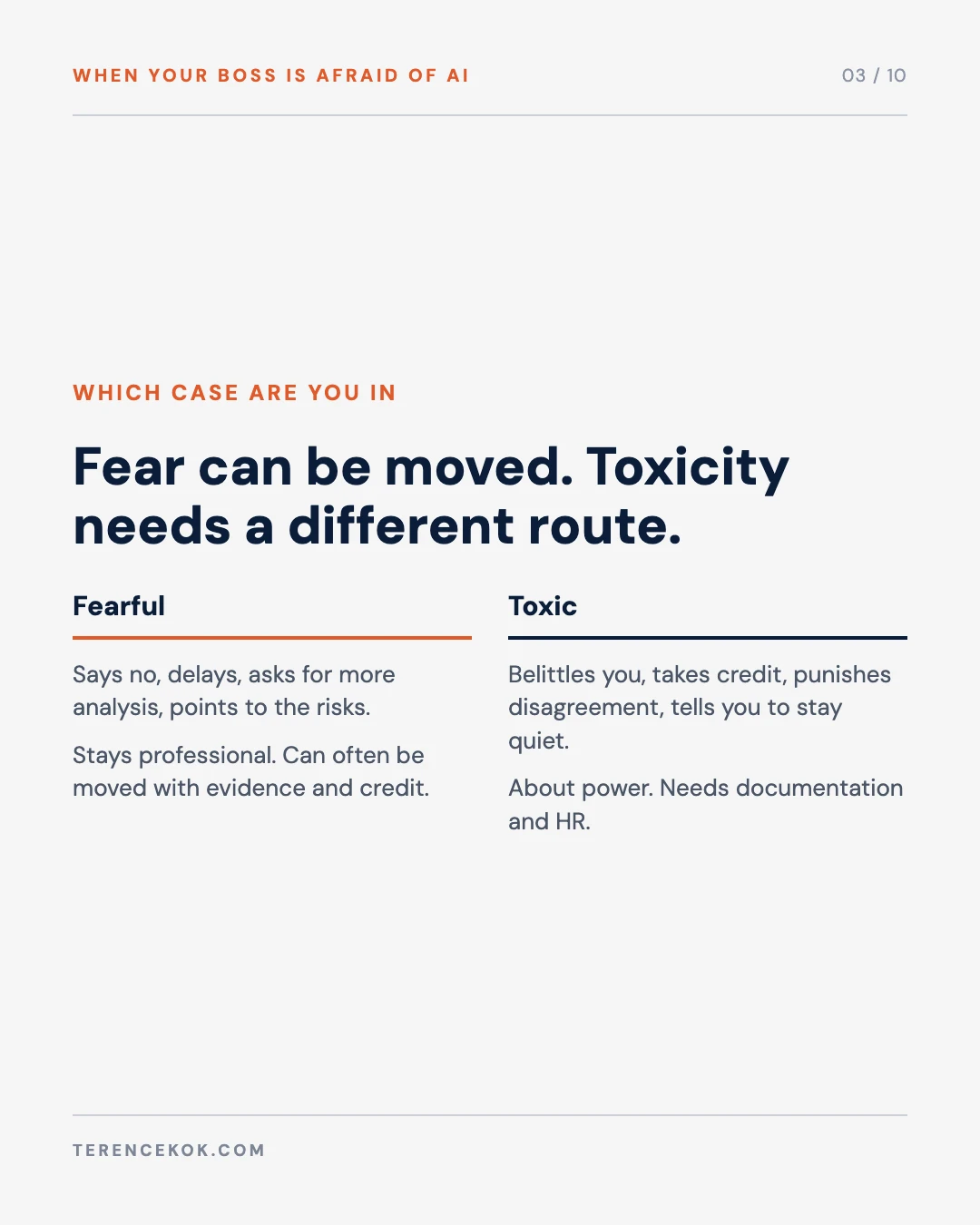
- A fearful boss and a toxic boss are different problems. The first can often be moved with evidence and credit. The second needs documentation and HR, and evidence alone will not fix it.
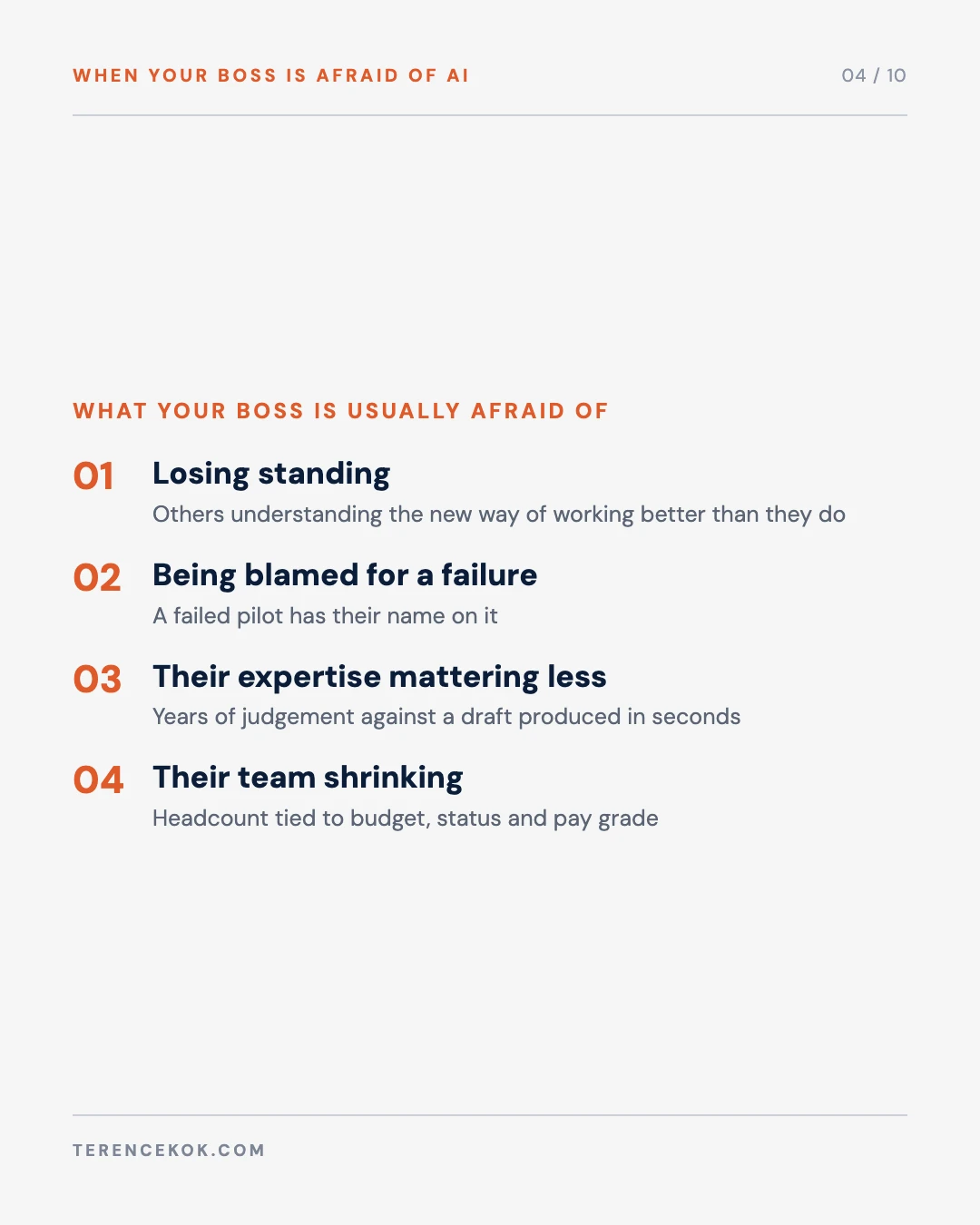
- Your boss is rarely afraid of the technology. The usual fears are losing standing, being blamed for a failure, and having their expertise matter less.
- Competitor movement persuades when it arrives as a documented risk to the business. Articles about AI in general tend to make a fearful boss dig in.
The guide, in ten slides
Save it, or send it to someone who is stuck in the same position.
The position you are in
You have probably tried the obvious things already. A proposal that went nowhere. A demo your boss watched with folded arms. A forwarded article that got no reply. Meanwhile a competitor has announced an AI-assisted service, or started hiring for roles your company does not have, or quoted a turnaround time your team cannot match.
This puts you in a real bind. If you push too hard, you damage the relationship with the person who controls your assignments, your appraisal and your next promotion. If you do nothing, you watch the gap open and you may be the one blamed for it later, because you were the person who saw it coming.
I hear a version of this in almost every leadership session I run, usually after the formal part has ended. The people asking are rarely trying to get ahead of their boss. Most of them are trying to protect the business and their own position at the same time. Both are reasonable things to want.
Fear and toxicity are different problems
Before you choose a tactic, be honest about which situation you are in.
A fearful boss says no, delays, asks for more analysis, or points to the risks. The behaviour is frustrating, but it stays professional. They are protecting something, and if you can work out what, you can often find a version of the proposal they can live with.
A toxic boss does something else. They belittle you in front of others for raising the idea, take credit for work you did, punish you in your assignments or your review for disagreeing, or tell you to stop talking about it with other people. That behaviour is about power, and no business case will change it.
Many bosses are a mix of the two, and fear can make a decent manager behave badly for a while. Most of this piece is about the fearful case, because it is the more common one and the one you can influence. The toxic case gets its own section further down.
What your boss is usually afraid of
In my advisory work, the managers who block AI are rarely afraid of the technology itself. The fear sits closer to home, and it usually takes one of four forms.
Losing standing. Your boss built their position on knowing how the work is done. If a tool changes how the work is done, they worry that the people below them will understand it better than they do. Saying no keeps the ground familiar.
Being blamed for a failure. An AI pilot that leaks client data or produces a wrong answer in front of a customer has a name attached to it. From where your boss sits, the downside of a failed pilot is personal and immediate. The downside of falling behind a competitor is shared and slow.
Their expertise mattering less. Much of a manager’s value is judgement accumulated over years. When a tool produces a plausible first draft in seconds, some people read that as a statement about what their experience is worth.
Their team shrinking. Headcount is often tied to status, budget and pay grade. If AI makes a team of twelve do the work of eight, a manager may hear the proposal as a plan to make their department smaller.
None of these fears is irrational. Each is a reasonable reading of the incentives your boss faces. That matters, because a proposal that ignores the fear will be read as a threat however well it is argued. I wrote about the same pattern among staff in What Looks Like Resistance to AI Is Usually Self-Protection. It applies to managers just as much.
What makes it worse
A few moves feel productive and usually set you back.
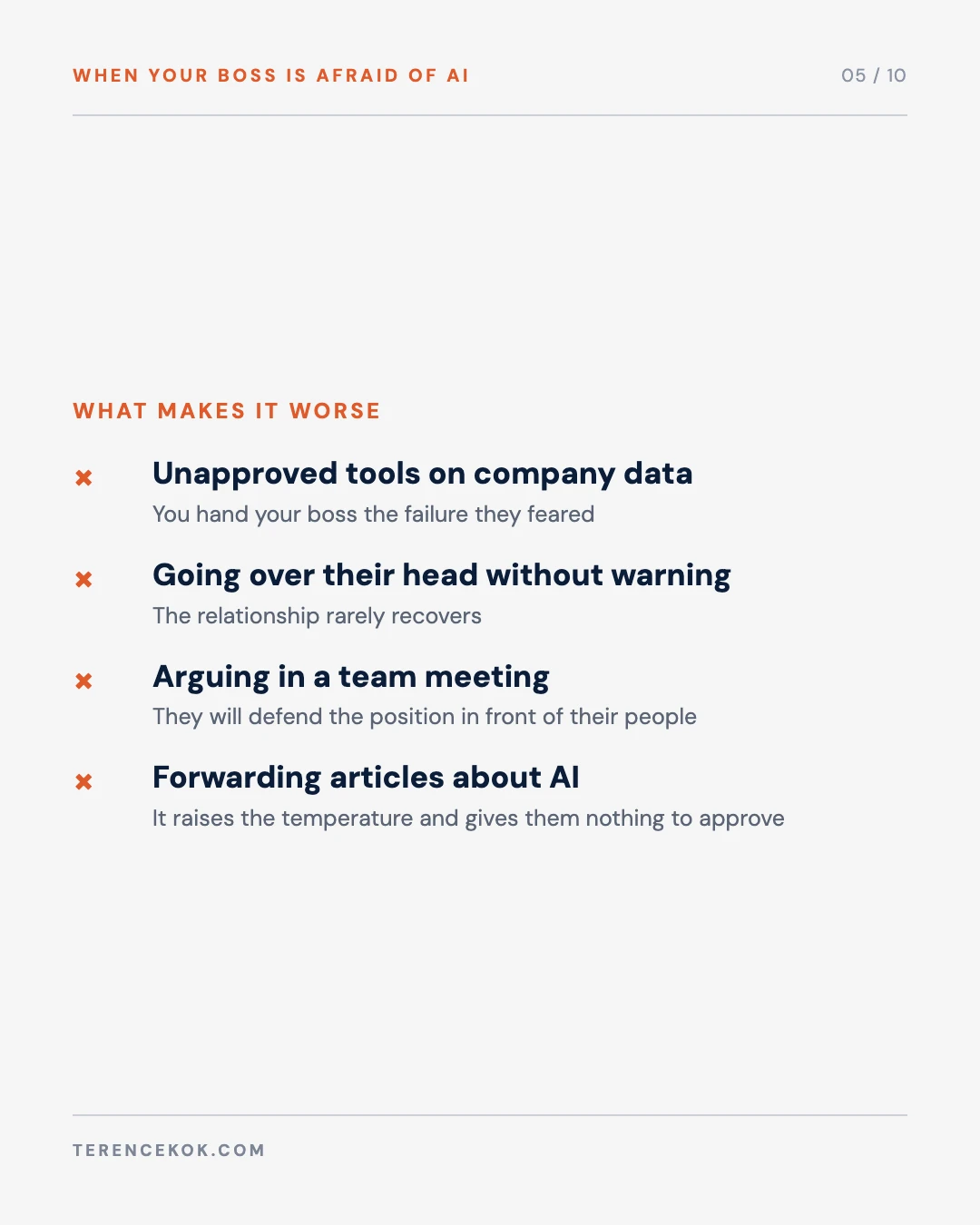
Using unapproved AI tools on company data. It is tempting to prove the point by doing the work with a public tool. This is what people call shadow AI. If client or company data goes into a system nobody approved, you have handed your boss the exact failure they were afraid of, with your name on it. Use only tools your organisation has sanctioned, on data you are allowed to use.
Going over their head without warning. Taking the case to your boss’s manager behind their back tells them you are a threat. Even if the idea is adopted, the relationship rarely recovers.
Arguing in public. Pressing the point in a team meeting forces your boss to defend a position in front of their people. They will almost always hold it.
Sending articles about AI in general. A fearful person reads a headline about AI transforming everything as confirmation that the thing is dangerous and beyond their control. It raises the temperature without giving them anything they can say yes to.
Build a competitor file
Your strongest argument is what competitors are doing, and it only works when it is specific. “Everyone is using AI” is easy to dismiss. “Our two nearest competitors have both done these three things in the last six months” is much harder to ignore.
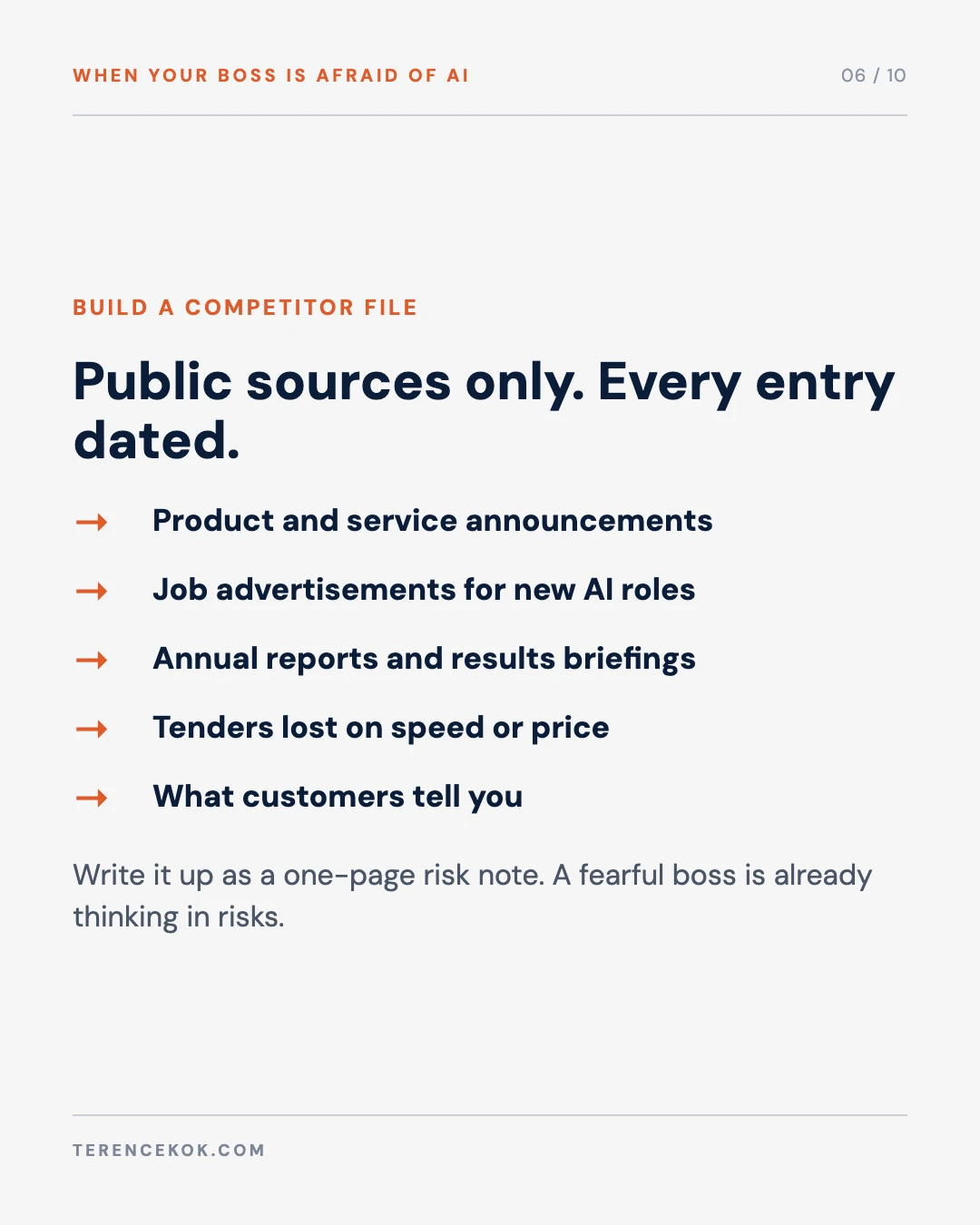
Keep a short, dated file from public sources only:
- Product and service announcements. New AI-assisted offerings, faster turnaround claims, new pricing.
- Job advertisements. Roles in AI, data or automation that did not exist in their organisation a year ago are a reliable early signal of what they are building.
- Annual reports and results briefings. Listed competitors increasingly name AI programmes and the savings they expect from them.
- Tender outcomes and lost deals. If you have lost work where the winner promised speed or price you could not match, write down what they promised.
- What customers tell you. A client who mentions that another supplier now offers something faster is worth a line in the file.
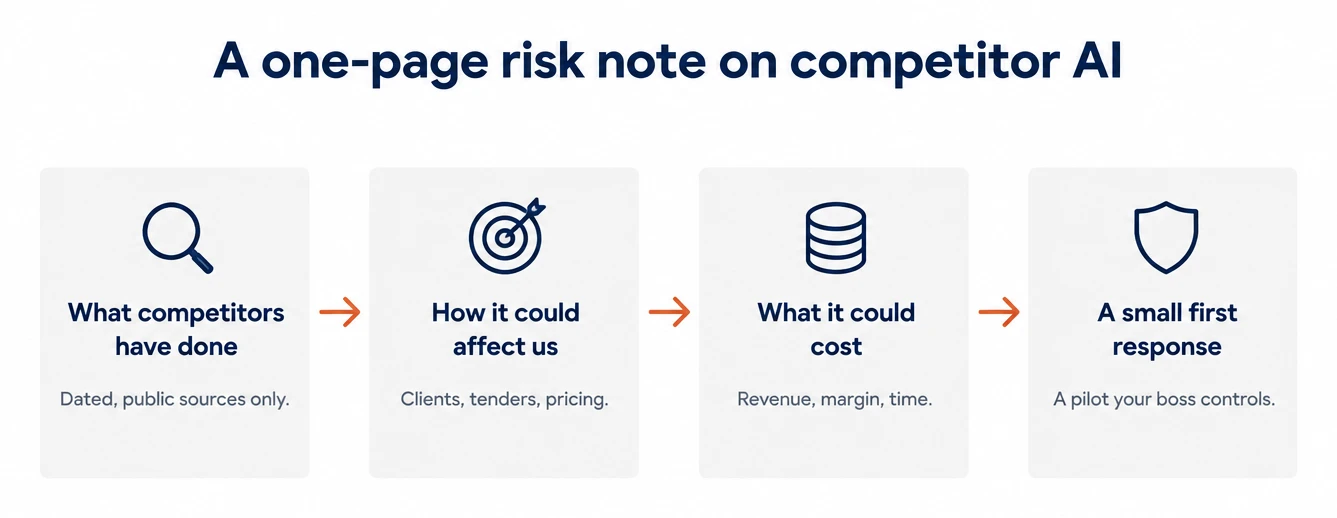
Then write it up as a one-page risk note, not an opportunity pitch. A fearful boss is already thinking in risks. Give them the risk of standing still, in the same terms they would use for any other business risk: what is happening, how likely it is to affect you, what it would cost, and what a small first response would be.
Start inside your own remit
You probably do not need your boss’s permission for everything. You need it for things that change their department, their budget or their exposure. Most people have some part of their own work where they already decide how it gets done.
Pick one task there that is repetitive, low-risk and easy to measure. A weekly report, a first pass on meeting notes, a literature scan, a draft reply to a routine query. Use only approved tools and only data you are cleared to use. Record how long the task took before and after, and every time the tool got something wrong.
After a month you have something much more useful than an argument. You have a small, safe, documented result from inside the business, produced by someone your boss already trusts. That is a very different conversation from a proposal.
How to present the result
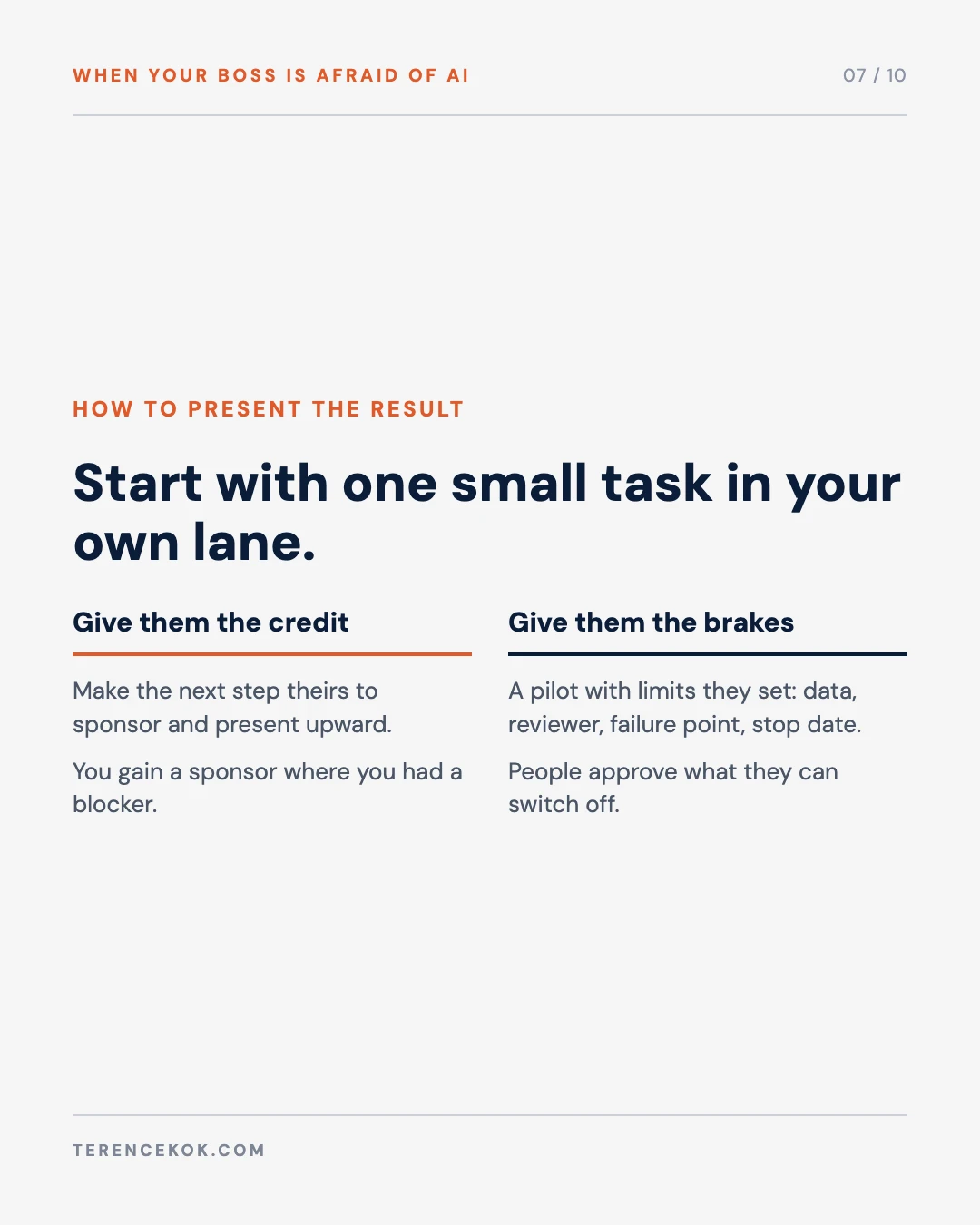
When you bring the result to your boss, make two things clear.
It is theirs to take forward. Frame the next step as something they could sponsor and present upward. Many blocked initiatives move the moment the blocker can own the win. You lose some visible credit. You gain a sponsor where you had a blocker, and people above your boss usually know who did the work anyway.
They control the risk. Propose a small pilot with limits your boss sets: which data is allowed, who reviews the output, what counts as a failure, and a clear point at which it stops. A fearful manager says yes more easily to something they can switch off. A simple way to structure this is the Agent Risk Assessment Matrix, which sorts uses of AI by how much autonomy they have and how much damage a mistake could do. Starting in the low-autonomy, low-consequence corner takes most of the fear out of the room.
Speak to the fear directly if it helps. “This is about getting through the same work faster, not reducing the team” is only worth saying if it is true. If you cannot honestly promise it, do not.
Find allies with care
You do not have to carry this alone, but how you find support matters.
Peers in other departments who are further along can tell you what worked with their own managers, and sometimes a pilot in a neighbouring team gives your boss the comfort of not going first.
Risk, compliance and IT are often assumed to be blockers too. In my experience they are frequently glad to help someone who wants to do AI in the open, and their involvement answers your boss’s fear of being blamed.
Your boss’s manager is the most sensitive route. If you go there, tell your boss first. Something like “I would like to share the competitor note with our director, and I would like you in the room” keeps you honest and gives your boss the chance to lead. If your organisation has an AI programme office or innovation channel, that is another open route that does not require you to go around anyone.
When the behaviour is toxic
If what you are dealing with is belittling, retaliation, credit-taking or instructions to stay quiet, the steps above will not be enough, and some of them could expose you further.
Write down what happens, with dates, what was said and who was present. Keep copies of your own work and of any written exchanges. Talk to HR if your organisation has a function you trust, or to a trusted senior person outside your reporting line. If you are in Singapore, the Tripartite Alliance for Fair and Progressive Employment Practices (TAFEP) takes reports of workplace harassment and discrimination, and it is worth knowing the channel exists before you need it.
Keep your AI proposal separate from any complaint. Mixing the two lets the complaint be dismissed as a disagreement about strategy.
Knowing when to leave
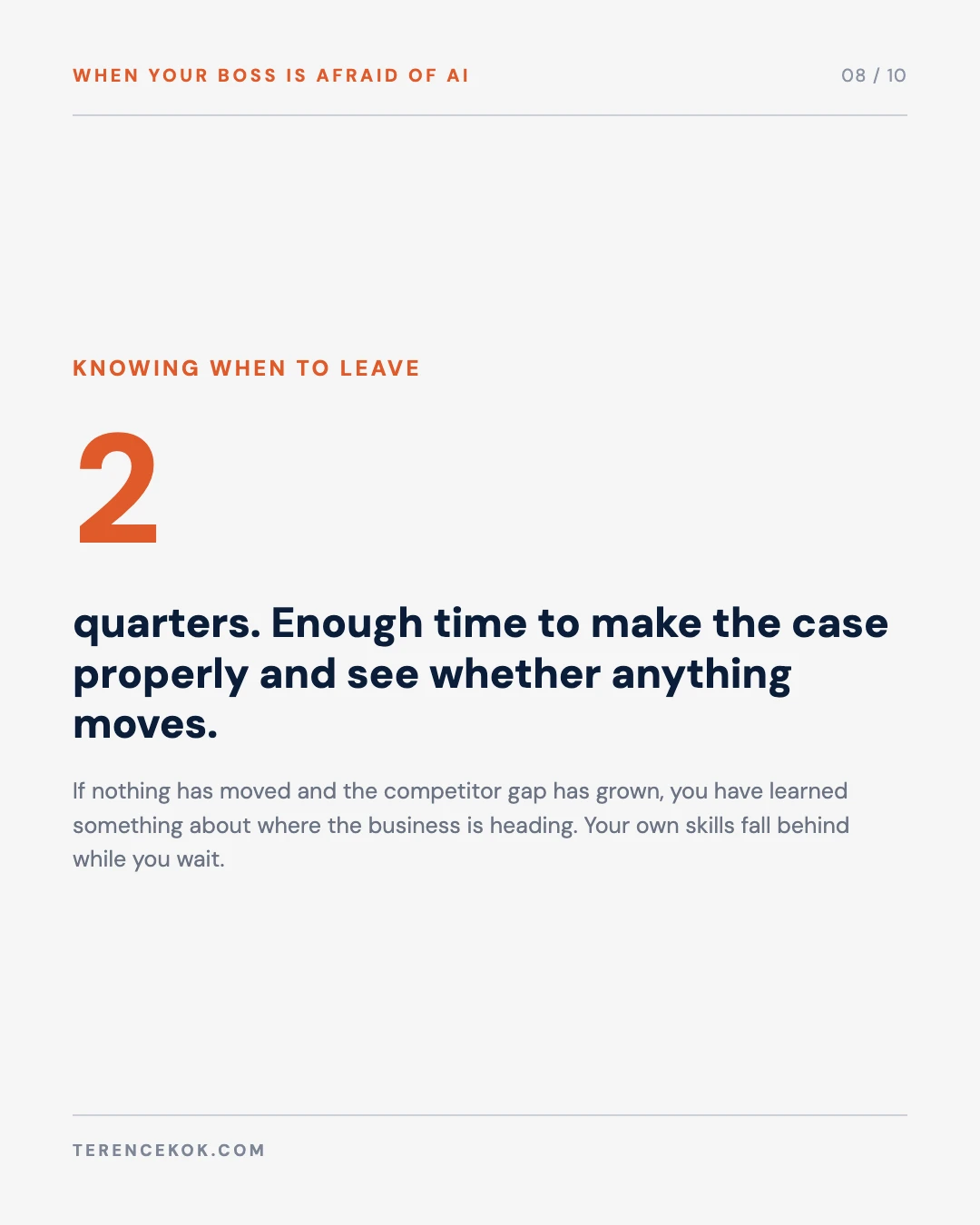
Some bosses will not move, and some companies will not move them. That is worth recognising early, because the cost of waiting is not only the company’s. Your own skills fall behind while you wait.
Give yourself a clear window. Two quarters is reasonable. Build the competitor file, run the small task, make the proposal with the credit and the brakes, and bring in at least one ally. If at the end of that period nothing has moved and the competitor gap has grown, you have learned something important about where the business is heading and how it treats people who see problems early.
Leaving is not a failure of persuasion. The people who have done the work of making the case, running a safe pilot and documenting the result carry that experience into their next role. Many employers are looking for exactly that.
What to do this month
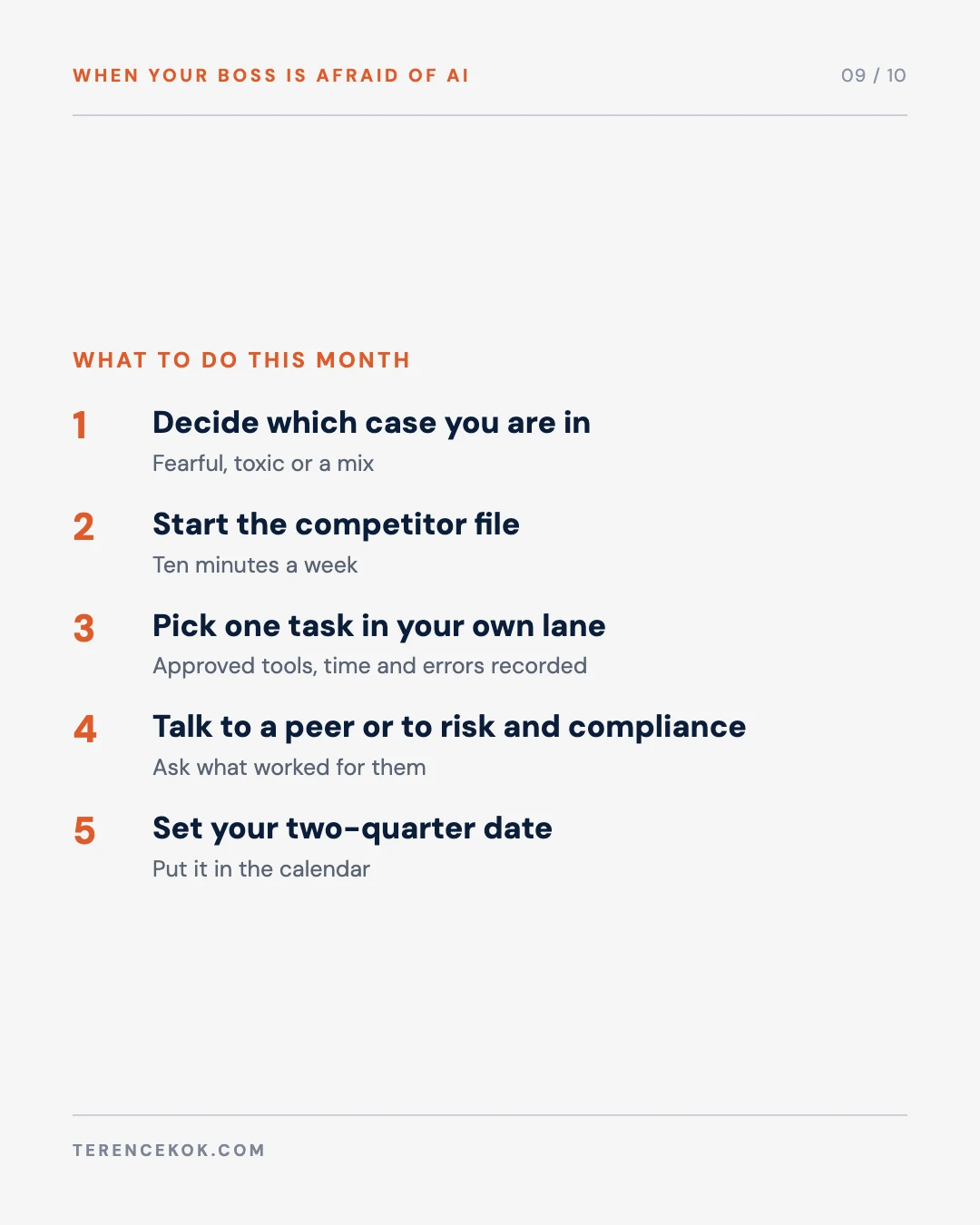
Decide which case you are in. Fearful, toxic or a mix. Be honest, because the tactics differ.
Start the competitor file. Ten minutes a week, public sources only, every entry dated.
Pick one task in your own lane. Approved tools, cleared data, time recorded before and after, every error noted.
Book one conversation with a peer or with risk and compliance. Ask what worked for them, and whether they would help shape a small pilot.
Set your two-quarter date. Put it in your calendar. When it arrives, look at what has moved and decide.
Evidence & Methodology
This piece draws on my own advisory and teaching work, not on a survey. Here is how much weight each claim can bear.
| Claim | Source | Grade |
|---|---|---|
| Managers who block AI are usually protecting standing, avoiding blame, defending their expertise or protecting headcount | My pattern from advisory work and leadership sessions | My call |
| A proposal the blocker can own and switch off is more likely to be approved | My observation of what has moved stalled initiatives | My call |
| Competitor job advertisements are an early signal of what they are building | Common practice in competitive intelligence; my own use of it | My call |
| TAFEP takes reports of workplace harassment and discrimination in Singapore | TAFEP, Seek help on workplace harassment | Measured |
Sources
- Tripartite Alliance for Fair and Progressive Employment Practices. Seek help on workplace harassment in Singapore.

What Looks Like Resistance to AI Is Usually Self-Protection
Why stalled adoption is usually people protecting their standing, and the commitment that moves them.

Boards Are Asking for AI Strategy. Many Are Asking Because They Are Afraid.
How to tell whether an AI mandate from above is a strategy or a symptom.

What I Was Afraid Of When I Started Advising on AI
My own version of the fear, and a test for telling useful fear from noise.