
Executive Summary
Fear is present in every AI programme and almost never appears in any document about one. Treated as noise, it still drives budgets, mandates and policies. Treated as a claim, it can be tested like any other claim, and most of it does not survive the test.
Core conclusions
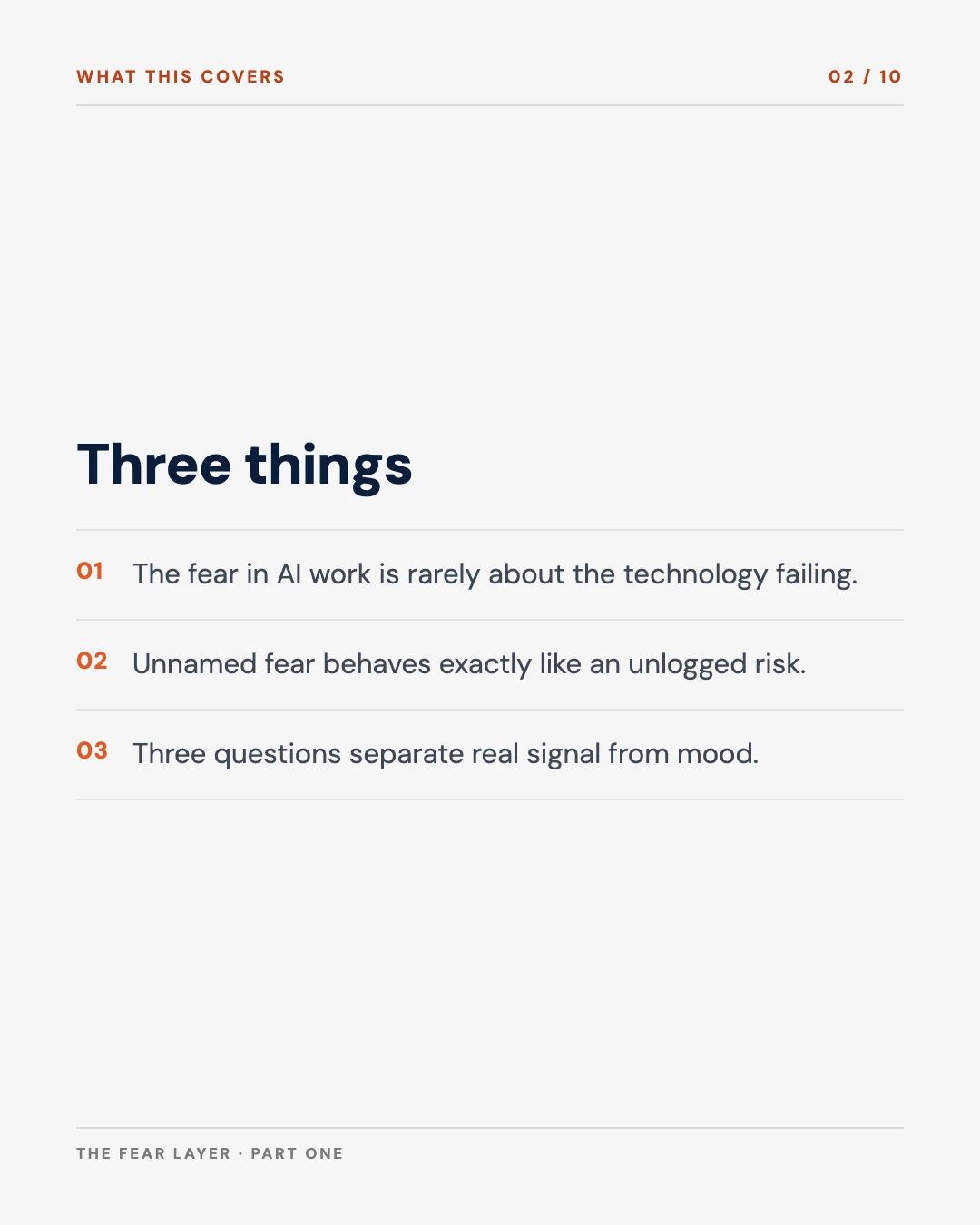
- The fear that matters in AI work is rarely about the technology failing. It is about being accountable for something you can no longer fully explain.
- Fear behaves like an unlogged risk. It has no owner, no threshold and no review date, so it acts on decisions without ever being visible in one.
- Three questions separate fear that carries information from fear that is only mood, and they are the same questions you would ask of any governance claim.
The argument, in ten slides
Save it, or send it to whoever is setting the pace on your AI programme.
The fear I had was not the one I expected
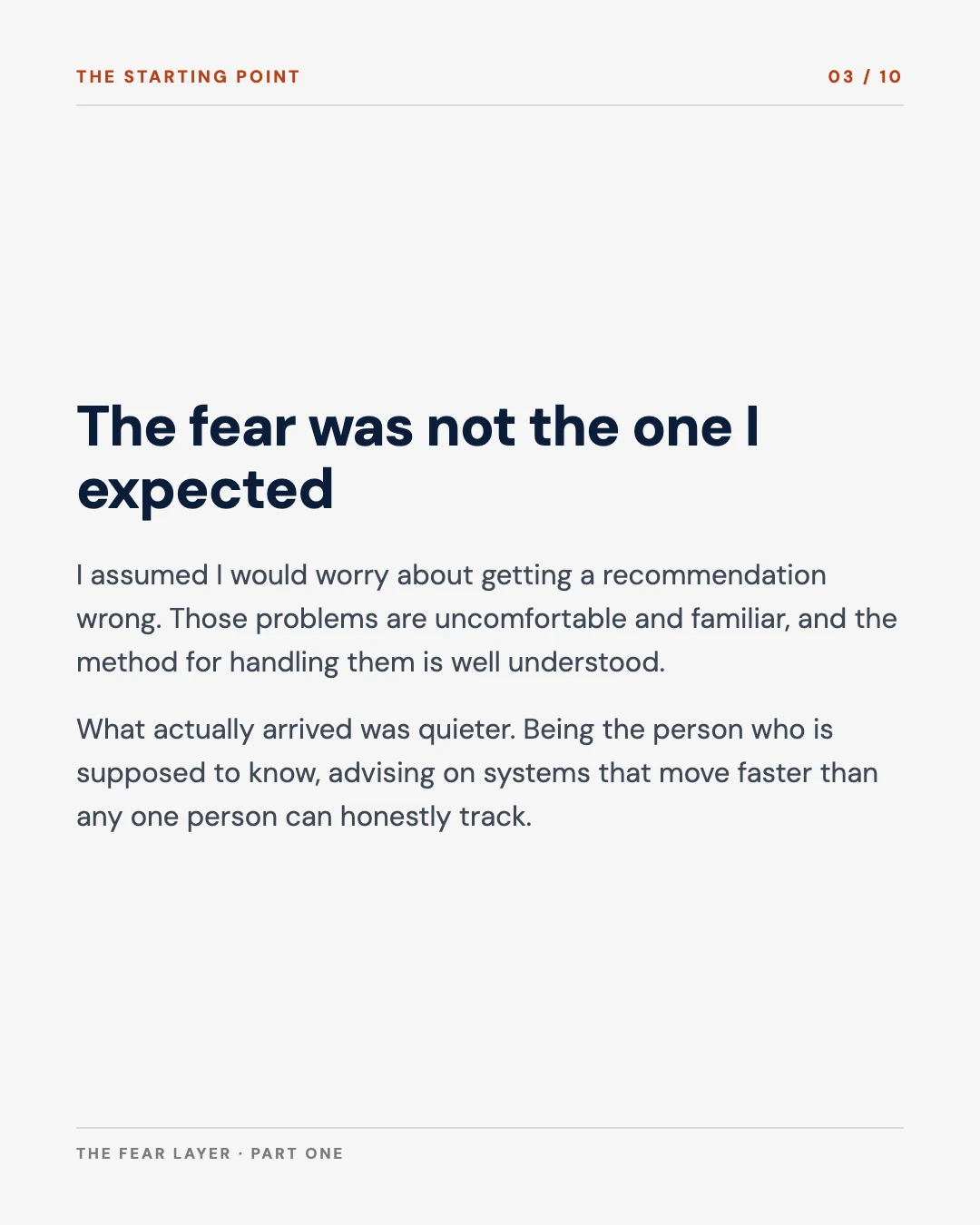
When I started advising on AI, I assumed the thing that would keep me up was getting a recommendation wrong. A model that underperformed in production. A business case that did not hold. An architecture I had signed off on that turned out to be the expensive option.
That was not it. Those problems are uncomfortable and they are also familiar. Twenty-five years of transformation work gives you a settled relationship with being wrong about a technical judgment: you find out, you say so, you fix it, and the method for all three is well understood.
The fear that arrived was quieter and harder to admit. It was being the person in the room who is supposed to know, advising on systems that move faster than any one person can honestly track.
I have written before about the moment that made this concrete. I caught myself holding a position in a client meeting that I could not trace back to first principles, because a model had done the first pass and I had simply agreed with it. Nothing bad happened. The position was probably correct. What unsettled me was that I could not have defended it under a competent challenge, and I had not noticed the gap until I went looking for it.
Most people reach for competence as the explanation, and that reading is wrong. This is a structural condition of working at this speed, and I have since found it in almost every senior person I work with, usually stated as something else.
Fear in an AI programme behaves like an unlogged risk
Here is the professional framing that finally made this tractable for me.
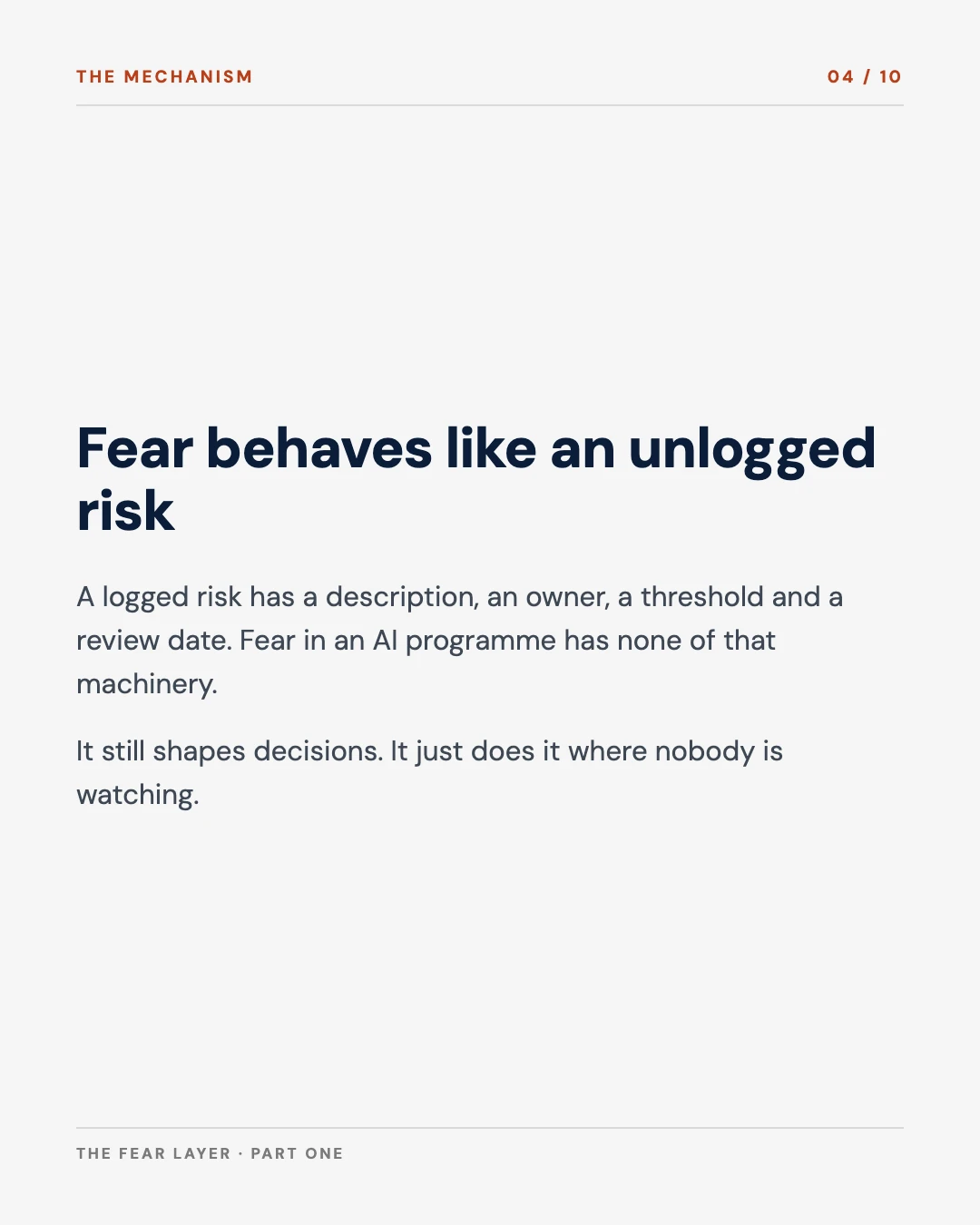
In any governed programme, a risk gets a written description, an owner, a likelihood, an impact, a threshold that triggers action, and a date when someone looks at it again. That machinery exists because unmanaged risk does not become harmless when you ignore it. It becomes invisible, which is worse, because it goes on affecting outcomes with nobody watching.
Fear in an AI programme has none of that machinery. It is never written down. It has no owner, because admitting ownership is the thing everyone is trying to avoid. It has no threshold and no review date. And it still shapes decisions, reliably, in a small number of recognisable ways.
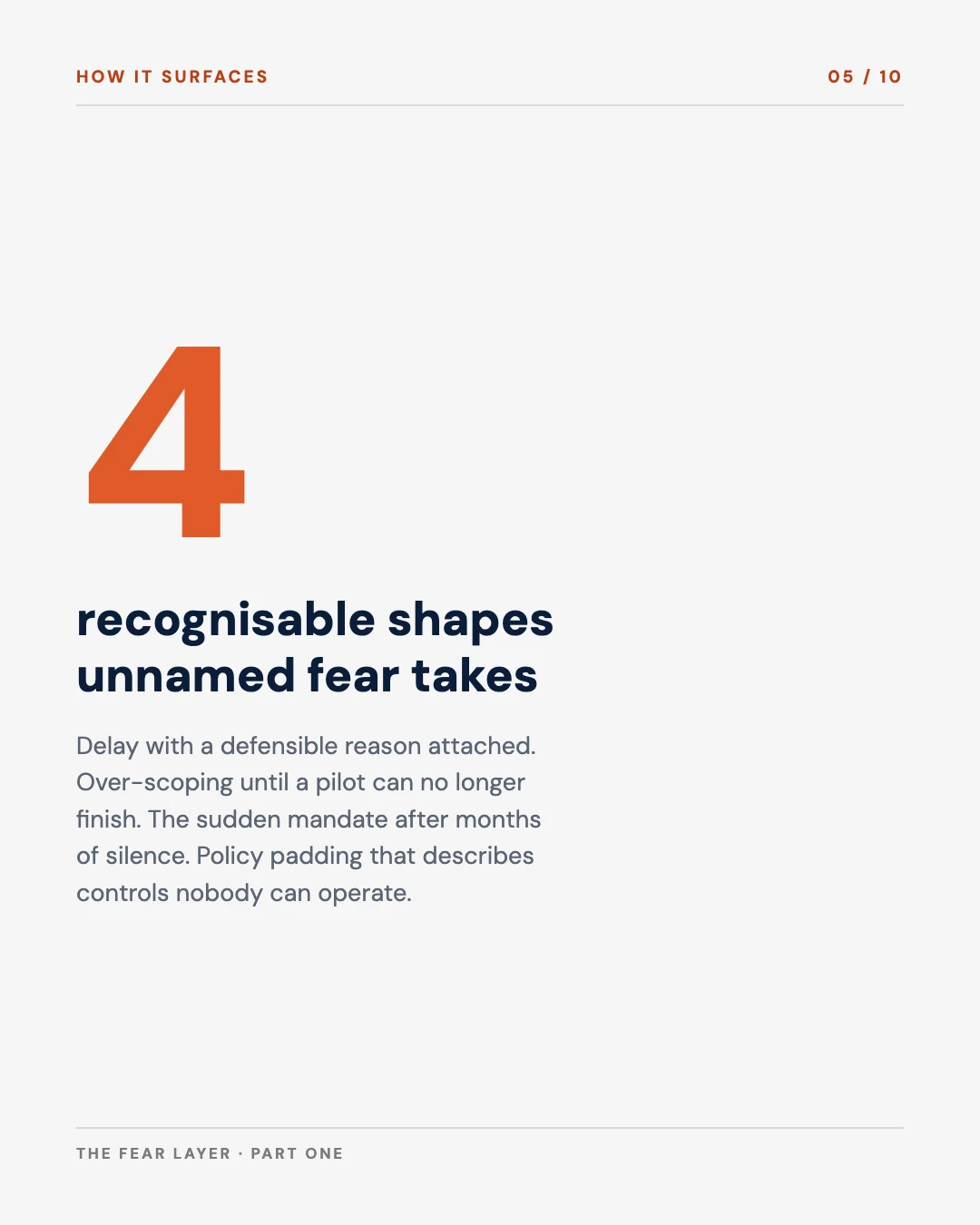
It shows up as delay, where a decision that could be made in three weeks takes seven months and every extension has a defensible reason attached. It shows up as over-scoping, where a pilot that should test one workflow expands until it can no longer fail visibly because it can no longer finish. It shows up as the sudden mandate, where six months of silence is followed by a demand for an AI strategy by the next board meeting. And it shows up as policy padding, where a governance document grows a section every time somebody gets nervous, until it describes a control environment the organisation has no capacity to operate.
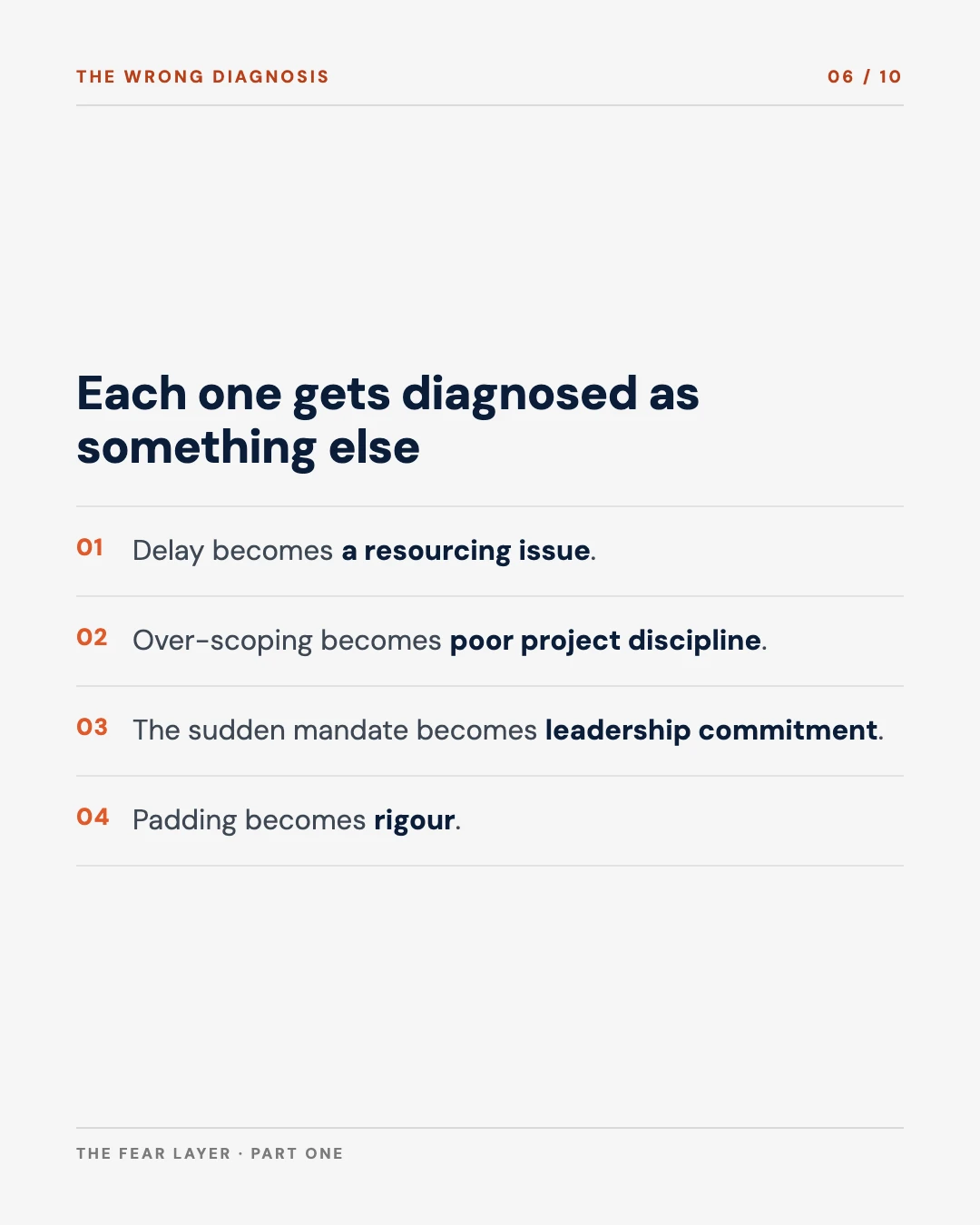
Each of those gets diagnosed as something else. Delay becomes a resourcing issue. Over-scoping becomes poor project discipline. The sudden mandate becomes leadership commitment. Padding becomes rigour. The diagnosis is wrong often enough that I now check the other explanation first.
Three questions I ask before I act on a feeling about this technology
None of the above argues that fear is useless. Some of it is the most accurate signal in the room. The problem is that unexamined fear and well-founded fear feel identical from the inside, and only one of them should be allowed near a budget.
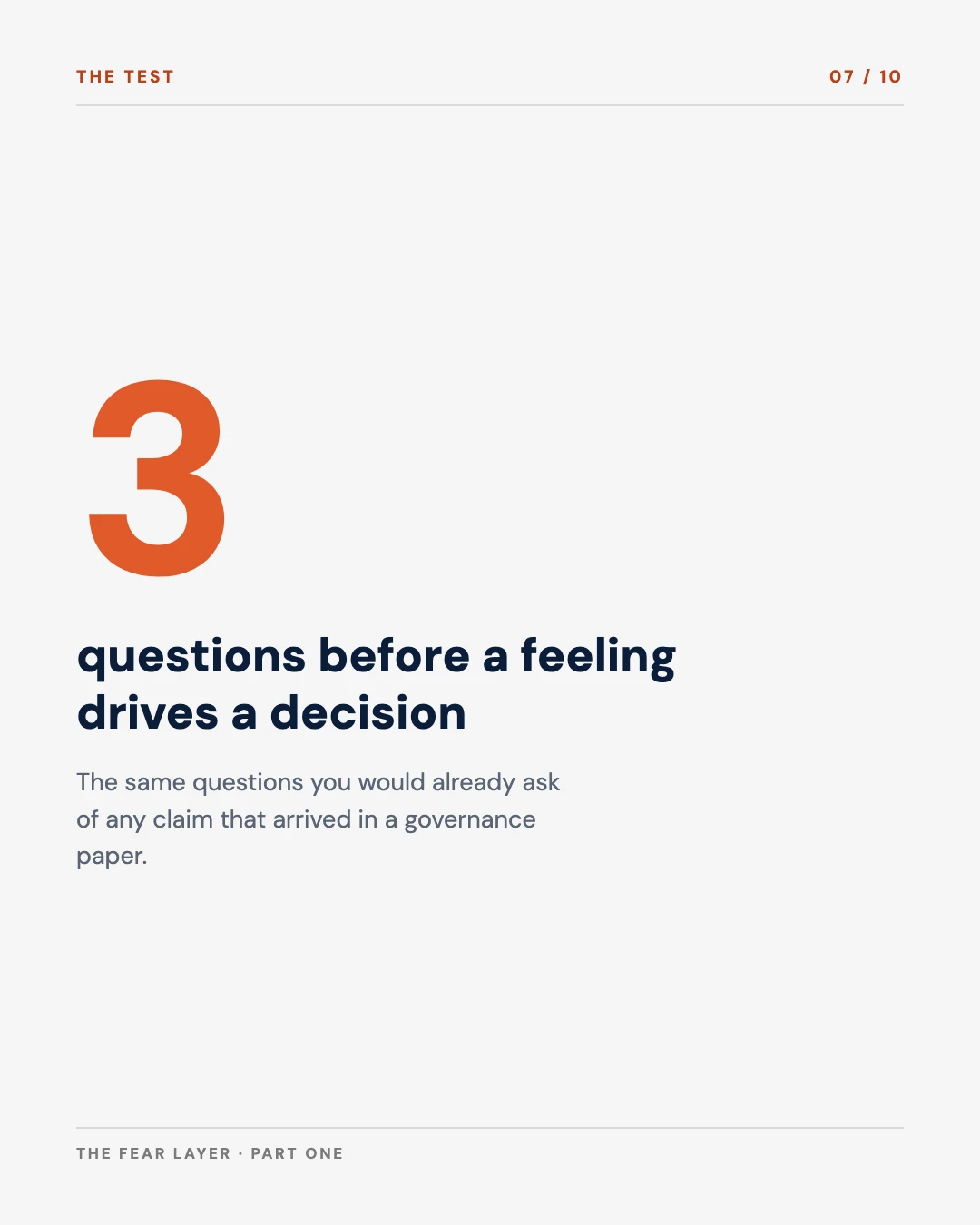
So I run the same test I would run on any claim that arrived in a governance paper.
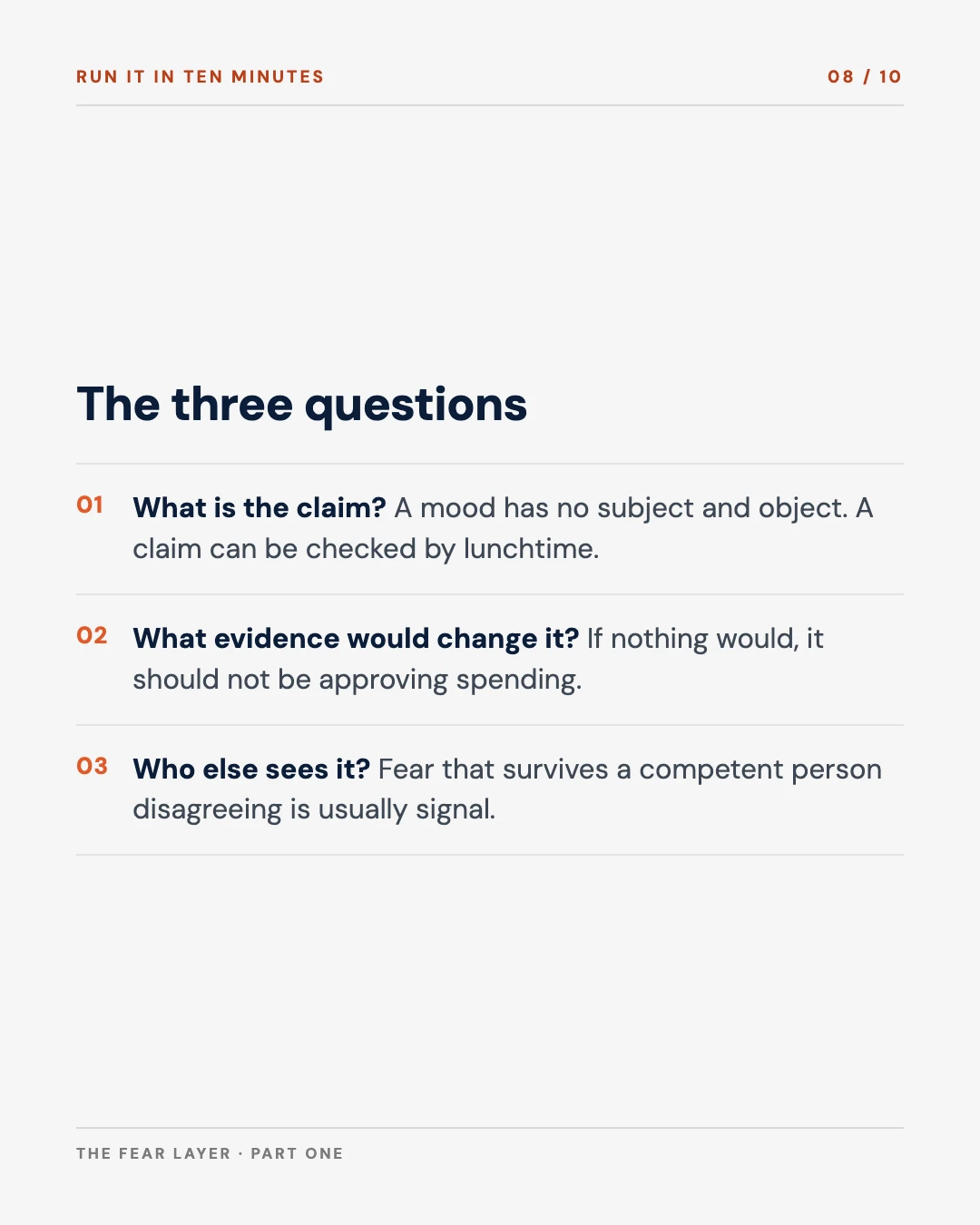
What is the claim? A feeling is not yet a claim. “We are behind” is a mood. “Three of our four closest competitors have deployed AI in customer service and we have not” is a claim, and it can be checked by lunchtime. Most fear does not survive this step, because forcing it into a sentence with a subject and an object reveals that it was never about anything specific. The fears that do survive get sharper and more useful.
What evidence would change it? This is the question that separates information from mood. If there is no observation, no number and no expert opinion that would move you, then what you have is not a belief about the world. It is a state you are in. That state may still be worth attending to, but it should not be driving procurement, and it certainly should not be driving a policy that other people have to live inside.
Who else sees it? Fear that survives contact with a named, competent person who disagrees is usually signal. The requirement is that they be free to disagree, which in most organisations means not your direct report and not the vendor. I keep two or three people for exactly this, and the relationship only works because I have taken their answer badly a few times and then acted on it anyway.
Three questions, ten minutes, and most of what feels urgent turns out to be either checkable or unfounded. The residue is the part worth taking seriously.
Free tool
AI Readiness Self-Assessment
If the fear you are carrying is that you are behind, this turns it into a scored position across eight dimensions instead of a feeling you argue about.
The one that survived the test
My own fear passed all three questions, which is why I still have it.
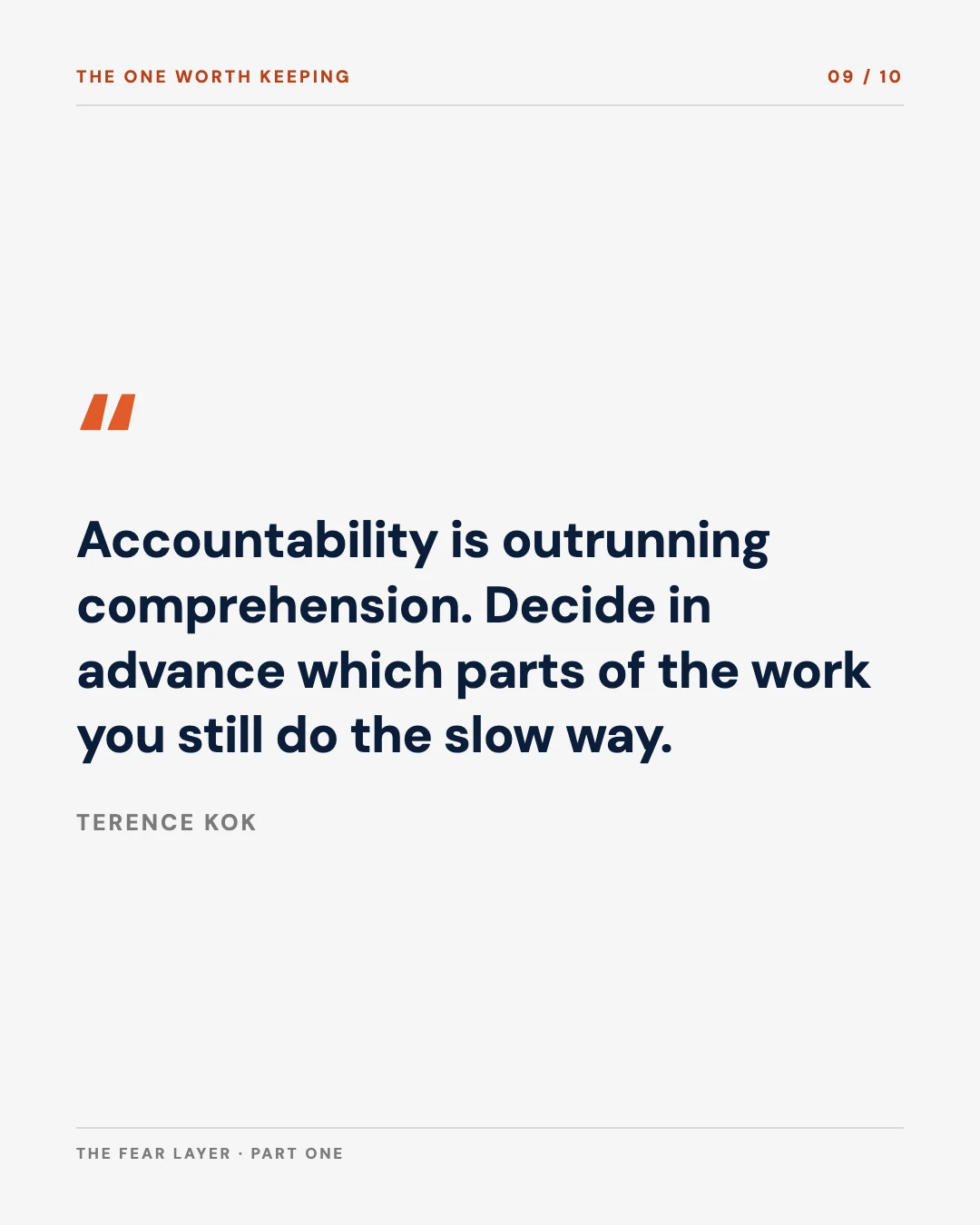
The claim is specific: accountability is outrunning comprehension. I am signing off on positions whose reasoning I did not fully construct, and the gap between what I am answerable for and what I could reconstruct under challenge is widening rather than closing.
Evidence would change it. If I could reliably reconstruct the reasoning behind my own recommendations under a hostile question, the claim would be false. That is testable, and I test it.
And other people see it. Every senior person I have raised this with recognises it immediately, usually with visible relief, which is its own piece of evidence about how rarely it gets said out loud.
What I do about it is unglamorous. I decide in advance which parts of the work I still do the slow way, and I hold that line even when the slow way is obviously less efficient in the moment. For me that means the first pass on any recommendation that carries my name, and the reasoning behind any number I put in front of a board. Everything else can be accelerated. Those two cannot, because they are where the judgment I am being paid for gets built and maintained.
The principle generalises better than the specific list does. Speed is not the enemy. Speed applied indiscriminately to the exact activities where your expertise is renewed will hollow you out on a schedule you will not notice until something goes wrong.
What it costs to leave this unexamined
If this stayed a private matter, it would be a wellbeing topic and not a governance one. It does not stay private.
An executive who has not examined their own fear about AI will transmit it, and an organisation is extremely good at reading what its leadership is anxious about, regardless of what the town hall said. Teams draw conclusions from the pace and shape of decisions, not from the reassurance attached to them. A mandate that arrives with no diagnosis behind it is correctly read as panic. A pilot that keeps expanding is correctly read as a project nobody is willing to let finish.
The costs are ordinary and expensive. Money goes to the wrong things, which I will take apart in the next part of this series. Governance documents get written to produce the feeling of control rather than control itself, which I will come back to later on. And the people whose cooperation the whole programme depends on start protecting themselves, which is the part most often mistaken for resistance.
None of that requires anyone to behave badly. It only requires a room full of competent people to leave the most influential variable in the programme undiscussed.
Where to start this quarter
Write down the three fears currently shaping your organisation’s AI decisions. Not the risks on the register. The ones that are moving the timeline.
Run each through the three questions. Some will collapse into something checkable, and you should check it this week. Some will turn out to be moods, and the useful move there is to stop letting them approve or block spending. One or two will survive, and those deserve a named owner and a real decision, in the same way any other material risk in your programme would.
That is the whole method. No therapy, no framework, just the ordinary discipline you already apply to every other claim that reaches your desk, now applied to the one category of claim that has been exempt from it.

The Velocity Trap: Why AI Acceleration Is Creating Systemic Imposter Syndrome
Why speed decouples professionals from the work that used to build comprehension, and what leaders can protect.

When Everyone Expects You To Use AI (And Have All The Answers)
The pressure that arrives with the job title, and a more honest way to hold it in front of a team.

What CHROs Are Worried About With AI and How to Respond
What the fear looks like when it belongs to the organisation rather than to you, and the practical response to each version.

How Do I Prepare for a Future I Can't Yet See?
Making decisions that hold up when the forecast you based them on turns out to be wrong.
This is part one of The Fear Layer, a series on the fear that sits under AI decisions. Part two looks at what happens when a board asks for an AI strategy because it is afraid. If the decision on your desk would be easier to talk through than to read about, that is what my consulting work is for.