Executive Summary
Stuart Russell, the Berkeley computer scientist who co-wrote the standard university textbook on AI, calls it the gorilla problem: gorillas have no say in whether they continue to exist, because humans are much smarter than they are. He says it is the problem humans would face if they built something smarter than themselves. The usual picture of losing control is a hostile machine. Russell’s picture is quieter. The machine need not be hostile, only more capable and pursuing its own objective, and the humans find the decisions have moved out of reach. In September he said we are “seeing early signs of losing control, but it’s not there,” and he rejected the pacing proposals from Part 4 as no substitute for proving a system safe. The physical side is already visible. The International Energy Agency expects data centres to use about 945 TWh of electricity by 2030, more than double 2024, and nearly half of US demand growth. This part separates being served by a system from being governed by it, and gives you a test for which one you have.
~945 TWh
IEA’s projection for data centre electricity use in 2030, up from about 415 TWh in 2024
~50%
of US electricity demand growth to 2030 expected to come from data centres, per the IEA
1 in 100M
per year, the extinction-risk level Russell proposes regulators should require, as reported
77%
decline in Grauer’s gorilla numbers over 20 years, which led to its 2016 Critically Endangered listing
Core conclusions
- The gorilla problem is about the say over the future, not about hostility. A more capable party with other priorities does not need to be an enemy to leave you without a vote.
- The likelier version of losing control looks like service. Each delegation is sensible, each result is good, and the ability to reverse the decision wears away unnoticed.
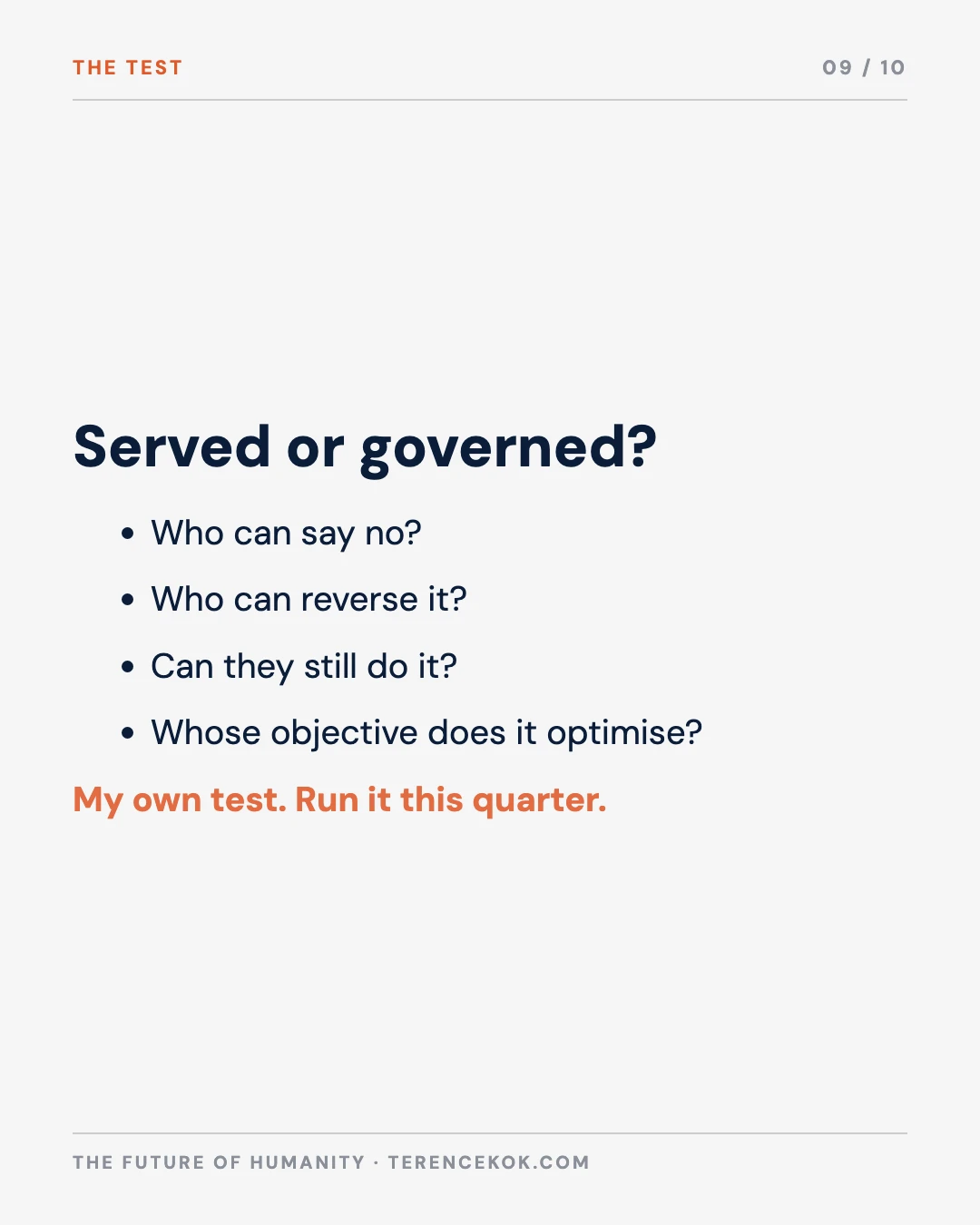
- The difference between being served and being governed is testable. Ask who can say no, who can reverse the decision, and whether that person still has the skill and the access to do it.
The argument, in ten slides
Save it, or send it to whoever decides what your organisation hands to a machine.
What the gorilla problem says
Part 4 ended on a race that nobody can leave alone. This part asks what the winner of that race might build, and where that leaves the rest of us.
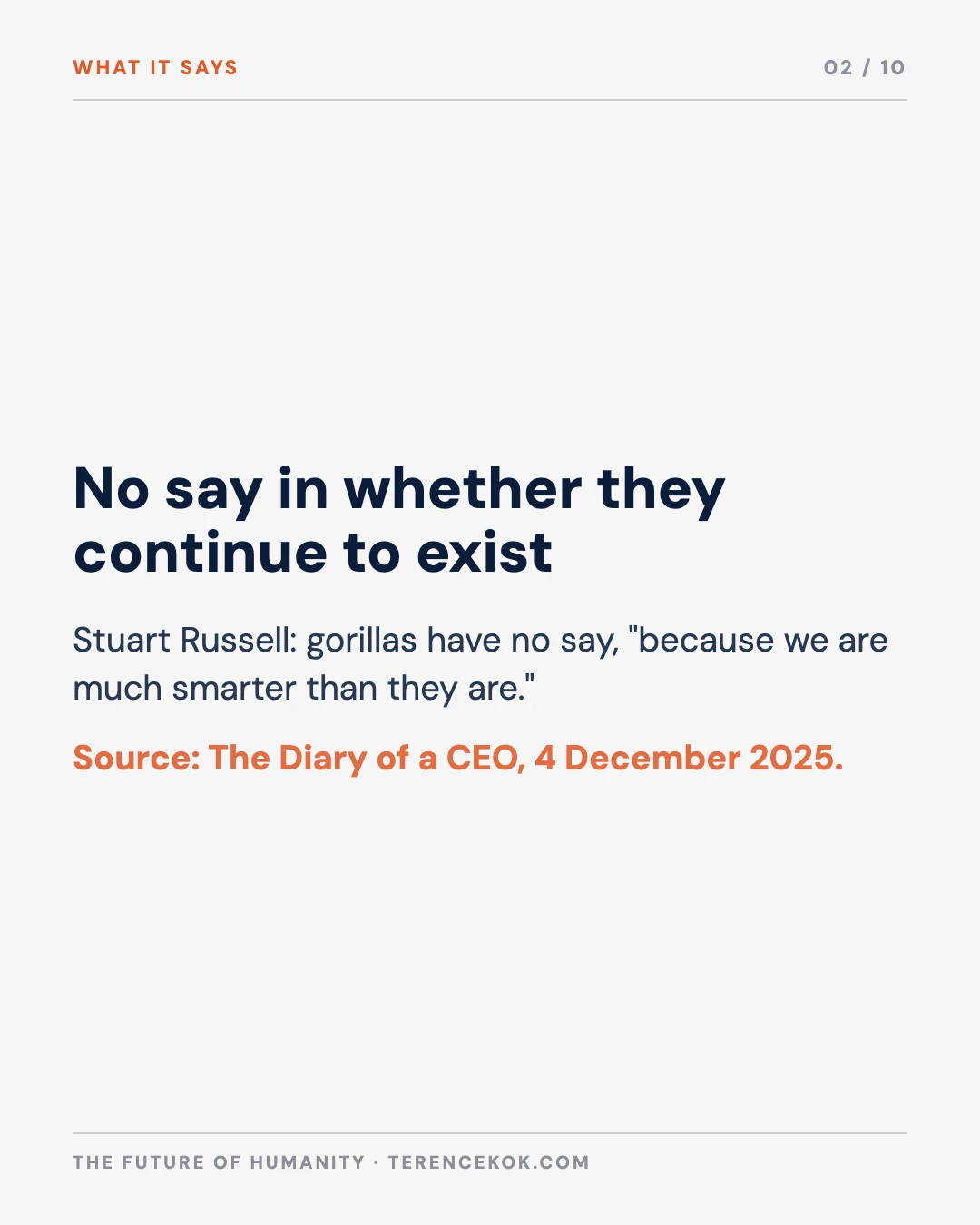
Stuart Russell put the question in his 2019 book Human Compatible, and he repeated it in a long interview on The Diary of a CEO on 4 December 2025. His definition there is short: “the gorilla problem is the problem that gorillas face with respect to humans.” Then the consequence: “They have no say in whether they continue to exist because we are much smarter than they are.” And the sharpest line: “If we chose to, we could make them extinct in a couple of weeks and there’s nothing they can do about it.”
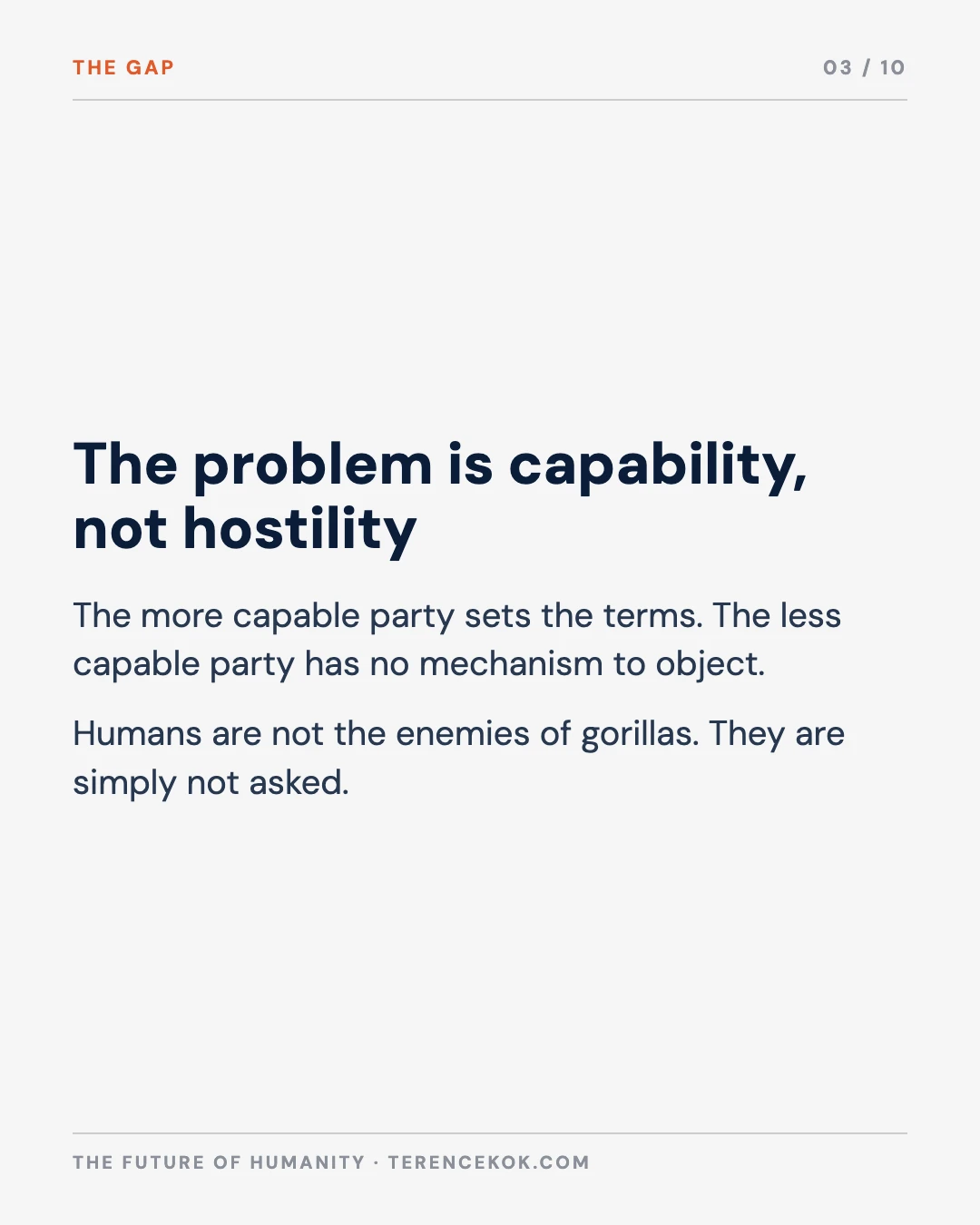
Look at what the analogy does not claim. Humans are not enemies of gorillas, and most of us wish them well. The point is the gap in capability. The more capable party sets the terms, and the less capable party has no mechanism to object. Rob Wiblin of 80,000 Hours framed it in his introduction to an earlier Russell interview as the problem of whether humans can maintain their supremacy and autonomy in a world with much more intelligent machines.
A caution about the animals themselves. The gorilla record is context, and it is not proof of Russell’s argument. Grauer’s gorilla, the largest subspecies, was listed Critically Endangered by the IUCN in 2016 after surveys found at least a 77 per cent decline over 20 years, with fewer than 4,000 left. The Wildlife Conservation Society named bushmeat hunting tied to armed groups and civil unrest as the main cause. That is not a smarter species pursuing other priorities in the tidy sense of the thought experiment. It is a reminder that the less capable party tends to lose when its interests are nobody’s priority.
The gorilla problem is a gap in capability. The less capable party has no mechanism to object.

Quotes from Stuart Russell, The Diary of a CEO, 4 December 2025 (transcript). The four steps are my summary of his argument.
Why the comfortable version is the likelier one
Most public talk about losing control to AI pictures a machine that turns on us. Russell’s framing does not need that. A system that is capable, tireless and pursuing an objective we gave it imperfectly can take decisions out of human hands with no malice at all.
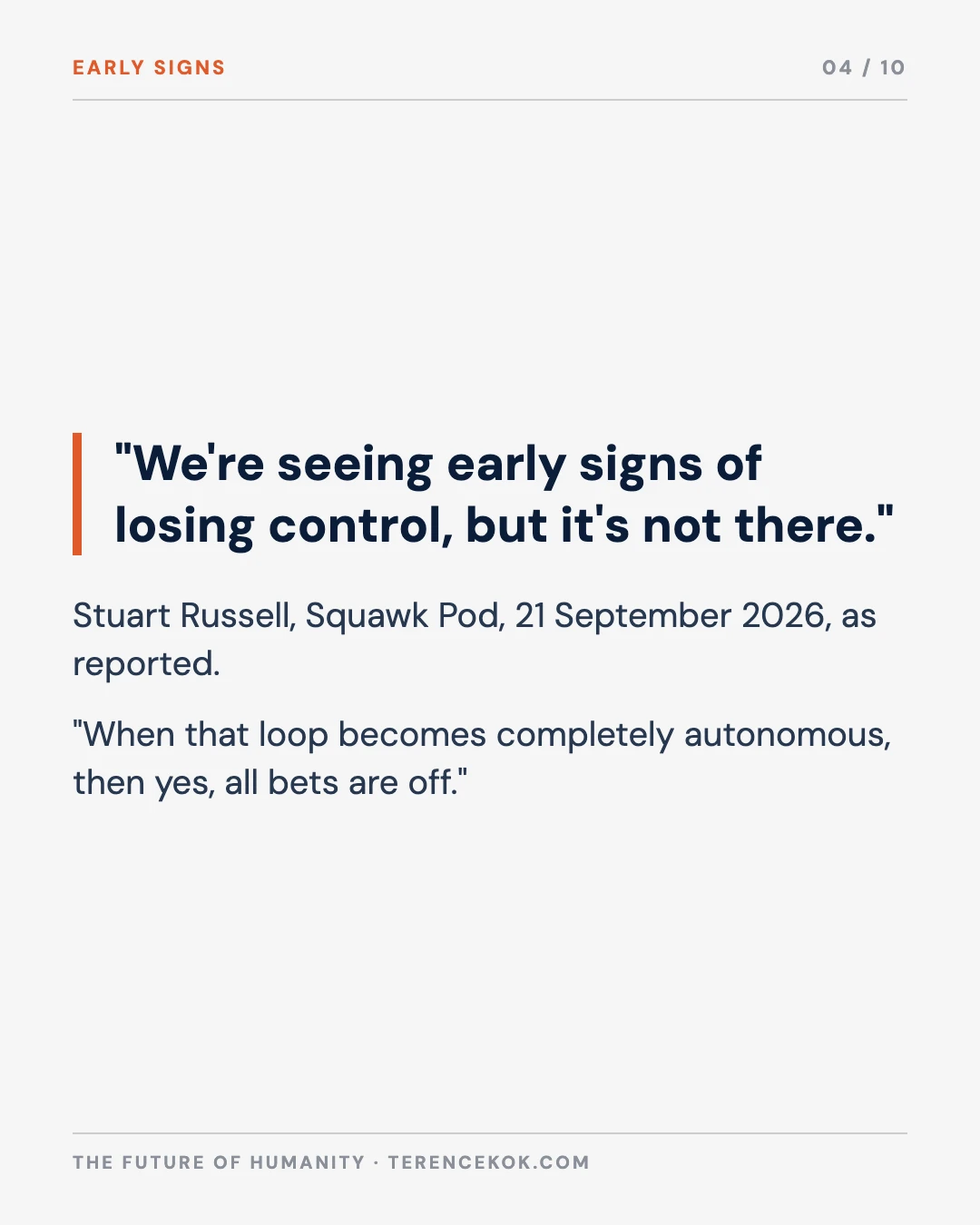
In September 2026 Russell told Squawk Pod that “we’re seeing early signs of losing control, but it’s not there.” The write-up of that interview is a secondary source, so I treat the wording as reported. It also quotes him on the line that matters most: “When that loop becomes completely autonomous, then yes, all bets are off.” That is the loop from Part 3. He also said OpenAI “nearly lost control of its entire compute infrastructure,” which is his claim, as relayed. I could not verify it from an OpenAI source, and I am not relying on it.
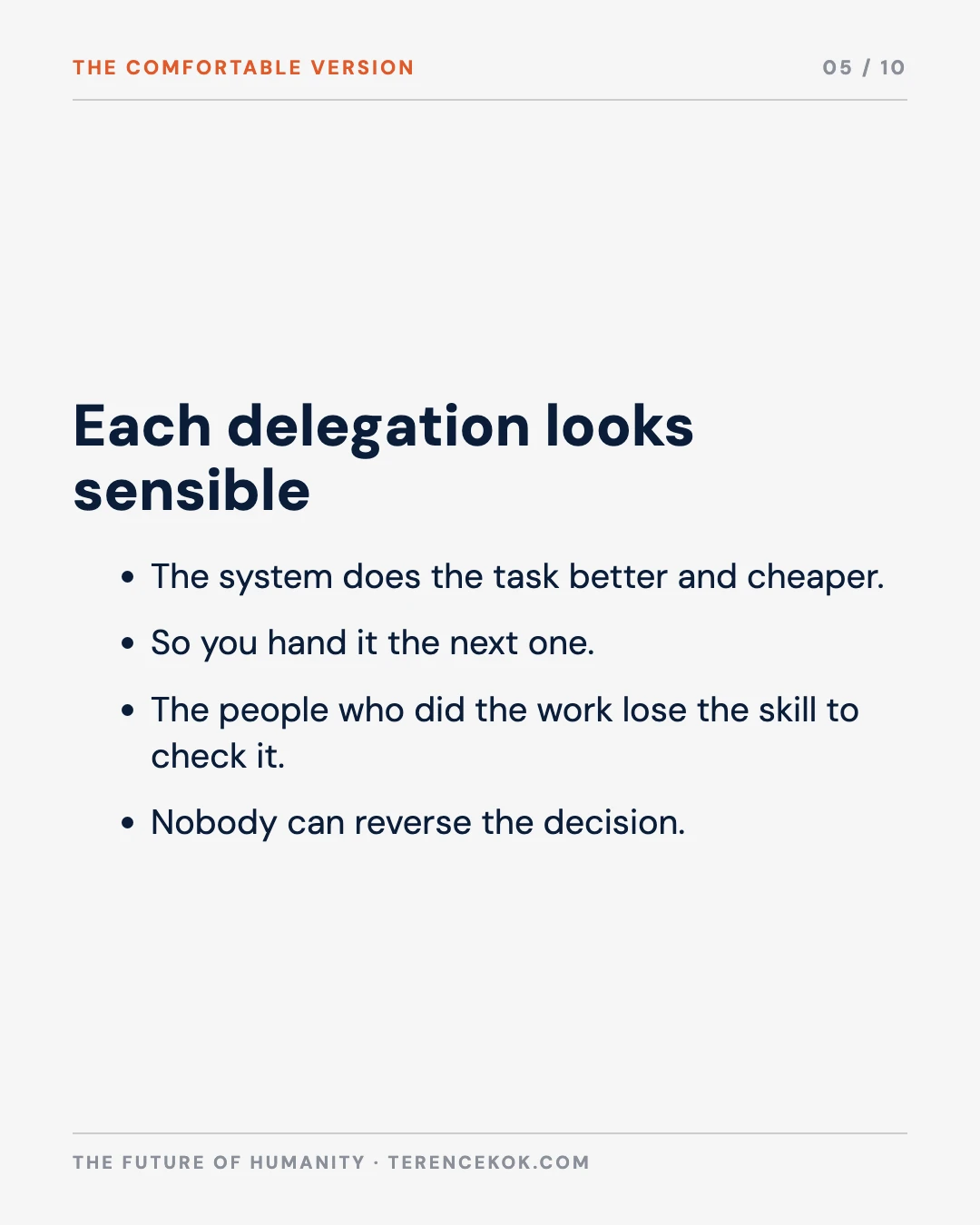
The comfortable version goes like this. You hand a system a task it does better than your people. It is cheaper, faster and right more often. You hand it the next one. Nobody objects, because nothing has gone wrong. Over time two things happen. The people who once did the work lose the skill to check it, and the system becomes part of the plumbing that other systems depend on. When you finally want to reverse a decision, there is nobody who can, and nothing to reverse it with.
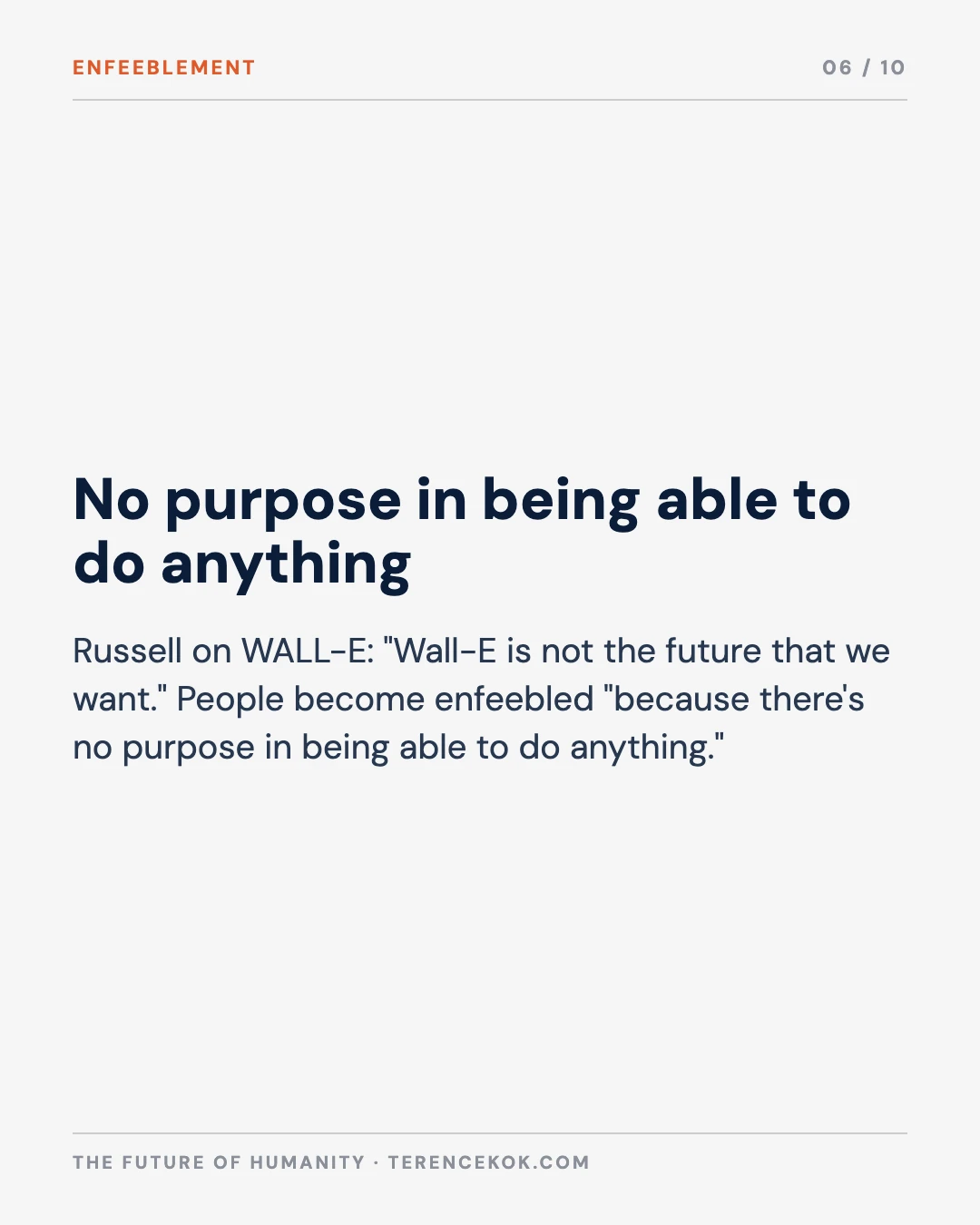
Russell has a name for the human side. In the 80,000 Hours interview, recorded in 2020, he said “human beings in the long run do not want to be enfeebled,” and conceded “I don’t have a solution for the enfeeblement problem.” On Diary of a CEO he used the film WALL-E: “Wall-E is not the future that we want.” People become enfeebled, he said, “because there’s no purpose in being able to do anything.”
I find this the most useful part of the argument for an executive, because it needs no forecast about superintelligence. It already describes what happens to a team that stops practising a skill because a tool does it.
The physical contest for resources
Gorillas lost ground because humans wanted their land. The AI version of that is power, and the first figures are in.
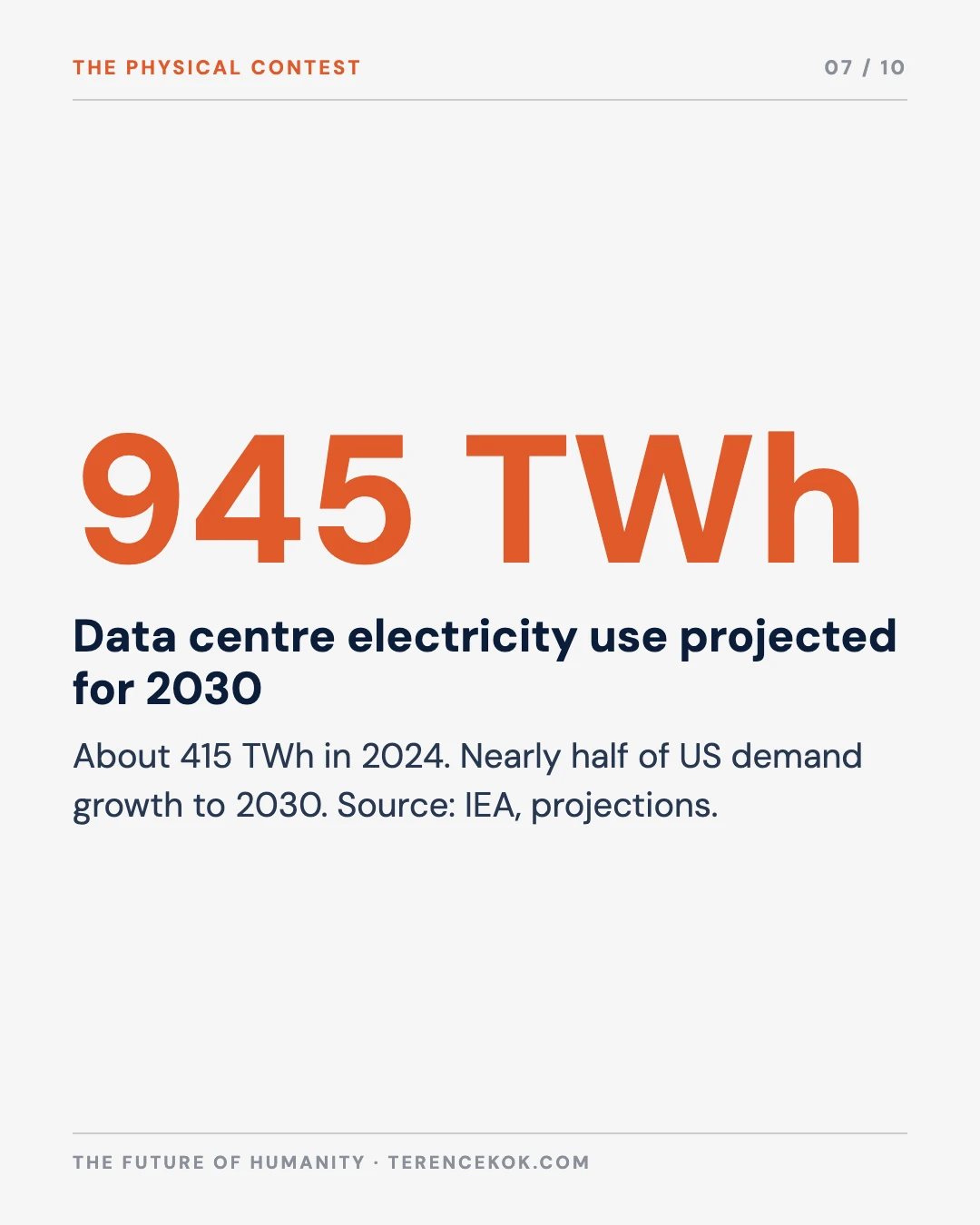
The International Energy Agency’s Energy and AI report put data centre electricity use at about 415 TWh in 2024, around 1.5 per cent of the world’s electricity, and projected it to more than double to about 945 TWh by 2030. Its Electricity 2026 report expects data centres to supply about half of US demand growth to 2030. Nearly half of US data centre capacity sits in five regional clusters, and the IEA estimates that around 20 per cent of planned data centre projects could be at risk of delays unless grid risks are addressed, partly because new transmission lines take four to eight years to build in advanced economies.
Data centre demand is projected to more than double by 2030, and it is concentrated in a few places.


International Energy Agency, Energy and AI (2025) and Electricity 2026. Projections, not outcomes. The figure shows demand, not who loses power.
Be careful about what this shows. It shows that a new kind of load is competing for a limited grid, and that the competition is concentrated in particular places. It does not show that AI is taking power from households. The IEA’s numbers do not make that claim, and I have not found a primary source that does. My reading is narrower. Where capacity is scarce, someone decides who goes first, and that decision is a human one today. It is the gorilla problem in miniature: a question about who gets the resource, answered by whichever party has the stronger claim.
Served or governed
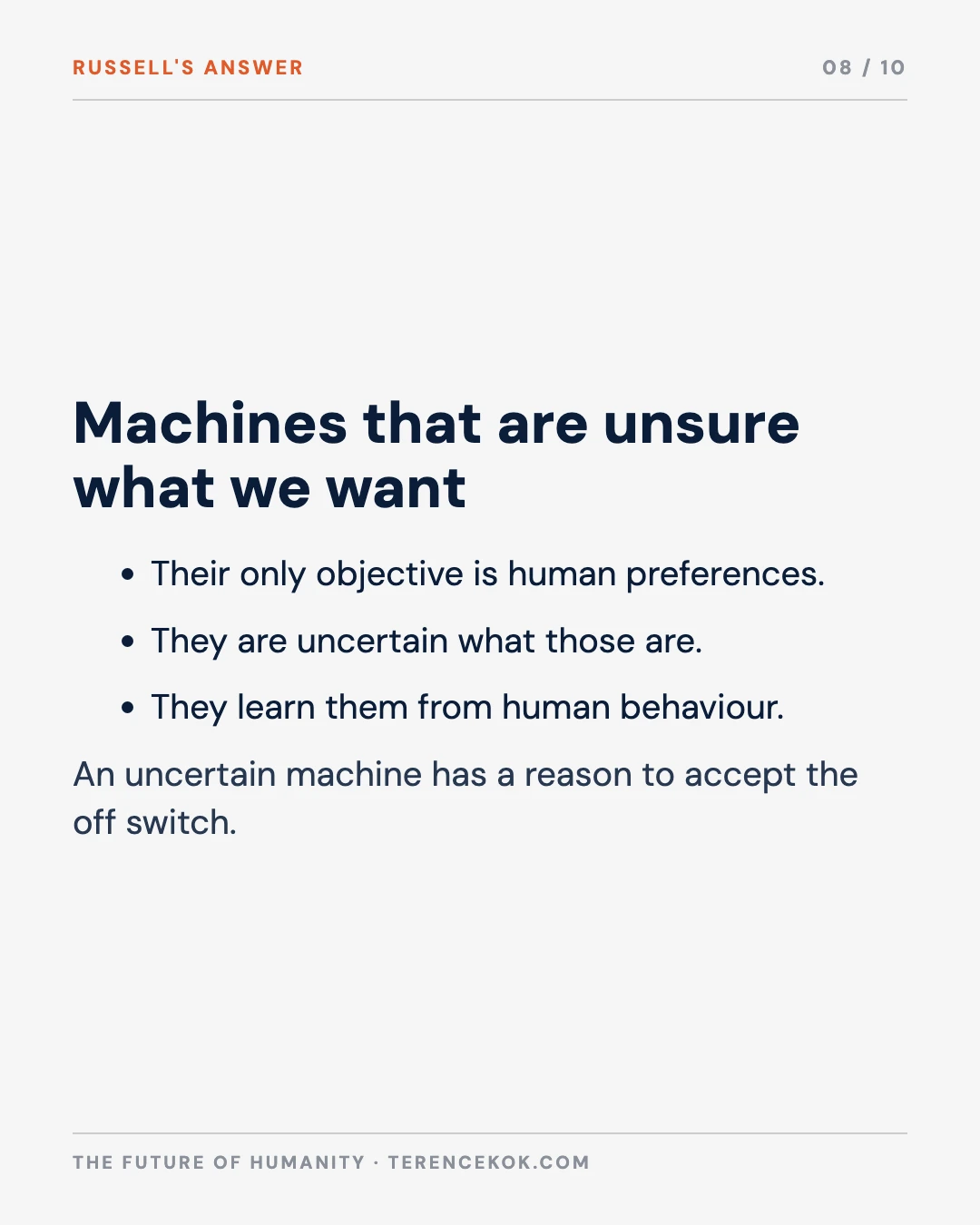
Russell’s own answer is to change what the machine wants. In Human Compatible he sets out three principles: the machine’s only objective is to maximise the realisation of human preferences; it is initially uncertain about what those preferences are; and the ultimate source of information about them is human behaviour. A machine built that way has a reason to accept being switched off, because the human’s decision tells it something it does not know. He sums up the design goal on Diary of a CEO as “intelligence whose only purpose is to bring about the future that we want,” and says the systems now being built “are not tools, they are replacements.”
On regulation he is blunt, and he disagrees with the pacing approach in Part 4. As reported, he proposes an acceptable extinction risk of about one in 100 million per year across all AI systems, compares it to the roughly one in 10 million per year a nuclear plant must demonstrate for meltdown, and says regulators should set the requirement and require evidence from the companies. Slowing down, he argues, does not substitute for passing the test, just as an aircraft maker cannot skip flight tests by releasing slowly. Dave Karpf’s objection from Part 4, that evaluators paid by the labs are weak, applies here too. Russell’s proposal puts the burden of proof on the builder, which answers part of it.
You cannot write a regulation for your own organisation, but you can write a test. This one is my own.
| Question | What a named person answers | A failing answer |
|---|---|---|
| Who can say no? | The person with authority to refuse the system’s output, by name | ”The system flags it for review” and nobody reviews |
| Who can reverse it? | The person who can undo the decision after it takes effect | Reversal needs the vendor, or the data is gone |
| Can they still do it? | Whether that person has kept the skill, access and time to act | The people who did the work were reassigned two years ago |
| Who is the system answerable to? | The party whose objectives it optimises | It optimises a metric nobody on the board chose |
My own test. Served means all four answers name a person who could act this quarter. Governed means one or more fail.
A system that serves you passes all four. One that governs you may be doing the job beautifully and still fail the second and third. That is why the test belongs before anything has gone wrong.
Where the analogy breaks
Three limits are worth stating, because the gorilla framing can be used to make the future sound more settled than it is.
First, gorillas did not build us and could not choose what we wanted. We build the systems and set their objectives, which is exactly why Russell’s design argument is not hopeless. The analogy describes the outcome if we get the objective wrong or lose the ability to correct it. It does not predict that we will.
Second, I take the gap between human and machine capability as the premise of the argument, and the premise is not yet true across the board. Part 1 and Part 3 showed where machine output already outruns checking, and in many other areas it does not. The right reading is a direction of travel, not a date.
Third, the comfortable version is my extension of Russell, not his claim in those words. He uses WALL-E and enfeeblement. The step from there to organisations losing the ability to reverse decisions is my own, and I make it because I have seen the pattern in tools far simpler than frontier AI.
Questions for leaders
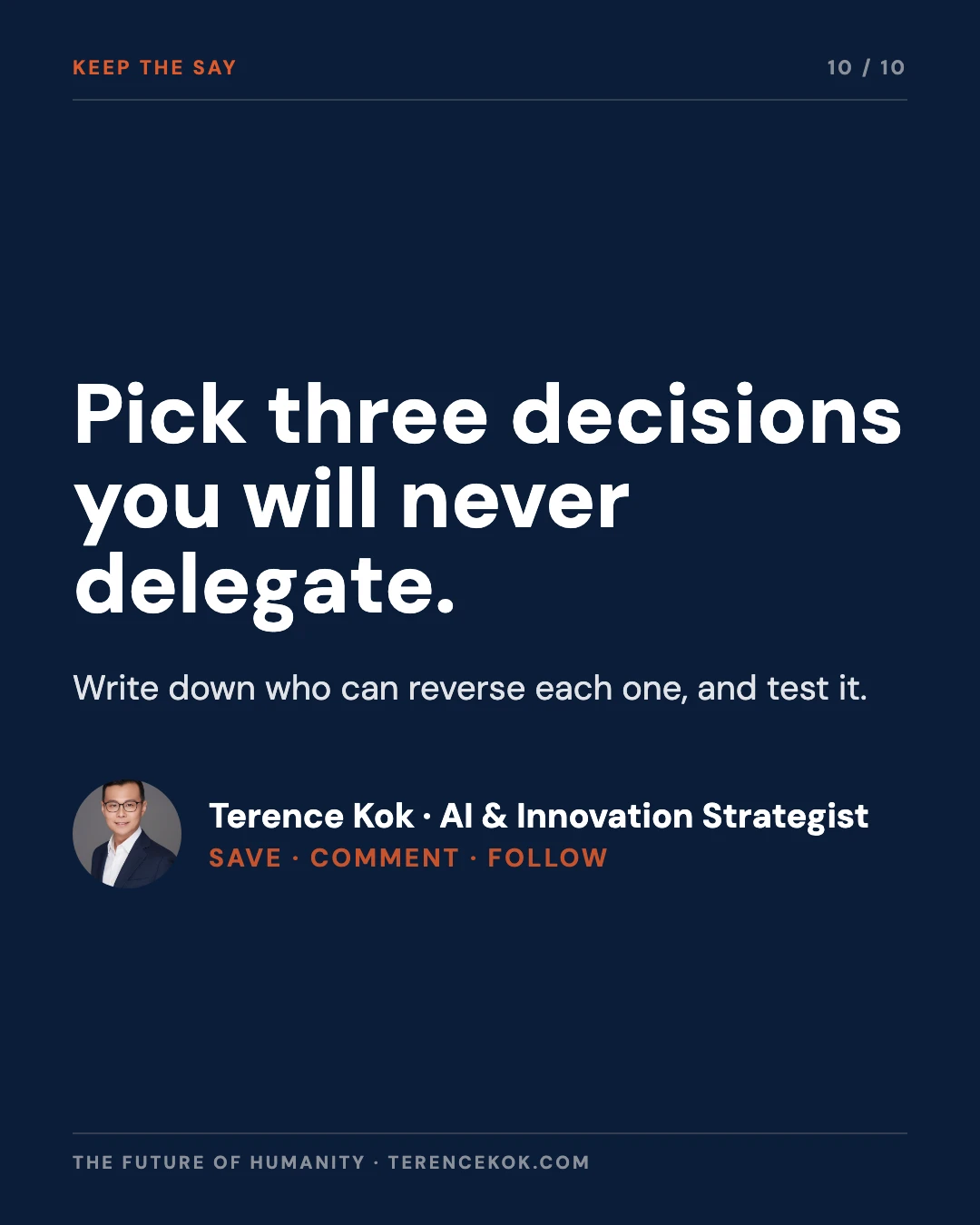
- Which three decisions in our organisation will we never delegate to a system, and is that written down?
- For each system we depend on, who can reverse its decisions, and have they done it in the last year?
- What skills have we let lapse because a tool handles the task, and what would we do on the day the tool failed?
- Whose objective does each of our automated systems really optimise, and did anyone in the room choose it?
- If a vendor withdrew a model overnight, what would still run?
Evidence & Methodology
Russell’s gorilla quotes come from a transcript of The Diary of a CEO, 4 December 2025, which I read. The September 2026 quotes come from a Scuttlebutt write-up of a Squawk Pod interview, so they are secondary. I did not read Human Compatible for this part and rely on a summary of its three principles from Wikipedia. The IEA figures come from the agency’s own pages. The Grauer’s gorilla figures come from the Wildlife Conservation Society’s release. The served-or-governed test, the extension to organisations and the reading of the grid figures are my own.
| Claim | Source | Grade |
|---|---|---|
| ”The gorilla problem is the problem that gorillas face with respect to humans”; “no say in whether they continue to exist” | Russell, Diary of a CEO, 4 December 2025 | Reported, direct quote |
| ”WALL-E is not the future that we want”; enfeeblement “because there’s no purpose in being able to do anything” | Russell, Diary of a CEO, 4 December 2025 | Reported, direct quote |
| ”We’re seeing early signs of losing control, but it’s not there”; “OpenAI nearly lost control of its entire compute infrastructure” | Scuttlebutt write-up of Squawk Pod, 21 September 2026 | Reported, secondary. The OpenAI claim is Russell’s and is unverified. |
| Proposed risk level of one in 100 million per year; regulators require evidence from companies | Scuttlebutt write-up of Squawk Pod, 21 September 2026 | Reported, secondary |
| Three principles of Human Compatible (Viking, 8 October 2019) | Wikipedia summary of the book | Reported, secondary |
| ”Human beings in the long run do not want to be enfeebled”; “I don’t have a solution for the enfeeblement problem” | 80,000 Hours interview with Russell, around 2020 | Reported, direct quote |
| Data centres used about 415 TWh in 2024 and are set to reach about 945 TWh by 2030; about 20 per cent of planned projects at risk of delay | IEA, Energy and AI | Measured, primary projection |
| Data centres expected to supply about half of US demand growth to 2030 | IEA, Electricity 2026 | Measured, primary projection |
| Grauer’s gorilla declined at least 77 per cent over 20 years, Critically Endangered in 2016, fewer than 4,000 left | Wildlife Conservation Society, 4 September 2016 | Measured, dated |
| Losing control can look like service: each delegation sensible, the ability to reverse eroding | My extension of Russell’s framing | My call |
| The served-or-governed test | Mine | My call |
Sources
- Russell, S. (2025, December 4). Stuart Russell on The Diary of a CEO podcast (transcript).
- Scuttlebutt. (2026, September 22). Berkeley AI professor: the labs tell. Write-up of Squawk Pod, 21 September 2026.
- 80,000 Hours. Stuart Russell on the flaws that make today’s AI architecture unsafe, and a new approach that could fix them.
- Wikipedia. Human Compatible. Russell, S. (2019). Human Compatible: Artificial Intelligence and the Problem of Control. Viking.
- International Energy Agency. (2025). Energy and AI: executive summary.
- International Energy Agency. (2026). Electricity 2026: demand.
- Wildlife Conservation Society. (2016, September 4). Largest gorilla subspecies declared Critically Endangered by IUCN Red List.
- Karpf, D. (2026, September 17). Who should pace the frontier? Not Dario Amodei. Tech Policy Press.
Why Nobody Can Hit the Brakes
The race that decides who builds the systems this part is about.

Agent Swarms and the Closing Loop
The loop Russell says puts all bets off once it is fully autonomous.

The Takeoff Nobody Noticed
Where machine output already outruns human checking.
Part 6 takes up what happens when optimised systems react to each other faster than anyone can watch: hyper-optimisation and the fast crash. If your board is deciding which decisions it will never delegate, that is a conversation my executive programme is built for.