
Executive Summary
Bolting AI onto unchanged workflows and messy data produces incremental gains at best. Real, compounding value requires redesigning the underlying systems, data, and processes before the AI layer goes in.
Core conclusions
- SMEs should design workflows and data capture around AI from the start, not retrofit AI onto systems built for a pre-AI operating model.
- Grants and vendor programmes deliver more value when spent on redesigning core workflows and data models than on buying standalone tools.
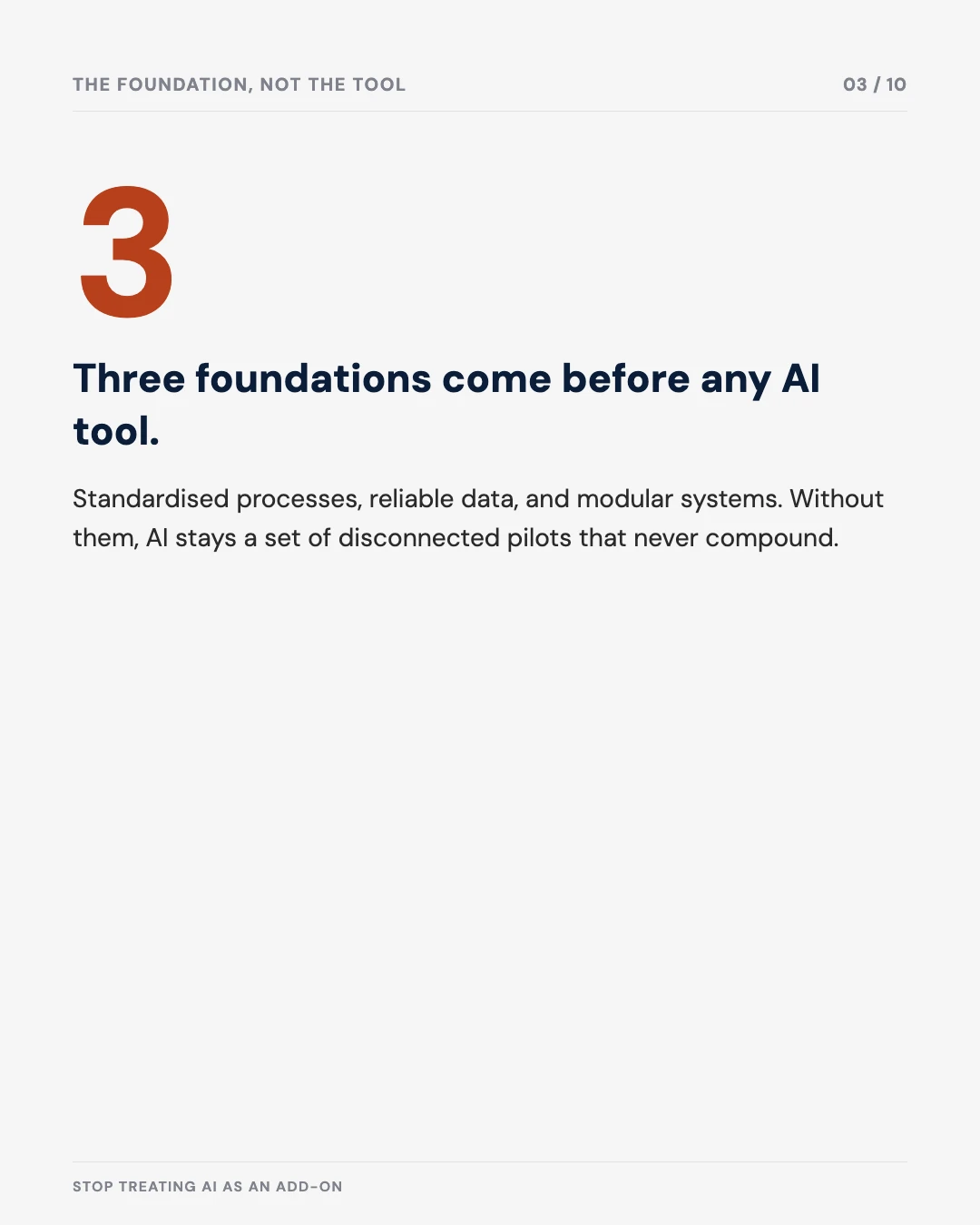
- Structural readiness (standardised processes, reliable data, modular systems, and clear metrics) is the precondition for AI to generate traceable ROI rather than isolated pilots.
The argument, in ten slides
Save it, share it, or send it to whoever’s about to sign off on the next AI pilot.
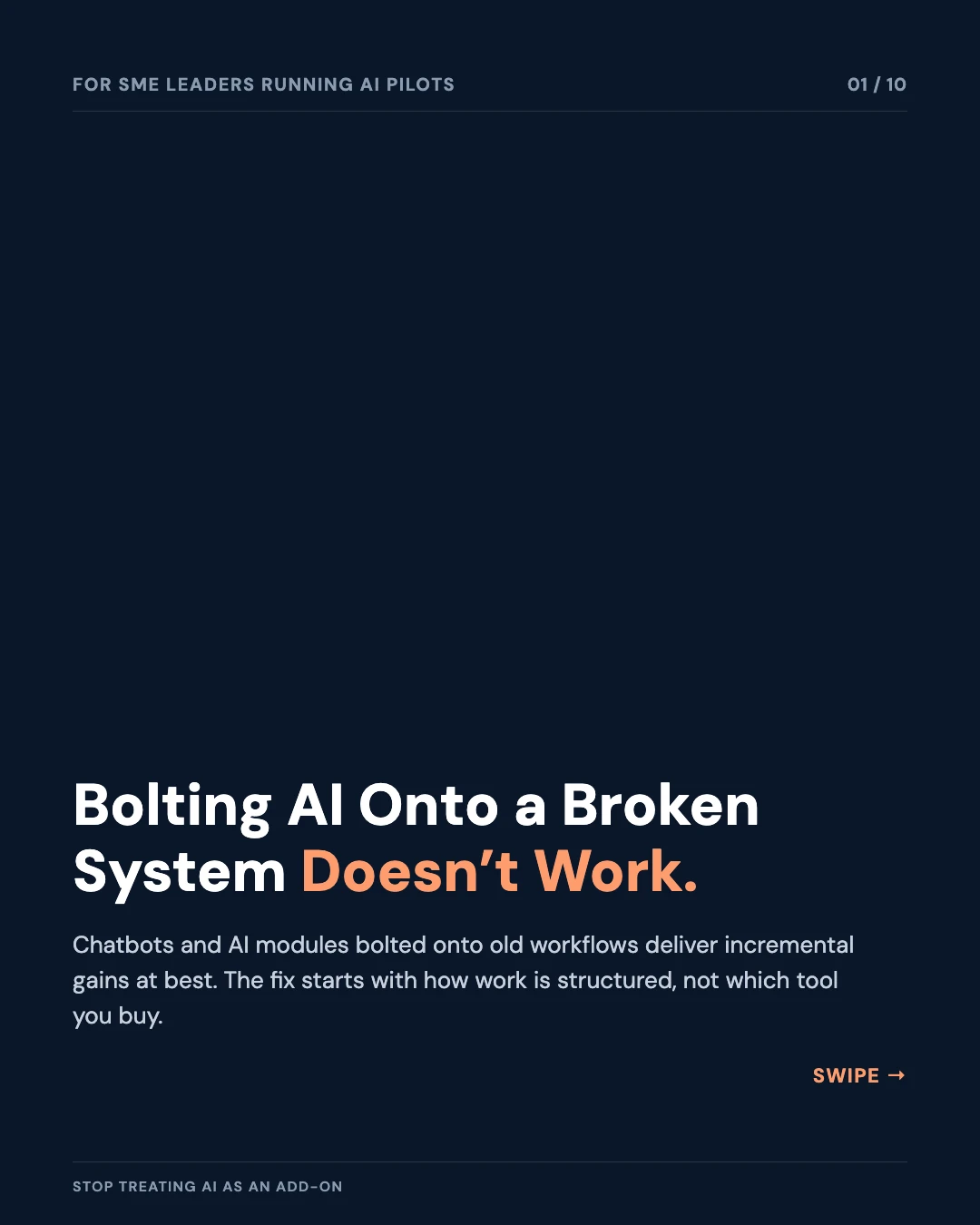
Many SMEs are being pushed to “adopt AI” through grants, vendor pitches, and digitalisation roadmaps. They deploy a chatbot on their website, bolt an AI module onto their existing ERP, or subscribe to an AI-powered dashboard, expecting a step change in productivity. In practice, most experience only incremental improvements because the underlying systems, data, and processes were never designed with AI in mind.
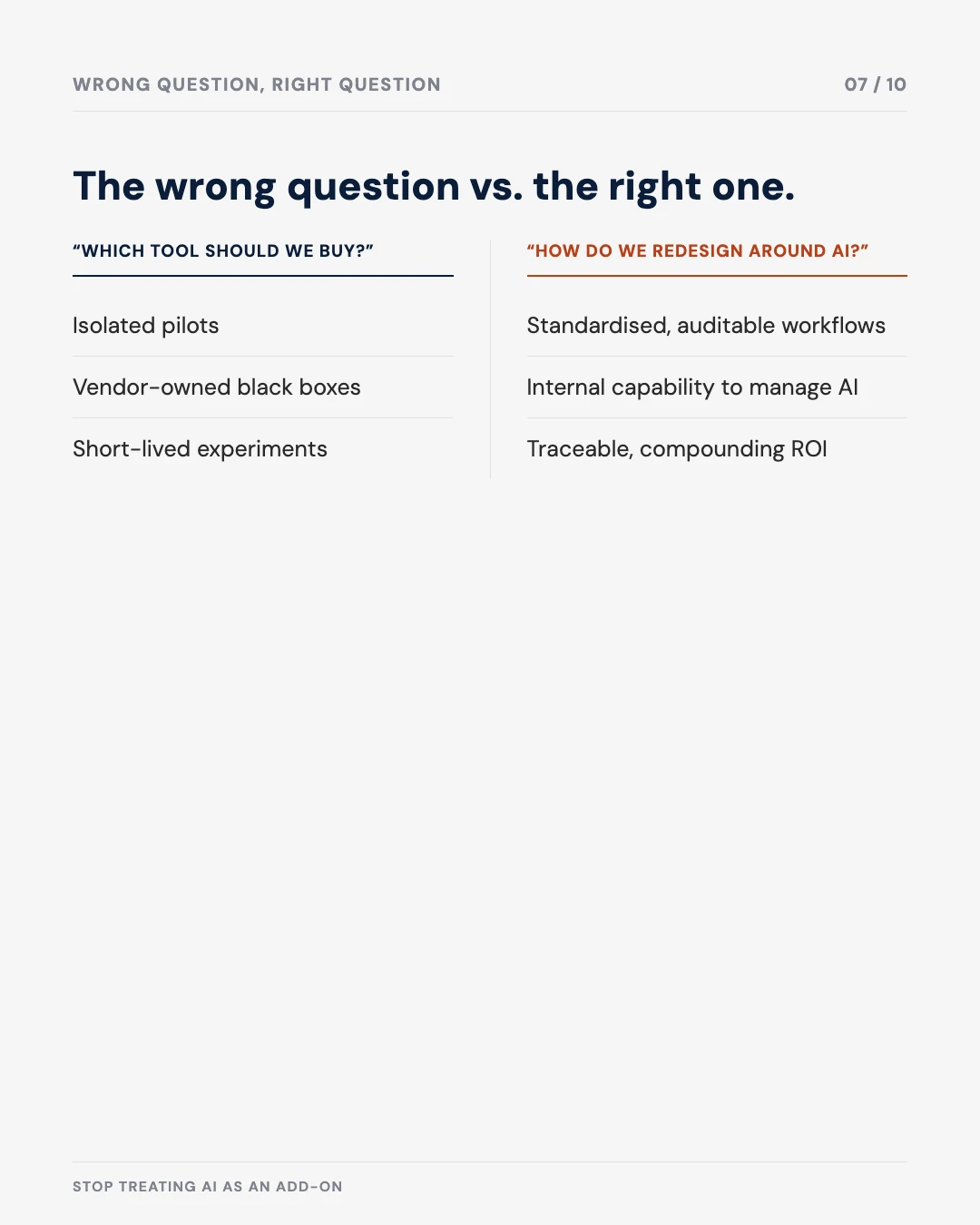
For Singapore SMEs, especially in sectors such as logistics, construction, retail, and light manufacturing, the more strategic question is not “Which AI tool should we buy?” but “How should we redesign our workflows, data, and systems so that AI can actually operate at scale and deliver measurable impact?”
1. Designing Around AI, Not Adding It Later
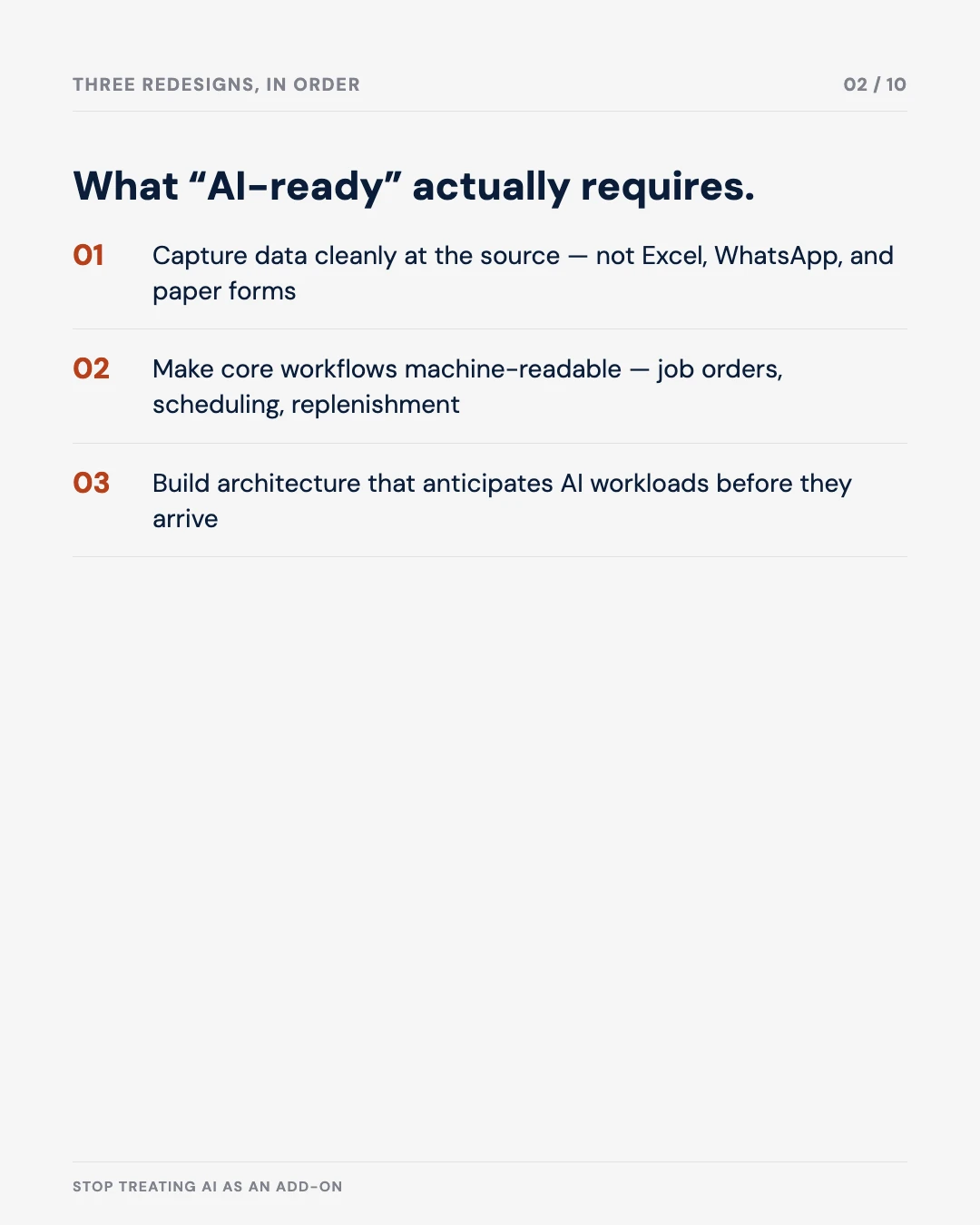
An AI-centric SME does not start with tools; it starts with how work is structured.
- Data is captured cleanly at source. Instead of scattered Excel files, WhatsApp instructions, and paper forms, operational data is captured in structured form through consistent templates and basic workflow systems. This reduces manual reconciliation and prepares the ground for forecasting, optimisation, and anomaly detection models. I learned this lesson directly: stop tuning prompts, start cleaning data.
- Key workflows are made machine-readable. Repetitive tasks such as order processing, job scheduling, inventory replenishment, and quotation generation are formalised into clear rules, fields, and status transitions. Once these are machine-readable, AI can support or automate decisions in a controlled and auditable way.
- The architecture anticipates AI workloads. Even if an SME starts with simple rules-based automation, systems are chosen and configured so that AI services (e.g. demand forecasting, routing optimisation, document understanding) can be integrated later without rework. This means using APIs, avoiding vendor lock-in where possible, and ensuring basic logging and monitoring are in place.
2. What This Looks Like for a Typical Singapore SME
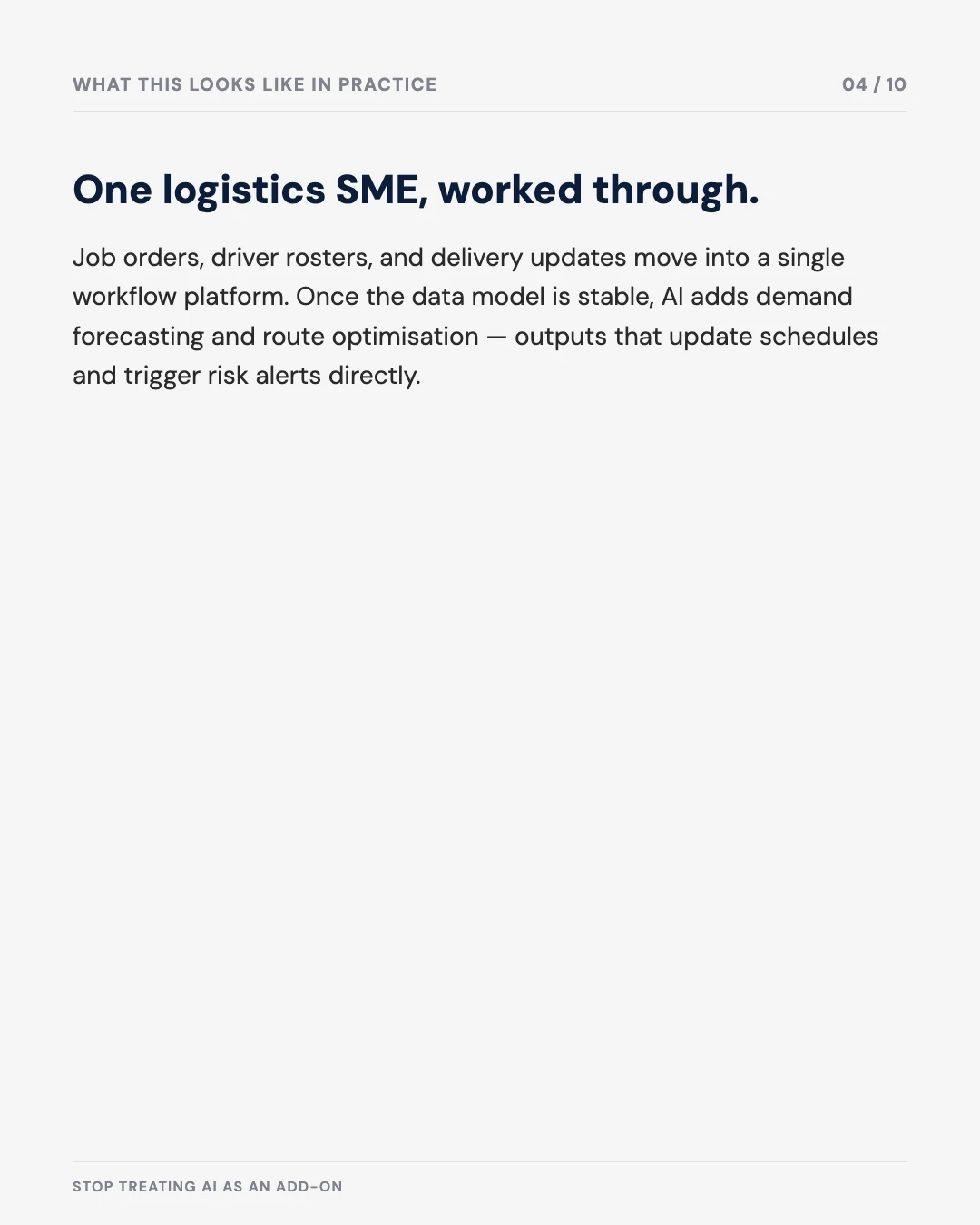
- A logistics SME standardises job orders, driver rosters, and delivery status updates into a single workflow platform, rather than handling each customer differently via email and messaging.
- Once the data model is stable, they introduce AI-based demand forecasting and route optimisation to predict daily workloads and optimise driver assignment and routing under local constraints such as peak-hour traffic and road restrictions.
- The AI outputs are then mapped directly into operations: updated job schedules, suggested loading plans, and alerts when service-level risks are detected.
AI is not just generating a report for management. It is embedded into day-to-day decisions because the underlying system was designed to accommodate and act on AI outputs.
3. Aligning with Policy and Support Environment
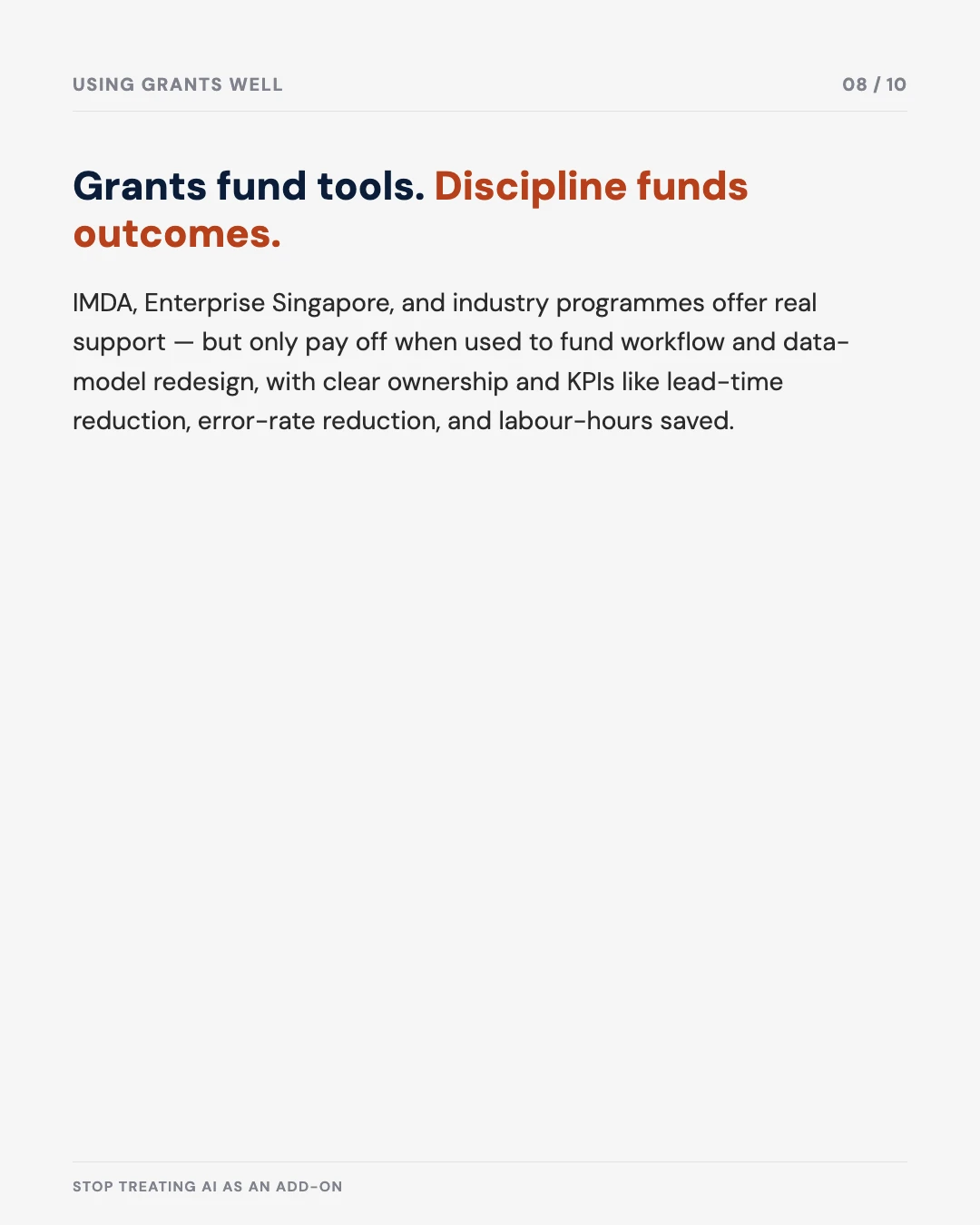
Singapore provides strong support for digitalisation and AI adoption through IMDA, Enterprise Singapore, and various industry-specific programmes. I lay out a fuller sequencing framework for this in A Structured Approach to AI Adoption for Singapore SMEs.
However, many SMEs still approach these initiatives as discrete projects or pilots.
A more disciplined approach is to use these schemes to:
- Fund redesign of core workflows and data models, not just the purchase of tools.
- Implement basic governance: clear data ownership, documented processes, and simple yet explicit KPIs (e.g., lead time reduction, error rate reduction, labour-hours saved).
- Build internal capability to manage and refine AI-enabled systems, rather than treating them as black-box products owned entirely by vendors.
This positions SMEs to apply grants and vendor solutions to build a coherent, AI-ready operating environment that can scale and evolve, rather than a patchwork of isolated pilots.
4. Moving from “AI Pilots” to an AI-Ready Business
For Singapore SMEs, the shift is not about becoming a “deep tech” company. It is about becoming structurally ready for AI:
- Processes are standardised enough to be automated.
- The data is reliable enough to support prediction and optimisation.
- Systems are modular enough to incorporate AI services without major disruption.
- Metrics are defined clearly enough to demonstrate ROI to owners, boards, and banks.
Once these foundations are in place, AI investments start to generate traceable improvements in productivity, capacity utilisation, customer responsiveness, and risk management. Without them, AI remains a collection of experiments that rarely move the needle.
Without these foundations, AI remains a collection of experiments that rarely move the needle.
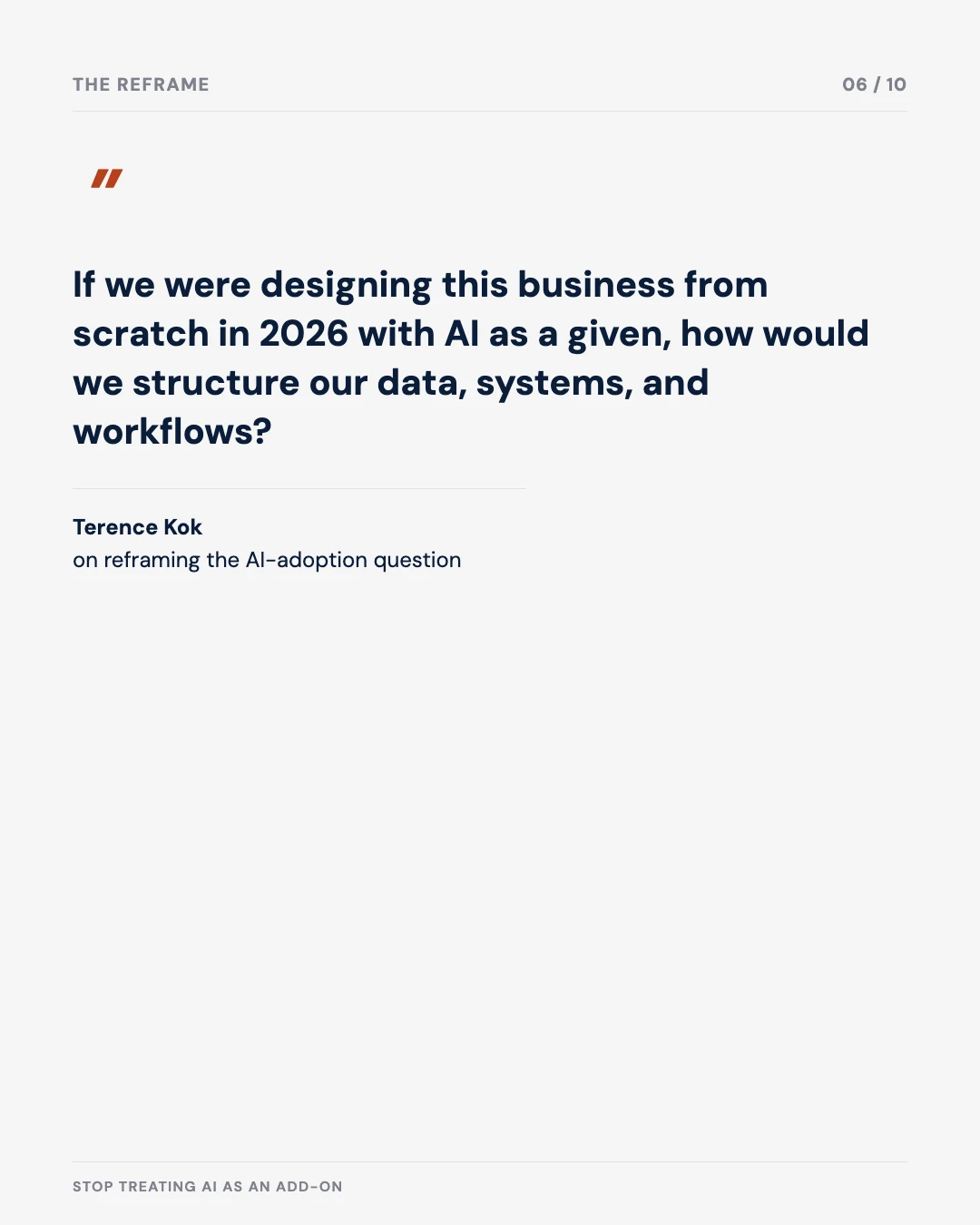
Instead of asking “Which AI solution should we try this year?”, SME leaders should ask: “If we were designing this business from scratch in 2026 with AI as a given, how would we structure our data, systems, and workflows?”.
The closer current operations move towards that target state, the more AI will deliver real, compounding value rather than isolated, short-lived pilots.
Free tool
Organisational AI Readiness Quiz
17 questions across Data, Process, Technology, People, and Governance to find out how close your SME actually is to the AI-ready target state above.
Free tool
Business Automation Map
Click the processes you already use AI for and see where the workflow-redesign gaps sit by impact and effort.