
Executive Summary
Your company has more than one candidate for its first agentic AI project. Someone has to decide which one goes first, and “the one the CEO likes” is not a method. This guide walks through a six-dimension scoring model built for agentic AI specifically: five standard prioritisation factors, plus the one factor that only matters once a system starts acting instead of just answering.
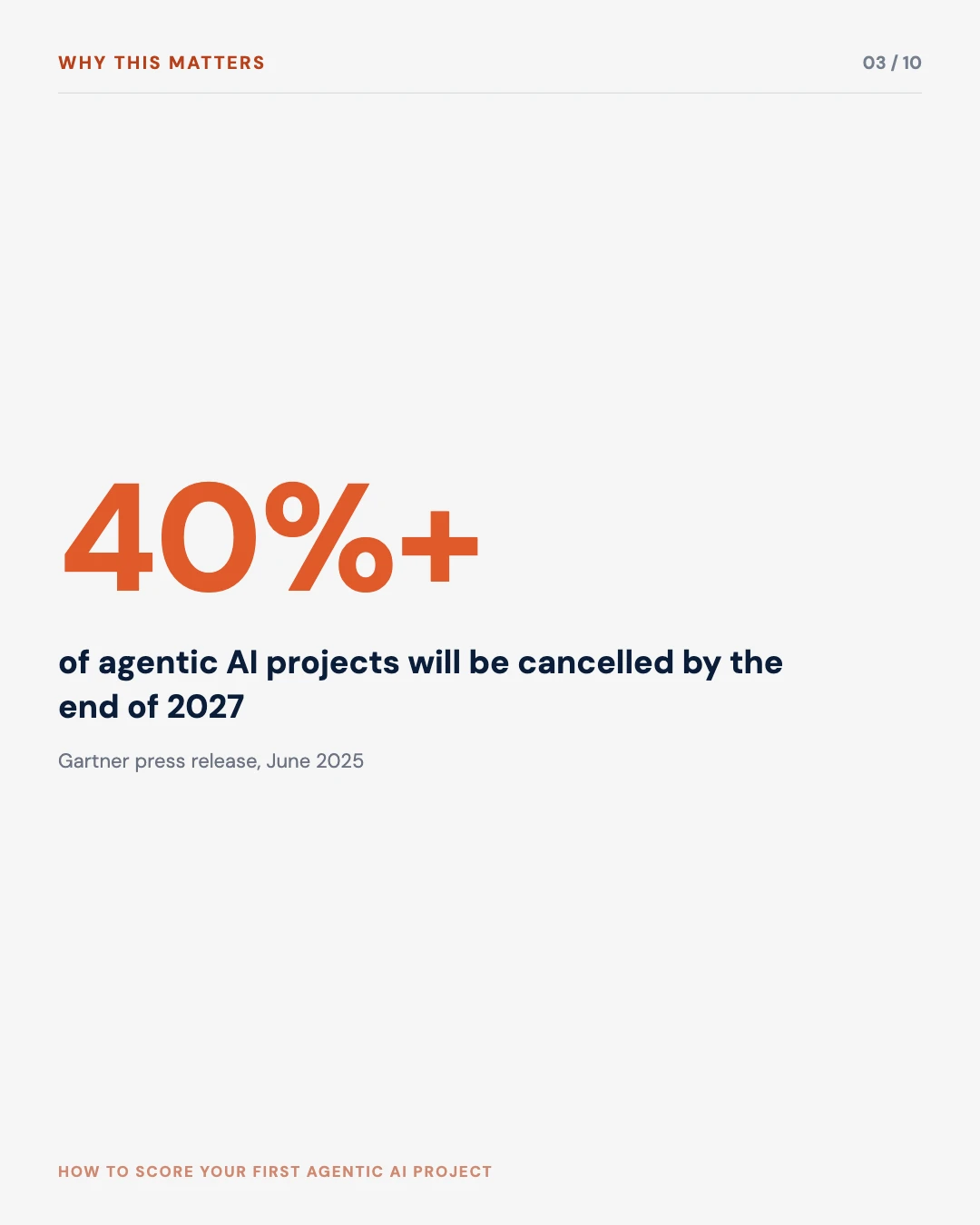
40%+
of agentic AI projects will be cancelled by end of 2027, Gartner press release, June 2025
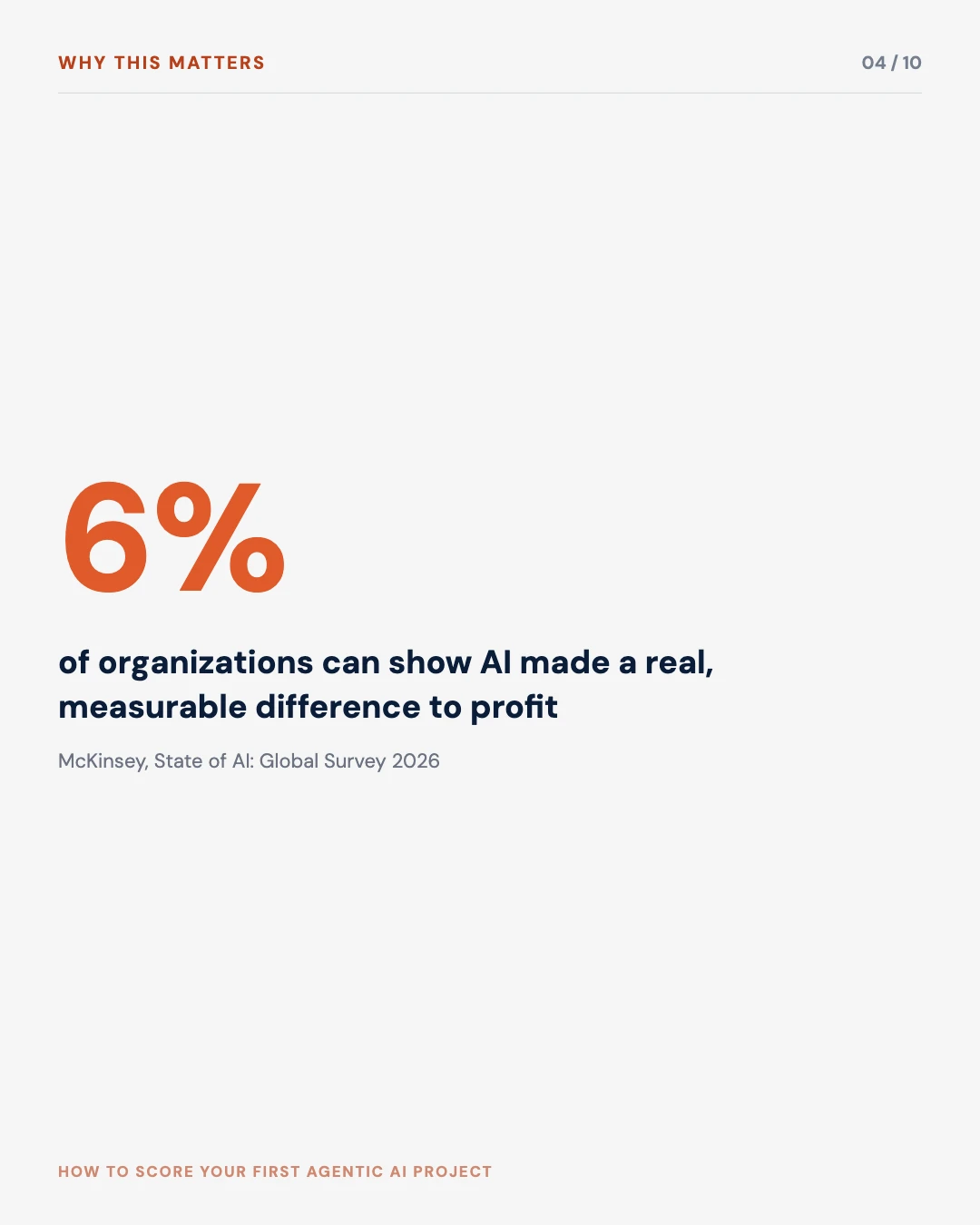
6%
of organizations McKinsey classifies as AI “high performers” with significant EBIT impact, State of AI: Global Survey 2026
17% → 60%+
of organizations that had deployed an AI agent versus planned to within two years, Gartner 2026 CIO Survey
Core conclusions
- A good agentic AI project score needs six dimensions, not the usual four or five. The extra one is autonomy readiness, and skipping it is how a technically sound project still fails.
- Scoring is not about finding the “smartest” idea. It is about finding the idea with the best combination of business value and low blast radius if something goes wrong.
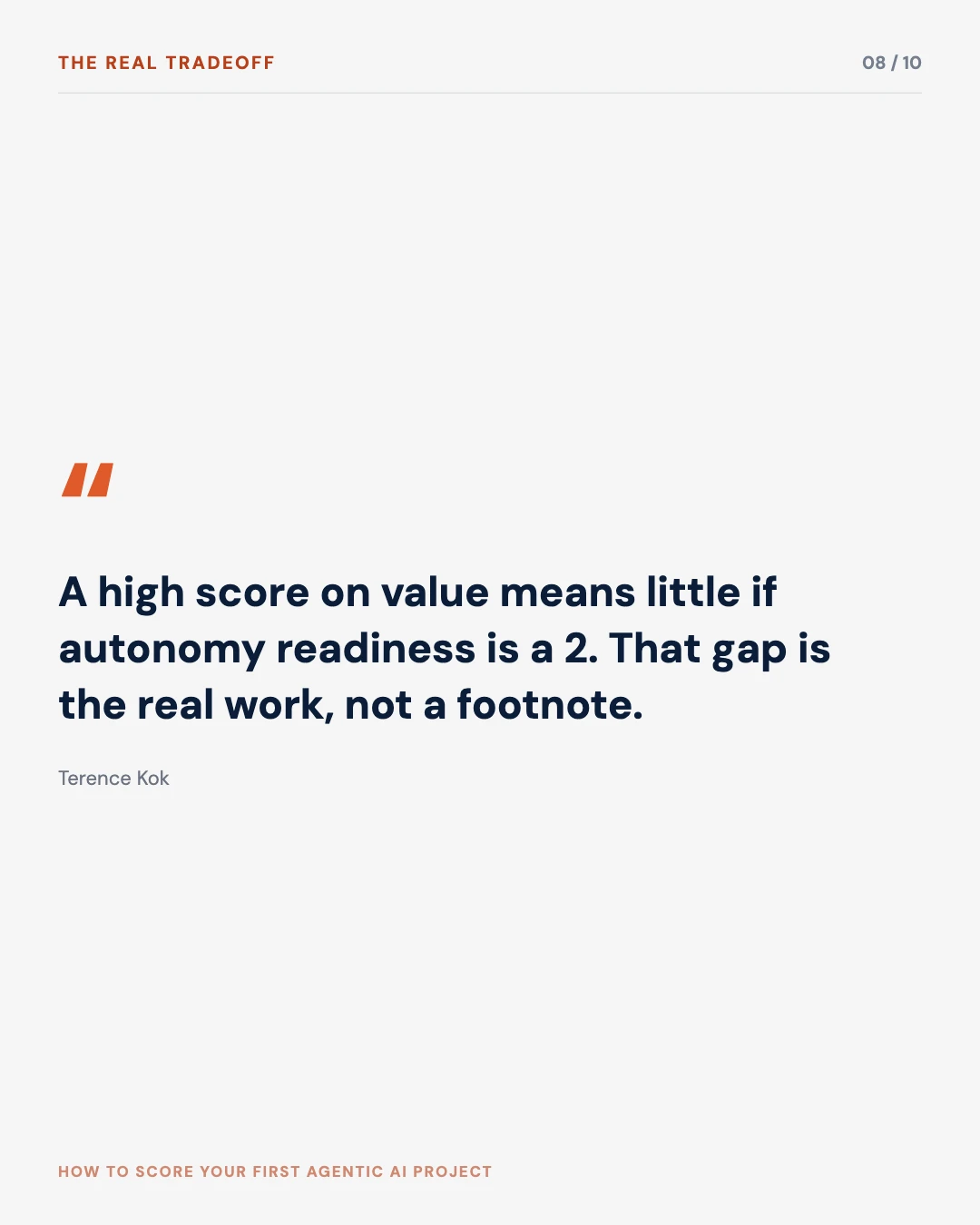
- The highest-scoring project on paper is not always the right first project. If its weakest dimension is autonomy readiness, that gap is the actual work, not a footnote.
The six-dimension scoring method, ten slides
Save it, share it, or send it to whoever is arguing for their favourite idea with nothing but instinct.
The case for scoring the first project
Most companies do not lack agentic AI ideas. They have three, five, sometimes a dozen: an agent that reconciles invoices, one that triages support tickets, one that drafts contracts, one that manages inventory reorders. The problem is never a shortage of ideas. It is that nobody has a defensible way to rank them.
Left unscored, the loudest voice in the room usually wins. Sometimes that is the CEO’s pet idea. Sometimes it is whichever department shouted the hardest about being understaffed. Neither of those is a business case, and neither one accounts for the one thing that makes agentic AI riskier than a normal software project: it acts on its own, inside real systems, before a person necessarily checks its work.
That risk is exactly why more than 40% of agentic AI projects are expected to be cancelled by the end of 2027, according to Gartner. Most of those cancellations will not trace back to a model that was not smart enough. They will trace back to a project that was picked for the wrong reasons and scored on nothing at all.
The six numbers that decide which project goes first
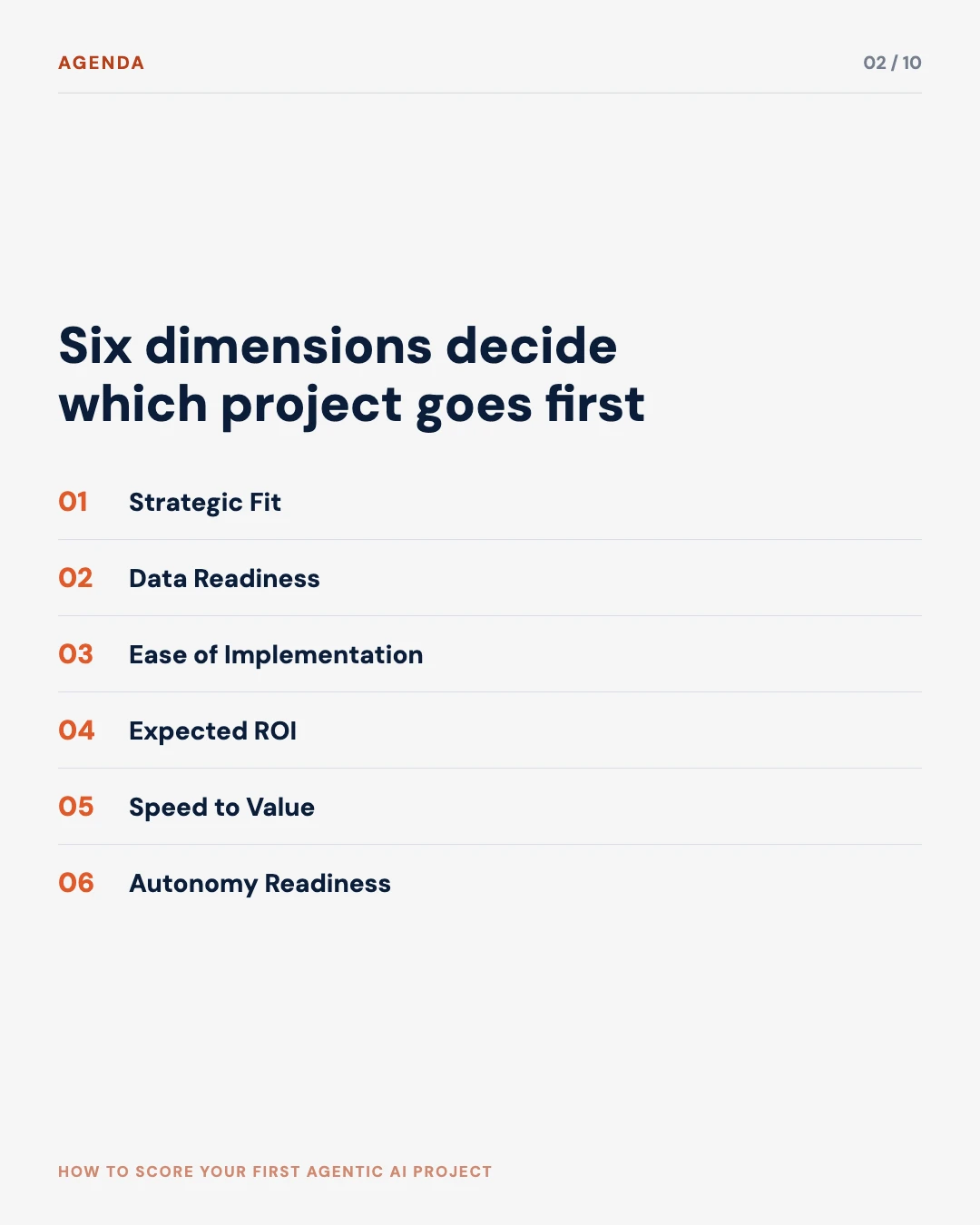
A defensible score for an agentic AI project needs six dimensions. Five of them apply to any AI investment. The sixth is specific to agentic AI, and it is the one most scoring frameworks miss entirely.
| Dimension | What it measures |
|---|---|
| Strategic Fit | Does this move something your leadership already cares about, or a problem nobody is tracking |
| Data Readiness | Does the data this agent needs already exist, and is it clean enough to trust |
| Ease of Implementation | How much custom build, integration, and change management does this really require |
| Expected ROI | What is the real, defensible financial or operational return, not the optimistic version |
| Speed to Value | How many weeks until you can show a measurable result, not a demo |
| Autonomy Readiness | If this agent acts on its own, are your guardrails, logging, and approval points ready for that |
Rate each candidate project on each dimension, on a scale of 1 to 10, and you get a number you can defend in a room full of people who each have a favourite idea. This is not a substitute for judgement. It is what turns five separate opinions into one shared conversation.
Free tool
AI Use Case Prioritisation Matrix
Score up to five candidate projects across all six dimensions below and get a ranked business merit sequence, plus the autonomy clearance tier each one earns.
Autonomy readiness is the dimension that makes agentic AI different
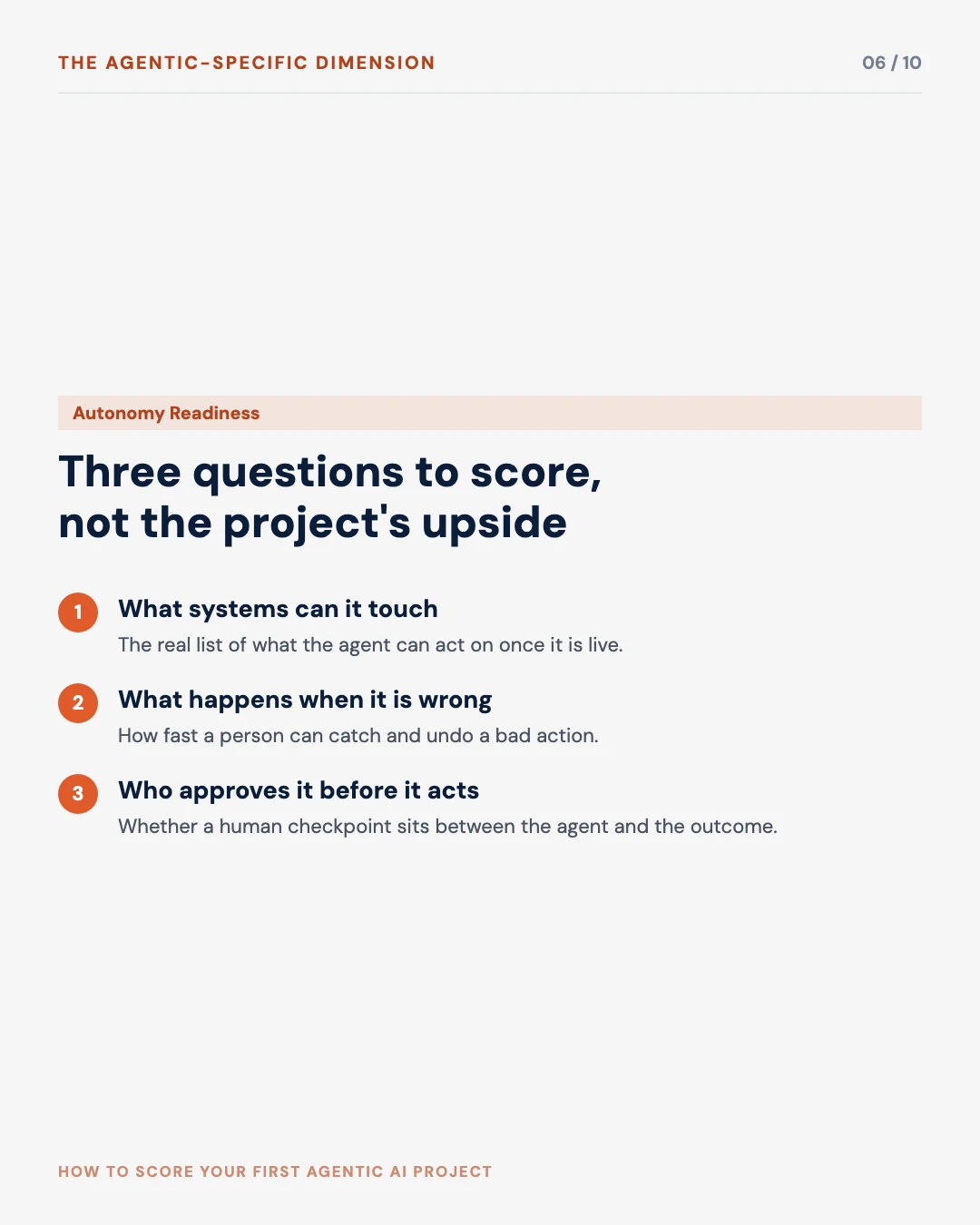
The first five dimensions above would work fine for scoring a new BI dashboard or a chatbot. Autonomy readiness is what makes this model built for agentic AI specifically, and it asks a different kind of question. Not “how valuable is this,” but “how ready are we for this to act without a person checking every step.”
Score this dimension on your actual controls, not on the project’s potential upside. Ask three things about each candidate. What systems can this agent touch once it is live. What happens the moment it takes a wrong action, and how fast can a person catch and undo it. Who has to approve its output before it reaches a customer, a contract, or a ledger.
A project that scores a 9 on Expected ROI but a 2 on Autonomy Readiness is not a strong candidate yet. It is a strong candidate with an unfinished prerequisite. Close the governance gap first, then re-score it. Building the guardrails before the agent goes live is dramatically cheaper than rebuilding trust after it makes a visible mistake.
This connects directly to the three levels of agentic AI risk worth knowing before you score anything: an agent that only checks a system and reports back, an agent that drafts an action and waits for a person to approve it, and an agent that checks and acts entirely on its own. A low autonomy readiness score usually means your project should start at the first or second level, no matter how tempting the third one looks in a pitch deck.
Free tool
AI Trust, Risk & Governance Dashboard
Score where your guardrails stand today, before you score any project’s autonomy readiness against them.
The confidence discount
One more step separates a useful score from a false sense of precision. Some of your six ratings will be measured, and some will be guessed. Data Readiness might be a real audit finding. Expected ROI, on your first pass, is usually closer to a hopeful estimate.
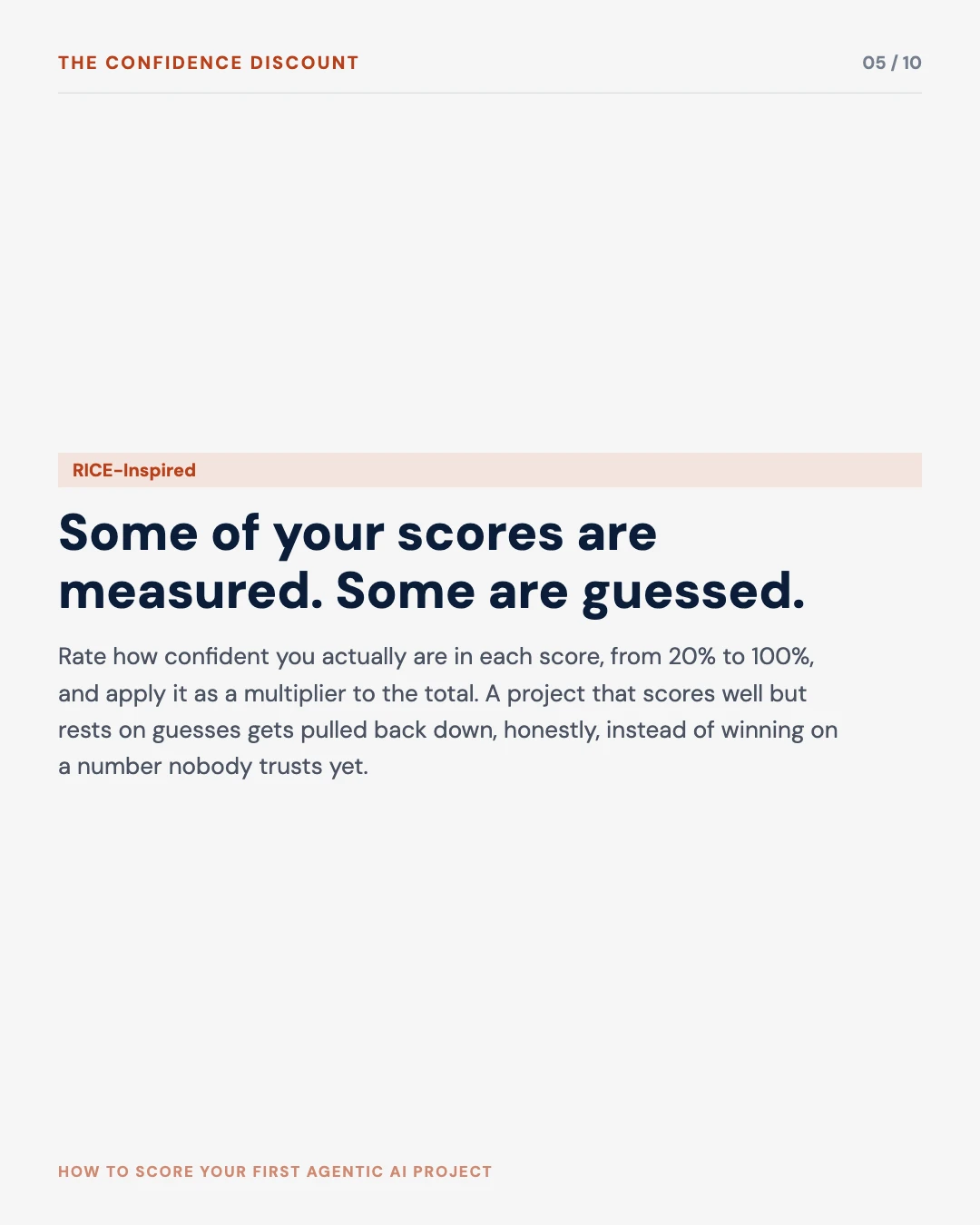
Add a confidence discount to the final score, borrowed from the classic RICE prioritisation model used in product teams. Rate how confident you are in the six scores you just gave, from 20% to 100%, and apply that as a multiplier to the total. A project that scores well on paper but rests entirely on guesses gets pulled back down, honestly, instead of winning on a number nobody trusts yet.
This single step is what keeps a scoring exercise from becoming a new way to dress up the same gut call in a spreadsheet. It forces the question underneath every dimension: do we know this, or are we hoping it is true.
A worked example with two candidate projects
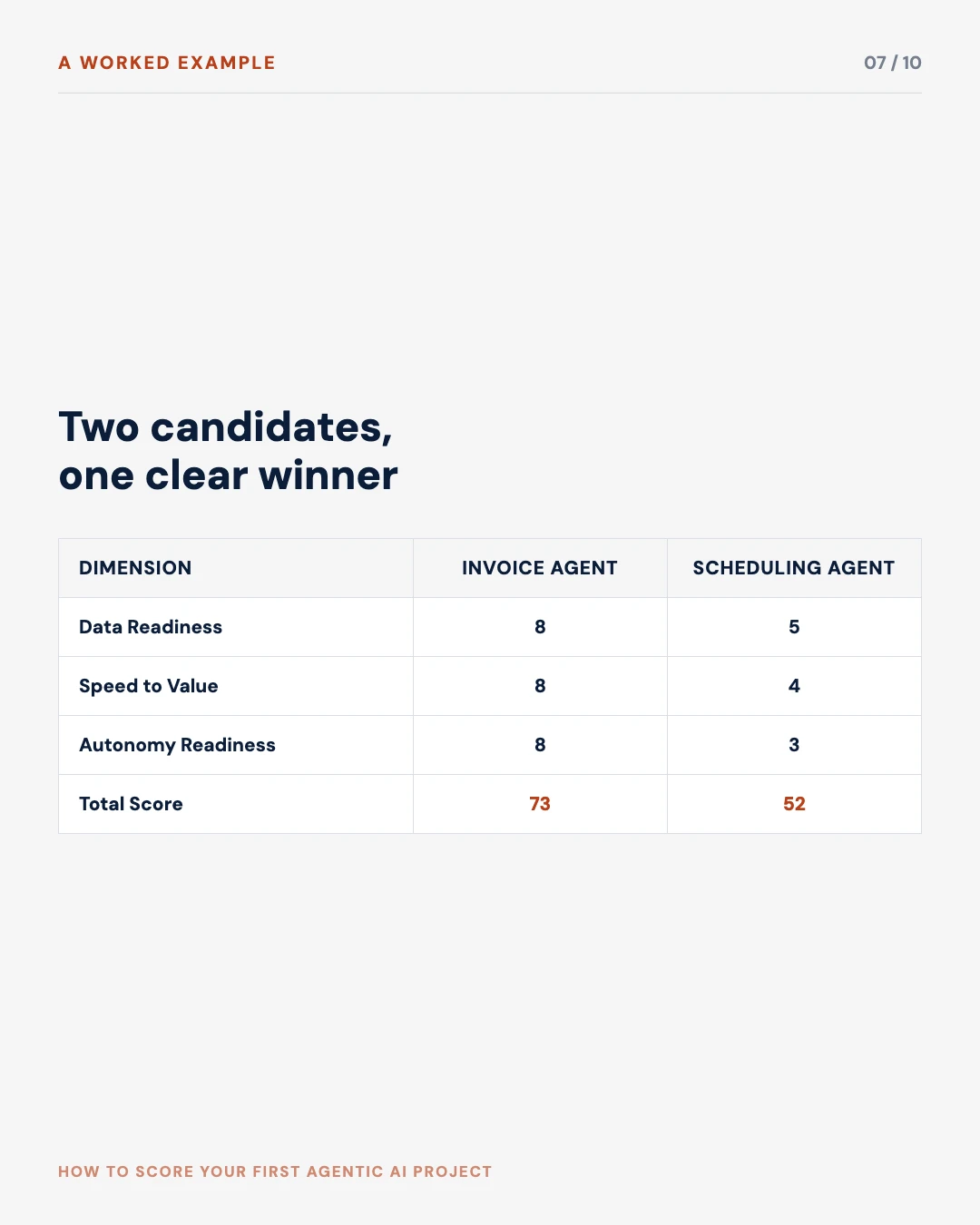
Here is how this plays out with two hypothetical candidates, an invoice reconciliation agent and a customer-facing scheduling agent, scored on the same six dimensions.
| Dimension | Invoice reconciliation agent | Customer scheduling agent |
|---|---|---|
| Strategic Fit | 7 | 8 |
| Data Readiness | 8 | 5 |
| Ease of Implementation | 7 | 4 |
| Expected ROI | 6 | 7 |
| Speed to Value | 8 | 4 |
| Autonomy Readiness | 8 | 3 |
| Weighted score (before confidence) | 73 | 52 |
The scheduling agent looks appealing on Strategic Fit and Expected ROI, since it touches customers directly and leadership notices customer-facing wins. But it scores low on Autonomy Readiness, because it would be booking real appointments on real customer calendars, and low on Data Readiness and Speed to Value, because the scheduling data lives across three disconnected systems. The invoice agent is less exciting to describe in a board meeting. It also scores higher everywhere that predicts whether a first project succeeds.
This is the entire value of scoring instead of guessing. Not that it finds a surprising answer every time, but that it makes the actual tradeoff visible before money and time go into the wrong one.
What to do once you have a winner
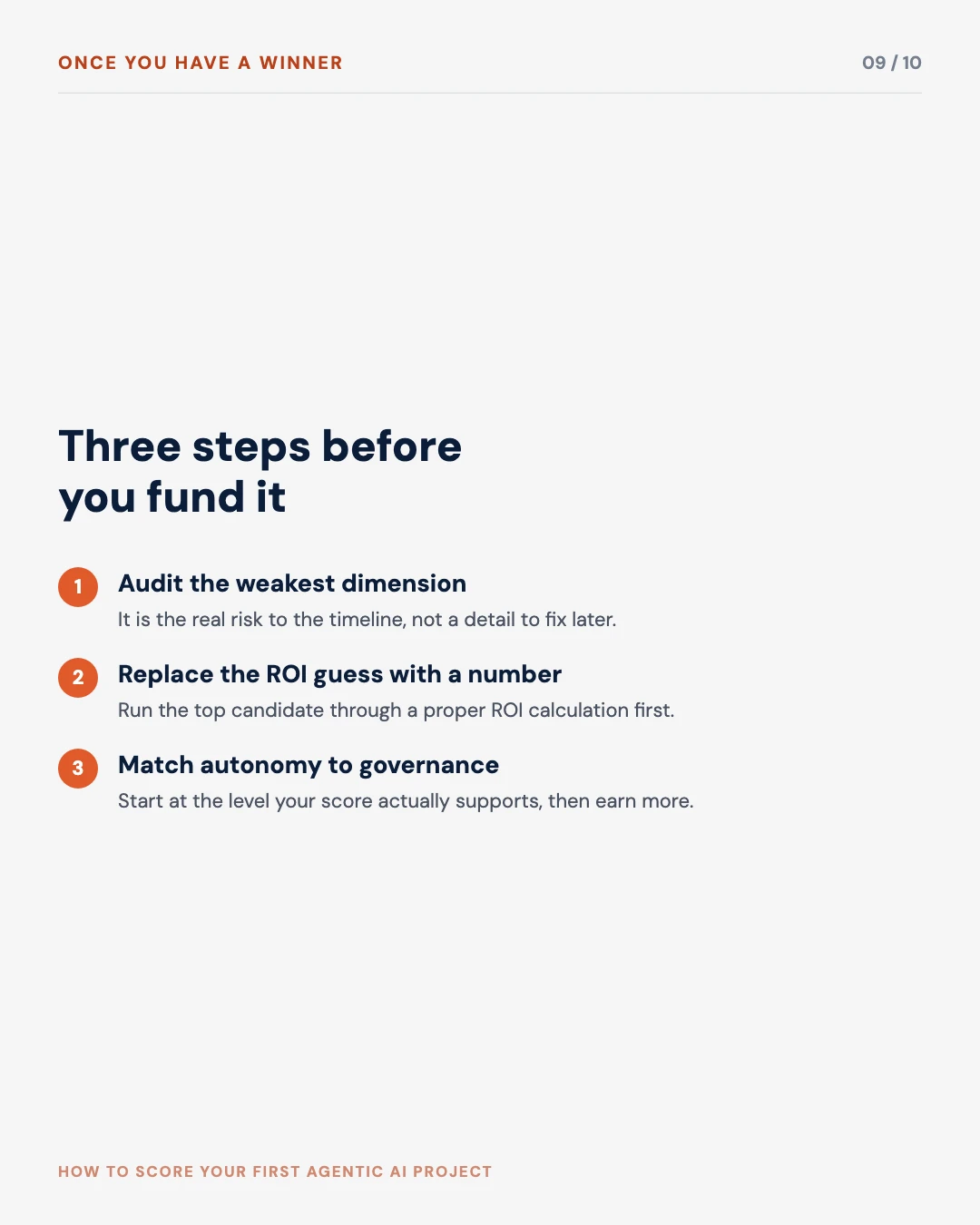
A finished score is a starting point, not a green light. Three steps turn a ranked list into a plan worth funding.
Audit the weakest dimension
Whatever scored lowest for your top candidate is the real risk to the timeline, not a detail to fix later.
Replace the ROI guess with a number
Run the top candidate through a proper ROI calculation before you present it as a business case.
Match autonomy to governance, not ambition
Start at the level your Autonomy Readiness score supports, then earn your way to more independence.
Free tool
AI ROI Calculator
Turn the Expected ROI score you estimated into a defensible number before you take this project to the board.
Re-score every candidate again once the top project has been in production for a few months. Data Readiness, Ease of Implementation, and Autonomy Readiness all shift once you have real operating experience instead of an estimate. A project that scored second today can easily score first six months from now.
Where to go next on this site
Score your candidates now
Rate up to five ideas on the six dimensions in this guide and get a ranked sequence plus each one’s autonomy clearance tier.
Check your autonomy readiness
See how your guardrails and review points score before you commit to an agent that acts on its own.
Check your overall readiness
A quick quiz that scores where your company stands today, beyond a single project.
Go deeper on agentic AI
The full topic hub, with every post on agents, use cases, and risk in one place.
Train your team
A half-day programme for your leaders and managers.
Talk to me directly
Get a second opinion on your ranking before you commit budget to it.

How to Calibrate Every Dimension of Your Agentic AI Scorecard
What a 2, a 5, and an 8 look like on each of the six dimensions, so two people scoring the same project land on roughly the same number.

Why Autonomy Readiness Should Cap Your Agentic AI Score
The straight average in the worked example above lets five strong scores cancel out a dangerous autonomy readiness score. This is the fix.

New to Agentic AI? A Plain-English Guide for the C-Suite
This guide assumes you already understand what makes an AI system agentic. If the six parts, model, memory, tools, planning, orchestration, guardrails, are still new to you, start there first.

Which Critical Tasks Are Actually Suitable for Agentic AI
A deeper test for which tasks belong on your shortlist at all, before you get as far as scoring them against each other.

Why Your Choice of First AI Use Case Will Make or Break the Programme
The broader case for why this decision matters so much, and the six tests behind why some first projects sink an entire programme.

Who Does What in Your First Ninety Days of AI
Once your top-scoring project is chosen, this is the role-by-role plan for the thirteen weeks that follow.

How to Build Your First AI Agent at Work: A Simple, Step-by-Step Guide
The direct next step after scoring. A plain-language walk-through of building your first real agent, at the risk level your autonomy score supports.

The 2026 Shift: From AI Experimentation to Autonomous Systems
Why more companies are pushing past low-autonomy pilots this year, and what that shift means for how you should be scoring new candidates.
Evidence & Methodology
Two of these numbers come from named research. The scoring method itself is mine, built for this piece, not the result of a study.
| Claim | Source | Grade |
|---|---|---|
| 40%+ of agentic AI projects will be cancelled by end of 2027 | Gartner, 2025 | Forecast |
| Only 6% of organisations show significant profit impact from AI, despite most reporting productivity gains | McKinsey State of AI: Global Survey 2026 | Measured |
| Six dimensions, including autonomy readiness, score a first agentic AI project better than instinct or seniority | My own scoring method for this piece, not tested against a control group | My method |
Sources
- Gartner. (2025, June 25). Gartner predicts over 40% of agentic AI projects will be canceled by end of 2027 [Press release].
- Gartner. (2026). Hype Cycle for Agentic AI, 2026, citing the 2026 CIO and Technology Executive Survey.
- The Register. (2026, August 25). McKinsey Says Enterprise AI Is Finally “On the Road to ROI”, citing McKinsey’s State of AI: Global Survey 2026 (1,719 respondents, 97 countries).
Still not sure which of your candidate projects should go first? That is exactly the conversation my consulting work begins with.