
Executive Summary
Two thirds of agents in the largest industry survey have used AI, and nearly half of them say it made no noticeable difference to their business. The reason is where the effort went. Most of it went into writing listing copy, which every competitor can also do in thirty seconds. The measurable gains sit in two less popular places: answering an enquiry inside the first hour, when the lead is still warm, and ranking who to call first on what buyers do instead of what they typed into a form. Both are bounded by the same constraint. A licensed agent, a fair housing regulator and a data protection regulator all treat the AI’s output as the firm’s own words, so every piece a buyer sees needs a named human sign-off.
68%
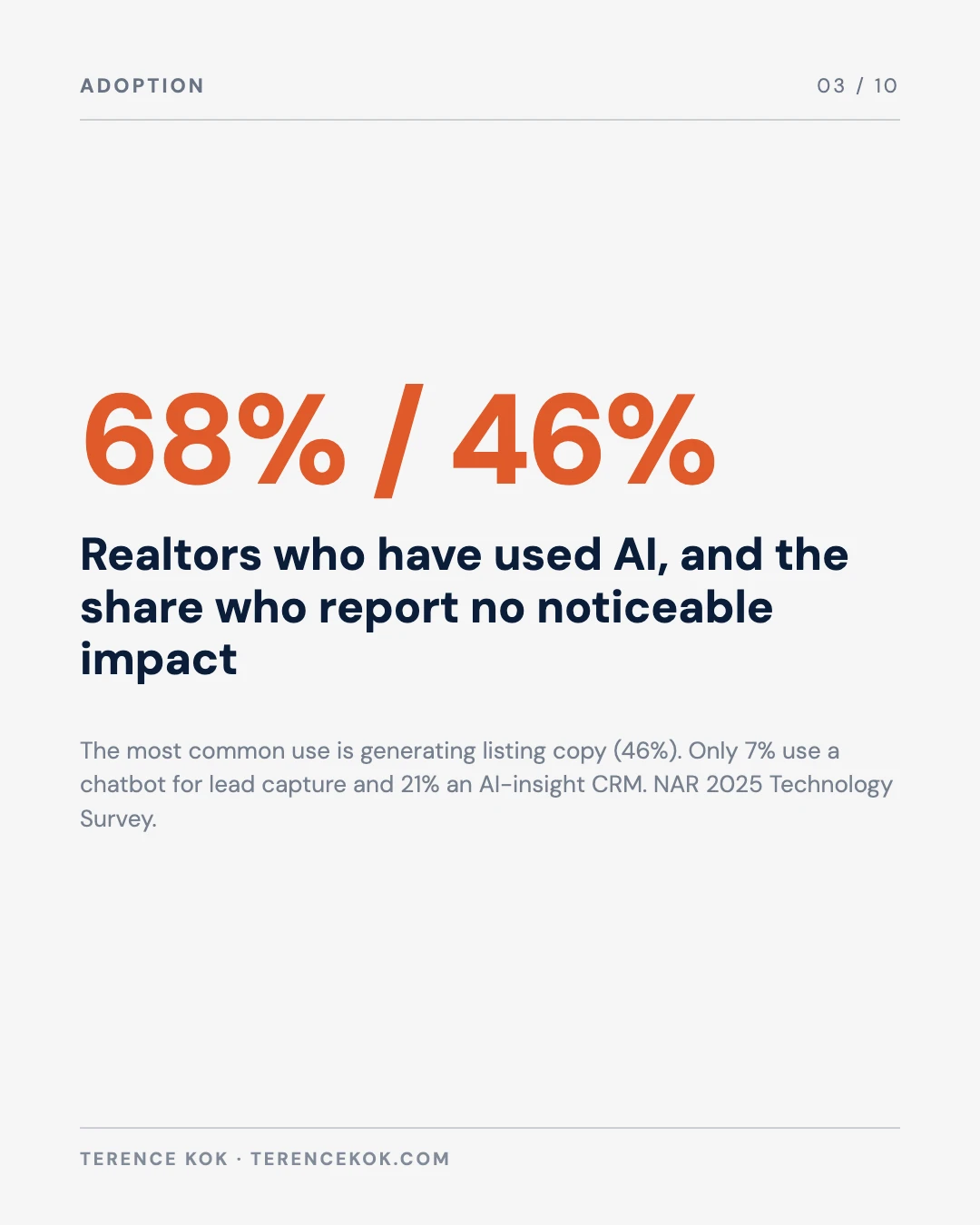
of US Realtors have used AI tools, and 46% of them report no noticeable impact on their business, NAR 2025 Technology Survey
7x
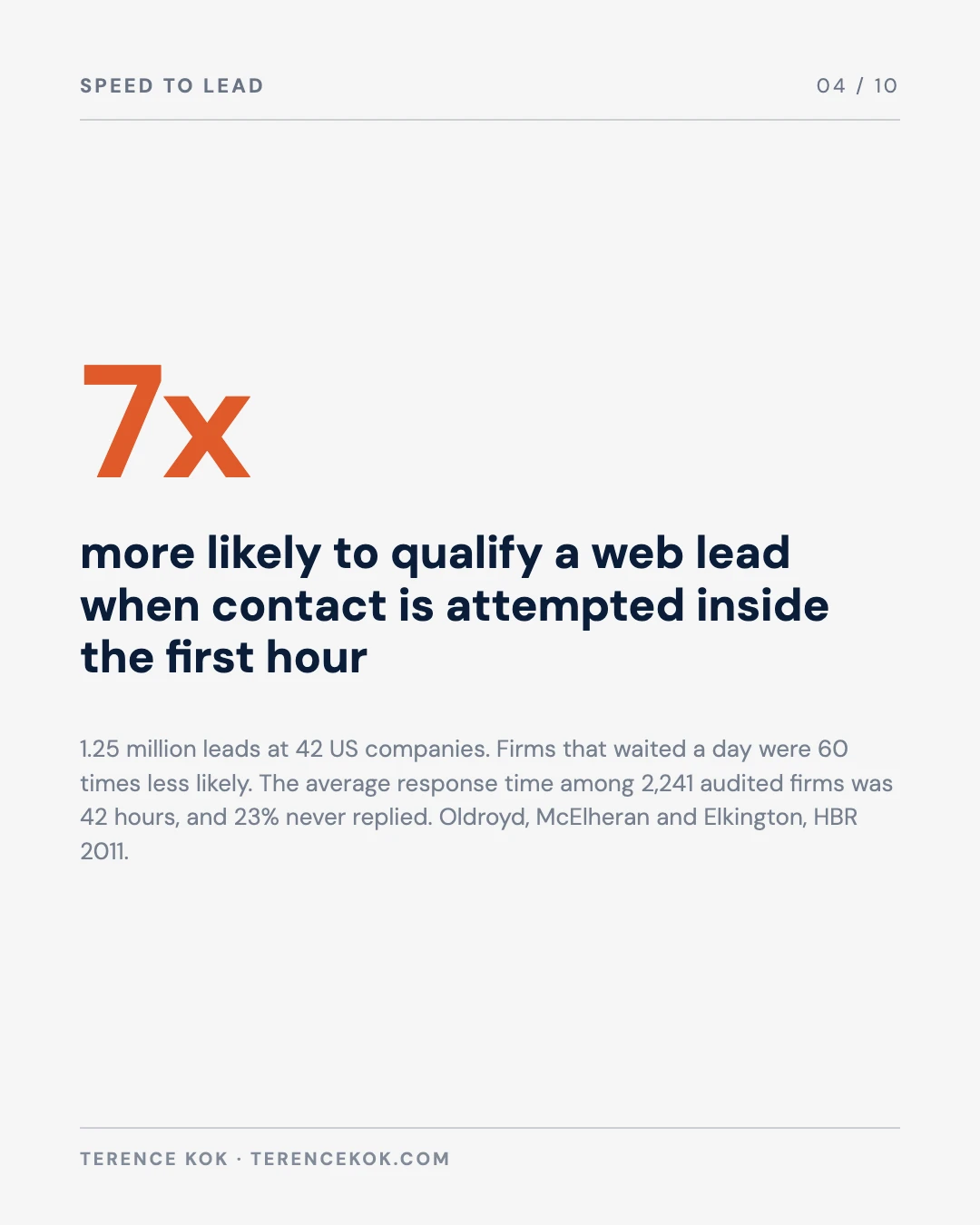
more likely to qualify a web lead when contact was attempted within an hour rather than an hour later, across 1.25 million leads at 42 US companies, Harvard Business Review 2011
42 hrs
average response time to a web enquiry among 2,241 audited US companies; 23% never replied at all, same study
46% vs 7%
share of Realtors using AI-generated content such as listing descriptions, against the share using a chatbot for lead capture or client communication, NAR 2025
Core conclusions
- The first hour after an enquiry is where AI earns its keep in real estate. It is also the least adopted use, because the popular use, drafting copy, is easier to start and harder to measure.
- Lead scoring built on behaviour, what a buyer saved, shared, revisited and asked, outperforms scoring on budget and postcode fields, and the portals already collect the behaviour.
- The regulator holds the licensee responsible for what the AI says, shows and targets. Accuracy, image disclaimers, fair targeting and consent are the four checks that decide whether the programme survives its first complaint.
The argument, in ten slides
Save it, or send it to whoever runs your sales floor.

High adoption and low measured impact
The National Association of Realtors surveyed its members on technology in 2025 and found that 68 percent had used AI tools in some form: 20 percent daily, 22 percent weekly, 27 percent a few times a month. That is the fastest adoption of any tool category I can remember in the industry. The next number is the one worth sitting with. Asked what the AI had done for their business, 46 percent said no noticeable difference. Only 17 percent reported a significant positive impact.
The pattern behind those two numbers is visible in the same survey. The most common AI use was generating content, mostly listing descriptions, at 46 percent of respondents. The share using a chatbot for lead capture or client communication was 7 percent. The share using a CRM with AI-driven insights was 21 percent. Agents adopted the use that was easiest to start and hardest to measure, and skipped the two uses where the arithmetic is straightforward.
McKinsey Global Institute estimated in 2023 that generative AI could add US$110 to 180 billion of value to commercial real estate, on the condition that the industry changed how it worked to capture it. The NAR numbers suggest that condition is mostly unmet. I see the same shape in other sectors. The first use of a new tool is the one that feels like the tool, and for a language model that is writing. Writing a listing faster saves an agent twenty minutes a week. It does not bring a single extra buyer to the door, because every competing agent has the same model and the same twenty minutes. The uses that move revenue are less glamorous. They are about who gets called, how fast, and in what order.
The first hour after an enquiry is where the money is
The most useful study on lead response is fifteen years old and was run across financial services, cars, software and education, with no property firms in the sample. James Oldroyd, Kristina McElheran and David Elkington audited 2,241 US companies by sending each a web enquiry and timing the reply. Thirty-seven percent responded within an hour. Twenty-four percent took more than a day. Twenty-three percent never responded. Among the companies that did respond within a month, the average was 42 hours.
Their second study, across 1.25 million leads at 42 companies, measured what the delay cost. Firms that attempted contact within an hour were nearly seven times as likely to have a meaningful conversation with a decision maker as firms that tried even an hour later, and more than sixty times as likely as firms that waited a day. The reasons the authors found for the delay will be familiar to anyone who has run a sales floor: leads pulled from the CRM once a day instead of continuously, agents focused on their own prospecting over inbound, and distribution rules built around fairness to the team at the expense of speed to the buyer.
Property buyers behave the same way as the buyers in that study, with one difference that makes it worse. A buyer who enquires on a listing at 9pm on a Sunday has usually enquired on four other listings in the same sitting. The agent who replies first gets the viewing. The agent who replies on Monday afternoon gets a polite “already viewed, thanks.”
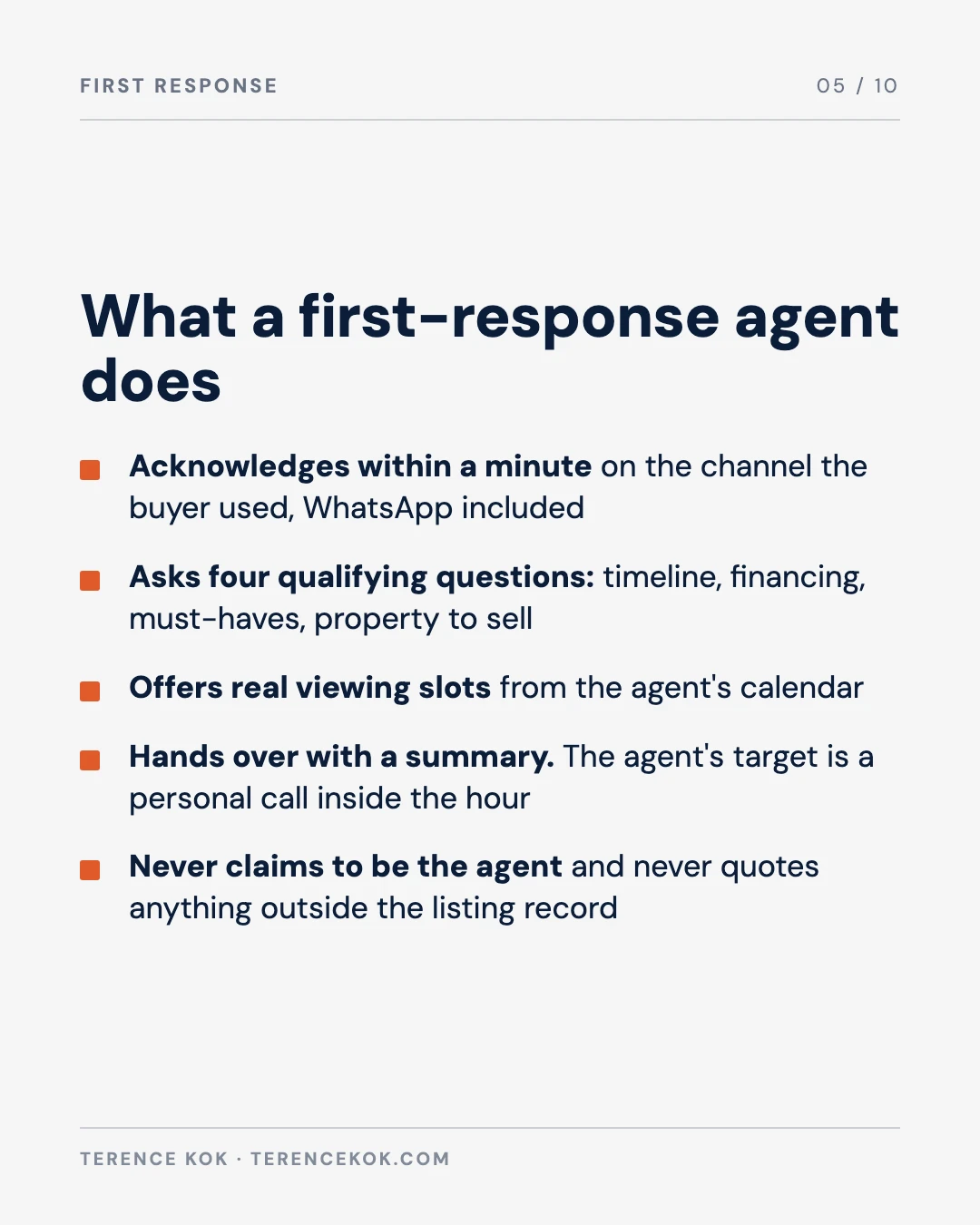
This is the job a well-built AI first-responder does. It acknowledges the enquiry within a minute, on the channel the buyer used, and asks the three or four questions an experienced agent would ask before booking a viewing: timeline, financing status, must-haves, whether they have a property to sell first. It offers viewing slots from the agent’s real calendar. It then hands the conversation to a named agent with a summary, and the agent’s target is a personal call inside the hour. In Singapore that conversation happens on WhatsApp more often than by email, and the tooling now supports that channel natively.
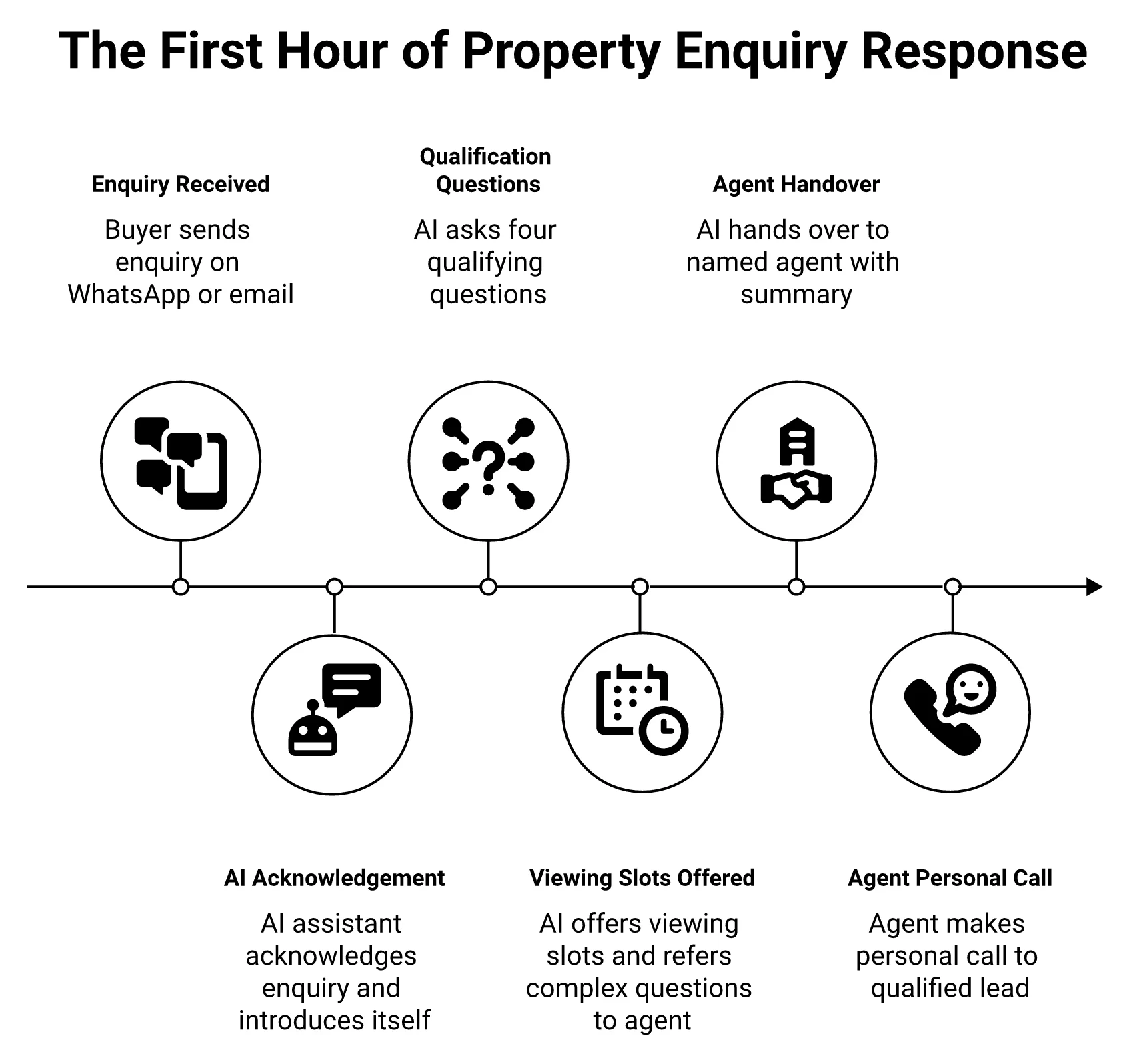
Two rules keep this safe. The AI introduces itself as an assistant and never claims to be the agent. And it does not quote prices, availability, or anything about the property that is not in the listing record. When it does not know, it says a person will come back with the answer. The first rule is a matter of trust and, in several jurisdictions, disclosure law. The second is what stops a helpful-sounding model from inventing a balcony.
Free tool
Agent Risk Assessment Matrix
Place a first-response agent on the autonomy and consequence grid and get the controls it needs before it talks to a buyer, including what it may and may not say unsupervised.
Lead scoring should run on behaviour
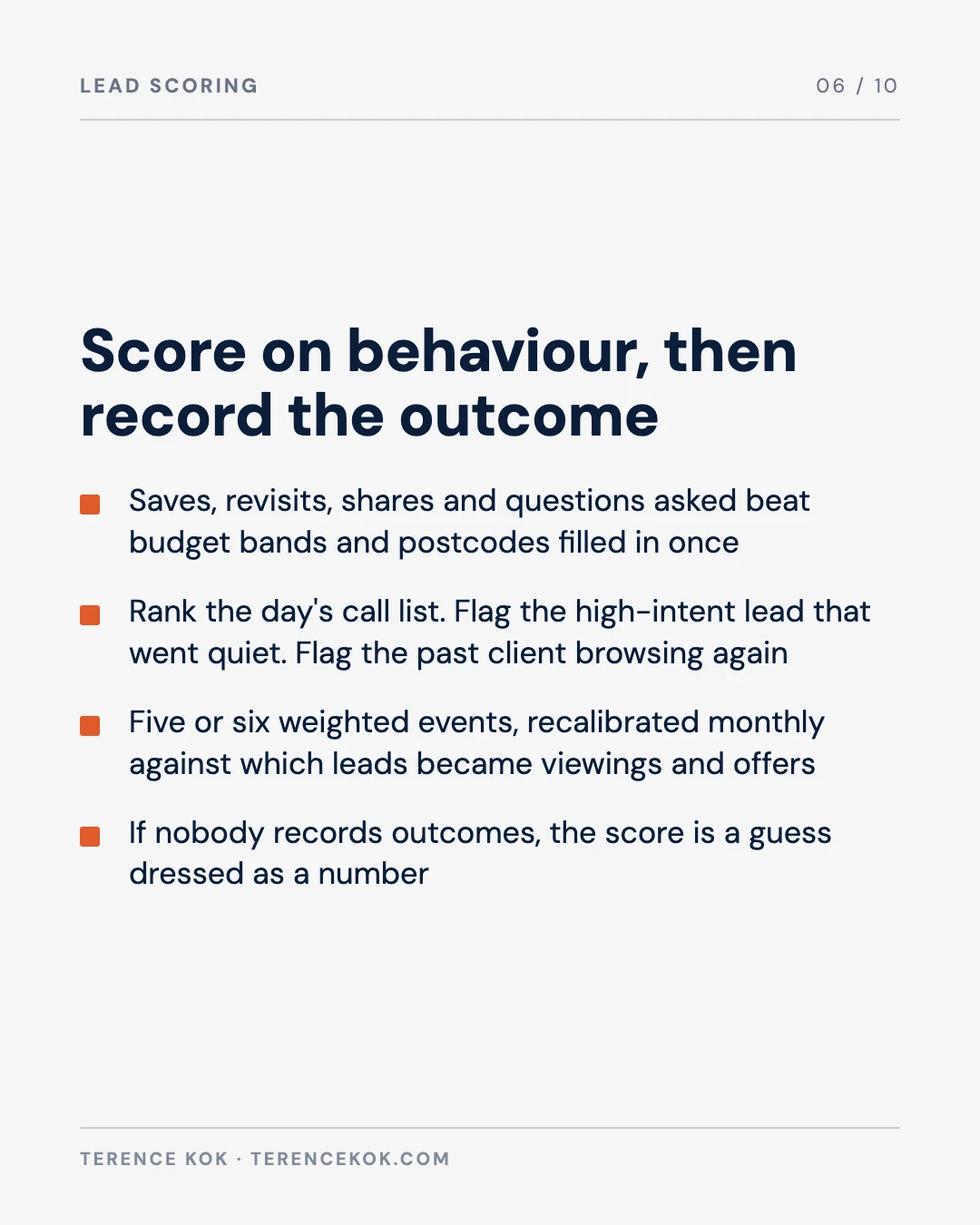
The second measurable use is deciding who to call first. Most agencies score leads on what the buyer declared: budget band, preferred district, bedroom count, a self-reported timeline. Those fields are filled in once, often optimistically, and never updated.
Behaviour is a better signal, and the portals already collect it. Zillow’s own analysis of two years of US sales found that listings saved by five or more users a day typically went under offer within a week, and listings saved by fewer than one a day sat for over a month. That is a listing-side statistic published by a portal with a product to sell, so I grade it accordingly below, but the direction matches what every experienced agent knows from the floor: the buyer who saves a listing, comes back to it three times, shares it with someone and asks about the maintenance fee is closer to a transaction than the buyer who filled in a form with a large budget and never returned.
A scoring model that reads those signals, from the portal, the agency website and the CRM together, does three things an agent cannot do by hand. It ranks the day’s call list. It flags the lead that went quiet after high engagement, which is usually a buyer who found something elsewhere and is still worth a call. And it notices the seller-side signal that agents miss most often: a past client who has started browsing again, which in a market where sellers hold a home for a median of eleven years before selling is the earliest sign of a listing appointment.
The model does not need to be sophisticated. A weighted score on five or six behavioural events, recalibrated monthly against which leads converted, beats most of what agencies buy off the shelf. The discipline that matters is feeding it real outcomes. If nobody records which leads became viewings and which viewings became offers, the score is a guess dressed as a number.
Listing content carries the most regulatory exposure
Drafting is where most agents started and it does save time. Property descriptions, social captions, the twelve variants of an email for different buyer segments, a translation of the listing into Mandarin or Bahasa: all of that is faster with a model and none of it needs to be worse.
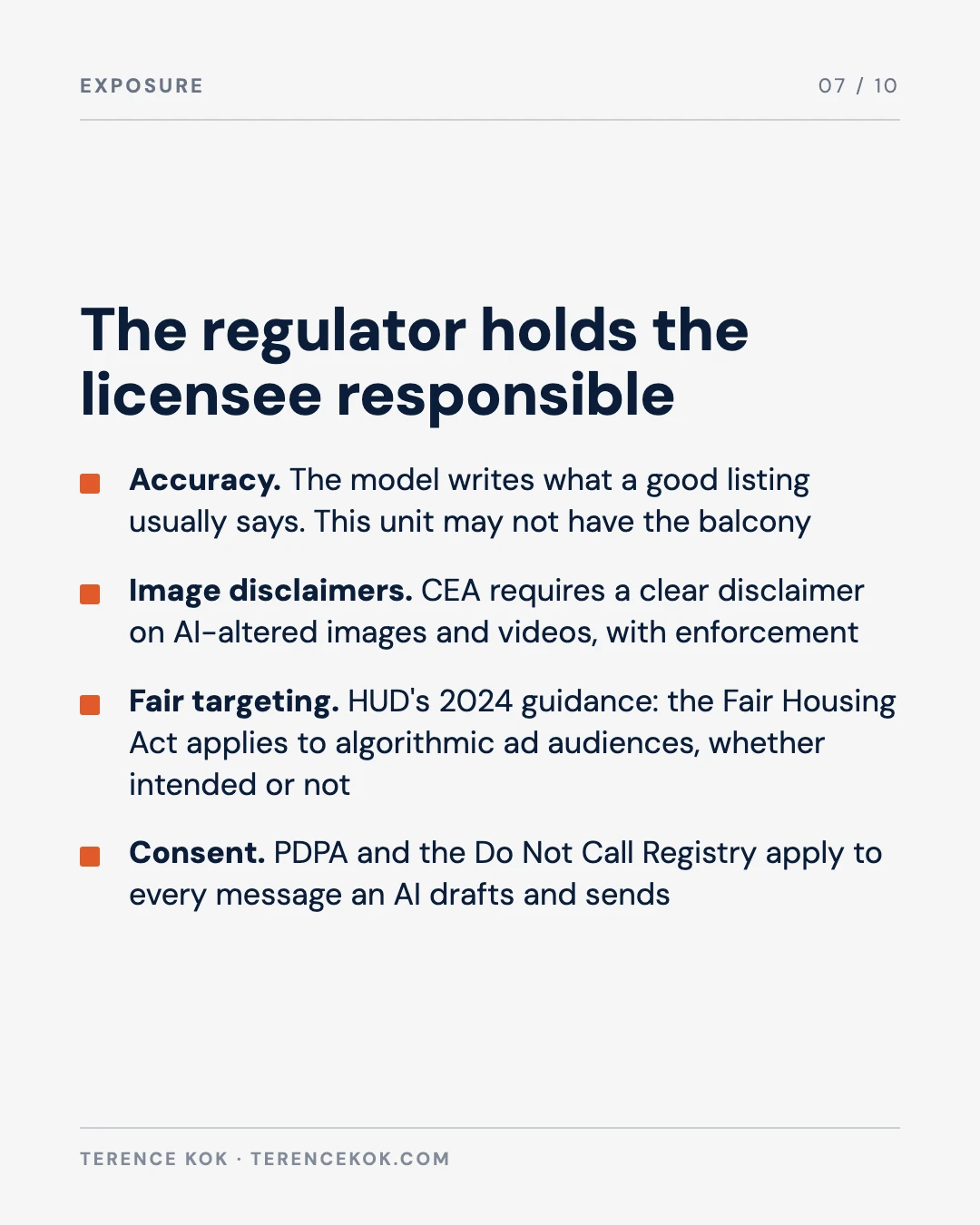
The risk is that the model writes what a good listing usually says, and this property may not have it. The typical failures are a draft that describes a balcony the unit does not have, a “recently renovated” kitchen that was last touched in 2009, and an MRT station that is a 25-minute walk described as “steps away.” None of that is malice. The model is pattern-matching to thousands of listings, and the pattern includes features this unit lacks.
The regulator does not care which tool wrote it. In Singapore, the Council for Estate Agencies’ code of ethics requires marketing materials to accurately reflect the property, and the CEA has said publicly that agents must provide clear disclaimers when AI is used to alter or enhance images or videos, with enforcement action for those who do not. It is reviewing its regulations to give further guidance on AI in advertising. Every ad still needs the salesperson’s registration number and the agency name. The same logic runs through the advertising codes in most markets I work in: the licensed person is responsible for the claim, regardless of who or what drafted it.
Image enhancement deserves its own line because it is where the technology is most tempting. Virtual staging, sky replacement, decluttering and twilight conversion all sell a property harder. Used with a disclosure they are fine. Used without one they are a misrepresentation with a timestamp, and the buyer who turns up to a viewing and finds a different room is the complaint that reaches the regulator.
The control is simple. One person who has physically seen the property signs off every description and every enhanced image before it goes live, and the sign-off is recorded. That takes five minutes a listing and removes most of the exposure.
Targeting and outreach need a fairness and consent check
The third place AI shows up in real estate marketing is deciding who sees the ad and who receives the follow-up. This is where the legal exposure is largest and least understood.
In May 2024 the US Department of Housing and Urban Development issued guidance making explicit that the Fair Housing Act applies to housing advertising delivered through algorithmic targeting, whether or not the exclusion was intentional. The examples HUD gave are exactly the optimisations an ad platform performs by default: an audience model trained on who responded before ends up excluding families with children, particular language groups, or residents of particular neighbourhoods, because the historical data was shaped that way. That guidance now sits in HUD’s archive after a change of administration, but the statute it interpreted has not changed, and Meta settled a Justice Department lawsuit on the same point in 2022.
Singapore does not have a fair housing statute in that form, but the same mechanism appears through two other doors. The Personal Data Protection Act governs what data an agency can use to profile a buyer and requires consent for marketing messages, and the Do Not Call Registry applies to every telemarketing message sent to a Singapore number, including messages an AI drafts and schedules. An outreach agent that sends a “just checking in” WhatsApp to a number on the registry has committed the breach, and the agency’s name is on it.
The practical checks are these. No protected characteristic, and no proxy for one, goes into the targeting model; postcode and language are the two proxies that slip through most often. Every outreach list passes through the DNC check before an AI sends anything. And the AI does not send a first message to anyone who has not enquired, because cold outreach is where consent is thinnest and complaints are most likely.
How far each sales job can be handed to AI
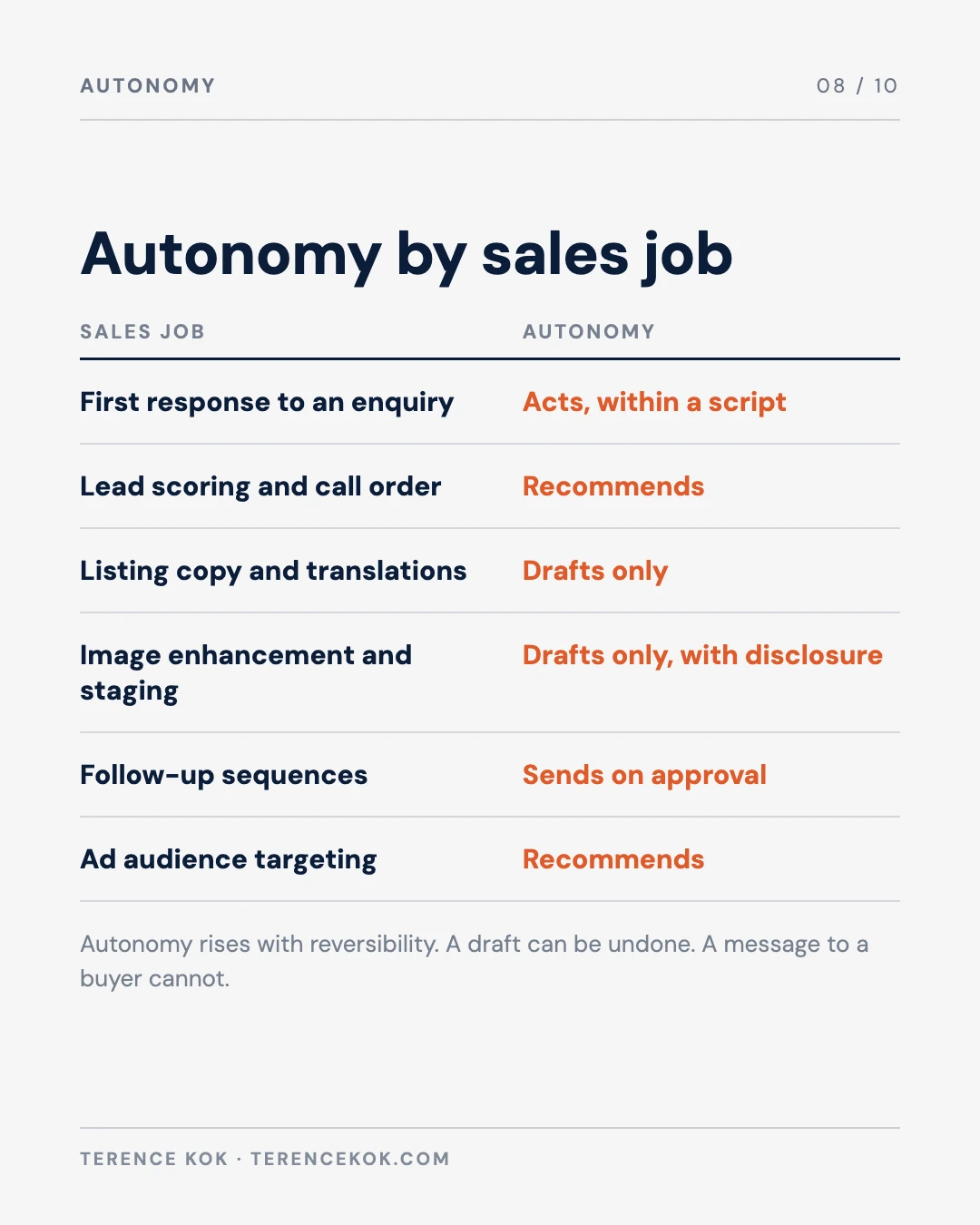
The pattern across the four uses above is the same one I apply to agentic AI in any sector: autonomy should rise with reversibility. A draft can be undone. A message to a buyer cannot. The table below is how I would set the boundaries for an agency starting now.
| Sales job | What the AI does | Where the human stays | Autonomy |
|---|---|---|---|
| First response to an enquiry | Acknowledges within a minute, qualifies on four questions, offers real calendar slots, hands over with a summary | Personal call inside the hour; any question about price, availability or the property beyond the listing record | Acts, within a script |
| Lead scoring and call order | Ranks the day’s list on behavioural signals, flags re-engaged past clients and gone-quiet high-intent leads | Decides who to call and what to say; records outcomes so the score keeps learning | Recommends |
| Listing copy and translations | Drafts descriptions, captions, segment variants, translations from the listing record | A person who has seen the property signs off every draft; sign-off is recorded | Drafts only |
| Image enhancement and staging | Virtual staging, decluttering, lighting | Disclosure on every enhanced image; original photo retained | Drafts only |
| Follow-up and nurture sequences | Drafts personalised follow-ups after a viewing, schedules the cadence | Approves each sequence; DNC and consent check runs before any send | Drafts, sends on approval |
| Ad audience targeting | Proposes segments from engagement data | Removes protected characteristics and their proxies; reviews audience composition monthly | Recommends |
”Acts, within a script” means the AI may complete the interaction unsupervised but only along a bounded conversation it cannot leave. “Recommends” means a person makes the call every time. “Drafts only” means nothing reaches a buyer without a named approval.
Free tool
AI Use Case Prioritisation Matrix
Score the six jobs in the table above, or your own list, on value and readiness and get a sequence for the next two quarters instead of trying all six at once.
What to measure in the first ninety days
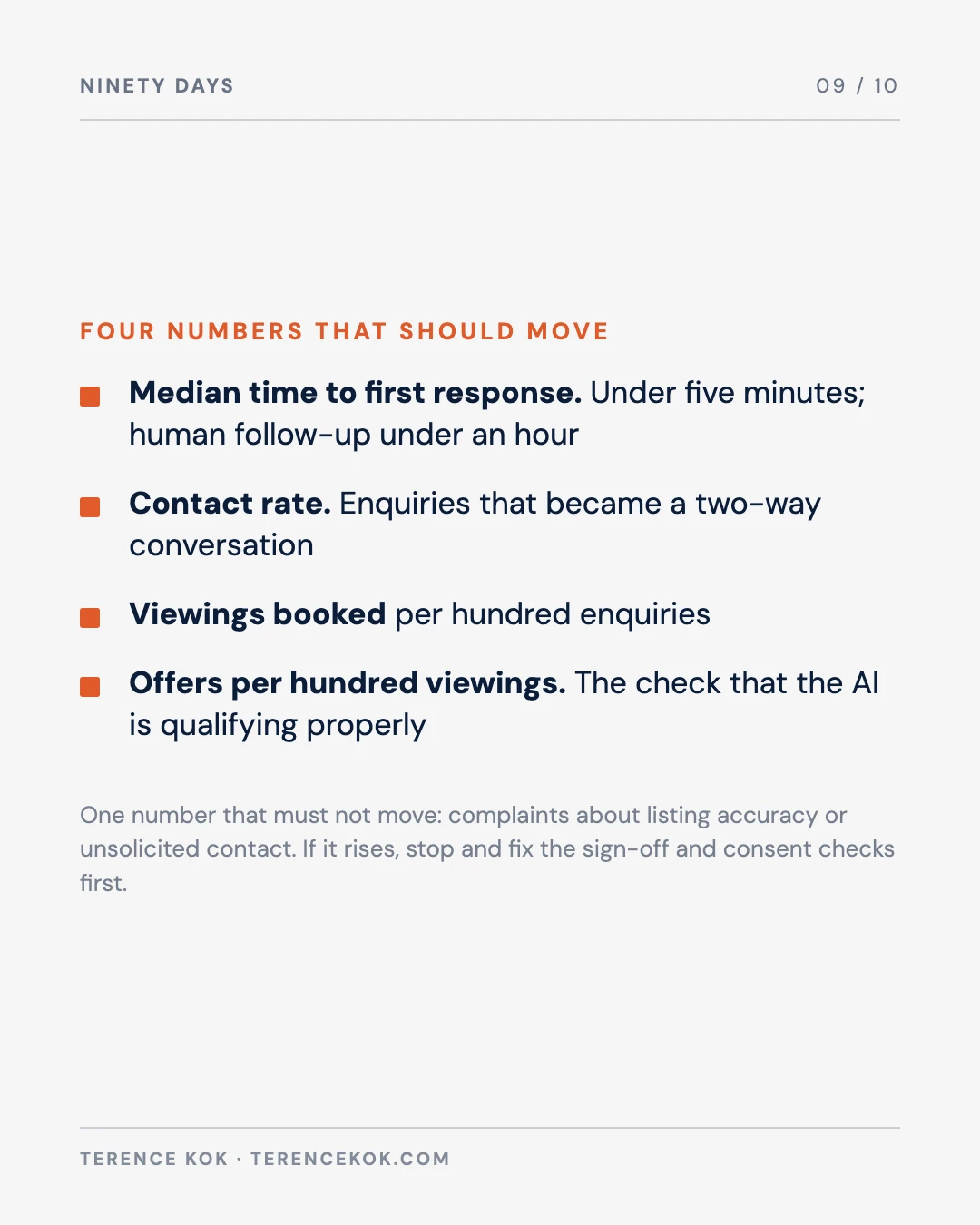
An agency that does the first-response and lead-scoring work properly will see the result in four numbers, and none of them are “hours saved.”
Median time to first response, measured from the enquiry timestamp to the first human-or-AI reply, with the target under five minutes and the human follow-up under an hour. Contact rate, the share of enquiries that became a two-way conversation, which is the number the Harvard study was measuring. Viewing-booked rate per hundred enquiries. And offers per hundred viewings, which is the check that the AI is qualifying properly and not filling the calendar with tyre-kickers.
Alongside those four, one number that must not move: complaints about listing accuracy or unsolicited contact. If that rises, the programme is buying speed with the agency’s licence, and it should stop until the sign-off and consent checks are fixed.
Evidence & Methodology
The response-time evidence is strong but old and from other sectors. The adoption numbers are current but self-reported by agents. The portal statistic comes from a company selling the product. My own claims about where the gains sit come from client work outside the property sector as much as inside it. Here is the grading.
| Claim | Source | Grade |
|---|---|---|
| 68% of Realtors have used AI; 46% report no noticeable impact; 46% use AI-generated content; 7% use a chatbot for lead capture; 21% use an AI-insight CRM | NAR 2025 Technology Survey, US Realtor members, self-reported | Measured, self-reported |
| Contact within an hour is nearly 7x as likely to qualify a lead; 42-hour average response; 23% never reply | Oldroyd, McElheran and Elkington, HBR, 2011. 2,241 audited companies and 1.25 million leads at 42 firms, across finance, autos, software and education. One author ran a lead-response software company | Measured, different sector, 2011 |
| Listings saved 5+ times a day go under offer within a week; under 1 save a day sits for over a month | Zillow Research, 2025, two years of US sales; published by a portal with a listing product to sell | Reported, vendor-published |
| Sellers hold a home for a median of 11 years before selling | NAR 2025 Profile of Home Buyers and Sellers | Measured, US only |
| Fair Housing Act applies to algorithmic ad targeting whether or not exclusion was intended | HUD guidance, 2 May 2024, now archived; the statute is unchanged | Measured, regulatory text |
| CEA requires accurate marketing and disclaimers on AI-altered images, with enforcement | CEA statements reported February 2026; CEA blog, July 2025 | Reported, regulator statement |
| Generative AI could add US$110 to 180 billion of value to commercial real estate | McKinsey Global Institute, November 2023 | Forecast |
| The measurable gains sit in first response and lead scoring, not content drafting | My own read, from sales-automation and agent-governance work outside property as much as inside it | My call |
Sources
- National Association of Realtors. (2025). Realtors embrace AI, digital tools to enhance client service, NAR survey finds, summarising the 2025 Realtor Technology Survey.
- Oldroyd, J. B., McElheran, K., & Elkington, D. (2011). The short life of online sales leads. Harvard Business Review, March 2011.
- Real Estate News. (2025). The ‘magic number’ of listing views for a fast sale, reporting Zillow Research’s analysis of views, saves and shares.
- National Association of Realtors. (2025). Top 10 takeaways from NAR’s 2025 Profile of Home Buyers and Sellers.
- US Department of Housing and Urban Development. (2024). HUD issues Fair Housing Act guidance on applications of artificial intelligence.
- Marketing-Interactive. (2026). AI-generated ads under scrutiny, but no complaints lodged with Singapore watchdogs, including the Council for Estate Agencies’ position on AI-altered images.
- Council for Estate Agencies. (2025). AI innovation and compliance: vital for the real estate agency industry.
- Bisnow. (2023). McKinsey: real estate must change to unlock $180B in potential value from generative AI, reporting McKinsey Global Institute’s November 2023 estimate.
Where to start this quarter
Pull the last ninety days of enquiries out of the CRM and the portals and measure one thing: median time from enquiry to first human reply. Few agencies have ever looked. When they do, the number is usually measured in hours, sometimes days, with a long tail that was never answered. That single figure is the business case for everything above.
Then put a first-responder on one channel for one team, with the script bounded to the listing record and the hand-off target set at one hour. Run it for a month against the enquiries the other teams still handle by hand, and compare contact rate and viewings booked. If the lift is there, expand to the next channel. Leave the content drafting running in the background; it is useful, and it was never the point.

Audiences Don't Trust AI-Made Ads. Marketers Think They Do.
Why a visible human decision in the listing keeps buyer trust when a disclosure label does not.

Why Your Choice of First AI Use Case Will Make or Break the Programme
The general case for choosing a first use you can measure, which is the argument this post makes for property.

AI Can Triage. It Can't Be Accountable. Most Enterprises Have the Order Backwards.
The principle behind the sign-off rule: the AI can qualify and rank, but a named person owns what reaches the buyer.

Where Agentic AI Actually Works Today (Singapore Data Inside)
Which agent patterns are working in Singapore businesses now, including customer-facing first response.
If your agency or sales team is deciding where AI goes first, the ninety-day measurement above is the conversation I usually start with. My consulting work covers scoping that first deployment and building the sign-off and consent controls around it.