
Executive Summary
For most of my career, and probably yours, the deal was simple: put in the years, make fewer mistakes, get paid more. AI now runs that same pattern-matching in seconds, for a fraction of the cost. Tenure alone stopped being the asset it used to be, and what replaces it is not the technical course everyone is rushing to take.
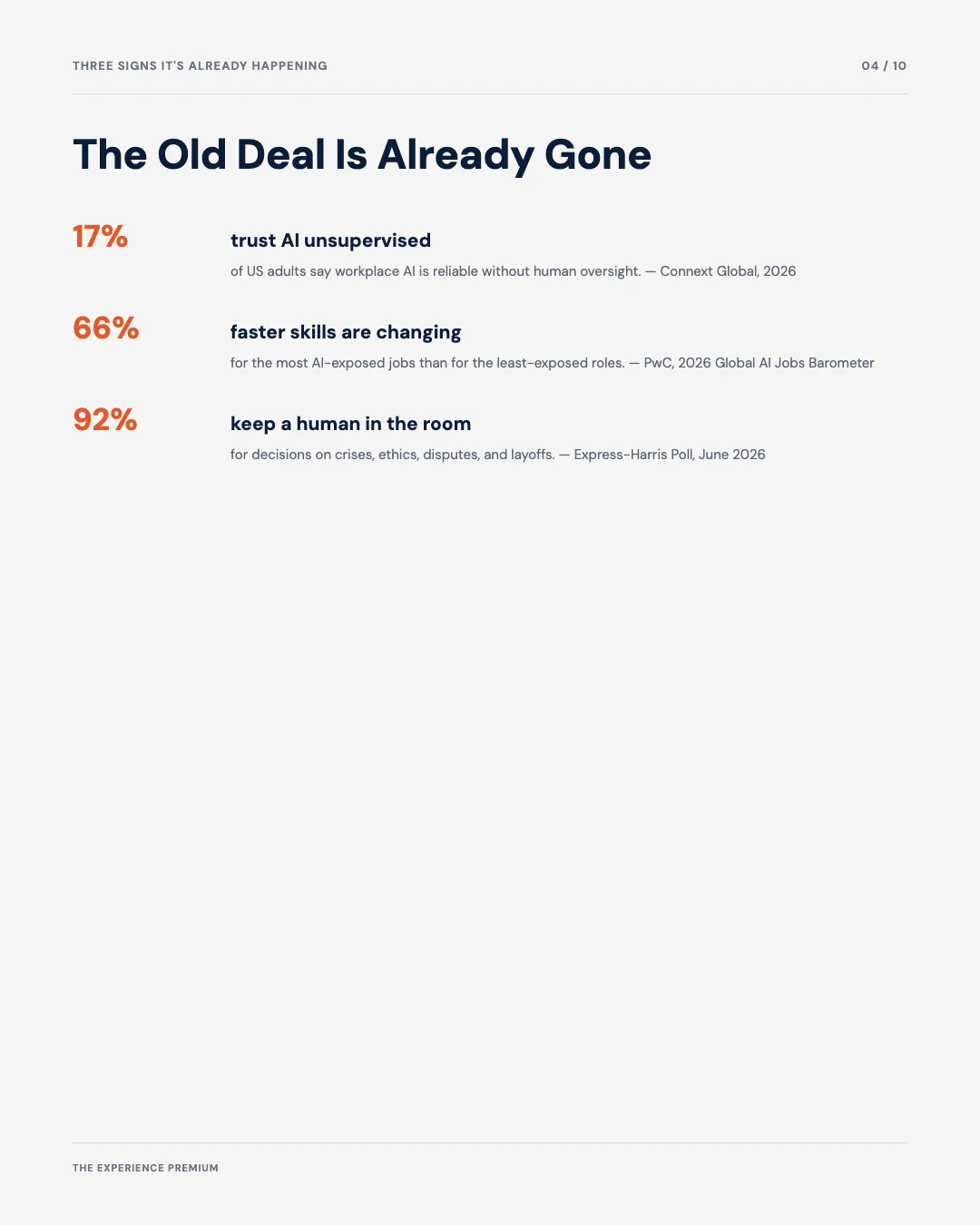
17%
of US adults say workplace AI is reliable without human oversight, per the Connext Global 2026 AI Oversight Report
66%
faster the skills needed for the most AI-exposed jobs are changing than for the least-exposed roles, per PwC’s 2026 Global AI Jobs Barometer
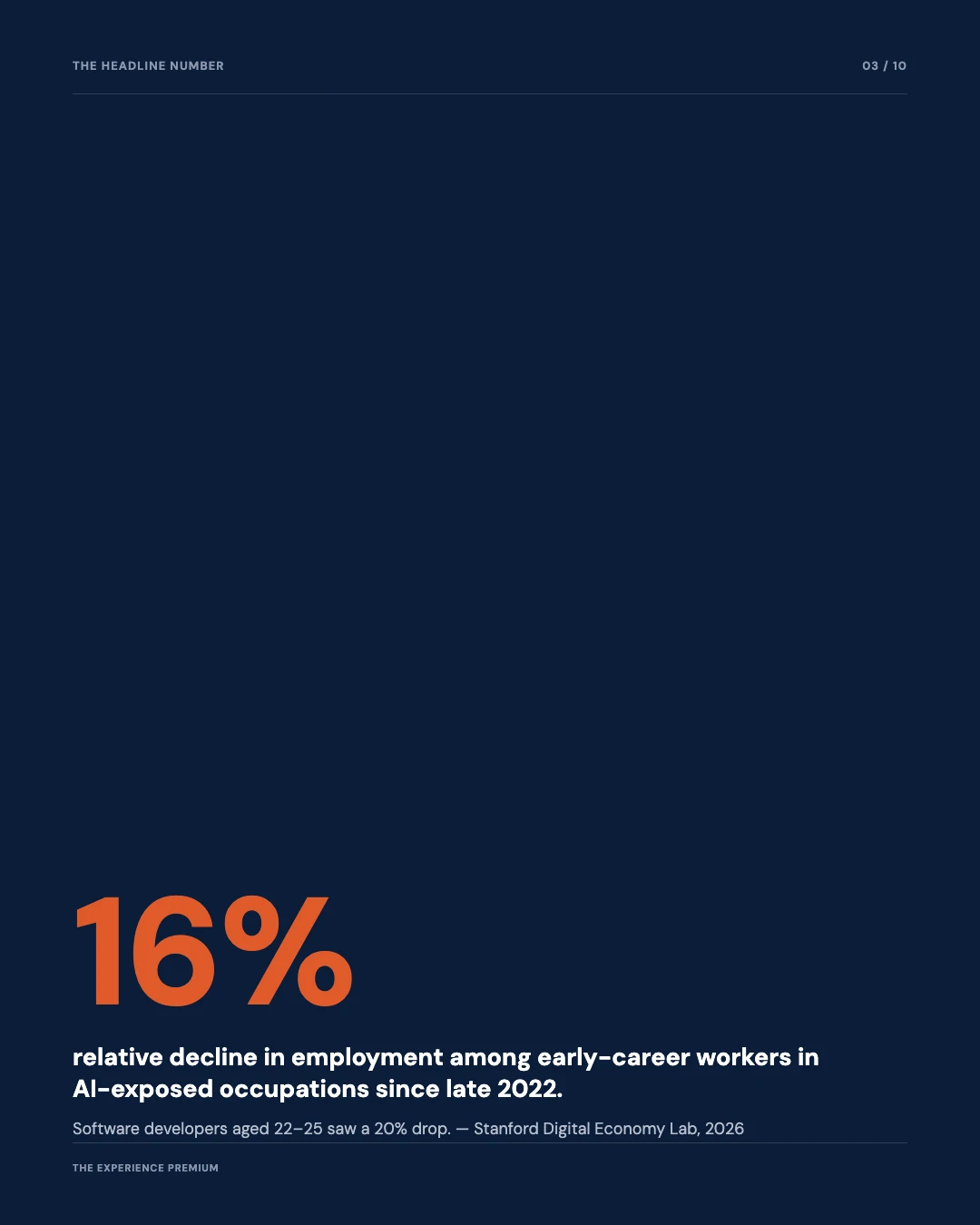
16%
relative decline in employment among early-career workers in AI-exposed occupations since late 2022, per Stanford Digital Economy Lab
92%
of employers say their company is committed to keeping a human in decisions involving crises, ethics, disputes, feedback, and layoffs, per an Express Employment Professionals-Harris Poll, June 2026
Core conclusions
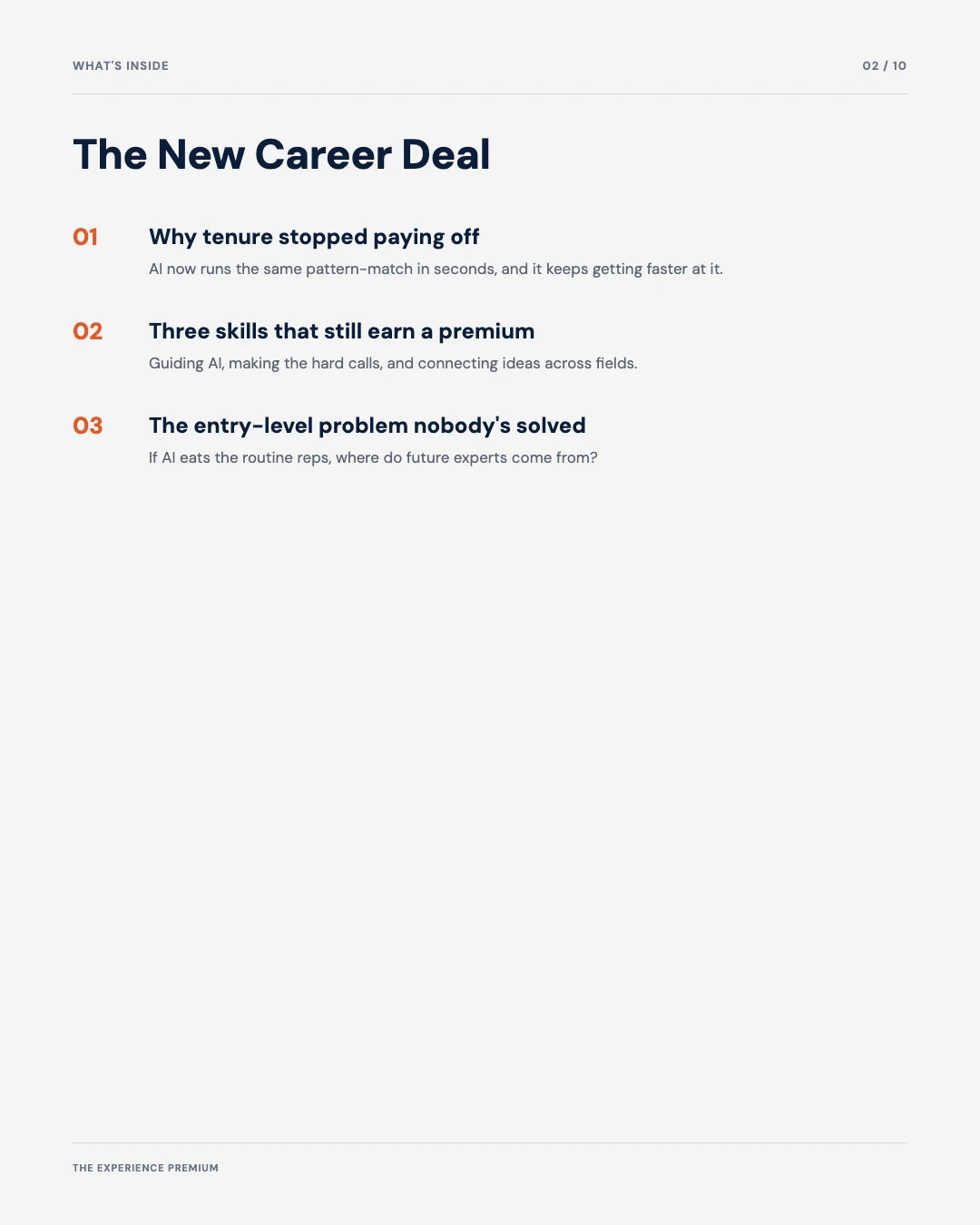
- The old deal (more years, fewer errors, higher pay) is breaking because AI now performs the pattern-recognition part of experience in seconds rather than decades, and it keeps getting faster at it.
- Technical upskilling alone will not rebuild that deal. Skills in the most AI-exposed jobs are now changing 66% faster than the rest of the job market, which is faster than any training course can track. Human value has moved to three things a model still cannot do alone: guiding and checking its work, making calls that need empathy and trust, and connecting ideas across fields it treats as separate.
- The open wound is entry-level work. If AI absorbs the routine reps juniors used to learn on, companies still have not worked out how to grow, or reward, the judgment that used to come from doing those reps yourself.
The three-skill playbook, in ten slides
Save it, share it, or send it to whoever still thinks tenure alone is the plan.


The old deal is breaking
For most of my career, the unwritten rule was clear. Put in the years, and you made fewer mistakes. Make fewer mistakes, and you solved problems faster, because you had already seen a version of this one before. Solve problems faster, and you got paid more. That was the deal, and it held for decades because pattern recognition, the kind you build by living through enough cases, used to be something only a human brain, aged by experience, could do well.
AI broke that link. A model can now scan years of tickets, contracts, or transactions in seconds and surface the pattern a twenty-year veteran would have taken a career to notice. It does this cheaply, and it does not need to sleep, retire, or ask for a raise. Simply having tenure, on its own, no longer guarantees an edge. That does not make experience worthless. It makes raw tenure, unattached to anything else, a much weaker bet than it used to be.
| Signal | Value | Source |
|---|---|---|
| US adults who say workplace AI is reliable without human oversight | 17% | Connext Global, 2026 AI Oversight Report |
| Companies with no reliable AI committed to “AI plus dedicated oversight” | 35% | Connext Global, 2026 AI Oversight Report |
| Gap in pace of skill change between the most and least AI-exposed jobs | 66% faster | PwC, 2026 Global AI Jobs Barometer |
| Increase in that skills-change gap versus a year earlier | 75% | PwC, 2026 Global AI Jobs Barometer |
| Early-career employment decline in AI-exposed occupations since late 2022 | 16% | Stanford Digital Economy Lab, 2026 |
| Entry-level job postings in the US, last 18 months | -35% | Revelio Labs, 2026 |
Two things are true at once: AI adoption is not slowing down, and most companies still do not trust it to run unsupervised. That gap between adoption and trust is exactly where human value is relocating.
Why “I’ve seen this before” stopped being the trump card
Many people are responding to this shift the way you would expect: by learning new technical skills. That instinct is not wrong. Continuous learning still matters. But it is running into a pace problem. PwC’s 2026 Global AI Jobs Barometer found that the skills needed for the most AI-exposed jobs are now changing 66% faster than for the least-exposed roles, a gap that grew 75% wider in a single year. Put plainly: by the time a course is designed, approved, and delivered, the AI capability it was built to answer has often already moved on. You cannot out-train a system that upgrades faster than any curriculum committee can meet.
That is the real lesson buried in the “learn to code” era of career advice. Learning specific tools will always help at the margin, but it is not a durable strategy on its own, because the tools keep changing under you. What does not keep changing as fast is the small set of things AI still cannot do by itself.
Three ways people still out-earn the model
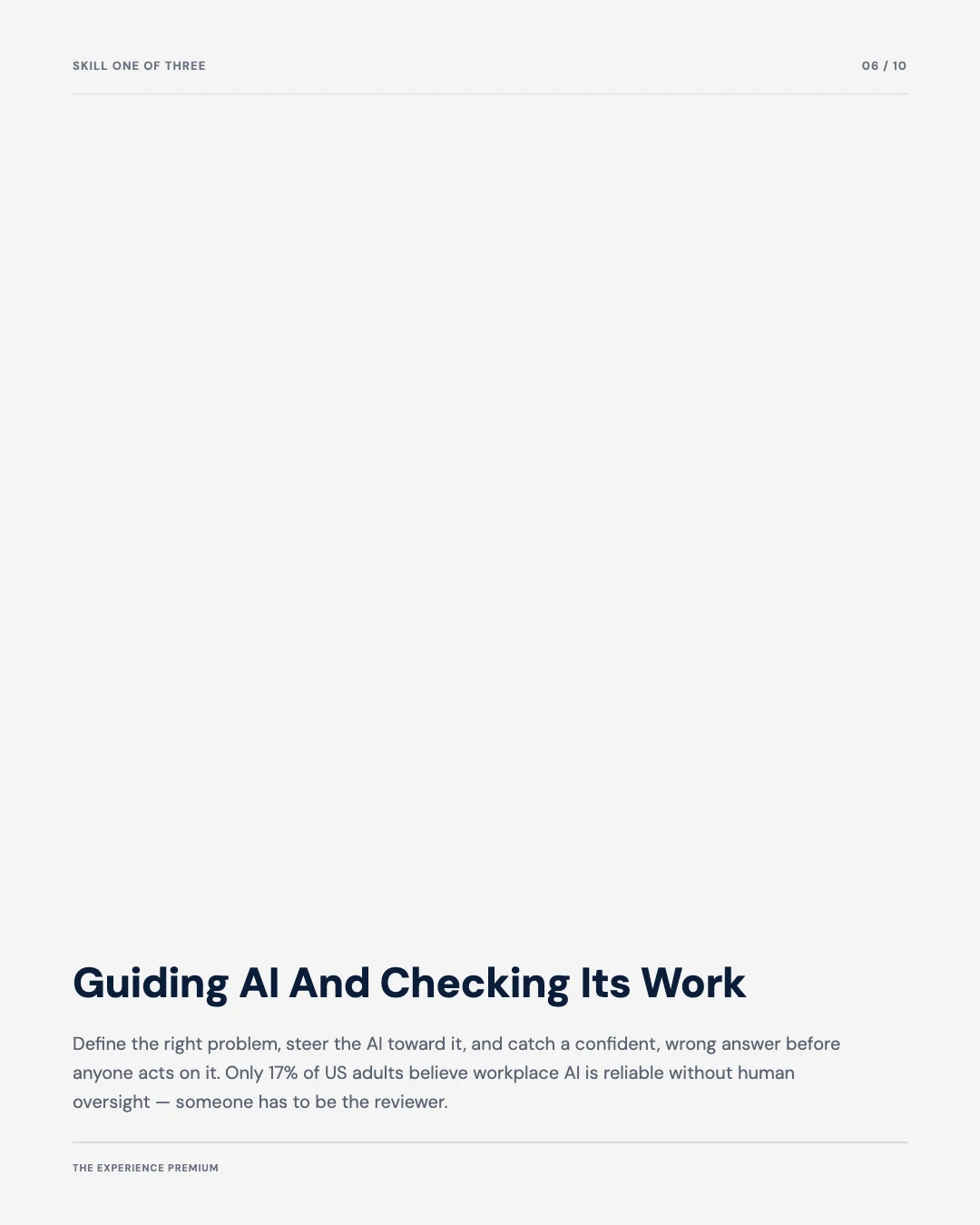
1. Guiding AI and checking its work
Instead of doing every task by hand, the higher-value job now is defining the right problem, steering the AI toward it, and making sure its answer is accurate and safe before anyone acts on it. This is not a lesser job than doing the work yourself. Only 17% of US adults believe workplace AI is reliable without human oversight, and close to two-thirds expect that human review will increase, not shrink, from here. Someone has to be that reviewer, and it has to be someone who understands the work well enough to catch a confident, wrong answer. I have written before about how much harder that verification work actually is than it looks, in AI Fatigue: Why Verification Is Harder Than Creation.
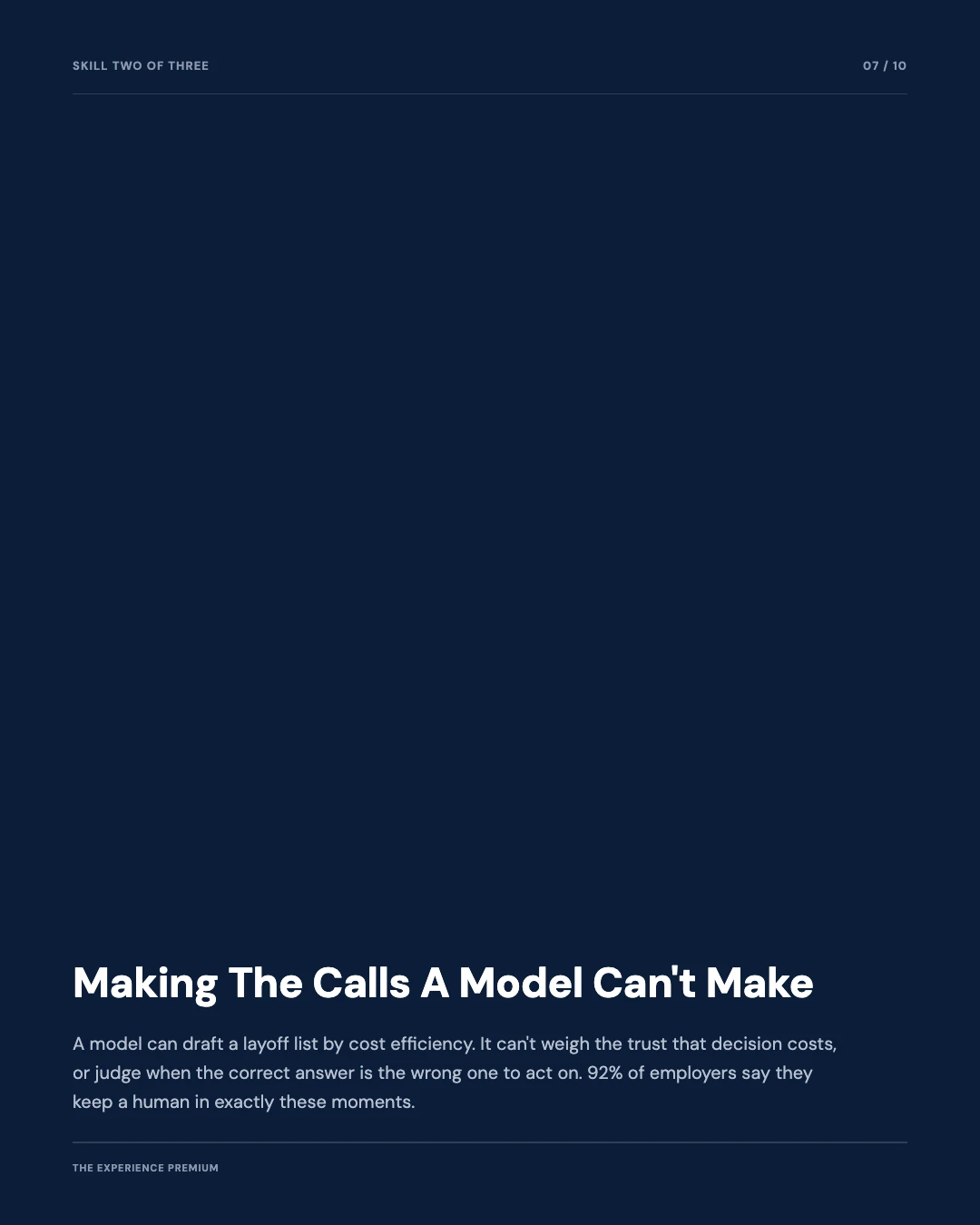
2. Making the calls a model can’t make
AI has no real grasp of human emotion, organisational culture, or what a specific team will consider fair. A model can draft a layoff list by cost efficiency. It cannot sit with the manager who has to deliver the news, weigh the years of trust that decision will cost, or judge when the technically correct answer is the wrong one to act on. Ninety-two percent of employers in a June 2026 Express Employment Professionals-Harris Poll said their company is committed to keeping a human in exactly these moments: crises, ethics, disputes, feedback, and layoffs. That is not sentimentality. It is a recognition that empathy, trust, and moral judgement are not things a model can be trained to feel, only imitate.
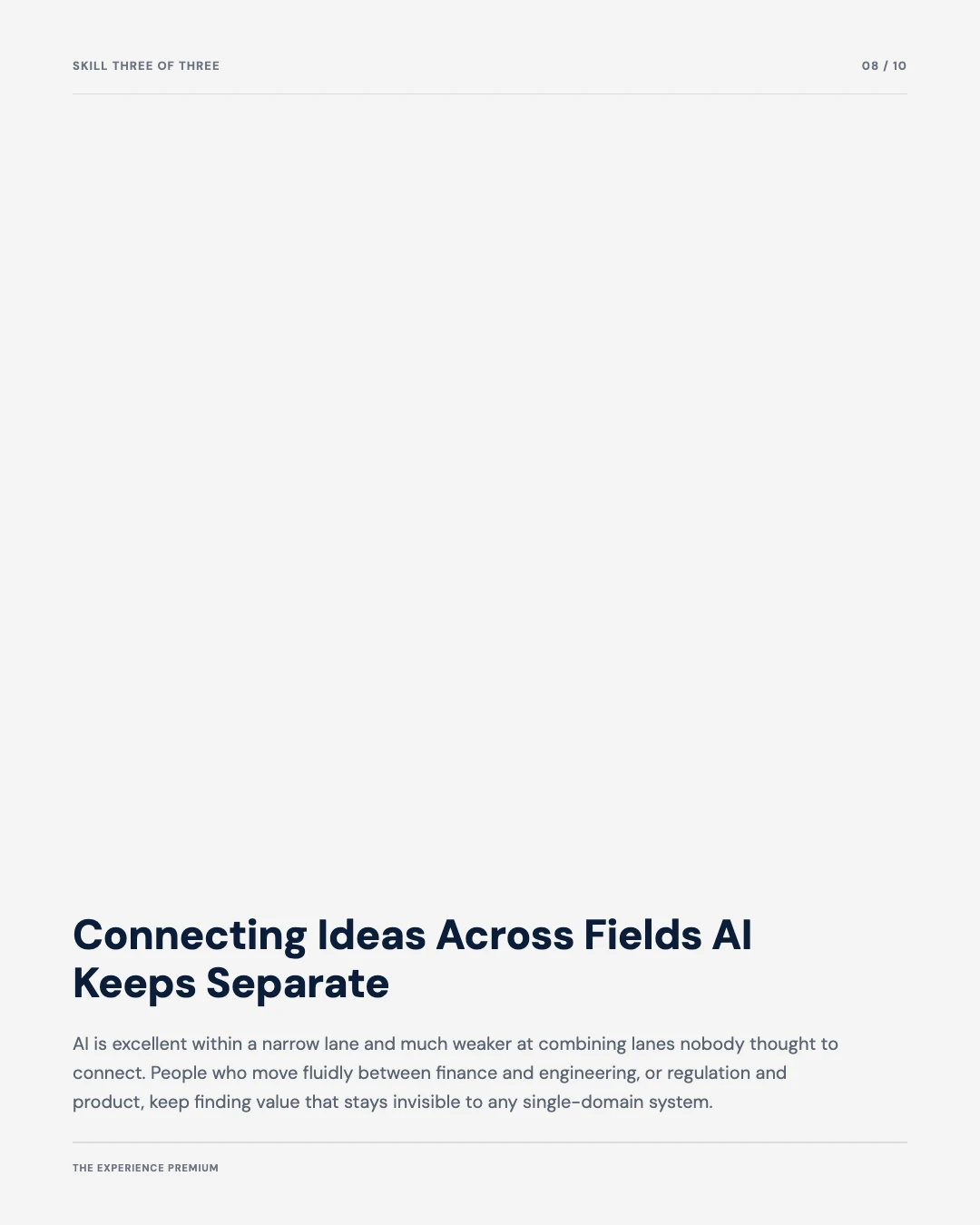
3. Connecting ideas across fields AI keeps separate
AI is usually excellent within a narrow lane and much weaker at combining lanes nobody thought to connect. A model fine-tuned on supply chain data will not spontaneously notice that the fix belongs in how the sales team writes contracts. People who move fluidly between finance and engineering, or between regulation and product design, keep finding value that stays invisible to any single-domain system. I go deeper on why this specific human quality, rather than technical depth alone, has become the differentiator in The Human Advantage in the Age of AI.
| What still needs a human | What it looks like day to day | Why AI can’t do it alone |
|---|---|---|
| Guiding and verifying | Defining the problem, choosing which tools the AI gets, catching a confidently wrong output before it ships | 17% trust AI output unsupervised; the rest need a reviewer who understands the work |
| Difficult, human decisions | Layoffs, disputes, culturally sensitive calls, judgement about fairness | Models have no real model of empathy, trust, or organisational history |
| Integrating diverse ideas | Spotting the fix that lives between two departments’ data | AI specialises within a niche; it does not go looking outside its lane |
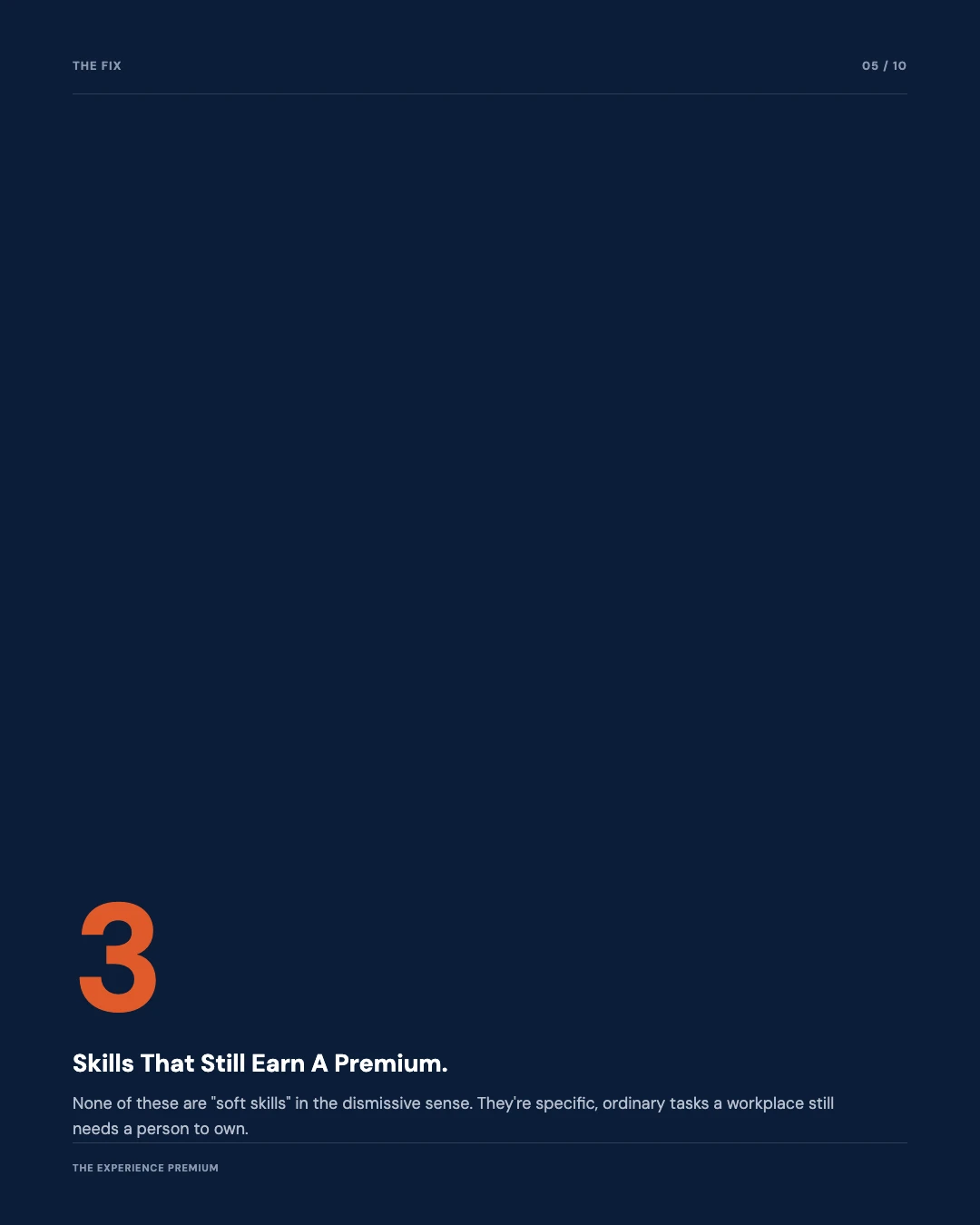
None of these three are “soft skills” in the dismissive sense. They are the specific, ordinary tasks a workplace still needs a person to own.
The problem nobody has solved: where do future experts come from?
Here is the part of this shift that worries me most, and it is structural, not personal. Senior judgement, the kind described above, was never handed to anyone on day one. It was built slowly, by doing the routine, entry-level version of a task hundreds of times until the pattern became instinct. That is exactly the layer of work AI is absorbing first. Entry-level job postings in the US have fallen roughly 35% over the last 18 months, and Stanford Digital Economy Lab’s analysis found a 16% relative decline in employment for early-career workers in AI-exposed occupations since late 2022, with the sharpest drops in software development. I wrote about the flip side of this same shift, and where the closing door is quietly opening a different one, in The Entry-Level Job Market Broke. Here’s the Opening It Left Behind.
If routine, entry-level tasks disappear before a person has done enough of them to build real judgement, the pipeline that produces the next generation of senior experts, the ones with the empathy and cross-field instinct AI still lacks, runs dry. That is not a problem AI can solve for us. It is a problem only employers can solve, deliberately, by redesigning how someone earns their first ten thousand hours when the easy reps are gone.
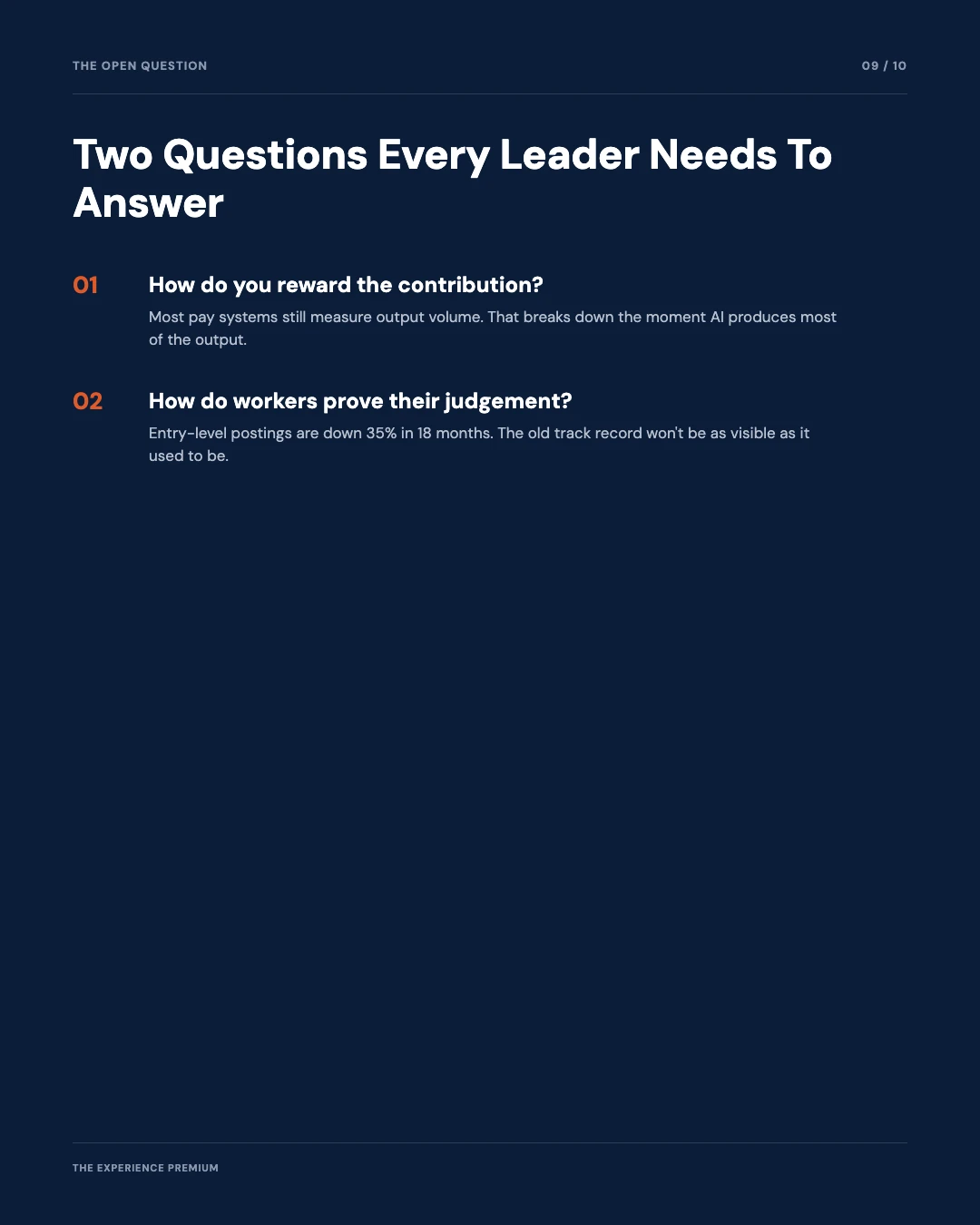
Two questions every leader needs an answer to
How should companies evaluate and reward human contribution as AI takes over routine tasks? Most performance and pay systems still measure output volume, tickets closed, reports written, code shipped. That measure breaks down the moment AI produces most of the volume. The organisations getting ahead of this are shifting towards measuring judgement calls made, errors caught before they became costly, and decisions a person was willing to put their name on.
What is the best way for workers to demonstrate judgement when traditional experience counts for less? The honest answer is visibility. A senior professional’s judgement used to be self-evident from their track record. When that track record includes fewer hands-on reps, judgement has to be demonstrated actively: catching a specific AI error in front of others, making a documented call under ambiguity, being the person a team turns to when a decision cannot be automated away.
Where to start this week
You do not need a five-year plan to act on this. You need to start being deliberate about the three things above, in your own role, this month. Notice where you are currently just executing AI output without really checking it. Notice the last difficult, human call you made that a model could not have made for you. Notice the last time you connected an idea from one part of the business to a problem in another. That is already the shape of the work that still pays a premium.
The honest truth is that the old deal, years in, mistakes down, pay up, is not coming back. What replaces it is not a mystery, and it is not another technical certificate. It is becoming the person who can be trusted to guide the AI, make the call it can’t make, and see the connection it missed.
Sources: Connext Global, 2026 AI Oversight Report; PwC, 2026 Global AI Jobs Barometer; Stanford Digital Economy Lab, employment analysis of AI-exposed occupations, 2026; Revelio Labs, US entry-level job postings analysis, 2026; Express Employment Professionals-Harris Poll, June 2026.
Free tool
Human-AI Interaction & Decision Quality
Benchmark how much your team defers to AI output versus checking it themselves, the exact skill described in Pillar 1 above.
Free tool
AI Use Case Prioritisation Matrix
Score candidate tasks for your team and see which ones actually need a human reviewer, versus which are safe to hand over.
The AI Governance & ROI Executive Programme walks leadership teams through exactly this shift: how to redesign performance measurement and career pathways once routine tasks move to AI. Details are on the workshops page.