Executive Summary
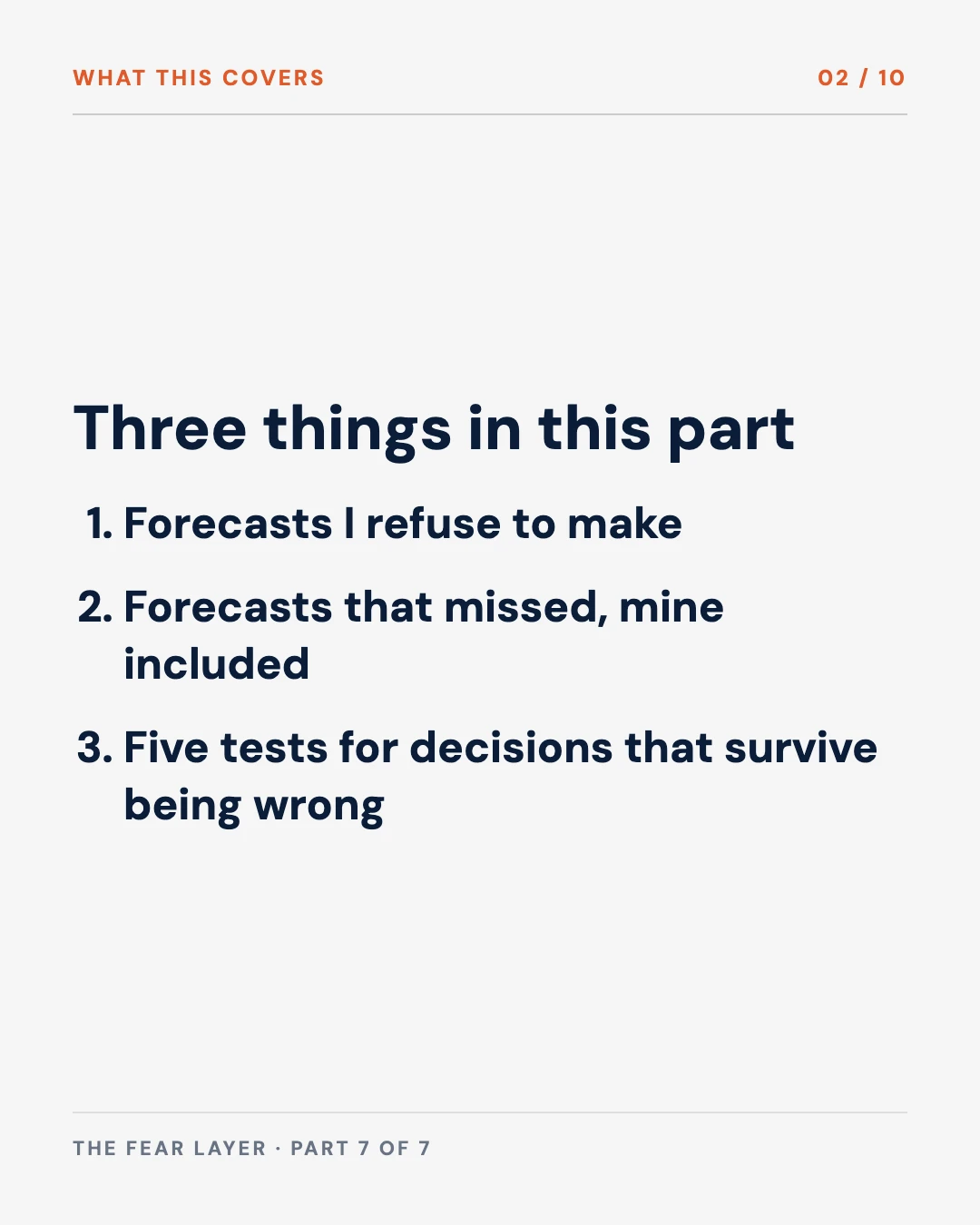
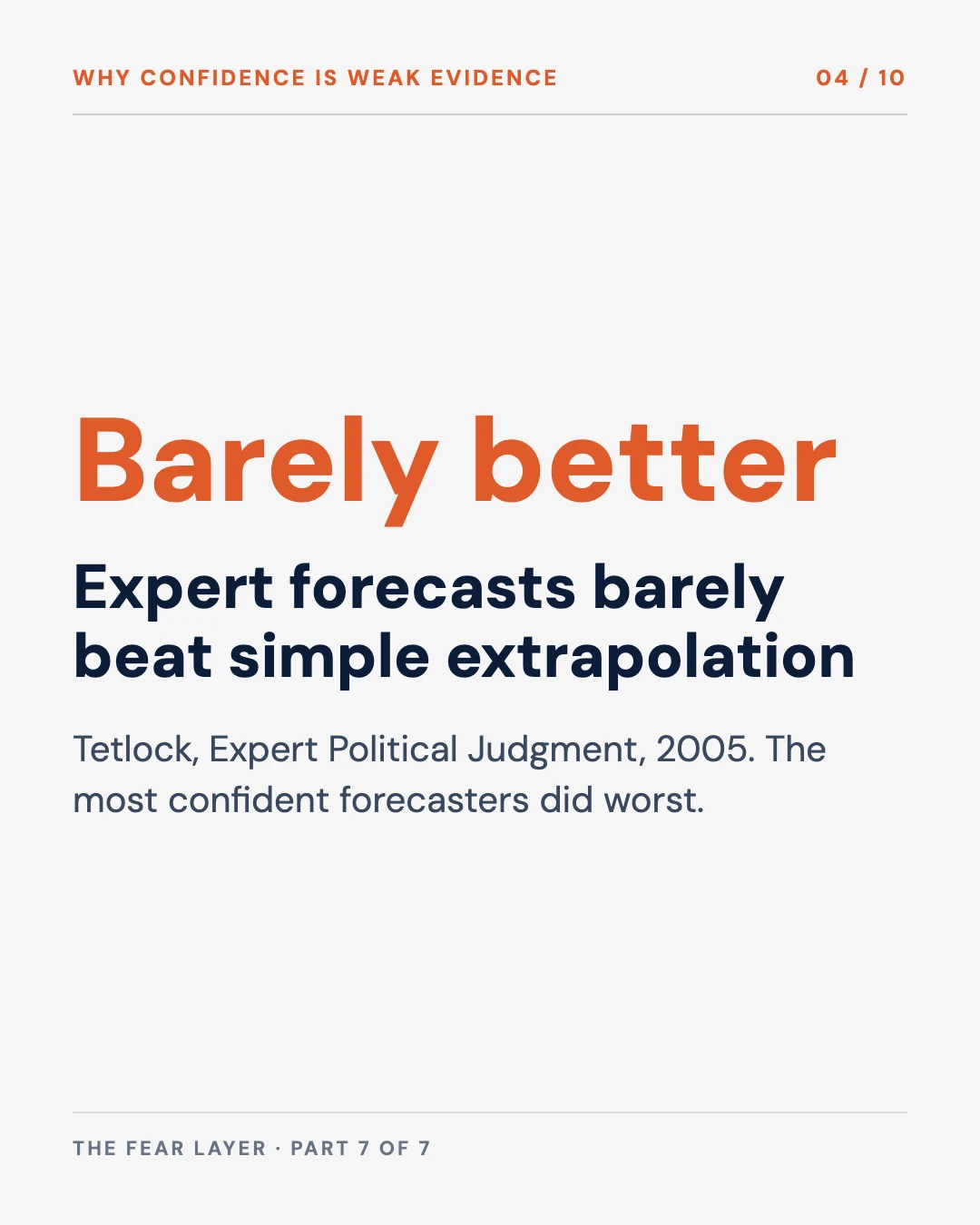
Nobody can tell you where AI goes from here, and the people who sound most certain have the worst record. Tetlock’s long study of expert forecasts found that specialists did little better than simple extrapolation, and the most confident were often the least accurate. The useful response is to stop trying to forecast and to make decisions that still work when the forecast is wrong. That is a skill, and it can be practised.
Core conclusions
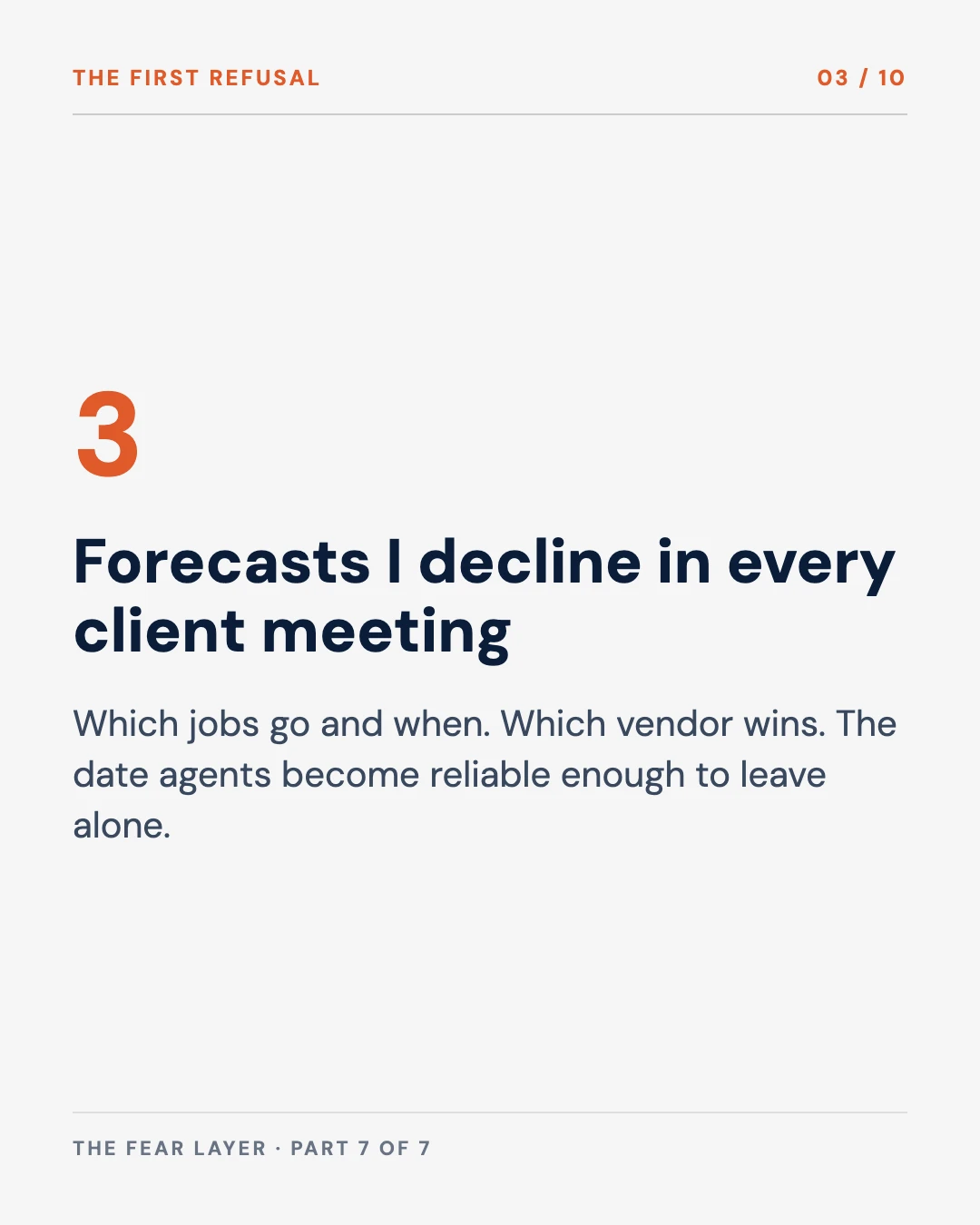
- There are forecasts worth refusing: which jobs go and when, which vendor wins, and the date agents become reliable. The evidence does not support a number for any of them.
- Public forecasts from the best-informed people in the field have missed badly. Mine have missed too, in smaller ways, and the only misses I can show you are the ones I wrote down.
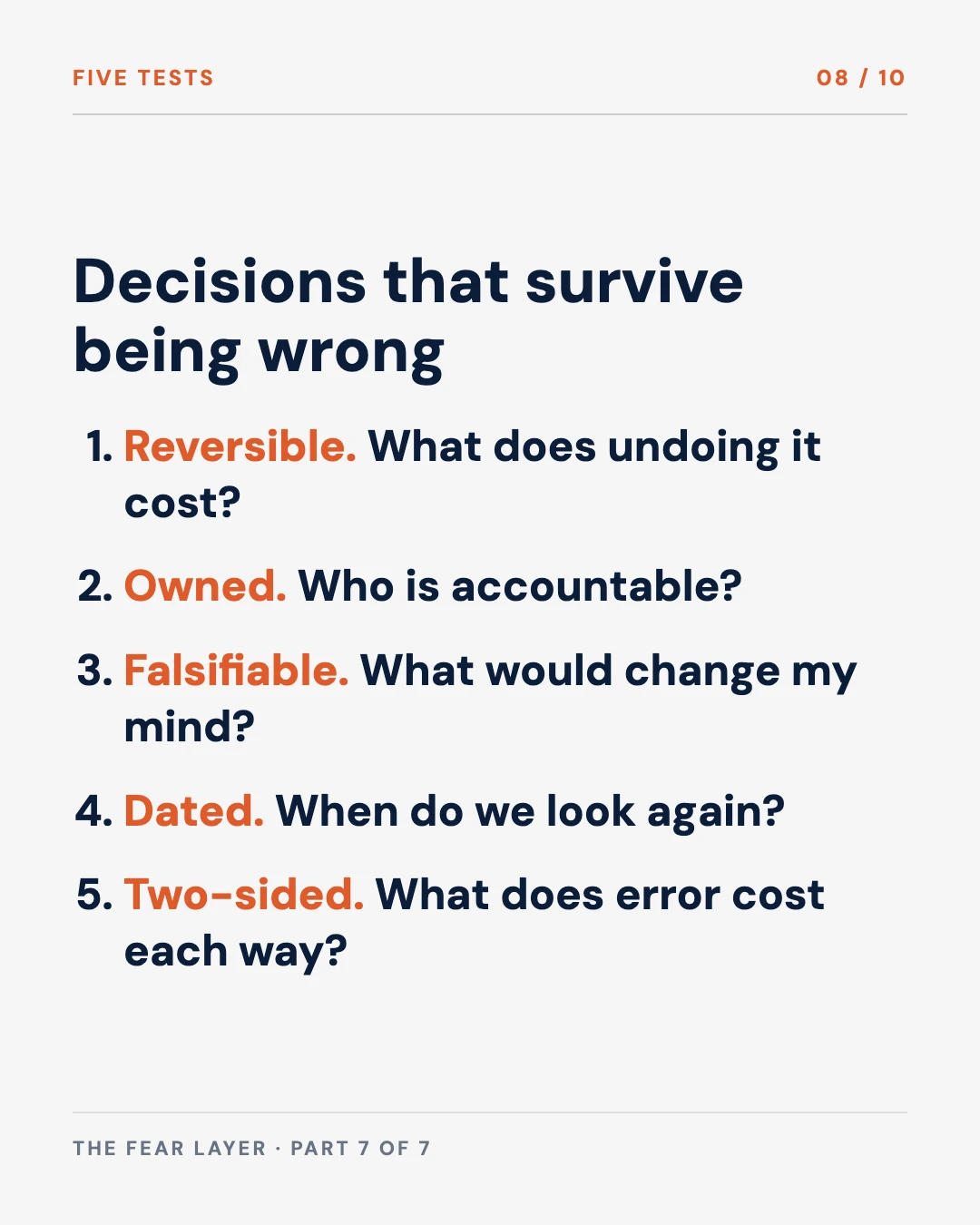
- A decision survives being wrong if it is reversible, has a named owner, states what would change it, and carries a review date.
The argument, in ten slides
Save it, or send it to the leader whose next decision rests on a forecast.
Why the last part is a list of what I do not know
This is the seventh and last part of a series about the fear that sits under AI decisions. The first part was about my own. The middle parts followed it into a boardroom, a purchase, a policy and a team meeting.
What remains is the fear underneath the others, and it belongs to everyone who has to decide something this year: that the ground will move again before the decision has paid back. I cannot remove it. I can say which parts of it are justified, which are not, and what I do about the rest.
I would also rather finish the series by showing the list than by closing on a flourish. I have asked leaders for six parts to say plainly what they do not know. It would be odd to stop doing it myself at the end.
Forecasts I refuse to make
There are three I decline, and I decline them in client meetings as well as here.
Which jobs go, and by when. I can tell you which tasks in a role are exposed to current tools, and I can tell you how to test that on your own work. I cannot tell you the date a role disappears, because the date depends on cost, regulation, liability and the speed at which an organisation will accept a machine’s error. None of those follow the technology’s schedule.
Which vendor or model wins. Anyone who gives you a name is guessing about a market whose leaders have changed several times in three years. I advise on what to keep portable, because a good answer there does not depend on a winner.
The date agents become reliable enough to leave alone. I can describe the tests an agent should pass before it works unattended. I cannot give you a quarter. The gap between a demo that works once and a system that works every time is the one I see most often underestimated, and I have no method for predicting when it closes.
I refuse these for a reason beyond modesty. Philip Tetlock tracked tens of thousands of forecasts from hundreds of experts over two decades and found that, as a group, they did only a little better than simple extrapolation, and the ones with the strongest, most coherent stories did worst. A forecast delivered with confidence is information about the forecaster. It is weak information about the future.
Forecasts that missed
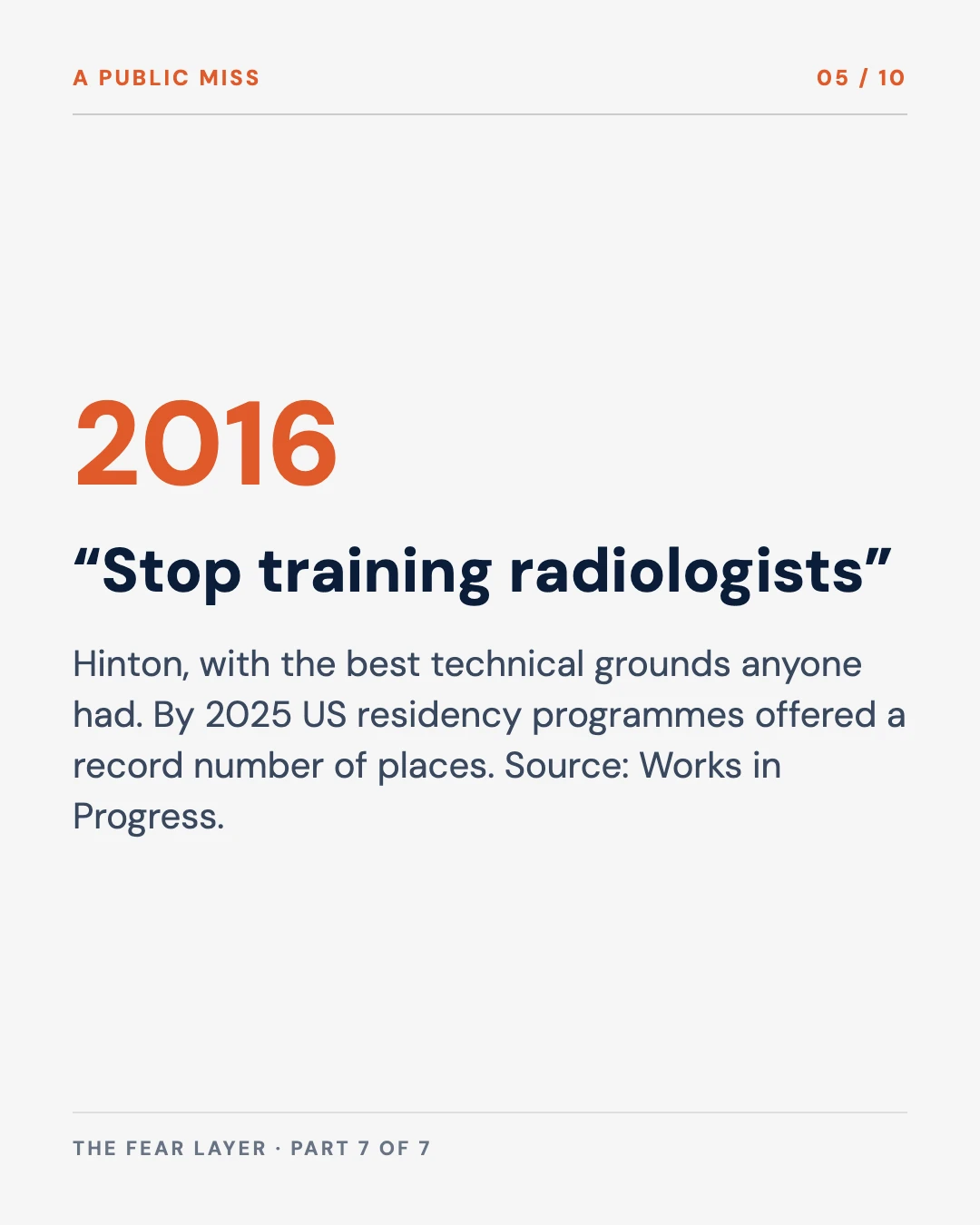
The cleanest public example is the one most people in the field know. In 2016 Geoffrey Hinton said at a conference that we should stop training radiologists, because deep learning would outperform them within about five years. Almost a decade later, American radiology residency programmes were offering a record number of places, and radiologist vacancies were at historic highs. His view has since softened toward radiologists working alongside the tools. I do not cite this to score a point against someone far more qualified than I am. I cite it because he had the best technical grounds anyone could have, and the forecast still missed, for reasons that sat outside the technology: how medicine is paid for, who carries liability, and how people actually work.
My own record is smaller and I will only show you what is written down.
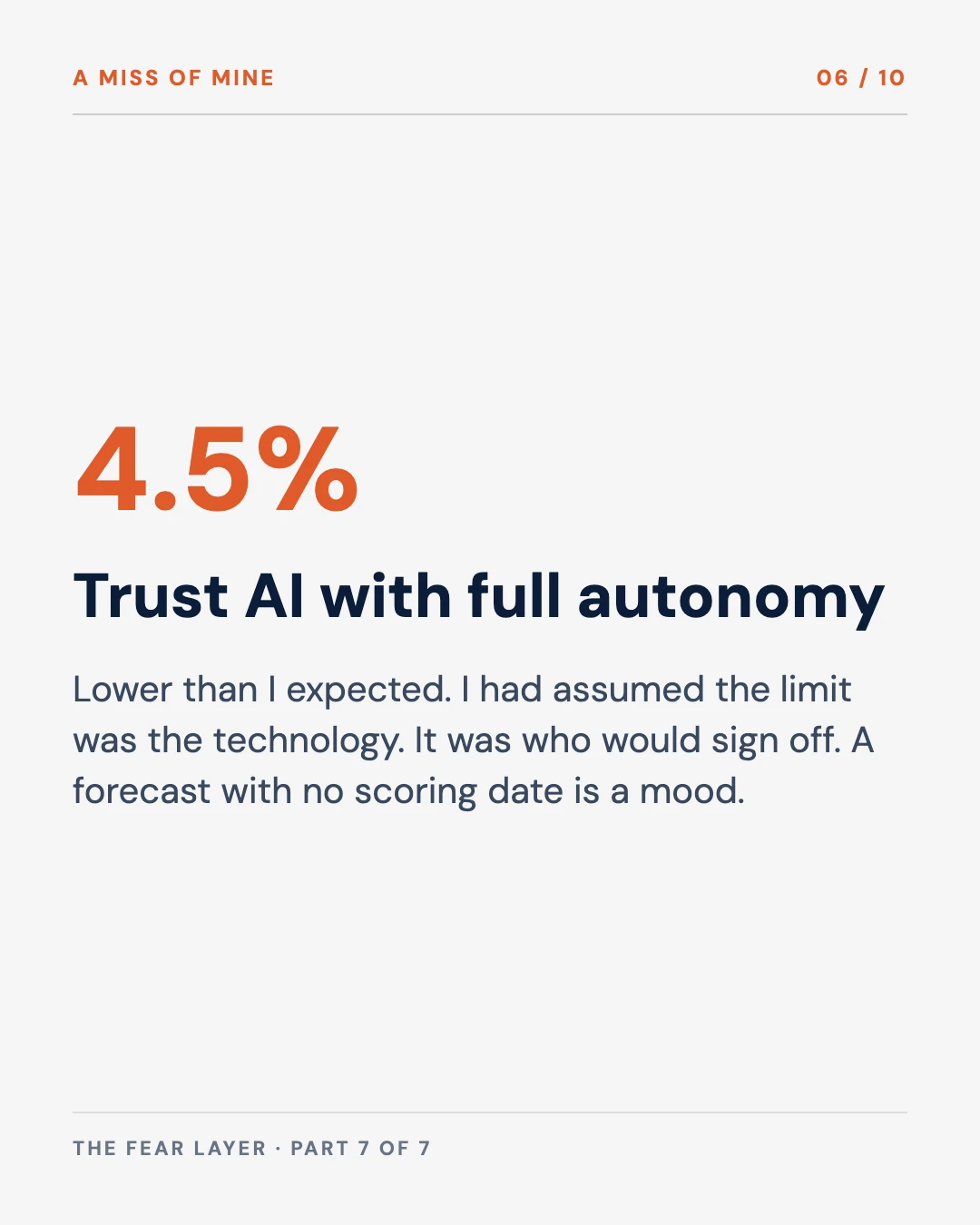
In my earlier piece on which tasks suit agentic AI, I reported that only 4.5% of organisations trust AI with full autonomy. I wrote then that the figure was lower than I expected. I had assumed the constraint on adoption would be what the technology could do. The evidence said it was who was willing to sign off. That was a miss in my reading of where the limit sat, and it changed how I advise.
In the piece on tokenised finance I set out a dated forecast for 2026 to 2031. It is not wrong yet and some of it will be. I have put a review in my diary for the end of 2027, and I will publish what I got right and what I did not. A forecast with no scoring date is a mood.
I am sure there are other misses, and the honest limit of this section is that I only have the ones I wrote down. That is the practical argument for writing forecasts down at all.
What I hold on to
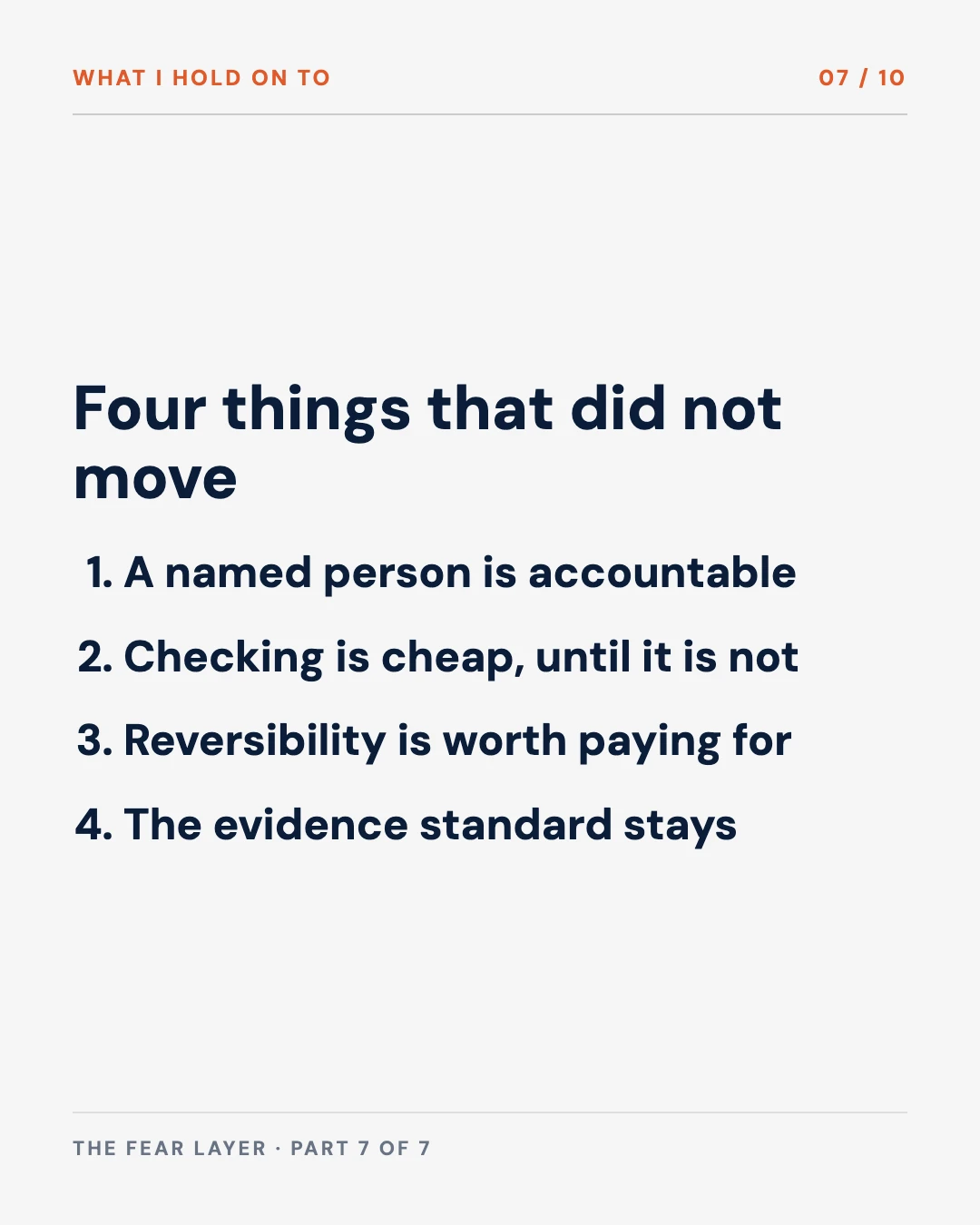
When the ground moves, I look for the things that did not move across the last three years of changes. There are four.
A named person is still accountable. Models, vendors and regulations have all changed. The fact that a board, a regulator or a court will ask who decided has not. Every part of this series came back to it.
Checking costs less than being wrong, until it does not. Verification is the cheapest control in almost every case I have seen, and it is the first one dropped under time pressure. I keep the slow way on the work that carries my name, as I described in the first part.
Reversibility is worth paying for. A decision you can undo in a quarter is worth more than a better decision you cannot. I will accept a worse expected result to keep an exit.
The evidence standard does not change. A claim about AI needs a source, a grade and a statement of where it would be wrong, however exciting the claim. I hold my own writing to that, which is why most of my posts carry an evidence table.
None of these is a forecast. That is why they have lasted.
Decisions that survive being wrong
If you cannot forecast, you still have to decide. The method I use is five tests, applied before a budget is committed. A decision that passes all five is not guaranteed to be right. It is built to be survivable when it is not.
| Test | The question to answer | If you cannot answer |
|---|---|---|
| Reversible | What does it cost to undo this in six months? | Shrink it until you can answer, or stage it. |
| Owned | Which named person is accountable for it? | It is a wish, not a decision. |
| Falsifiable | What observation would make me change course? | You are committed to a belief, not a plan. |
| Dated | When will we look again, and who calls it? | Drift will make the decision for you. |
| Two-sided | What does it cost if I am wrong in each direction? | You have only priced the fear of one of them. |
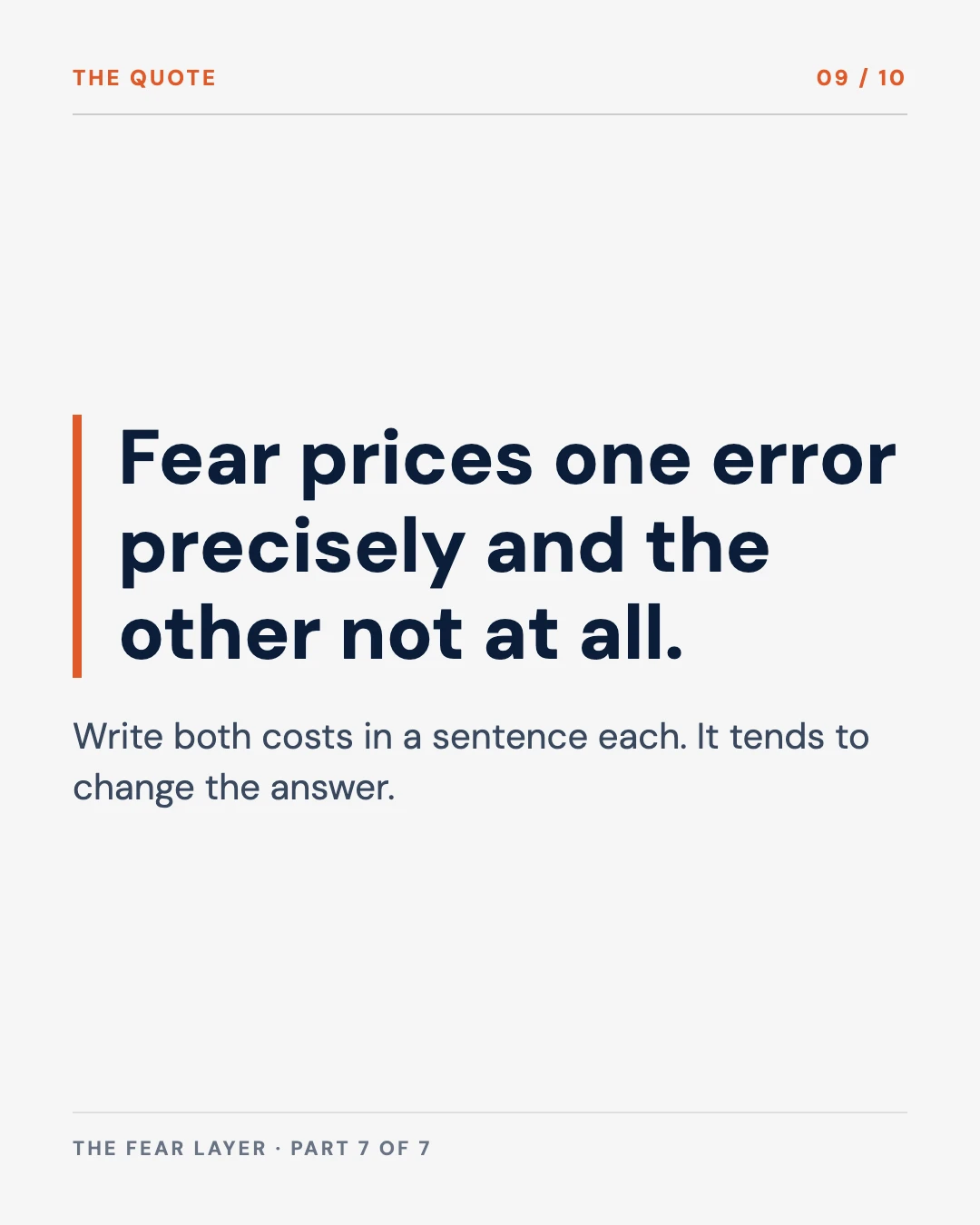
The fifth test is the one leaders skip, and it connects back to the first part. Fear prices one error very precisely and the other not at all. The fear of being late makes buying look free. The fear of being wrong makes waiting look free. Neither is free, and writing both costs down in a sentence each tends to change the answer.
Price the error on both sides of a decision.
Writing both costs in a sentence each, with a review date, tends to change the answer. It also makes the decision survivable if it turns out wrong.
The test is my own practice from advisory work, not a study.
What to do this quarter
Pick one decision that currently depends on a forecast about AI. It might be a hiring plan, a platform commitment or a policy. Write down the forecast it depends on, then run the five tests on it. If the decision fails two or more, reshape it before you spend anything.
Then write the forecast down with a date, and put a review in the diary. You will be wrong about some of it. The aim is to find out cheaply and in public, with an owner, before somebody else finds out for you.
Evidence & Methodology
This part makes few empirical claims, and I have graded each one. The rest is my own judgment, labelled as such.
| Claim | Source | Grade |
|---|---|---|
| Expert forecasters as a group did only slightly better than simple extrapolation, and the most confident did worst | Tetlock, Expert Political Judgment, Princeton University Press, 2005 | Measured |
| In 2016 Hinton said we should stop training radiologists because deep learning would outperform them within about five years | Reported in Works in Progress, “AI isn’t replacing radiologists” | Reported |
| US radiology residency programmes offered a record number of positions in 2025, and vacancy rates are high | Same Works in Progress article | Reported |
| Only 4.5% of organisations trust AI with full autonomy, and I expected a higher figure | My earlier post on agentic AI task suitability; the figure is as I reported it there | Adapted |
| The three forecasts I refuse and the five decision tests | My own practice across advisory work, not a study | My call |
Sources
- Tetlock, P. E. (2005). Expert Political Judgment: How Good Is It? How Can We Know? Princeton University Press.
- Works in Progress. AI isn’t replacing radiologists.

What I Was Afraid Of When I Started Advising on AI
Where the series began, and the three questions for testing a fear before it drives a decision.
How Do I Tell My Team Their Work Is Changing?
The previous part, on saying what you know, what you do not, and when you will say more.

The Fear of Being Late Is Making Leaders Buy the Wrong Things
The two-sided cost test applied to a purchase.
This is part seven and the last of The Fear Layer. If you are making a decision this quarter that rests on a forecast, that is work my consulting practice does.