Executive Summary
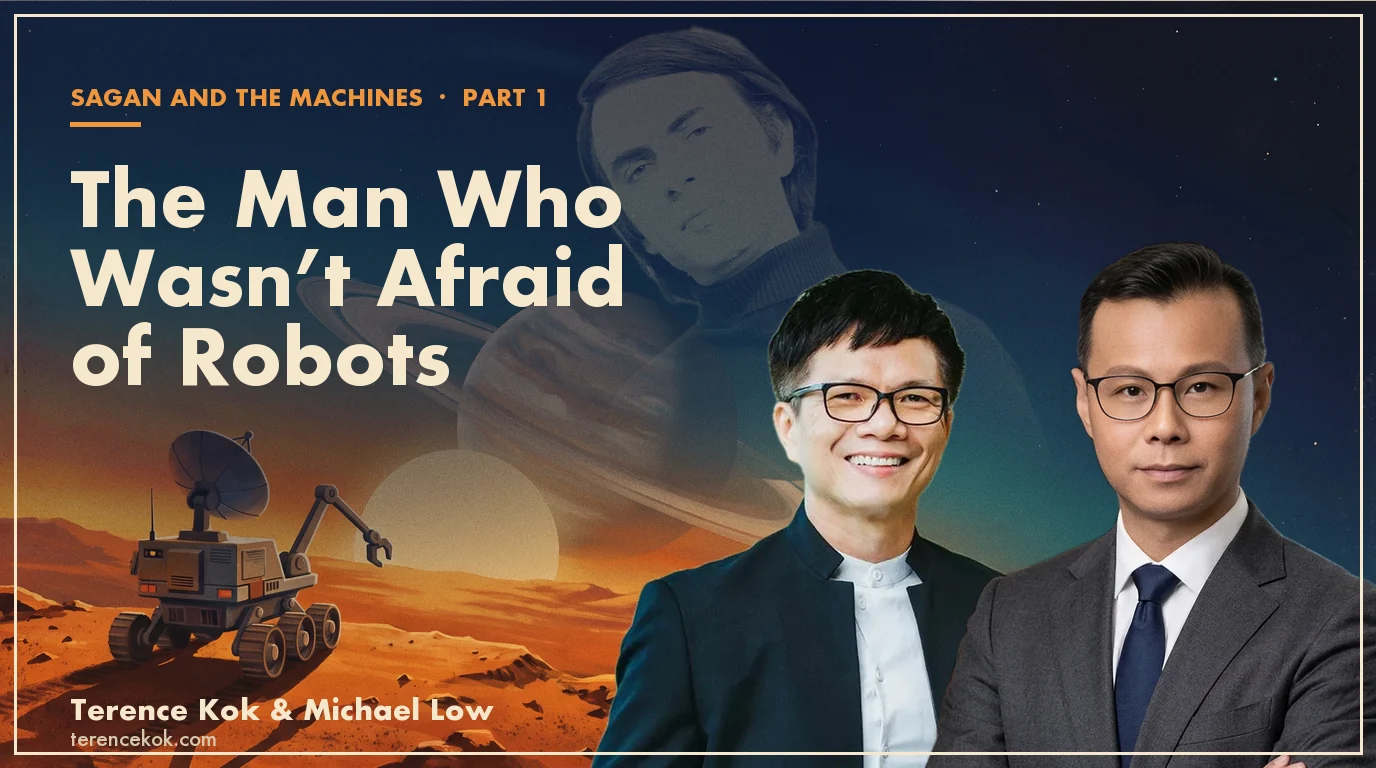
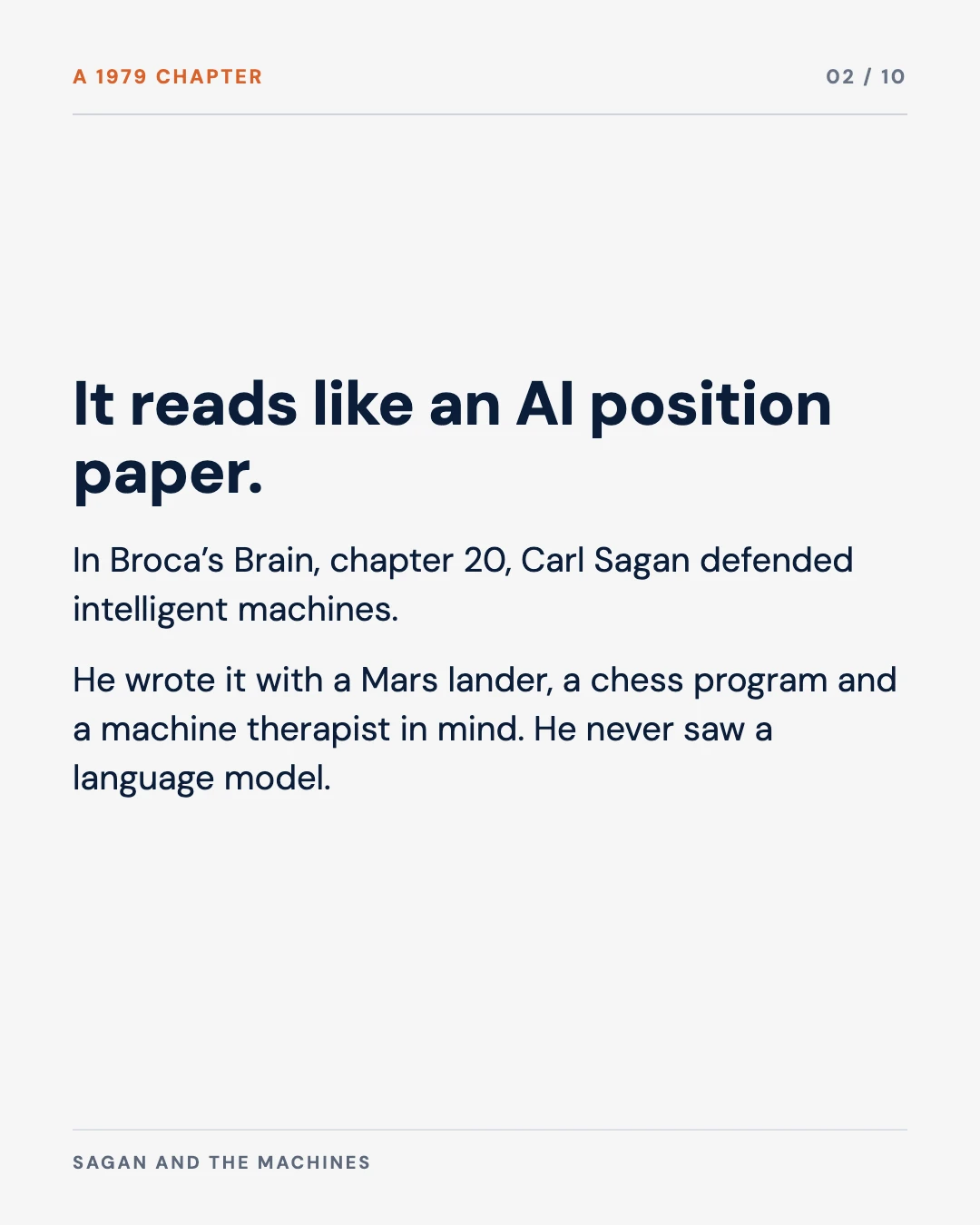
Carl Sagan is remembered for the stars, but in 1979 he published a chapter in Broca’s Brain that reads like a position paper on AI. It argued that machines should be built, that the resistance to them was a prejudice he named speciesism, and that “there is nothing inhuman about an intelligent machine.” He wrote it with a Mars lander in mind, a chess program that had just entered a state tournament, and a chatbot that could play a psychotherapist. He died in December 1996 and never saw a language model. This first part sets out his case in his own words, checks it against what has happened since, and names the three places where I think it is weakest. It opens a ten-part series that sets his writing beside the AI debate of 2026.
1979
year Sagan’s chapter defending intelligent machines appeared in Broca’s Brain
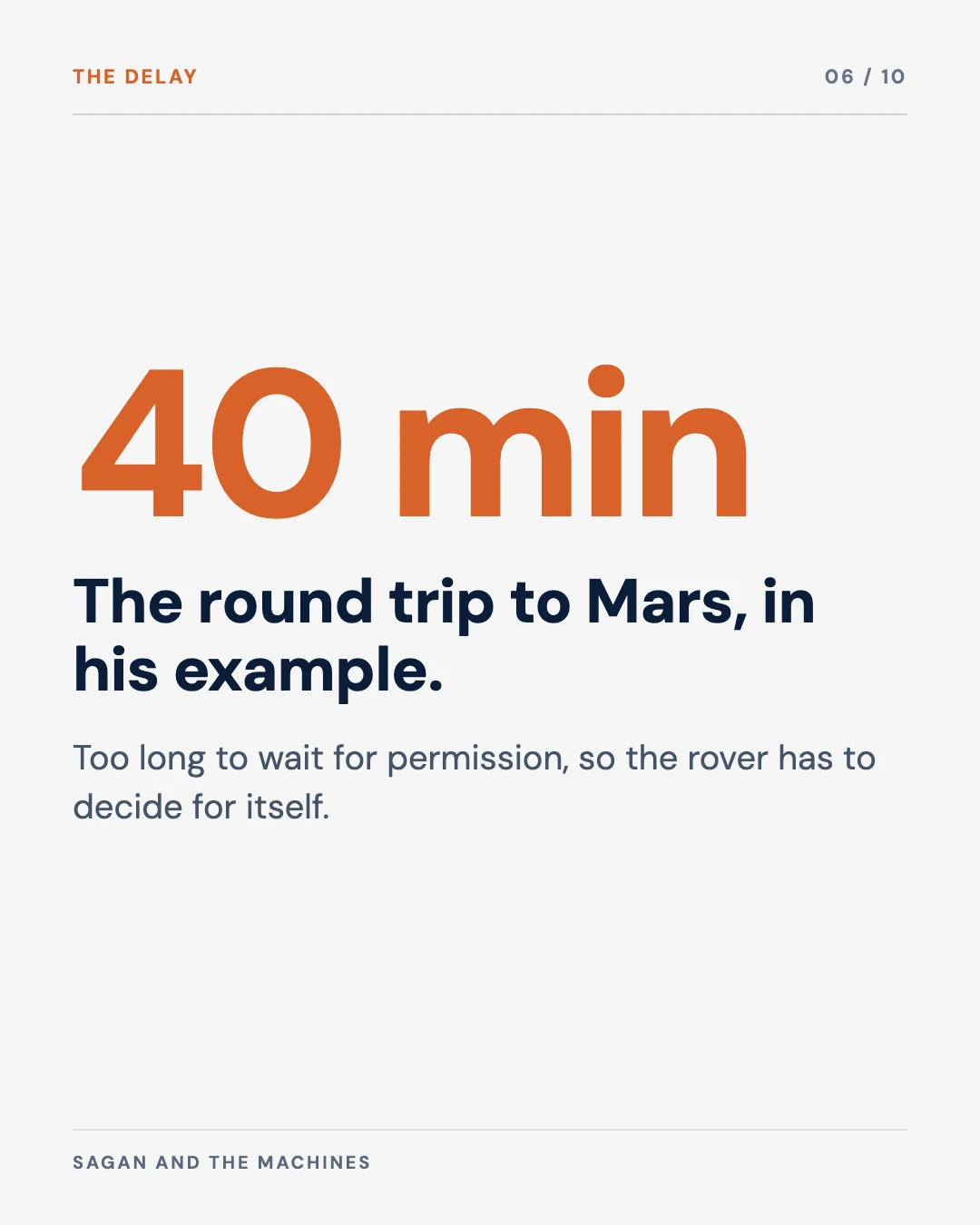
40 min
the round-trip delay to Mars, in his example, that made a rover that decides for itself necessary
< 5 months
between Sagan’s death on 20 December 1996 and Deep Blue’s win over Kasparov in May 1997
175 m
Perseverance’s Sol 200 drive on Mars, only the first 8 m planned from Earth
Core conclusions
- Sagan defined his target as prejudgment, “a conclusion drawn before all the facts are in.” By his own definition, trusting a machine before the evidence is in is the same fault as dismissing it.
- He got the direction right, and several specifics, including chess and machine autonomy in space. He expected machines to be specialised, and today’s general-purpose models are the biggest miss.
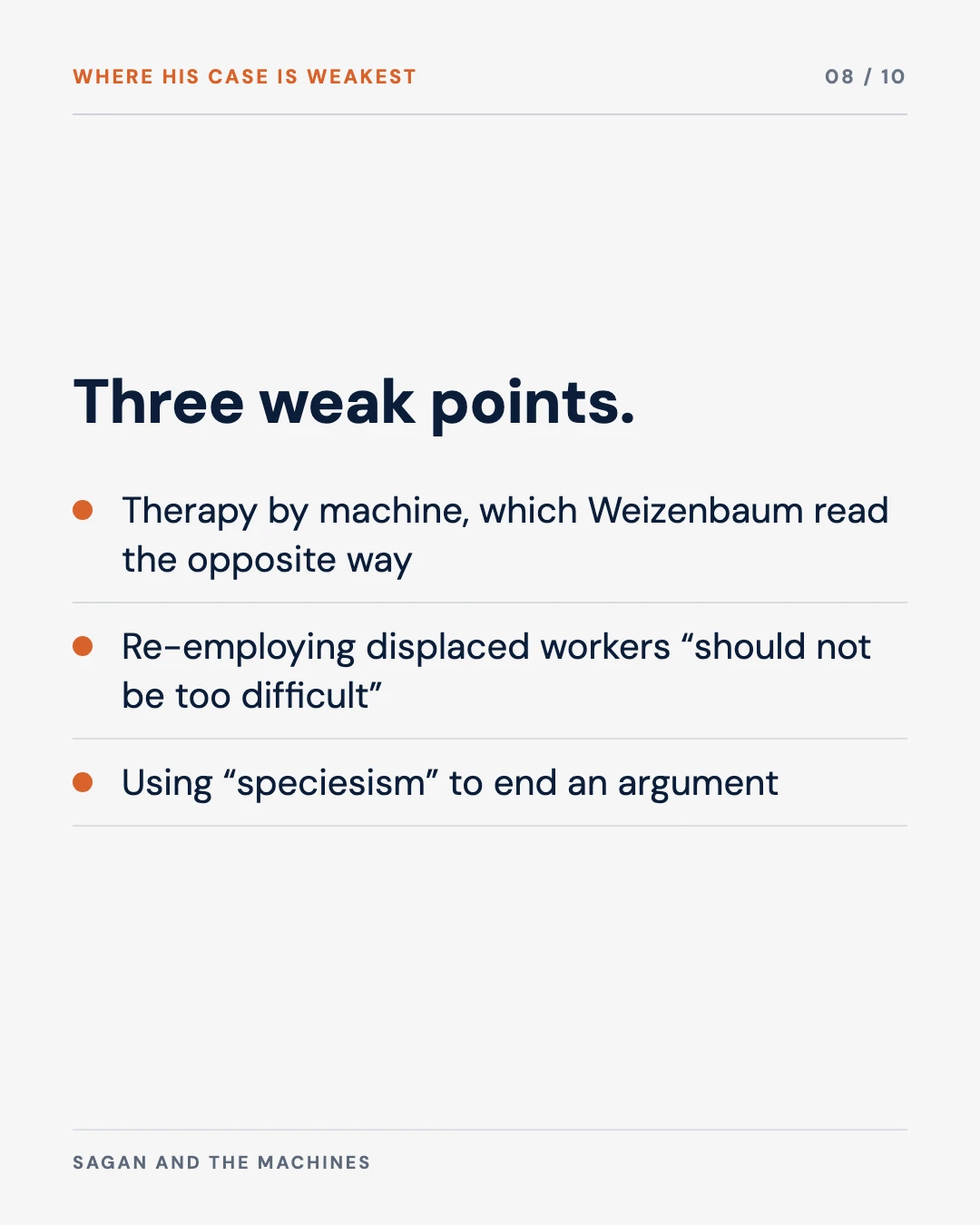
- Three parts of his case need a hard look: the confidence that therapy by machine could be made safe, the assumption that displaced workers would be re-employed with ease, and the use of “speciesism” to end an argument rather than win it.
The argument, in ten slides
Save it, or send it to someone who still thinks the AI debate began in 2022.
A chapter that reads like a position paper
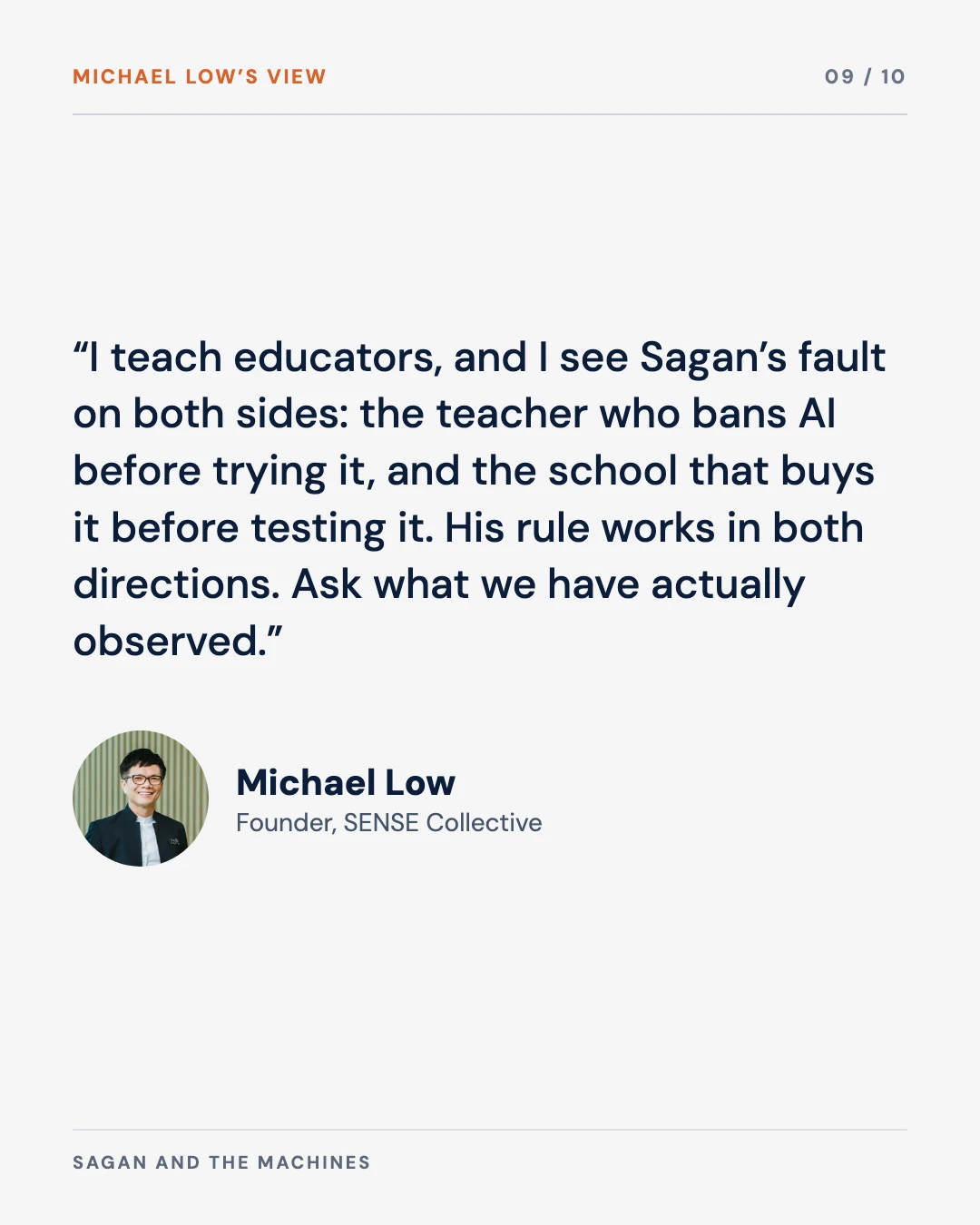
Michael Low and I are writing this series together. Both of us honour Carl Sagan as one of the authors who gave us wisdom early in life, and we want to make it practical now, because the takeoff the builders describe is already under way, as The Future of Humanity series argues. Each part takes one of his ideas and asks what it would mean for a board, a team or a person deciding what to hand to a machine.
Most people know Sagan through Cosmos. Fewer know that in 1979 he collected his essays in Broca’s Brain, and that chapter 20 is a sustained defence of machine intelligence. In the UK printing I read it is titled “In Defence of Robots,” and it runs from page 295 to page 308. The US edition spells it “Defense.”
I read the chapter itself for this series, in the UK printing, because Sagan is one of the most misquoted writers online. One line sometimes credited to him (“Stone Age emotions, medieval institutions and godlike technology”) belongs to the biologist E. O. Wilson, not to Sagan. Every quotation below comes from the pages of the chapter, and I give the page.
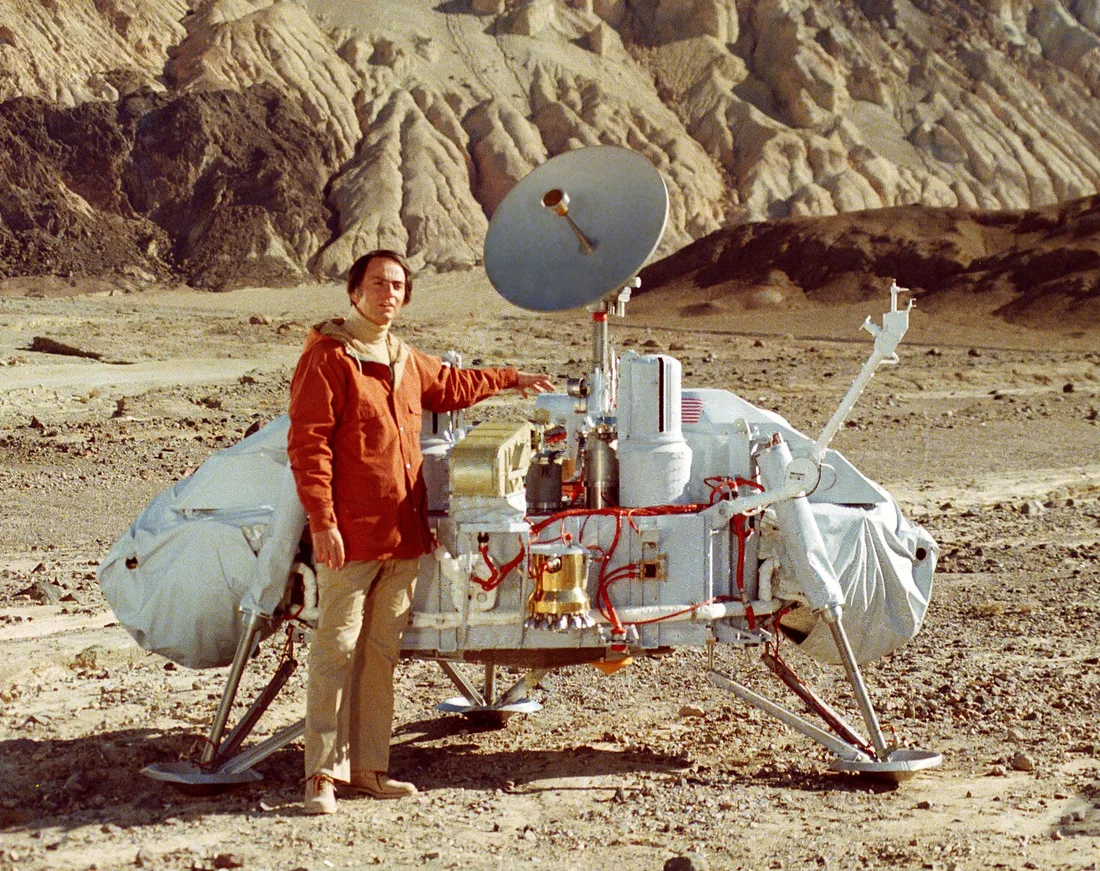
The setting matters. Sagan was writing in the years after Apollo and Skylab, when the press kept contrasting clever astronauts with dumb machines. He had also worked on the Viking landers, which reached Mars in 1976. That context is why a planetary scientist ended up writing about artificial intelligence.
Who he was arguing against
The chapter opens with the complaint. Robots, Sagan writes, especially robots in space, often get a bad press. The claims he lists are that a human was needed for the final landing adjustments on Apollo 11, that a Mars rover could never choose rock samples as well as an astronaut, and that only men could have repaired the Skylab sunshade.
Then he turns on the comparisons themselves: “all these comparisons turn out, naturally enough, to have been written by humans. I wonder if a small self-congratulatory element, a whiff of human chauvinism, has crept into these judgments.” He compares the habit to racism and sexism and gives it a name: “speciesism,” which he defines as “the prejudice that there are no beings so fine, so capable, so reliable as human beings.”
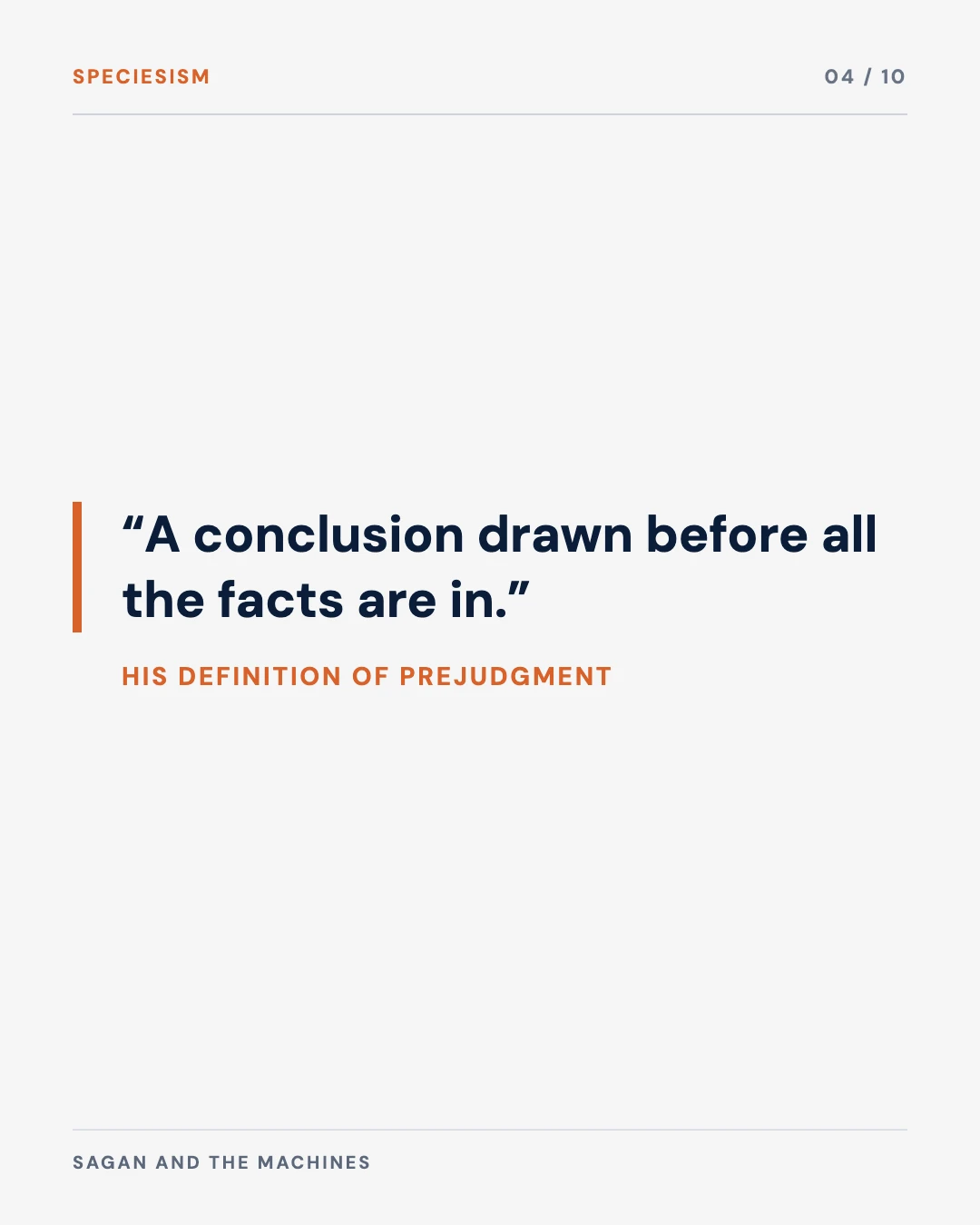
… prejudgment, a conclusion drawn before all the facts are in.
Carl Sagan Broca's Brain, 1979, chapter 20
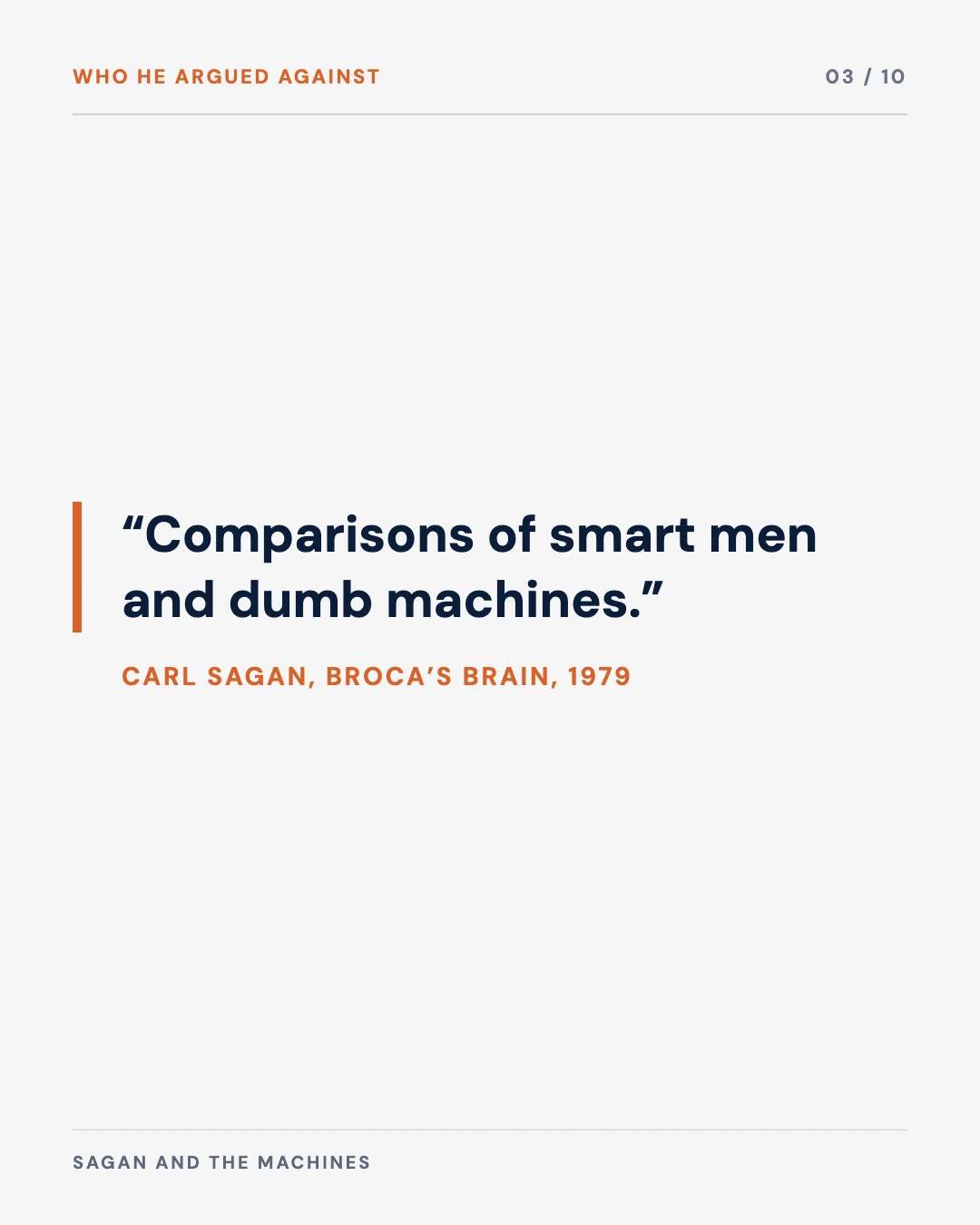
Look at what he did next. He did not claim machines were better. He said the comparison was unfair: “comparisons of smart men and dumb machines.” Nobody had asked what machines could have been built for the roughly thirty billion dollars Apollo and Skylab cost. That is a point about method, and it is the sharpest thing in the chapter.
He also had a practical case. Humans on long missions need food, air, water, entertainment and company, and he noted we feel reluctant to send people on suicide missions but “do not yet feel any strong ethical prohibitions against sending machines” on them. Machines needed none of the life support.
The evidence he offered
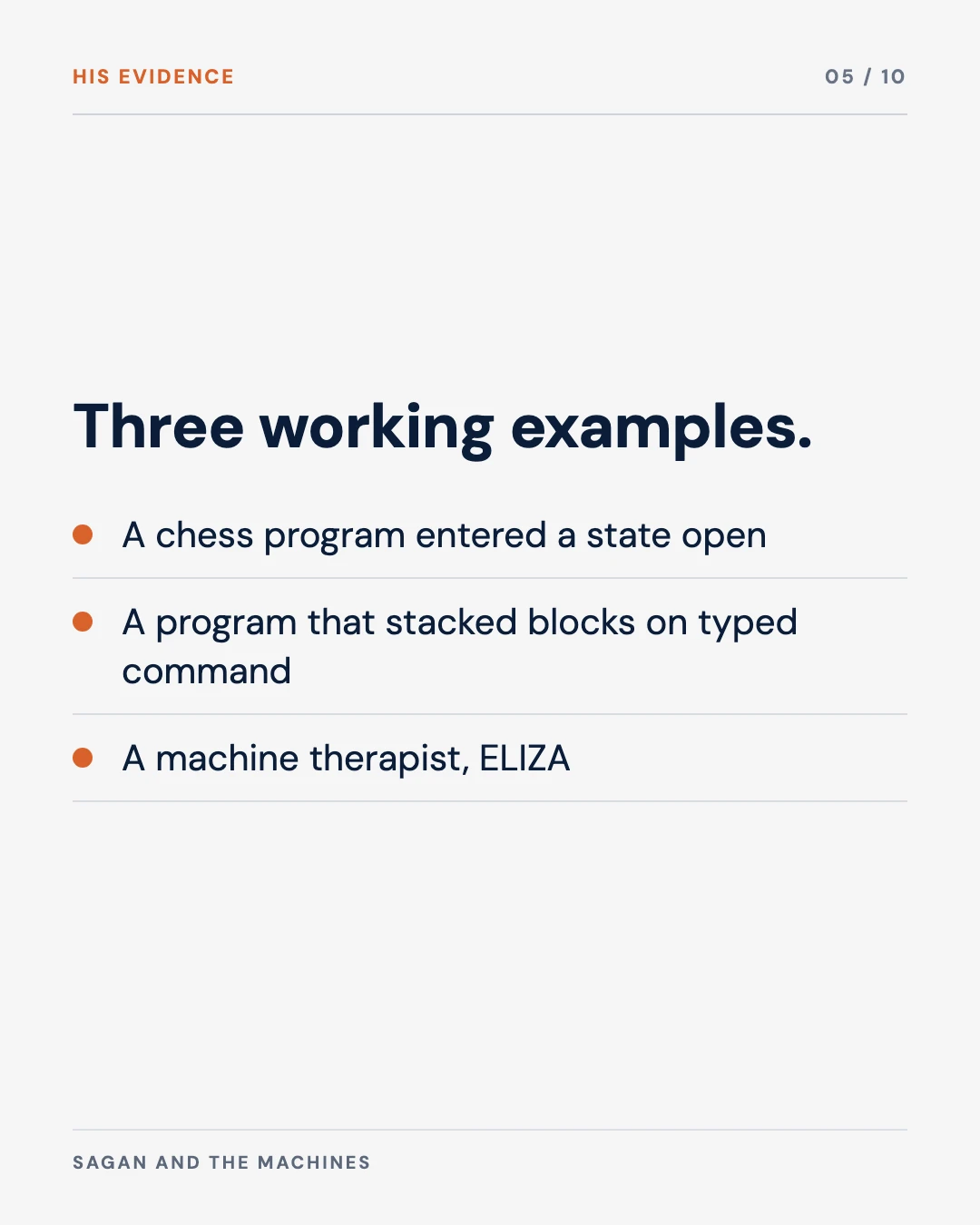
Sagan did not argue from speculation. He gave his readers three working examples.
First, a conversation. He quotes Alan Turing’s imagined dialogue about a sonnet, then notes that “no device of this sophistication has yet been built, although I am not sure how many humans would pass Turing’s human test.”
Second, a program by Terry Winograd that stacked children’s blocks in response to typed instructions, answered questions about why it had moved a pyramid, and learned the word “steeple” when told what one was.
Third, a machine psychotherapist built by Joseph Weizenbaum at MIT. Sagan reproduces a full dialogue, and calls one reply “astonishing”, adding that “one is very tempted to say ‘perceptive’.” He adds a caveat I think matters: “There is certainly a selection effect here,” meaning that most such dialogues were nowhere near so striking. Then the line that has been quoted ever since: the response “is, of course, preprogrammed. But, then, so are the responses of human psychotherapists.”
He went on to imagine “a network of computer psychotherapeutic terminals, something like arrays of large telephone booths, in which, for a few dollars a session, we are able to talk to an attentive, tested and largely nondirective psychotherapist.” He added, in one sentence, that “ensuring the confidentiality of the psychiatric dialogue is one of several important steps still to be worked out.”
On chess he was just as concrete. “The ten best chess players in the world still have nothing to fear from any present computer. But the situation is changing.” A program had recently done well enough to enter the Minnesota State Chess Open. His joke about it has aged well: a stranger admires a checker-playing dog, and the owner shrugs, “Oh, it’s not all that remarkable. He loses two games out of three.”
The delay that makes the case
The strongest section is about Mars. Sagan distinguishes machines that carry their intelligence on board from machines controlled remotely, and says the best answer will be a mix. Then he states the problem.
The argument for a machine that decides on its own is a message that arrives too late.

1979 passages from Carl Sagan, Broca's Brain, chapter 20. Sol 200 figures from NASA's description of Perseverance's AutoNav drive. The four steps are my summary.
His fix was not full autonomy. It was sensors and a rule: stop, or back off and try another direction, until Earth replies. For harder cases, “they can be programmed to recognize that the questions are beyond their abilities and to inquire of human operators.” That sentence describes escalation to a human for exactly the decisions a machine should not take alone, and it is a short statement of how to build an agent that still holds.
He then climbs a ladder of machine intelligence.
In 1979 Sagan placed Mars landers on a ladder from insect to dog, and expected the climb to be slow.
Quotations from Carl Sagan, Broca's Brain (1979), chapter 20, "In Defence of Robots" in the UK printing I read. The ladder layout is my summary of his passage.
He also saw that machines would not look like film robots. “There is no reason for such machines to look any more human than a vacuum cleaner does. They will be specialized for their functions.”
What the decades proved
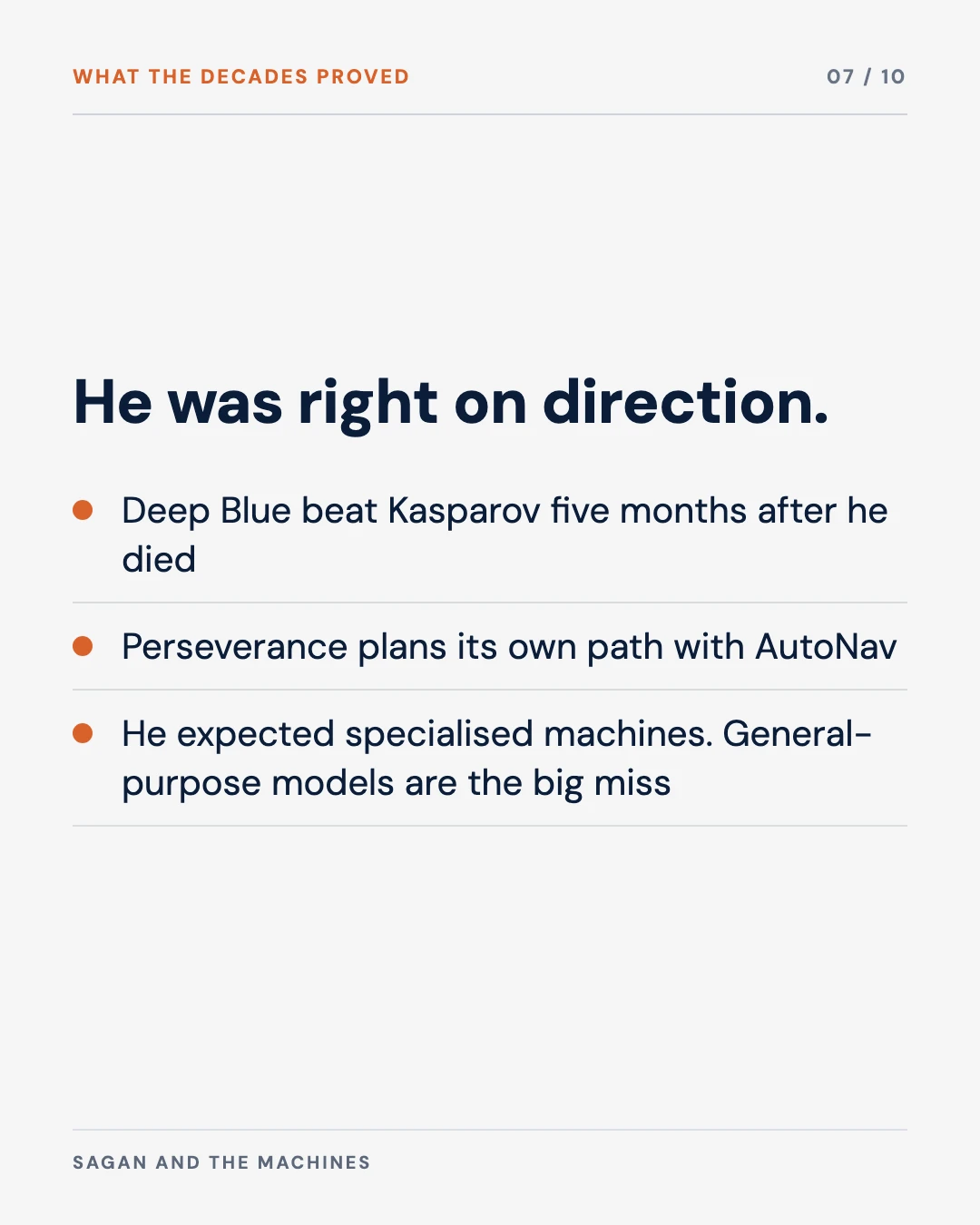
Sagan died on 20 December 1996. In May 1997 IBM’s Deep Blue beat Garry Kasparov 3.5 to 2.5, the first win by a computer over a reigning world champion in a standard-time match. His line that the ten best players had nothing to fear lasted eighteen years.
The Mars argument held up in a way that is almost eerie. NASA says that once AutoNav takes over, “the rover autonomously chooses a path to reach the intended destination.” On Sol 200 the rover covered 175 metres in total, and the first 8 metres came from commands sent up earlier by its drivers.
| Sagan in 1979 | What has happened since | My reading |
|---|---|---|
| The ten best chess players have nothing to fear | Deep Blue beat the world champion in May 1997 | He was right about the direction, early |
| Machines on Mars will need to decide for themselves | Perseverance chooses its own path with AutoNav once it takes over | He was right, and the human checkpoint remains |
| Machines will be specialised for their functions | Frontier models are general-purpose systems | He missed this one |
| A machine therapist is conceivable; confidentiality is still to be worked out | Companion and therapy chatbots exist, and privacy is still a live problem | Right on possibility, light on the risks |
| Displaced workers can be re-employed “over a human generation” | Contested, and the subject of Part 8 | The least tested part of his case |
My own comparison. The 1979 column is Sagan’s chapter; the middle column is drawn from NASA, History.com and general knowledge of current systems.
Three places his case is weakest
On therapy, Weizenbaum, the man who built the program Sagan admired, took the opposite lesson. Looking back in his 1976 book he wrote that he had not realised “extremely short exposures to a relatively simple computer program could induce powerful delusional thinking in quite normal people.” The history of what became known as the ELIZA effect is that people project understanding onto a text interface. Sagan treated the astonishing reply as evidence of machine skill. Weizenbaum treated it as evidence of how readily people read understanding into a machine. Both can be true, and the second is the risk a deployer carries. Part 3 takes it up.
On work, Sagan gave the re-employment of displaced workers a few sentences. They would be arranged, it “should not be too difficult” over a generation, “particularly if there are enlightened educational reforms,” and “human beings enjoy learning.” It is the most optimistic passage in the chapter, and the one he supported least.
On the word itself, “speciesism” is a powerful label, and a label can end an argument as easily as win it. If every worry about machine reliability counts as human vanity, the worry never has to be answered. Sagan’s own definition guards against that. He called the fault a conclusion drawn before the facts are in. By that standard, a leader who gives an AI system authority because the demo was impressive is making the mirror-image error. I would apply his test in both directions.
My verdict
Sagan was right on the evidence he had, and right on the method. The strongest sentence in the chapter is the one about prejudgment, and it is also the best defence against both hype and dismissal. He was also generous in a way the debate has lost: he wrote about machines as an expression of human ability. His last paragraph says so: “There is nothing inhuman about an intelligent machine; it is indeed an expression of those superb intellectual capabilities that only human beings, of all the creatures on our planet, now possess.”
I would add a condition he did not need to state in 1979, because the machines were small. A capability that expresses human ability still needs human accountability, and the Mars rover shows what that looks like: a machine that decides most things alone and asks when it cannot.
Questions for leaders
- Which decisions does each AI system in our organisation take without a person, and what evidence earned it that room?
- Where do we escalate to a human, and does the system recognise when it is out of its depth, as Sagan’s rover was built to?
- When a colleague doubts a system, do we ask for the facts, or treat the doubt as vanity?
- When we trust a system, do we hold it to the same standard of evidence, or has a demo done the persuading?
- If our systems are general-purpose where we expected specialised ones, which controls were designed for the narrower machine?
Evidence & Methodology
Every Sagan quotation comes from the UK printing of Broca’s Brain (chapter 20, pages 295 to 308), which I read in digitised form. The digitised text is imperfect in places, so where a word was unclear I paraphrased and did not quote. Weizenbaum’s 1976 sentence reaches me through a History.com article, so it is secondary. NASA’s description of AutoNav and the Sol 200 drive come from NASA pages. The Deep Blue score and Sagan’s date of death come from standard references. The comparison table and my verdict are my own.
| Claim | Source | Grade |
|---|---|---|
| Chapter 20 of Broca’s Brain (1979) defends machine intelligence and coins “speciesism” | Sagan, Broca’s Brain, pp. 295 to 296 | Reported, direct quote |
| Prejudgment definition; “smart men and dumb machines”; machines “specialized for their functions” | Sagan, pp. 296, 306 | Reported, direct quote |
| Machine therapist passage, “preprogrammed … so are the responses of human psychotherapists”, therapy terminals, confidentiality “still to be worked out” | Sagan, pp. 299 to 300 | Reported, direct quote |
| Chess: ten best players have “nothing to fear”; the checker-playing dog | Sagan, p. 301 | Reported, direct quote |
| Mars 20 light-minutes away; reply forty minutes later; escalate to human operators | Sagan, pp. 304 to 305 | Reported, direct quote |
| Viking “about as intelligent as a dragonfly”; the ladder up to “dog intelligence” | Sagan, pp. 305 to 306 | Reported, direct quote |
| Displaced workers: “should not be too difficult”, “human beings enjoy learning” | Sagan, p. 307 | Reported, direct quote |
| Closing “nothing inhuman” sentence | Sagan, p. 308 | Reported, direct quote |
| Deep Blue beat Kasparov 3.5 to 2.5 in May 1997 | History.com | Measured, secondary |
| Sagan died 20 December 1996 | Cornell Chronicle, 20 December 1996 | Measured, primary |
| Once AutoNav takes over, Perseverance “autonomously chooses a path to reach the intended destination”; Sol 200 drive of 175 m in total, first 8 m commanded | NASA | Measured, primary |
| Weizenbaum: “extremely short exposures … could induce powerful delusional thinking” | History.com, quoting Computer Power and Human Reason (1976) | Reported, secondary |
| ”Stone Age emotions, medieval institutions and godlike technology” is E. O. Wilson’s line, not Sagan’s | Wilson interviews, 2009 | Reported, secondary |
| The table’s “my reading” column and the verdict | Mine | My call |
Sources
- Sagan, C. (1979). Broca’s Brain: Reflections on the Romance of Science. New York: Random House. Chapter 20, “In Defence of Robots” (page numbers from the UK printing), pp. 295 to 308.
- History.com. The first chatbot, ELIZA, and Weizenbaum’s warning.
- NASA. Perseverance’s Sol 200 AutoNav drive.
- History.com. Kasparov defeated by Deep Blue.
- Cornell Chronicle. (1996, December 20). Carl Sagan, Cornell astronomer, dies.
- Wikimedia Commons. Sagan large.jpg and P-13734B Carl Sagan.jpg, NASA/JPL, public domain.
The Gorilla Problem
The opposite instinct: Stuart Russell on why a more capable machine need not be hostile to take the say away from us.
Emotionally Aware AI and Its Guardrails
The therapy-terminal question Sagan raised, and the guardrails an empathic system needs.
Agent Swarms and the Closing Loop
What happens when the human checkpoint Sagan wanted a rover to keep gets shorter.