Executive Summary
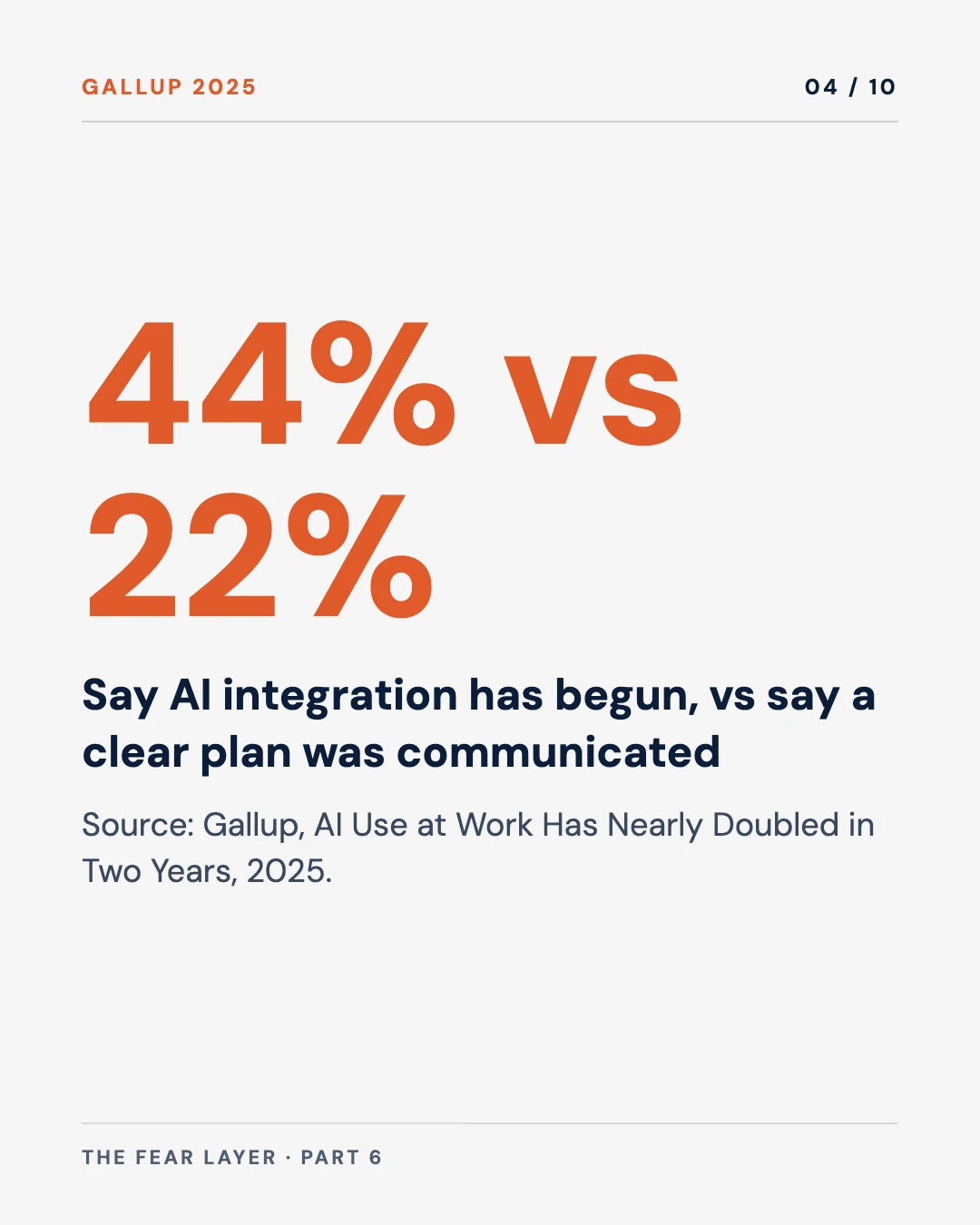
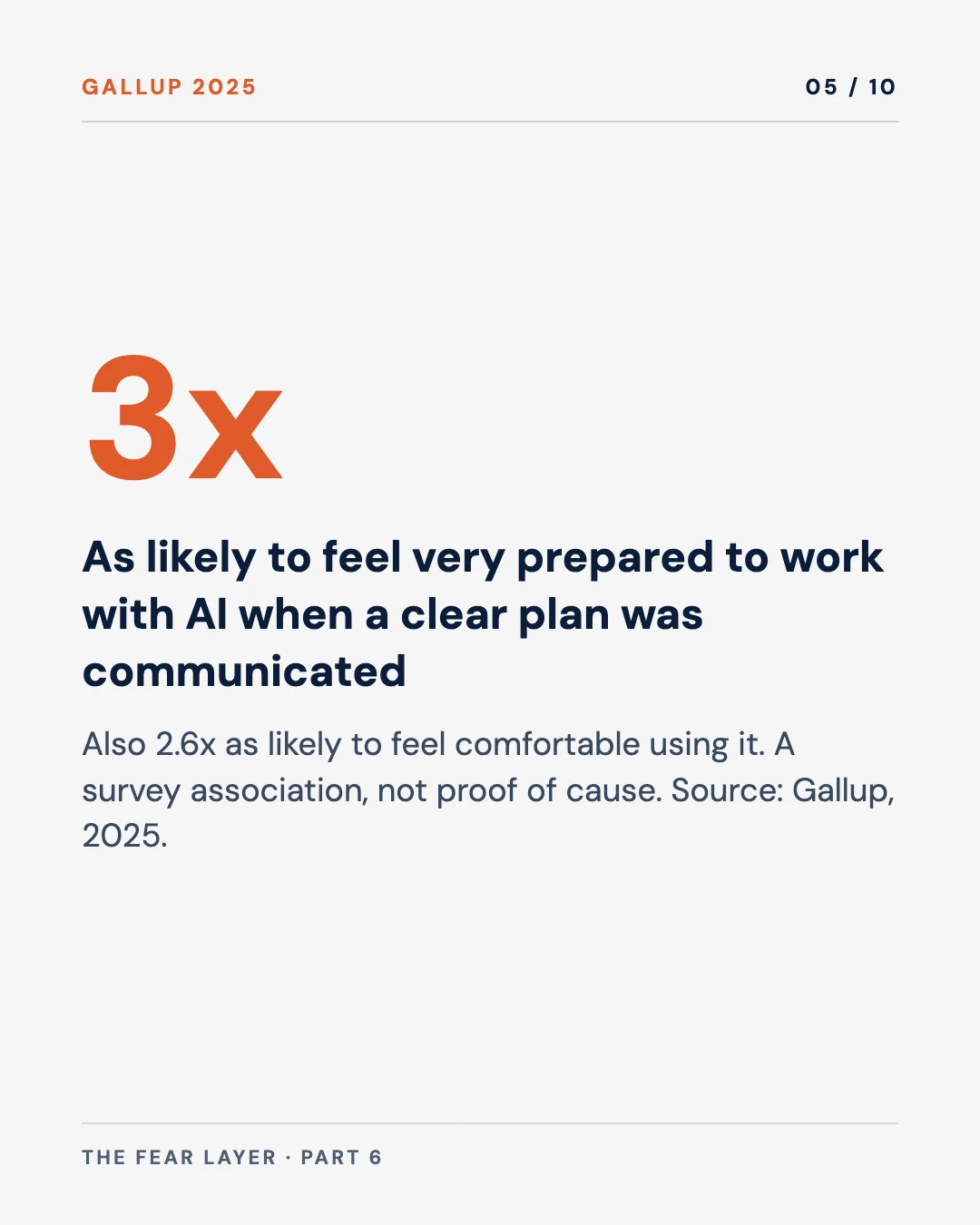
The conversation about how AI will change someone’s job is the one leaders postpone longest, usually because they believe they need the full answer before they open their mouth. Gallup’s 2025 workplace research shows the cost of waiting. 44% of employees say their organisation has begun integrating AI, but only 22% say it has communicated a clear plan or strategy for doing so. Employees who strongly agree their leaders have communicated a clear plan are three times as likely to feel very prepared to work with AI, and 2.6 times as likely to feel comfortable using it in their role. The silence is not neutral. People fill it with their own forecast, and it is rarely kind.
Core conclusions
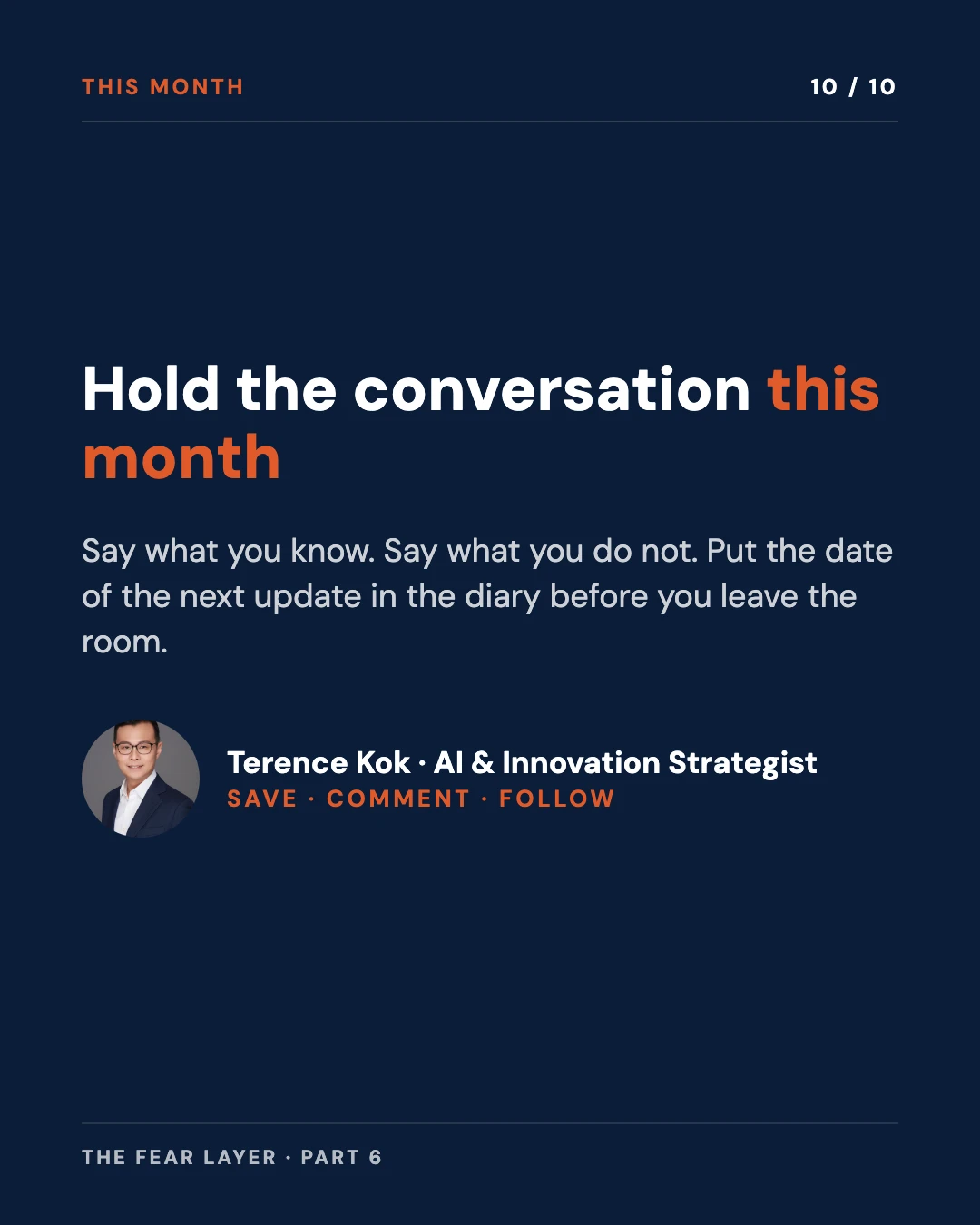
- You do not need the answer to start the conversation. You need to say what you know, what you do not, and when you will next tell them more.
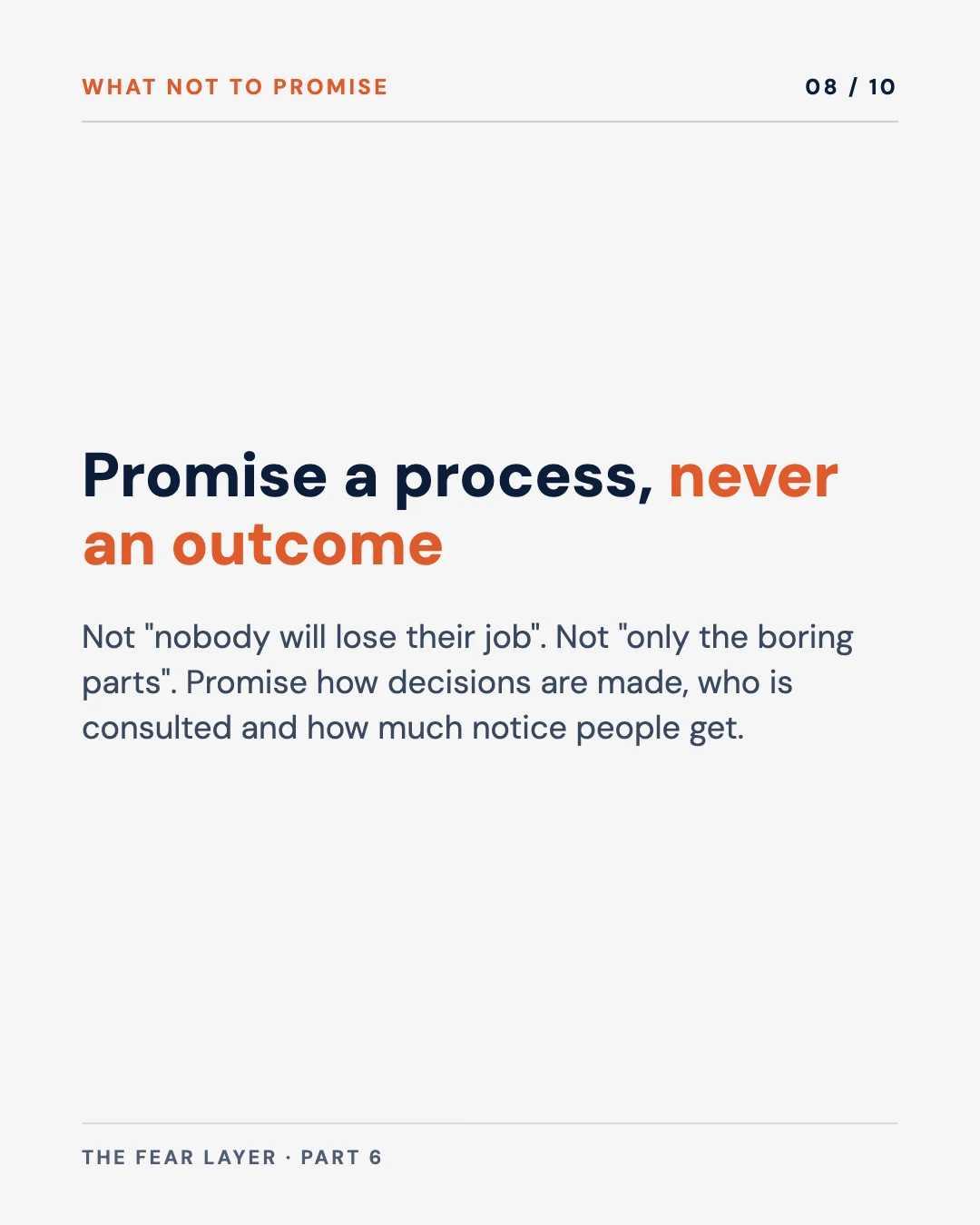
- Promise a process, never an outcome. A promise that nobody will lose their job is believed for one quarter and remembered for ten years.
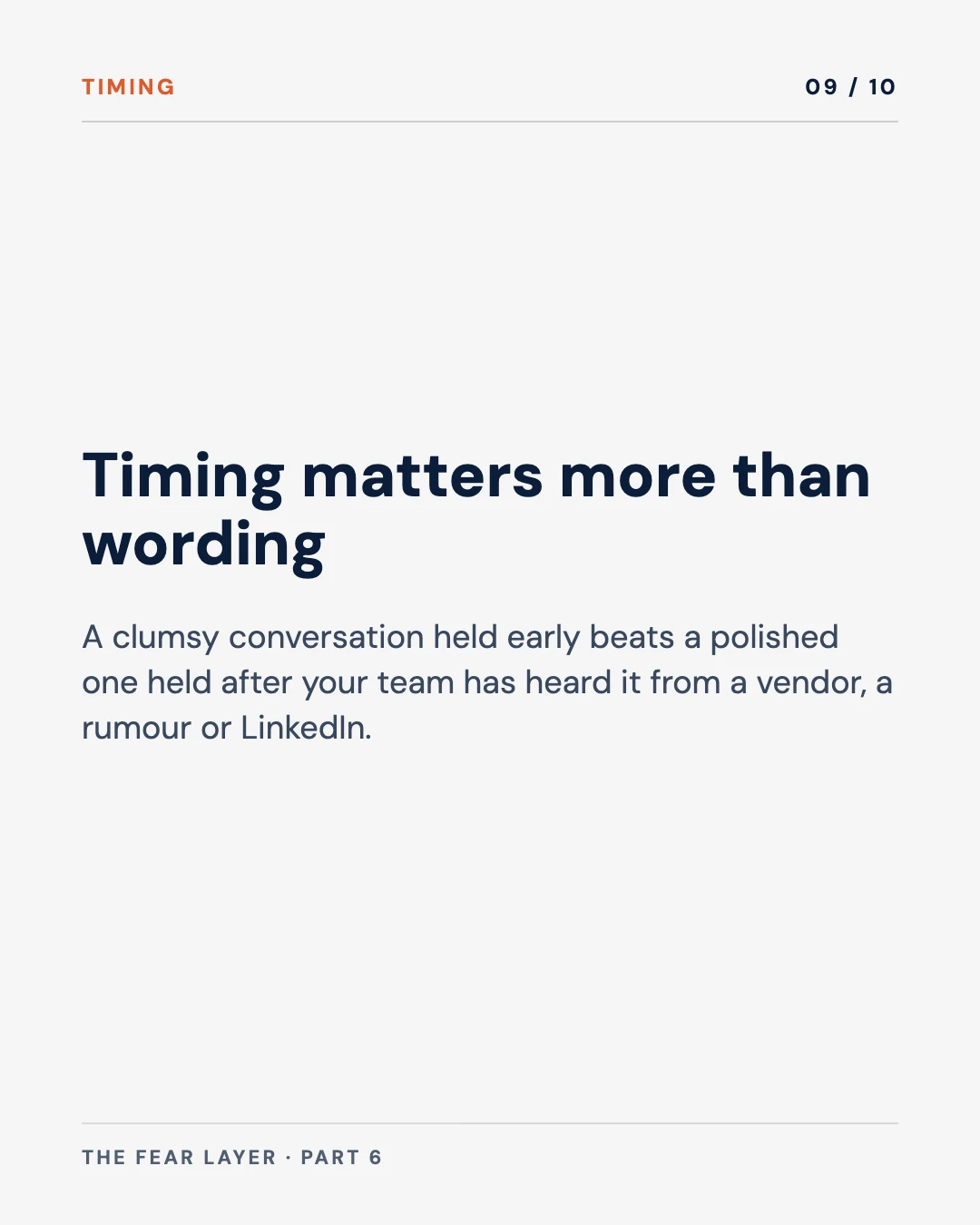
- Timing matters more than wording. A clumsy conversation held early beats a polished one held after people have heard it from a vendor, a rumour or a competitor.
The argument, in ten slides
Save it, or send it to the leader who keeps saying they will talk to the team once the plan is final.
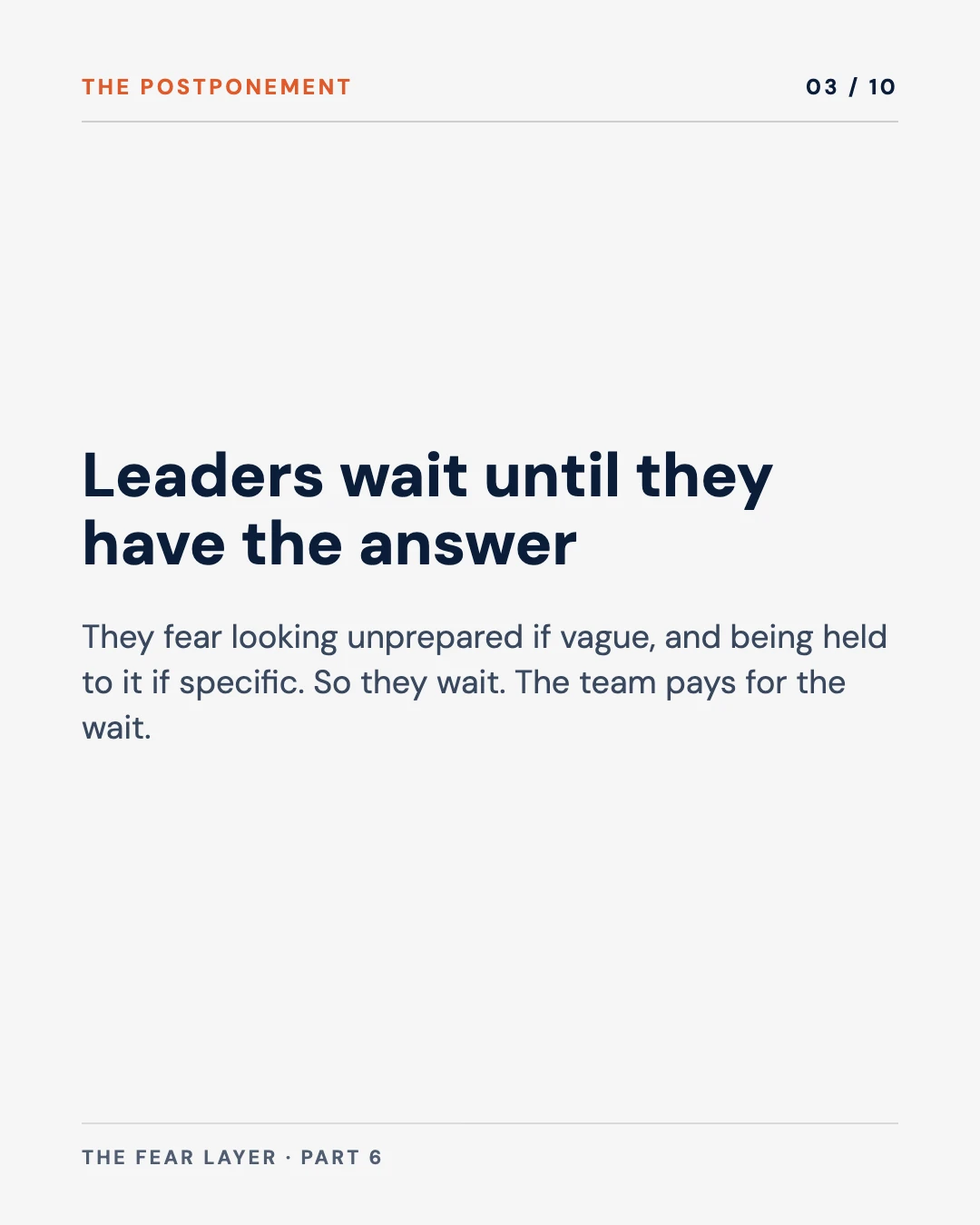
Leaders wait for an answer they cannot have yet
This is the sixth part of a series about the fear that sits under AI decisions. The earlier parts followed it into a board mandate, a purchase and a policy. This one follows it into a meeting room with a team in it, and the fear there belongs to the leader as well as the team.
The leader’s version runs like this. People will ask what the plan is. I do not know what the plan is, because I do not know what the tools will do next year. If I say something vague I look unprepared. If I say something specific I may be wrong, and they will hold me to it. So I will wait until the plan is clear.
It is a reasonable chain of thought, and it produces one of the most expensive habits in AI adoption. In my advisory work, the leaders who put this conversation off are rarely avoiding it out of indifference. They are protecting themselves from being seen not to know, and the team pays for it.
Silence gets filled
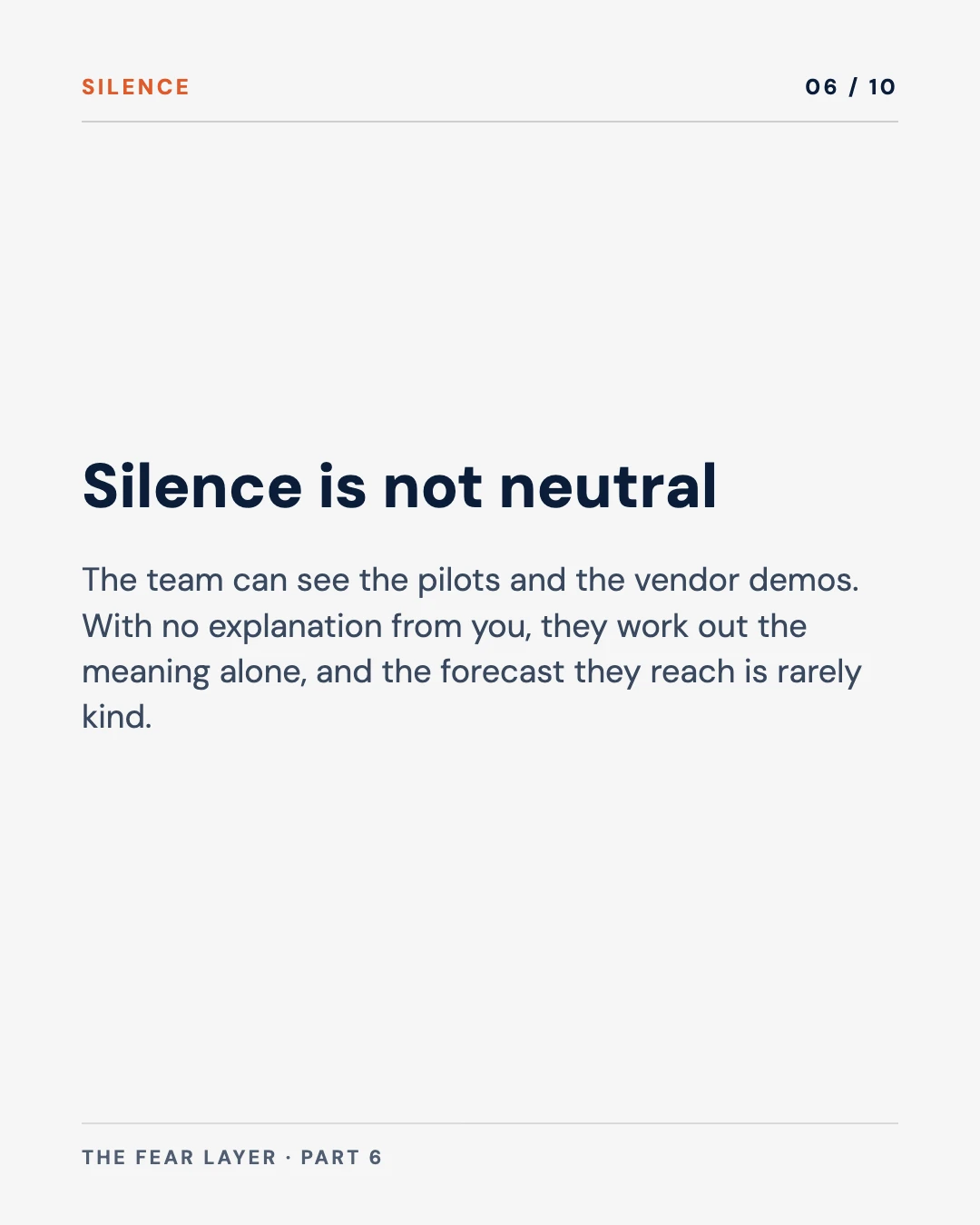
The team is not waiting calmly while the leader finishes the plan. They can see the pilots, the vendor demos and the new tools appearing in their workflow. They have read the same headlines as everyone else. What they lack is anyone telling them what it means for them, so they work it out alone.
Gallup’s 2025 workplace research puts a number on the gap. 44% of employees said their organisation had begun integrating AI into its practices. Only 22% said it had communicated a clear plan or strategy for doing so. Adoption is running at twice the pace of explanation.
Organisations are adopting AI faster than they are explaining it.
Source: Gallup, AI Use at Work Has Nearly Doubled in Two Years (2025); U.S. adults working full or part time, Gallup Panel.
The same research shows what the explanation is worth. Employees who strongly agreed that their leadership had communicated a clear plan for AI integration were three times as likely to feel very prepared to work with AI, and 2.6 times as likely to feel comfortable using it in their role. That is an association from a survey and I would not claim it proves a single conversation causes confidence. It does match what I see: the teams that adopt well are usually the ones that were told early what was going on.
What to say when you do not have the answer
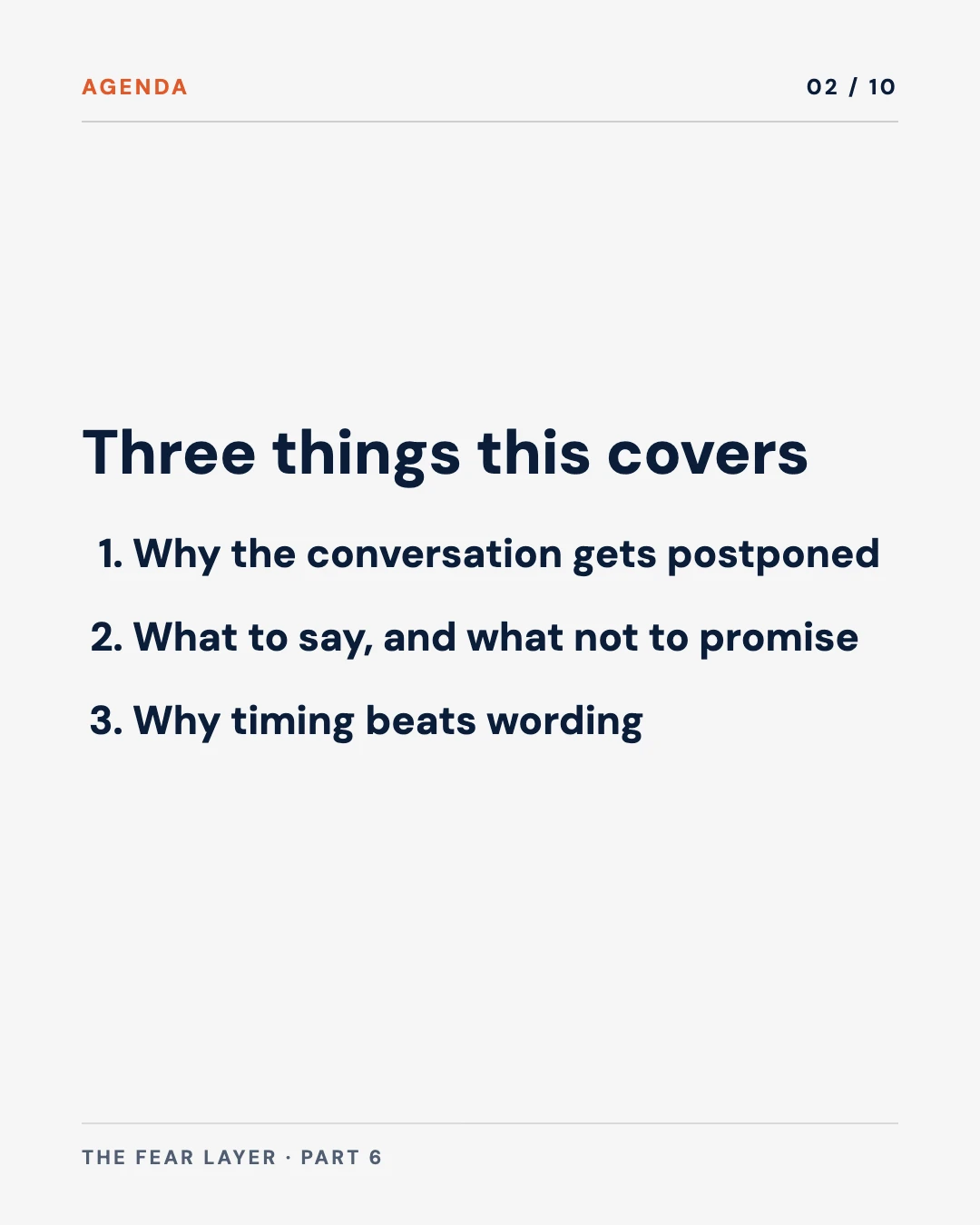
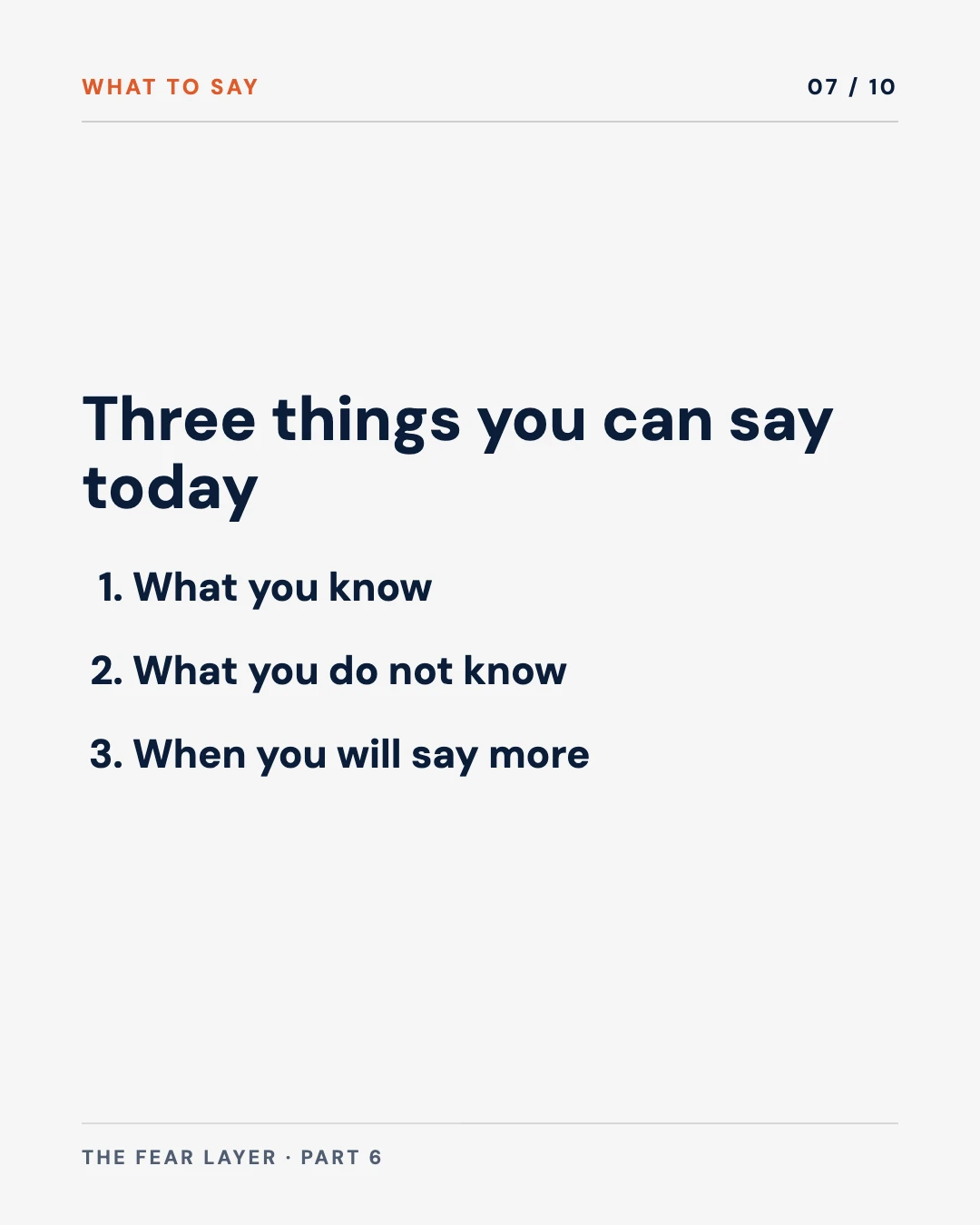
The belief that you need the whole answer first is the mistake. A team does not need your forecast for the next five years. It needs three things, and you can say all three today.
What you know. The tools you are already using, the processes where AI is being tested, what has been decided and what has not. Be concrete and short. If the finance team’s month-end reconciliation is being piloted with an AI tool, say so by name, because a rumour about it will be more specific than your summary.
What you do not know. Say plainly that you do not yet know how roles will change, and that nobody honestly does. This sentence is the one leaders are most reluctant to say, and in my experience it does the most work. A team that hears a leader admit uncertainty tends to believe the rest of what they say. A team that hears confident language with nothing behind it usually has the opposite reaction.
When you will say more. Give a date. Not “we will keep you updated”, which commits you to nothing and which people have learned to translate as “we will not”. A date, such as the first Monday of each month, turns an open-ended worry into a wait with an end point.
That is the whole structure. It takes ten minutes to say and it is honest at every point.
What not to promise
The temptation, once the room goes quiet, is to reassure. Do not.
Do not promise that nobody will lose their job. You may mean it today. You cannot guarantee it for a technology whose abilities are changing every quarter, and the people listening know that. When the promise is broken, even for reasons outside your control, it is remembered as a lie, and it makes the next honest statement harder to believe.
Do not promise that AI will only handle the boring parts. Teams hear this one as a euphemism, because what counts as boring is decided by someone else, and the boundary moves.
Do not promise that everyone will be retrained. Retraining is a good commitment only if there is a budget, a time allowance and a destination role behind it. Without those it is a sentence people will quote back to you.
What you can promise is a process. Tell them how decisions about their work will be made, who will be consulted, how much notice they will get, and what support exists. These are promises you control. They are also the things people care about most, because the fear is less about the outcome than about being decided about without being told.
Timing matters more than wording
Leaders spend most of their preparation on the wording and very little on when. I think that is backwards.
A conversation held early, even a clumsy one, tells the team that they are being treated as adults and that they will hear things from you first. A polished conversation held late tells them the opposite, because by then they have heard the news from a vendor presentation, a colleague at another firm or a post on LinkedIn. Your careful wording arrives as a correction to a story they already believe.
The earliest useful moment is when the first pilot starts touching someone’s actual work. Before that there may be nothing to say. After it, every week of silence costs trust. If you are not sure whether you have reached that point, ask the person whose task the pilot is changing. They already know.
Where to start this month
If you lead a team that AI is already touching, hold the conversation within the month. Do not wait for the plan to be final. Say what you know, say what you do not, and put the date of the next update in the diary before you leave the room.
If you lead leaders, ask them whether they have had this conversation, rather than whether they have a communications plan. The two get very different answers. A plan can be complete and never delivered.
If you are the one being told, ask for the three things directly: what is known, what is not, and when you will hear more. A leader who has not thought about it will usually be glad to be asked, because it hands them a structure.
Free tool
Workforce AI Readiness Diagnostic
Eighteen questions on the people side of AI adoption, including fear, leadership sponsorship and change capacity.
Evidence & Methodology
Only the Gallup figures are cited statistics. The three-part structure, the list of promises to avoid and the point about timing are my own, drawn from advisory work. Here is which is which.
| Claim | Source | Grade |
|---|---|---|
| 44% of employees say their organisation has begun integrating AI; 22% say it has communicated a clear plan or strategy for doing so | Gallup, AI Use at Work Has Nearly Doubled in Two Years, 2025; U.S. adults employed full or part time, Gallup Panel | Measured |
| Employees who strongly agree leadership has communicated a clear AI plan are 3 times as likely to feel very prepared to work with AI and 2.6 times as likely to feel comfortable using it in their role | Same Gallup article; a survey association, not evidence of cause | Measured |
| The know, do-not-know and when-I-will-say-more structure, and the three promises to avoid | My own pattern across advisory engagements, not a study | My call |
| Timing matters more than wording | My own observation; not tested against any dataset | My call |
Sources
- Gallup. (2025, June 15). AI Use at Work Has Nearly Doubled in Two Years.

What Looks Like Resistance to AI Is Usually Self-Protection
What the team is feeling while you wait, and why their caution is rational.
Governance Theatre Is What Fear Looks Like on a Slide
The previous part, on what fear produces when it reaches the governance function.

When Your Boss Is Afraid of AI
The same silence seen from below, by the person waiting to be told.
This is part six of The Fear Layer. Part seven is the closing one, on what I still do not know about where this goes. If you are about to have this conversation with a team and want to think it through first, that is work my consulting practice does.