
Executive Summary
The entry-level job market is genuinely tighter than it was three years ago, and AI is part of why. But the same shift has opened an unusually early window for graduates willing to build rather than apply.
Core conclusions
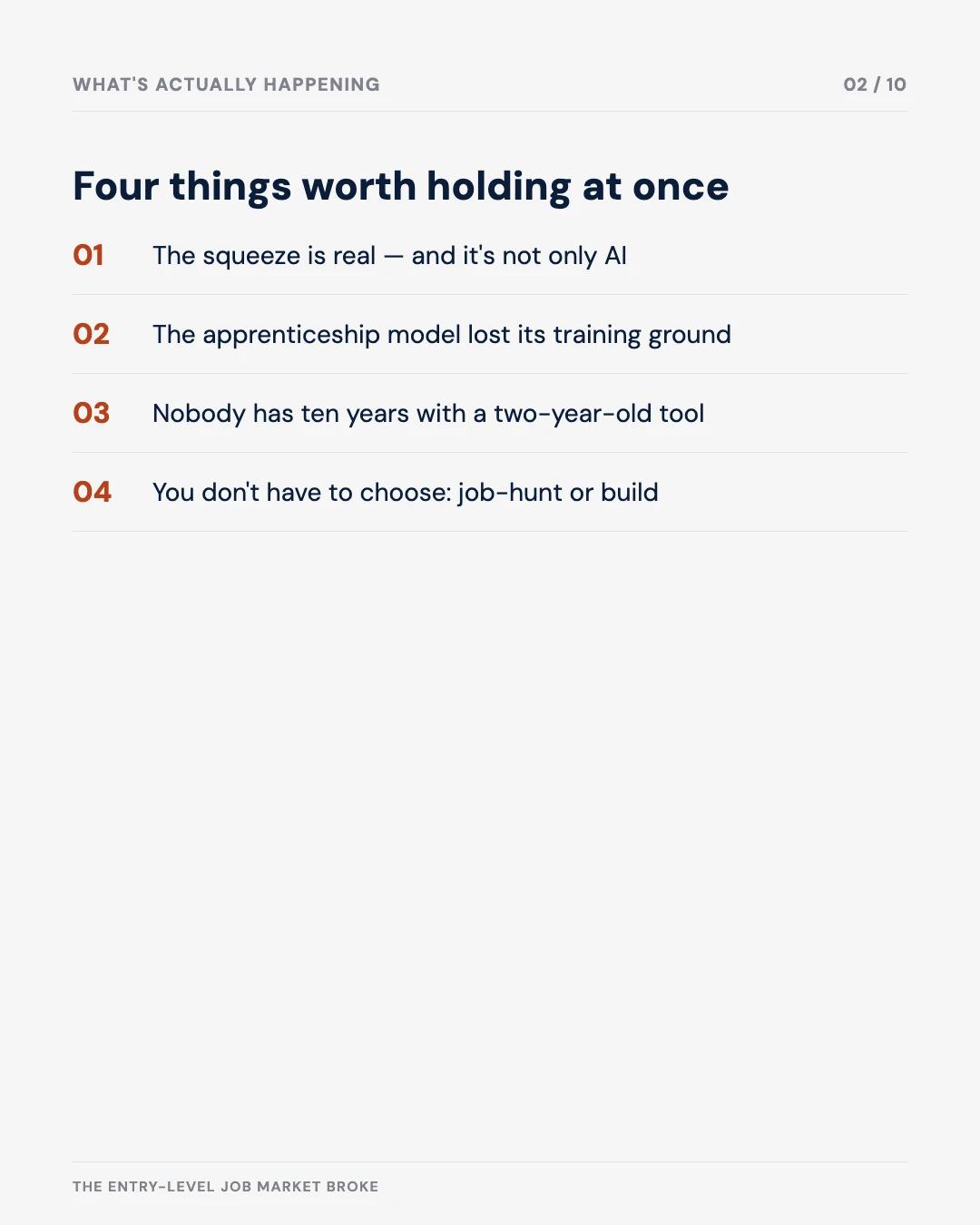
- Junior roles trained judgment, not just output, and AI has taken over much of the ticket-queue work that used to do that training. The loss is real, not imagined.
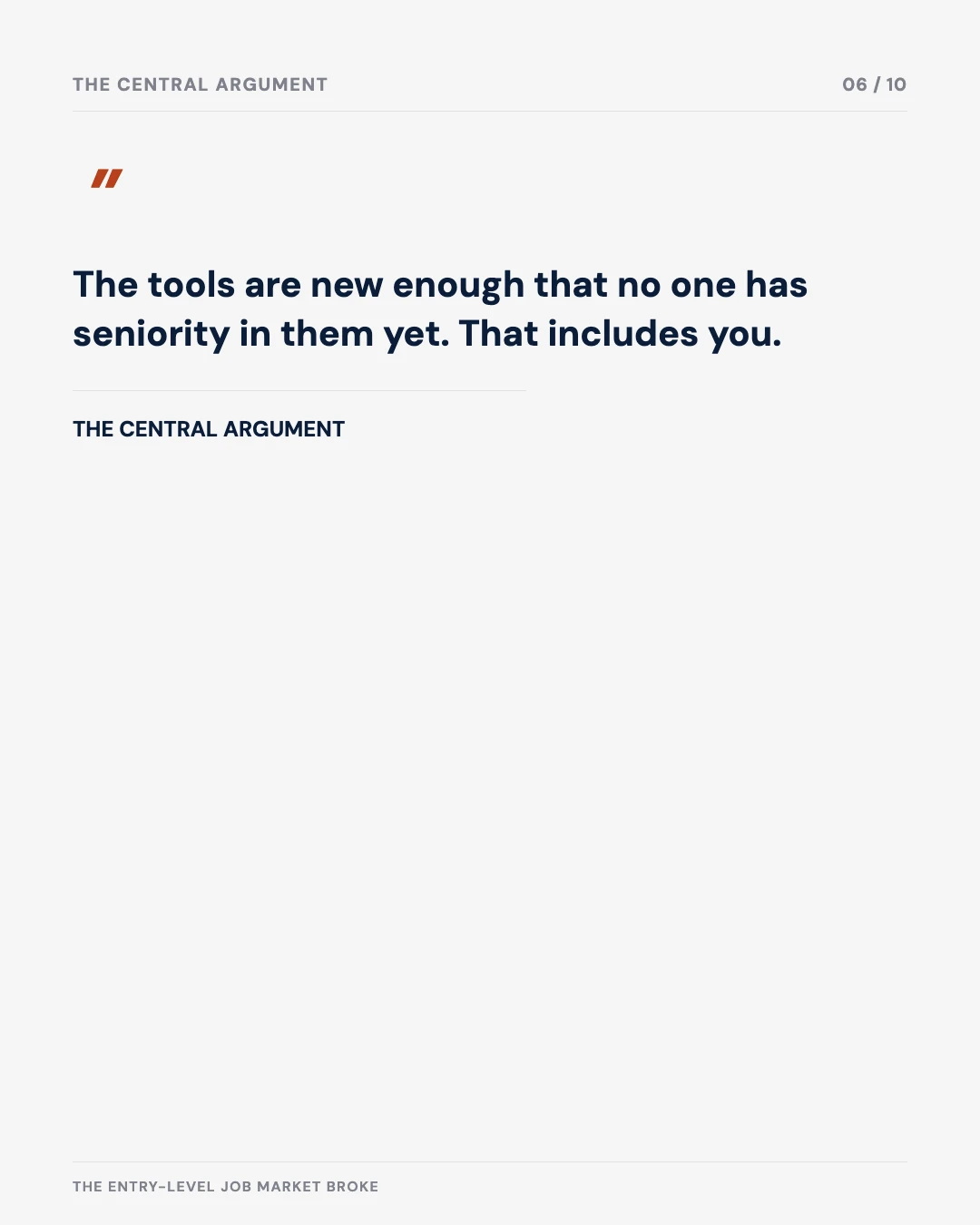
- Fluency with AI-native tools is measured in weeks, not years, so the usual seniority advantage doesn’t exist yet. Nobody has a decade of experience with a two-year-old tool.
- Building something real while still job-hunting is no longer a side project; it’s now a legitimate way to demonstrate exactly the fluency employers can’t yet source from experience.
The argument, in ten slides
Save it, share it, or send it to a new grad deciding what to do next.


I mentor early-stage founders through NUS’s National GRIP programme, most of them straight out of university or still in it. So I hear the same two conversations happening back to back, sometimes in the same afternoon.
In one, a graduate tells me they’ve sent out two hundred applications and heard back from three. In the other, a 23-year-old shows me a working product they built alone in a month, already has paying users, and is trying to decide whether they even want a job anymore.
Both conversations are describing the same market. That’s the part worth sitting with.
The squeeze is real
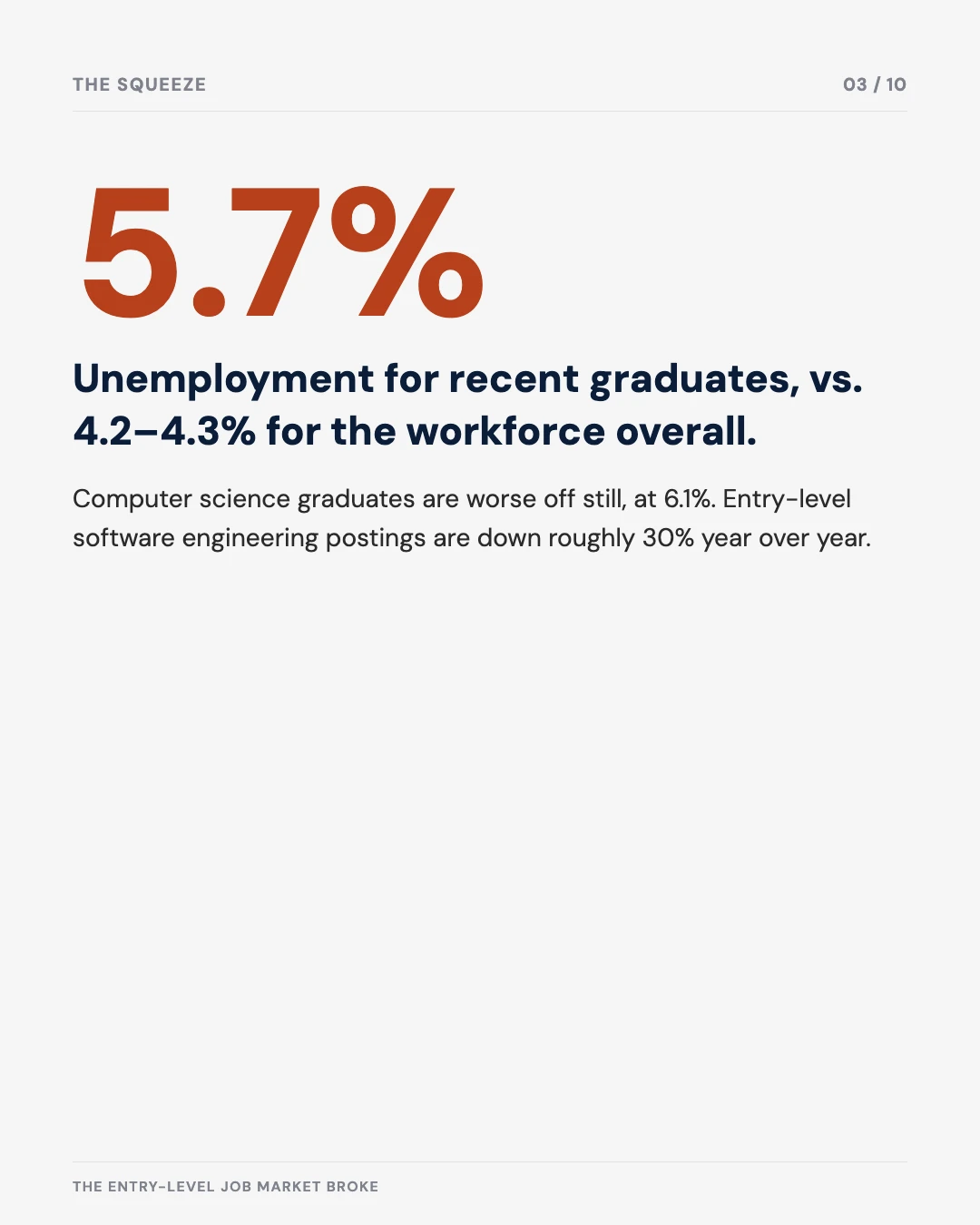
Recent graduates are unemployed at 5.7 percent, against roughly 4.2 to 4.3 percent for the workforce overall. Computer science graduates specifically are worse off, at 6.1 percent, nearly double the rate of most other majors. Entry-level software engineering postings are down roughly 30 percent year over year.
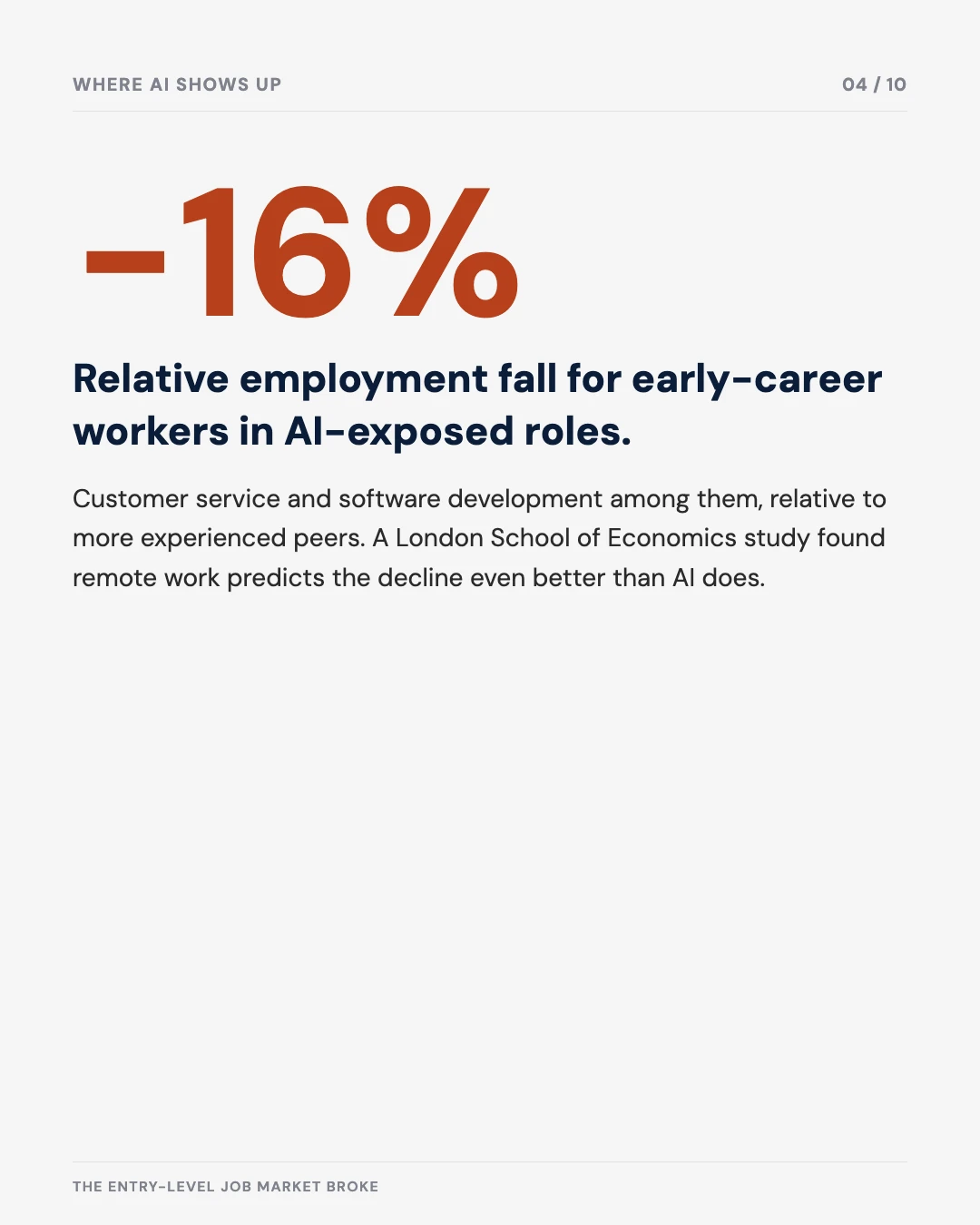
I’m not going to tell you AI is the whole explanation. A London School of Economics study this year found that remote work predicts the entry-level decline better than AI does, mostly because remote hiring makes on-the-job supervision more expensive, and supervision is exactly what junior roles used to run on. But AI is not nothing either. Early-career workers in roles most exposed to AI, customer service and software development among them, have seen employment fall 16 percent relative to their more experienced peers over the same period.
So hold both facts. The market is genuinely tighter than it was three years ago, for reasons that are only partly about AI. And whatever the cause, the junior role you were counting on is harder to get than it used to be.
What the junior role actually did
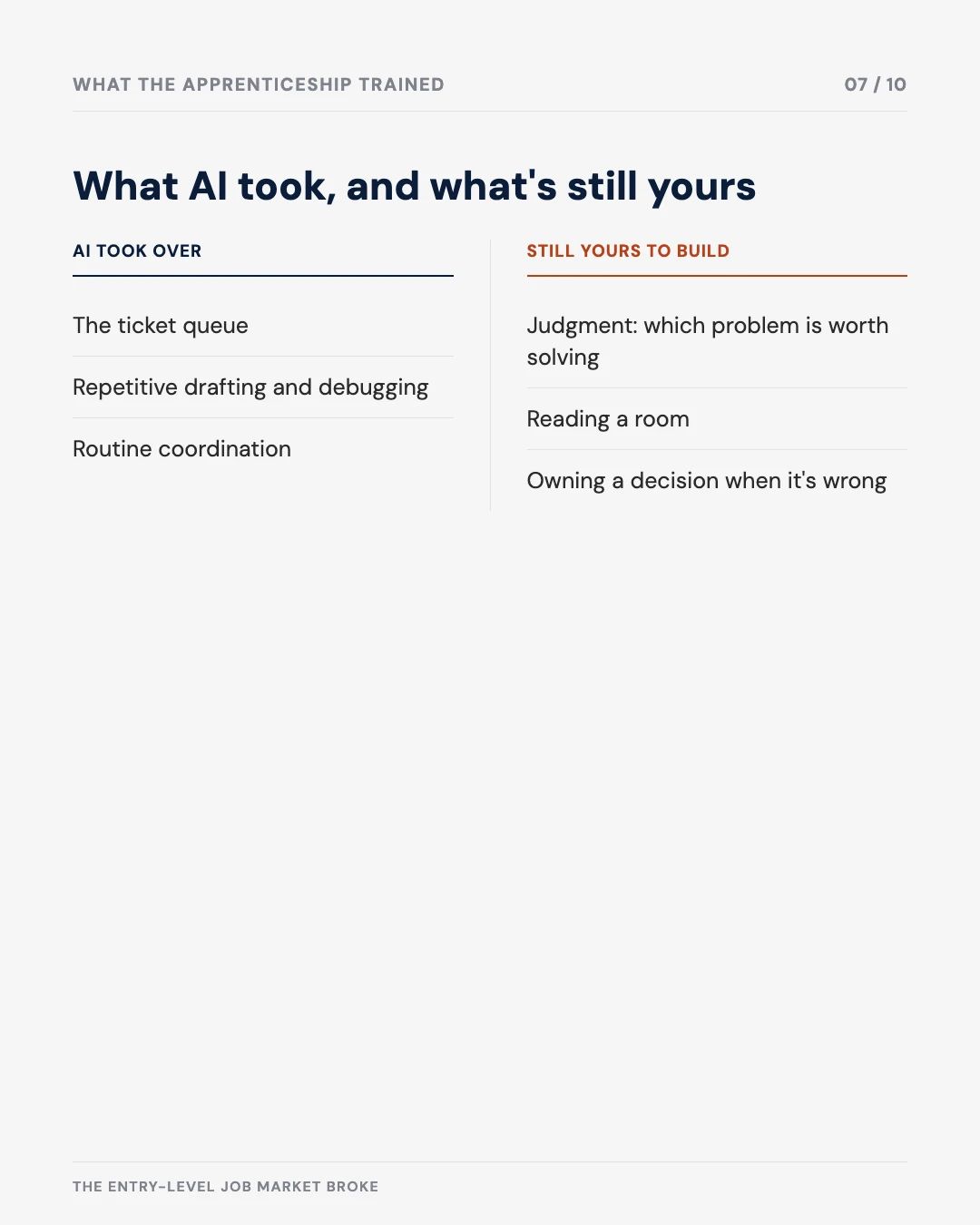
The apprenticeship model in most companies never paid you for output. It paid you to absorb judgment, slowly, by doing the tickets nobody senior wanted while someone more experienced corrected your mistakes. That was the actual product. The salary was the wrapper around it.
AI has taken over a lot of that ticket queue. What that means for how you build a career from here is worth thinking through deliberately, not by default. What it hasn’t taken over is the judgment the apprenticeship was quietly training into you. Deciding which problem is worth solving, reading a room, owning a decision when it turns out wrong: none of that got automated. It just lost its usual training ground.
That’s the loss. Here’s the part I think gets left out of most of these conversations.
Nobody has ten years of experience with a two-year-old tool
Jensen Huang told Carnegie Mellon’s graduating class this year to “run, don’t walk” toward AI, and said no generation has entered the workforce with more powerful tools or greater opportunity than this one. I’d usually be skeptical of a commencement speech turned into a career strategy. But the underlying claim holds up structurally, not just rhetorically.
The advantage a 45-year-old normally has over a 22-year-old is a decade of pattern-matching on how the tools work. That advantage does not exist yet in AI-native building, because the tools are too new for anyone to have banked it. The gap right now runs between fluent and not fluent, and fluency in these tools is measured in weeks, not years. I have laid out a structured pathway for closing that fluency gap fast, aimed specifically at graduates and early-career engineers.
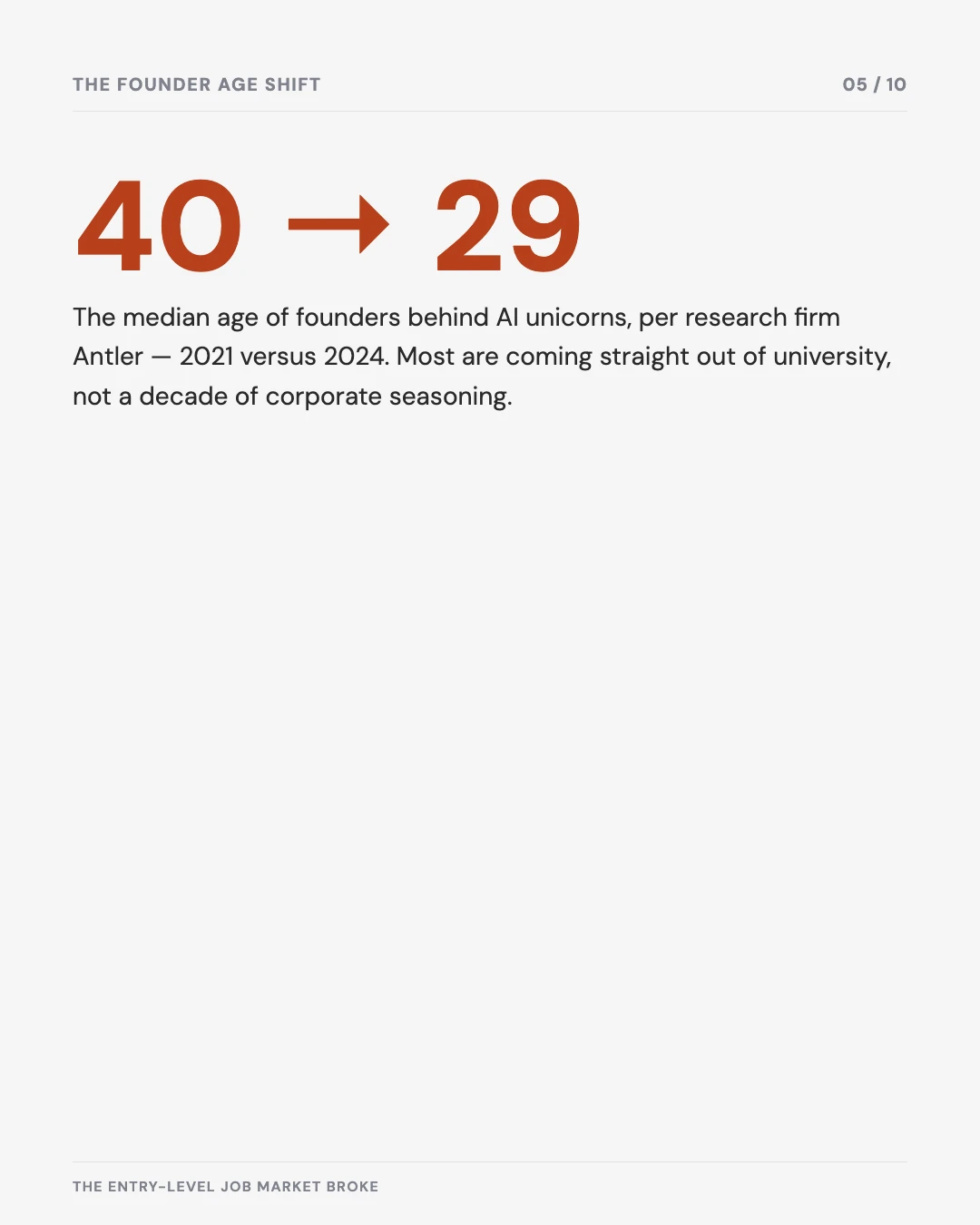
That’s the mechanism behind a genuinely strange data point. Research firm Antler tracked the founders behind AI unicorns and found the median founder age fell from 40 in 2021 to 29 in 2024. A separate industry study, the Leonis AI 100, put the median age of AI startup founders at 29 at the point of founding. Most of them are coming straight out of university or a research lab, not a decade of corporate seasoning.
Zach Yadegari is the sharpest version of this. He built Cal AI, a calorie-tracking app, to more than thirty million dollars in annual revenue by the time he was nineteen, and sold it to MyFitnessPal. He did not out-experience anyone. He shipped faster than people twice his age who were still waiting for permission.
You don’t have to choose
I want to be careful here, because I’ve watched enough founders up close to know that “everyone should start a company” is bad advice dressed up as inspiration. Most people shouldn’t, at any age, and a founder’s path is harder and lonelier than the pitch decks make it look.
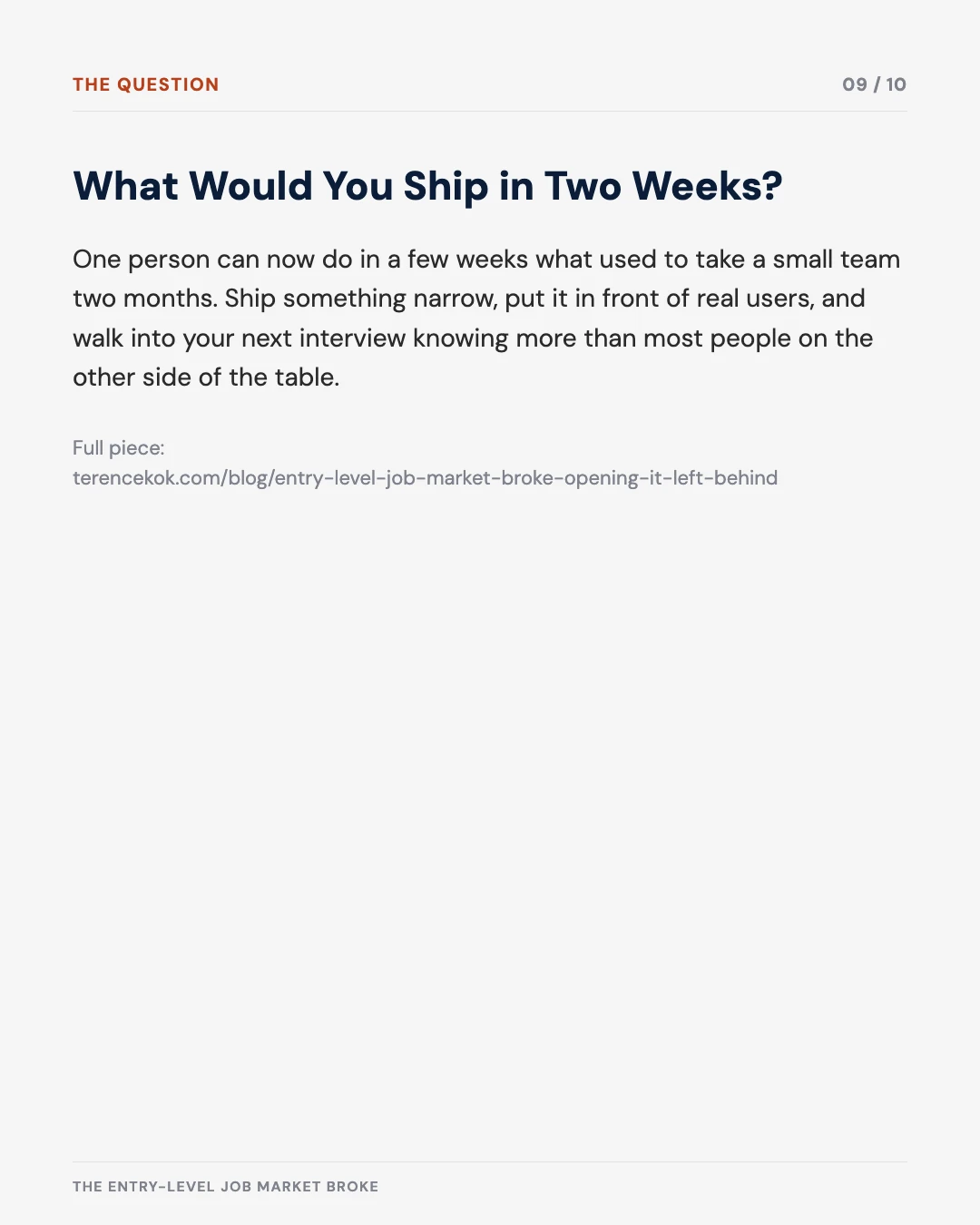
What I am saying is narrower. If you’re graduating into a market where the traditional door is genuinely stuck, building something real while you keep looking for that job is no longer the side project it used to be. The tools now let one person do in a few weeks what used to take a small team two months. Ship something narrow, put it in front of real users, and you will walk into your next interview knowing more about how these tools behave in practice than most of the people on the other side of the table. Do it twice, and the “years of experience” line on the job posting stops being the obstacle it looks like.
The bottom line
The market really is squeezed for graduates trying to get hired into someone else’s system, and it would be dishonest to tell you otherwise. It is comparatively open for graduates willing to build their own, not because the barrier is low, but because for the first time in a long time, nobody older than you has much of a head start.
The tools are new enough that no one has seniority in them yet. That includes you.