
Executive Summary
AI is entering capital markets in three places at once. Retail brokers now let AI agents place orders on a client’s behalf. Compliance teams are using language models to review e-communications for market abuse. And MAS’s Project Guardian has moved tokenised bonds and funds into live use, which raises the question of whether operational data from the underlying assets could value a tokenised infrastructure bond continuously. Each move has a control gap. Singapore’s suitability rule assumes a human adviser forms the recommendation, and MAS’s proposed AI risk guidelines are not yet final. Surveillance vendors report large cuts in false positives, but no bank has published before-and-after figures, and a quieter alert queue can mean a blind one. No tokenised instrument I could find is valued from asset condition data today. My recommendations are a graded kill switch that sits outside the agent, a surveillance baseline that estimates what the system misses as well as what it flags, and condition-triggered revaluation in place of continuous pricing.
$460m
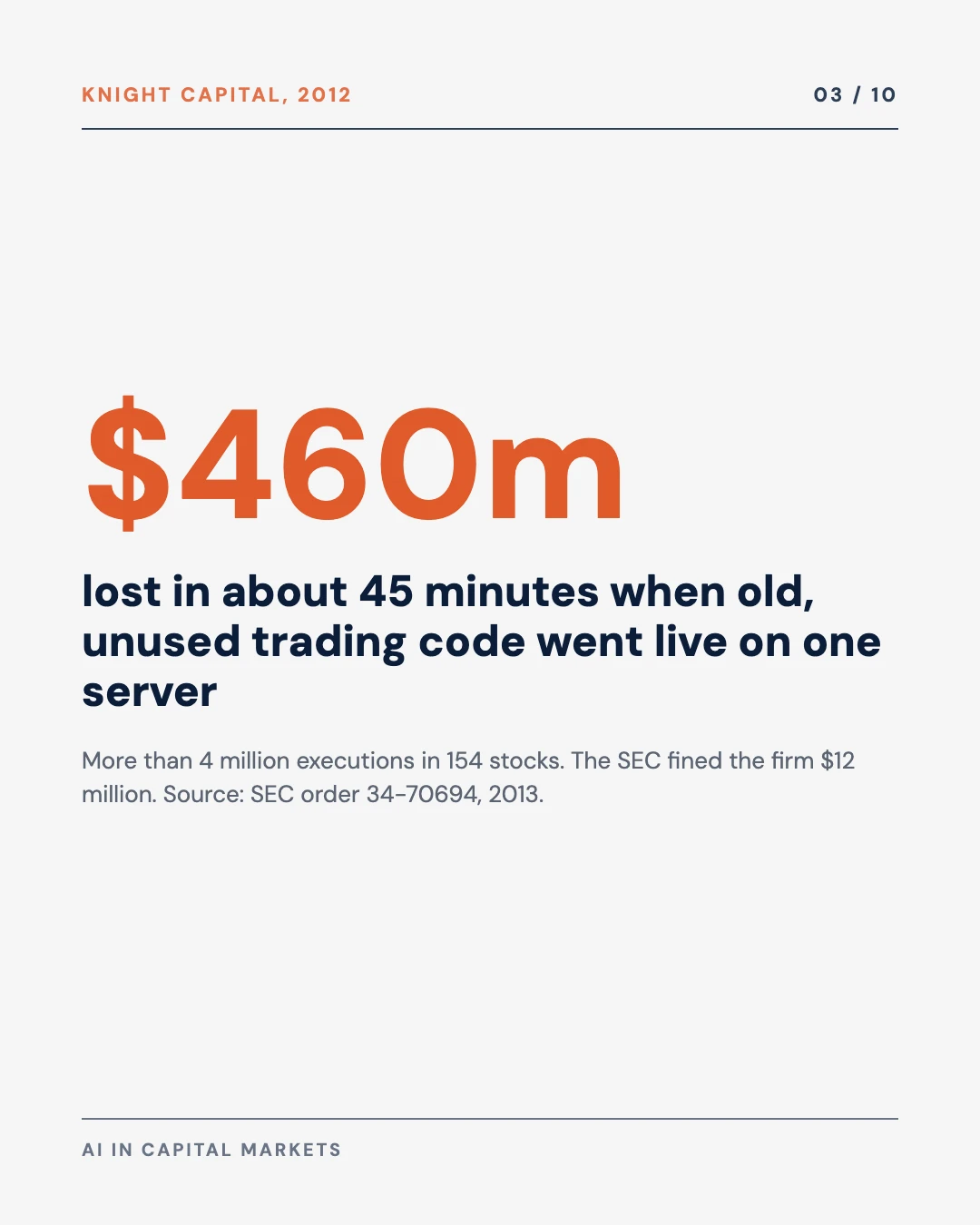
lost by Knight Capital in about 45 minutes when dormant trading code went live, SEC order, 2013
$2bn+
in SEC penalties against more than 100 firms for off-channel communications since December 2021
2 years+
that some firms ran faulty surveillance alerts without knowing, FCA Market Watch 79, 2024
12 months
transition MAS proposes once its AI risk management guidelines are issued; still in draft in October 2026
Core conclusions
- An AI agent that places orders is held to the same suitability and market-access rules as the firm that runs it. The firm carries the liability when the agent leaves its mandate, so the mandate, the limits and the stop must be enforced outside the model.
- LLM-based surveillance should be judged on what it misses as well as on how many alerts it removes. Seeded test cases, sampling below the alert threshold and comparison with the old system give a usable baseline even when confirmed abuse is rare.
- Asset condition, utilisation and maintenance data can make a tokenised infrastructure bond more transparent. Used to set its price continuously, the same data would bring oracle, model and margin-call risks that no current framework covers.
The argument, in ten slides
Save it, or send it to whoever owns trading controls, surveillance or digital assets in your firm.
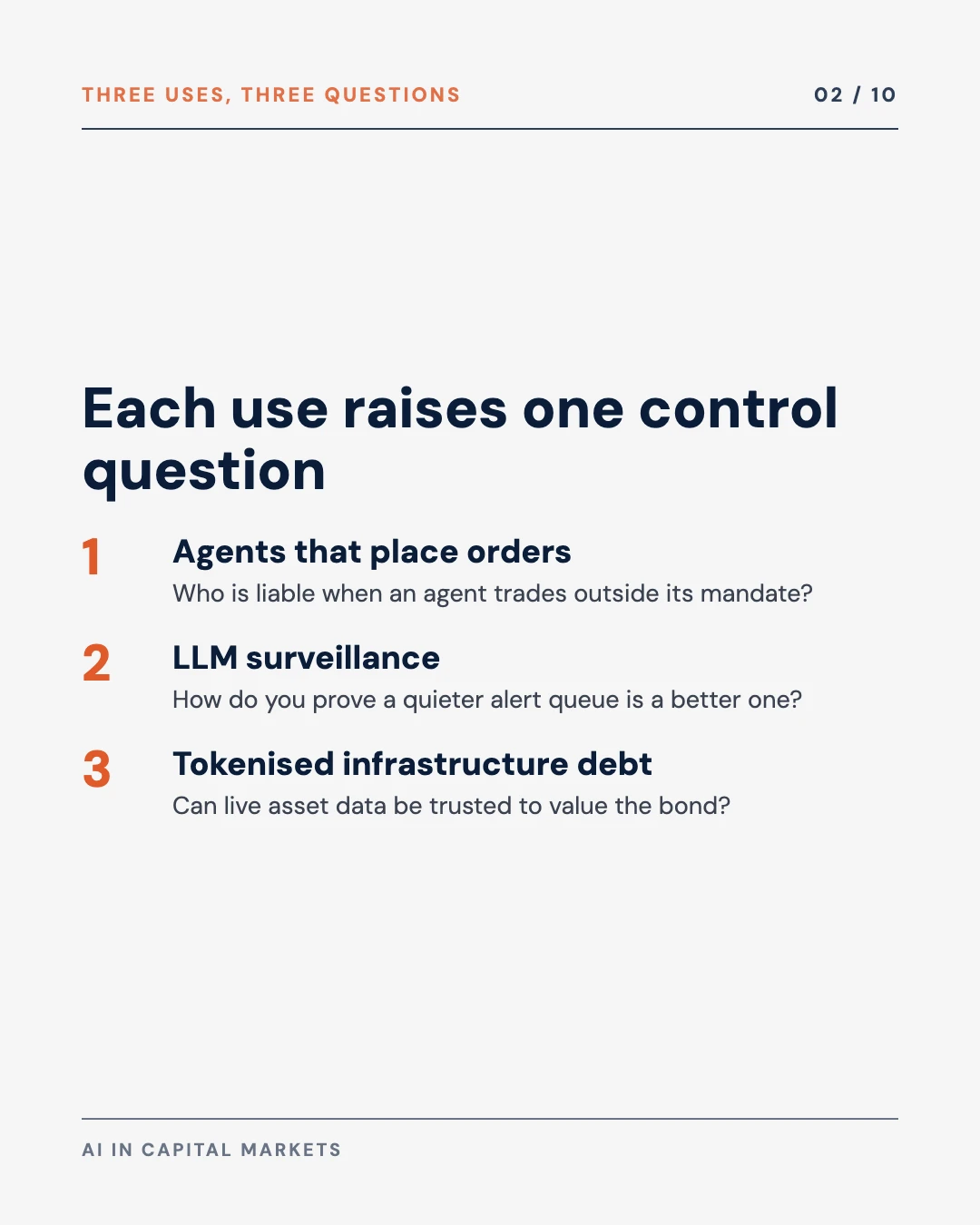

Our last post together looked at how traditional finance and decentralised finance are converging on shared rails. This one goes a level down, into three specific uses of AI in markets, brokerage and digital assets: agents that place orders, models that watch traders, and data that could value tokenised debt. Christina brings the view from a multi-market brokerage platform. I bring control design from safety-critical engineering, where the first question about any automated system is how it stops. Each of the three uses arrived before the controls for it.
Agents that place orders
Two US brokers have opened their platforms to AI agents this year. Public.com launched agents that execute trades on a client’s portfolio in March 2026, which clients can “pause, stop, or edit” at any time. Robinhood opened a beta of agentic trading in May: the client funds a dedicated account, the agent can reach only the money in it, every trade triggers a push notification, and the client can “disconnect the agent at any time with the tap of a button”. IOSCO’s May 2026 supervisory toolkit notes that most agentic uses in capital markets are still at the proof-of-concept stage. Retail execution is one of the first to leave it.
Robinhood’s design choices are worth studying because they are control choices. A ring-fenced account caps the loss at the deposit. A notification per trade keeps the client informed. A disconnect button gives the client a stop. What the design leaves open is the question regulators will ask first: when the agent decides what to buy, who made the recommendation?
Suitability under the Financial Advisers Act
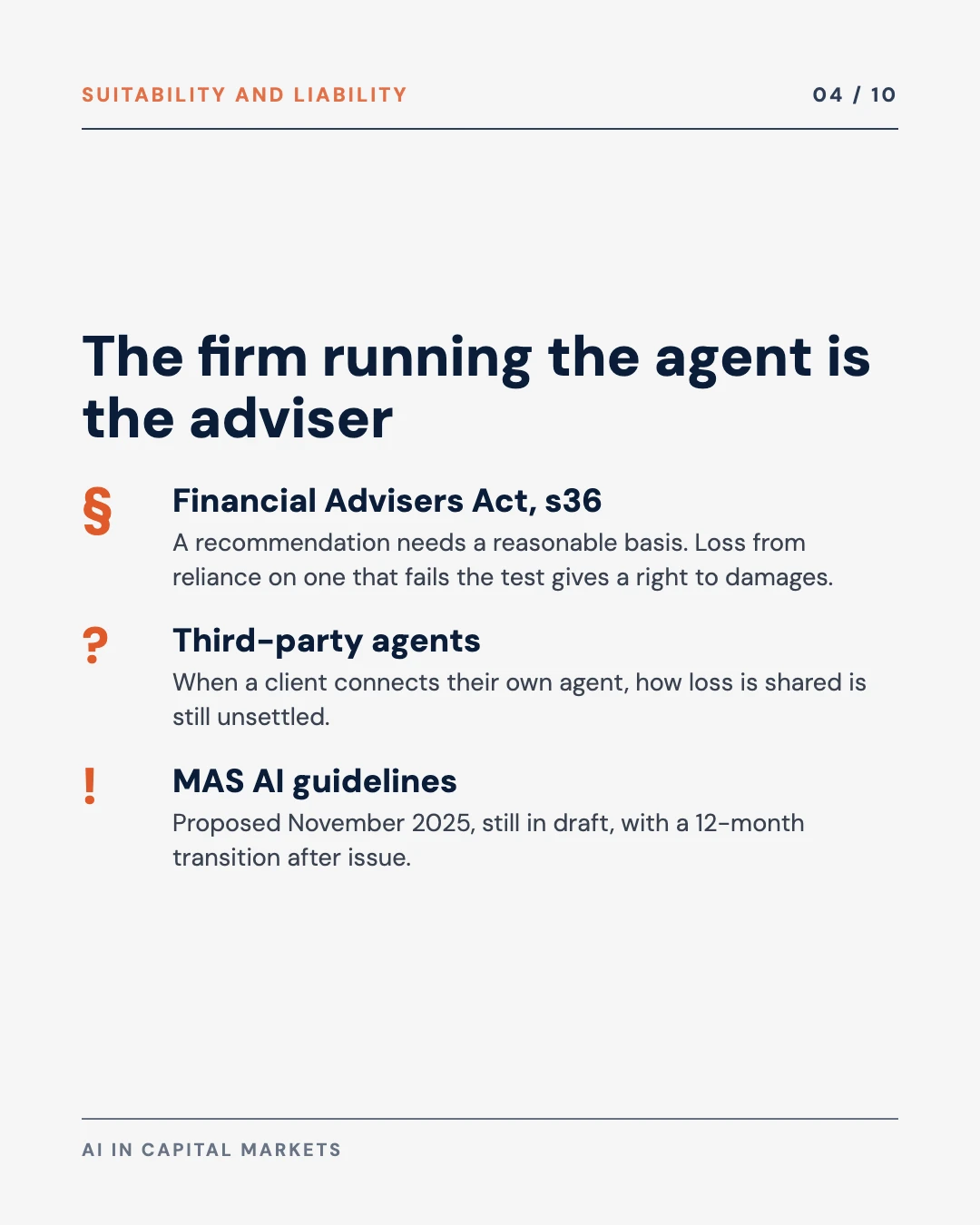
In Singapore the answer starts with section 36 of the Financial Advisers Act 2001. A licensed adviser “must not make a recommendation with respect to any investment product” to a client who may reasonably rely on it without “a reasonable basis”, which includes considering the client’s investment objectives, financial situation and particular needs. Section 36(3) makes the adviser liable to pay damages for loss caused by reliance on a recommendation that fails the test. Notice FAA-N16 adds the know-your-client, needs analysis and record-keeping steps behind it.
The rule was written for a person forming a view. MAS extended it to algorithms in its 2018 Guidelines on Provision of Digital Advisory Services. They require controls “to suspend the provision of advice if an error or bias within the algorithms is detected”, post-transaction sample testing reviewed by “an independent and qualified human adviser”, and disclosure to clients of the circumstances in which the firm may override the algorithm or “temporarily halt” the service. They place responsibility for the design on the board and senior management.
Those guidelines describe a robo-adviser that maps a questionnaire to a model portfolio and rebalances it. An agent that turns a client’s sentence into a trading strategy of its own is a different machine. Its behaviour cannot be fully specified in advance, it can call tools and data the firm did not anticipate, and the same instruction can produce different orders on different days. MAS named this risk in its November 2025 consultation on AI risk management guidelines: “an AI agent with access to tools could autonomously execute actions that are not aligned with an FI’s business objectives or a customer’s best interests.” In August 2026 MAS told Parliament the guidelines “apply to all AI use cases by FIs, including agentic AI, and will be finalised soon”. The draft proposes a 12-month transition after issue. Firms launching trading agents now are working ahead of the final text.
Who carries the loss
The regulatory position is clearer than the commercial one. Under section 36, a firm that offers an agent which recommends and executes is the adviser, and the model is its tool. The harder case is a client who connects their own third-party agent to a broker through an API, which is what “open to agents” makes possible. The broker then receives orders from software it did not build, acting on instructions it did not see. Whether that is execution-only business, and how loss is shared between client, agent provider and broker when the agent goes outside what the client intended, has not been tested in a Singapore court. FINRA’s 2026 oversight report names the same risk in plain terms: agents “may act beyond the user’s actual or intended scope and authority”.
| Who supplies the agent | Likely position | What the firm should hold |
|---|---|---|
| The broker or adviser | The firm is the adviser; section 36 and the digital advisory guidelines apply | A written mandate per client, pre-trade limits, suitability checks on the agent’s orders, a log tying each order to the mandate |
| A third party, chosen by the client | Unsettled; closer to execution-only, but the firm still controls market access | Ring-fenced funding, per-agent credentials the firm can revoke, order limits, clear client terms on agent liability |
| The client’s own build | Execution-only in most cases | The same market-access controls as any direct client, plus rate limits on API order flow |
My reading of the position as of October 2026. It is a governance view, not legal advice, and the middle row in particular needs a lawyer’s opinion for each product.
An industry reference paper hosted by MAS in July 2026, Safeguards for Agentic Finance at Runtime, puts the principle well: “Authority is explicit… defined by the mandate, not inferred by the agent.” It states that it is not regulatory guidance. I would still treat it as the clearest statement available of what a supervisor will expect to see.
Kill-switch design
Market rules already require brokers to stop automated orders, and none of them mention AI. The US Market Access Rule, SEC Rule 15c3-5, requires pre-trade controls that “prevent the entry of erroneous orders” and keeps them “under the direct and exclusive control of the broker or dealer”. The EU’s RTS 6 requires firms to “cancel immediately, as an emergency measure, any or all of its unexecuted orders”, which it calls “kill functionality”, and to know which algorithm, trader or client is responsible for each order. SGX’s rules require automated pre-execution risk checks on every order and the ability to “immediately suspend or terminate” a client’s direct market access. IOSCO’s 2026 toolkit lists “circuit breaker or kill switch policies & procedures” among the items supervisors should check for AI.
Knight Capital is the case every trading-controls team should know. On 1 August 2012, a software release missed one of Knight’s eight order servers, and a repurposed flag woke old, unused code called Power Peg on it. In about 45 minutes it sent more than 4 million executions in 154 stocks, building net positions of about $3.5 billion long and $3.15 billion short, and the firm realised a $460 million loss. The SEC later fined Knight $12 million, finding among other things that it had no adequate controls to stop the orders. The firm had the means to stop trading. It did not have a stop that a person could use with confidence, at the speed of the failure.
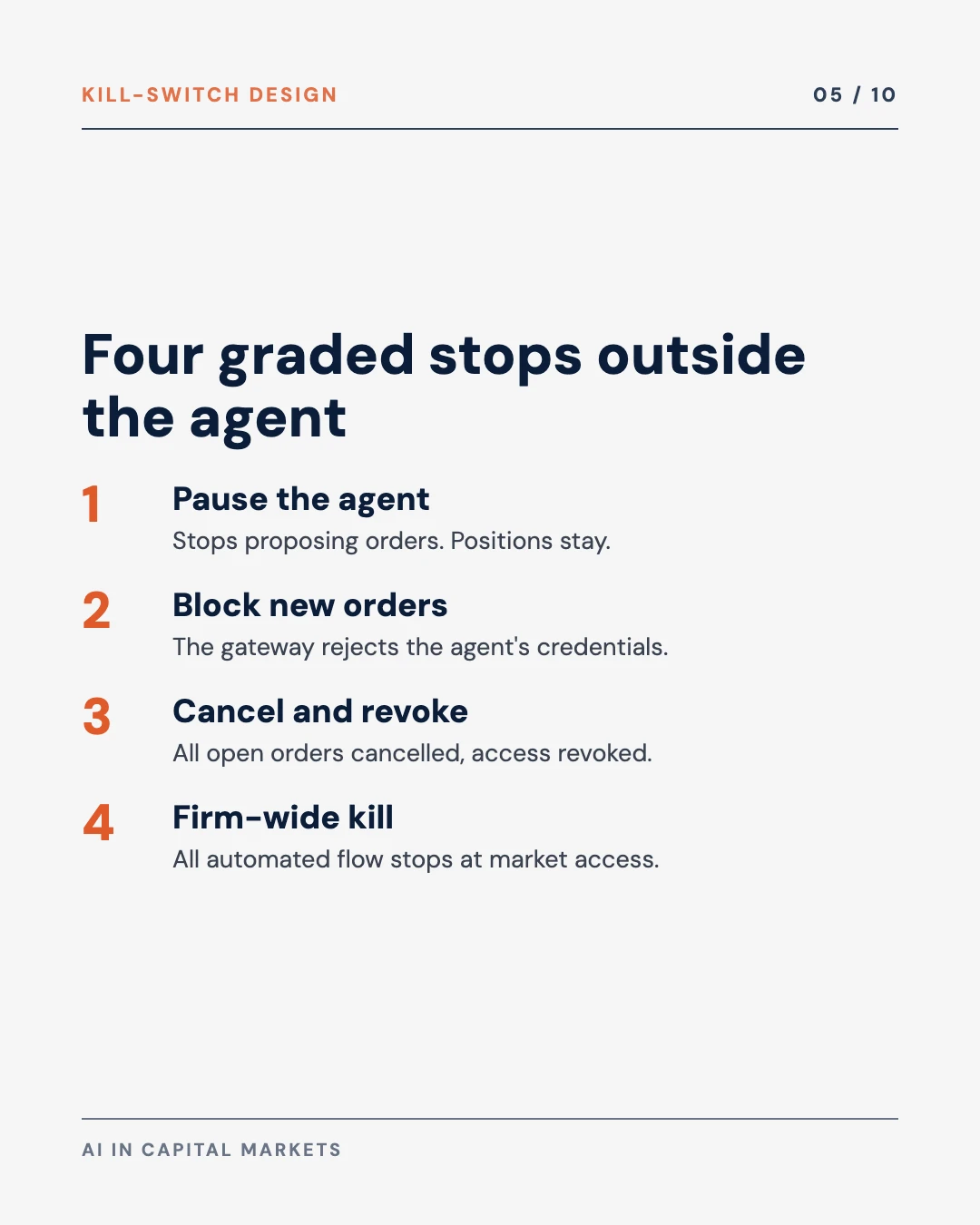
Safety-critical engineering solved this problem long ago, and the solution transfers. Machinery standards define stop categories by what is cut and in what order, because an uncontrolled stop can be as dangerous as no stop. Two principles matter most. The stop must sit outside the thing it stops: a kill switch that asks the agent to stop is a request. And each level must be tested on a schedule, by the people who would use it, because a stop that has never been pulled will fail when it is needed.
Four graded stops for an AI trading agent
Schematic. My design, adapted from the stop categories in machinery safety standards. Each level needs a named owner, a written trigger and a log entry, and every level sits outside the agent it stops.
The graded design matters for an AI agent because the first sign of trouble is usually ambiguous. A trader who suspects an agent is misreading its mandate should be able to pause it without unwinding positions or cutting off every client. A risk officer who sees orders breaching limits should be able to cancel all of them in one action. Each level needs a named owner, a written trigger and a log entry when it is used.
What the audit log must hold
RTS 6 asks firms to identify the algorithm, trader or client behind each order. For an agent, that is not enough to reconstruct a decision. The SAFR paper calls for a “tamper-evident, append-only” audit log. In my view each agent order should be traceable to six things: the mandate version in force, the client instruction that started it, the model and prompt versions, the data the agent read, the pre-trade checks it passed, and any human approval. FINRA asks firms to consider “how to track agent actions and decisions”. A firm that cannot answer that question from its own logs cannot defend a suitability complaint.
Free tool
Agent Risk Assessment Matrix
Place each AI agent on autonomy and consequence, and get the controls it needs. An agent that places client orders sits in the top-right corner.
AI in trade and communications surveillance
Surveillance teams have a volume problem and a quality problem. Regulators have widened the channels firms must record and review. Since December 2021 the SEC has fined more than 100 firms over $2 billion for failing to keep off-channel communications such as WhatsApp messages. The FCA’s 2025 review of 11 firms found 178 off-channel breaches disclosed by eight of them, with 41 per cent involving people at director grade or above. Every new channel adds messages to review.
The quality problem is older. In a 2024 survey of 64 senior executives by Acuiti, commissioned by the surveillance vendor Eventus, more than half said over 50 per cent of their alerts were low quality, and most saw fewer than 10 per cent of alerts escalated. The often-repeated claim that 95 to 99 per cent of surveillance alerts are false positives is not one I could trace to a primary source for trade or communications surveillance; the figure appears to come from anti-money-laundering transaction monitoring.
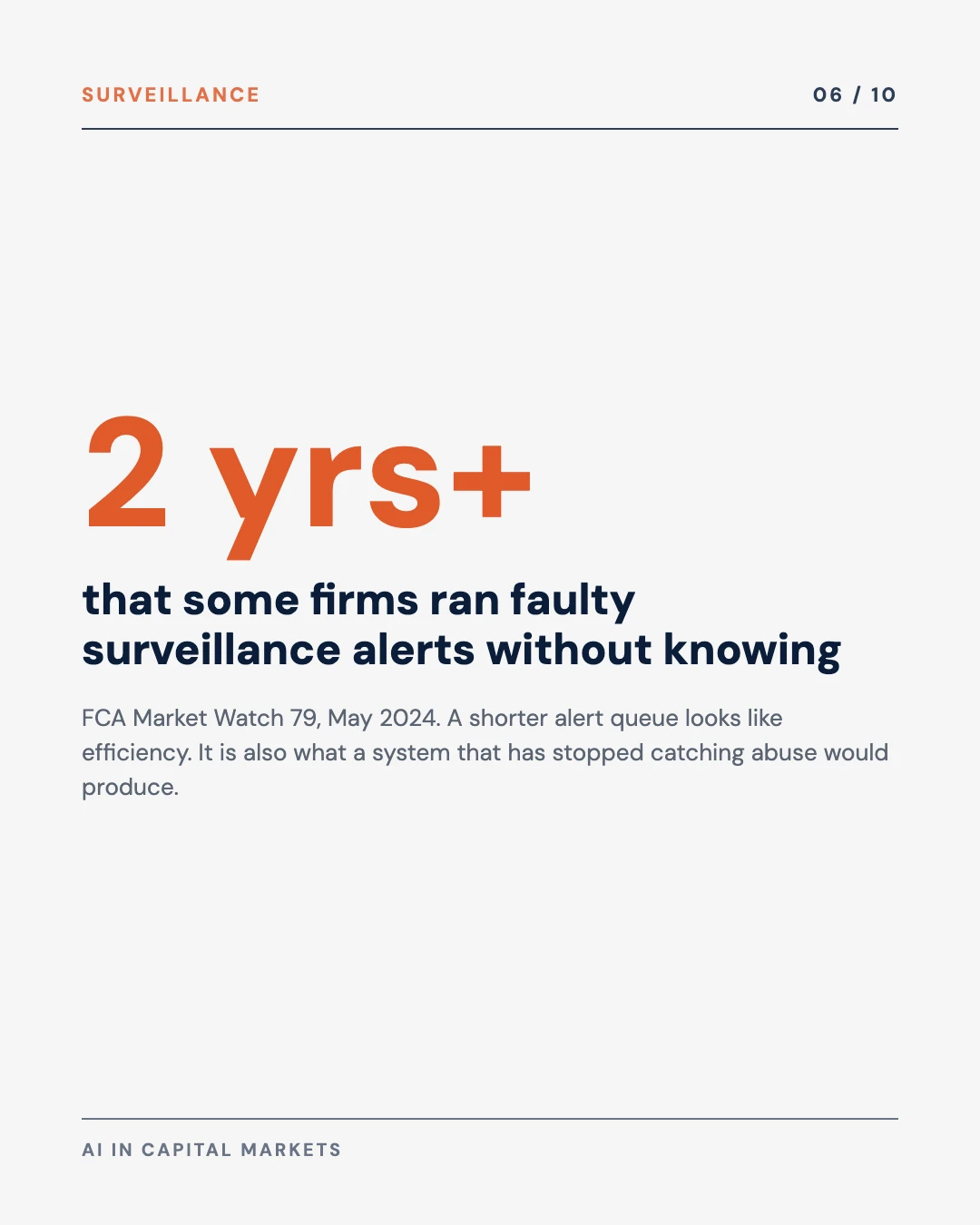
The FCA’s Market Watch 79, published in May 2024, describes a sharper risk. It found “surveillance alerts not working as intended and assumed by the firm”, and “in some extreme cases, we have seen firms unaware of faults for 2 years or more.” In a peer review of front-running surveillance at nine investment banks, about half focused their model reviews mainly on calibrating parameters.
What the vendors report
Language models read a message for intent, so they should be better than keyword lexicons at telling banter from collusion. Vendors say they are. Smarsh reported “up to 60%+ reduction in false positives” and “40+ hours saved per reviewer per month” from early preview users in March 2026. Other vendors claim larger cuts on their websites. None of these figures discloses the sample, the method or, most importantly, what happened to true positives. A Global Relay survey found the share of firms reluctant to adopt AI in surveillance fell from 57 to 38 per cent between its 2024 and 2025 surveys. I could not find a bank that has published its own before-and-after numbers for alert volumes, false-positive rates or analyst hours.
That gap is the point of this section. A firm switching to LLM review will see its alert queue shrink. A shorter queue looks like efficiency. It is also exactly what a system that has stopped catching abuse would produce, and the FCA has already seen firms run broken alerts for two years without noticing.
Setting a baseline when ground truth is sparse
Confirmed market abuse is rare, and the only cases a firm knows about are the ones its existing system caught. That makes precision easy to measure and recall nearly impossible. A firm can count how many alerts were escalated. It cannot count the abuse that never raised an alert. A 2026 preprint on detecting manipulation in intraday options markets makes the same point from the data side: when unlabelled trading days are assumed to be clean, measured precision sits near 25 per cent, which the authors attribute to incomplete enforcement labels rather than detector failure.
The MAS and SGX RegCo Trade Surveillance Practice Guide anticipated part of this in 2019. It expects surveillance programmes to be “back-tested with historical data”, reviewed at least annually, and reviewed more often where a programme produces “no or few exceptions, or too many false positives”. The first half of that last clause is the one that matters for LLM review. A model that quiets the queue should draw more scrutiny.
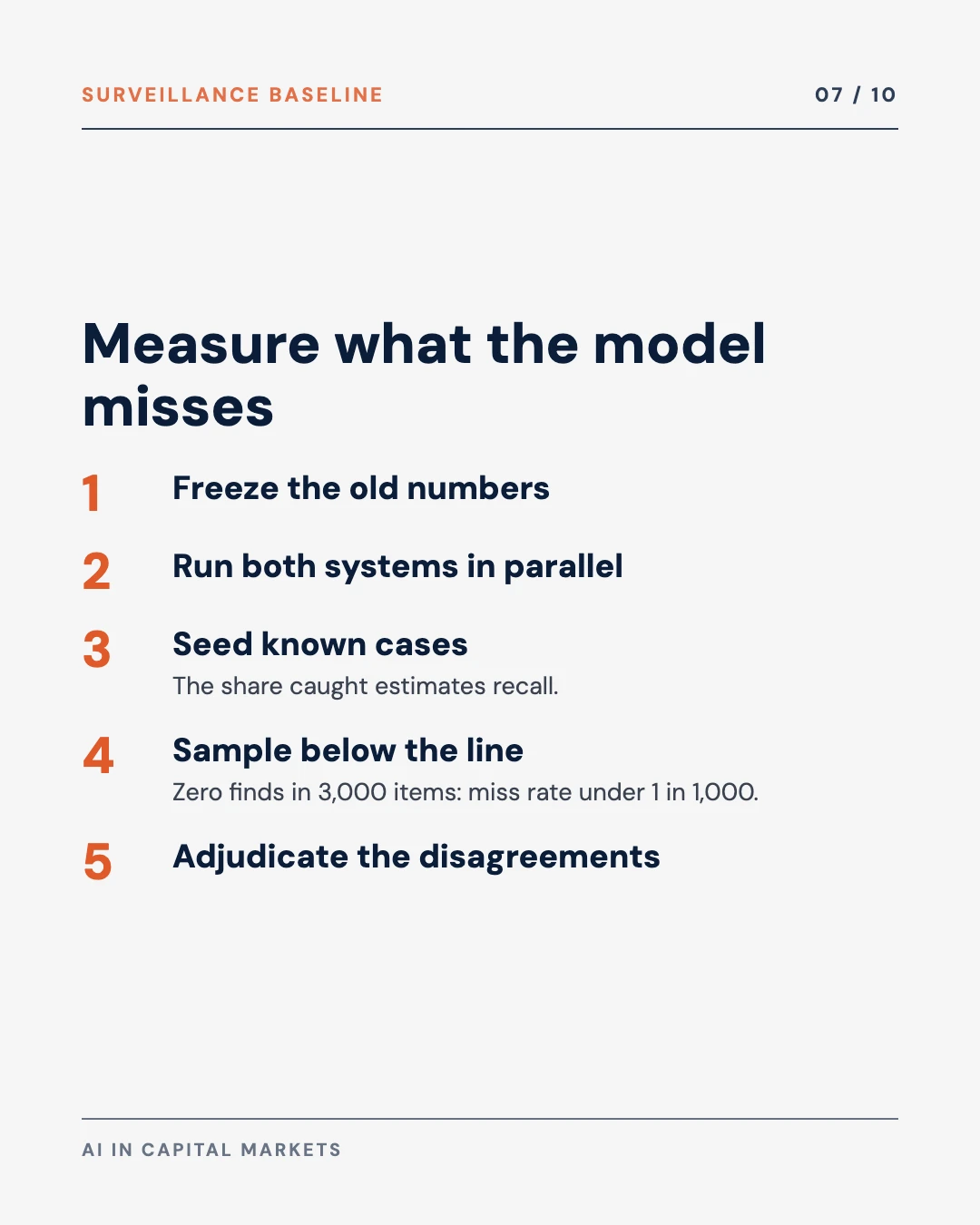
Five measurements for judging an LLM surveillance system
The five steps as set out in this post. A fall in alerts counts as an improvement only when the seeded-case catch rate holds and the below-the-line miss rate stays low.
Five measurements, taken together, give a baseline a board and a regulator can rely on:
- Freeze the old numbers. Before switching, record a full quarter of alert volume by scenario, escalation rate, suspicious transaction reports filed and analyst minutes per alert, taken from case-system timestamps rather than estimates.
- Run both systems in parallel. For at least one quarter, the old system and the new one review the same population, and analysts review both sets of alerts.
- Seed known cases. Compliance writes synthetic messages and trade patterns that should trigger an alert, from past enforcement cases and red-team scenarios, and plants them in the live flow without telling reviewers. The share caught is the best available estimate of recall.
- Sample below the line. Draw a random sample of messages and trades that neither system flagged and have them reviewed. If the sample finds nothing, the statistician’s rule of three still gives an upper bound: zero findings in 3,000 reviewed items puts the miss rate below about one in 1,000 at 95 per cent confidence.
- Adjudicate the disagreements. Items flagged by one system and not the other show where each is blind. Where the two systems work differently enough, the overlap between them can also be used to estimate the total amount of abuse present, using the capture-recapture method ecologists use to count animal populations.
A vendor claim of a 60 per cent cut in false positives becomes evidence only when it is reported alongside the seeded-case catch rate and the below-the-line miss rate. If the vendor cannot help the firm measure those two, the firm should measure them itself before decommissioning anything.
Tokenised infrastructure debt and AI-based valuation
MAS launched Project Guardian in May 2022 to explore “the economic potential and value-adding use cases of asset tokenisation”. It now brings together policymakers from Australia, France, Germany, the UK, Japan, Switzerland, the IMF and the World Bank, and lists live cases from Ant, Apollo, DBS, Franklin Templeton, Hamilton Lane, OCBC and UBS. Its Fixed Income Framework, published in November 2024, sets out how tokenised bonds should be structured. On green and KPI-linked bonds it says only that “the ability to integrate external data… may enrich information dissemination.” It says nothing about valuation.
Infrastructure debt is a natural candidate for tokenisation. The assets are long-lived, the cash flows are contracted, and the investor base wants smaller tickets and better liquidity. Singapore already pools infrastructure loans into securities: Clifford Capital’s ninth infrastructure asset-backed securities issue, Bayfront IX, raised US$802.4 million in September 2026. Those notes are not tokenised. The tokenised bonds that do exist are mostly green bonds. Hong Kong’s third government digital green bond, in November 2025, raised about HK$10 billion across four currencies and was described as the largest digital bond issue to date.
Valuation from live asset data
The idea is attractive. A toll road, a port terminal or a water treatment plant produces a constant stream of operational data: availability, throughput, asset condition scores and predictive maintenance flags. Unlisted infrastructure is typically valued quarterly, with heavy reliance on what IFRS 13 calls Level 3 inputs, which are unobservable. An AI model reading the operational stream could, in principle, update the expected cash flows and the credit risk of a tokenised bond in close to real time and publish the result on the same ledger.
The closest real example is Hitachi’s ¥10 billion digitally tracked green bond of December 2023, which used IoT data and a blockchain platform to report the environmental contribution of the projects it financed. The data fed disclosure, not price. I could not find any instrument, inside Project Guardian or outside it, whose valuation or coupon is driven by asset condition, utilisation or maintenance data. What follows is a proposal.
From my years in infrastructure, I would raise three problems before anyone builds this.
The data comes from the party that benefits. Operational data is produced by the operator, whose sponsor often holds equity below the bondholders. A continuous valuation fed by the operator’s sensors is an oracle problem: the price is only as honest as the feed, and the feed has an interested owner. Sensors drift, condition scores are subjective, and maintenance logs are kept for operations, not investors.
A live model is still a Level 3 model. Feeding a valuation model more data more often does not make its output observable. It makes it more frequent. The model’s assumptions about how a condition score translates into cash flow are judgements, and they need the same independent validation MAS expects for any material model.
Continuous prices create margin calls. If a tokenised bond is used as collateral, as tokenised assets increasingly are, a model that marks it down on a sensor reading can trigger margin calls and forced sales before anyone has checked whether the reading was real. That is procyclicality built into the instrument.
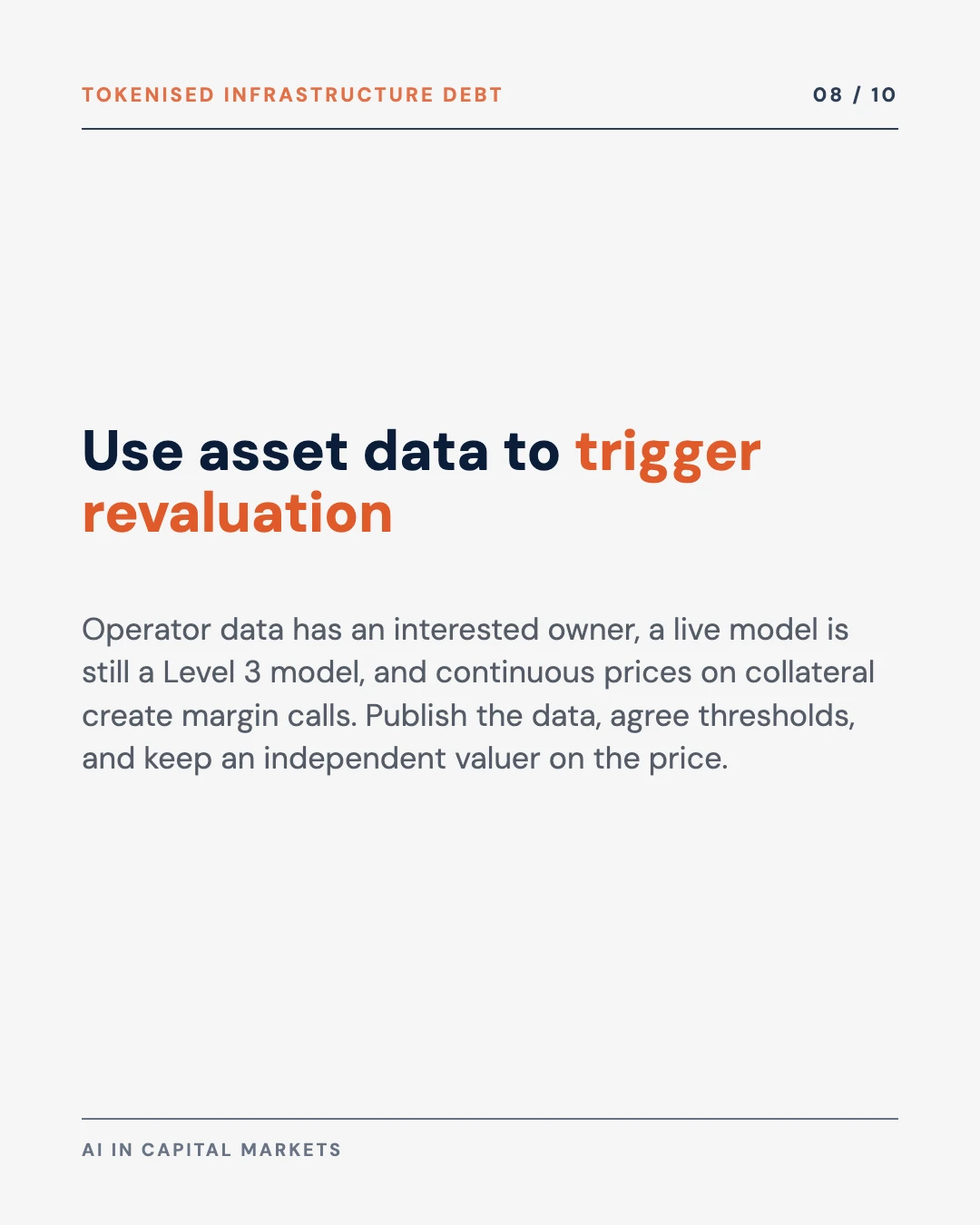
The better design, in my view, uses operational data to trigger revaluation rather than to set the price. Agree the thresholds in the bond documents: availability below a contracted level, a condition score crossing a band, a major unplanned outage. When one is crossed, the event is published to holders on the ledger at once and an independent valuer is required to revalue within a fixed period. Between events, the data stream is disclosed to holders as it is in Hitachi’s bond. Investors get the transparency, and the price still passes through a person accountable for it.
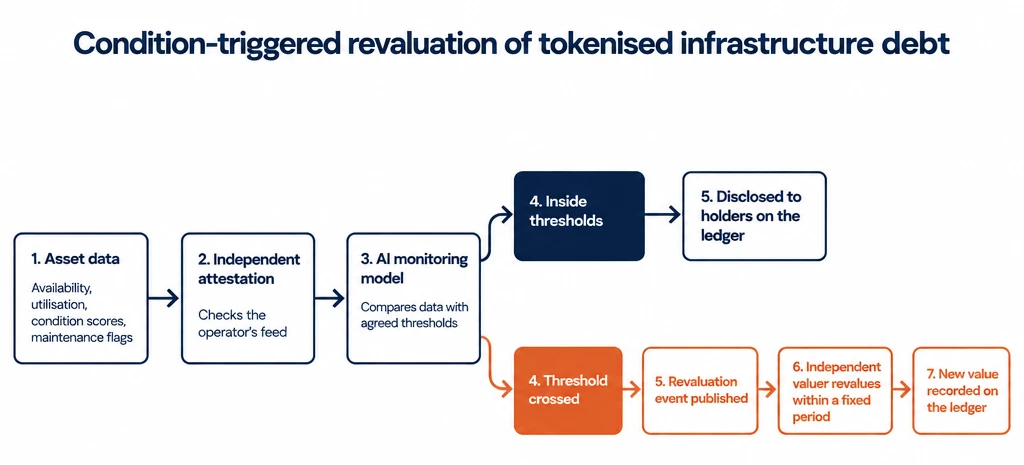
This is a design Project Guardian is well placed to test, because it brings together the regulators who would need to agree on it and the institutions that would issue it.
What to do this year
- Write the mandate before the agent trades. For every AI agent that can place orders, record its owner, the client mandate in machine-readable form, its order and loss limits, and the controls that enforce them outside the model.
- Build and test a graded stop. Pause, block, cancel and firm-wide kill, each with an owner and a written trigger, pulled in a test at least quarterly.
- Log the decision as well as the order. Mandate version, instruction, model and prompt version, data read, checks passed and human approval, in an append-only store.
- Settle third-party agent terms. If clients can connect their own agents, decide the liability position, ring-fence the funding and keep the right to revoke any agent’s credentials.
- Measure what surveillance misses. Freeze the old baseline, run in parallel, seed known cases, sample below the line, and do not decommission the old system until the miss rate is known.
- Treat a quieter queue as a finding to investigate. Follow the MAS-SGX practice guide and review more often when alerts fall sharply.
- Use asset data for disclosure and triggers. For tokenised infrastructure debt, publish operational data to holders, agree revaluation triggers in the documents, and keep an independent valuer on the price.
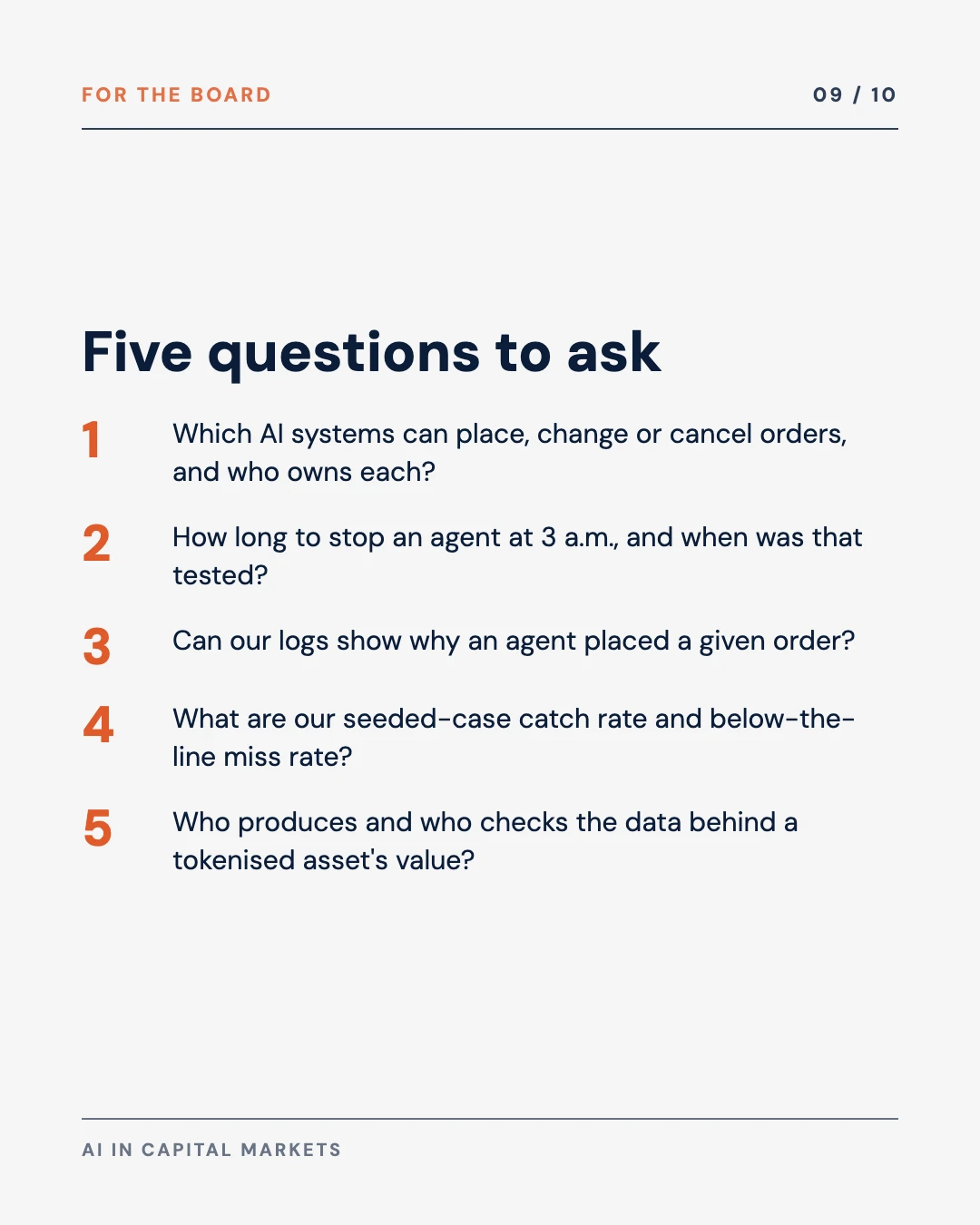
Questions for the board
- Which of our AI systems can place, change or cancel orders today, and who owns each one?
- If an agent breached its mandate at 3 a.m., how long would it take to stop it, and when did we last test that?
- Could we reconstruct, from our own logs, why an agent placed a particular order for a particular client?
- What is the seeded-case catch rate and the below-the-line miss rate of our surveillance, before and after any AI change?
- For any tokenised instrument we issue or hold, who produces the data behind its value, and who checks it?
Free tool
Technology Risk Board Pack
Twenty questions on resilience, change management and technology risk oversight, with the evidence to request for each. Trading agents and surveillance models fall under all four.
Evidence & Methodology
The regulatory text, enforcement figures and product details come from regulators, rulebooks and company announcements, read in early October 2026. Every surveillance performance figure I found was published by a vendor, and I have graded those accordingly. The liability table, the graded stop, the baseline method and the valuation design are my own judgement from safety-critical engineering and AI risk work, and I have marked them.
| Claim | Source | Grade |
|---|---|---|
| Section 36 reasonable-basis rule and damages under s36(3) | Financial Advisers Act 2001 (2020 Revised Edition) | Measured, statute |
| Digital advisory controls to suspend advice, human sample testing, disclosure of halts | MAS CMG-G02, October 2018 | Measured, regulator record |
| AI agent risk wording; 12-month transition; “will be finalised soon” | MAS consultation, November 2025; written parliamentary reply, August 2026 | Measured, regulator record |
| ”Authority is explicit… defined by the mandate”; append-only audit log | SAFR v1.0, July 2026, industry paper hosted by MAS, not regulatory guidance | Reported, industry paper |
| Market access controls, kill functionality, SGX pre-execution checks | SEC Rule 15c3-5; Delegated Regulation (EU) 2017/589 Art 12; SGX-ST Rules ch. 4 | Measured, rule text |
| Knight Capital: 4 million executions, about 45 minutes, $460m loss, $12m penalty | SEC order 34-70694, October 2013 | Measured, regulator record |
| Robinhood agentic trading features; Public.com agents | Company announcements, May and March 2026 | Reported by the companies |
| Agents may act beyond scope; firms should track agent actions | FINRA 2026 oversight report | Measured, regulator record |
| Most agentic uses at proof-of-concept; kill switch on supervisory checklist | IOSCO FR/02/2026 | Measured, regulator record |
| SEC off-channel penalties over $2bn, 100+ firms | SEC press release 2024-186 | Measured, regulator record |
| FCA off-channel review: 178 breaches, 41% director grade or above | FCA multi-firm review, August 2025 | Measured, regulator record |
| Faulty alerts unnoticed for 2 years or more; half of 9 banks focused on calibration | FCA Market Watch 79, May 2024 | Measured, regulator record |
| Over half report more than 50% low-quality alerts; most escalate under 10% | Acuiti survey of 64 executives, commissioned by Eventus, 2024 | Reported, vendor-sponsored survey |
| ”Up to 60%+” false-positive reduction, “40+ hours” per reviewer | Smarsh, March 2026, early preview, method undisclosed | Reported, vendor claim |
| AI reluctance fell from 57 to 38 per cent | Global Relay survey, 2025 | Reported, vendor survey |
| 95 to 99 per cent false-positive rate in trade surveillance | No primary source found | Unverified, not used |
| Precision near 25% under incomplete labels | Chen and Hybinette, arXiv 2608.05373, 2026, intraday options data | Reported, preprint |
| Back-testing, annual review, more frequent review for few or too many exceptions | MAS-SGX RegCo Trade Surveillance Practice Guide, 2019 | Measured, regulator record |
| Project Guardian launch, members and live cases; Fixed Income Framework wording | MAS, 2022 to 2025 | Measured, regulator record |
| HK$10bn digital green bond | Hong Kong Government, November 2025 | Measured, issuer record |
| Hitachi ¥10bn digitally tracked green bond using IoT data | Hitachi, December 2023 | Reported by the company |
| Bayfront IX infrastructure ABS, US$802.4m, not tokenised | Latham & Watkins, September 2026 | Reported by the adviser |
| No live instrument valued from asset condition data | My search of Guardian materials and public issuances | My call |
| Liability table, graded stop, six-item audit log, five-step baseline, condition-triggered revaluation | My assessment, the stop ladder adapted from machinery stop categories in IEC 60204-1 | My call |
Sources
- Attorney-General’s Chambers, Singapore. Financial Advisers Act 2001, section 36.
- Monetary Authority of Singapore. Notice on recommendations on investment products (FAA-N16).
- Monetary Authority of Singapore. (2018). Guidelines on provision of digital advisory services.
- Monetary Authority of Singapore. (2025). Consultation paper on guidelines on AI risk management.
- Monetary Authority of Singapore. (2026). Written reply to parliamentary question on agentic AI in financial services.
- Monetary Authority of Singapore. (2026). Safeguards for agentic finance at runtime (SAFR), version 1.0.
- Robinhood. (2026). Robinhood is now open to agents.
- Public. (2026). Public becomes the first brokerage to introduce AI agents for your portfolio.
- FINRA. (2025). 2026 annual regulatory oversight report: generative AI.
- IOSCO. (2026). Supervisory toolkit for artificial intelligence (FR/02/2026).
- Cornell Law School Legal Information Institute. 17 CFR 240.15c3-5, risk management controls for brokers or dealers with market access.
- legislation.gov.uk. Commission Delegated Regulation (EU) 2017/589, article 12.
- Singapore Exchange. SGX-ST rules, chapter 4: trading members.
- ESMA. (2026). ESMA issues supervisory briefing on algorithmic trading.
- U.S. Securities and Exchange Commission. (2013). In the matter of Knight Capital Americas LLC, release no. 34-70694.
- U.S. Securities and Exchange Commission. (2024). SEC announces enforcement results for fiscal year 2024.
- Financial Conduct Authority. (2025). Multi-firm review of off-channel communications.
- Financial Conduct Authority. (2024). Market Watch 79.
- Acuiti and Eventus. (2024). Trade surveillance market review.
- Smarsh. (2026). Smarsh launches AI-enabled communication surveillance for small to medium businesses.
- Global Relay. (2025). State of AI in surveillance 2025.
- Chen, A., and Hybinette, M. (2026). Velocity- and regime-aware detection of intraday options market manipulation, with explainable attribution. arXiv 2608.05373.
- Monetary Authority of Singapore and SGX RegCo. (2019). Trade surveillance practice guide.
- Monetary Authority of Singapore. (2022). MAS partners the industry to pilot use cases in digital assets.
- Monetary Authority of Singapore. Project Guardian.
- Monetary Authority of Singapore. (2024). Guardian fixed income framework.
- Monetary Authority of Singapore. (2025). MAS launches BLOOM initiative to extend settlement capabilities.
- Government of the Hong Kong SAR. (2025). HKSAR Government’s third digital green bonds offering.
- Hitachi. (2023). Hitachi announced the terms for the unsecured straight bond including digital green bond.
- Latham & Watkins. (2026). Latham advises Clifford Capital on US$802.4 million infrastructure asset-backed securities issuance.

How Traditional Finance and DeFi Will Integrate Over the Next Five Years
The settlement, collateral and agent-payment changes that sit underneath tokenised debt.

From Human-in-the-Loop to AI-on-the-Loop: Redesigning Oversight Architectures
The oversight model a firm needs once orders move too fast for a person to approve each one.

How Financial Institutions Should Use AI to Keep Up With Regulatory Change
MAS AI guidelines, digital advisory rules and surveillance expectations are all moving at once.

What the DBS Outages Teach Boards About Technology Risk
Why a stop that has never been tested fails when it is needed.
My thanks to Dr. Christina Chua for her contribution to this post. Her experience of how brokerage platforms bring new products to clients, through product, trading, technology and compliance teams, shaped the execution and suitability sections. Christina is Director, Institutional Sales at Moomoo Financial Singapore. The post does not discuss Moomoo’s products, and the views in it are not Moomoo’s.
If your firm is putting AI agents near client orders or replacing surveillance rules with a model, the graded stop and the surveillance baseline are where I usually start. My consulting work covers AI and technology risk governance for boards of regulated firms and public agencies.