
Executive Summary
Ask ten executives what “agentic AI” means and you’ll get ten different demos: agents booking travel, negotiating contracts, running whole departments unsupervised. Almost none of that is what’s actually live in production today. What’s live is narrower, more boring, and already earning its keep in Singapore’s own banks and government agencies.
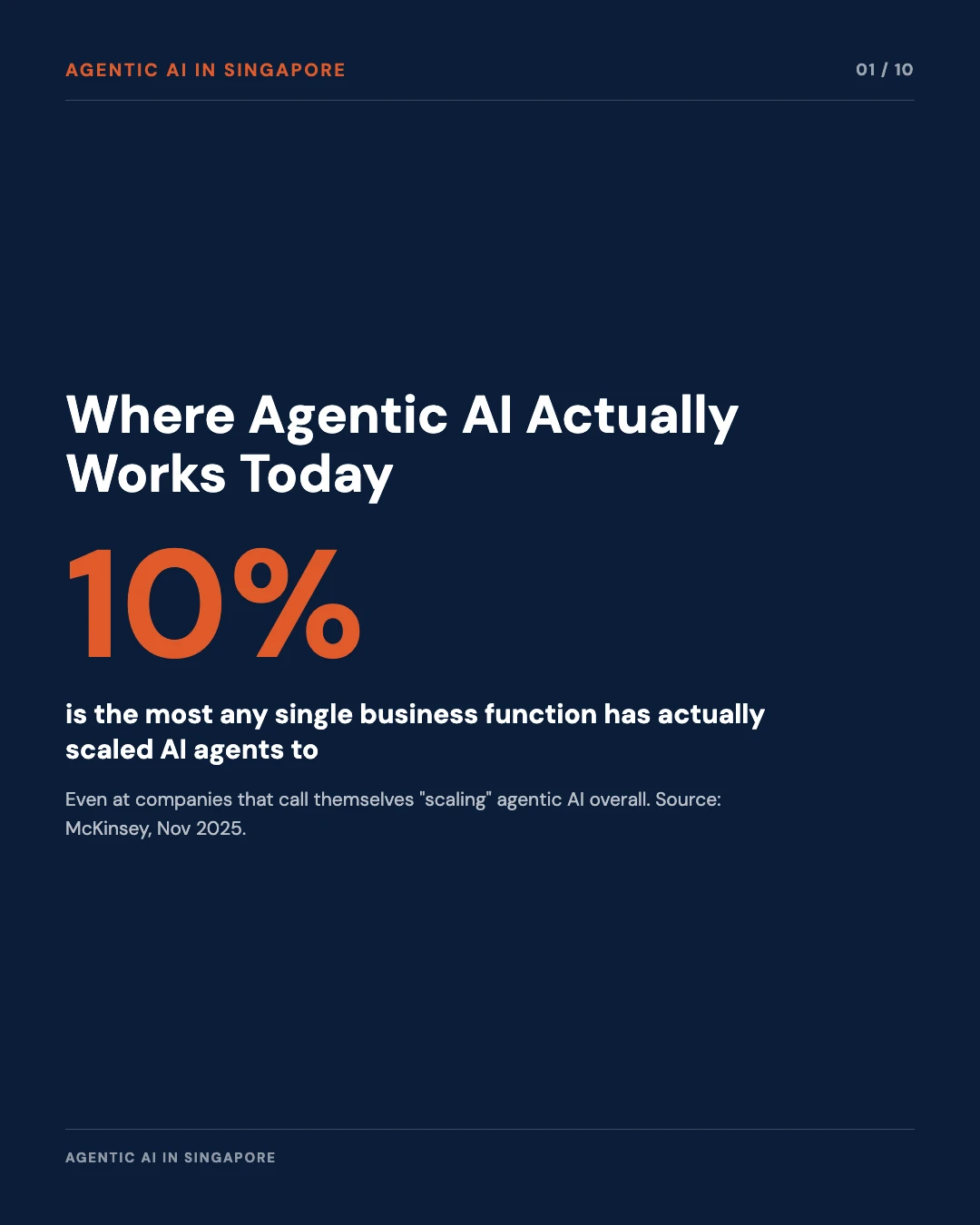
10%
is the most any single business function has actually scaled AI agents to, even at companies that call themselves “scaling” agentic AI overall
3
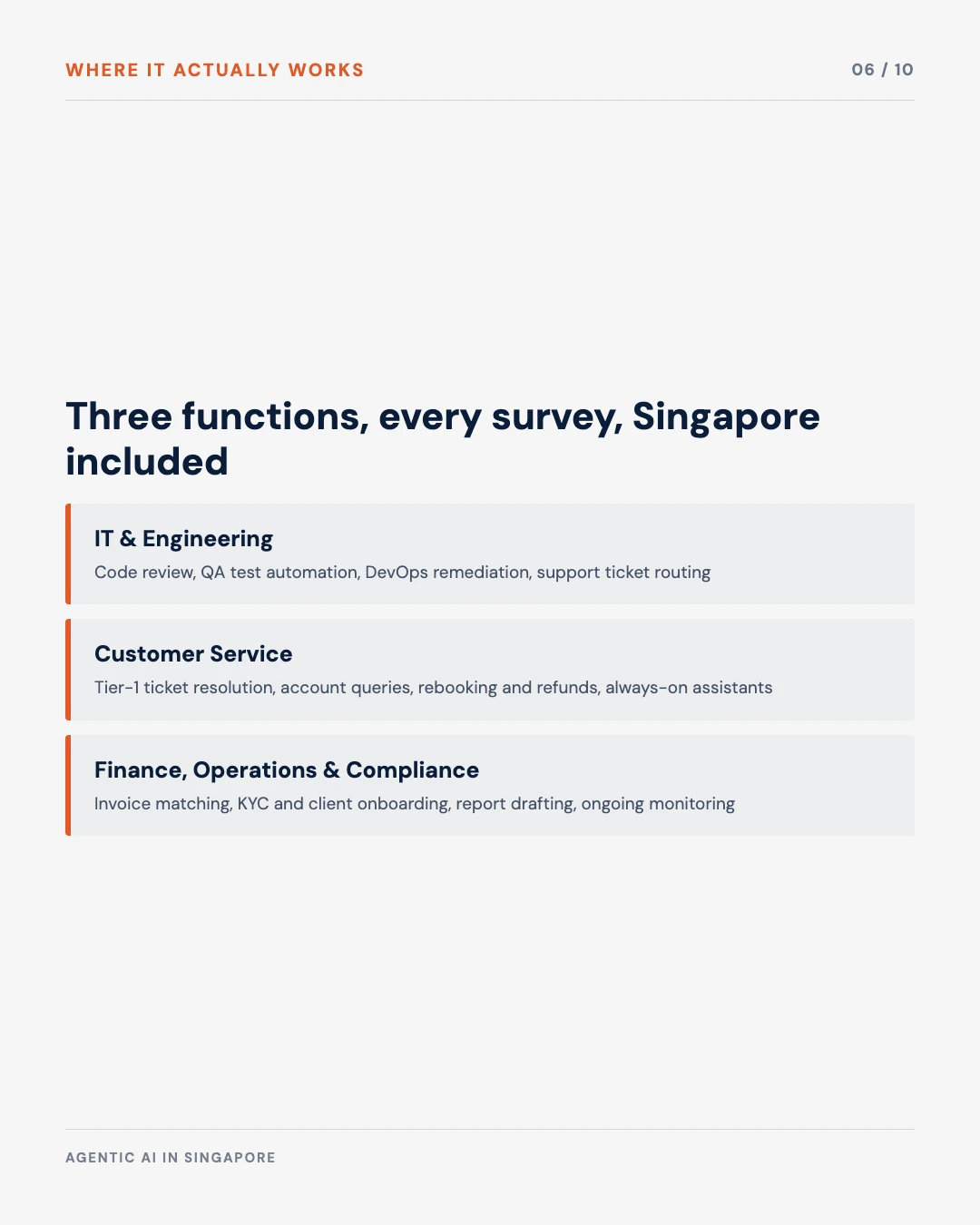
functions, IT, customer service, and finance & operations, show up as the top agentic AI users in every survey, Singapore included
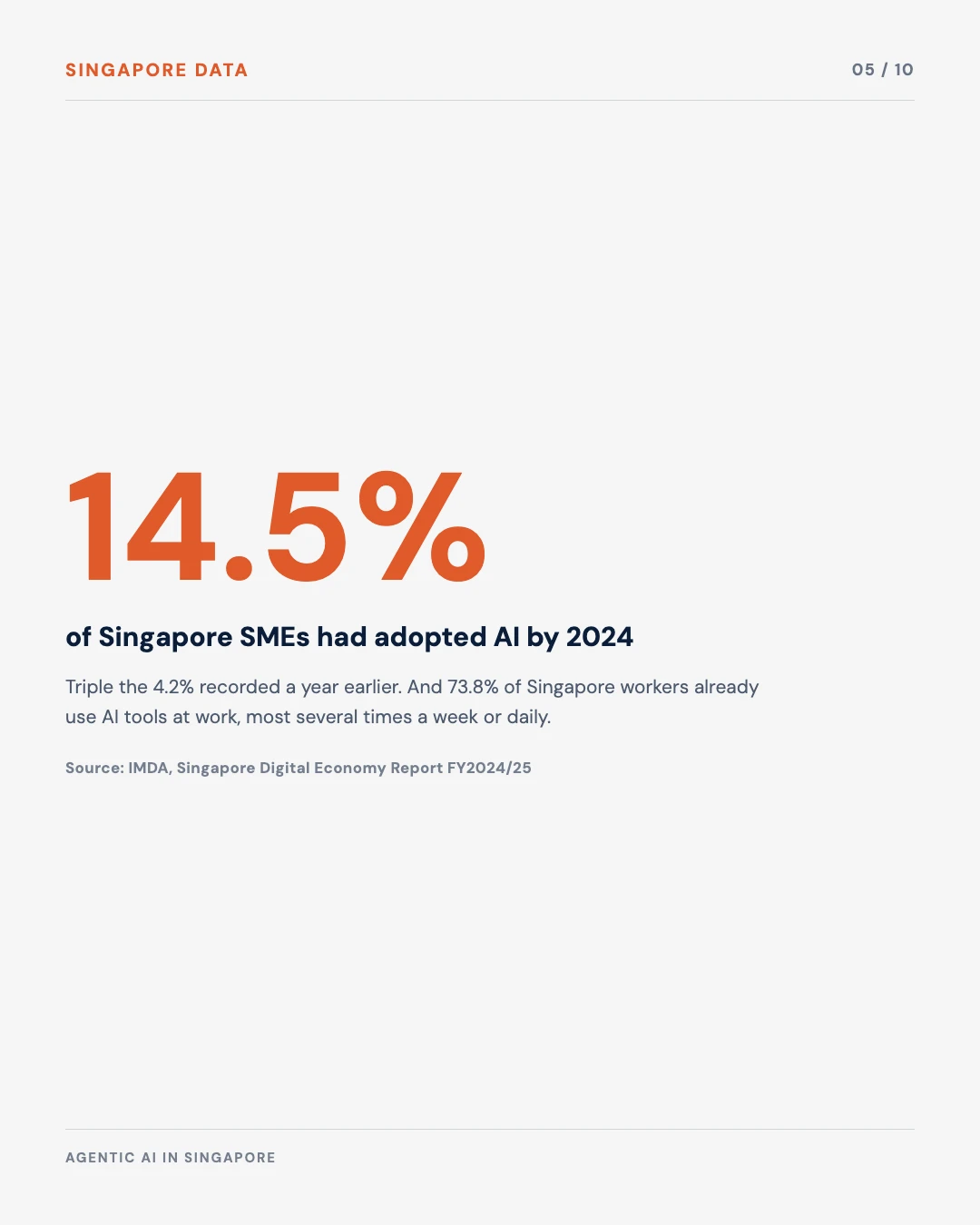
14.5%
of Singapore SMEs had adopted AI by 2024, triple the 4.2% recorded the year before
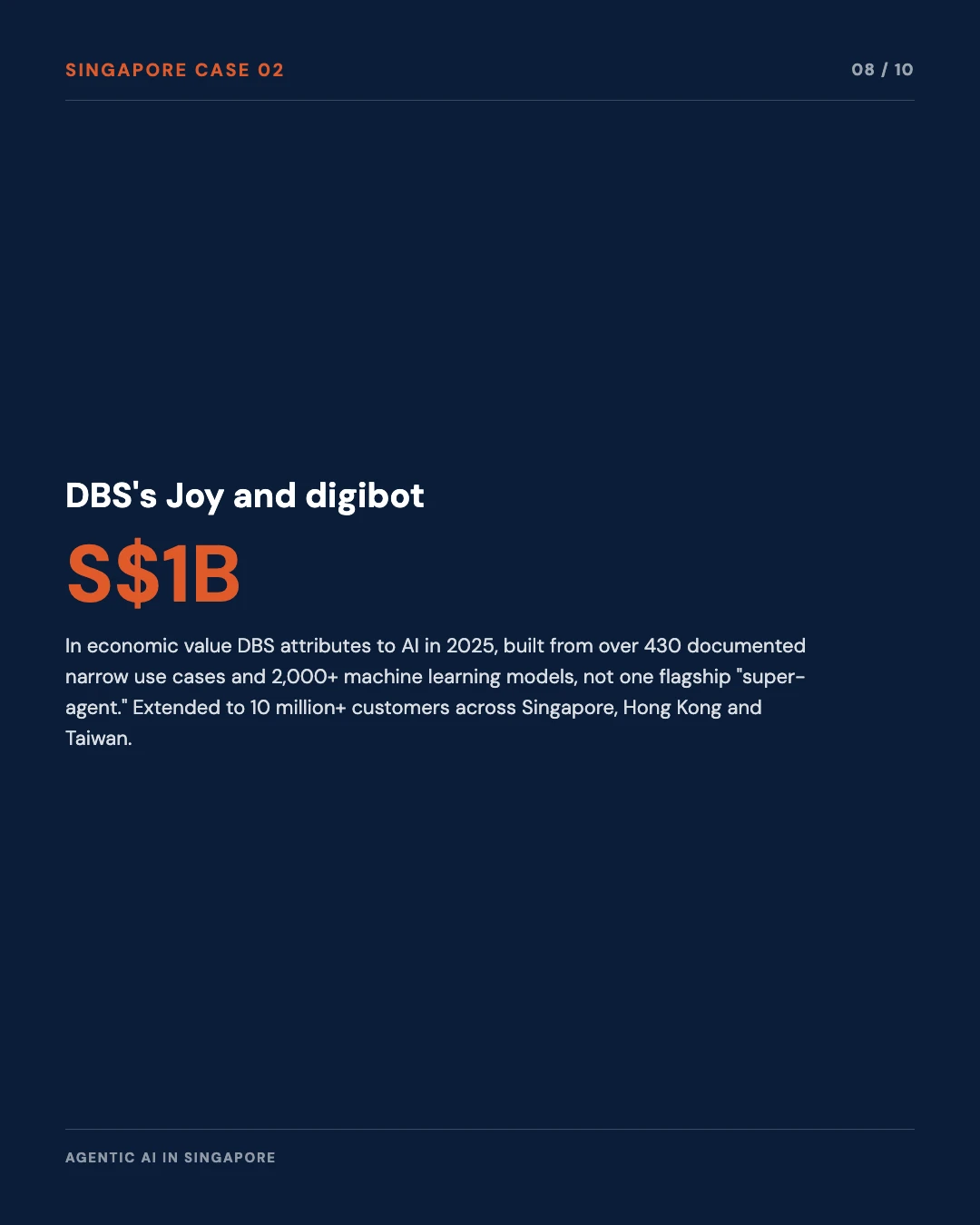
S$1B
in economic value DBS attributes to AI in 2025, built from over 430 narrow use cases, not one all-purpose agent
Core conclusions
- Most “agentic AI” in real production is not open-ended decision-making. It is bounded automation on tasks with a clear input, a clear output, and a clear rulebook: drafting a report, triaging a ticket, matching an invoice, testing a piece of software.
- The functions where it is actually live are consistent across every study we could find, global and local. IT and engineering, customer service, and finance, operations and compliance account for most of the working deployments. Marketing, strategy and other judgment-heavy functions barely feature.
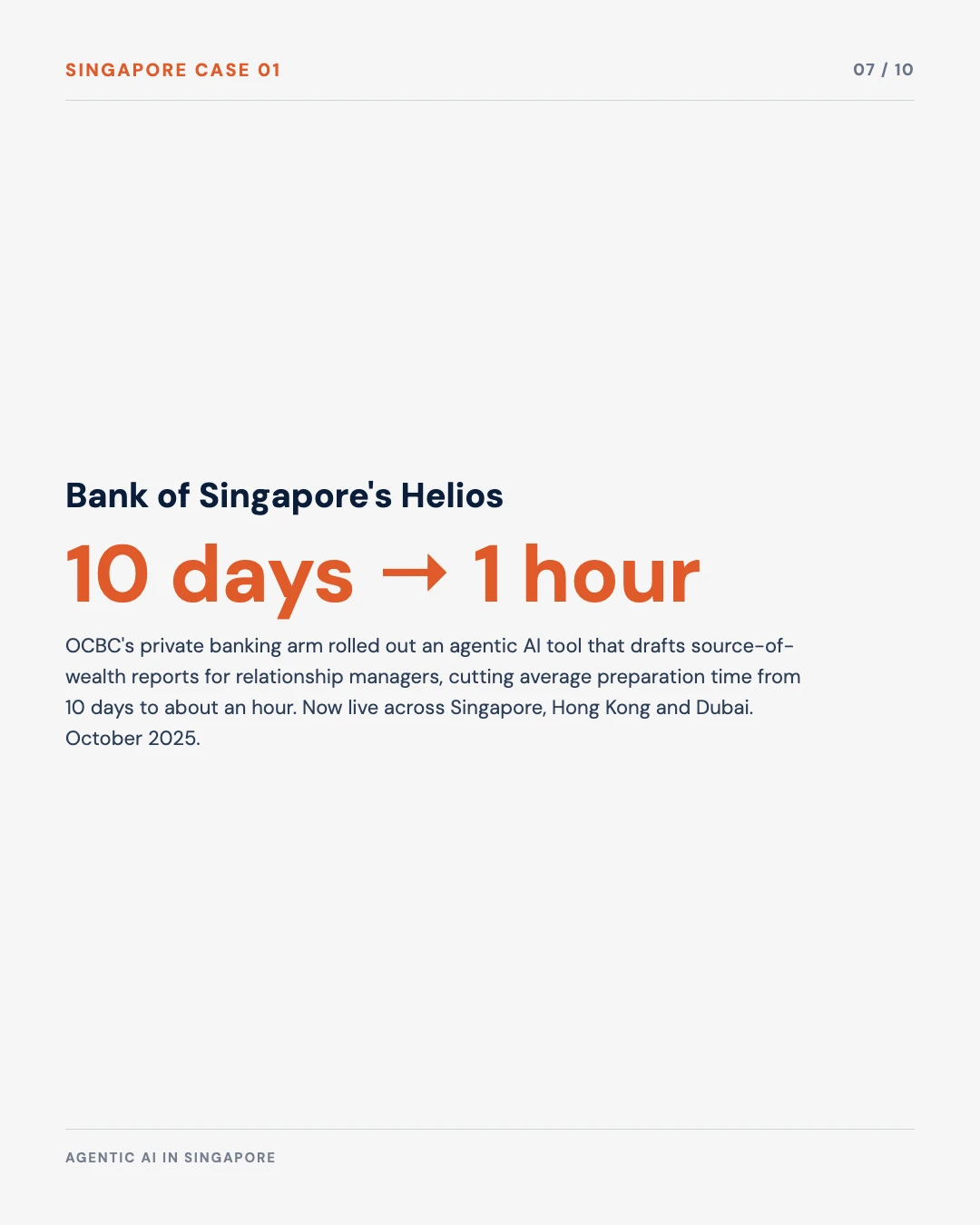
- Singapore’s own examples prove the pattern rather than contradict it. Bank of Singapore’s Helios tool cuts source-of-wealth report drafting from 10 days to under an hour. GovTech’s sandbox with the Cyber Security Agency and IMDA tested three narrow use cases, not one general agent. That is what “working” looks like in 2026.
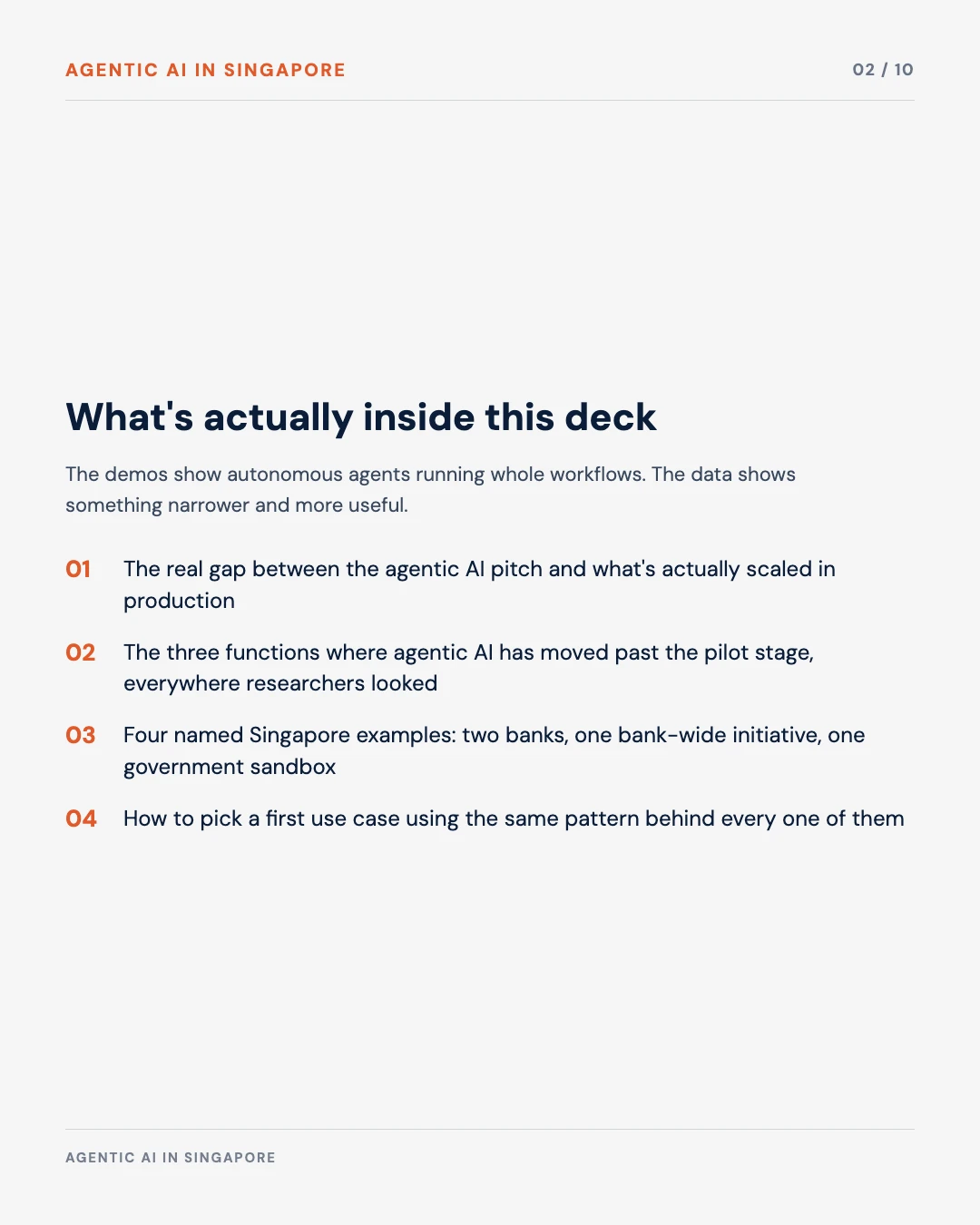
Where agentic AI actually works, in ten slides
Save it, share it, or send it to whoever is picking your company’s first use case.
The gap between the pitch and what’s actually running
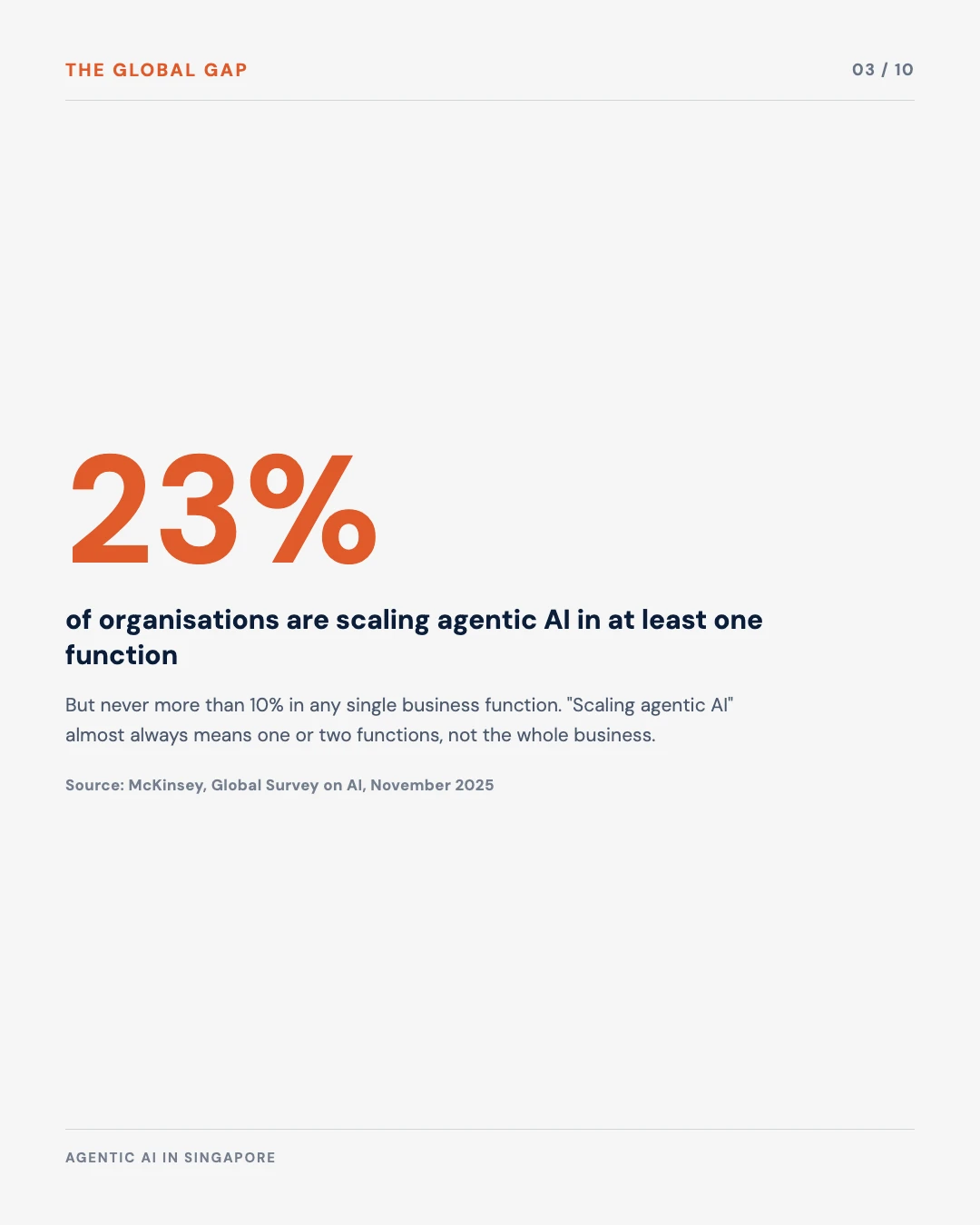
Every agentic AI product demo shows the same thing: an agent that plans, decides, and acts across a whole workflow with almost no human in the loop. That is not what most companies have actually deployed. McKinsey’s Global Survey on AI, published in November 2025, found that 23% of organisations are scaling an agentic AI system in at least one business function, and 39% more are experimenting. That sounds like fast progress, until you look closer: in any single business function, no more than 10% of respondents report actually scaling agents there. Companies that are “scaling agentic AI” are almost always scaling it in one or two functions, not across the business.
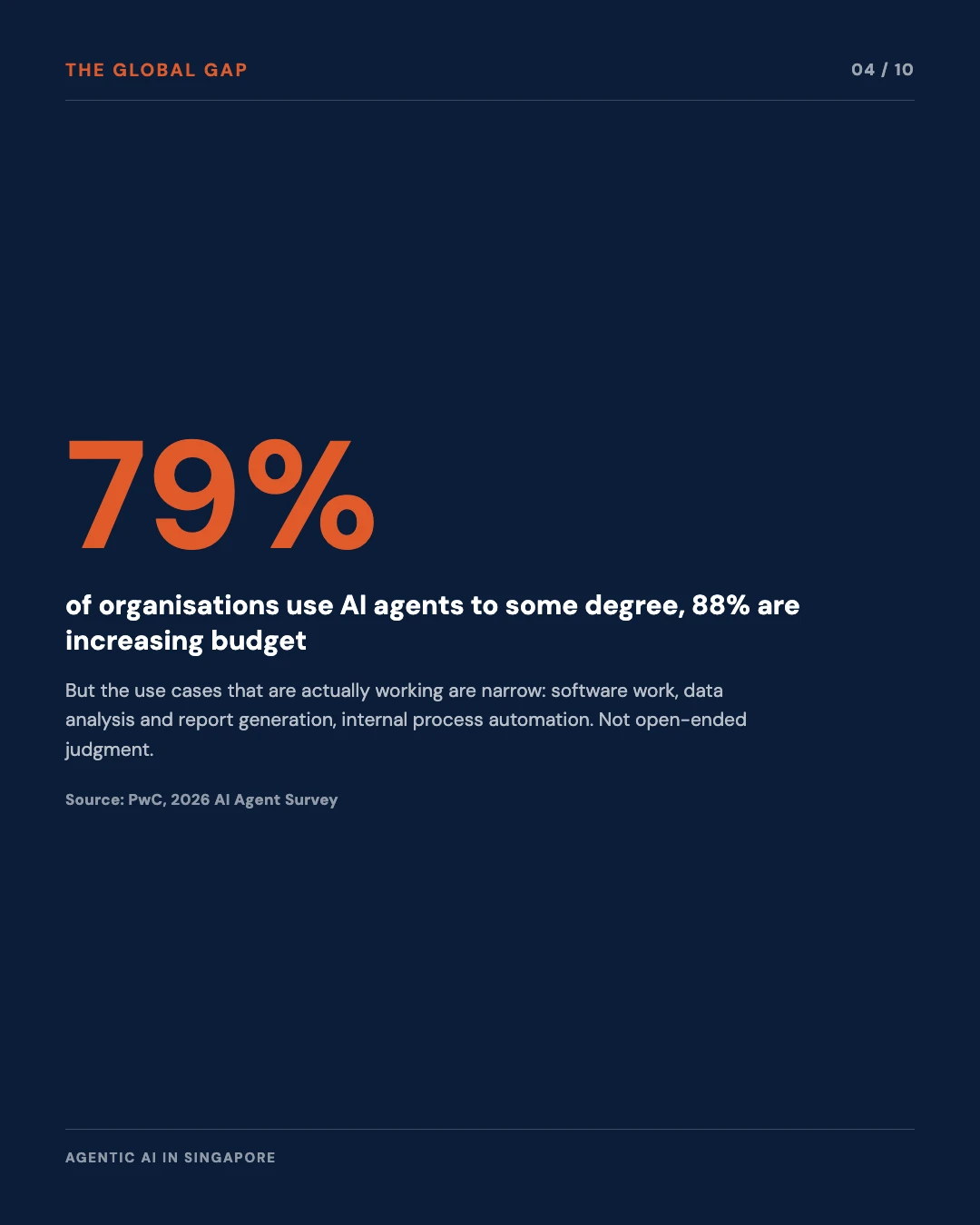
PwC’s 2026 AI Agent Survey tells a similar story from a different angle. 79% of organisations use AI agents to some degree, and 88% plan to increase their agentic AI budget. But the use cases that are actually working are narrow and well-defined: software work such as code generation, documentation and review sits around 59% of respondents, data analysis and report generation around 60%, and internal process automation around 48%. These are not the autonomous, judgment-heavy agents from the keynote slides. They are the same rule-bound, high-volume tasks companies have been automating for years, now handled by something that can read a document and act on it instead of following a fixed script.
| Metric | Value | Source |
|---|---|---|
| Organisations scaling an agentic AI system in at least one function | 23% | McKinsey, Global Survey on AI, Nov 2025 |
| Ceiling on how far scaling reaches within any single business function | 10% | Same McKinsey survey |
| Organisations using AI agents to some degree | 79% | PwC, 2026 AI Agent Survey |
| Organisations planning to increase their agentic AI budget | 88% | Same PwC survey |
| Singapore SMEs that had adopted AI by 2024, up from 4.2% in 2023 | 14.5% | IMDA, Singapore Digital Economy Report FY2024/25 |
| Singapore workers using AI tools at work, most several times a week or daily | 73.8% | IMDA pulse survey, cited in Singapore Digital Economy Report FY2024/25 |
Two different consulting firms, one government agency, one shared pattern: the gap is not between companies that use agentic AI and companies that don’t. It is between companies that scaled one narrow use case well and companies still trying to scale everything at once.
The three functions where agentic AI is actually earning its keep
Strip away the marketing language and the same three functions keep showing up as where agentic AI has moved past the pilot stage, in Singapore and everywhere else researchers have looked.
| Function | What the agent actually does | Singapore example |
|---|---|---|
| IT & Engineering | Code review and documentation, QA test automation, DevOps remediation, support ticket routing | GovTech’s AI Agents Sandbox tested agentic QA testing of government digital services, alongside the Cyber Security Agency and IMDA |
| Customer Service | Tier-1 ticket resolution, account queries, rebooking and refunds, always-on assistants | DBS’s Joy and digibot serve more than 10 million customers across Singapore, Hong Kong and Taiwan |
| Finance, Operations & Compliance | Invoice matching, KYC and client onboarding, report drafting, ongoing monitoring | Bank of Singapore’s Helios tool drafts source-of-wealth reports for relationship managers |
Notice what these three functions have in common: high transaction volume, a documented process to follow, and a single accountable owner. That combination is what makes a task ready for an agent, not how exciting or strategic the task sounds in a boardroom.
There is a matching signal at the model layer. Anthropic’s Economic Index found that computer and mathematical tasks, largely software work, made up roughly a third of all Claude.ai conversations, the single largest category by far, with “modifying software to correct errors” alone accounting for about 6% of consumer usage and 10% of enterprise API usage. Even independent of what any one company claims about its own rollout, usage data at the model layer points the same direction: the tasks agentic AI is actually asked to do concentrate in code, documents, and structured back-office work, not in open-ended strategic judgment.
What Singapore’s live examples actually look like
The clearest way to understand what “working” means in 2026 is to look at what specific organisations have actually shipped, not what they say they are building toward.
Bank of Singapore’s Helios. In October 2025, OCBC’s private banking arm rolled out an agentic AI tool called Helios (Holistic Wealth Lifecycle Insights and Ongoing Surveillance) that writes source-of-wealth reports for relationship managers. Average preparation time dropped from 10 days to about an hour. Helios is now in use across Singapore, Hong Kong and Dubai, with plans to extend it to OCBC’s Premier Private Client segment in consumer banking by the end of 2026, and to add ongoing monitoring of client activity between periodic reviews, not just one-off report drafting.
DBS’s Joy and digibot. DBS has extended generative and agentic AI capabilities to more than 10 million customers across Singapore, Hong Kong and Taiwan through its Joy and digibot assistants. The bank attributes roughly S$1 billion in economic value in 2025 to its AI and data programme as a whole, built from more than 430 documented AI use cases supported by over 2,000 machine learning models spanning risk management, operations and customer service. The number worth sitting with is 430, not S$1 billion: the value came from stacking hundreds of narrow, specific automations, not from one flagship “super-agent.”
OCBC’s 10x Initiative. OCBC has set a bank-wide target for every employee to use AI to lift their baseline productivity, with a public goal of 75% of customer service interactions AI-assisted and 100% of employees equipped with AI support by 2027. It is a scaling target built on the same customer-service and back-office use cases already proven at Bank of Singapore, rolled out wider rather than reinvented.
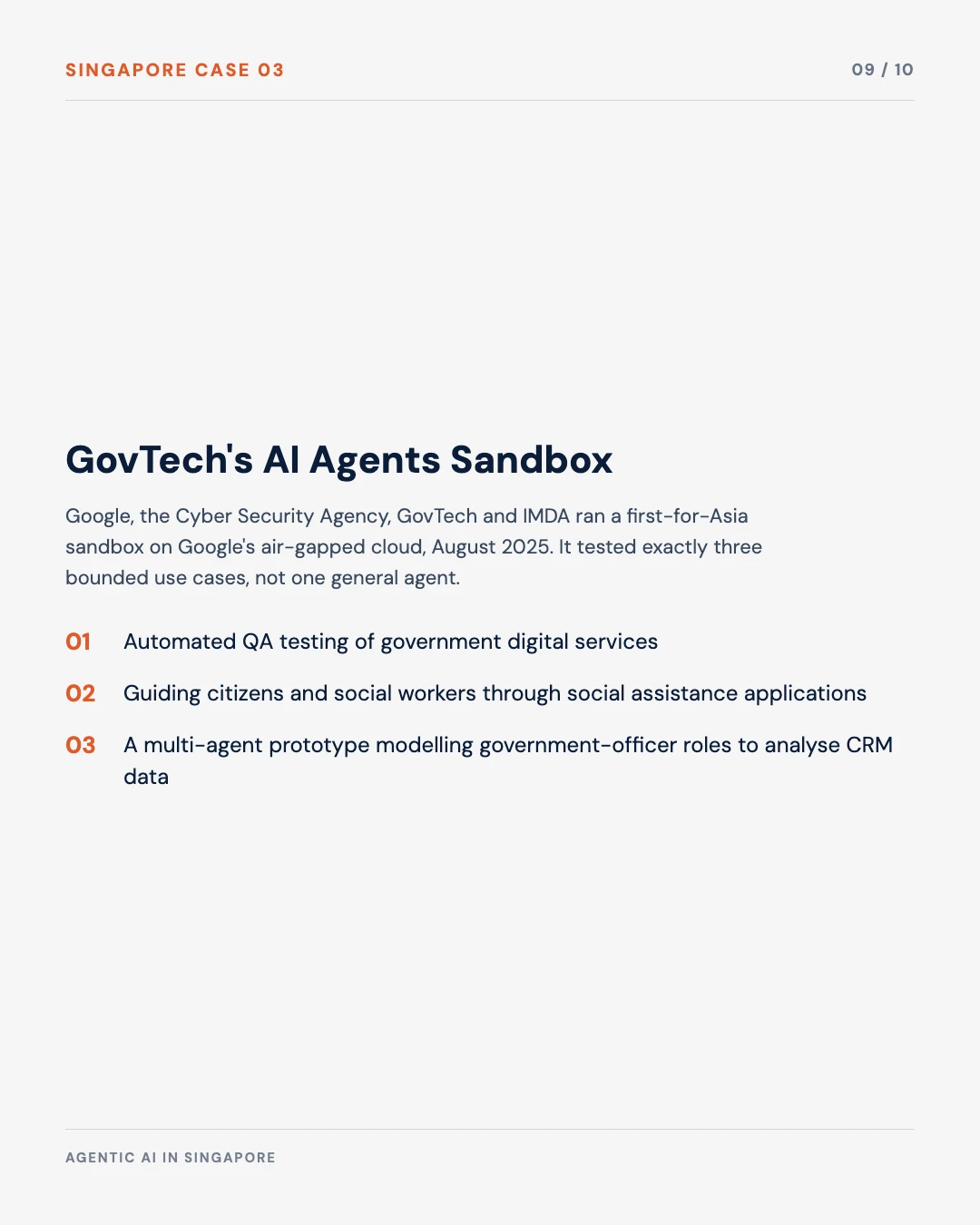
GovTech’s AI Agents Sandbox. In August 2025, Google, the Cyber Security Agency of Singapore, GovTech and IMDA ran a roughly four-month sandbox, described as a first for Asia, deploying agentic AI on Google’s air-gapped cloud. It tested exactly three bounded use cases: automated QA testing of government digital services, an agent that guides citizens or social workers through social assistance applications, and a multi-agent prototype that models specialised government-officer roles to analyse CRM data. Two governance tools came out of the same sandbox, not after it: the Agentic Risk & Capability (ARC) Framework to evaluate agent-specific risks, and AI Guardian, a safety-testing suite that checks for issues like prompt injection in near real time. In January 2026, IMDA published a Model AI Governance Framework for Agentic AI nationally, formalising the same risk-tiering logic the sandbox had already tested in practice.
Four organisations, four different sectors, and the same underlying shape: pick a narrow, well-documented task, automate it end to end, measure it, and only then decide whether to extend it. None of them started with an autonomous agent running an entire function unsupervised.
How to pick your own first use case
The pattern across every example above holds a practical lesson for any company still deciding where to start. Look for a task that is high in volume, bound by a documented process, owned by one accountable person, and low enough in risk that a mistake is annoying rather than dangerous. That is precisely what source-of-wealth report drafting, QA testing, and tier-1 ticket resolution have in common, and precisely what an ambitious, judgment-heavy task like “reinvent our customer strategy” does not.
Our free TRACE Agent Evaluation tool scores a candidate task against five checks built from this exact pattern, before any development work starts. If you have two or three candidate tasks and cannot decide between them, the AI Use Case Prioritisation Matrix ranks them using the same logic that separates Bank of Singapore’s report-drafting rollout from a hundred other ideas that never left the whiteboard.
The honest takeaway from a year of surveys, sandboxes and bank rollouts is unglamorous: the companies getting real value from agentic AI are not the ones with the most ambitious agent. They are the ones that picked the most boring, well-documented task first, and actually finished it.
Sources: McKinsey & Company, Global Survey on AI, November 2025; PwC, 2026 AI Agent Survey; IMDA, Singapore Digital Economy Report FY2024/25; Anthropic, Economic Index reports, 2026; Bank of Singapore media release, “Bank of Singapore deploys agentic AI tool to automate writing of source of wealth reports,” October 2025; DBS Bank newsroom and investor disclosures, 2025; OCBC Group, “10x Initiative” public statements; IMDA and GovTech Singapore, “AI Agents: Insights from the Singapore Government and Google Sandbox,” factsheet, 2026; IMDA, Model AI Governance Framework for Agentic AI, January 2026.
Free tool
TRACE Agent Evaluation
Score a candidate task against five checks built from the same pattern behind every working example above, before you build anything.
Free tool
AI Use Case Prioritisation Matrix
Score up to three candidate tasks and get a ranked, keep-or-cut order, using the same logic that separates the examples above from the ideas that never shipped.
I walk through this same task-selection logic step by step, with more detail on the order of operations, in How to Build Your First AI Agent at Work. The AI Governance & ROI Executive Programme applies it to your own team’s real tasks, with a scored starting point as the result. Details are on the workshops page.