
Executive Summary
Agentic AI has moved from demo to billed production, and the question that matters has shifted from how good the model benchmarks to whether it finished the task and can prove it. For Singapore’s regulated and public-sector deployments, that makes traceability the real evaluation criterion, not leaderboard rank.
Core conclusions
- Full action logging, defined failure boundaries with human escalation, and cost-per-completed-task pricing are replacing benchmark scores as the actual measure of agent value.
- For Singapore operators, from PUB water monitoring to LTA transport systems, traceability has to be architected in from day one, not bolted on once a regulator asks for it.
- Vendor due diligence should demand auditable task-completion data under real conditions, not a benchmark chart; IMDA’s updated Model AI Governance Framework already points enterprises this way.
The shift, in ten slides
Save it, share it, or send it to whoever owns vendor due diligence.
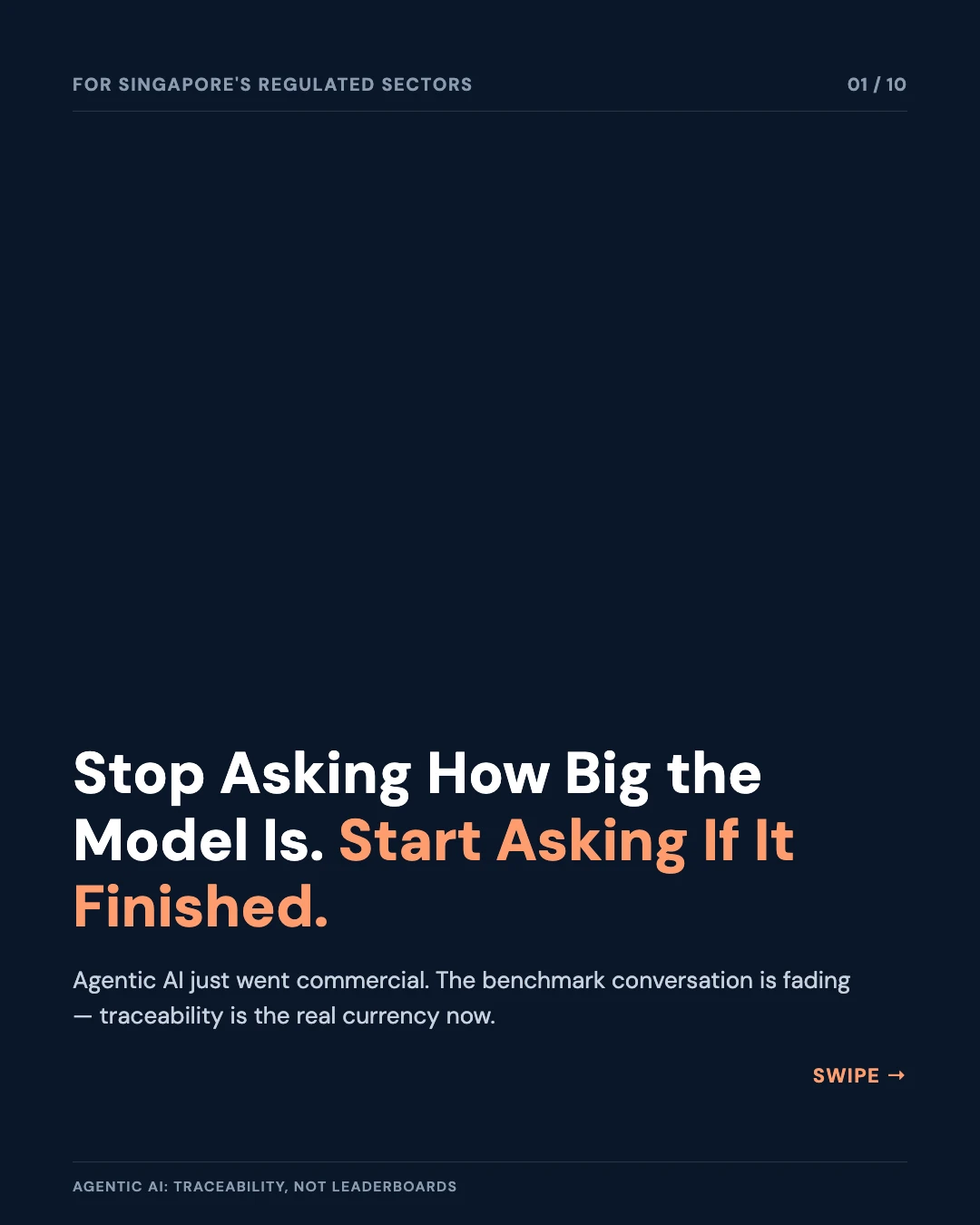
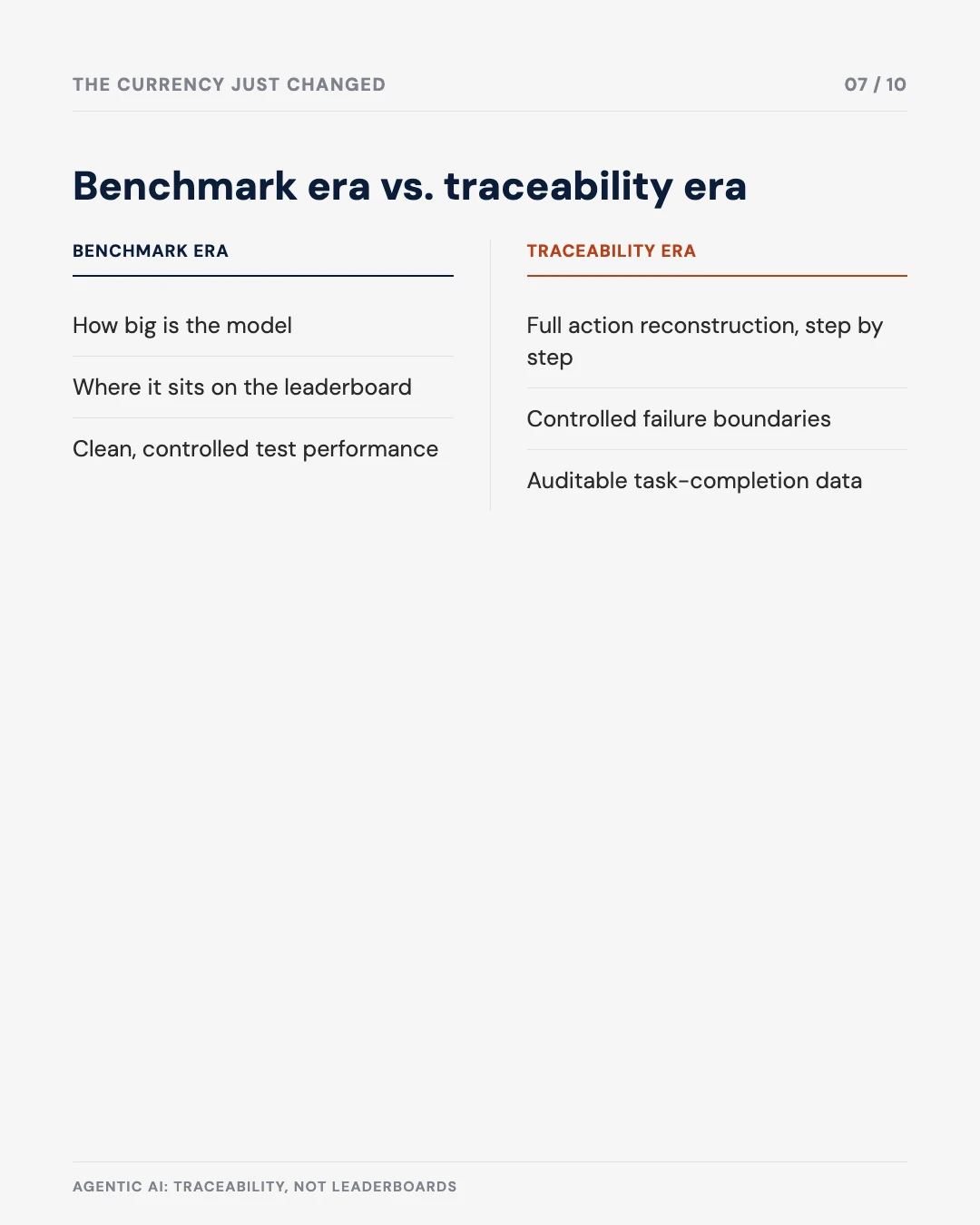
For the past few years, every AI conversation started the same way: how big is the model, how many parameters, where does it sit on the leaderboard? That conversation is fading. The question people actually care about now is much simpler and much harder to fake: can this system finish a real task on its own, reliably, without someone watching over its shoulder?
That’s not a small shift. It changes how AI gets evaluated, bought, and regulated.
The Model Stopped Being the Point
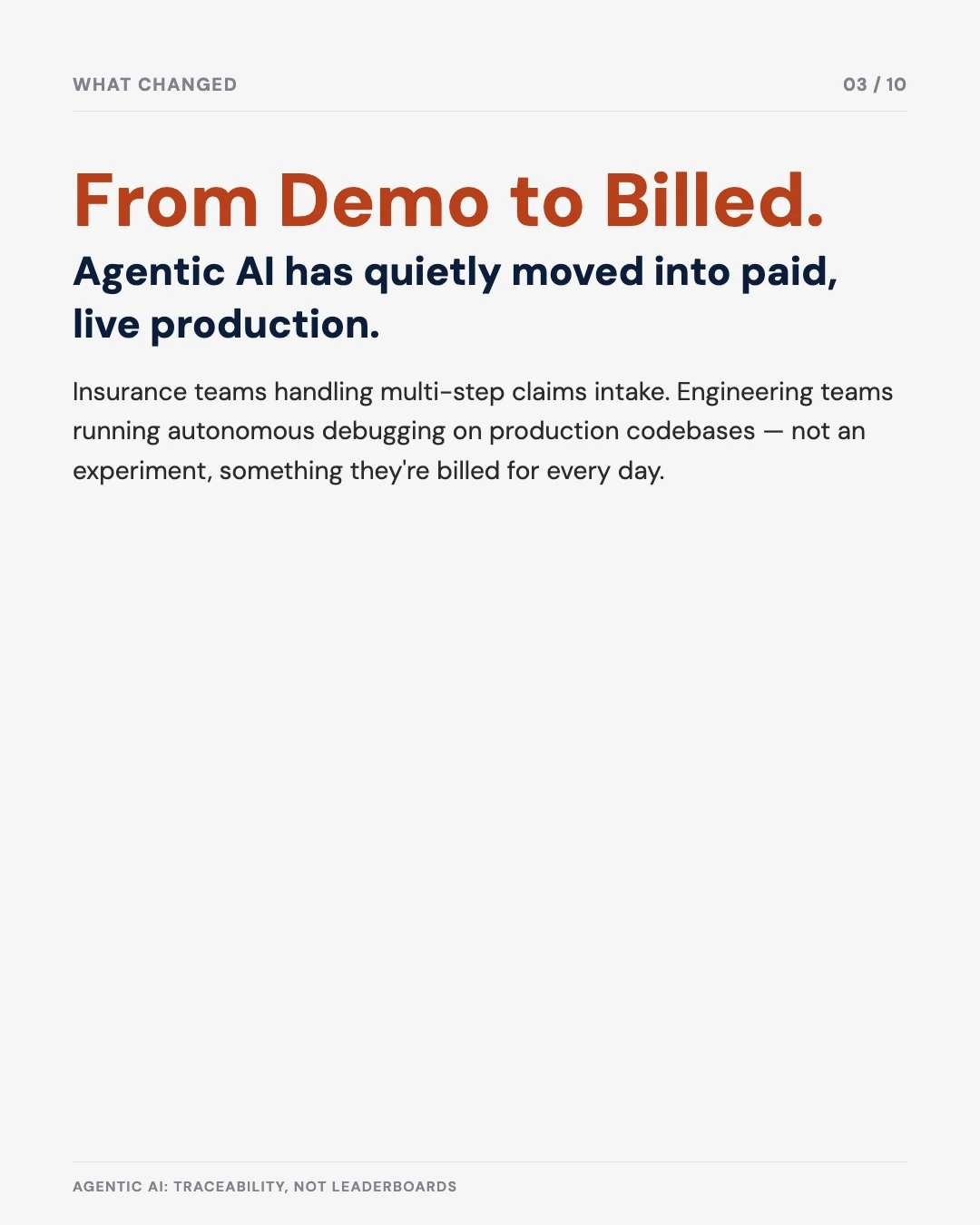
Agentic AI, meaning systems that can plan out several steps, call on tools and APIs, and push a task through to completion with minimal hand-holding, has quietly moved from demo territory into paid, live production. Insurance teams are using these agents to handle multi-step claims intake. Engineering teams are running them for autonomous debugging on production codebases, not as an experiment, but as something they’re billed for and rely on every day.
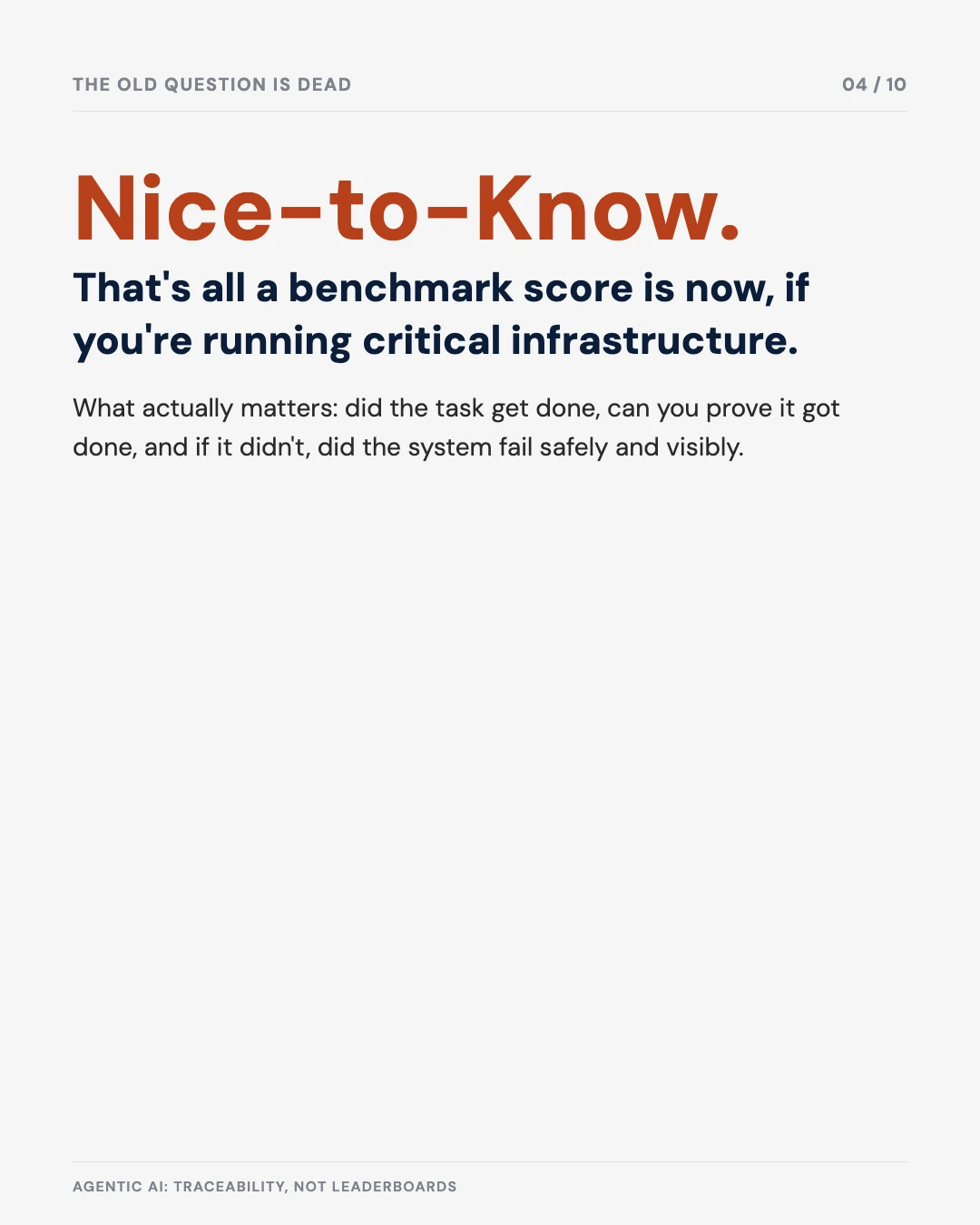
That changes what “good” means. A benchmark score tells you how a model performs in a clean, controlled test. It tells you almost nothing about whether that same system, dropped into a live environment with messy inputs, flaky third-party APIs, and real regulatory constraints, will actually get the job done correctly and consistently. If you’re running critical infrastructure, a citizen-facing service, or anything MAS regulates, the benchmark is a nice-to-know. What actually matters is: did the task get done, can you prove it got done, and if it didn’t, did the system fail safely and visibly.
Traceability Is the Real Currency Now
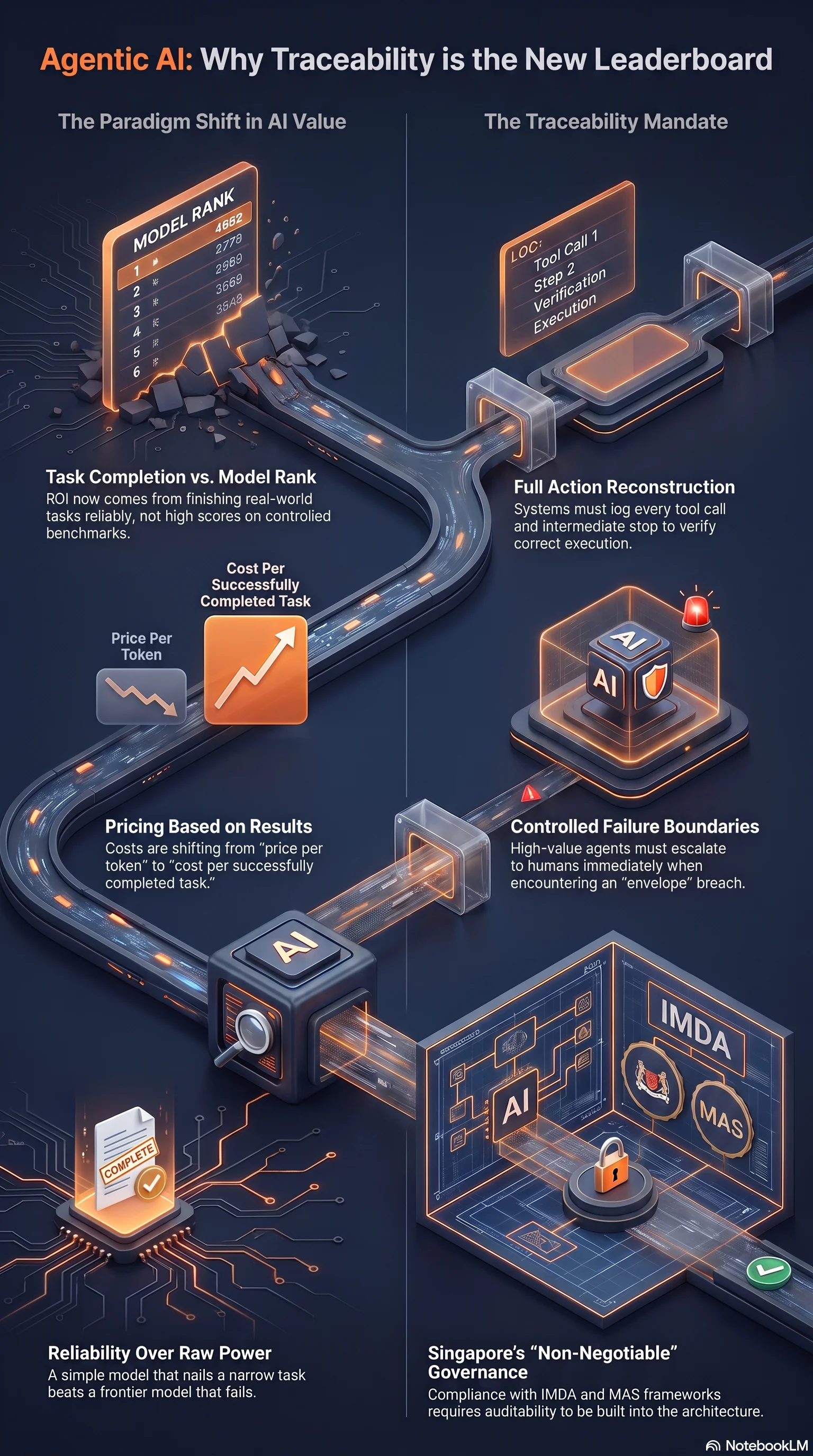
In an operations context, ROI on AI was never really about how impressive the model sounds. It comes from being able to show, end to end, that tasks got completed properly, from the moment data comes in to the moment a decision gets acted on and verified.
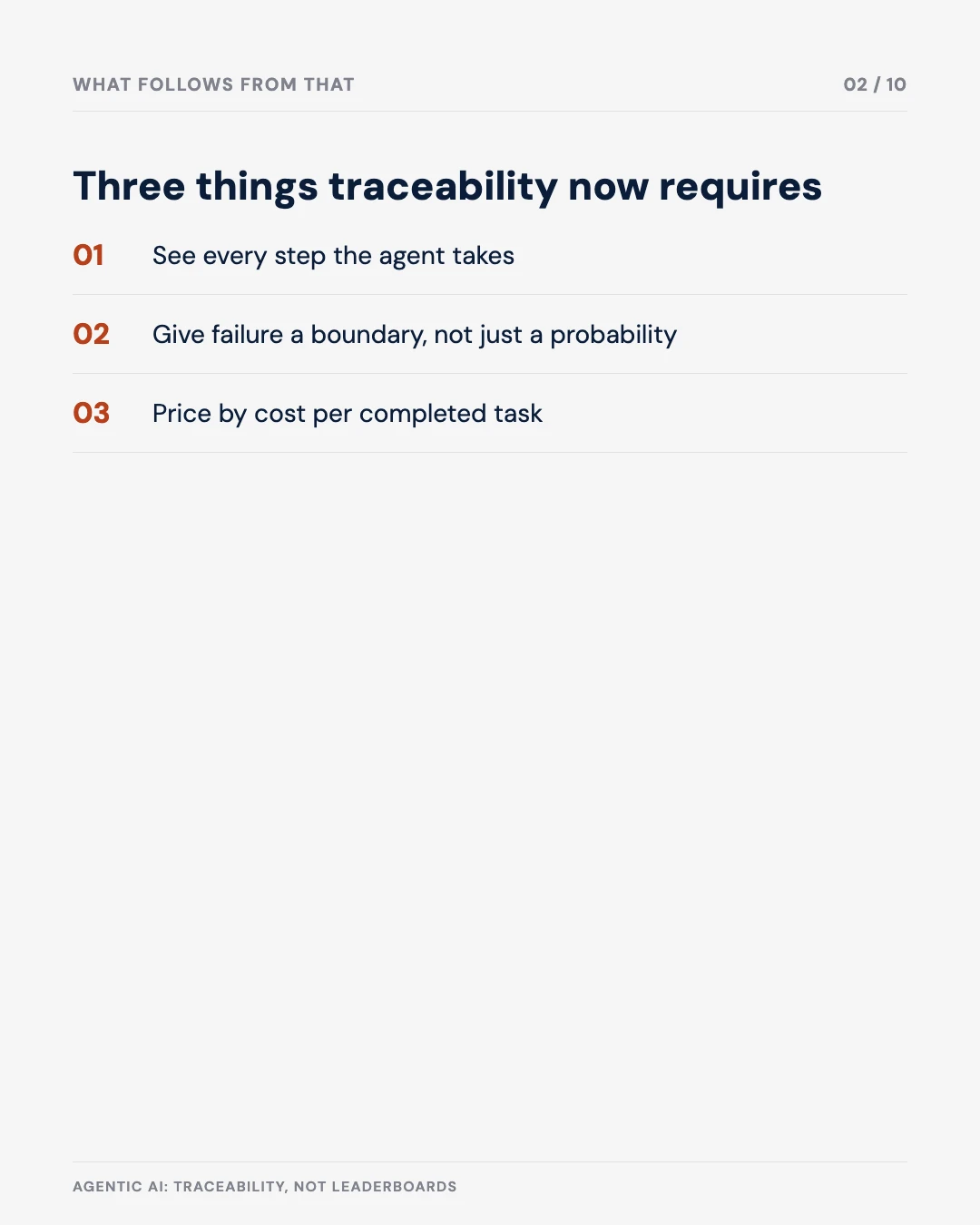
A few things follow from that.
- You need to see every step the agent takes. Every action needs a log detailed enough to reconstruct what happened: what came in, what tools got called, what the intermediate steps looked like, and what final action was taken. Without that, there’s no way to tell a system that’s working properly apart from one that’s confidently producing wrong answers. This is exactly what the TRACE framework is built to score before deployment, not after.
- Failure needs a boundary, not just a probability. A system’s real value comes as much from how it fails as from how often it succeeds. An agent that operates inside a monitored envelope, one that escalates to a human the moment something looks off instead of quietly carrying on, is worth more than a flashier model with no such guardrails. This matters more than raw benchmark performance.
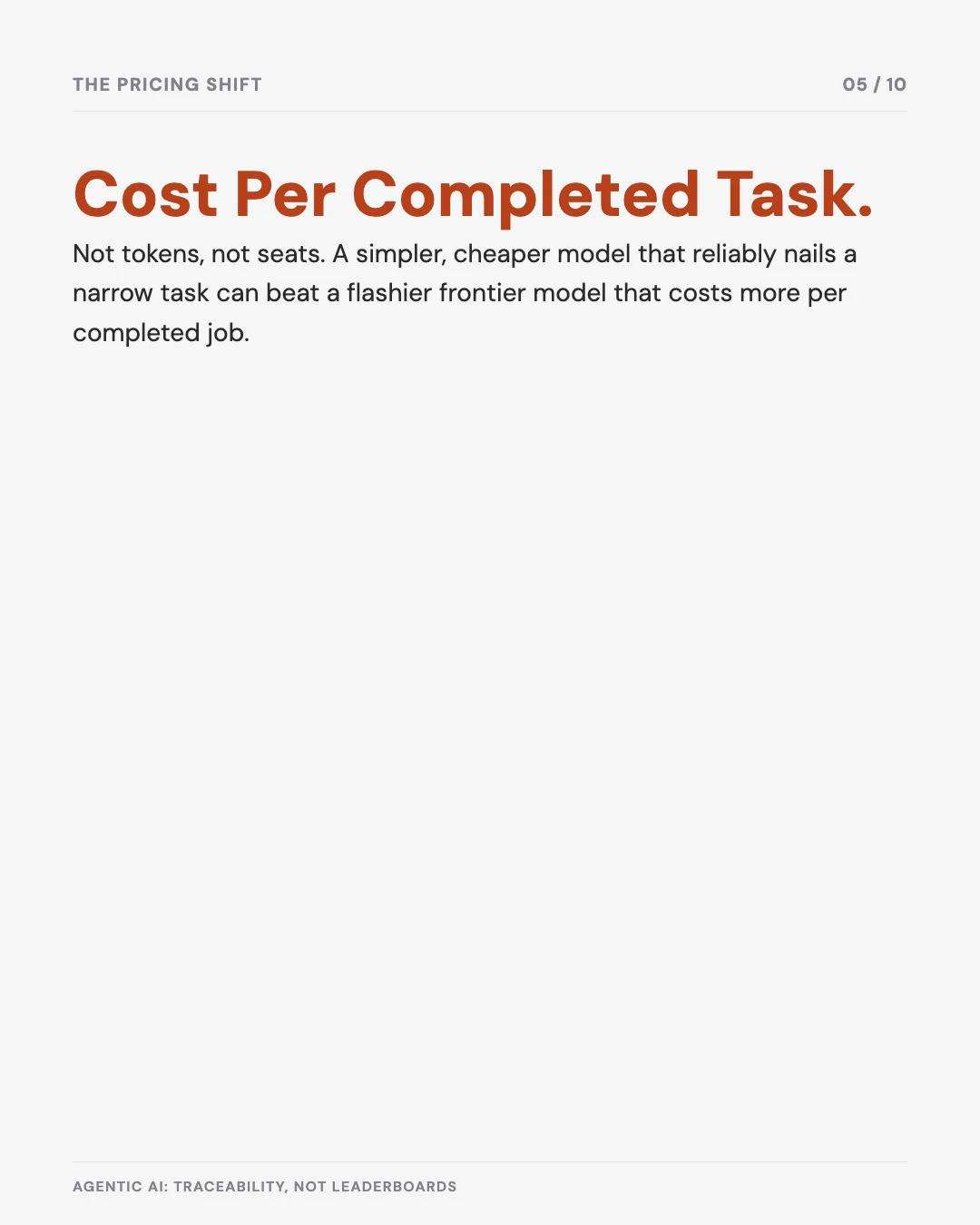
- Pricing is shifting to cost per completed task. The old token-based or seat-based pricing model is giving way to something closer to “cost per task actually finished.” That changes vendor selection entirely. A simpler, cheaper model that reliably nails a narrow, well-defined task can easily beat a flashy frontier model that costs more per completed job, especially when the task itself is repeatable and well scoped.
What This Means for Singapore
Singapore is arguably one of the more interesting test beds for this shift, given how far Smart Nation initiatives, GovTech deployments, and IMDA’s AI governance frameworks have already gone in setting expectations for accountable, auditable systems.
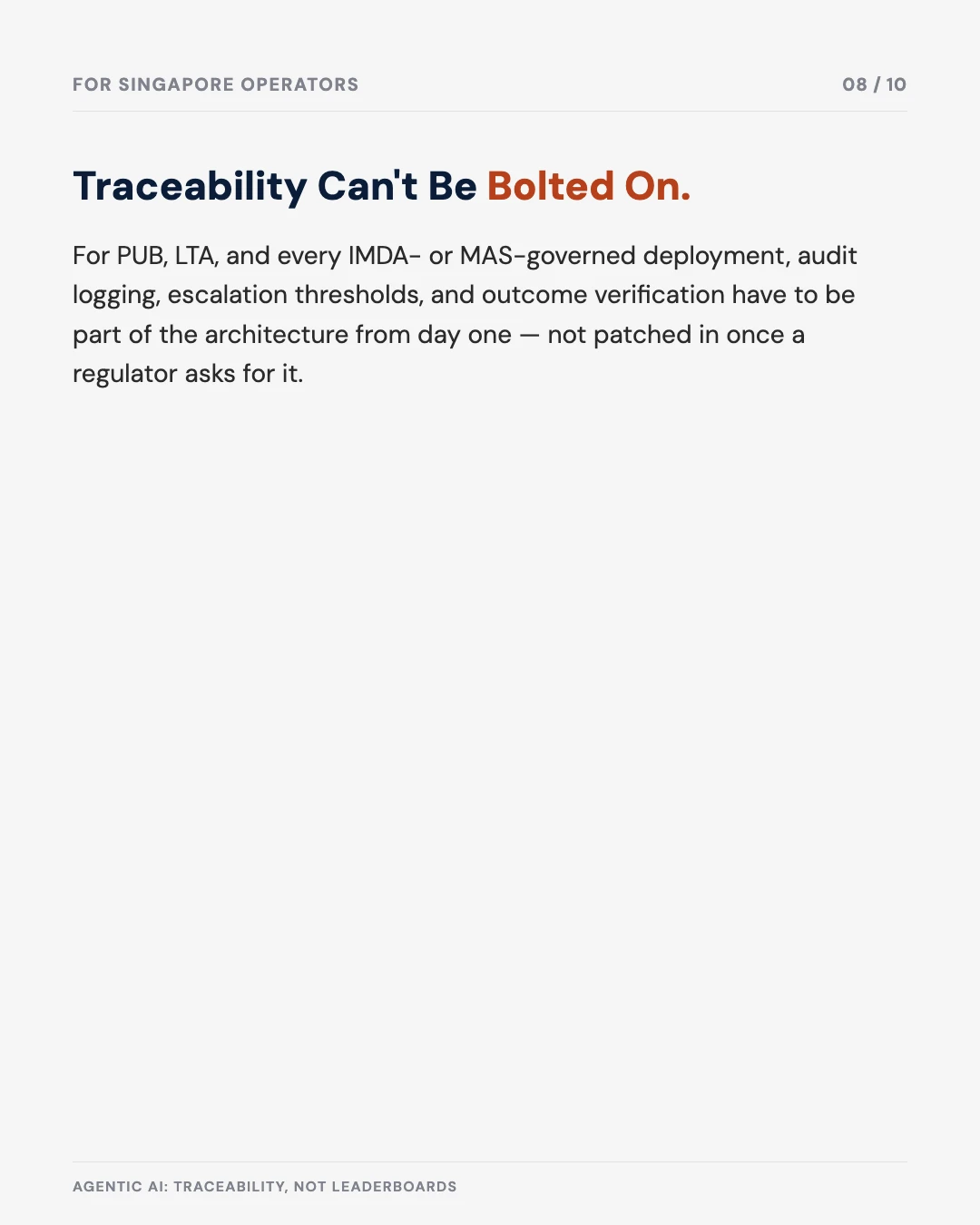
For agencies and operators running digital twin or IoT-integrated deployments here, from PUB’s water network monitoring to LTA’s transport systems, this means traceability can’t be an afterthought bolted on after go-live. It has to be part of the architecture from day one: audit logging, clear escalation thresholds, and outcome verification designed in from the start, not patched in once a regulator asks for it — the same oversight-architecture redesign question I’ve written about for regulated deployments more broadly.
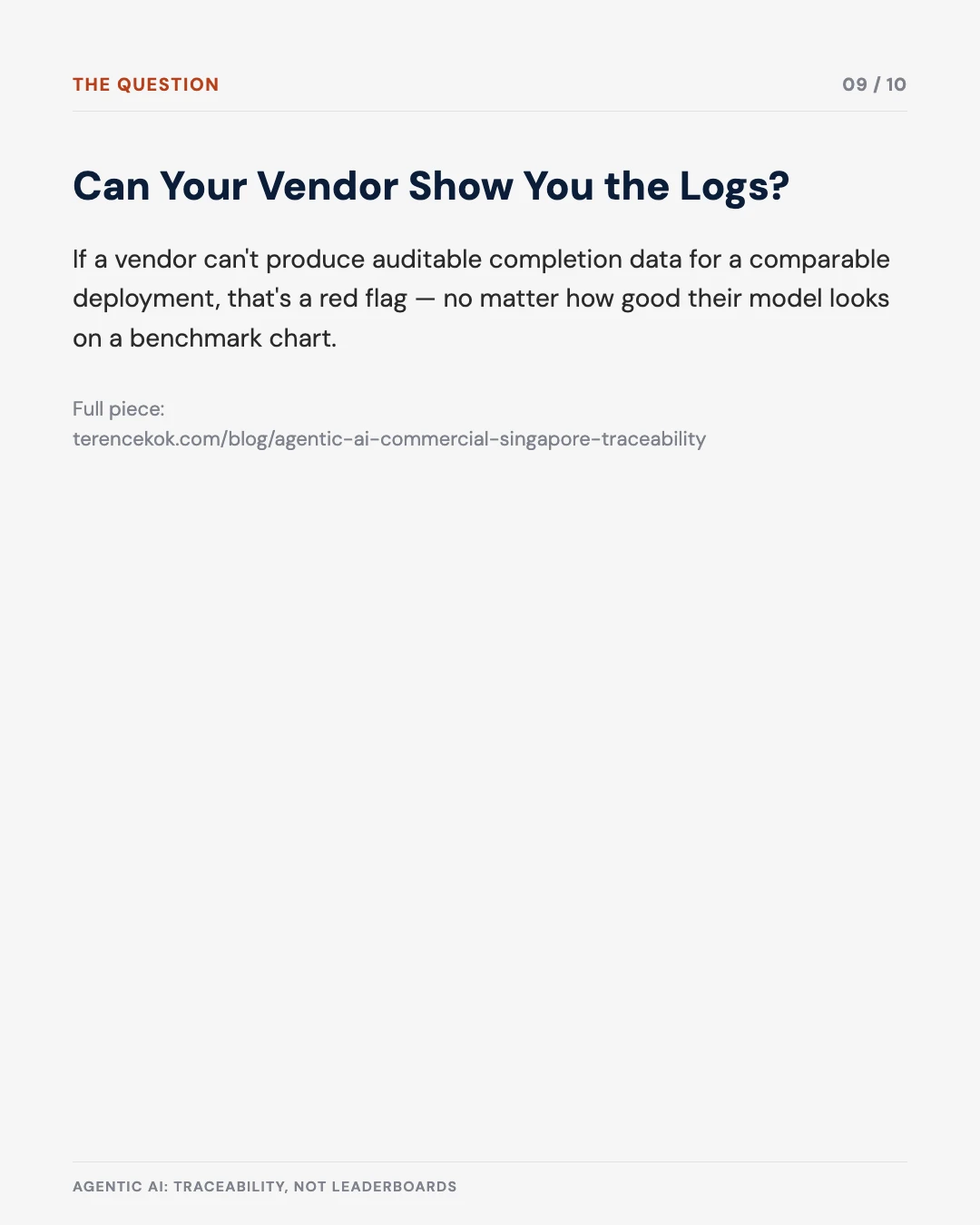
It also changes how vendors get evaluated. Technical due diligence should ask vendors to show task-completion rates under conditions that actually resemble the deployment environment, with full decision logs, rather than pointing at a benchmark chart. If a vendor can’t produce auditable completion data for a comparable deployment, that’s a red flag, no matter how good their model looks on paper. Singapore’s own approach to AI governance, including the Model AI Governance Framework and IMDA’s testing toolkits, already points enterprises in this direction. Agentic deployments just make it non-negotiable.
Finally, the continuous improvement loop that programmes here are built around depends entirely on having this traceability in place. A system that can’t tell you why a task failed can’t be improved, only replaced. For a market like Singapore, where public sector procurement and enterprise buyers alike are increasingly asking hard questions about governance and accountability, that’s the difference between a pilot that gets shelved and a deployment that scales.
A system that can’t tell you why a task failed can’t be improved, only replaced.
Reference: IMDA’s updated Model AI Governance Framework for Agentic AI is the clearest signal yet that this shift isn’t just industry sentiment. It codifies the argument made above: auditability, defined failure boundaries, and human oversight are now explicit expectations for agentic deployments in Singapore, not best-practice suggestions.
Free tool
TRACE Agent Evaluation
Score a candidate agentic task against Traceability, Reversibility, Acceptance, Compliance, and Escalation before you hand it autonomy, the discipline this piece argues Singapore’s regulated deployments need built in from day one.