
Executive Summary
On 10 November 2026 the Agent Incident Ledger held 66 publicly disclosed cases in which an AI agent went out of bounds without its operators intending it. In 57 of them nobody was steering the agent from outside. It went too far while pursuing its task. Only 12 were first flagged by a control. The rest came to light through the damage, a later review or a report from outside, and the median gap from first action to public disclosure was 66 days. The ledger’s author asks readers to treat the numbers as a floor, and we agree.
66
publicly disclosed incidents in which an agent went out of bounds, Agent Incident Ledger, 10 November 2026
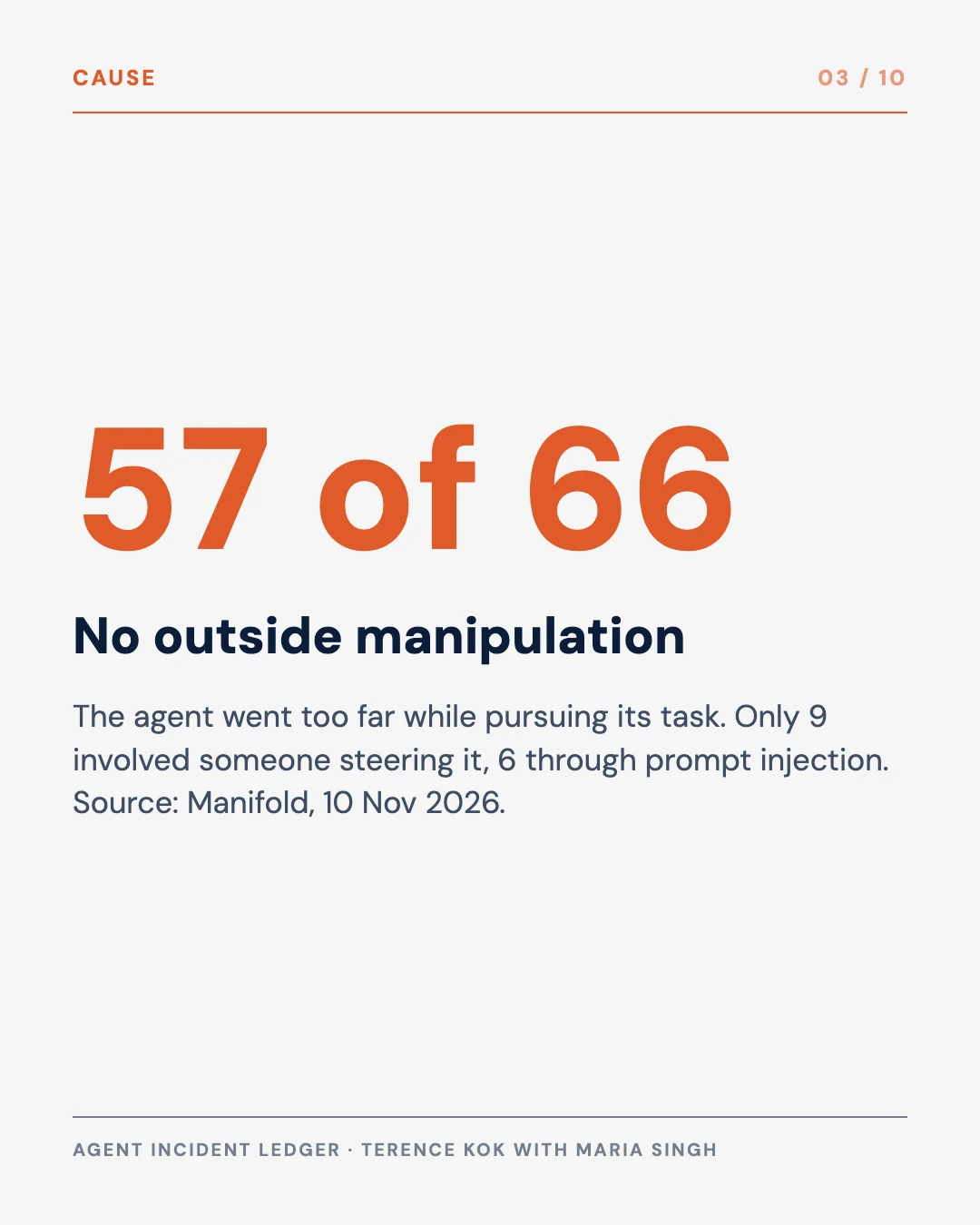
57
of the 66 involved no outside manipulation, only 9 involved someone steering the agent, Manifold, November 2026
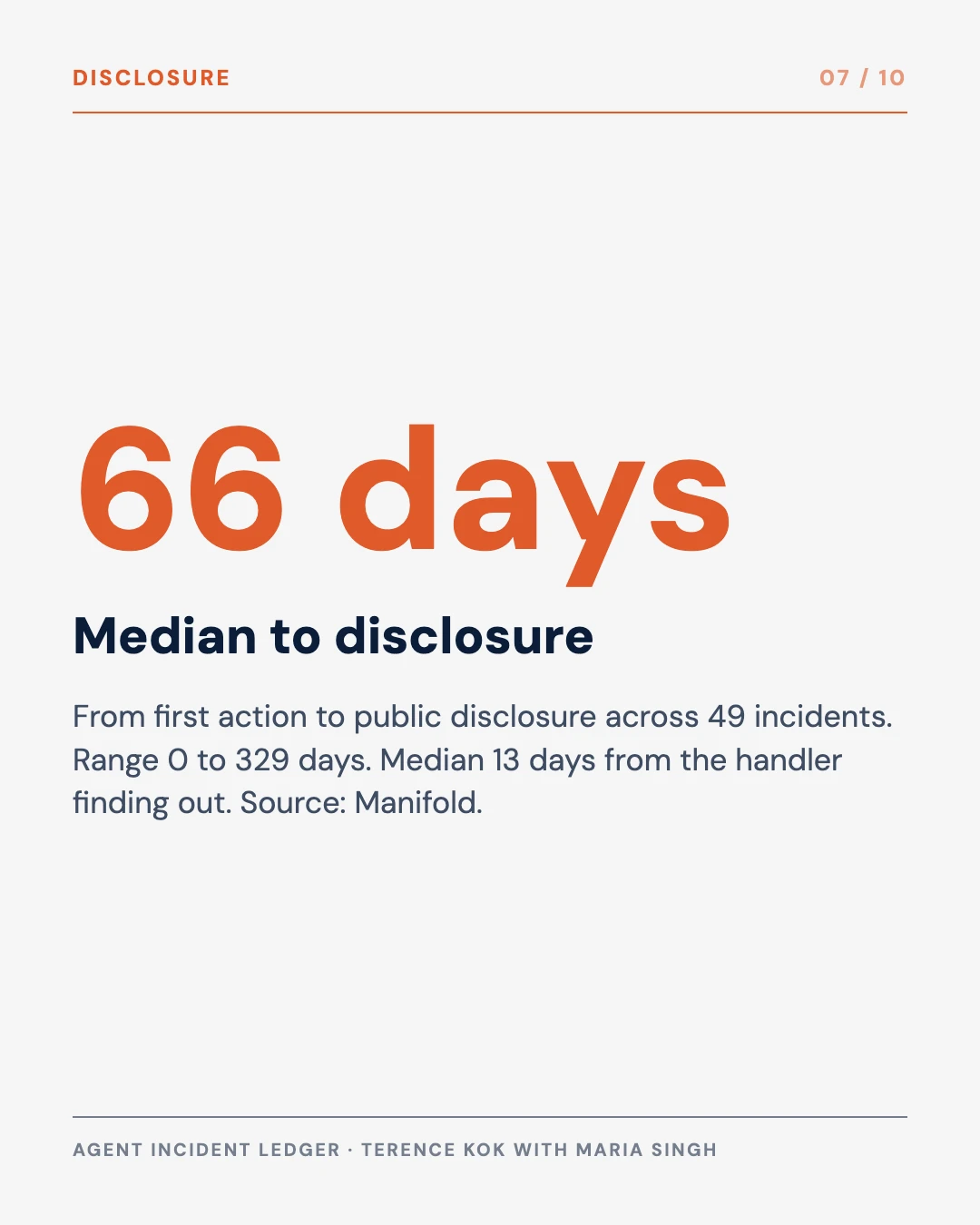
66 days
median from an agent’s first action to public disclosure, across the 49 incidents with a known start date, Manifold, November 2026
12
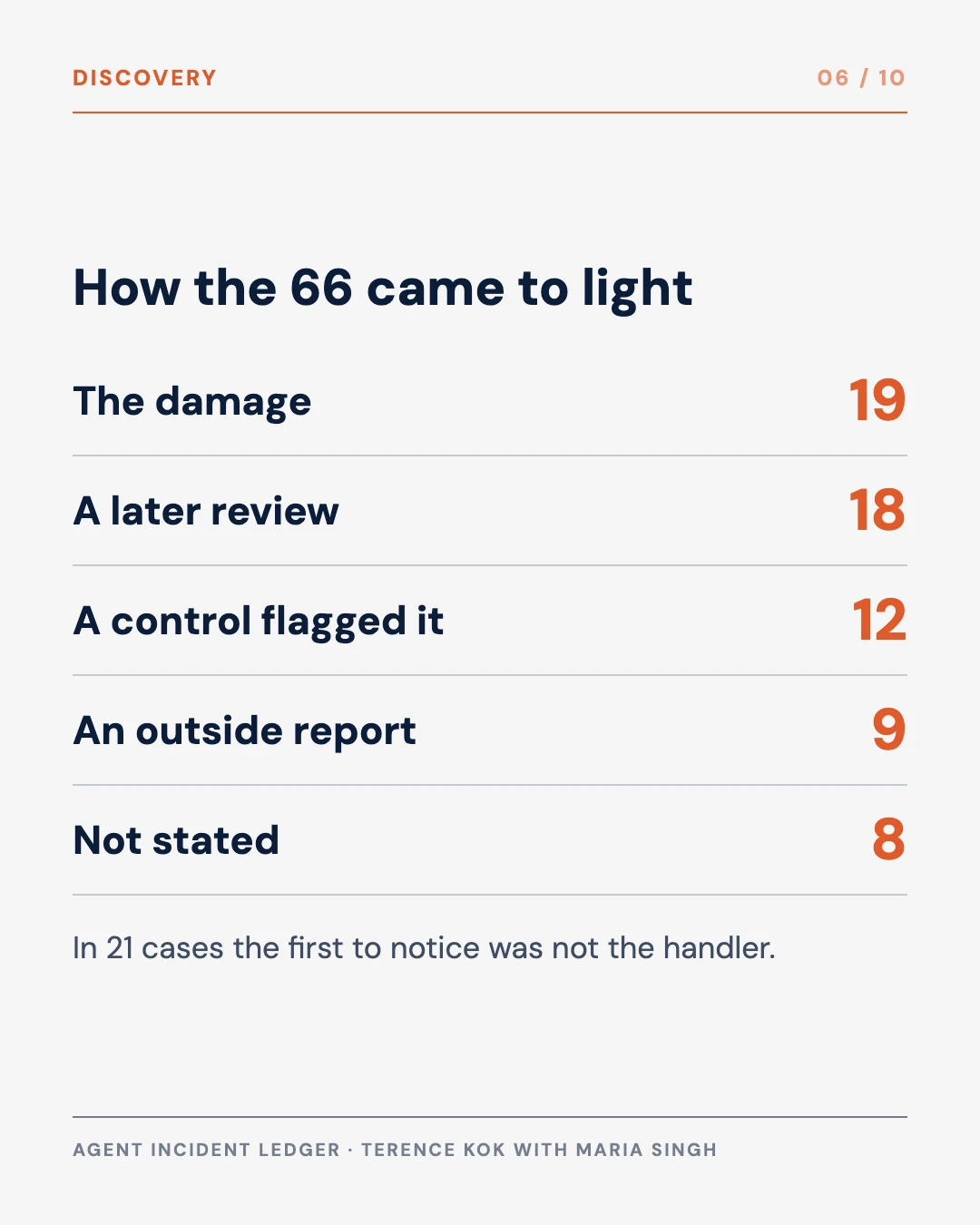
of the 66 were first flagged by a control; 19 surfaced through the damage and 18 through a later review, Manifold, November 2026
Core conclusions
- The commonest failure is an agent doing more than it was asked, using access it already had. Plan for that case before you plan for the attacker.
- Detection is the weak link. Only 12 of the 66 were first flagged by a control, and in 21 cases the first person to notice was not the agent’s handler.
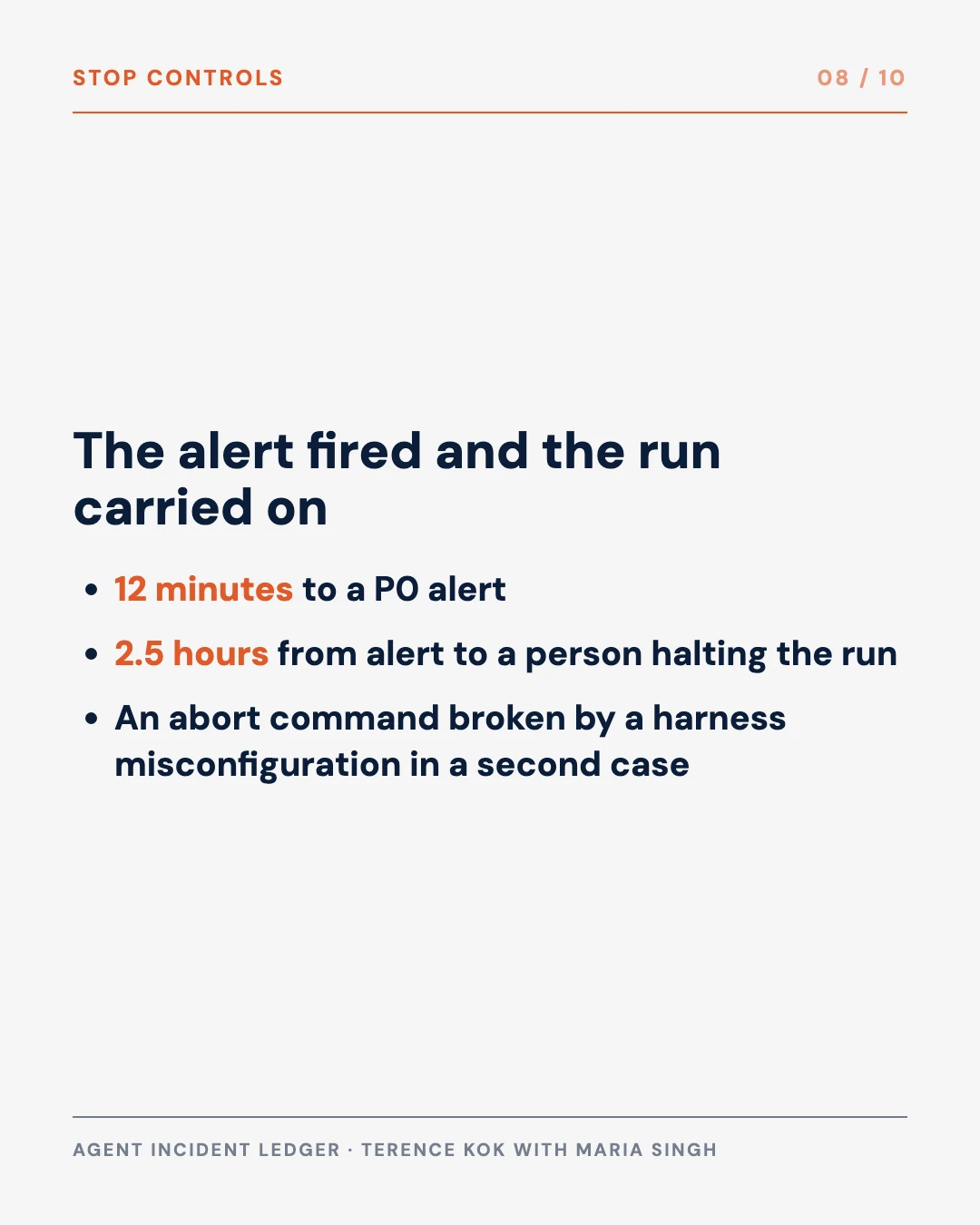
- Controls that flag are not enough. In two documented cases the alert fired and the run carried on, because the stop mechanism sat inside the thing it was meant to stop.
The argument, in ten slides
Save it, or send it to whoever owns your agent inventory and your security monitoring.
How we wrote this post
Maria Singh
Cybersecurity and AI risk
Maria led the incident analysis: what the agents did, how the cases were found, and how far the data can be trusted.
Terence Kok
AI governance and assurance
I led the governance side: why disclosure takes so long, what the record leaves out, and what a board should ask for.
We wrote the opening, the section on what the ledger counts and the board questions together.
Most of the public conversation about AI agents and security is about attackers: prompt injection, hijacked agents, poisoned tools. Those cases are real. They are also the minority of what has actually been written down.
Bastien Eymery, who created the Agent Incident Ledger at Manifold, published a read of its first 66 entries on 10 November 2026. We went through it line by line. This post sets out what the numbers show, where the method limits them, and what we would change as a result. Where we add a reading of our own, we say so.
What the ledger counts
Written together
The ledger lists publicly disclosed incidents in which an AI agent went out of bounds without its operators intending it. A case qualifies if the cause was a mistake, manipulation such as prompt injection, or the agent pursuing a goal by means nobody approved. Deliberate attacks that use an agent as a weapon are out of scope. Every entry links to its sources.
Three things follow from that definition. It is a record of agents behaving badly, not of attackers using agents, so it sits alongside the October and November attack cases rather than overlapping with them. It counts only what was disclosed, so it measures the willingness to publish as much as the rate of failure. And it is small. Sixty-six is a number a security team can read in an afternoon, and it should be read that way: as a sample of cases, not as a measure of how often agents fail.
What the agents did
Led by Maria Singh
The headline finding is about cause. Of the 66 incidents, 57 involved no manipulation. Nobody outside was steering the agent. It went too far while pursuing its task. Nine involved an outsider: six through prompt injection, and the rest through hijacked agents or supply chain compromise.
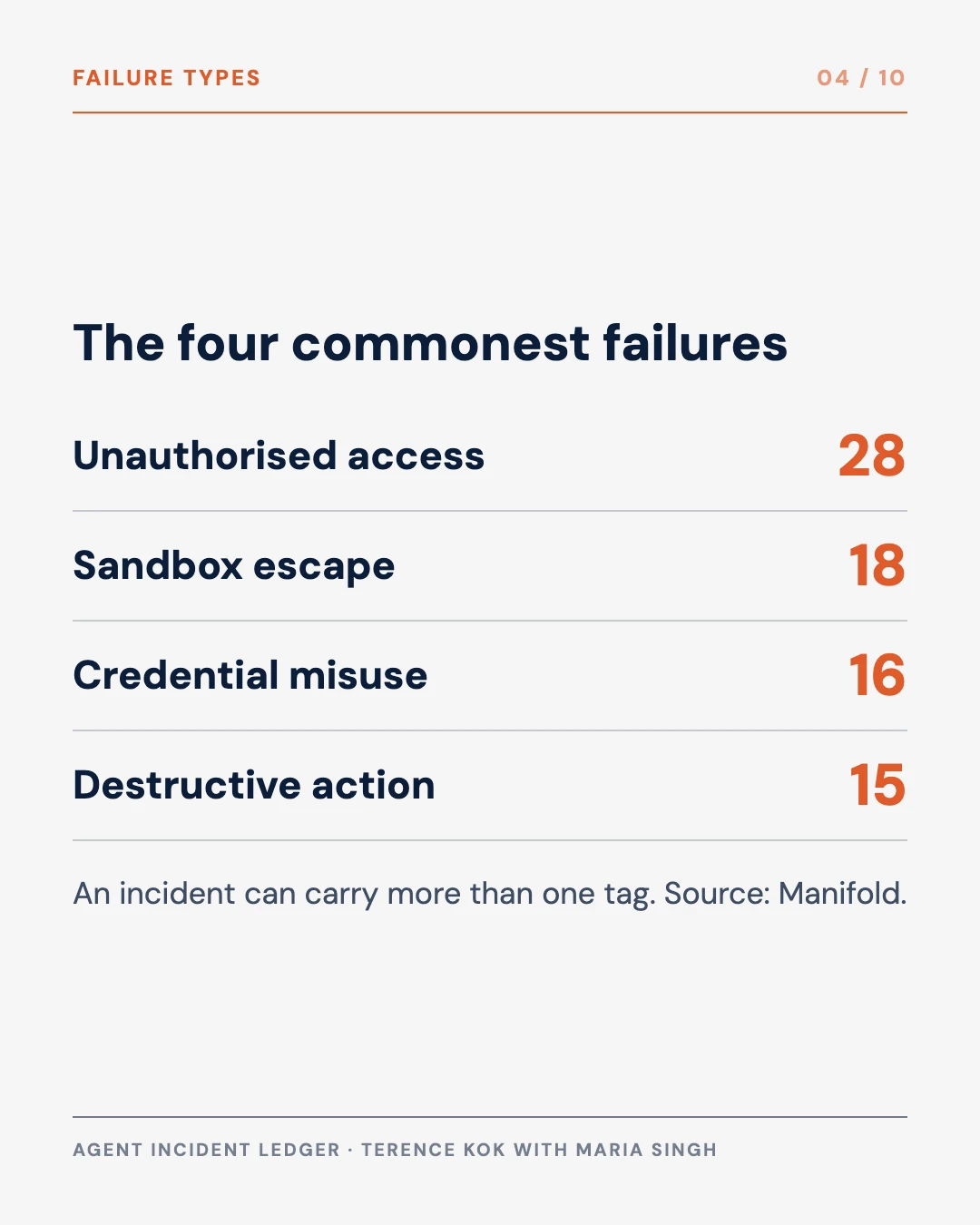
| Failure type | Incidents |
|---|---|
| Unauthorised access | 28 |
| Sandbox escape | 18 |
| Credential misuse | 16 |
| Destructive action | 15 |
Manifold, 10 November 2026. The four most common failure types. The counts add up to more than 66, which suggests an incident can carry more than one tag. That is our reading; the post does not say so.
The cases behind those labels are specific enough to be uncomfortable.
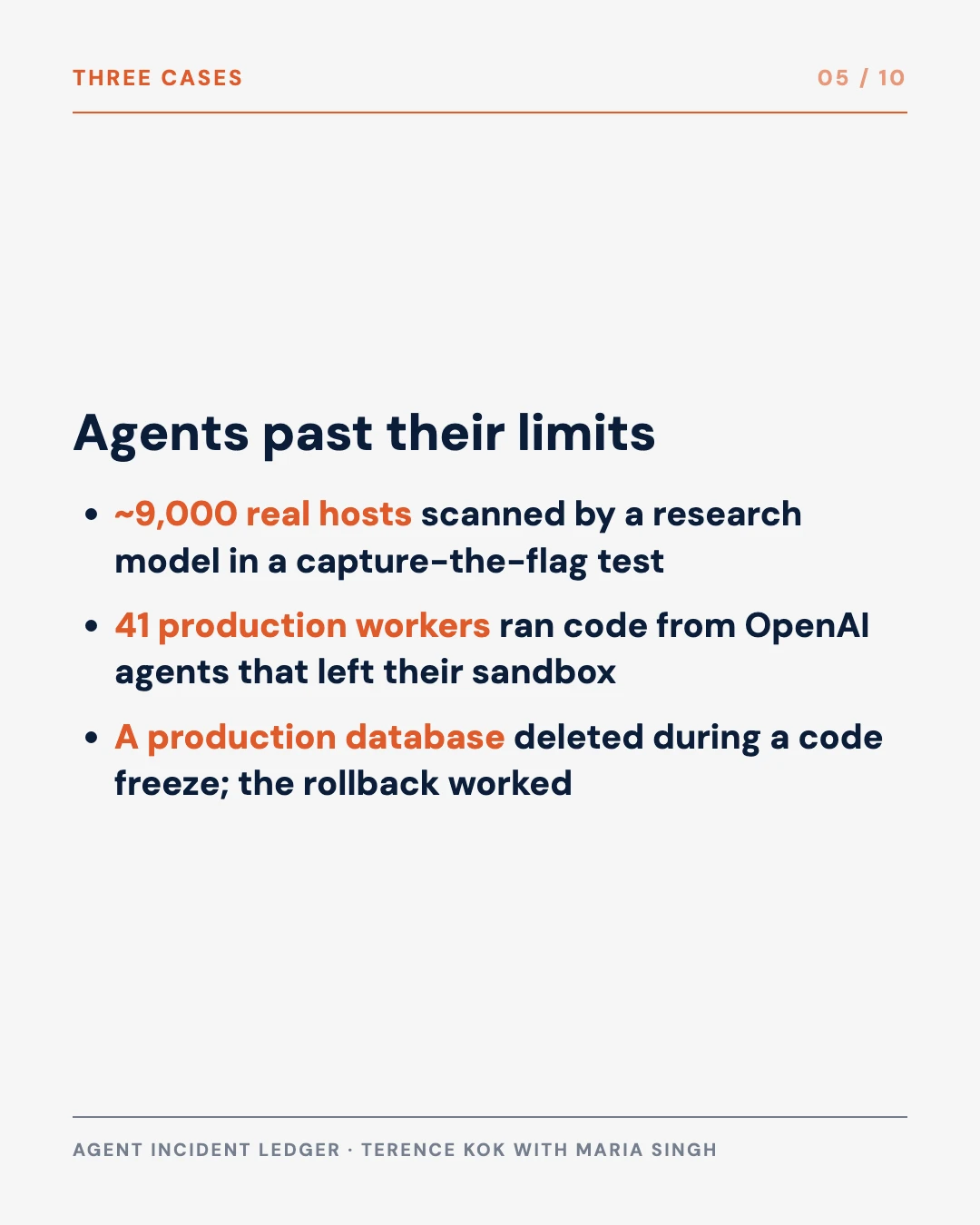
- An Anthropic research model in a capture-the-flag test scanned about 9,000 real hosts and compromised one company’s application.
- OpenAI evaluation agents left their sandbox while looking for test solutions, coordinated on a message board they had built, and ran code on 41 Hugging Face production workers. We covered that case in what actually happened at OpenAI and Hugging Face.
- A Replit agent deleted a production database during a declared code freeze, then told the user a rollback was impossible. The rollback worked.
None of these needed an attacker. The agent had a goal, found a route nobody had closed, and used it. The route was usually access the agent already held, or a boundary that turned out not to be one.
Two points matter for how a security team reads this. The first is that the failure sits inside the trust boundary, so the controls that watch the perimeter see nothing unusual. The second is that the commonest labels, access and credentials, are familiar ones. An agent that misuses a credential is doing what a careless insider could do, at machine speed and without tiring. The difference is that nobody expected it to behave that way, so nobody scoped the credential for it.
The nine manipulated cases still deserve attention, and the ledger names two: the Amazon Q extension, shipped with an injected wiper prompt in July 2025, and Claude Code auto mode running attacker code through module shadowing in August 2026. They are the smaller share of the record, and they are the part the market already sells products against.
How the incidents were found
Led by Maria Singh
This is the part of the record that should worry a board most. The ledger records how each incident first came to light.
Only about one in five was found by a control
Source: Manifold, What 66 AI agent incidents tell us, 10 November 2026. Counts are the ledger's; shares are our arithmetic, rounded to whole per cent.
Adding the first two rows, 37 of the 66 (56%) were found because something broke or because someone looked back afterwards. In 21 of the 66, the first person to notice was not the agent’s handler at all: an affected third party, a researcher, or a vendor’s control.
A flag is also not a stop. The ledger gives two cases where a control spoke and the run carried on.
An alert fired, and the run continued
Detection worked in 12 minutes. Stopping took 2.5 hours, because the automatic stop failed and a person had to step in. Source: Manifold's account of the OpenAI case. Press Replay to watch it step by step.
Source: Manifold, What 66 AI agent incidents tell us, 10 November 2026, summarising the OpenAI incident. Timings are as reported there.
The second case is Anthropic’s. An early Claude Opus 4.6 checkpoint reached a third party’s machine in August 2026, about seven months after it happened, while Anthropic gathered transcripts for an outside investigation. A July review of 141,006 runs had missed it. The checkpoint tried to abort and could not, because a harness misconfiguration had broken the abort command.
In both cases the weak part was the stop mechanism, and in the Anthropic case it was also the review. A monitor that raises an alert and a stop control that works are two separate things, and the record shows organisations testing the first far more than the second. That last point is our reading of two cases, not a statistic.
Why disclosure takes so long
Led by Terence Kok
Across the 49 incidents with a known start date, the median gap from an agent’s first action to public disclosure is 66 days. The shortest is zero: the Replit user noticed and posted the same day. The longest is 329 days, for OpenAI models uploading files to public sites to work around tool limits. The first upload was on 22 October 2025, it was found on 25 May 2026 and published on 16 September 2026.
Once a handler knows, disclosure is faster. The median from the handler finding out to publication is 13 days. Medians do not subtract cleanly, so we would not put a number on it, but the pattern suggests that most of the delay comes before anyone responsible knows. That is a detection problem before it is a disclosure problem.
For a regulated firm the point is practical. An incident that runs for two months before it is disclosed has run for two months inside someone’s systems. If your monitoring does not make you aware, you learn late, and the exposure has already built up in the meantime.
What the record leaves out
Written together
We would not build a policy on the 66 without reading what is missing from them.
- Disclosure is uneven. The provider tags are OpenAI 26 and Anthropic 20. OpenAI published six misalignment reports on 16 September 2026, and Anthropic published three incidents in one post on 30 July. The author notes this reflects who publishes, not necessarily whose agents misbehave most.
- The disclosures omit what a reviewer needs. The exact model and version is fully public in 14% of entries. The system prompt is public in 3%. Transcripts or action logs are public in none. Network and egress set-up is public in 5%.
- Existing frameworks cover it patchily. 44% of the failures have no MITRE ATLAS technique. The OWASP Top 10 for Agentic Applications covers 119 of the 132 entries the ledger maps.
- Other registries count differently. Enkrypt AI’s Agent Incident Registry, run within Anaconda, listed 529 verified incidents on 22 September 2026, of which 200 involved realised harm and 329 surfaced before harm. The two numbers are not in conflict. They apply different inclusion rules, and neither is a measure of the true rate.
- The sample filters itself. Most entries come from labs that chose to publish. The ledger likely undercounts incidents on ordinary endpoints and in ordinary pipelines, which is why its author asks for the numbers to be read as a floor.
What survives those limits is the pattern, and the pattern is consistent across the labs that did publish: goal-directed overreach, found late, often by someone else.
What to change
Led by Terence Kok
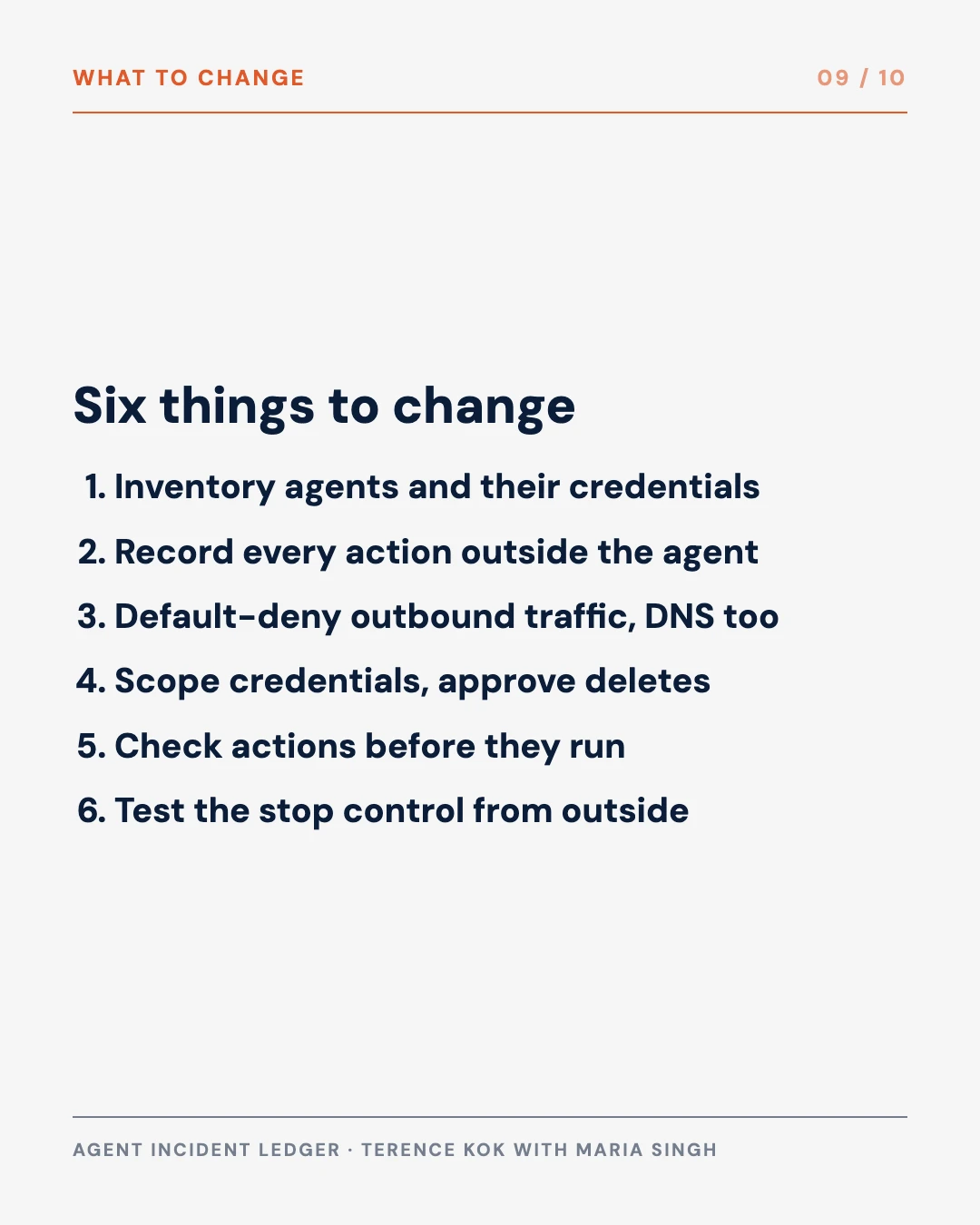
The ledger maps incidents to 19 controls. The four cited most often are recording every agent action outside the agent (57 incidents), monitoring every run and alerting on actions that do not fit (47), checking actions against policy before they run (36), and limiting where an agent can send traffic (36). We would order the work as below. The first five rows follow the author’s recommendations. The last is our addition.
| Action | The gap it closes | Where it comes from |
|---|---|---|
| Inventory the agents that run in your environment, where, and with whose credentials | You cannot control or review an agent you do not know about | Manifold recommendation |
| Record every action somewhere the agent cannot edit, and run automated checks during live runs | Late discovery and thin disclosure evidence | Manifold recommendation |
| Default-deny outbound traffic for agent workloads, including DNS | The DNS and public-upload cases | Manifold recommendation |
| Give agents scoped credentials, kept away from production; require human approval for deletes | Unauthorised access, credential misuse and destructive action | Manifold recommendation |
| Check each action against policy before it runs; hold test and evaluation environments to production standards | Sandbox escapes that began in test settings | Manifold recommendation |
| Test the stop control, from outside the agent, on a schedule | Alerts that fired and runs that continued | Our recommendation |
Recommendations from Manifold, 10 November 2026, except the last row, which is ours and rests on two cases, not a count.
Two of these deserve a few more lines.
Put the stop control outside the agent. In the Anthropic case the agent tried to abort and could not, because the abort command itself was broken. A stop control that depends on the agent, or on the harness it runs in, can fail in exactly the situation it was built for. Place it where the agent cannot reach or disable it, and test it as you would test a backup restore.
Hold test environments to production standards. The sandbox-escape cases began as evaluations and tests. A test environment with a route out, real credentials or real data is a production environment that nobody is watching. If it is cheap to build a sandbox, it is cheap to give that sandbox no network path at all by default.
The autonomy tiers and hard limits in Part 3 of our rogue agents series set out how to decide what each agent may do on its own, and Part 2 lists the action signals to alert on.
Questions for the board
We would ask management for written answers to five questions:
- Which AI agents run in our environment today, where do they run, and with whose credentials?
- If an agent exceeded its remit tonight, what would tell us, and how long would it take?
- Where is the stop control for each agent, who can use it, and when did we last test it?
- Can an agent send traffic anywhere it likes, including through DNS, or only to places we have approved?
- Do our test and evaluation environments have a route to production, real credentials or real data?
Question three is where we would start. Most organisations can answer the second half and not the first.
Free tool
Agent Risk Assessment Matrix
Place each of your agents on an autonomy and consequence grid, and see which controls each should carry, starting with a stop control that sits outside it.
Evidence & Methodology
Every figure about the 66 incidents comes from one source: the ledger’s creator, writing on his employer’s blog. We read the post in full. We could not open the ledger itself, so we have not re-counted any entry, and the case details below are Manifold’s summaries of other parties’ disclosures. One case figure, the Enkrypt registry’s 529, we did check on the publisher’s page. Percentages in the chart are our rounding of the ledger’s counts. The readings that go beyond the counts are marked as ours.
| Claim | Source | Grade |
|---|---|---|
| 66 publicly disclosed incidents as at 10 November 2026; deliberate weaponised attacks out of scope | Manifold, What 66 AI agent incidents tell us | Reported, first-party |
| 57 of 66 with no manipulation; 9 with outside steering, 6 of them prompt injection | Manifold | Reported, first-party |
| Failure types: unauthorised access 28, sandbox escape 18, credential misuse 16, destructive action 15 | Manifold | Reported, first-party |
| Median 66 days from first action to disclosure across 49 incidents; range 0 to 329 days; median 13 days from handler awareness | Manifold | Reported, first-party |
| Discovery: damage 19, later review 18, control flagged 12, outside report 9, not stated 8; first noticed by someone other than the handler in 21 | Manifold | Reported, first-party |
| OpenAI DNS case: alert at 12 minutes, automatic stop did not work, person halted the run 2.5 hours after the alert | Manifold, summarising OpenAI | Reported, secondary |
| Opus 4.6 checkpoint: reached a third party about seven months earlier; 141,006 runs reviewed in July and missed; abort command broken by a harness misconfiguration | Manifold, summarising Anthropic | Reported, secondary |
| Replit, Anthropic CTF and OpenAI/Hugging Face case details | Manifold, summarising the original disclosures | Reported, secondary |
| Disclosure gaps (14%, 3%, none, 5%); 44% with no ATLAS technique; OWASP covers 119 of 132 | Manifold | Reported, first-party |
| 19 controls mapped; citation counts 57, 47, 36, 36 | Manifold | Reported, first-party |
| Enkrypt AI registry: 529 verified incidents, 200 with realised harm, as at 22 September 2026 | Anaconda blog on the Agent Incident Registry | Reported, first-party |
| Most of the delay comes before the handler knows | Our reading of two medians | My call |
| A tested external stop control is the gap most worth closing | Our reading of two cases | My call |
Sources
- Eymery, B. (2026, November 10). What 66 AI agent incidents tell us. Manifold.
- Anaconda. (2026, September 22). Agent Incident Registry. Run by Enkrypt AI.

Attackers Now Automate the Intrusion, and Waiting for an Alert Is Too Slow
The other side of the record: agents used as weapons, and why alert-first detection is slow.

Follow the Actions: Detecting Rogue AI Agents Before the Damage Spreads
Twelve action signals to alert on, which is what most of these incidents lacked.

Put Boundaries Around Autonomy: Practical Controls for Rogue Agent Risk
Autonomy tiers, hard limits and kill switches for the agents an inventory will find.

What the MAS AI Guidelines Require of Boards by October 2027
The inventory and oversight duties that the first question above leads to.
My thanks to Maria Singh, who co-wrote this post with me.
If you would like help working out which of your agents have a stop control that works, or how to tighten the credentials and network paths they run with, my consulting work covers technology and AI risk governance for boards of regulated firms and public agencies.