How Robodebt went wrong.
An automated welfare debt program that ran for five years without a legal basis, ignored repeated warnings and cost far more than it saved. Every figure here comes from the Royal Commission, the Federal Court, official outcomes or named press. Independent analysis from public sources.

The short version.
From 2015 to 2020 the Australian Government ran an automated program that raised welfare debts by comparing a person's annual income on tax-office records with the fortnightly income they had reported to Centrelink. Where the person did not supply payslips, the system spread the annual figure evenly across the year and treated the difference as an overpayment. About 794,000 debts were raised against about 526,000 people.1
The method had no basis in law, and government lawyers had said so before it started. The Royal Commission that examined it called it "a crude and cruel mechanism, neither fair nor legal".1 It was budgeted to save about A$4.8 billion and ended as a net cost of about A$565 million, before two class action settlements. A$746 million was refunded and A$1.751 billion of debts was written off in total.1
Robodebt did not use artificial intelligence. The Commission is explicit that it used automation.1 Its lessons apply to AI because the failures were in how decisions about the system were made: the legal basis was never settled, the human check was designed out, the burden of proof moved to the public, and five years of warnings went unheeded.
2014 to 2015How the scheme began.
The idea was to use data the government already held. The tax office receives each employer's annual pay figures. Centrelink receives the income a person reports every fortnight. Where the two did not match, there might be an overpayment. Comparing them was not new. What was new was the plan to let the annual figure stand in for the fortnightly ones.
In late 2014 the Department of Social Services' own lawyers advised that averaging "might not be consistent with the legislative framework", and policy advice warned that debts calculated this way might be wrong. In February 2015 the Social Services Minister, Scott Morrison, signed an executive minute that noted the department's view that legislative change would be needed. The New Policy Proposal that went to Cabinet in March 2015 said legislation was not required and did not mention averaging. The Commission called that statement false, and found that Mr Morrison allowed Cabinet to be misled because he did not make the obvious inquiry.1
The measure was funded in the 2015–16 Budget under the heading of strengthening the integrity of welfare payments, and extended in later budget updates.1 A 2015 pilot showed that only about 40 per cent of people contacted made contact back. The pilot was not properly evaluated, and the online screens were never tested with users.1
The mechanismHow averaging produced debts.
Social security entitlement depends on what a person earned in each fortnight. Someone who works for part of the year and claims benefits for the rest can owe nothing, because they earned nothing while on benefits. Averaging divides the year's income by 26 and assumes the same amount was earned in every fortnight, including those spent on benefits.27 For anyone with casual, seasonal or broken work, that produces a debt for income that was never earned.
One year, twenty-six fortnights, two versions of the same income
What the scheme assumed: the year's income spread evenly, about $692 every fortnight. In the sixteen fortnights on benefit, that phantom income produces a debt that never existed.
Illustrative figures. The mechanism follows the Royal Commission's account of averaging ATO annual income data across fortnights.
The Commission identified five changes from the earlier, manual practice. Taken together they turned a lead for an officer to investigate into a debt notice generated by the system.1
| Before | Under the online scheme |
|---|---|
| ATO annual income data was a lead for an officer to check. | Unconfirmed ATO annual (PAYG) data became the primary evidence of income. |
| The department had to establish any debt. | The person had to disprove it, often with payslips several years old. |
| Entitlement was assessed on actual fortnightly income, as the law requires. | Annual income was averaged across fortnights automatically where the person did not supply records. |
| Compliance officers handled each case. | The process was designed to run online "to reduce (and preferably obviate) human involvement". |
| Reviews looked at recent periods. | Recovery reached back about five years. |
Process maps put before the Commission show how much was automated. A person who did not respond was treated as accepting the tax-office figure. Entitlement, the debt and a 10 per cent penalty were calculated automatically, and the debt notice was generated automatically.1 The letters left out a compliance phone number by design, to push people online. The Commission described the penalty as a "euphemistically called" recovery fee and found no evidence that anyone had considered its legal basis.1
Who had to do the checking, before and after the online system
After: the checking moved to the person. Anyone without old payslips was assumed to owe the averaged amount.
Schematic, from the Royal Commission's and the Commonwealth Ombudsman's accounts of the change.
The scheme at full scale.
The Online Compliance Intervention began in July 2016 and was fully rolled out in September, at 20,000 notices a week. Under the manual process there had been about 20,000 interventions a year. In November 2016 the Minister for Human Services announced that new technology was helping raise $4.5 million in welfare debts a day.1
By December the news was full of people who had received debts they did not owe, and the Australian Council of Social Service wrote to the Minister. By 27 January 2017, 76 per cent of people in the online phase, 99,404 people, had debts raised from averaged earnings.1 People were asked for payslips going back years, while the department's own website told them to keep payslips for six months.1 Debts were passed to private collectors without checking that the person had received the notice. The collectors were paid about A$11.6 million between 2015 and 2021.1
2017 to 2019Seven warnings.
The scheme ran for three more years after the first public alarm. Each warning had an answer that let it continue.
Seven warnings that averaging was wrong, and what happened next
Sources: Royal Commission into the Robodebt Scheme, report, 2023; Senate Community Affairs References Committee, June 2017; Prygodicz (No 2) [2021] FCA 634.
Two of these matter most for anyone governing an automated system. The first is the Ombudsman. When it investigated in 2017, the departments gave it a 2017 internal view that averaging could be used "as a last resort", which cited no law, rather than the 2014 advice. The Commission found that officers' explanation to the Ombudsman was untrue. The Ombudsman did not examine legality, and ministers then cited its report as evidence the scheme was lawful.1 The oversight body was used as cover.
The second is the tribunal. By the end of May 2017 about 29 first-tier tribunal decisions had rejected averaging.2 The department fixed each case that was appealed and otherwise carried on.1 An external error report that arrives one case at a time can be absorbed indefinitely unless someone is required to read the pattern.
2019 to 2021The legal collapse.
The legal position, known inside government since 2014, came out in court. The Australian Government Solicitor advised in March 2019 that averaging could not establish a debt. In September 2019 the Solicitor-General advised that averaged tax-office data could not support a conclusion about whether a debt existed or how much it was without further evidence.1 On 19 November 2019 the government stopped raising debts on averaged data alone, and a class action was filed the same day. Eight days later, in the test case Amato v Commonwealth, the Commonwealth consented to a declaration that the averaged debt had not been validly made.2
The scheme closed on 30 June 2020 and refunds began that July.1 The class action settled on the day set for trial, in November 2020. Approving the settlement in June 2021, Justice Murphy recorded the Commonwealth's admission that it "did not have a proper legal basis to raise, demand or recover" debts based on averaging.2
The peopleThe human cost.
This section records deaths by suicide. If it raises something for you or someone you know, in Australia call Lifeline on 13 11 14, in Singapore call the Samaritans of Singapore on 1767, or find a local helpline at findahelpline.com.
The Commission heard from people who had received debts they did not owe and could not disprove, and from families of people who had died. It records that Rhys Cauzzo, aged 28, died in January 2017 after debts raised by averaging in the manual phase that preceded the online scheme had been referred to a debt collector. It records that Jarrad Madgwick, aged 22, died in May 2019, and that his mother identified a debt notice as a precipitating factor; the Commission notes that his debt does not appear to have come from averaging.1 The Commission found that by July 2017 the Minister for Human Services, Alan Tudge, knew that at least two people had died by suicide, and that no comprehensive review followed.1
Its summary of what the design left out is one line: "Empathy could not be programmed into the Scheme."1
The moneyWhat it cost.
The scheme was budgeted to save A$4.772 billion. It achieved about A$406 million in savings at a total cost of A$971 million, a net cost that the Commonwealth accepts of about A$565 million.1 A$746 million was refunded to some 381,000 people, and A$1.751 billion of debts was written off in total, a figure that includes the refunds.1 The 2021 class action settlement added A$112 million.2 A second action, appealing that settlement on the ground of misfeasance, settled in September 2025 for A$475 million in compensation, about A$548.5 million with administration and legal costs. Justice Beach of the Federal Court approved it on 23 June 2026, with about 125,000 people registered to share in it.242629 The Scheme Administrator expects to make fixed payments from October 2026 to February 2027 and to pay individually assessed claims in mid to late 2028, about eight years after the scheme closed.24
Budgeted to save almost A$4.8 billion, it ended as a net cost
What it was meant to do
What it cost
What had to be undone
A$, nominal. Sources: Royal Commission report, pp. 401 to 402; Prygodicz (No 2) [2021] FCA 634; Gordon Legal and press reports of the 2026 approval. Bars share one scale.
The reckoning.
A Royal Commission, led by Catherine Holmes AC SC, was established in August 2022 and reported on 7 July 2023. It found the scheme "a costly failure of public administration, in both human and economic terms", and made adverse findings about ministers and senior officials. A sealed chapter referred individuals to the Australian Public Service Commission, the National Anti-Corruption Commission, the Australian Federal Police and a legal regulator.1 The report closes on "a myriad of ways that things can go wrong through venality, incompetence and cowardice".1
The accountability process took five more years and did not run smoothly. The Anti-Corruption Commission first declined to investigate. Its own Inspector then found officer misconduct in that decision, and an independent delegate reopened it. In March 2026 the Commission found that two former senior officials had engaged in serious corrupt conduct, one by misleading officers preparing the 2015 Cabinet submission and one by misleading the Ombudsman in 2017. It made no referral for prosecution, and found that four others, including Mr Morrison, had not acted corruptly.56910 The reason for no referral was evidential. The admissions that could prove an offence had been given under compulsion, and compelled evidence cannot be used in a criminal trial.30 The Royal Commission's finding about Mr Morrison and the anti-corruption finding apply different legal tests, and both stand.
Five years from the first court settlement to the last finding
Sources: Prygodicz (No 2) [2021] FCA 634; Royal Commission report, 2023; APSC, 13 September 2024; NACC releases of 6 June 2024, 30 October 2024 and 11 March 2026; Gordon Legal.
What the Royal Commission recommended.
The report's text refers to 57 recommendations; its numbered list and the government's response contain 56. In November 2023 the government accepted all of them, in full or in principle.13 Two deal directly with automation. The Commission's finding behind them is short: "The automation used in the Scheme at its outset, removing the human element, was a key factor in the harm it did."1
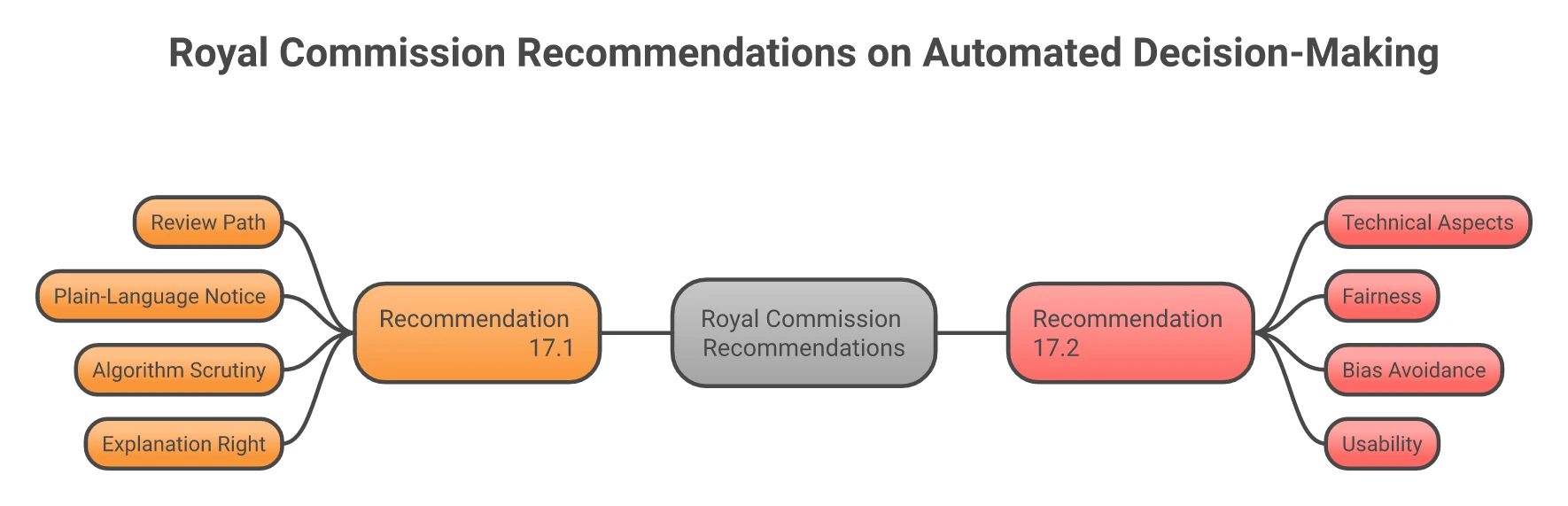
Recommendation 17.1 asks for a consistent legal framework for automation in government services; 17.2 for a body to monitor and audit it. The right to an explanation comes from the chapter's discussion behind 17.1. Royal Commission report, pp. 486 to 488.
Recommendation 17.1 asks government to consider legislating a consistent legal framework for automation, with a clear path to review, plain-language notice on agency websites that automated decision-making is used, and business rules and algorithms "made available, to enable independent expert scrutiny". Recommendation 17.2 asks for a body to monitor and audit automated decision-making for technical soundness, fairness, bias and usability.1 The government accepted both.3
Progress since has been slow. The Attorney-General's Department consulted on a framework from November 2024 to January 2025 and published a summary in August 2025.20 The Ombudsman updated its better practice guide in March 2025.16 Amendments to the Privacy Act require organisations to disclose certain automated decisions from 10 December 2026.22 In July 2026 the government listed a framework for automated decision-making in federal agencies among five AI safety priorities and asked the Attorney-General to lead it.31 As at 12 October 2026 no government bill has been introduced. A private member's bill to implement recommendations 17.1 and 17.2 was introduced on 7 September 2026 and is still before the House of Representatives.2132
For AIWhy it matters for AI.
Every failure in Robodebt has a direct counterpart in AI deployment. A rules engine that averages income and a model that predicts it both produce an estimate that someone has to decide whether to act on. In Robodebt the estimate went straight to a debt notice. The same questions apply to any AI system that decides or recommends something about a person: is there a legal basis for acting on this output, who checks it before it reaches the person, who carries the burden of correcting it, and who is reading the pattern of complaints and appeals?
Two features make AI riskier on these points. A probabilistic model is harder to explain than a formula, so the "business rules made available" that the Commission asked for are harder to produce. And the speed and scale that made the online scheme attractive are greater with AI. The Commission's recommendations were written for automation. They read as a minimum for AI.
The same pattern is appearing again in Australian services. In 2026 the Commonwealth Ombudsman confirmed it was investigating complaints about an aged-care assessment tool that classified people's funding levels and that assessors could not override, and by July the Senate had passed a private bill to require that such tools support professional judgement rather than replace it.31
ImplicationsWhat boards and agencies can take from it.
- Settle the legal basis before you automate. The lawyers' caveat was in the 2015 minute and missing from the Cabinet proposal. Any automated or AI decision about a person needs written confirmation that the method is lawful, and that confirmation should travel with the funding decision.
- Keep a human check where an error reaches a person. The Commission found that removing the human element was a key factor in the harm. Decide which outputs a person must review before they take effect, and fund the reviewers when the volume rises. The oversight ceiling calculator estimates how many you need.
- Do not move the burden of proof to the public. Asking people to disprove a machine's figure with records they were told they could discard turns an estimate into a verdict.
- Read appeals and complaints as a pattern. Twenty-nine tribunal decisions were handled one at a time. Someone senior should be required to report adverse external decisions in aggregate, with the error rate they imply.
- Protect the independence of legal advice. Advice that averaging was unlawful existed in 2014, 2018 and 2019. Legal advice on an automated program should go to the board or minister directly, not through the team that owns the program.
- Measure harm as well as savings. The scheme was judged on dollars recovered while the deaths, complaints and tribunal losses went uncounted. Put harm indicators beside the financial ones from the first month.
- Publish the rules and give reasons. The notices gave no reasons. The Commission asks for business rules and algorithms to be open to expert scrutiny. For AI, that means documenting what the system does and does not consider, and explaining each decision to the person affected.
- Do not lean on an oversight body that was given a partial picture. The Ombudsman's report was used as proof of legality on a question it had not examined. A clean review covers only what the reviewer was asked to look at.
To check a proposed automated or AI decision against these points, place it on the agent risk assessment matrix, which sets the controls by autonomy and consequence.
ChronologyFull timeline.
| When | Event | Sources |
|---|---|---|
| Late 2014 | Department of Social Services in-house legal and policy advice warns that averaging may not be consistent with the legislation and that debts calculated this way may be wrong. | [1] |
| Feb to Mar 2015 | The Social Services Minister signs an executive minute noting the department’s view that legislative change would be needed. The New Policy Proposal that follows says legislation is not required and does not mention averaging. | [1] |
| May 2015 | The measure is funded in the 2015–16 Budget. Pilots and a manual PAYG compliance phase run during 2015. | [1] |
| Jul to Sep 2016 | The Online Compliance Intervention starts in July and is fully rolled out in September at 20,000 notices a week. | [1] |
| Nov 2016 | The Minister for Human Services announces that new technology is helping raise $4.5 million in welfare debts a day. | [1] |
| Dec 2016 to Jan 2017 | Wrong debts dominate the news. By 27 January 2017, 76% of people in the online phase (99,404 people) had debts raised from averaged earnings. | [1][27] |
| Apr 2017 | The Commonwealth Ombudsman reports on the system after an own-motion investigation begun on 10 January. | [14] |
| Jun 2017 | A Senate committee recommends putting the scheme on hold until procedural fairness flaws are fixed. | [18] |
| 2017 to 2019 | Tribunal decisions reject averaging; draft external advice (Aug 2018) and Australian Government Solicitor advice (Mar 2019) say averaging cannot establish a debt. | [1][2] |
| Sep 2019 | The Solicitor-General advises that averaged PAYG data alone cannot support the existence or amount of a debt. | [1] |
| Nov 2019 | The government stops raising debts solely on averaged PAYG data (19 Nov). A class action is filed the same day. In Amato, the Commonwealth consents to a declaration that the averaged debt was not validly made (27 Nov). | [1][2] |
| May to Jun 2020 | Refunds are announced and the scheme closes altogether on 30 June. | [1] |
| Nov 2020 to Jun 2021 | The class action settles on the day set for trial. The Federal Court approves it in June 2021, recording the Commonwealth’s admission that it had no proper legal basis for averaged debts. | [2] |
| Aug 2022 | A Royal Commission is established. | [1] |
| 7 Jul 2023 | The Royal Commission reports, with a sealed chapter referring individuals to the APSC, the National Anti-Corruption Commission, the Australian Federal Police and a legal regulator. | [1] |
| Nov 2023 | The government accepts all 56 recommendations, in full or in principle. | [3] |
| Jun 2024 | The National Anti-Corruption Commission decides not to investigate the referrals. | [5] |
| Sep 2024 | The APSC finds 12 of 16 current and former public servants breached the APS Code of Conduct. | [4] |
| Oct 2024 to Feb 2025 | The NACC Inspector finds officer misconduct in the decision not to investigate. An independent delegate is appointed and decides the referrals should be investigated. | [6][7][8] |
| Nov 2024 to Jan 2025 | The Attorney-General’s Department consults on a legal framework for automated decision-making. | [20] |
| Mar 2025 | The Ombudsman updates its Automated Decision-Making Better Practice Guide. | [16] |
| Sep 2025 | A further settlement is agreed after an appeal claiming misfeasance: A$475 million in compensation. | [24][26] |
| Mar 2026 | The NACC reports that two former senior officials engaged in serious corrupt conduct, makes no referral for prosecution, and finds four others, including the former Prime Minister, did not act corruptly. | [9][10] |
| 23 Jun 2026 | The Federal Court (Justice Beach) approves the second settlement. About 125,000 people registered to share in it. | [24][25][29] |
| Jul 2026 | The government names a framework to regulate automated decision-making in federal agencies among five AI safety priorities, with the Attorney-General to lead it. | [31] |
| Sep 2026 | A private member’s bill to implement recommendations 17.1 and 17.2 is introduced (7 Sep). As at 12 October it is still before the House of Representatives. | [21][32] |
| Oct 2026 to 2028 | Fixed payments under the second settlement are scheduled from October 2026 to February 2027; individually assessed claims are expected to be paid in mid to late 2028. | [24] |
| 10 Dec 2026 | Privacy Act transparency duties for certain automated decisions are due to start. | [21][22] |
Common questions about Robodebt.
What was Robodebt?
An Australian Government program, run from 2015 to 2020, that raised welfare debts by comparing people’s annual tax-office income with the fortnightly income they had reported to Centrelink. Where the person did not supply records, the system averaged the annual figure across the year’s fortnights and treated the difference as an overpayment. The Royal Commission found it was neither fair nor legal. [1]
Was Robodebt an AI system?
No. The Royal Commission says the Scheme did not use AI; it used automation. It was a rules-based system that matched data, applied averaging and generated debt notices with little or no human review. Its lessons apply directly to AI because the failures were in governance rather than in the technology. [1]
Why was income averaging unlawful?
Social security entitlement is assessed on a person’s actual income in each fortnight. Averaging an annual figure assumes income was earned evenly, which is false for anyone with irregular or seasonal work or time between jobs. Government lawyers raised this from late 2014, and the Solicitor-General confirmed in 2019 that averaged data alone could not establish a debt. [1]
How much did Robodebt cost?
The scheme was budgeted to save about A$4.8 billion and achieved about A$406 million, at a net cost to the Commonwealth of about A$565 million. A$746 million was refunded to about 381,000 people and A$1.751 billion of debts was written off in total. Two class action settlements added A$112 million in 2021 and about A$548.5 million approved in 2026. [1][2][24]
Was anyone held accountable?
The APS Commission found 12 of 16 current and former public servants breached the Code of Conduct; four still employed were sanctioned. After a reconsideration forced by its own Inspector, the National Anti-Corruption Commission found in March 2026 that two former senior officials engaged in serious corrupt conduct, without referring anyone for prosecution. [4][6][9]
What did the Royal Commission recommend on automated decision-making?
Recommendation 17.1 calls for a consistent legal framework for automation in government services, with a clear path to review, plain-language notice that automation is used, and business rules and algorithms available for independent expert scrutiny. Recommendation 17.2 calls for a body to monitor and audit automated decision-making for technical soundness, fairness, bias and usability. The government accepted both. As at 12 October 2026 neither has been legislated. In July 2026 the government asked the Attorney-General to lead a framework for automated decision-making in federal agencies, and a private member’s bill to implement both recommendations has been before the House of Representatives since 7 September 2026. [1][3][21][31][32]
Why was no one prosecuted?
The National Anti-Corruption Commission found two former senior officials engaged in serious corrupt conduct but made no referral for prosecution. It concluded that an offence could be proved only with evidence they gave under compulsion, which cannot be used against them in a criminal trial, and that without it there would be reasonable doubt. Findings of corrupt conduct are not findings of guilt of a criminal offence. [9][10][30]
Has the second settlement been paid?
Not yet in full. The Federal Court approved it on 23 June 2026, and about 125,000 people registered before registrations closed. Gordon Legal, the Scheme Administrator, expects fixed payments from October 2026 to February 2027 and individually assessed payments in mid to late 2028. [24][29]
What should a board take from Robodebt?
Confirm in writing that any automated or AI decision about a person is lawful before it is funded, keep a human check where an error reaches a person, never make the public disprove a machine’s figure, and require someone senior to report appeals and complaints as a pattern. Robodebt ran for five years after the first legal warning because none of these was in place. [1]
Evidence & Methodology
Most of this case rests on findings of a Royal Commission, a Federal Court judgment and official outcomes, which are strong on what happened. The lessons are my reading of those findings, so each claim is graded by what it rests on.
| Claim | Source | Grade |
|---|---|---|
| Robodebt was "a crude and cruel mechanism, neither fair nor legal" | Royal Commission report, p. xxix | Finding of a Royal Commission |
| The Scheme did not use AI; it used automation | Royal Commission report, p. 472 | Finding of a Royal Commission |
| A$746 million refunded to about 381,000 people; A$1.751 billion of debts written off in total | Royal Commission report, pp. xxviii and 402. The written-off total includes the refunds. | Measured, Commonwealth figures |
| Budgeted savings of A$4.772 billion; about A$406 million achieved; net cost about A$565 million | Royal Commission report, p. 401 | Measured, accepted by the Commonwealth |
| About 794,000 debts raised against about 526,000 people | Royal Commission report, p. 402. The Federal Court judgment gives a narrower class: about 433,000 people and A$1.763 billion asserted. | Measured; figures differ by definition |
| Removing the human element was "a key factor in the harm" | Royal Commission report, p. 488 | Finding of a Royal Commission |
| 12 of 16 officials found in breach of the APS Code of Conduct | APSC outcomes, 13 September 2024 | Measured, official outcome |
| Two former senior officials engaged in serious corrupt conduct | NACC investigation report, 11 March 2026, and ABC reporting | Finding of an integrity body |
| A$475 million second settlement, approved 23 June 2026, about 125,000 registered | Gordon Legal as Scheme Administrator; AAP and Yahoo reports of the approval. The approval judgment itself was not read. | Reported, secondary for the approval |
| No prosecution referral because the decisive evidence was compelled and inadmissible | NACC report as explained by ABC News, 19 March 2026 | Reported, secondary |
| No government bill for an automated decision-making framework as at 12 October 2026 | Parliament of Australia bill record; iTnews on the July 2026 priorities | Primary record, checked 12 October 2026 |
| The illustrative averaging chart | Mechanism as described by the Royal Commission; figures invented to show it | Illustrative |
| The lessons for boards and agencies | My reading of the findings cited against each | My call |
Sources
- Royal Commission into the Robodebt Scheme (C. Holmes AC SC). (2023, 7 July). Report. robodebt.royalcommission.gov.au
- Prygodicz v Commonwealth of Australia (No 2) [2021] FCA 634 (Murphy J, 11 June 2021). Federal Court of Australia. judgments.fedcourt.gov.au
- Australian Government. (2023, November). Government response to the Royal Commission into the Robodebt Scheme. pmc.gov.au
- Australian Public Service Commission. (2023 to 2024). Robodebt Code of Conduct process (updates of 3 August 2023 to 13 September 2024). apsc.gov.au
- National Anti-Corruption Commission. (2024, 6 June). NACC decides not to pursue Robodebt Royal Commission referrals [Media release]. nacc.gov.au
- National Anti-Corruption Commission. (2024, 30 October). Public statement: NACC to reconsider decision not to investigate Robodebt referrals. nacc.gov.au
- National Anti-Corruption Commission. (2024, 13 December). Independent delegate appointed to reconsider Robodebt referrals. nacc.gov.au
- National Anti-Corruption Commission. (2025, 18 February). NACC to investigate Robodebt referrals. nacc.gov.au
- National Anti-Corruption Commission. (2026, 11 March). NACC publishes investigation report into Robodebt referrals. nacc.gov.au
- ABC News. (2026, 11 March). NACC Robodebt investigation finds two people engaged in serious corrupt conduct. abc.net.au
- Webber, M. (2024, 30 October). The findings on the NACC’s robodebt “mistake” explained. The Canberra Times. canberratimes.com.au
- Holding Redlich. (2025, February). The NACC confirms investigation of 6 referrals from the Robodebt Scheme Royal Commission. holdingredlich.com
- Johnson, C. (2025, 18 February). NACC forced to investigate the “Robodebt six”. Region / PS News. region.com.au
- Commonwealth Ombudsman. (2017, 10 April). Ombudsman publishes report on Centrelink’s automated debt system [Media release]. ombudsman.gov.au
- Commonwealth Ombudsman. (2019, April). Centrelink’s automated debt raising and recovery system: Implementation report (Report No. 01/2019). ombudsman.gov.au
- Commonwealth Ombudsman. (2025, March). Automated decision-making better practice guide. ombudsman.gov.au
- Senate Community Affairs References Committee. (2017). Design, scope, cost-benefit analysis, contracts awarded and implementation associated with the Better Management of the Social Welfare System initiative [Inquiry page]. aph.gov.au
- Senate Community Affairs References Committee. (2017, 21 June). Report: List of recommendations. aph.gov.au
- Senate Community Affairs References Committee. (2022, May). Accountability and justice: Why we need a Royal Commission into Robodebt. aph.gov.au
- Attorney-General’s Department. (2024 to 2025). Automated decision-making reform [Consultation]. consultations.ag.gov.au
- IDM. (2026, 11 September). Bill would ban agencies from automating decisions. idm.net.au
- Dawson, S., Lau, E., & Cowan-Dillon, L. (2025, 14 January). Practical implications of the new transparency requirements for automated decision making. Jackson Wells Samuel (JWS). jws.com.au
- Huggins, A. (2025, 24 November). Regulating automated government decision-making: An Australian perspective. AUSPUBLAW. auspublaw.org
- Gordon Legal. (2026). Robodebt class action appeal settlement (FAQ last updated 2 October 2026; accessed 12 October 2026). gordonlegal.com.au
- Seeto, T. (2026, 24 June). Centrelink recipients win “historic” $475 million payout as Robodebt class action settlement approved. Yahoo Finance Australia. au.finance.yahoo.com
- Grattan, M. (2025, 4 September). Government settles Robodebt class action appeal for $475 million in compensation. The Conversation. theconversation.com
- Whiteford, P. (2017, 11 January). Note to Centrelink: Australian workers’ lives have changed. The Conversation. theconversation.com
- Sadler, D. (2024, 16 September). “Failure of government”: Public servants breached code over Robodebt. ACS Information Age. ia.acs.org.au
- Garbutt-Young, L. (2026, 23 June). Australia’s biggest class action settlement approved. Australian Associated Press, in The Canberra Times. canberratimes.com.au
- Lewis, A. (2026, 19 March). The “catch-22” protecting Robodebt bureaucrats from criminal prosecution. ABC News. abc.net.au
- Colley, A. (2026, 20 July). Feds move to regulate automated decision-making. iTnews. itnews.com.au
- Parliament of Australia. (2026). Automated Decision-Making (Safeguards and Transparency) Bill 2026 [Bill homepage; status “Before Reps”, checked 12 October 2026]. aph.gov.au
Sources read on 11 October 2026. Time-sensitive items (the settlement, the anti-corruption findings and the legislation) were re-checked on 12 October 2026. Several Australian Government sites refused automated access, so their documents were read through Internet Archive captures of the original files. Page numbers are the report's printed page numbers. Further reading: the Commonwealth Ombudsman's Automated Decision-Making Better Practice Guide[16].
Published 11 October 2026. Last checked 12 October 2026. An independent case study written from public sources only. Public servants are not named; ministers are named only in connection with findings the Royal Commission made about them. Licensed CC BY-NC 4.0. Corrections are welcome and are logged on the editorial standards page.
This is a personal site. The views, frameworks and publications here are my own analysis. They do not speak for Orion Five Engineering or any past employer or client, and they do not draw on the confidential information, data or proprietary methods of any of them.
Work with Terence Kok on AI strategy, governance and deployment.