
Executive Summary
Most AI pilots fail not because the technology is broken, but because the organisation lacks the operational maturity to support it. MIT’s Project NANDA found off-the-shelf tools succeed roughly twice as often as internal builds, and the gap is governance maturity, not technical capability.
Core conclusions
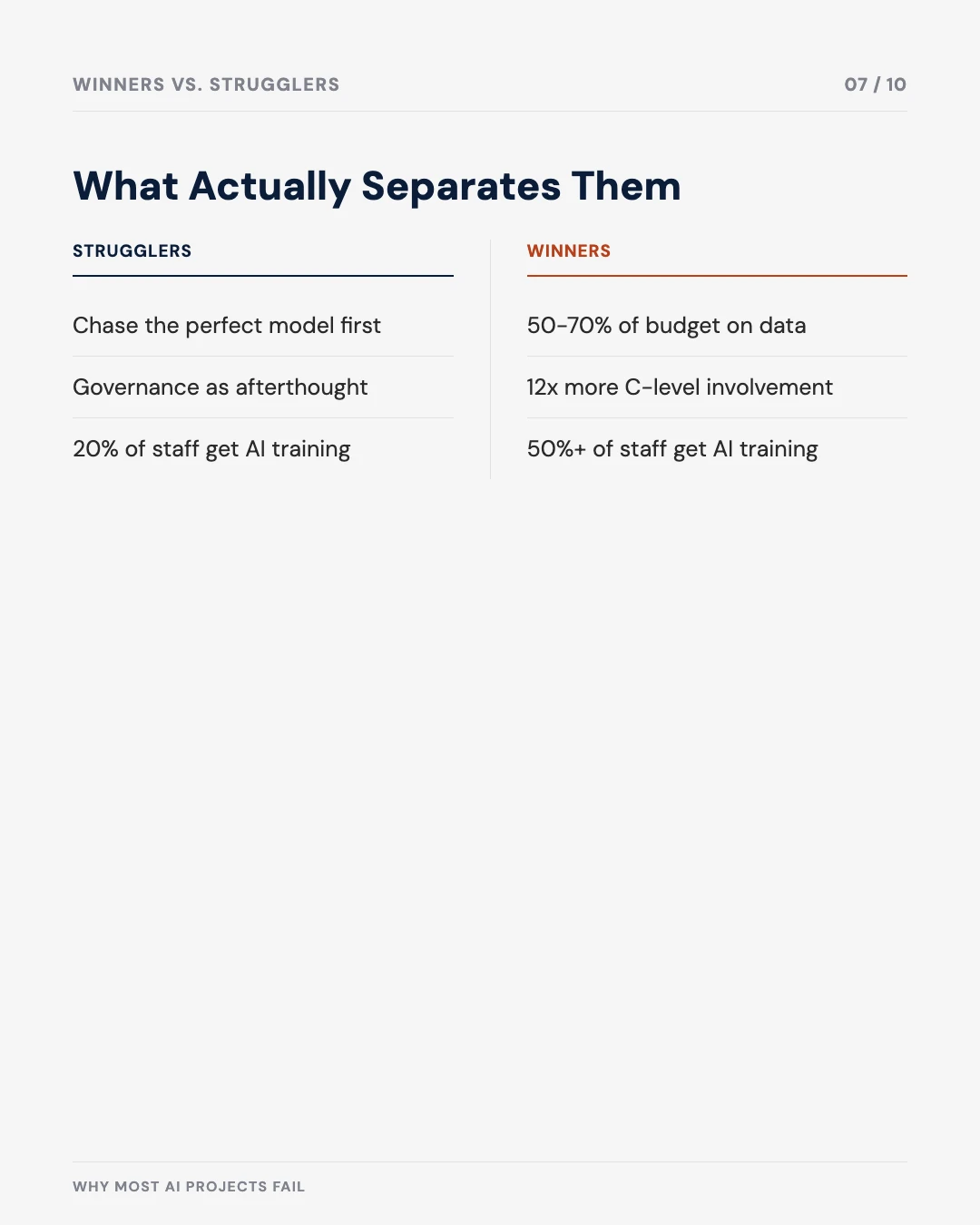
- Winning organisations spend 50-70% of their AI budget and timeline on data readiness before touching model selection. Losing organisations do the opposite.
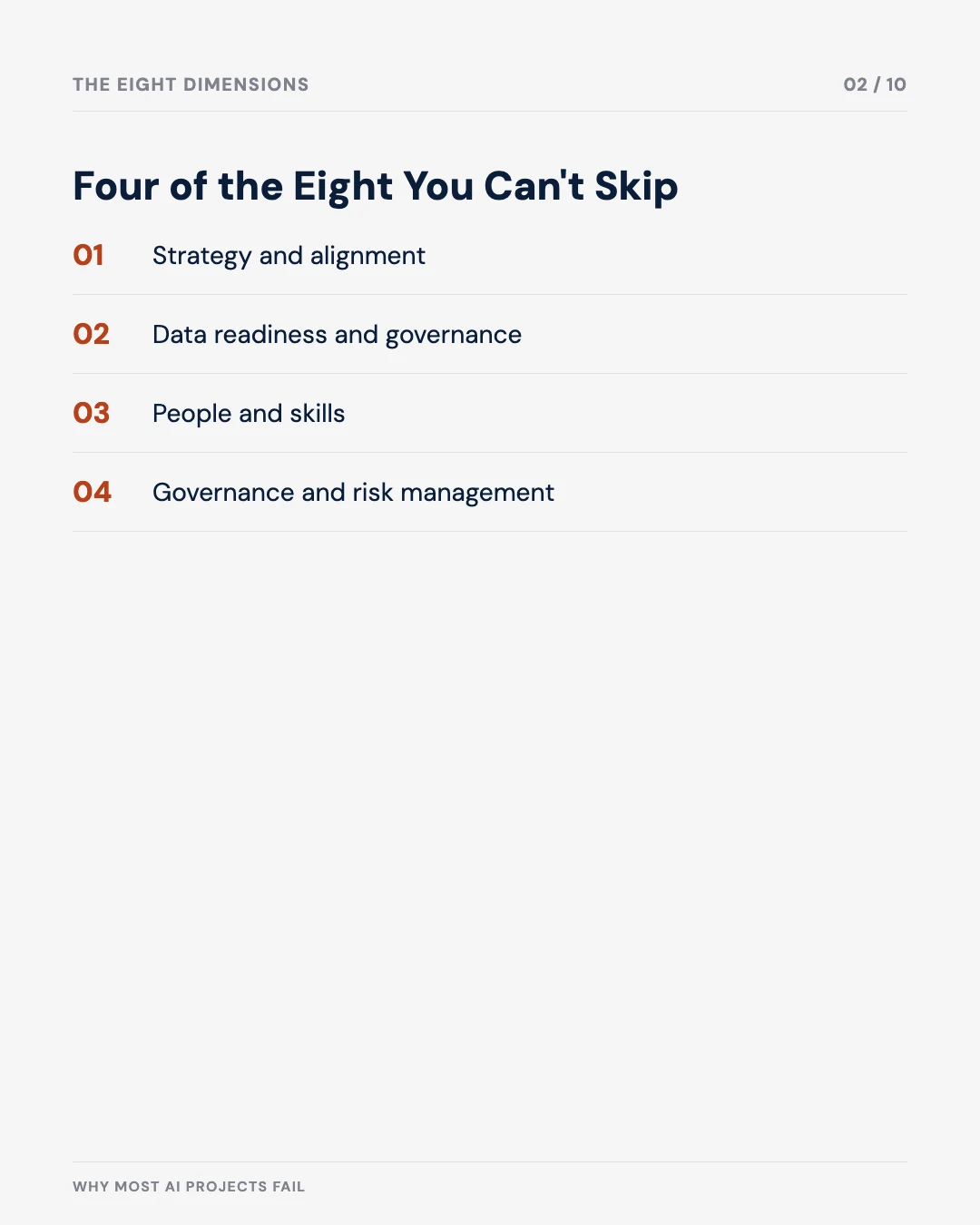
- AI maturity spans eight dimensions (strategy, data, infrastructure, people, culture, governance, process, ethics), and organisations can’t skip stages: deploying production AI without “Defined” maturity across all eight is building on sand.
- The fix is treating AI as an operational transformation, not a tech adoption exercise: aligned incentives, governance, data infrastructure, and continuous investment in people.
The eight dimensions, in ten slides
Save it, share it, or send it to whoever owns the AI budget.
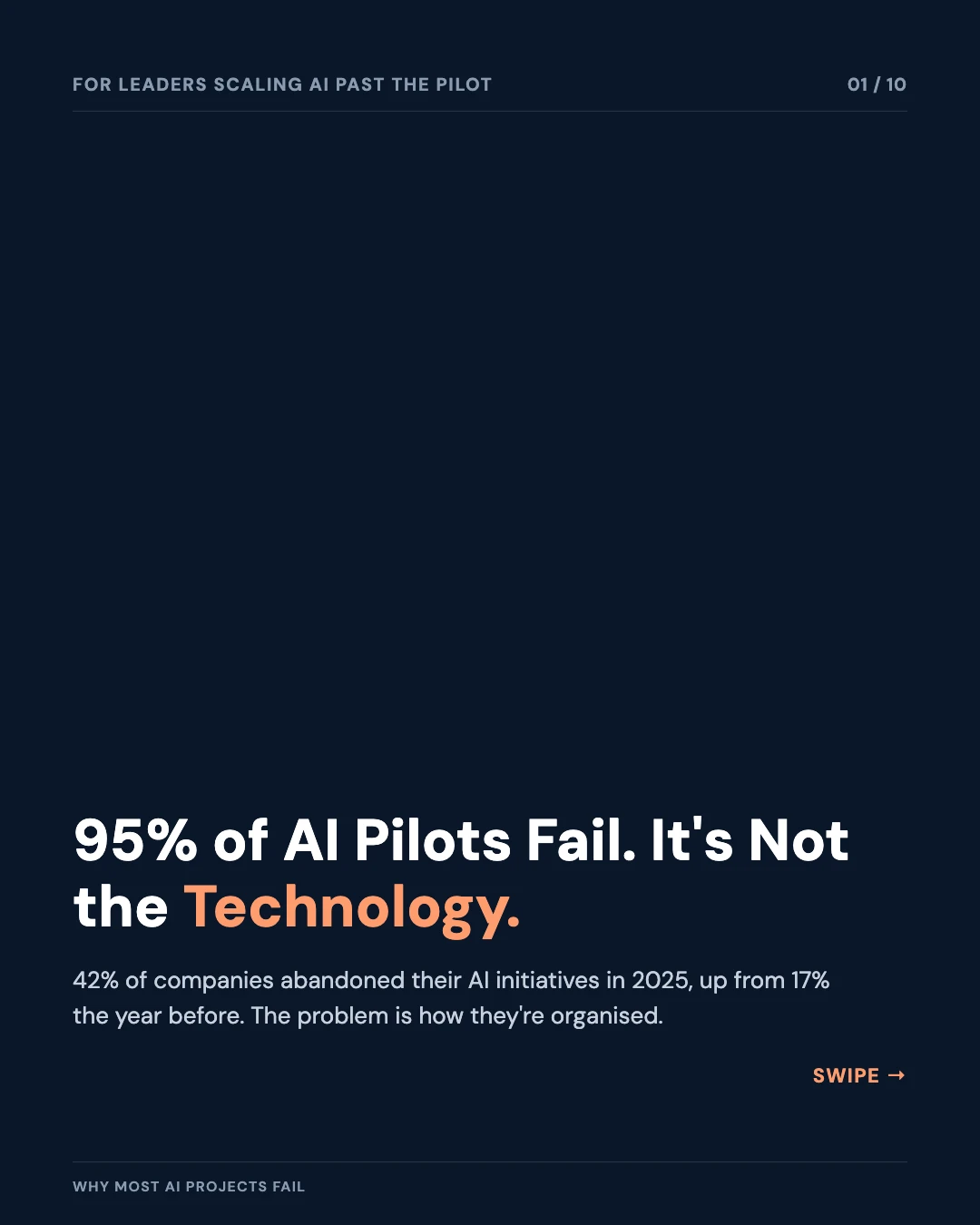

Most AI projects don’t work out. We’re talking 95% of enterprise AI pilots delivering basically zero ROI.
And it’s getting worse. In 2025, 42% of companies threw in the towel on their AI initiatives altogether, up from just 17% the year before.
The tech isn’t broken. The models work. The infrastructure is there. The problem is us, or more specifically, how we’re set up to use AI.
The problem is how you’re organised, not fear.
Sure, people talk about “fear of AI” holding back adoption. But that’s missing the point. You can’t workshop your way out of this with team-building exercises and motivational speeches. The issue is structural misalignment across your organization.
Think about it: if your data is a mess, your teams work in silos, and nobody’s clear on what AI is supposed to achieve, all the enthusiasm in the world won’t save your project.
Why AI Projects Fail
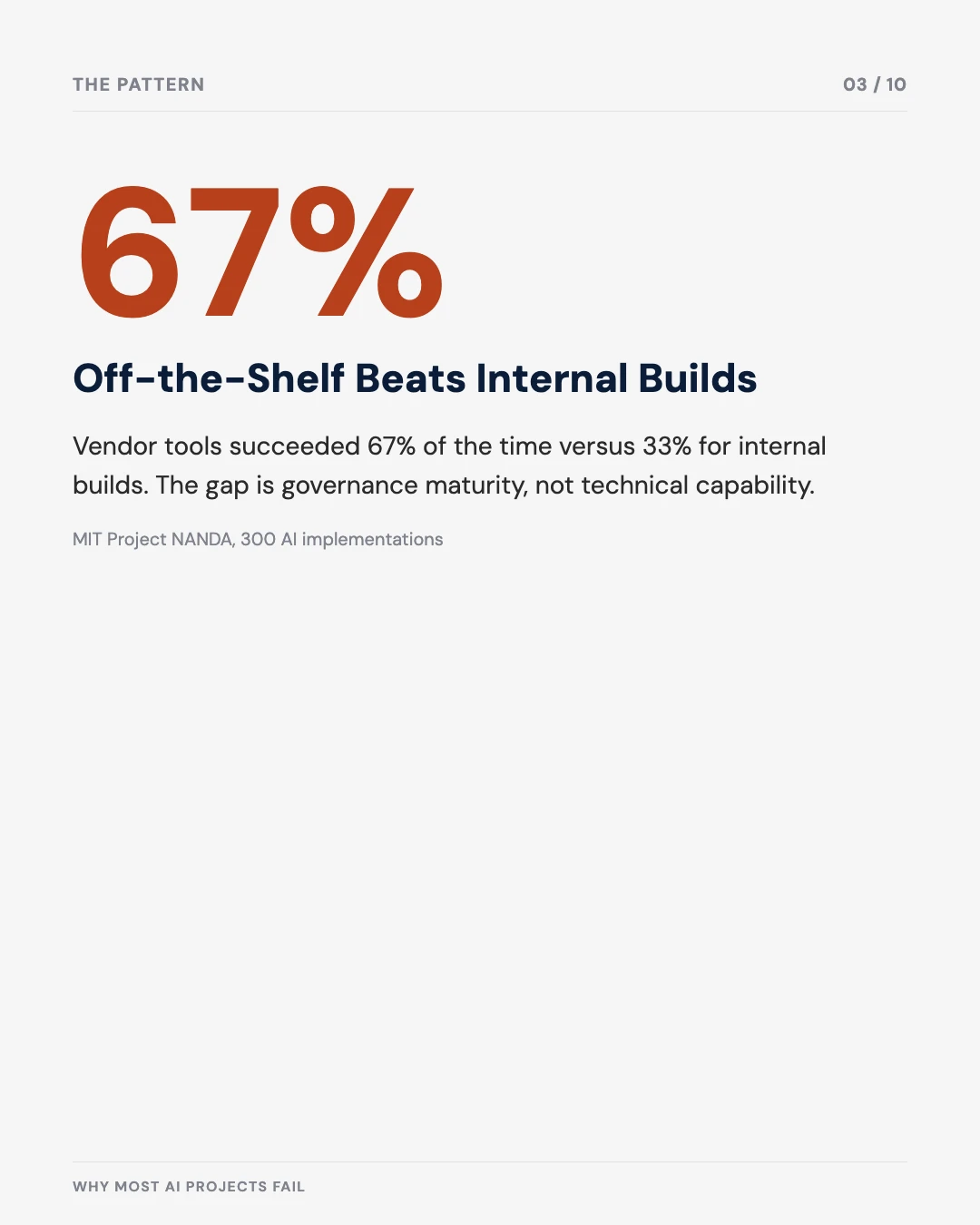
MIT’s Project NANDA looked at 300 AI implementations and found something interesting. Companies using off-the-shelf vendor tools succeeded about 67% of the time, while internal builds only made it to production 33% of the time. The difference was governance maturity, not technical capability.
Here’s the pattern: tools like ChatGPT are amazing for individual use because they don’t need to play nice with your legacy systems, custom workflows, or compliance frameworks. But in enterprise settings, these same tools hit a wall. They can’t adapt to your specific needs, can’t integrate with your fragmented data, and don’t fit into your governance structure.
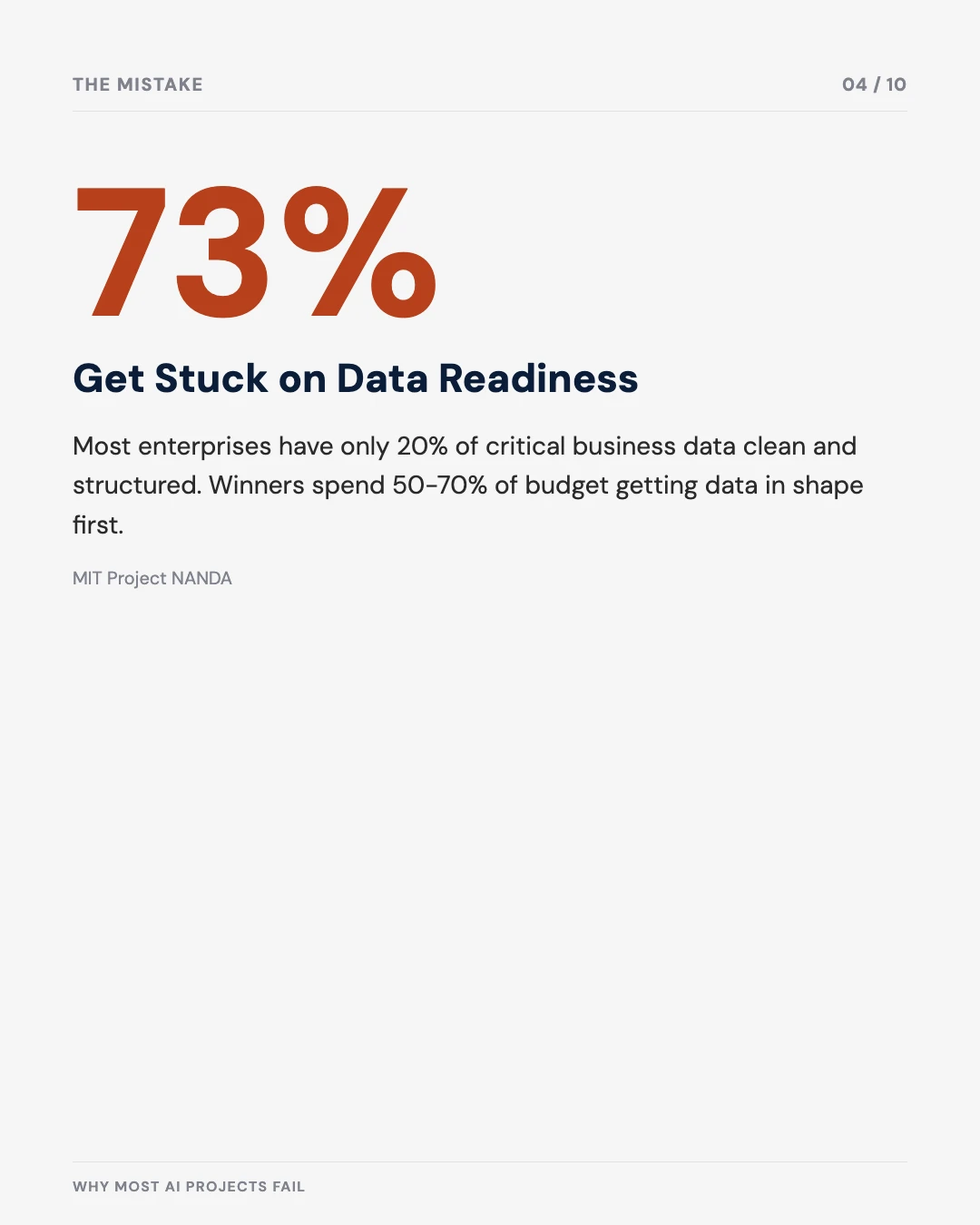
And here’s a critical mistake most companies make: they spend too much time picking the perfect model and not enough time on data readiness. The winners? They allocate 50-70% of their timeline and budget to getting their data in shape: extraction, quality checks, governance. Companies that fail put all their energy into infrastructure and model selection.
The 8 Things You Need to Get Right
1. Strategy and Alignment
Stop with the “let’s do AI because everyone else is.” Get specific. What problem are you solving? What does success look like in numbers? If you can’t articulate measurable outcomes, you’re building a solution in search of a problem.
2. Data Readiness and Governance
This is where 73% of companies get stuck. Most enterprises only have 20% of their critical business data in clean, structured databases. The other 80%? Buried in emails, documents, PDFs, and random systems. You need to spend 3-6 months just figuring out what data you have, where it lives, and what shape it’s in before you can do anything meaningful with AI. This is the exact lesson behind Stop Tuning Prompts. Start Cleaning Data.
3. Technology Infrastructure
Your systems need to support modern AI deployment: think containers, version control, monitoring, and hybrid cloud setups. Your legacy tech isn’t a blocker, but it does determine how you’ll need to implement AI.
4. People and Skills
You need three types of people: technical folks (data engineers, ML engineers), domain experts who understand the business problem, and change management specialists. And here’s a reality check: about 40% of your current workforce will need reskilling in the next three years. Budget for it or fail because of it.
5. Culture and Reinforcement
Incentive structures decide this. If your performance reviews penalize people for trying new workflows, if your departments won’t share data with each other, if you reward “the way we’ve always done it,” AI won’t stick. These are operational problems requiring process redesign, not communication campaigns.
6. Governance and Risk Management
Frameworks like NIST AI RMF aren’t bureaucratic overhead. They’re how you scale AI without blowing up. You need cross-functional governance with technical, legal, and ethics representatives to make sure AI initiatives don’t go rogue.
7. Processes and Change Management
Use proven change management frameworks such as ADKAR (a five-step model for guiding people through change: awareness, desire, knowledge, ability, reinforcement) or Prosci’s related methodology to document how you’ll adopt AI, train people, and measure success. Companies that do this see 3x better ROI on AI investments.
8. Ethics and Compliance
Bias testing, fairness checks, privacy controls, audit trails: these aren’t nice-to-haves once you’re at scale. Early pilots can be scrappy, but production systems need this stuff built in.
You Can’t Skip Levels
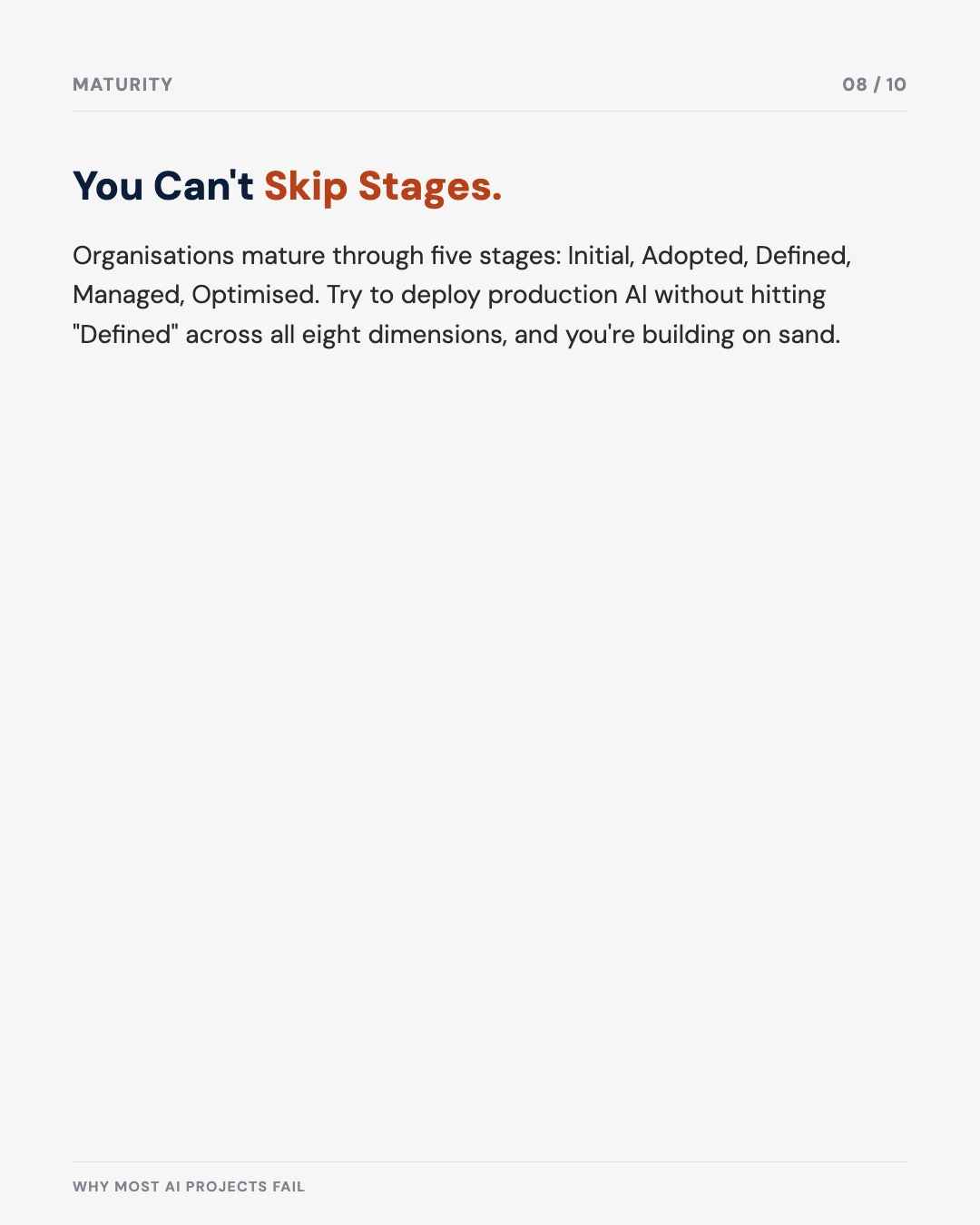
Organizations mature through five stages: Initial (reactive, inconsistent), Adopted (starting to apply practices), Defined (standardized processes), Managed (metrics-driven), and Optimized (institutional scale).
You can’t skip stages. If you try to deploy production AI without hitting “Defined” maturity across all eight dimensions, you’re building on sand.
What Works
Companies succeeding with AI do things differently:
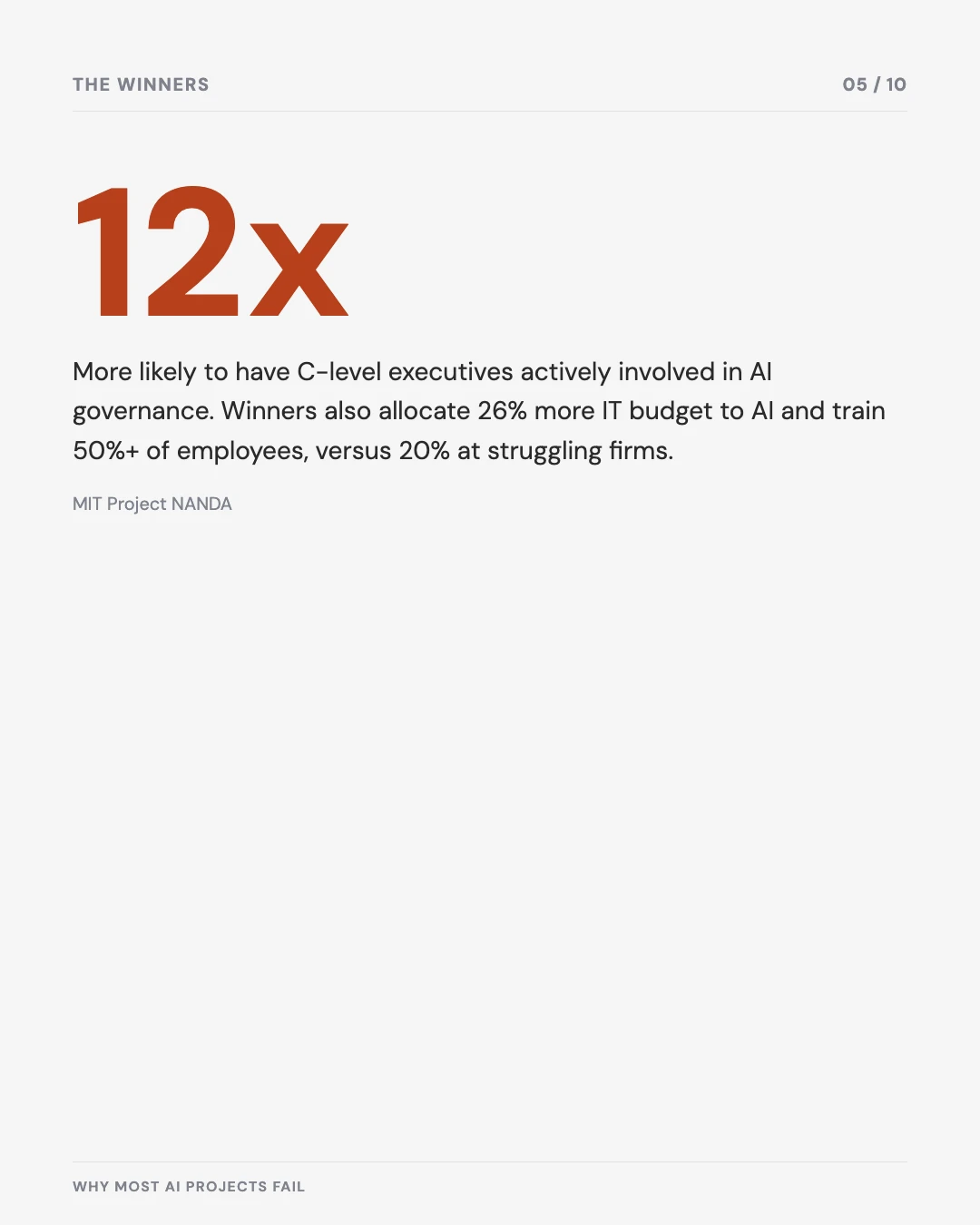
- They allocate 26% more IT budget to AI than laggards
- They’re 12x more likely to have C-level executives actively involved in AI governance
- 50% or more of their employees get AI training (versus 20% at struggling companies)
- They design AI to augment humans, not replace them, and deploy 5x more AI workflows at scale
- They measure ROI across four dimensions: efficiency, revenue, risk mitigation, and business agility, not just one metric
Deal with the Real Employee Concerns
Here’s what people worry about. 37% fear that relying on AI will erode their professional skills, and 64% think AI will just add to their workload.
And only 12% get adequate training to offset either worry.
Give people protected time to learn: that’s what fixes this. Build AI skills into performance reviews. Clarify how AI amplifies their expertise.
And about that shadow AI problem (23-58% of employees using unapproved AI tools)? It happens because you haven’t given them approved options with clear policies. Solve it with integration and clear guidelines. I go deeper on the scale of this specific risk in Shadow AI Is Already Inside Your Organisation.
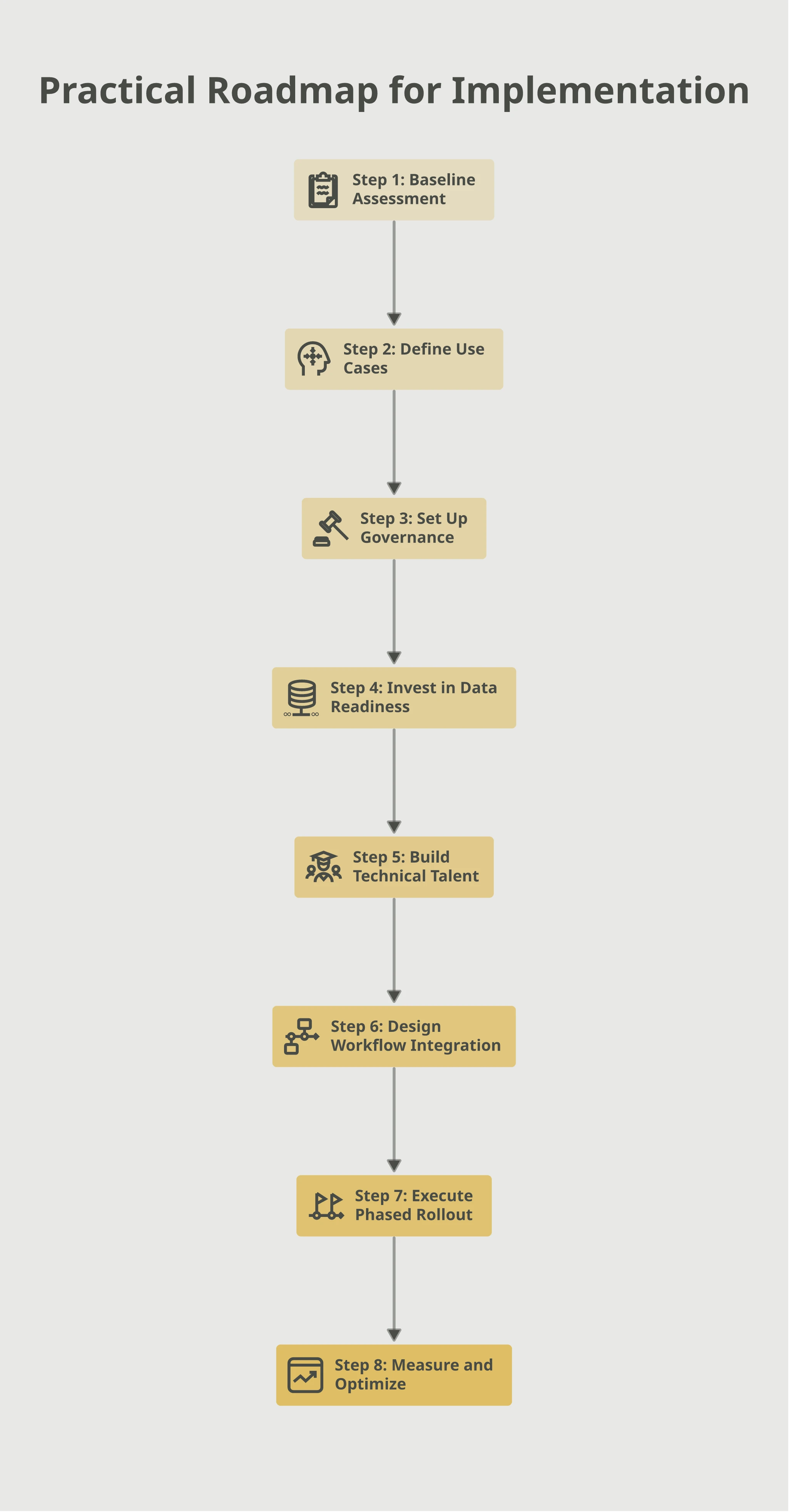
Your Practical Roadmap
- Run a baseline assessment across all eight dimensions. Use frameworks like MITRE AI Maturity Model to identify gaps.
- Define specific use cases with measurable outcomes tied to business strategy. Prioritize by impact and data readiness.
- Set up governance with clear ownership, approval processes, and published policies.
- Invest heavily in data readiness: 50-70% of your resources should go here.
- Build your technical talent through recruiting and training across data engineering, domain expertise, and change management.
- Design workflow integration with clear KPIs and continuous monitoring.
- Execute a phased rollout using structured change management frameworks.
- Measure continuously and optimize. Track early productivity indicators separately from actual financial results.
Operational maturity decides the outcome
95% of AI pilots fail because organizations try to deploy AI without the operational maturity to support it, not because the technology isn’t ready or people are scared.
Operational readiness decides this: aligned incentives, solid governance, quality data infrastructure, and trained people. Psychological safety and motivational programs don’t move any of those.
The companies moving AI from pilot to production treat it like the operational transformation it is. They put their money where the actual work is: data readiness and governance. They embed change management from day one. They measure ROI holistically. And they invest in their people continuously.
That’s what separates the winners from the 95%.
Evidence & Methodology
This piece leans on one strong study and a lot of supporting numbers I have not individually re-traced. Here is the one I would defend under cross-examination, and the ones I would not.
| Claim | Source | Grade |
|---|---|---|
| Off-the-shelf tools succeed roughly 67% of the time versus 33% for internal builds, across 300 AI implementations | MIT Project NANDA’s 2025 State of AI in Business report | Measured |
| 42% of companies abandoned AI initiatives in 2025, up from 17% the year before | Not tied to the source below or any other citation in this post | Unsourced |
| Winners allocate 50-70% of their budget and timeline to data readiness before model selection | Presented as a finding here, not attributed to a specific study | Unsourced |
| The eight-dimension maturity model itself (strategy, data, infrastructure, people, culture, governance, process, ethics) | My own synthesis, not a published academic framework | My framework |
Sources
- Challapally, Pease, Raskar & Chari (MIT Project NANDA). (2025). The GenAI divide: State of AI in business 2025.
Free tool
Organisational AI Readiness Quiz
Run the baseline assessment this piece calls for across the same territory as the eight-dimension model: Data, Process, Technology, People, and Governance, with a tiered roadmap out.