
Executive Summary
AI transformation is failing for the same structural reason cloud, agile, RPA, and blockchain initiatives did before it: organisations suspend discipline in response to ambition, not because the technology doesn’t work.
Core conclusions
- Three structural requirements separate AI programmes that scale from those that stall: enterprise-level infrastructure instead of siloed initiatives, a locked-scope delivery cadence, and culture treated as structural design rather than communications.
- Fragmented AI creates risk that conventional software doesn’t: duplicated infrastructure, inconsistent controls, and regulatory exposure that accumulates invisibly until something goes wrong.
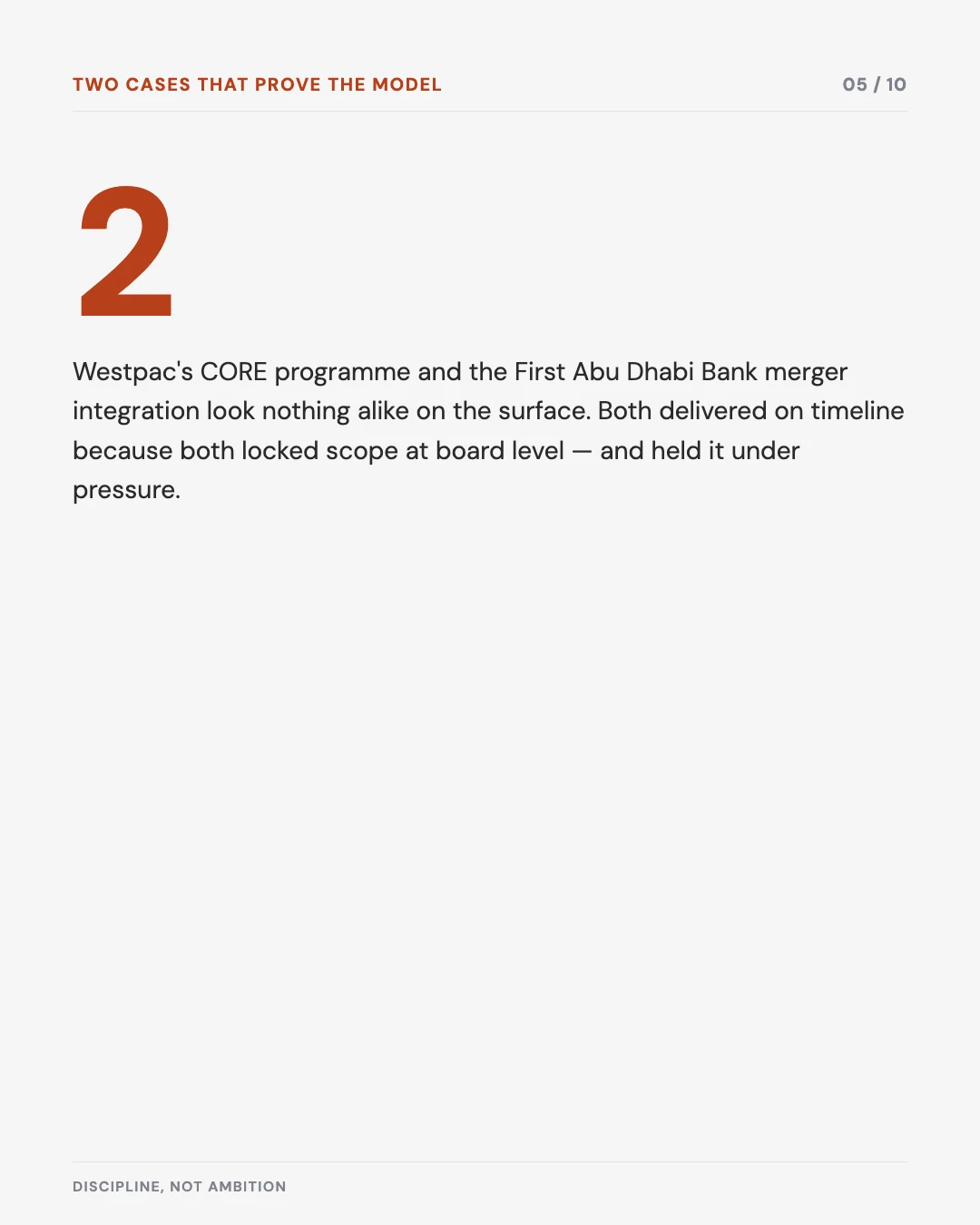
- Westpac’s CORE programme and the First Abu Dhabi Bank merger integration both show that discipline is what makes ambition achievable, not a constraint on it.
The case for discipline, in ten slides
Save it, share it, or send it to whoever’s about to greenlight another AI pilot without an architecture behind it.
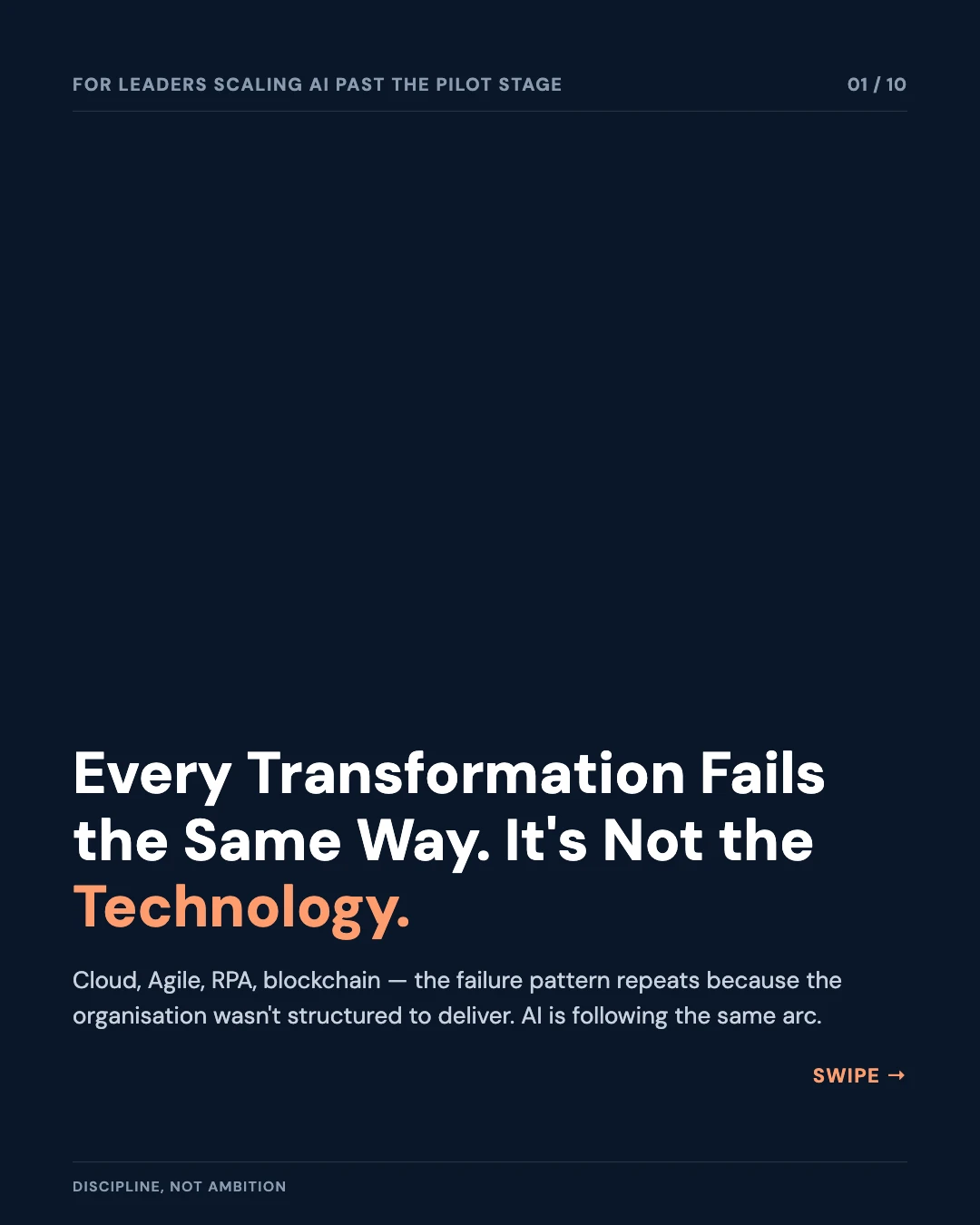
Every major technology cycle produces the same failure pattern. Companies announce ambitious programmes. Resources are committed. Announcements are made. And then, somewhere between the press release and production, the initiative loses momentum, not because the technology did not work, but because the organisation was not structured to deliver it.
Cloud transformation produced hundreds of half-migrated estates running hybrid architectures that were never intended to be permanent. Agile adoption created organisations where every team ran sprints but no one had a coherent delivery plan. RPA programmes left fragile bot estates that nobody owned. Blockchain initiatives produced proofs of concept that never became products.
AI is following the same arc. The technology is more capable than anything that came before it. The failure modes are identical.
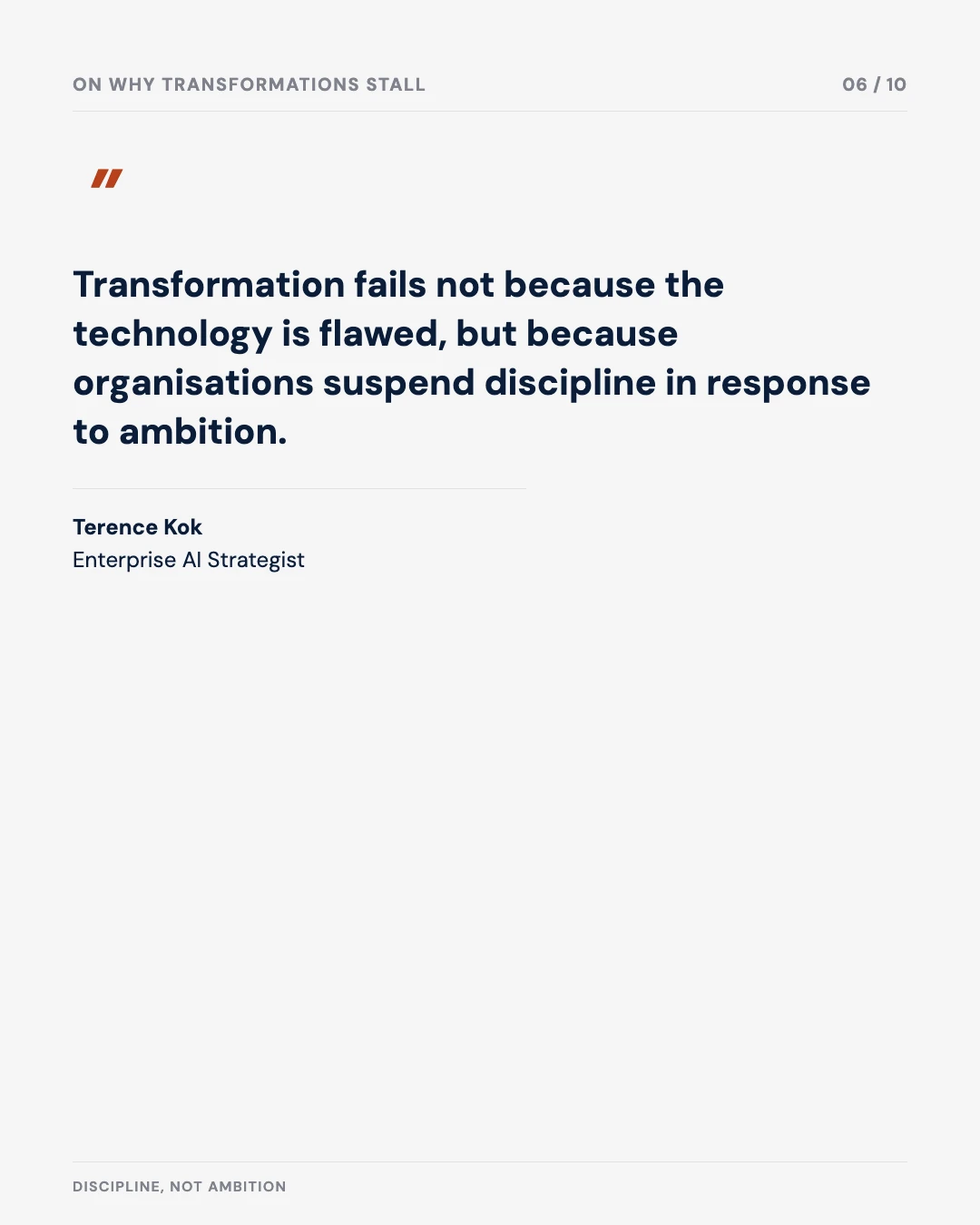
Transformation fails not because the technology is flawed, but because organisations suspend discipline in response to ambition.
The pattern that repeats
When a technology generates enough executive attention, organisations enter a mode that prioritises visible activity over strategic foundation. Pilots multiply. Teams are tasked with “exploring AI.” Vendor relationships are signed before use cases are defined. Each business unit pursues its own approach, and the organisation accumulates a fragmented portfolio of initiatives that do not add up to capability.
The pattern is recognisable because it has happened before. The organisations that extracted durable value from Cloud, from Agile, from digital transformation broadly, were not the ones that moved fastest. They were the ones that designed the transformation architecture before building on top of it, and held to that design under pressure.
AI requires the same discipline. The difference is that the stakes of getting it wrong are higher. Fragmented AI implementations across business units create duplicated infrastructure, inconsistent governance controls, incompatible data practices, and regulatory exposure that accumulates in ways that are not visible until something goes wrong. Architecture and controls that should have been designed upfront must be retrofitted (at significantly greater cost and risk) or left unaddressed.
What disciplined transformation looks like
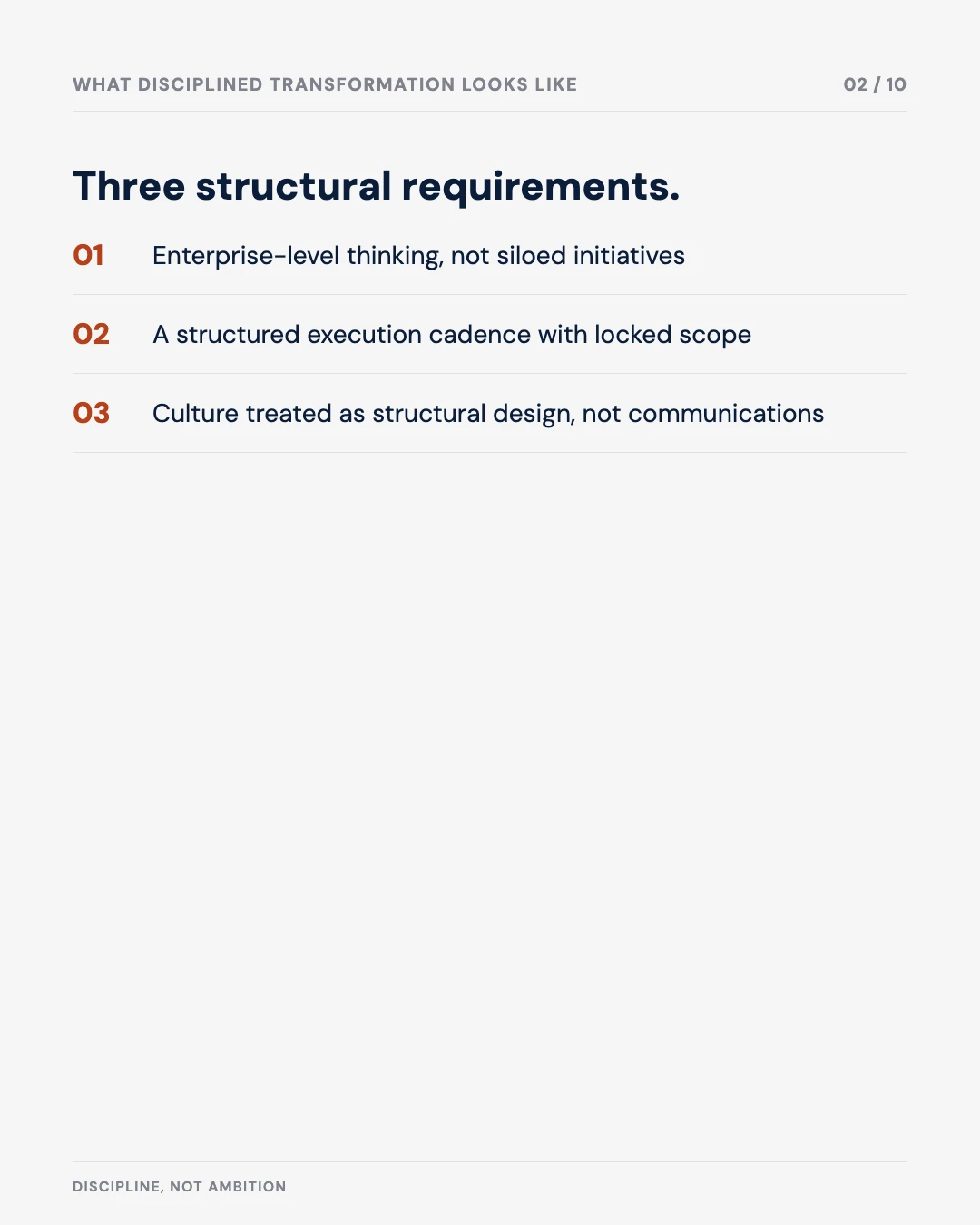
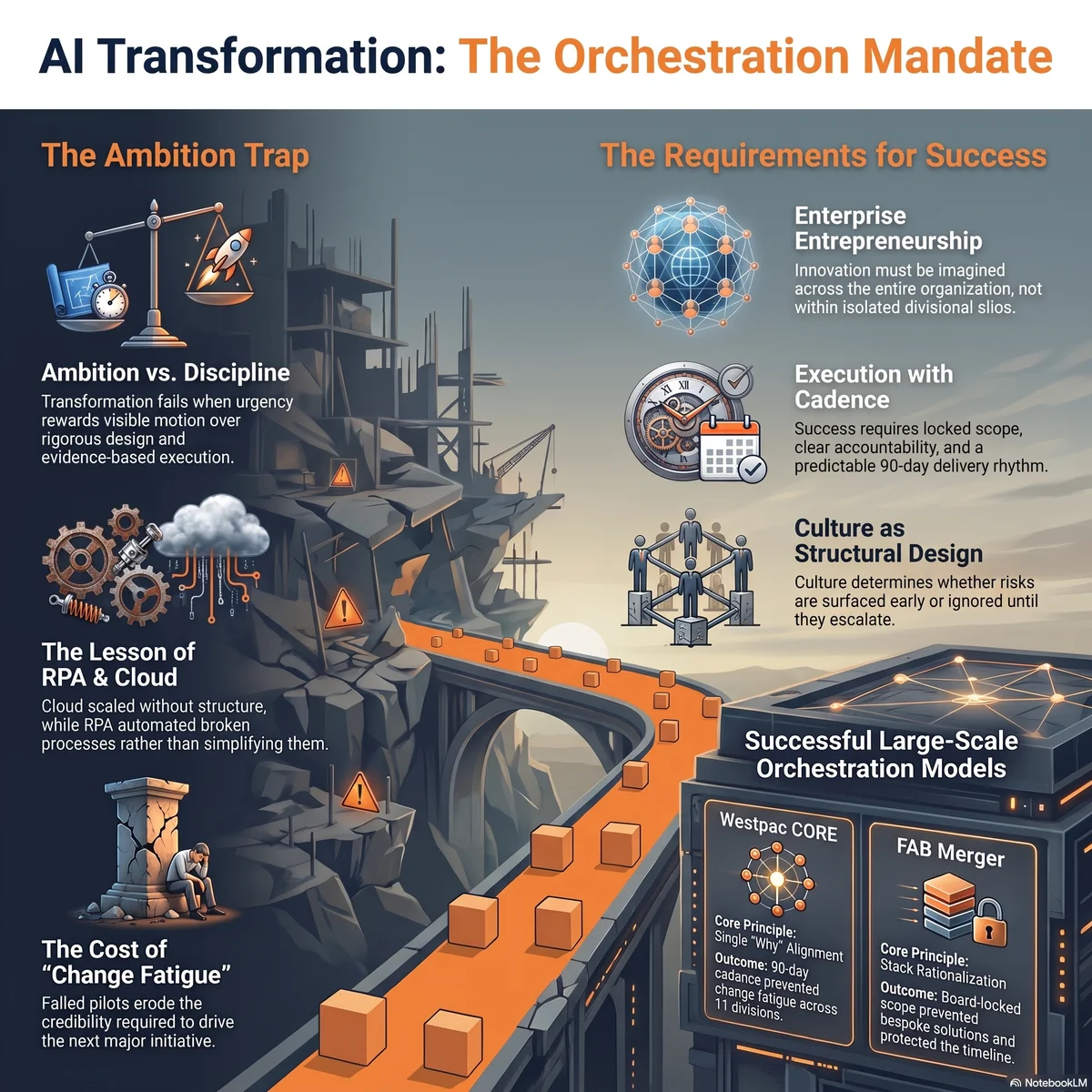
Three structural requirements distinguish AI programmes that scale from those that stall.
Enterprise-level thinking, not siloed initiatives. AI value compounds when it is built on shared infrastructure: common data platforms, shared governance frameworks, reusable model components. Organisations that allow each business unit to run independent AI programmes forfeit that compounding effect. The unit economics of siloed AI look attractive on a department P&L and destructive on an enterprise balance sheet. The decision about where AI runs and on what infrastructure is an enterprise architecture decision, not a department procurement decision.
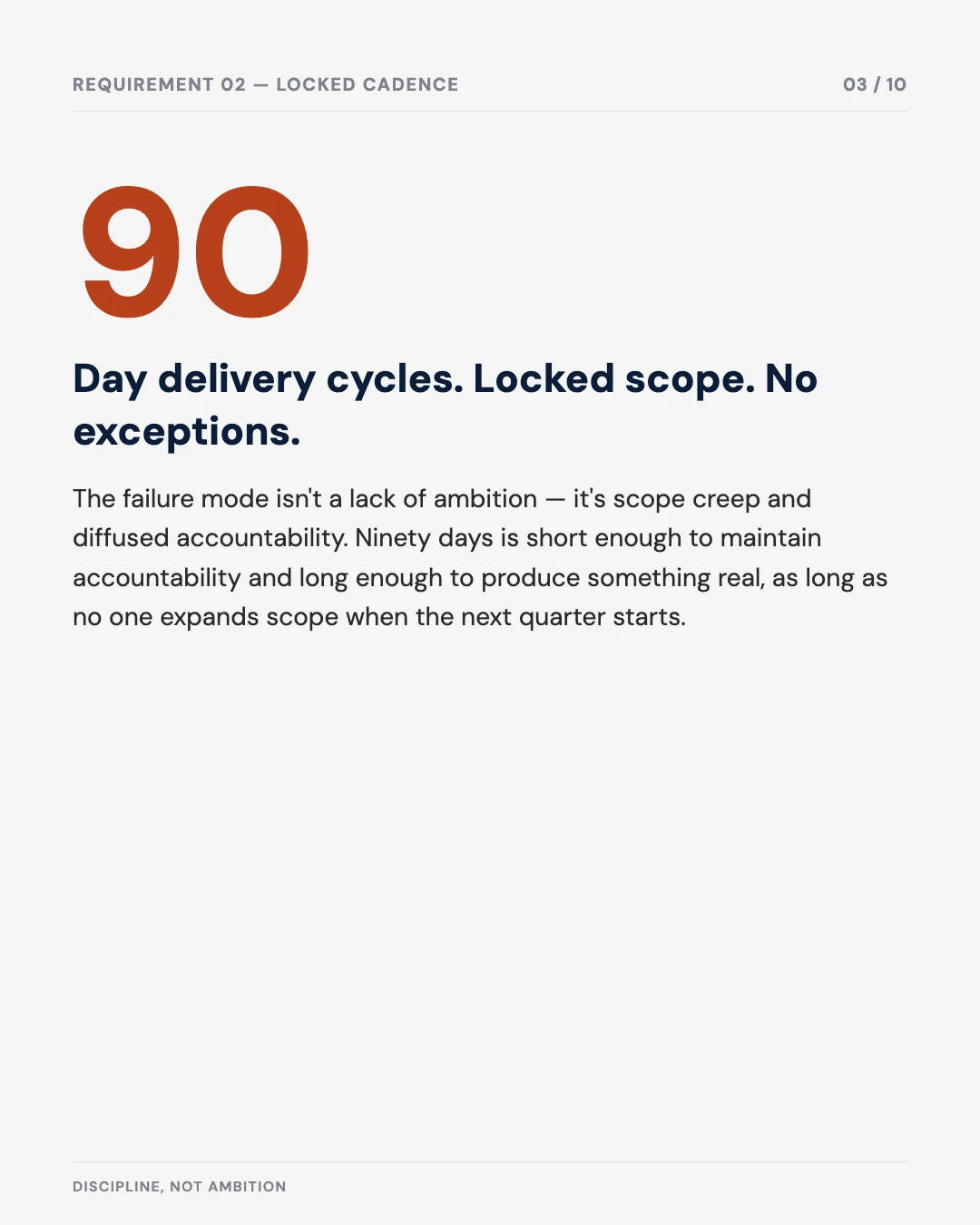
A structured execution cadence with locked scope. The failure mode in most transformation programmes is not a lack of ambition. It is scope creep and accountability diffusion. Workstreams expand. Timelines extend. Ownership becomes unclear. The antidote is a locked delivery cadence: fixed scope for each phase, defined deliverables, clear owners, and a governance structure with the authority to enforce constraints. Ninety-day delivery cycles work because they are short enough to maintain accountability and long enough to produce meaningful output. What they require is the discipline to not expand scope when the next quarter begins.
Culture treated as structural design, not communications. Most transformation programmes address culture through communications: town halls, leadership messaging, change management workshops. These are necessary and insufficient. Culture in a transformation context means the operating model: who has decision rights, what behaviours are rewarded, how disagreement is surfaced and resolved, what metrics people are held to. Changing culture means changing those structural elements. Communications reinforce the change; they do not produce it.
Two cases that demonstrate the model
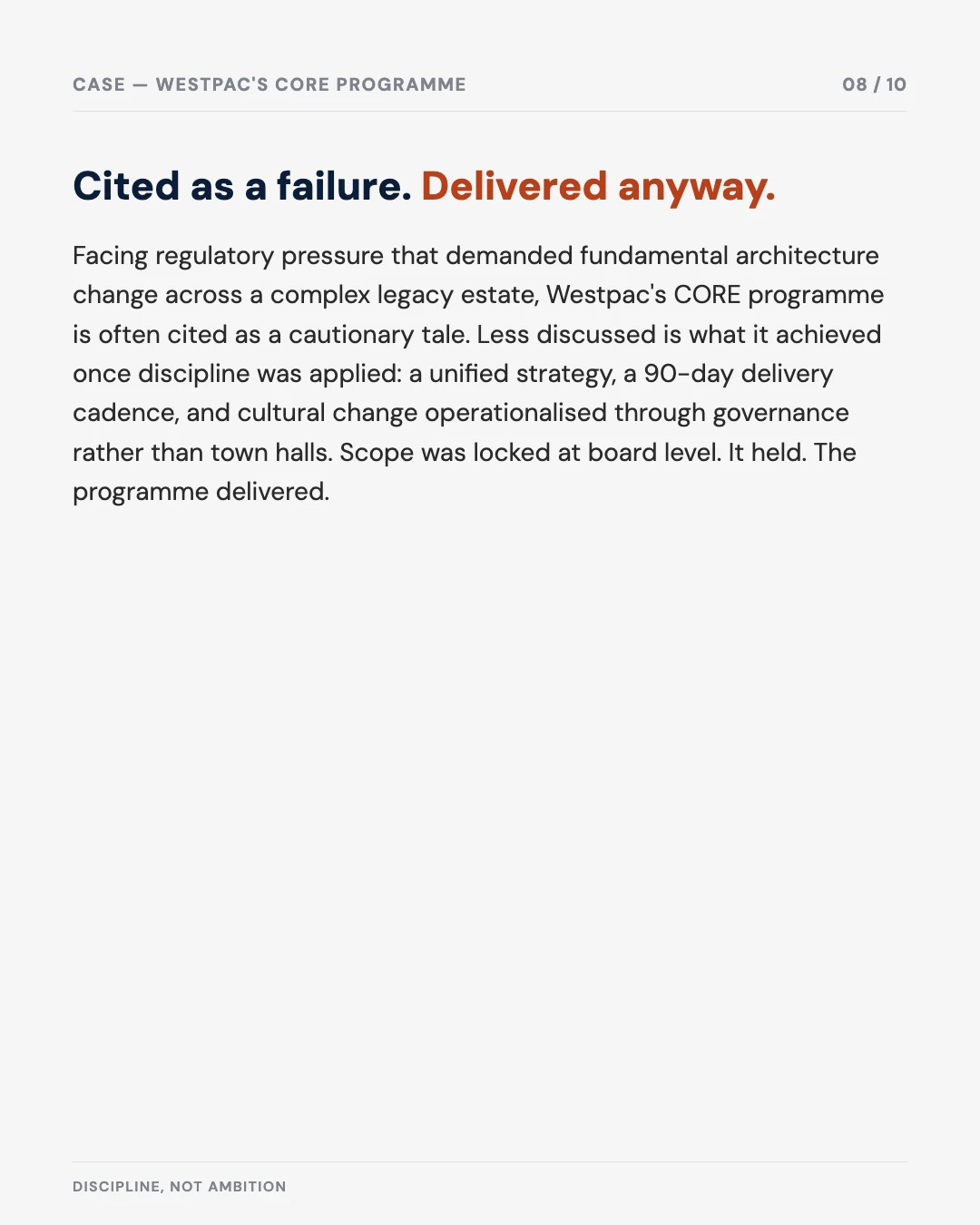
Westpac’s CORE programme is frequently cited as a case study in transformation failure. Less frequently cited is what the programme achieved when the discipline was applied. Facing regulatory pressure that required fundamental architecture change across a complex legacy estate, the programme was restructured around a unified strategy, a 90-day delivery cadence, and a deliberate effort to operationalise cultural change through governance structures rather than communications alone. The scope was locked at board level and held. The programme delivered.
The First Abu Dhabi Bank merger integration provides a contrasting case from a different context. A merger of two large banks, each with its own technology estate, is one of the most complex transformation scenarios in financial services. The FAB integration was treated from the outset as an architecture rationalisation exercise rather than a systems consolidation exercise, a framing that matters because it changes what decisions get made at what level. Scope was locked at board level. Constraints were strict. The integration delivered on timeline.
In both cases, the discipline was not the constraint on ambition. It was what made ambition achievable.
The AI-specific risk
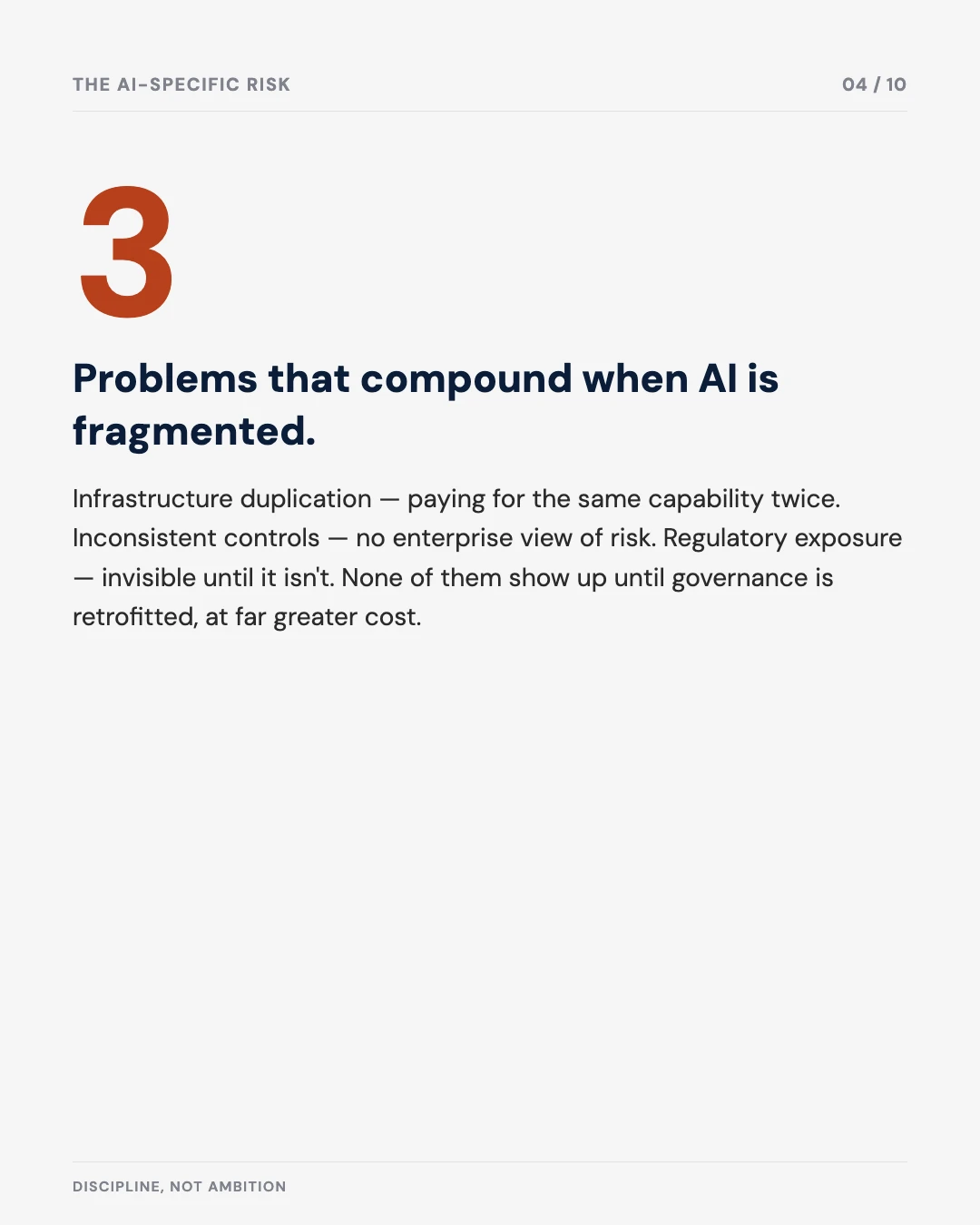
Fragmented AI creates a category of risk that does not exist in the same way with conventional software. When teams independently deploy AI systems without shared governance, three problems compound.
The first is infrastructure duplication. Each team builds or procures its own AI stack. The organisation pays for the same capability multiple times, with no interoperability between implementations.
The second is inconsistent controls. Different teams apply different standards for bias testing, output validation, human oversight, and audit logging. The organisation’s AI risk profile becomes impossible to assess at an enterprise level because no one has visibility across the portfolio.
The third is regulatory exposure. Regulators assess AI governance at the organisation level. An organisation that cannot demonstrate coherent governance across its AI systems (because those systems were deployed independently without central oversight) is exposed regardless of how well-governed any individual system might be.
The fix is not a governance policy document. It is architecture designed at the outset to support enterprise-level oversight, with the authority structures to enforce it.
From pilots to platforms
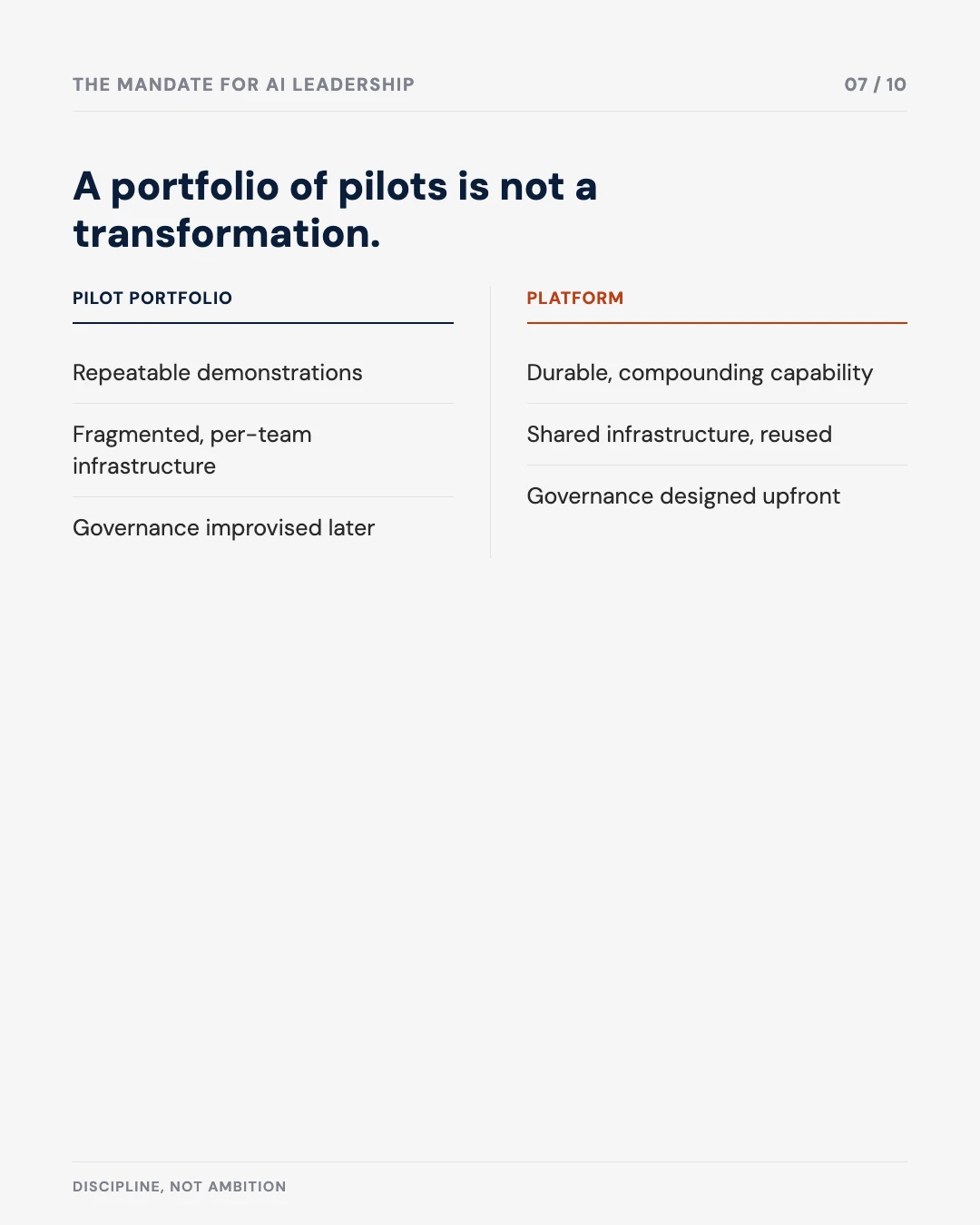
The mandate for AI leadership is to convert pilots into platforms, activity into capability, and ambition into traceable advantage.
Pilots are necessary. They establish feasibility, build organisational confidence, and generate the learning that informs production design. But a portfolio of pilots is not a transformation. The transition from pilot to platform requires exactly the discipline that the pilot phase tends to defer: shared infrastructure, locked governance, defined accountability, and a delivery cadence that produces durable capability rather than repeatable demonstrations.
The organisations that will extract lasting advantage from AI are not the ones with the most pilots running today. They are the ones building the platform that makes each subsequent deployment faster, cheaper, and more governable than the last.
That requires discipline. And discipline, in a technology cycle this large, is the scarce resource.
Free tool
AI Readiness Self-Assessment
Diagnoses whether the five operational foundations, data, process, governance, team capability, and measurement, are in place before transformation investment is committed.
Free tool
Enterprise AI Value & Adoption Dashboard
The production-stage instrument for tracking the traceable advantage this article calls for, across TCO, AI-influenced revenue, cost savings, and adoption by business unit.
The Four-Question Governance Baseline provides the shared governance structure that must be designed at enterprise level rather than per-deployment.