
Executive Summary
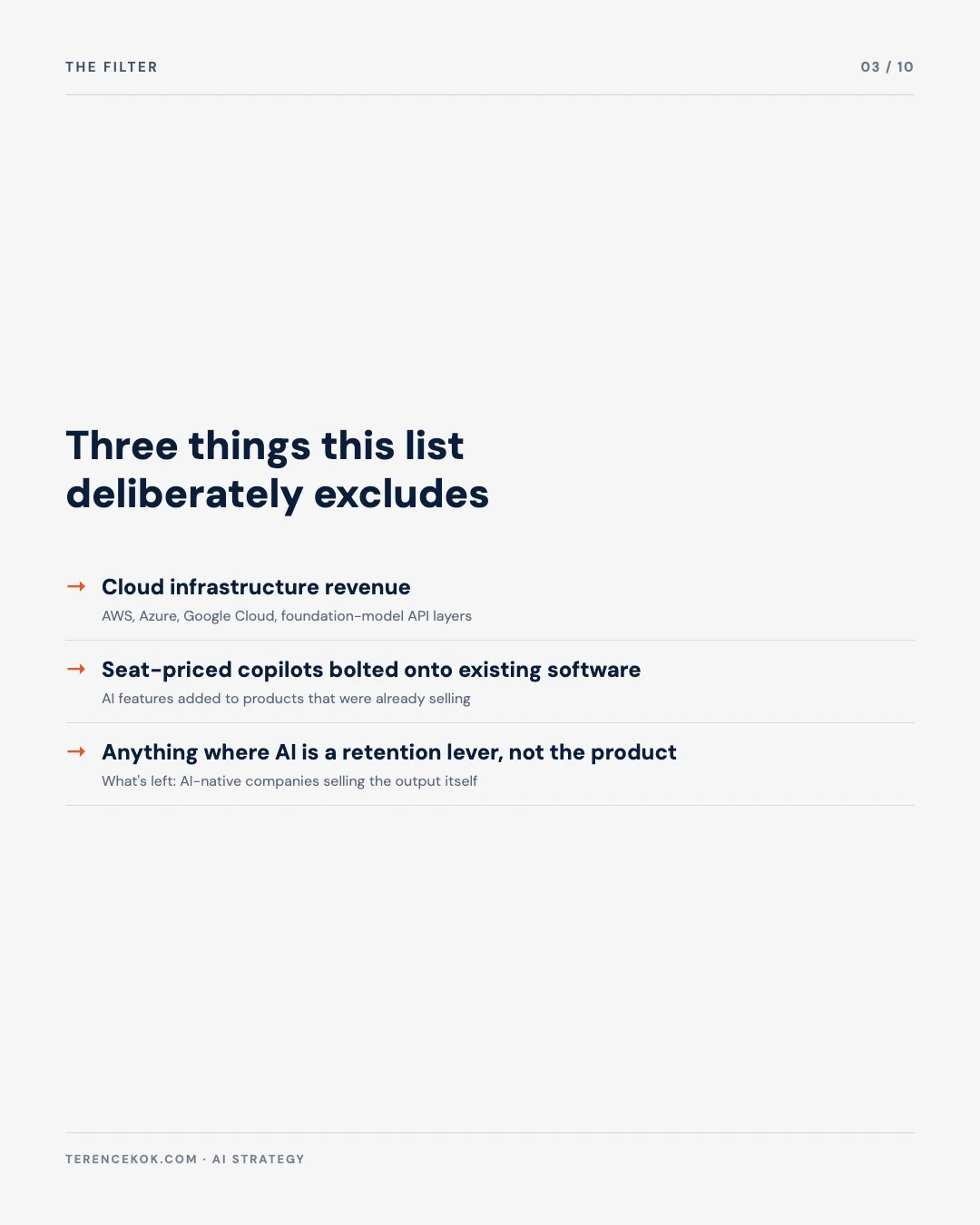
Strip out cloud infrastructure revenue (AWS, Azure, Google Cloud) and strip out AI features bolted onto software that was already selling before generative AI existed (seat-priced copilots, assistant add-ons), and a much smaller, much more interesting list remains: AI-native companies whose entire revenue depends on the AI output itself, in legal work product, clinical documentation, resolved customer tickets, shipped code, generated video and voice. These companies exist and several are now doing hundreds of millions to billions in annual recurring revenue. What they share isn’t their category. It’s how they charge.
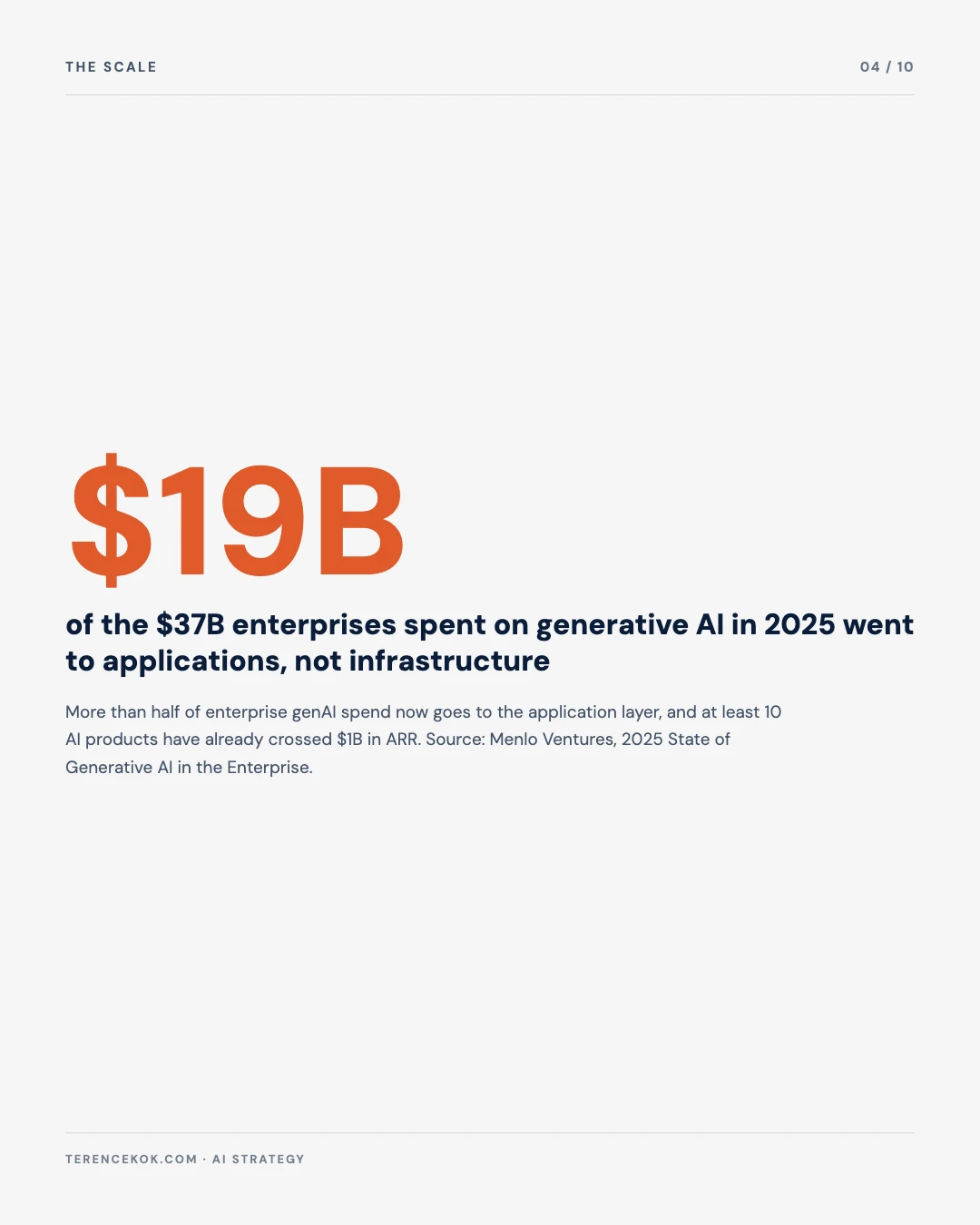
$19B
of the $37B enterprises spent on generative AI in 2025 went to applications, not infrastructure, per Menlo Ventures’ 2025 State of Generative AI in the Enterprise
10+
AI products now generate $1B+ in ARR, and more than 50 have crossed $100M, per the same Menlo Ventures report
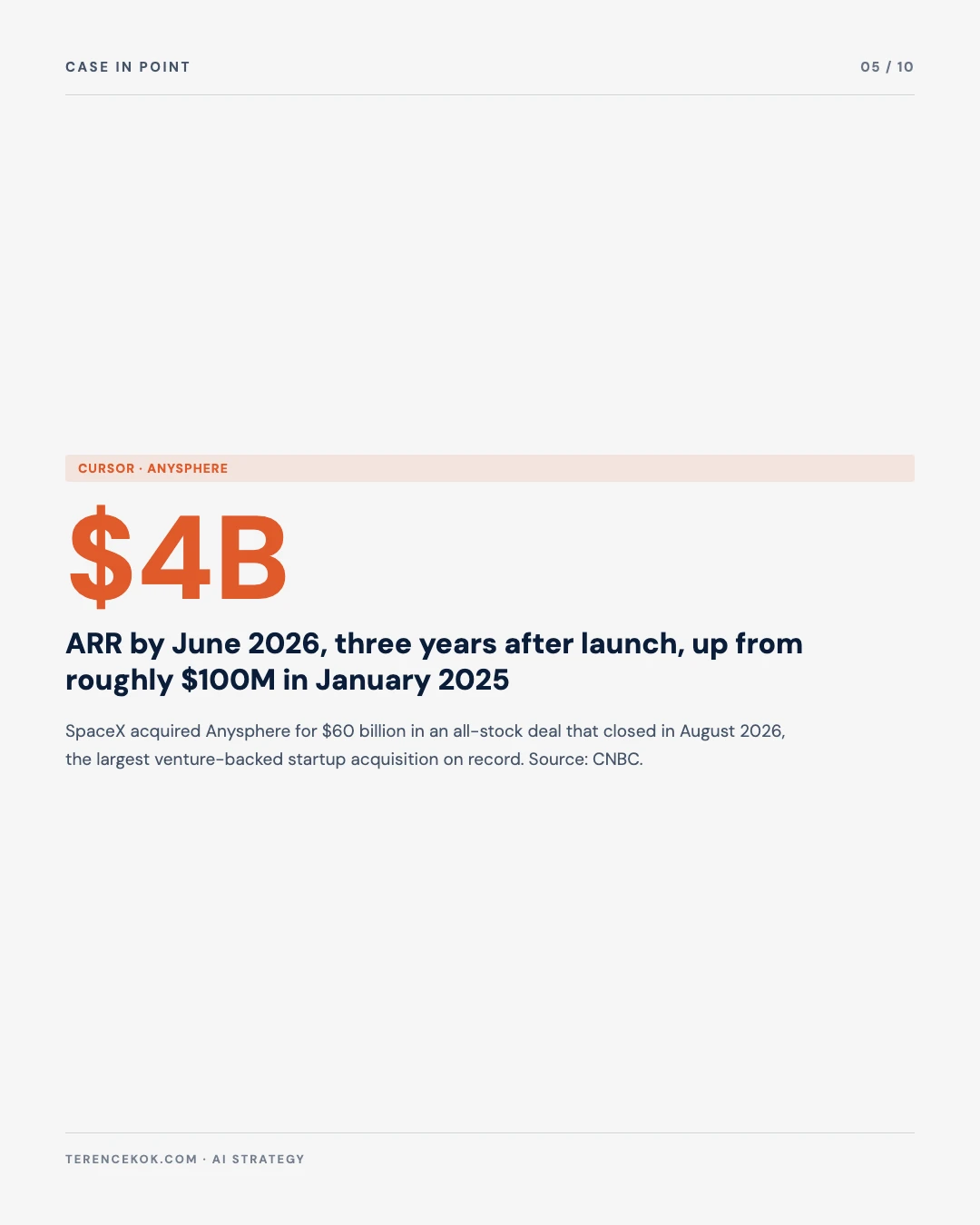
$60B
SpaceX’s all-stock acquisition of Cursor-maker Anysphere, closed August 2026, at roughly $4B ARR, CNBC
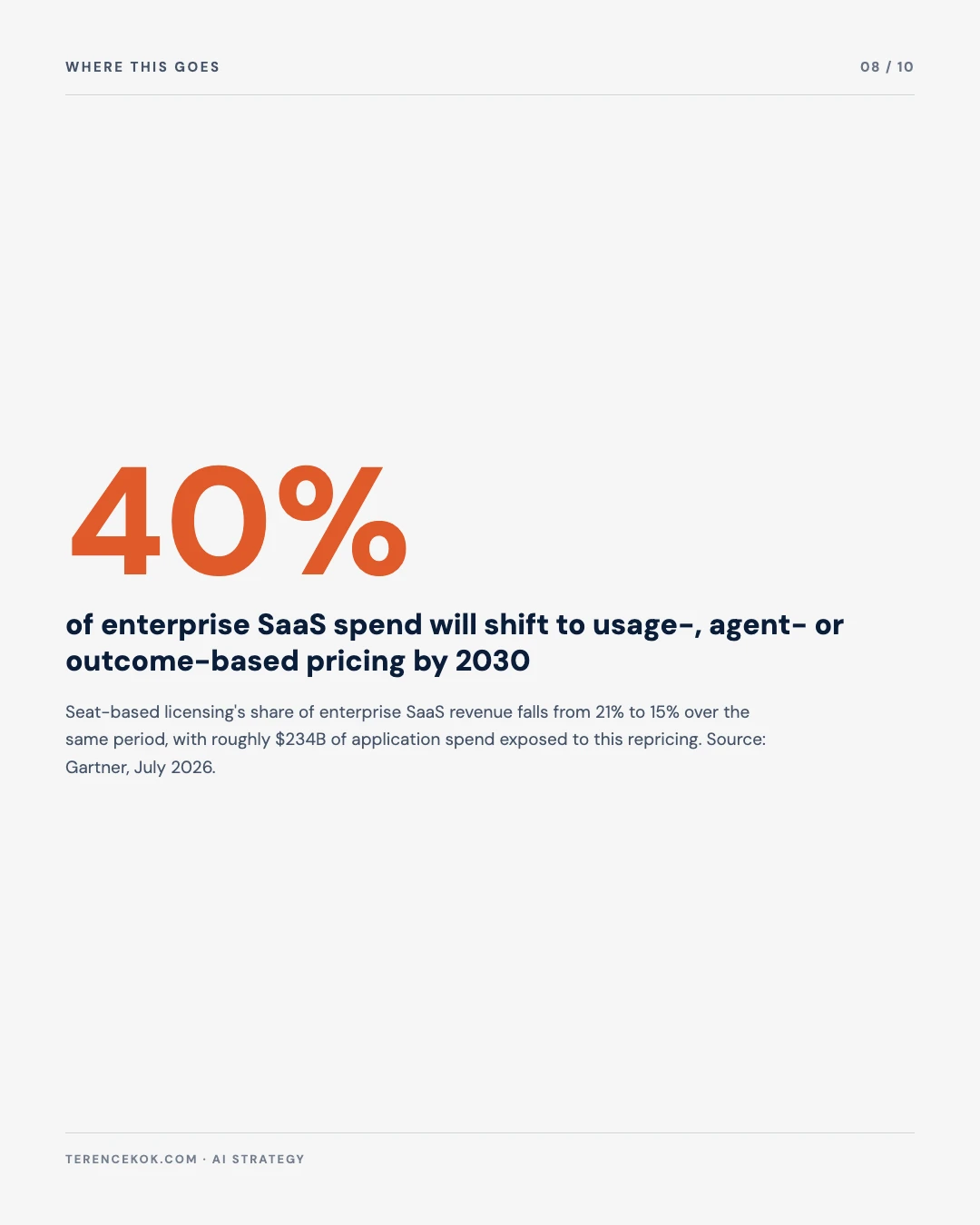
40%
of enterprise SaaS spend Gartner expects to shift to usage-, agent-, or outcome-based pricing by 2030, from seat-based licensing
Core conclusions
- A short list of AI-native companies, none of them hyperscalers, are past $100M to $600M+ ARR by selling the AI output itself, not a productivity add-on.
- Almost every company on that list has abandoned or never adopted per-seat pricing. They charge per document, per resolution, per minute, per encounter, per token.
- Reported ARR in this category is noisy and sometimes gamed, contracted-but-undeployed revenue gets reported as if it were collected. Treat any single headline number as directional, not exact.
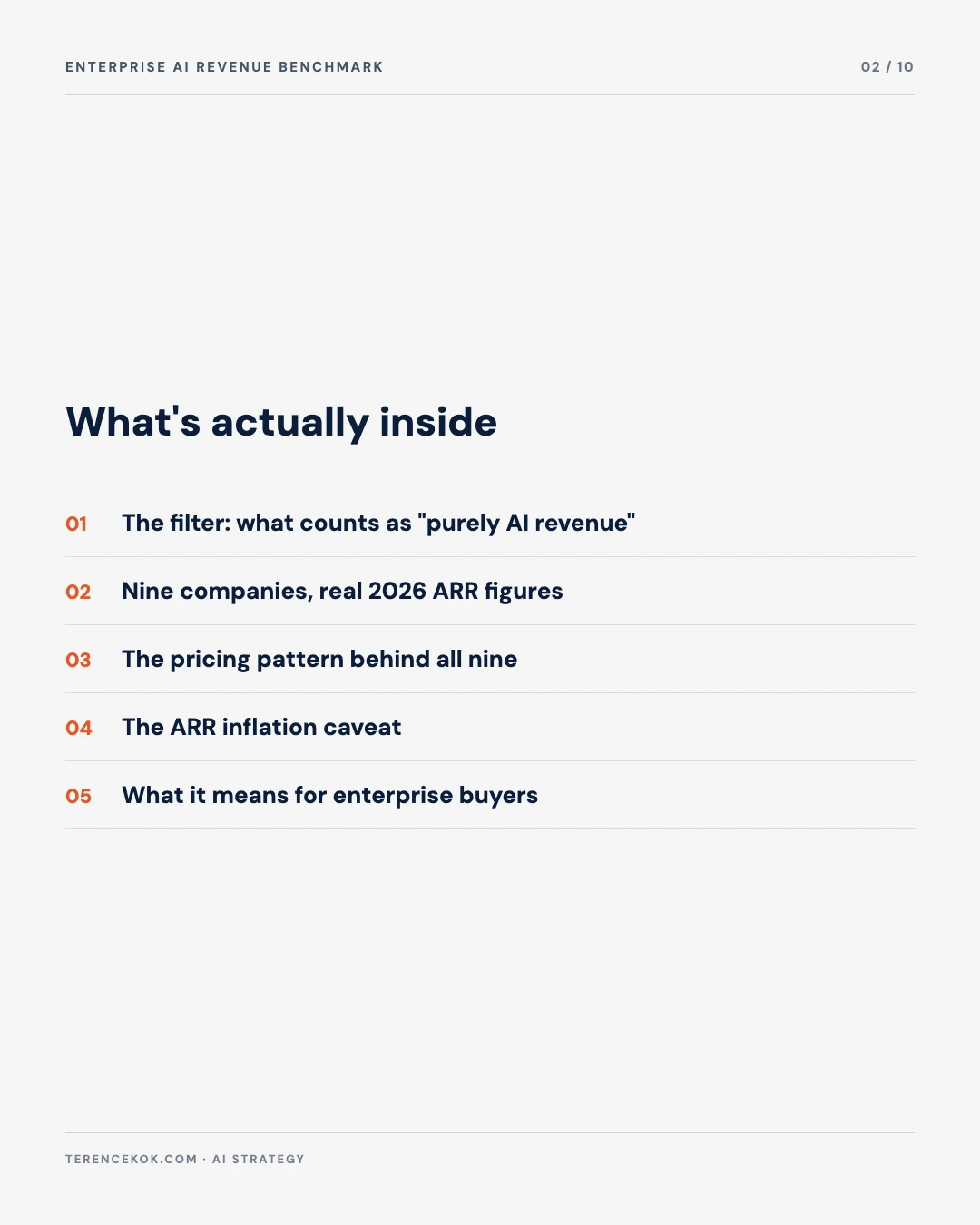
Nine companies, real ARR figures, and the pricing pattern behind them, ten slides
Save it, share it, or send it to whoever is still building an AI business case around per-seat licensing.
Defining what actually counts as AI revenue
Ask “which AI companies make money” and you’ll get an answer dominated by three names that don’t actually tell you anything about the application layer: Microsoft, Amazon and Google, because their AI revenue is inseparable from cloud infrastructure they’d be selling regardless, and OpenAI and Anthropic, because they’re the picks-and-shovels layer everyone already knows about, Anthropic alone reportedly crossed a $47 billion revenue run rate by late May 2026. That’s a true and boring answer.
The more useful question, and the one worth benchmarking, is narrower: which companies built a business where the AI doesn’t assist the work, it is the work, and customers pay for the output, not for a productivity boost to something they were already paying for. That rules out AI features added to Salesforce, ServiceNow or Microsoft 365, where the revenue was already there and AI is a retention and expansion lever, not a new revenue category. What’s left is a specific, checkable list of pure-play AI-native companies, and several of them are now doing real, audited-adjacent, hundreds-of-millions-to-billions-in-ARR numbers.
Free tool
AI Vendor Evaluation Scorecard
Rate two AI vendors side by side across seven dimensions, including how they actually price, before you sign against a demo rather than a business model.
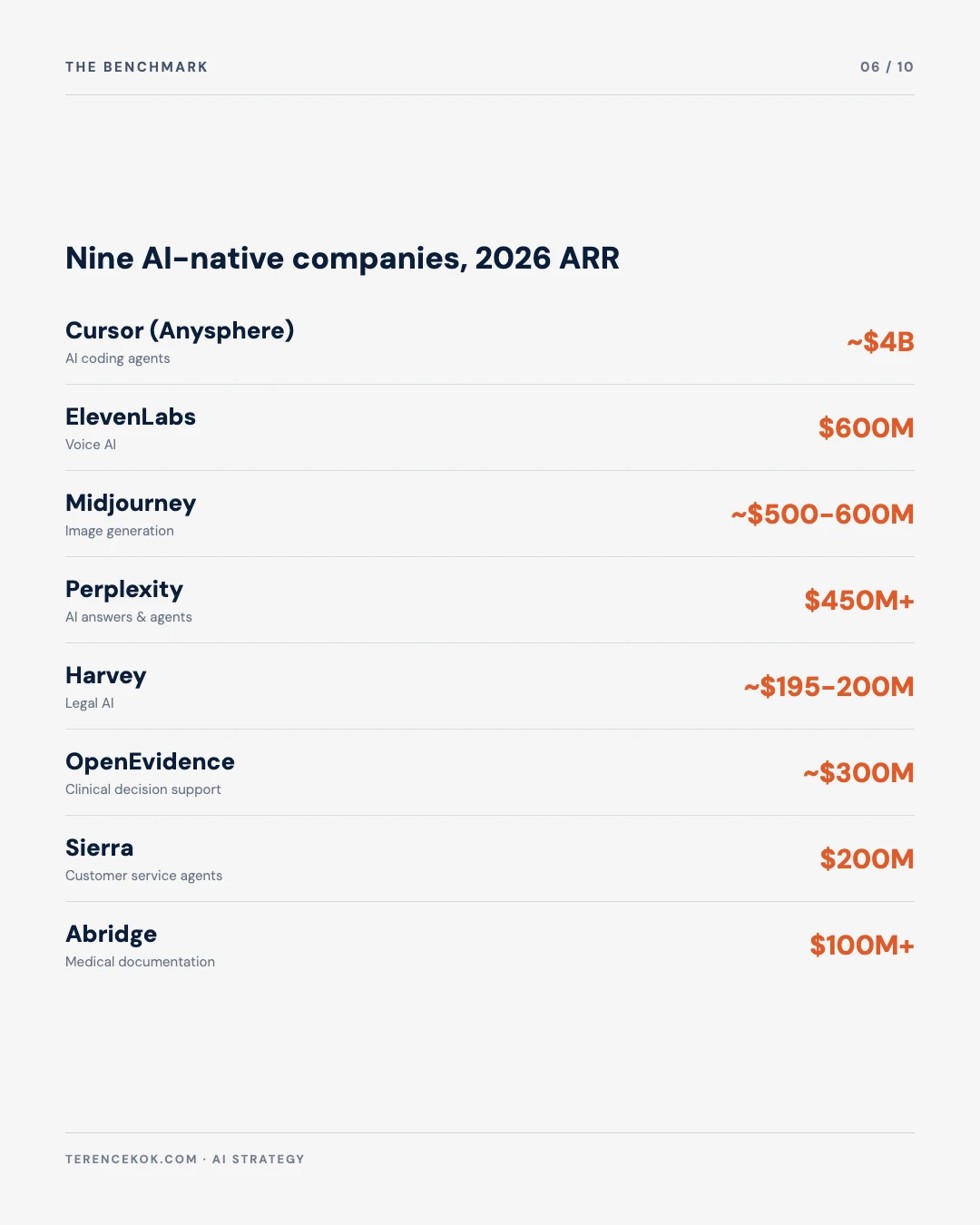
Nine companies with real AI revenue
Each of these generates revenue directly from AI output, not from an existing product line AI happened to improve. Figures are 2026 reported or annualised ARR, several are moving fast enough that the number is stale within a quarter of being quoted.
| Logo | Company | Category | 2026 ARR (reported) | What’s actually sold |
|---|---|---|---|---|
 | Cursor (Anysphere) | AI coding agents | ~$4B, acquired by SpaceX for $60B in Aug 2026 | Code written and shipped, usage-priced |
 | ElevenLabs | Voice AI | $600M (Jun 2026), up from $330M at end of 2025 | Generated speech, dubbing, voice agents |
 | Midjourney | Image generation | Estimated $500-600M, bootstrapped, no VC funding | Generated images, flat subscription |
 | Perplexity | AI answers/agents | $450M+ (Mar 2026), up from $305M a month earlier | Search answers and “Perplexity Computer” agent actions |
 | Harvey | Legal AI | ~$195-200M (early 2026), $11B valuation | Drafted legal work product, per matter/document |
 | OpenEvidence | Clinical decision support | ~$300M annualised (mid-2026) | Physician-facing answers, funded by pharma advertising |
 | Sierra | Customer service agents | $200M (2026), up from $100M a year earlier | Resolved customer tickets, outcome-priced |
 | Synthesia | AI video | $150M+ (late 2025), projecting past $200M in 2026 | Generated avatar video, per-minute/seat hybrid |
 | Abridge | Medical documentation | $100M+ (contracted ARR reported at $117M in Q1 2025) | Clinical notes generated per patient encounter |
Sources: CNBC, TechCrunch, Sacra, ElevenLabs, Fierce Healthcare, Yahoo Finance/FT, see full citations below. Logos are each company’s own mark, used here to identify them, not an endorsement by or affiliation with terencekok.com.
Two of these are worth pausing on because they show the range of what “purely AI revenue” can look like. OpenEvidence doesn’t charge doctors anything, its clinical-answer product is free at the point of use and monetised almost entirely through pharmaceutical advertising placed against physician queries, reportedly at a 90% gross margin. That’s a different monetisation shape from every other company on the list, but it fails the “efficiency tool” test the same way the others do: the entire $300M is generated by the AI answering a clinical question, there’s no legacy software business underneath it. Cursor is the other outlier, an $4 billion ARR company that had existed for roughly three years got folded into SpaceX in an all-stock deal, which says as much about where capital thinks AI-native revenue is durable as any ARR figure does on its own.
What made each company successful, and the risk each one faces now
Revenue at this scale isn’t an accident of good timing. Each of these nine won a specific, identifiable bet, and each is now carrying a specific, identifiable risk that could stall the trajectory just as fast. Reading the two side by side is more useful than the ARR number alone.
Cursor (Anysphere)
Cursor won by refusing to be a model company. It built a VS Code fork that developers could adopt in minutes, then stayed deliberately agnostic about which model powered it, wiring in whichever frontier model was best that quarter rather than betting the product on one lab’s roadmap. That posture, plus relentless attention to multi-file editing and agent-mode UX, is why it went from roughly $100M to $4B in ARR in under eighteen months, the fastest trajectory of any software company on record, without a traditional enterprise sales motion to explain it.
That same multi-model posture is now the thing under direct threat. The day the SpaceX acquisition was announced, OpenAI notified Cursor it would wind down its model-access contract, citing SpaceX and xAI’s history of violating terms of service elsewhere, with a hard cutoff of November 12, 2026 that blocks Cursor from GPT models including the unreleased Astra. Keeping Anthropic’s models on good terms, and keeping the “indie developer” trust that built the user base in the first place, while operating inside a company at open war with two of its three former model suppliers, is the whole question for the next year.

Founder’s philosophy
“The goal with the company is to replace coding with something that’s much better.”
ElevenLabs
ElevenLabs won by treating voice as a first-class modality years before the major labs did, shipping realistic, low-latency, multilingual speech and then expanding from a text-to-speech API into a full conversational voice-agent and dubbing platform enterprises could build call centres, audiobooks and localisation pipelines on top of. That product expansion, not the original demo, is what turned it into $600M of usage-priced infrastructure revenue.
The same realism is now the company’s biggest exposure. The FBI logged $893 million in AI-voice-fraud losses in 2025, and in April 2026 a U.S. senator publicly pressed ElevenLabs and three competitors on consent verification, celebrity-voice blocking and watermarking, after ElevenLabs’ tools had already been tied to a 2023 deepfake robocall and abusive celebrity voice clones circulated online. The company already blocks celebrity cloning and gates its professional tool behind identity verification; whether that self-policing satisfies regulators before a heavier mandate arrives is now a real constraint on how freely the product can keep shipping in its largest market.
Founder’s philosophy
“We spend so much time on screens and keyboards. It’s almost crazy. The ideal interaction between humans and technology will be different. Voice will be one of the primary interfaces, the way we’re speaking now.”
Midjourney
Midjourney won by staying independent. Never raising outside capital meant never facing the engagement-metric pressure that pushes funded competitors toward feature sprawl, so it just kept getting better at the one thing its Discord-native community actually cared about: image aesthetics. $500-600M in revenue on roughly 107 employees is what obsessive product focus without a board to please looks like.
Independence from investors doesn’t buy independence from litigation. On June 11, 2026, Disney, NBC Universal and DreamWorks filed a joint copyright suit alleging Midjourney’s models were trained on, and now reproduce, protected characters including Elsa, Buzz Lightyear and Shrek. The case was still working through discovery as of mid-2026, and Midjourney’s entire defence rests on a fair-use argument that has not yet been tested against plaintiffs this large in this specific medium. A loss wouldn’t just cost Midjourney, it would reset what every image-generation company can legally train on.

Founder’s philosophy
“We like to say we’re trying to expand the imaginative powers of the human species. The goal is to make humans more imaginative, not make imaginative machines, which I think is an important distinction.”
Perplexity
Perplexity won by unbundling the answer from the ad load and the ten blue links, then kept moving past search into “Perplexity Computer,” an agent that takes actions rather than just citing sources, which is what drove ARR from $305M to $450M in a single month after its February 2026 launch. Killing advertising entirely that same month, going subscription-and-agent-only, was a bet that usage-based monetisation would outperform ads at scale, and the growth curve has backed it so far.
Perplexity is being sued for the same reason the product works: it summarises other people’s reporting instead of sending readers to the source first. News Corp’s outlets sued first in December 2024, and CNN, the New York Times and the Chicago Tribune have all filed their own suits since, CNN’s alone alleging more than 17,000 unauthorised uses of its stories, videos and images. None of those cases has yet forced a change to how Perplexity sources answers, but a loss in any one of them could require a materially more expensive relationship with publishers than the one it runs today.

Founder’s philosophy
“It’s almost like a moral duty for all of us to seek wisdom and become perpetual learning machines because nothing else can help us keep upgrading ourselves.”
Harvey
Harvey won by building with law firms as design partners from day one, Allen & Overy among the earliest, rather than shipping a general legal chatbot and hoping it fit how Big Law actually bills and reviews work. That workflow-specific focus is why it now sits inside roughly half of the Am Law 100 and holds content partnerships with LexisNexis and Microsoft 365 Copilot that a general-purpose model can’t easily replicate.
Harvey no longer competes on model access, every legal AI vendor can call the same frontier models now, it competes on workflow depth and content rights, and Legora raised $550M at a $5.55B valuation in March 2026 specifically to contest that ground internationally. Harvey has to keep converting scale into deeper matter-level integration and provable outcomes, because the moment legal AI stops being judged on drafting speed and starts being scrutinised for the liability of a wrong citation in a filed brief, audit trails will matter more than who signed up first.
Founder’s philosophy
“I think it’s really hard to figure this out without failing. You just have to fail a million times.”
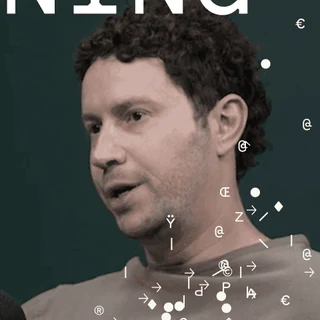
OpenEvidence
OpenEvidence won by removing the single biggest adoption barrier in clinical software, a purchasing decision, making the product free for verified physicians and funding it through pharmaceutical advertising instead. That let it spread doctor to doctor the way a genuinely useful reference tool does; it’s now reportedly used by a majority of US physicians, generating roughly $300M annualised at a reported 90% gross margin.
The model that removed the adoption barrier is also the liability. Physicians and medical ethicists are openly debating whether pharma-funded advertising embedded next to AI-generated clinical answers is meaningfully different from, or more persuasive than, traditional drug-rep marketing, and the evidence on whether pharmaceutical promotion improves or merely increases prescribing is mixed at best. OpenEvidence has to keep the advertising and the clinical answer visibly, provably separate as it scales, because the day a major health system or regulator concludes it can’t, the free-to-doctor model that built its user base turns into a liability.
Founder’s philosophy
“In medicine, there is no room for error or hallucination.”
Sierra
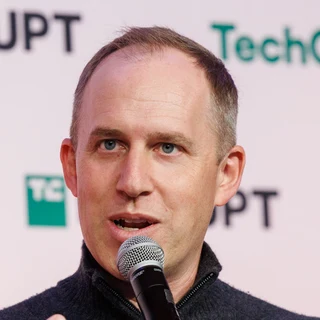
Sierra won by building for the enterprise from day one rather than layering a chatbot onto a support widget, with compliance-ready connectors, structured guardrails and outcome-based pricing that let risk-averse buyers like Cigna, SiriusXM and ADT say yes without betting budget on an unproven category. That combination took it from zero to $200M ARR in a year and a $950M round at a $15.8B valuation in May 2026.
The company’s own high-touch delivery model is now the constraint on how fast it can keep growing. Sierra, like its closest rival Decagon, still runs forward-deployed implementations behind the low-code pitch, engineers building bespoke integrations for each enterprise customer, a services-heavy cost structure to carry as the category matures. Whichever of the two turns bespoke builds into genuinely reusable, self-serve configuration first keeps its margins once “AI customer service agent” stops being a novelty and starts being an RFP line item every vendor claims to check.
Founder’s philosophy
“The atomic unit of the web was the website. The atomic unit of mobile was the mobile app. The atomic unit of AI is the agent.”
Synthesia
Synthesia won by building consent into the product rather than bolting it on after a scandal. Its stock avatars come from real actors who are paid every time their likeness is used and can opt out, and custom avatars require a live, un-uploadable consent verification, which let it sell into Fortune 100 learning-and-development and compliance budgets that would never touch an unlicensed deepfake tool. Holding SOC 2, ISO 27001 and ISO 42001 certification, and being a launch partner of the Partnership on AI’s synthetic-media standards, is unglamorous work that happens to be exactly what enterprise procurement teams require before they’ll sign.
Consent-first positioning protects Synthesia’s reputation, not its product category from commoditisation. Google’s and OpenAI’s video models are closing the realism gap fast, and Synthesia’s format is still mostly the static talking-head video. Extending into more dynamic, interactive content without loosening the consent architecture that differentiates it is the tightrope the company has to walk through 2026 and 2027.

Founder’s philosophy
“We have this internal principle called utility over novelty.”
Abridge
Abridge won by building with health systems as co-designers instead of selling around them, and turned that into the deepest EHR integration in its category: Epic named Abridge the first partner in its “Partners and Pals” third-party developer program, with live deployments now running inside Kaiser Permanente, Johns Hopkins, Mayo Clinic, Duke Health and dozens more. Integration depth, not accuracy alone, is what took it from a promising scribe tool to infrastructure sitting inside the daily workflow of entire hospital systems.
Microsoft’s Nuance DAX Copilot is the well-capitalised incumbent Abridge has to keep out-executing, and deep EHR access raises the stakes on accuracy: a documentation error that shapes a diagnosis code or a billing entry isn’t a minor bug, it’s a liability question. Abridge’s task now is proving specialty-by-specialty accuracy, emergency medicine, primary care and beyond each carry different documentation demands, holds up at the scale its Epic partnership is about to throw at it, not just in the health systems that helped design the product.

Founder’s philosophy
“Nothing crushes my soul more than clerical work.”
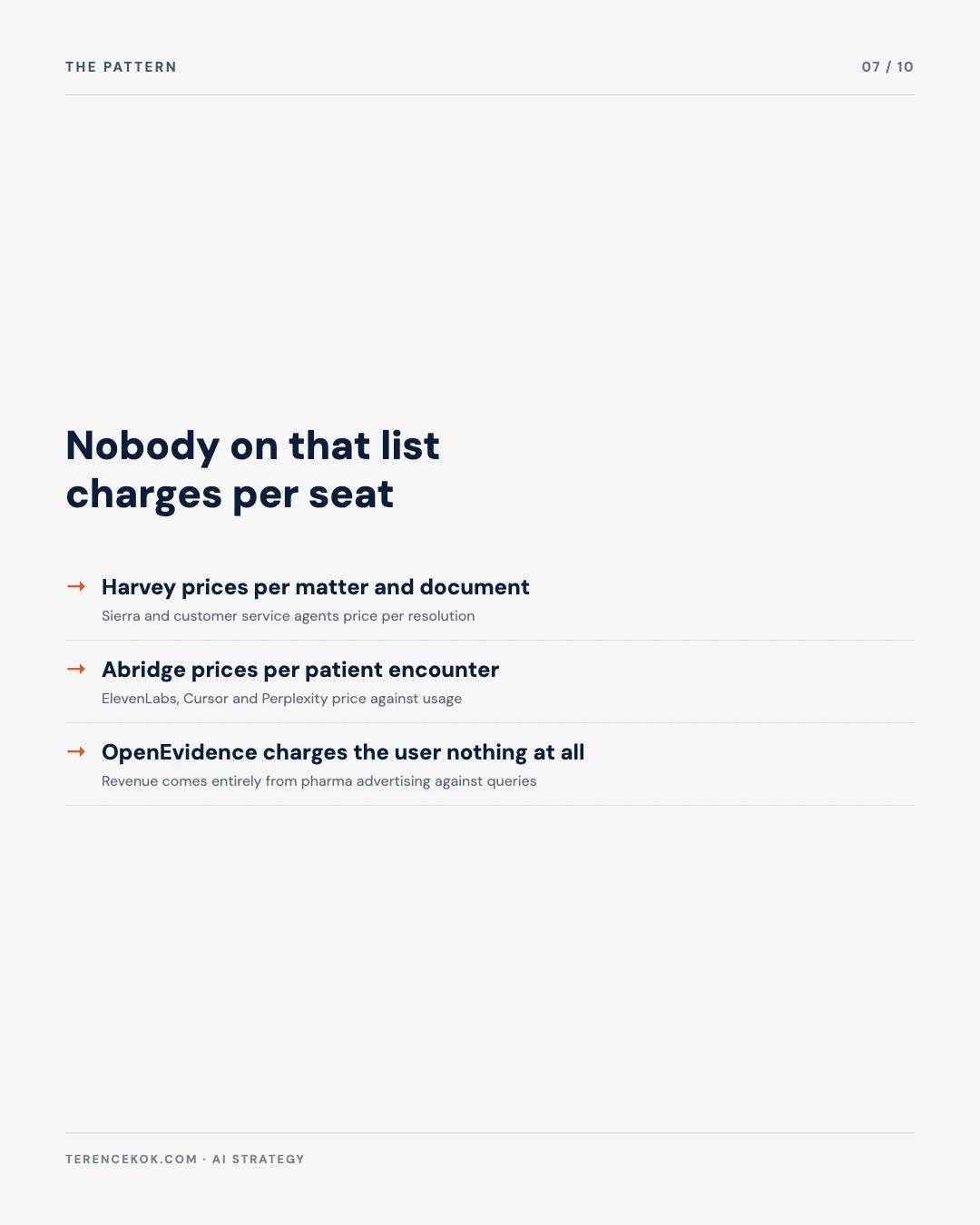
None of these nine companies charge per seat
Run down that table and the categories look unrelated, legal, healthcare, code, customer service, video, voice, search. The pricing model is where the real signal is, and it’s consistent: none of these companies built their core revenue on a per-seat licence. Harvey prices against matters and documents. Sierra and Decagon-style customer service agents increasingly price per resolution. Abridge prices per patient encounter. ElevenLabs, Cursor and Perplexity price against usage or consumption. OpenEvidence doesn’t charge the user at all.
That’s not incidental. Usage-based pricing has grown from roughly 30% of SaaS companies in 2019 to 85% by 2024, and Gartner now projects that by 2030 at least 40% of enterprise application software spend will have shifted to usage-, agent- or outcome-based models, pulling seat-based licensing’s share of enterprise SaaS revenue down from 21% to 15%. Gartner frames the mechanism as “agentic arbitrage”: once an AI agent can complete the underlying task itself, charging by the human seat using the software stops making sense, because the software increasingly isn’t waiting on a human seat at all. Gartner puts roughly $234 billion of enterprise application spend at risk of this repricing between now and 2030.
This is the structural reason “AI applications that enhance efficiency” and “AI applications with real AI-based revenue” are different categories, not just different phrasings of the same thing. A seat-priced copilot’s revenue is capped by headcount and threatened by its own success: the better it gets at the task, the less reason there is to keep paying for the human seat it was licensed against. An outcome-priced AI product has the opposite dynamic, its revenue scales with the volume of work actually completed, and improving the AI increases revenue rather than cannibalising it.
Free tool
AI Trust, Risk & Governance Dashboard
Outcome-based vendors shift risk onto whoever defines “resolved” or “drafted correctly.” Model that exposure before it’s buried in a contract you signed for the pricing, not the accountability terms.
These ARR figures are not exact
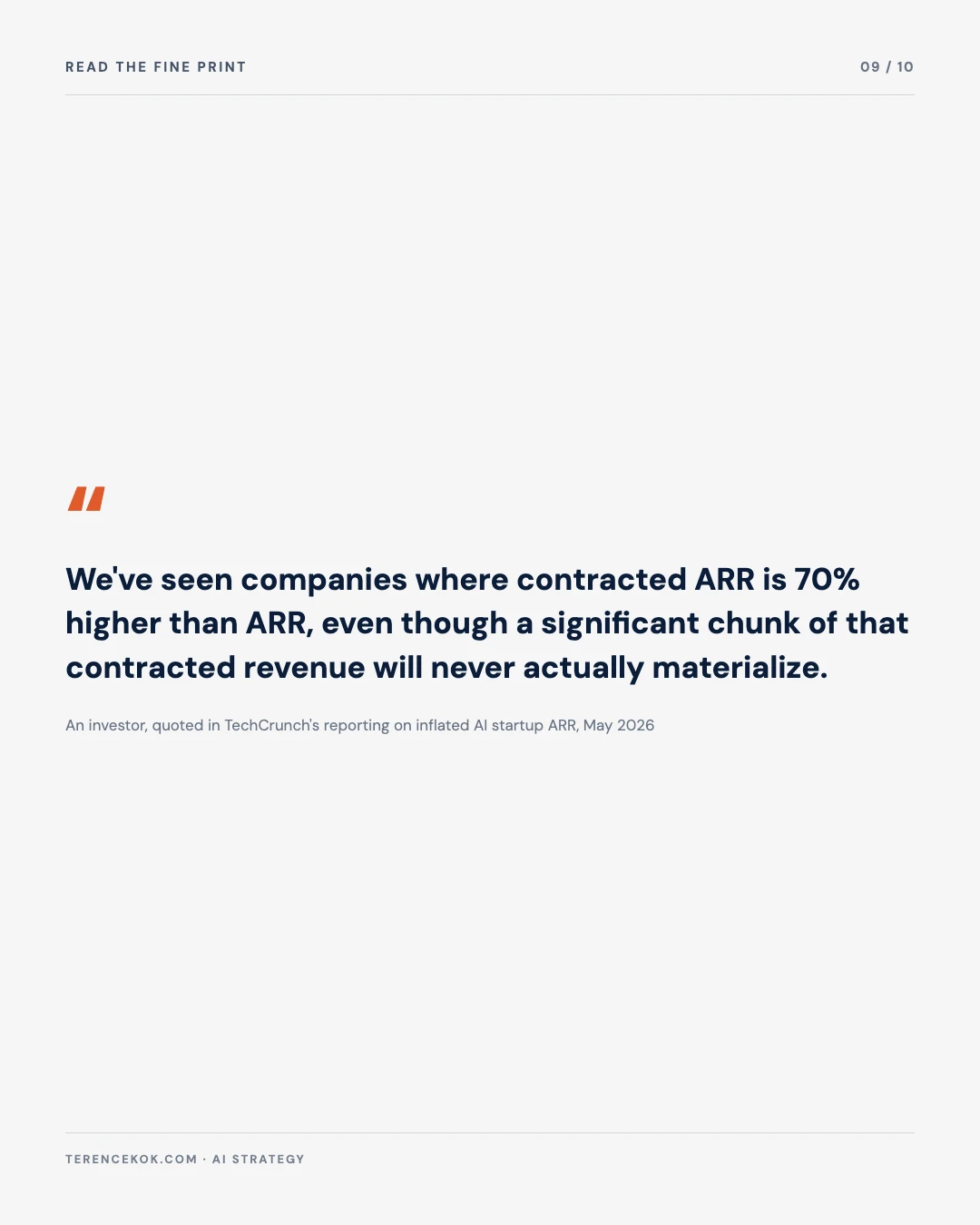
Every figure in the table above should carry an asterisk, and it’s worth explaining why rather than pretending otherwise. TechCrunch’s reporting on AI startup fundraising found investors and founders routinely reporting “contracted ARR”, revenue from signed contracts not yet deployed or billed, as if it were standard ARR. One investor told the outlet they’d seen “companies where CARR is 70% higher than ARR, even though a significant chunk of that contracted revenue will never actually materialize,” and multiple investors separately confirmed knowing of at least one high-profile enterprise AI startup that publicly claimed to have crossed $100 million in ARR when only a fraction of that figure came from currently paying customers.
None of the nine companies above have been specifically implicated in that reporting, and several, Harvey, Sierra, ElevenLabs, disclose growth through named executives on the record with major outlets rather than anonymous “sources familiar with the matter.” But the broader lesson holds for benchmarking any of this: AI ARR figures move fast enough, and get restated often enough, that the right way to use this table is directionally, which categories have real, durable, outcome-tied revenue at scale, not as a precise leaderboard to cite a quarter from now.
What this means for enterprise buyers
If your organisation is evaluating AI vendors against this backdrop, the useful diligence question stops being “does the demo work” and becomes “how does this company get paid, and does that pricing model still make sense once the product is good at the job.” A vendor selling you a seat-priced assistant has no structural incentive to make the assistant good enough that you need fewer seats. A vendor selling you outcome-priced resolutions, documents or generated output has the opposite incentive, and that alignment is closer to what “purely AI-based revenue” should mean for a buyer, not just for a benchmark of who’s growing fastest.
Sources
- Menlo Ventures. (2025). 2025: The State of Generative AI in the Enterprise.
- CNBC. (2026, March 25). Legal AI startup Harvey raises $200 million at $11 billion valuation.
- Sacra. Harvey at $195M ARR; Abridge revenue, valuation & funding.
- CNBC. (2026, June 16). SpaceX to acquire the AI coding startup Cursor for $60 billion.
- TechCrunch. (2025, November 21). Bret Taylor’s Sierra reaches $100M ARR in under two years.
- CNBC. (2026, May 4). Bret Taylor’s Sierra raises nearly $1B in latest AI capital push.
- TechCrunch. (2026, January 13). ElevenLabs CEO says the voice AI startup crossed $330M ARR last year.
- ElevenLabs. (2026). ElevenLabs crosses $500M ARR and welcomes new investors.
- CNBC. (2026, January 26). Nvidia and Alphabet VC arms back AI startup Synthesia at $4 billion valuation.
- CNBC. (2026, January 21). OpenEvidence, the “ChatGPT for doctors,” doubles valuation to $12 billion.
- Fierce Healthcare. (2026). OpenEvidence clinches $250M, doubles valuation to $12B.
- Yahoo Finance, via Financial Times. (2026, April 8). Perplexity ARR tops $450M after pricing shift, FT reports.
- TechCrunch. (2026, July 8). These AI startups are growing revenue at faster and faster rates.
- TechCrunch. (2026, May 22). How VCs and founders use inflated ‘ARR’ to crown AI startups.
- Gartner. (2026, July 1). Gartner Says $234 Billion in Enterprise Application Software Spend Is at Risk from Agentic AI.
- The Tribune. (2026). OpenAI to terminate Cursor model access following SpaceX acquisition.
- Forbes. (2026, April 19). Senator Hassan Demands Answers From ElevenLabs After FBI Reports $893 Million In AI Voice Scams.
- Georgetown Law Tech Institute. (2026). Disney, NBC Universal, and DreamWorks File Major IP Lawsuit Against AI Image Generator Midjourney.
- Variety. (2026, May 28). CNN Sues Perplexity, Alleging AI Company Infringed Its Copyrights.
- Modern Counsel. (2026). Where the legal AI platform market stands in 2026.
- Medscape. (2026). When AI Recommends Treatment, Should Drug Ads Appear?.
- Fierce Healthcare. Epic partners with Abridge to deepen AI integration into EHRs.
- Synthesia. AI Ethics and safety at Synthesia.
The AI Governance & ROI Executive Programme includes a vendor-diligence module built around exactly this pricing-model question, before a contract gets signed on the strength of a demo. Details are on the workshops page.