
Executive Summary
Productivity and worker pay have been diverging for 45 years, and the mechanism behind that divergence, technology whose gains flow disproportionately to capital, is exactly what economists studying AI say it is structurally built to do, faster than any prior wave. The 2026 data isn’t a forecast of this happening. It’s a record of it already happening: labor’s share of corporate income has fallen further this year even as share buybacks hit records and AI gets cited in a rising share of layoffs. Being experienced, trained and market-ready buys temporary protection from displacement, not a share of the value your productivity is creating. Closing that gap is a design choice, not an inevitability, and it has to be made at the level of what technology gets bought and how compensation gets structured, not by individuals working harder.
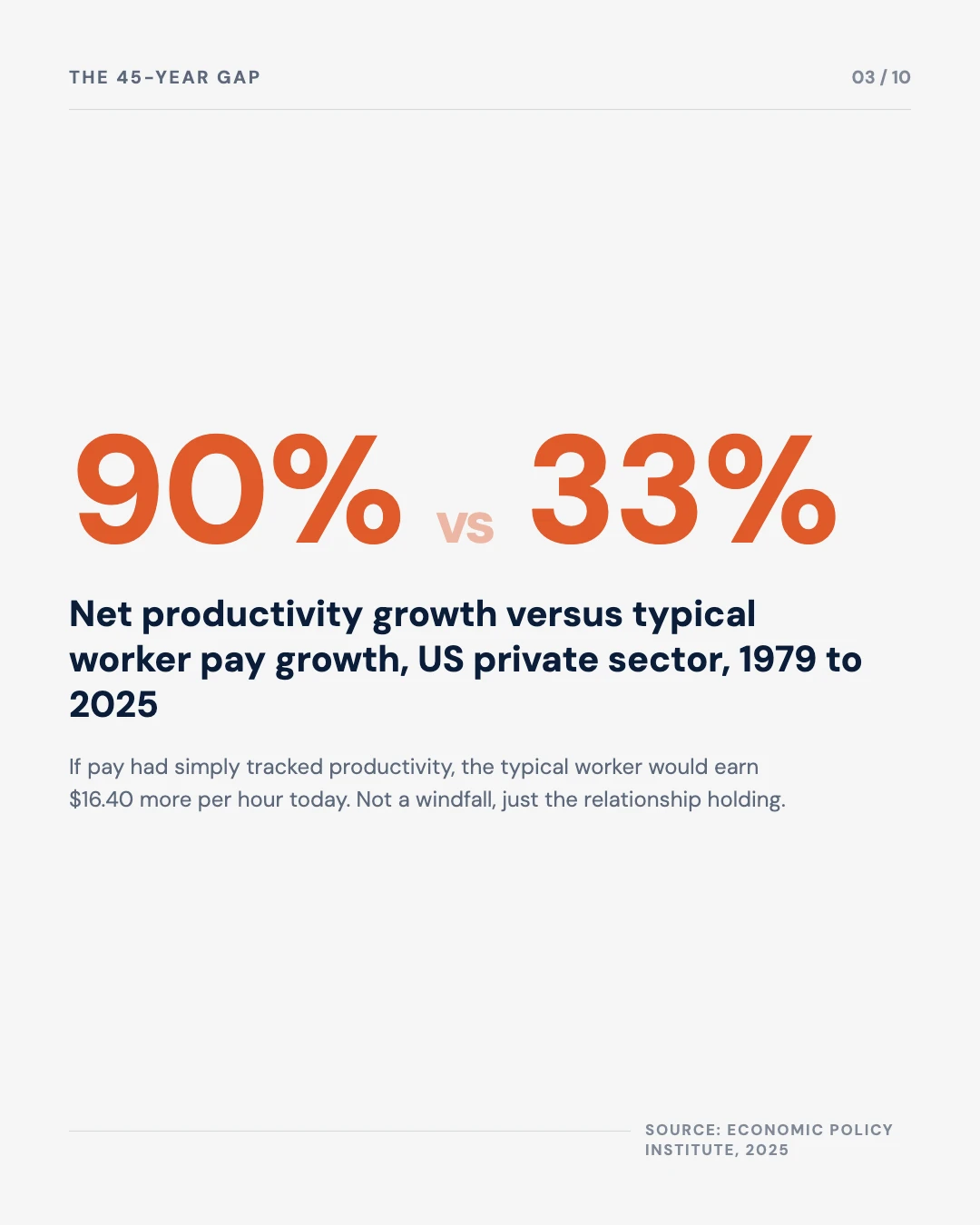
90% vs 33%
net productivity growth versus typical worker pay growth, US private sector, 1979 to 2025, Economic Policy Institute
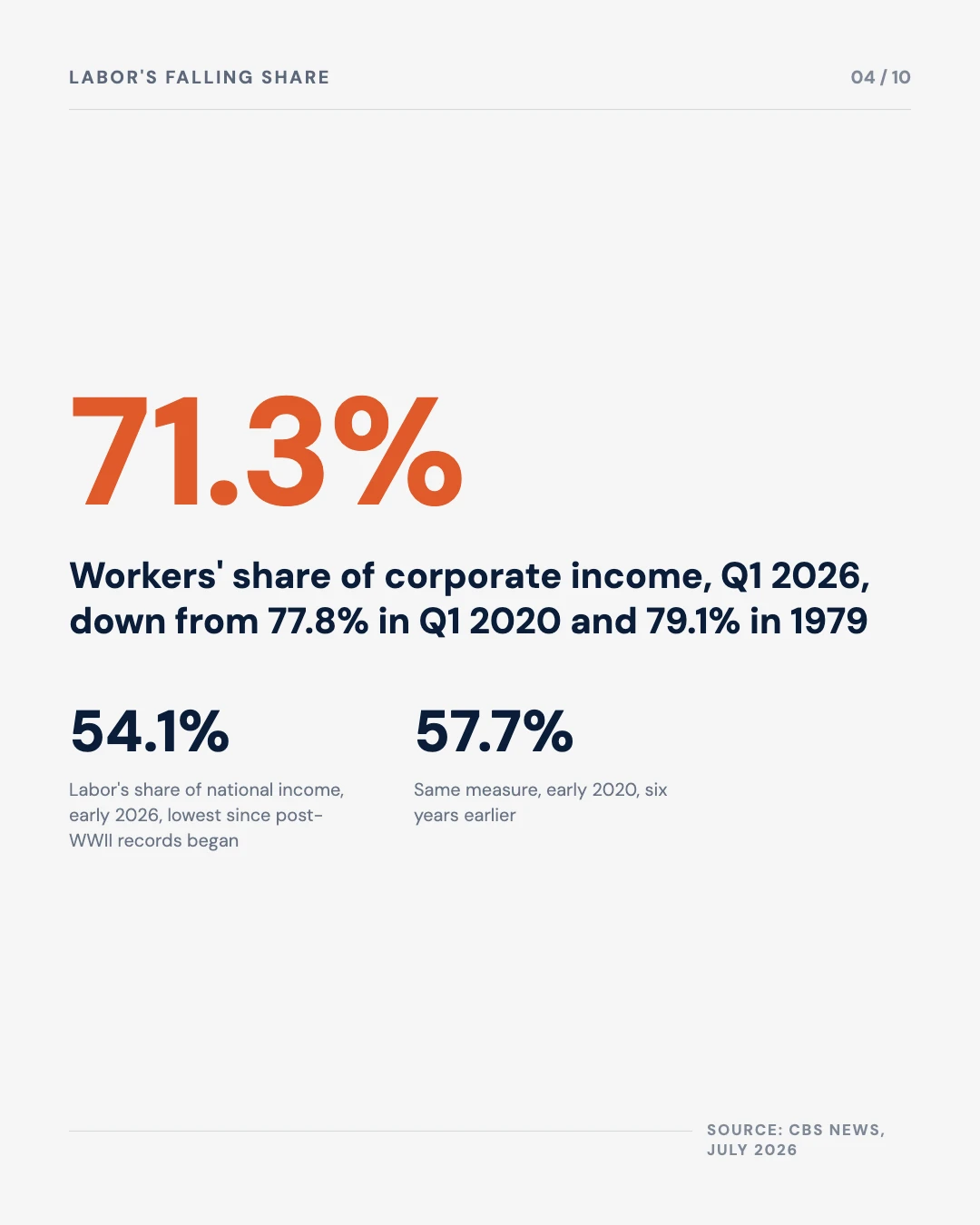
71.3%
workers’ share of corporate income in Q1 2026, down from 77.8% in Q1 2020 and 79.1% in 1979
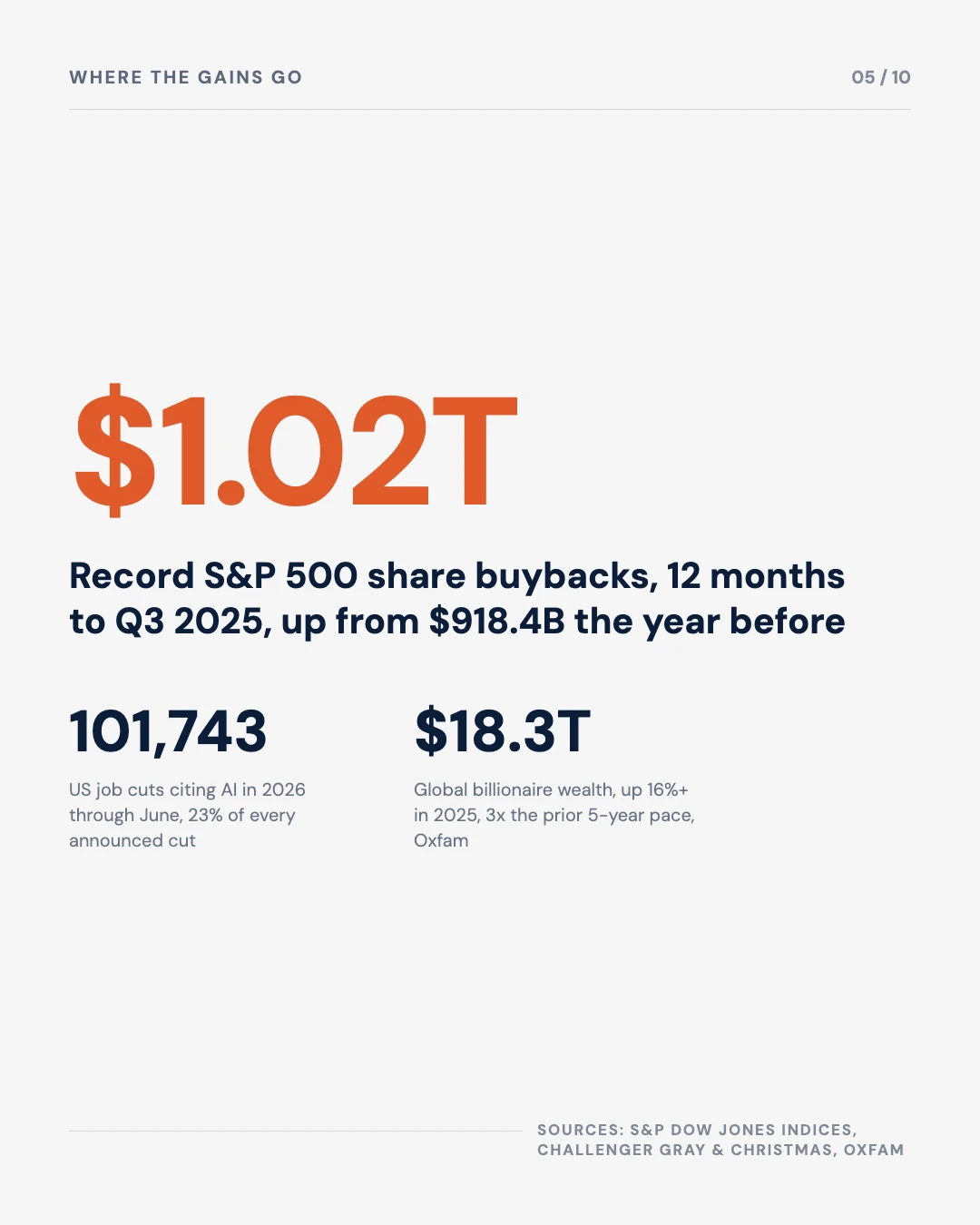
$1.02T
record S&P 500 stock buybacks in the 12 months to Q3 2025, S&P Dow Jones Indices
101,743
US job cuts citing AI in 2026 through June, 23% of all announced cuts, Challenger, Gray & Christmas
Core conclusions
- The productivity-pay gap isn’t new. What’s new is a general-purpose technology that Daron Acemoglu’s own macroeconomic modelling predicts will widen the gap between capital and labor income further, regardless of how large AI’s aggregate productivity effect turns out to be.
- The 2026 numbers already show the mechanism running in real time: labor’s share of corporate income is falling, buybacks are at record highs, and AI is the fastest-growing cited reason for job cuts, in the same fiscal year, not sequential events.
- Experience and readiness buy a worker protection from being automated away today. They don’t automatically buy a growing share of the value that worker’s productivity creates, and research on which AI technologies are “pro-worker” versus not shows that outcome is a choice enterprises make in the investment case, not a fixed property of the technology.
The gap, the mechanism, and what to do about it, ten slides
Save it, share it, or send it to whoever just got told to be more productive without being told why that stopped paying off.

The 45-year lie inside “just be more productive”
Since 1979, net productivity in the US, output per hour worked, less depreciation, has grown 90.2%. Over the same period, the hourly pay of a typical production or nonsupervisory worker in the private sector has grown 33.0%, according to the Economic Policy Institute’s long-running productivity-pay series. Productivity has grown roughly eight times faster than typical pay across that stretch. If pay had simply tracked productivity, the way it did for the three decades before 1979, EPI calculates the typical worker would be earning $16.40 more per hour today, $13.53 of it in wages and the rest in benefits, not as a windfall, just as the outcome of the same relationship holding.
That’s the baseline “work harder, get ahead” was quietly built on top of for nearly half a century, and it stopped being true for most workers a long time before AI showed up. The advice never updated to match. What AI changes isn’t the existence of the gap. It’s the speed at which the mechanism that produces it is now operating, and how visible that mechanism has become in a single year’s data.
Free tool
Enterprise AI Value & Adoption Dashboard
Check where your own AI programme’s gains are actually landing, cost savings and margin, or revenue and capability your people get paid more to run.
AI isn’t a neutral productivity tool. It’s built to be capital-biased
Daron Acemoglu’s 2025 paper, “The Simple Macroeconomics of AI,” is the most rigorous attempt yet to size what AI actually does to growth and distribution, using a task-based model rather than speculative scenarios. His headline growth number is deliberately modest: no more than a 0.66% increase in total factor productivity over ten years from currently exposed tasks, revised down to under 0.53% once harder-to-learn, context-dependent tasks are accounted for. That number alone punctured a lot of the more excitable 2024 and 2025 forecasting.
The finding that matters more for this piece is the distributional one, and it’s stated plainly: AI is predicted to widen the gap between capital and labor income. Even in scenarios where AI’s productivity boost to low-skill tasks helps some workers, the paper finds no evidence that AI reduces labor income inequality overall, and it shows AI’s aggregate effect skewing toward capital rather than labor, independent of how fast or slow the total growth number turns out to be. In other words, the size of the AI productivity dividend is still genuinely uncertain. Who captures it is not.
That prediction isn’t waiting for confirmation.
CBS News, July 2026 · workers’ share of corporate income, US
Three decades of a slow decline, then a sharper drop in the years AI moved from pilot to production.
Source: CBS News, “This number helps explain why many Americans are down on the economy,” July 1, 2026.
The causes aren’t singular. Weakened union bargaining power, a federal minimum wage frozen since 2009, and tax policy that favours capital gains over wages have all been building this for decades. AI is not the sole author of that trend. It’s the newest and fastest-moving contributor to a mechanism that was already well established, at exactly the point Acemoglu’s model says it should be accelerating, not slowing, the divergence.
Follow where the AI productivity gains are actually going
If AI-driven productivity were flowing to the workers producing it, the 2026 numbers underneath the labor-share figures would look different. They don’t. S&P 500 companies spent a record $1.02 trillion on share buybacks in the twelve months to Q3 2025, up from $918.4 billion the year before, according to S&P Dow Jones Indices. That’s capital being returned to shareholders at the same time employers are running the fastest pace of AI-attributed layoffs on record: Challenger, Gray & Christmas has tracked 101,743 US job cuts citing AI in 2026 through June, 23% of every announced cut, already well ahead of the 54,836 recorded across all of 2025 and part of 173,568 cumulative AI-cited cuts since the firm started tracking the category in 2023.
Wealth concentration is moving in the same direction at the top of the distribution. Oxfam’s January 2026 inequality report found global billionaire wealth rose more than 16% in 2025 to a record $18.3 trillion, three times faster than the average annual pace of the previous five years, with the number of billionaires passing 3,000 for the first time. None of this proves AI alone is driving billionaire wealth growth. It does show the same pattern repeating at every scale the data can measure this year: gains concentrating with owners of capital, not with the workforce whose output is generating them.
| Where the value is measured | 2026 direction | What it means for a worker’s pay |
|---|---|---|
| Labor share of corporate income | Fell to 71.3%, down from 77.8% in 2020 | A shrinking share of every dollar of output reaches paychecks, even when output rises |
| S&P 500 buybacks | Record $1.02 trillion, 12 months to Q3 2025 | Capital returned to shareholders faster than it’s reinvested in headcount or wages |
| AI-cited job cuts | 101,743 through June 2026, 23% of all cuts | Productivity gains from AI are being realised as cost reduction, not redistributed as pay |
| Billionaire wealth | Up 16%+ in 2025 to $18.3 trillion, 3x the 5-year average pace | Ownership of capital, not labor, is where this year’s fastest gains are landing |
Four independent data sources, four different methodologies, the same direction in the same year. That’s what makes 2026 different from any single one of these numbers on its own.
What this actually means if you’re experienced, trained and ready for the market
The workers currently best insulated from AI-driven displacement are the ones with deep, tacit expertise, the judgment AI still can’t reliably replicate. That’s real protection, and it’s worth naming plainly rather than pretending experience counts for nothing. But protection from being replaced is a different claim from participation in the value being created, and conflating the two is where a lot of “reskill and you’ll be fine” advice quietly breaks down.
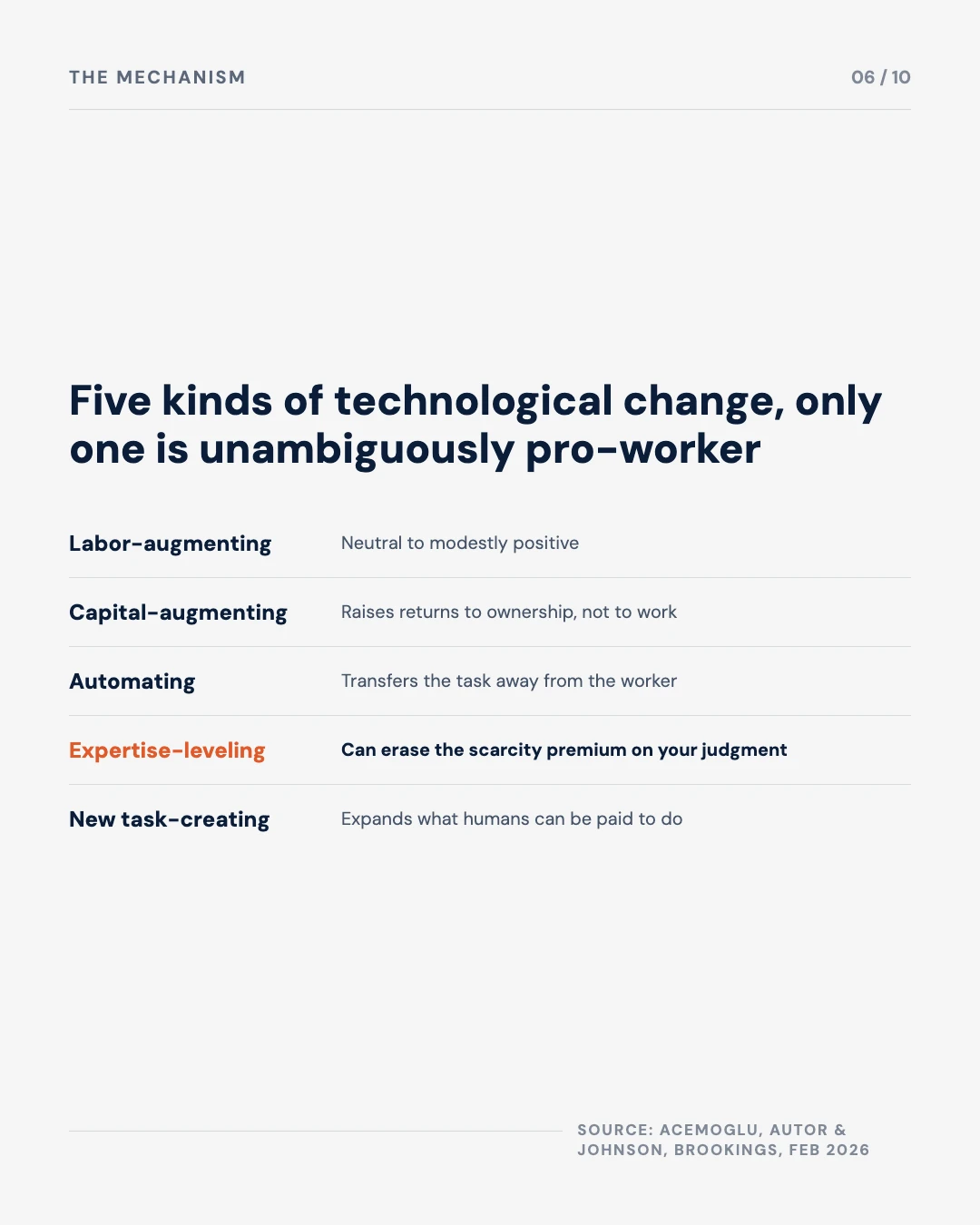
Acemoglu, together with David Autor and Simon Johnson, published a framework in February 2026, “Building Pro-Worker Artificial Intelligence,” through the Hamilton Project at Brookings, that names exactly why. They split technological change into five categories by what it does to a worker’s bargaining position, not just their employment status.
| Category | What it does | Effect on the worker |
|---|---|---|
| Labor-augmenting | Helps a worker do their current tasks faster | Neutral to modestly positive, depends on who captures the time saved |
| Capital-augmenting | Increases the value of capital relative to labor | Negative: raises the return to ownership without raising the return to work |
| Automating | Transfers a task from a worker to a machine | Negative for the worker performing that task |
| Expertise-leveling | Lets less-experienced people do specialist work | Ambiguous: can raise output while reducing the market’s willingness to pay for scarcity |
| New task-creating | Expands the range of valuable work humans can do | The only category the authors call unambiguously pro-worker |
Most enterprise AI deployment today sits in the automating and expertise-leveling rows, not the new-task-creating one, and that placement is a decision made in a business case, not a property of AI itself.
Expertise-leveling is the row that applies most directly to an experienced professional. It doesn’t take your job. It takes the scarcity premium the market used to pay for your judgment, by making a version of that judgment available to people who didn’t spend twenty years building it. Your output can stay valuable to your employer at the exact same moment the market’s willingness to pay a growing wage for it flattens, because the thing that made your judgment scarce is being deliberately, and often successfully, engineered away. That’s a subtler failure mode than a layoff notice, and it’s much harder for an individual worker to see happening to them in real time, because their paycheck doesn’t stop, it just stops growing relative to what they’re actually producing.
Free tool
Outcome as a Service Qualification Checklist
If your delivery time is shrinking because of AI, this checks whether your pricing is still tied to hours, or to the outcome that’s actually worth paying for.
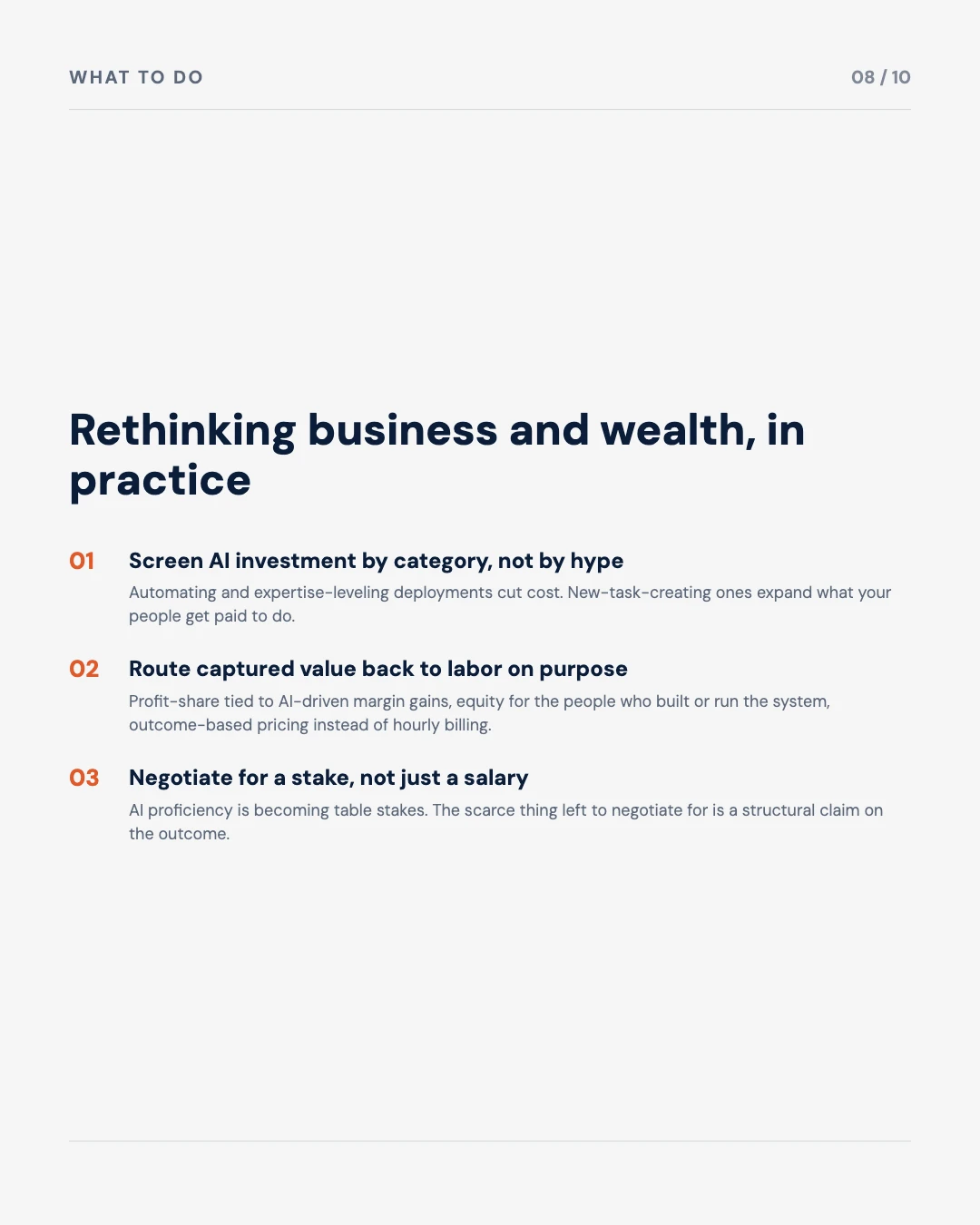
What rethinking business and wealth development actually requires
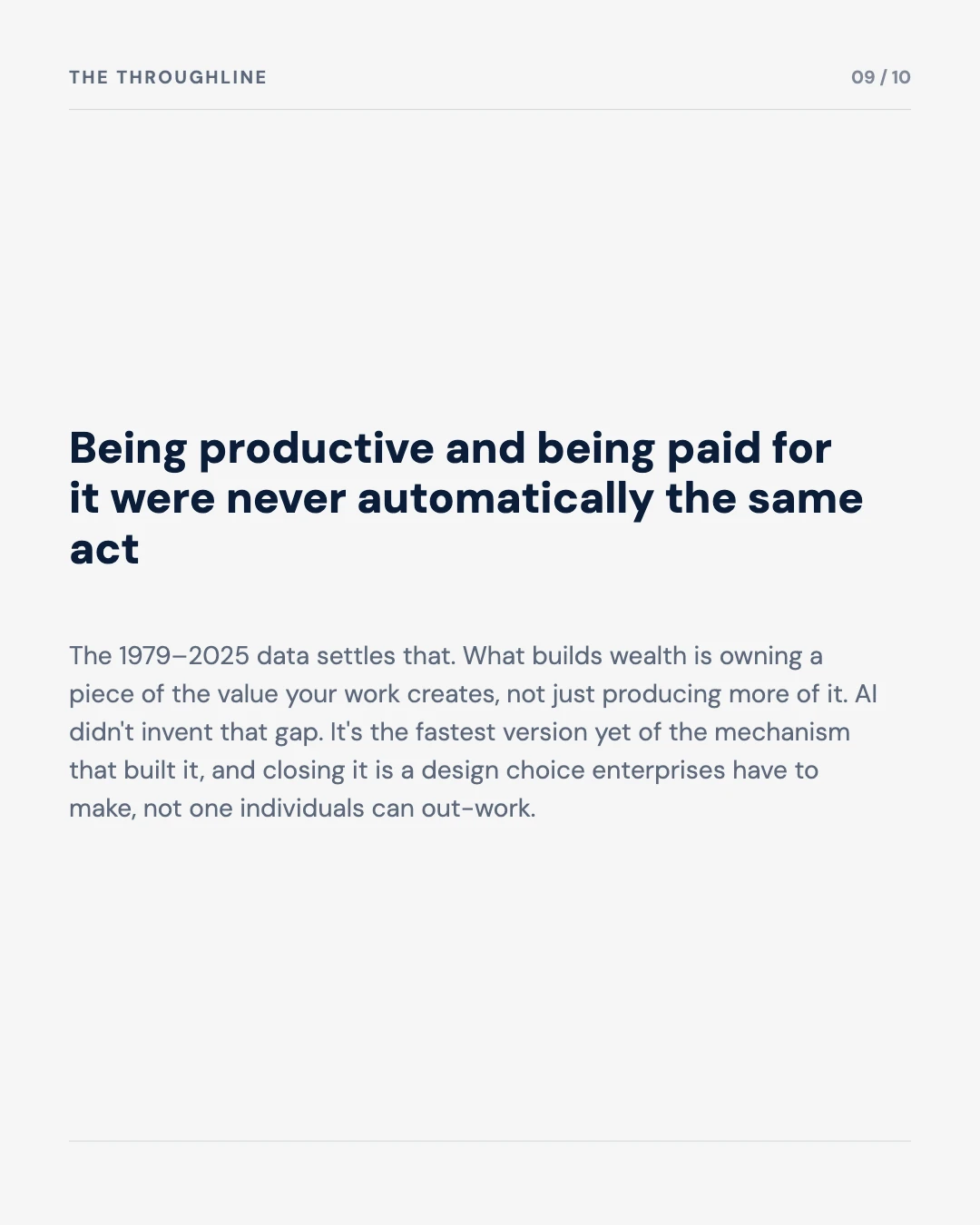
None of this is an argument against deploying AI, and it isn’t an argument that experienced workers are powerless. It’s an argument that the old assumption, that being productive and being paid for it are the same act, needs to be replaced deliberately, at both the business and the individual level, because the data says it’s already coming apart on its own.
For businesses, that starts with using the five-category framework above as a genuine screen on the AI investment case, not a compliance checkbox: ask whether a given deployment is automating and expertise-leveling your way to a lower cost base, or genuinely new-task-creating in a way that expands what your people can be paid to do. Then close the loop that data alone won’t close: build the mechanisms, profit-share tied to AI-driven margin expansion, equity for the people who built or ran the system, outcome-based contracts that price the result instead of the hours it used to take, that route some of the captured value back to labor instead of defaulting it to buybacks by omission. Acemoglu, Autor and Johnson’s own policy recommendations, tax incentives favouring labor, stronger worker voice mechanisms, targeted public investment in worker-complementing tools, are aimed at exactly this gap, because the market alone hasn’t been closing it for 45 years and there’s no evidence it starts closing it now.
For experienced individuals, the strategic shift is from optimising for productivity to optimising for a stake in the outcome. Being fast and good at your job was never, on its own, the thing that reliably built wealth, the 1979 to 2025 data settles that. What builds wealth is owning a piece of the value your work creates: equity, profit share, a business model priced on results rather than time, assets you control rather than hours you sell. AI proficiency is becoming table stakes, not a differentiator, the same levelling effect already visible in how fast fluent, competent output has gone from a rare skill to a free one. The scarce thing left to negotiate for isn’t skill. It’s a structural claim on the outcome that skill produces.
The banks and law firms cutting entry-level classes while running record AI-cited layoffs and record buybacks in the same fiscal year aren’t behaving irrationally. They’re behaving exactly as the incentives in front of them predict. Changing what “productive” buys a worker in 2027 and beyond isn’t a matter of individuals working harder or getting more AI-fluent. It’s a matter of whether enterprises deliberately build the mechanisms that route value back to the people creating it, before the gap that’s been widening since 1979 becomes the permanent shape of the AI-era economy instead of an inherited flaw inside it.
Sources
- Economic Policy Institute. (2025). The Productivity–Pay Gap.
- Acemoglu, D. (2025). The Simple Macroeconomics of AI. NBER Working Paper No. 32487; Economic Policy, 2025.
- Acemoglu, D., Autor, D., & Johnson, S. (2026, February). Building Pro-Worker Artificial Intelligence. NBER Working Paper No. 34854; The Hamilton Project, Brookings Institution.
- CBS News. (2026, July 1). This number helps explain why many Americans are down on the economy.
- S&P Dow Jones Indices. (2025, December 18). S&P 500 Q3 2025 Buybacks.
- Challenger, Gray & Christmas, Inc. (2026, July 1). Challenger Report: June Layoffs Cool to 45,849.
- Oxfam International. (2026, January). Billionaire wealth jumps three times faster in 2025 to highest peak ever.
The AI Governance & ROI Executive Programme works through exactly this question at the organisational level, how to structure AI investment and compensation so productivity gains route back to the people creating them, before the gap shows up in next year’s attrition numbers instead of this year’s plan. Details are on the workshops page.