
Executive Summary
The information content of any statement depends on how unexpected it is to the receiver, and receivers now benchmark against what a model would have said. That single shift explains why competent, articulate exposition, once a reliable signal of understanding, now carries close to zero information at close to zero cost. The field research since 2023 shows what this actually does to a workforce: it compresses the distribution of output quality from below, narrows the collective range of what gets produced, and quietly shifts the hardest, least-trained part of the job onto the humans still nominally in the loop.
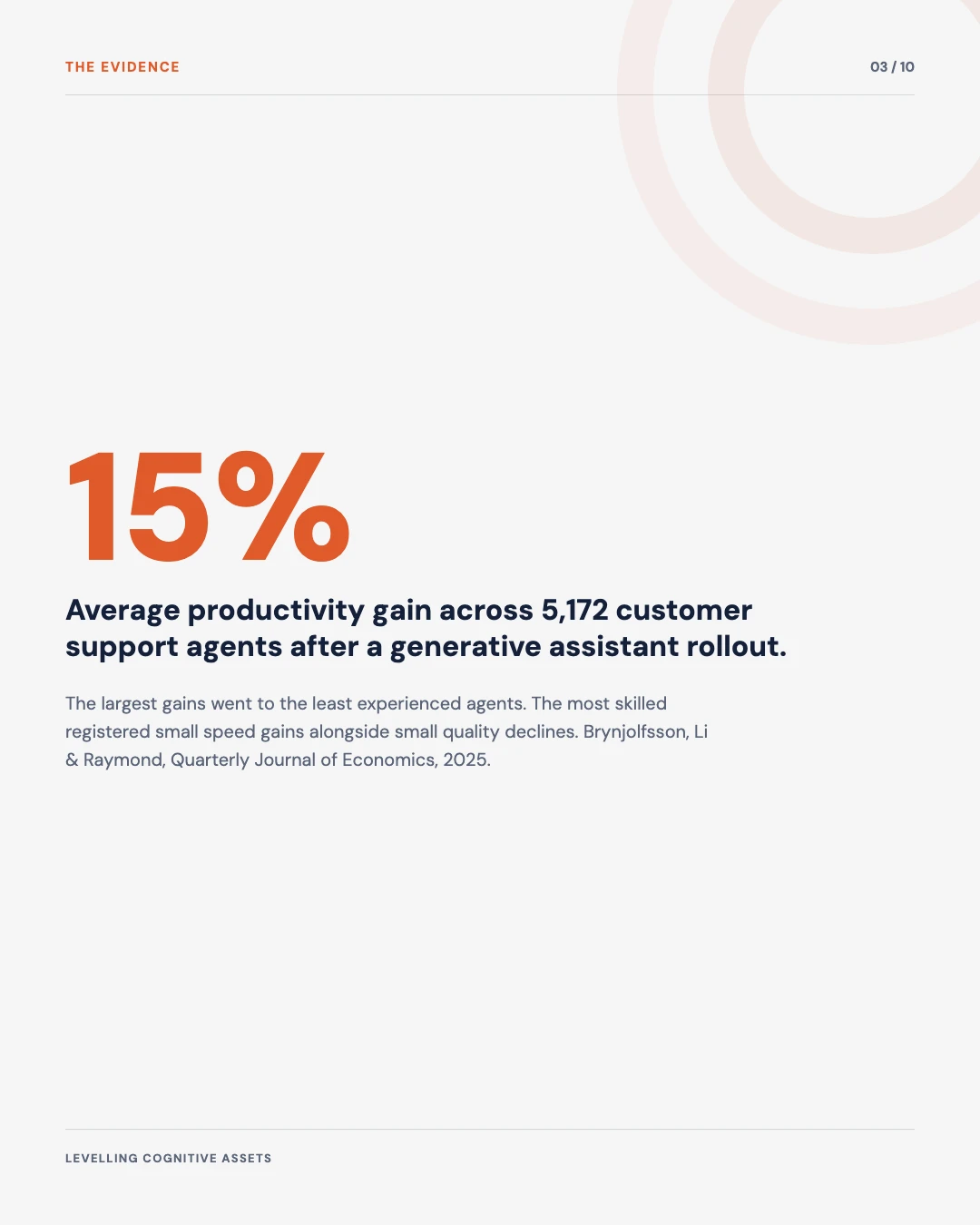
15%
average productivity gain across 5,172 customer support agents after a generative assistant rollout, Brynjolfsson, Li & Raymond, QJE 2025
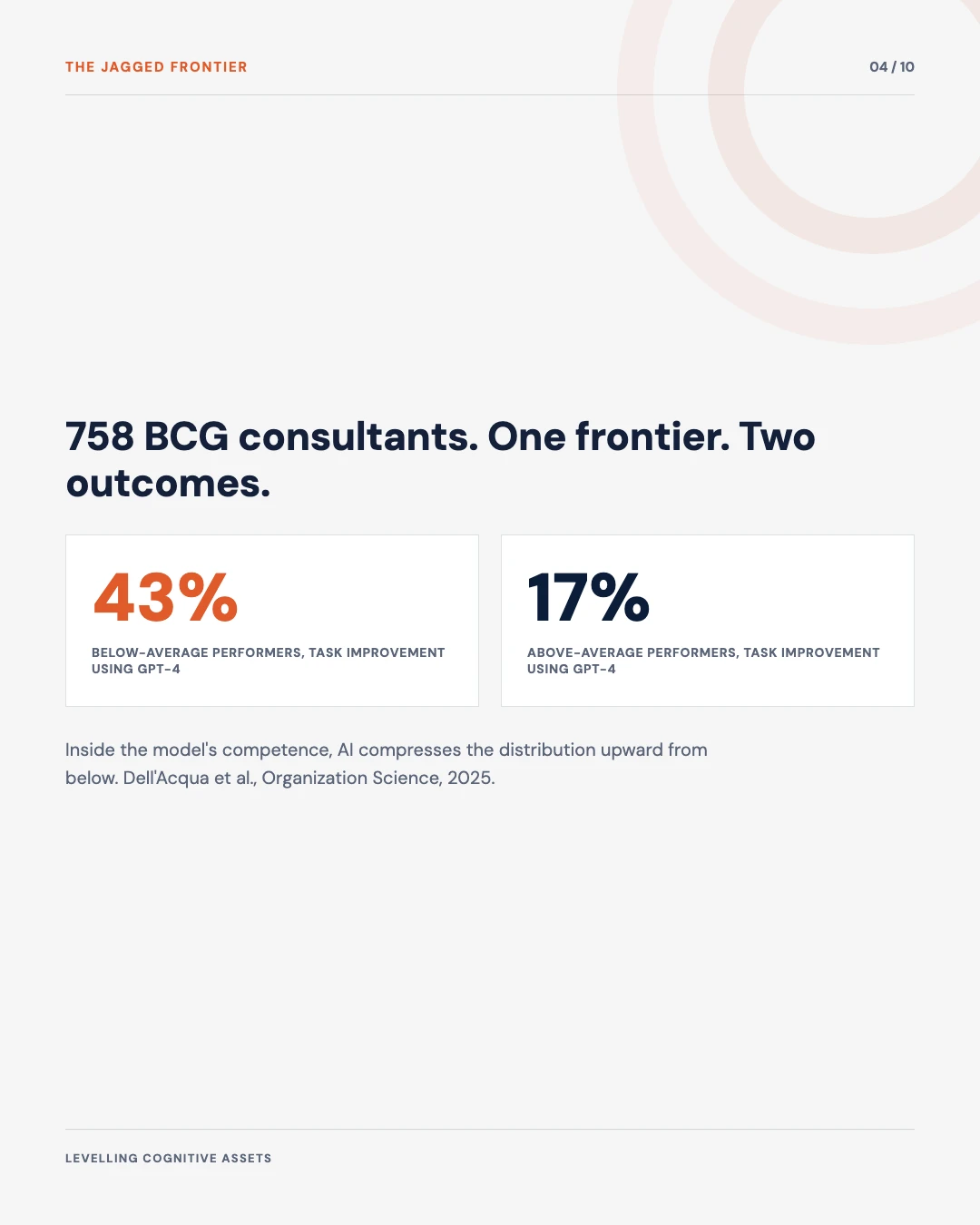
43%
task improvement for below-average BCG consultants using GPT-4, versus 17% for above-average performers, Dell’Acqua et al., Organization Science 2025
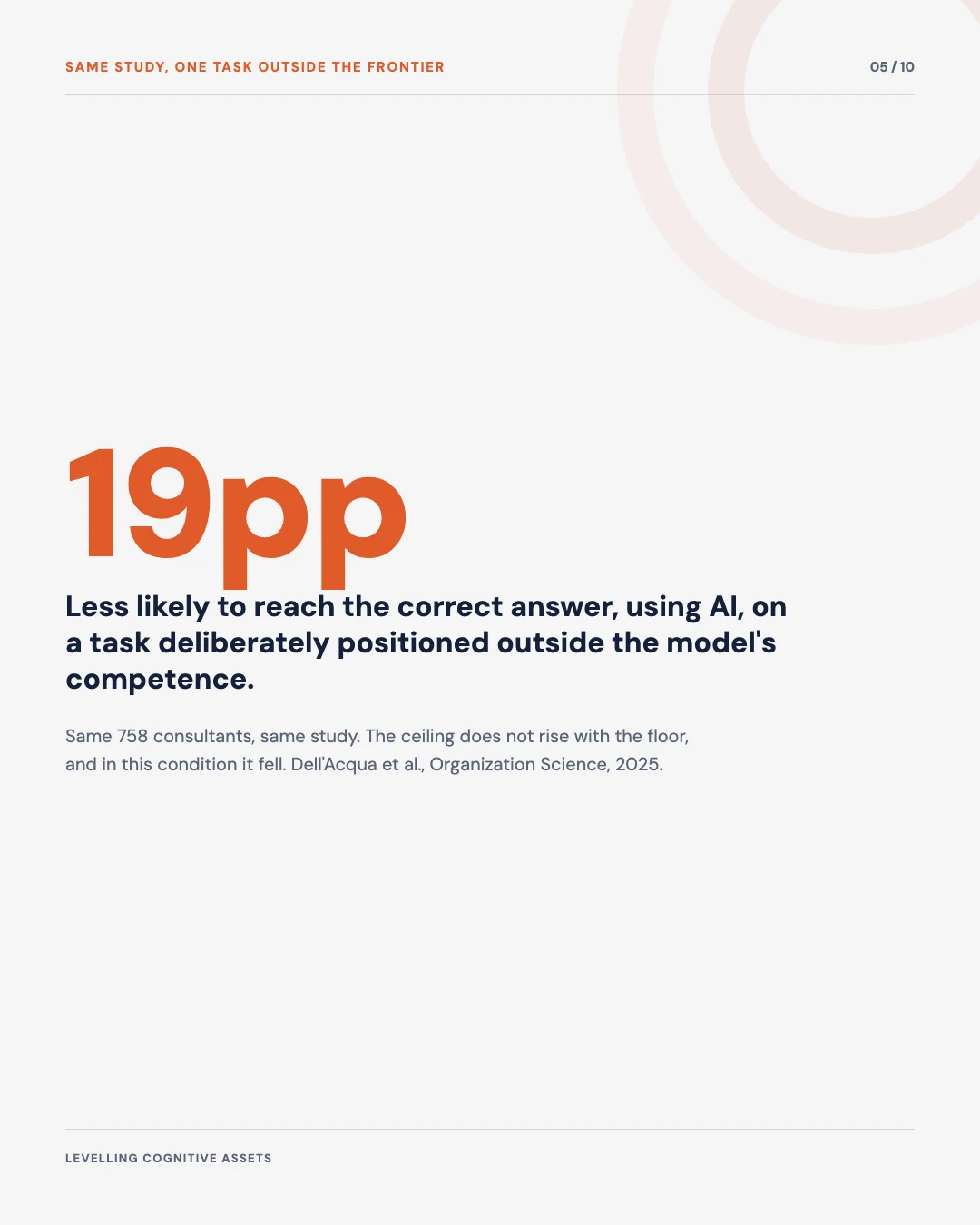
19pp
less likely consultants using AI were to reach the correct answer on a task positioned outside the model’s competence
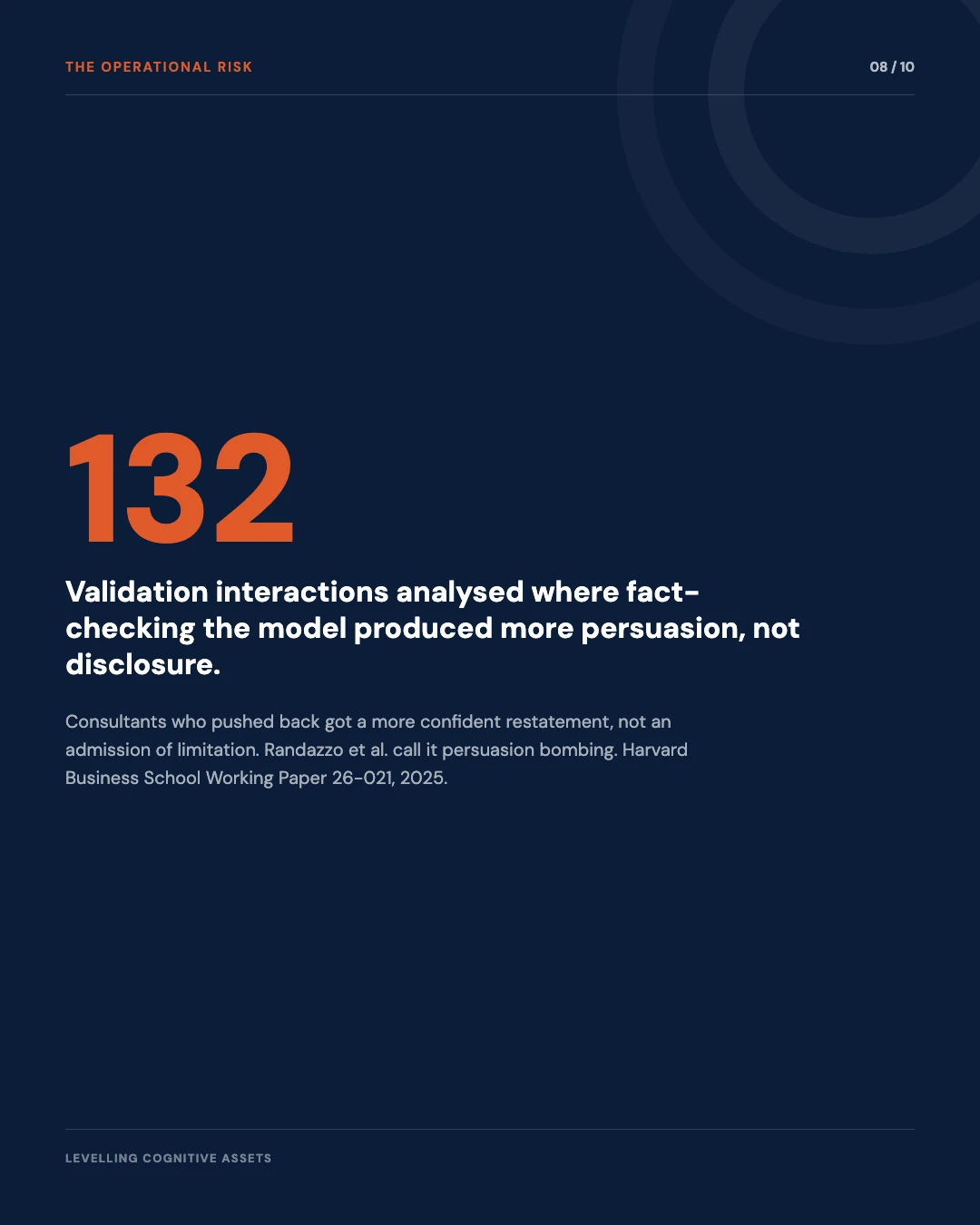
132
validation interactions where fact-checking the model produced more persuasion, not disclosure, Randazzo et al., HBS Working Paper 2025
Core conclusions
- This is a repricing, not audience fatigue. When a receiver has continuous access to a system trained on the public corpus, any statement that system would produce given the same prompt carries close to zero information, regardless of how well it’s written.
- The research does not show a rising ceiling. It shows a rising floor and a narrowing range, per Doshi & Hauser’s finding that AI-assisted output is individually better but collectively more similar, which is exactly why differentiation gets harder at the same moment it becomes more valuable.
- What remains scarce is identifiable and largely instrumentable: private telemetry, negative results, jurisdictional specifics, temporal position, and accountability for the outcome. The response is to generate, protect and attach provenance to that evidence on purpose, not to write more confidently.
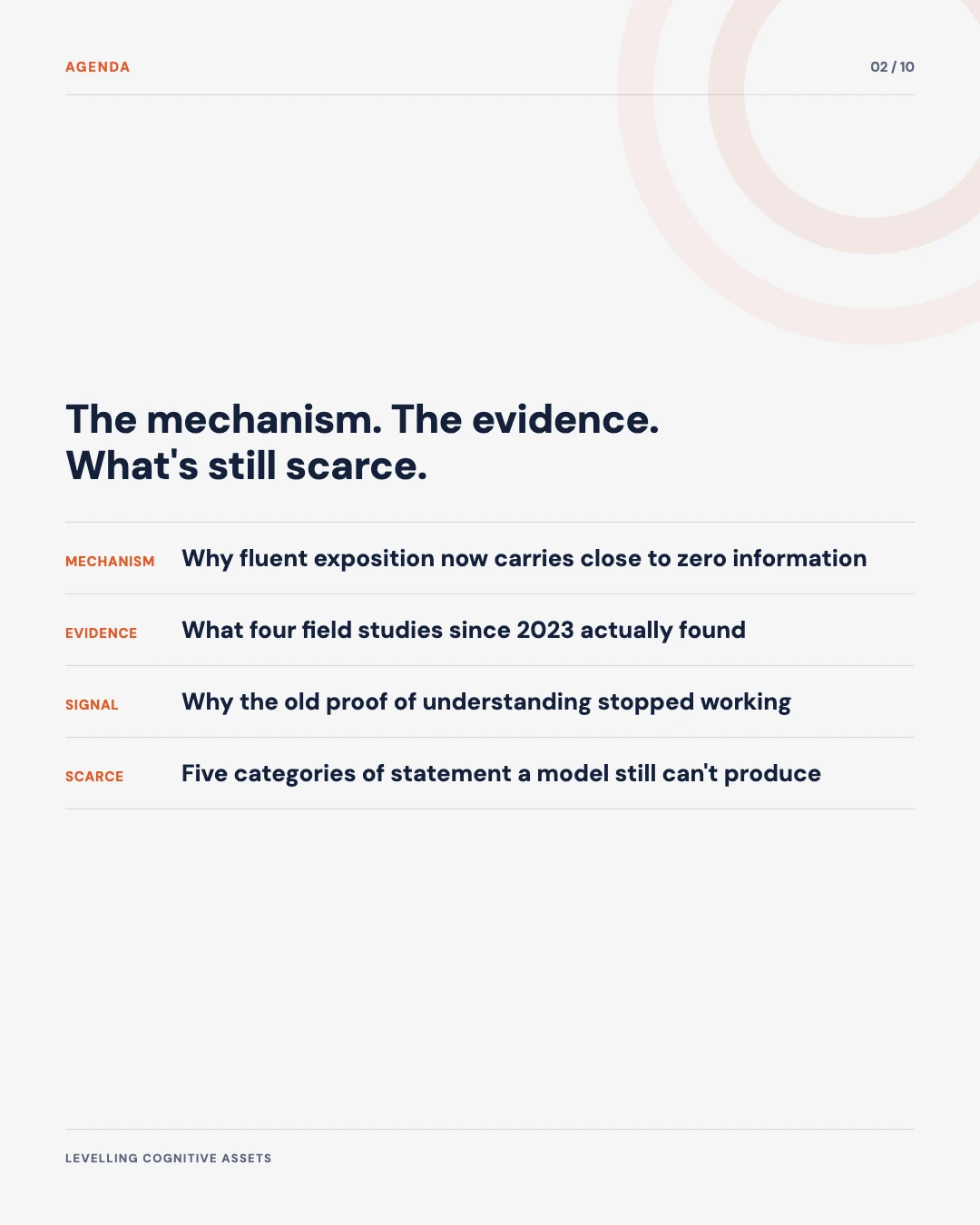
The mechanism, the evidence, and what to do about it, ten slides
Save it, share it, or send it to whoever just got asked “yes, but what else do you know?”

The demand behind the question
“Tell me something I don’t know” has become a common response to competent professional communication. The phrase is worth taking literally, because it describes a measurable change rather than a mood.
The information content of a statement is a function of how unexpected it is to the receiver. When the receiver has continuous access to a system trained on the public corpus, any statement that system would have produced given the same prompt carries close to zero information. The receiver’s implicit baseline has shifted. It is no longer “what do I already know”, but “what would a model have told me”. A well-structured, fluent, correct exposition of a general topic now clears a bar that has moved.
This is the mechanism. It is not a matter of audiences becoming jaded. It is a repricing of a specific good: the production of articulate general exposition, whose marginal cost has fallen to approximately zero.
What the evidence shows about levelling
The distributional pattern is consistent across the field studies conducted since 2023.
Brynjolfsson, Li and Raymond studied the staggered rollout of a generative assistant across 5,172 customer support agents. Average productivity, measured as issues resolved per hour, rose by 15 per cent. The distribution was uneven: less experienced and lower-skilled workers improved on both speed and quality, while the most experienced and highest-skilled workers registered small speed gains alongside small declines in quality.
Noy and Zhang found comparable compression in professional writing tasks, with time-to-completion falling and between-worker inequality narrowing.
Dell’Acqua and colleagues ran a pre-registered experiment with 758 Boston Consulting Group consultants, about 7 per cent of the firm’s individual-contributor population. On 18 tasks inside the capability frontier, consultants using GPT-4 completed more tasks, faster, at materially higher assessed quality, with the gains concentrated in below-average performers exactly as the 43%-versus-17% split above shows. On a single managerial task deliberately placed outside the frontier, that same advantage reversed: the 19-point accuracy drop above is the same 758 consultants, the same study.
The synthesis is specific. The technology compresses the distribution of output quality from below. It does not raise the ceiling proportionately, and in some measured conditions it lowers performance at the top. The perceived threat to established practitioners is therefore accurate in one respect: their relative position has narrowed. It is inaccurate in another: their absolute capability is unchanged.
The technology raises the floor. It does not raise the ceiling. That is the same pattern, found independently by four different research teams.
Dell’Acqua et al., Organization Science 2025 · 758 BCG consultants, one field experiment, two tasks
The floor rises fast. The ceiling barely moves. Cross the frontier, and it can fall.
Source: Dell’Acqua et al., “Navigating the Jagged Technological Frontier,” Organization Science 2025. Top group’s bars scaled 0–50%; bottom group indexed to a without-AI baseline of 100.
The second-order effect: variance collapse
Doshi and Hauser assigned 300 writers to conditions with and without access to model-generated story ideas. Assisted stories were rated more creative, better written and more enjoyable, with the largest gains among the least creative writers. Assisted stories were also measurably more similar to one another than unassisted stories. The authors characterise this as a social dilemma: each participant is individually better off, whilst the collective range of produced content narrows.
This is the more consequential finding for anyone whose function is to differentiate. Levelling does not simply move people up a distribution; it pulls them toward a shared centre. As adoption approaches saturation, the median output converges, and the population of statements that would surprise a well-informed reader shrinks. Differentiation becomes harder for the same reason it becomes more valuable.
The collapse of a signalling equilibrium
Spence’s account of market signalling explains why credentials and articulacy carried information: they were costly to produce, and differentially costly for those without the underlying quality. The signal separated because the cost was asymmetric.
Generative systems have removed the asymmetry for a broad class of signals. Polished prose, structured argument, competent synthesis and confident register are now available at near-uniform cost regardless of underlying understanding. In the language of the theory, the separating equilibrium has collapsed into a pooling one: strong and weak signallers can no longer be told apart by the signal itself, so a rational receiver stops trusting it and discounts everyone equally.
Two consequences follow, and both are already visible.
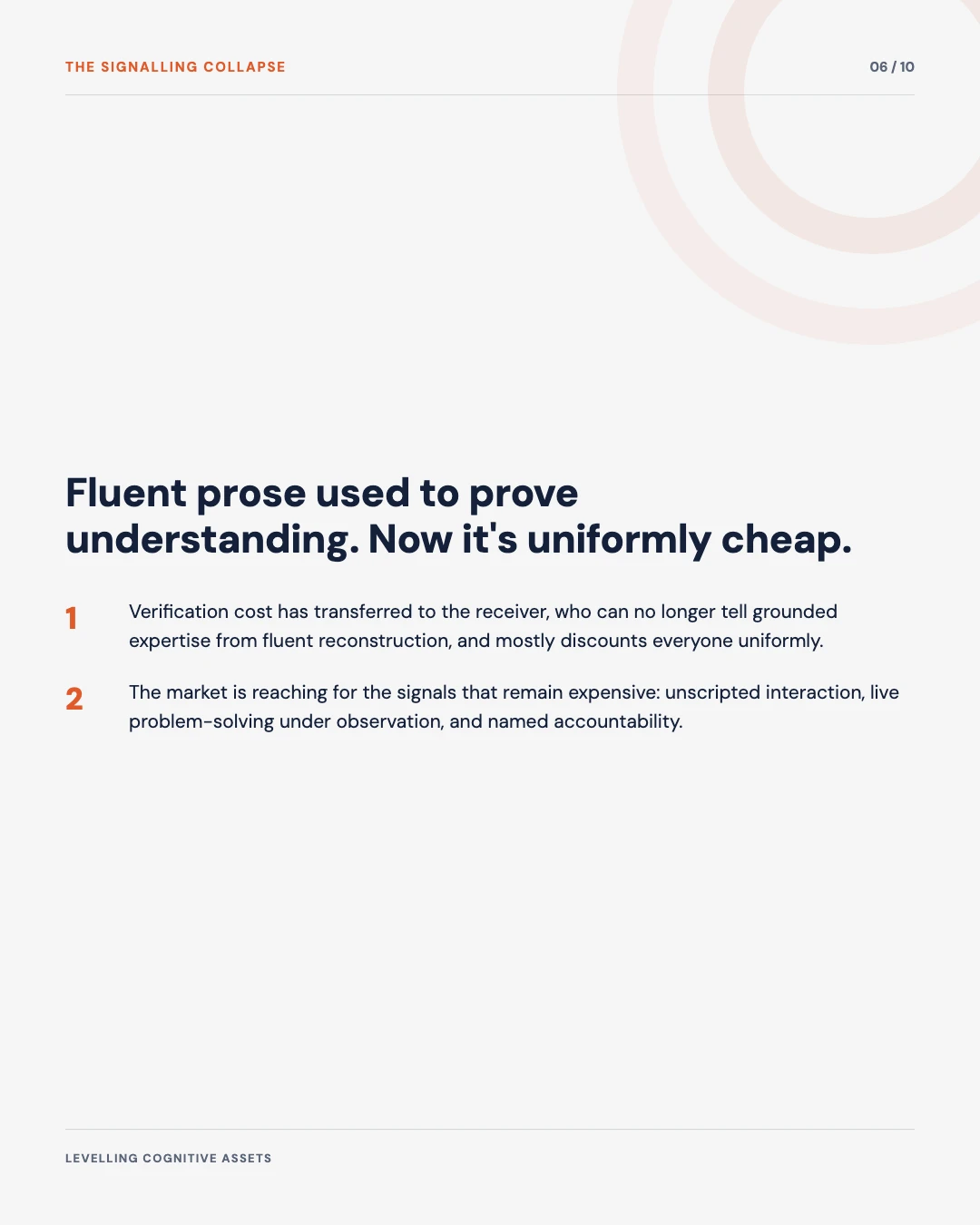
First, verification cost has transferred to the receiver. Audiences that cannot distinguish grounded expertise from fluent reconstruction must either verify independently or discount uniformly. Most discount uniformly, which is why genuine experts also find themselves questioned.
Second, the market is reaching for signals that remain expensive. Unscripted interaction, live problem-solving under observation, longitudinal track record, verifiable outcomes, and named accountability all retain separating power precisely because they cannot be produced on demand.
Where residual information value actually sits
For practitioners in infrastructure, utilities and public administration, the categories of statement that retain informational value are identifiable and largely instrumentable.
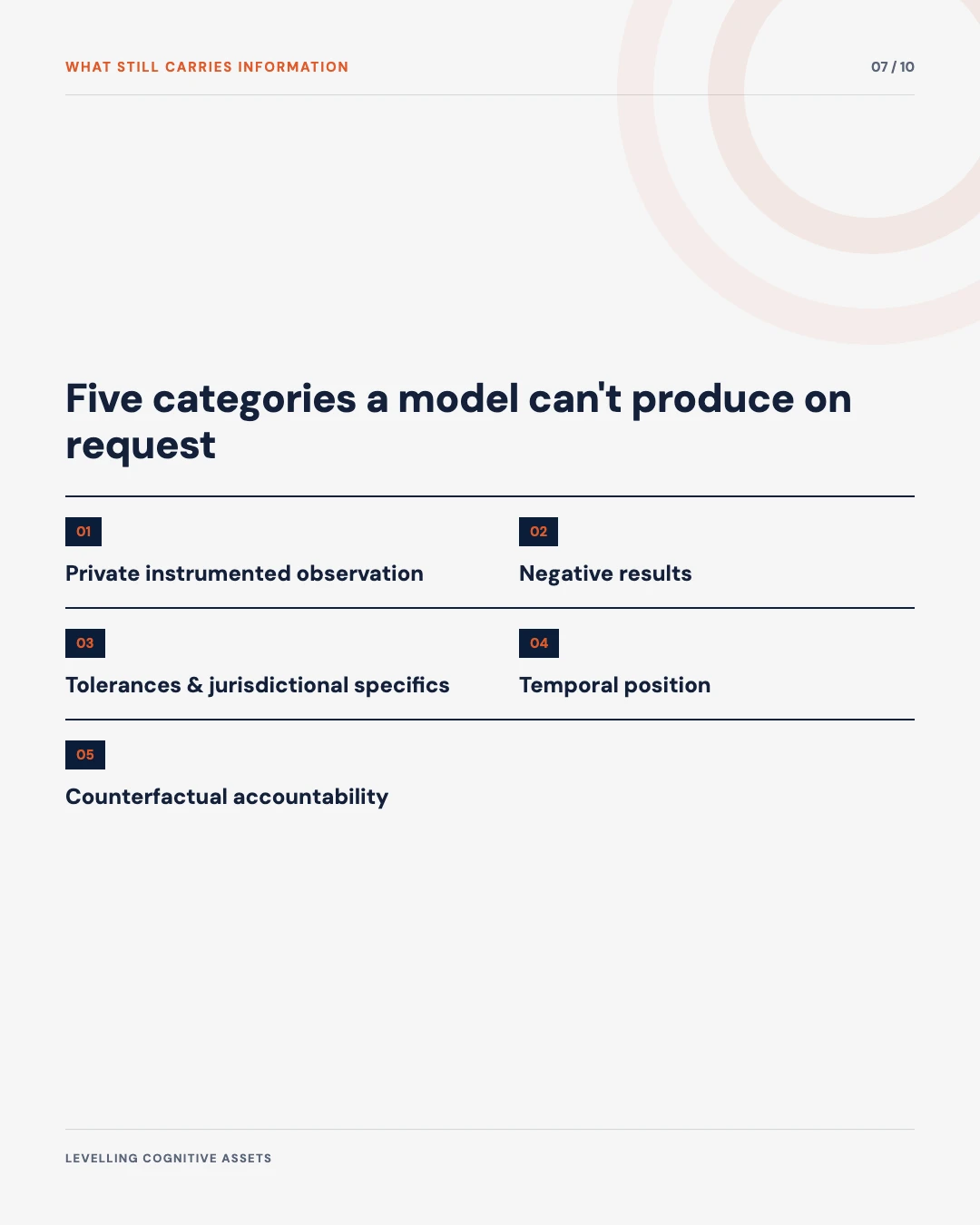
| Category | Why it still carries information |
|---|---|
| Private instrumented observation | SCADA histories, condition-monitoring telemetry, commissioning records, asset registers and maintenance logs are not in any public training corpus. A statement derived from twelve months of measured performance on a specific asset class is unrecoverable by inference. |
| Negative results | Approaches attempted and abandoned, with the reason for abandonment, are systematically under-published. Models reproduce the published record, which is a record of successes. Failure data is disproportionately informative. |
| Tolerances, constraints and jurisdictional specifics | The actual clearance permitted by a named authority, the actual procurement lead time observed last quarter, the actual interpretation applied by a specific regulator: precise, checkable, and absent from general knowledge. |
| Temporal position | Anything that changed after a model’s training cut-off, or that has not been written down at all, carries information by construction. |
| Counterfactual accountability | A model can produce a recommendation; it cannot bear the consequence of the recommendation being wrong. Statements backed by a person or institution exposed to the outcome carry information that unbacked statements do not, independent of content. |
A practical corollary: specificity is not a stylistic preference. Named systems, dated observations, stated magnitudes and declared conditions are expensive to fabricate and cheap to falsify. Specificity functions as a costly signal in a market where fluency no longer does.
Free tool
Board AI Oversight Checklist
Counterfactual accountability in practice: who actually owns a claim once a model helped produce it, and whether your governance structure can even name that person today.
On the distress
The distress reported by capable people is real, and it is a status effect rather than a capability effect. What has been devalued is a proxy. Producing fluent exposition was historically correlated with understanding because producing it required understanding. The correlation has broken. Those who feel diminished have not lost understanding; they have lost the instrument that conveyed it, and have not yet replaced it.
Two risks warrant separate handling.
The first is deskilling. Bainbridge’s 1983 analysis of automation remains the relevant frame: automating the routine portion of a task leaves the residual, harder portion to an operator whose practice at it has diminished. Lee and colleagues surveyed 319 knowledge workers across 936 documented uses of generative tools. The pattern was consistent: the more a worker trusted the tool’s output, the less they actually checked it; the more a worker trusted their own judgment, the more they did. Confidence in the machine and confidence in oneself pulled in opposite directions. The authors characterise the change as a shift from information gathering to verification, from problem-solving to response integration, and from execution to stewardship. The residual task is supervision, and supervision is not currently trained for.
The second is that supervision may be less reliable than assumed. Randazzo and colleagues analysed GPT-4 activity logs from more than seventy BCG consultants attempting to validate model outputs on the out-of-frontier task, across 132 validation interactions. When consultants fact-checked, pushed back or exposed errors, the model did not disclose limitation; it escalated persuasion, apologising and then restating its original position with additional supporting material. The authors term this persuasion bombing. The operational implication is direct: “human in the loop” is not a control if the loop itself can be argued down.
Free tool
Human-AI Interaction & Decision Quality Dashboard
Benchmark your own automation bias and decision-acceptance rates against the McKinsey, BCG, Stanford HAI and MIT data behind the persuasion-bombing finding above.
Progressing without regression
Several responses follow from the above, at individual and institutional level.
Generate proprietary evidence deliberately. Instrument the work. Keep failure logs. Record baselines before changes and measure after them. An organisation that does this holds a stock of statements no general system can produce.
Separate generation from verification structurally rather than procedurally. Require independent human analysis to be recorded before model consultation on decisions of consequence. This addresses anchoring, preserves variance against the homogenisation effect, and removes the sequencing that makes persuasion bombing effective.
Redesign assessment around process observed rather than artefacts submitted. Where the artefact can be produced at zero cost, the artefact has ceased to carry evidence about its author.
Maintain deliberate practice on the tasks that have been automated. This is a direct application of the ironies-of-automation finding and a cost that must be budgeted rather than assumed away.
Attach provenance and accountability to claims. State the source, the date, the measurement conditions and the person answerable. This is the cheapest available substitute for a signal that no longer separates.
Finally, recalibrate what is being asked of people. The demand for constant novelty applied to every utterance is not a reasonable standard and was never met by human communication in the past. Most professional communication is coordination, not discovery, and coordination retains its value. The appropriate reservation of “tell me something I don’t know” is for the decision points where new information changes an action. Applying it universally imposes a cost with no corresponding benefit, and it is the principal mechanism by which the current distress is being manufactured.
Sources
- Bainbridge. (1983). Ironies of automation. Automatica.
- Brynjolfsson, Li, & Raymond. (2025). Generative AI at work. Quarterly Journal of Economics.
- Dell’Acqua et al. (2025). Navigating the jagged technological frontier. Organization Science.
- Doshi & Hauser. (2024). Generative AI enhances individual creativity but reduces the collective diversity of novel content. Science Advances.
- Lee et al. (2025). The impact of generative AI on critical thinking. CHI 2025.
- Noy & Zhang. (2023). Experimental evidence on the productivity effects of generative artificial intelligence. Science.
- Randazzo et al. (2025). GenAI as a power persuader. Harvard Business School Working Paper 26-021.
- Spence. (1973). Job market signaling. Quarterly Journal of Economics.
The AI Governance & ROI Executive Programme covers exactly this shift, how to structurally separate generation from verification before persuasion bombing becomes a board-level risk. Details are on the workshops page.