
Executive Summary
Layer 8’s theory is one thing; shipping it to production is another. This is the engineering checklist for the contract boundaries, routing thresholds, memory architecture, and failure modes that a normal test suite won’t catch.
Core conclusions
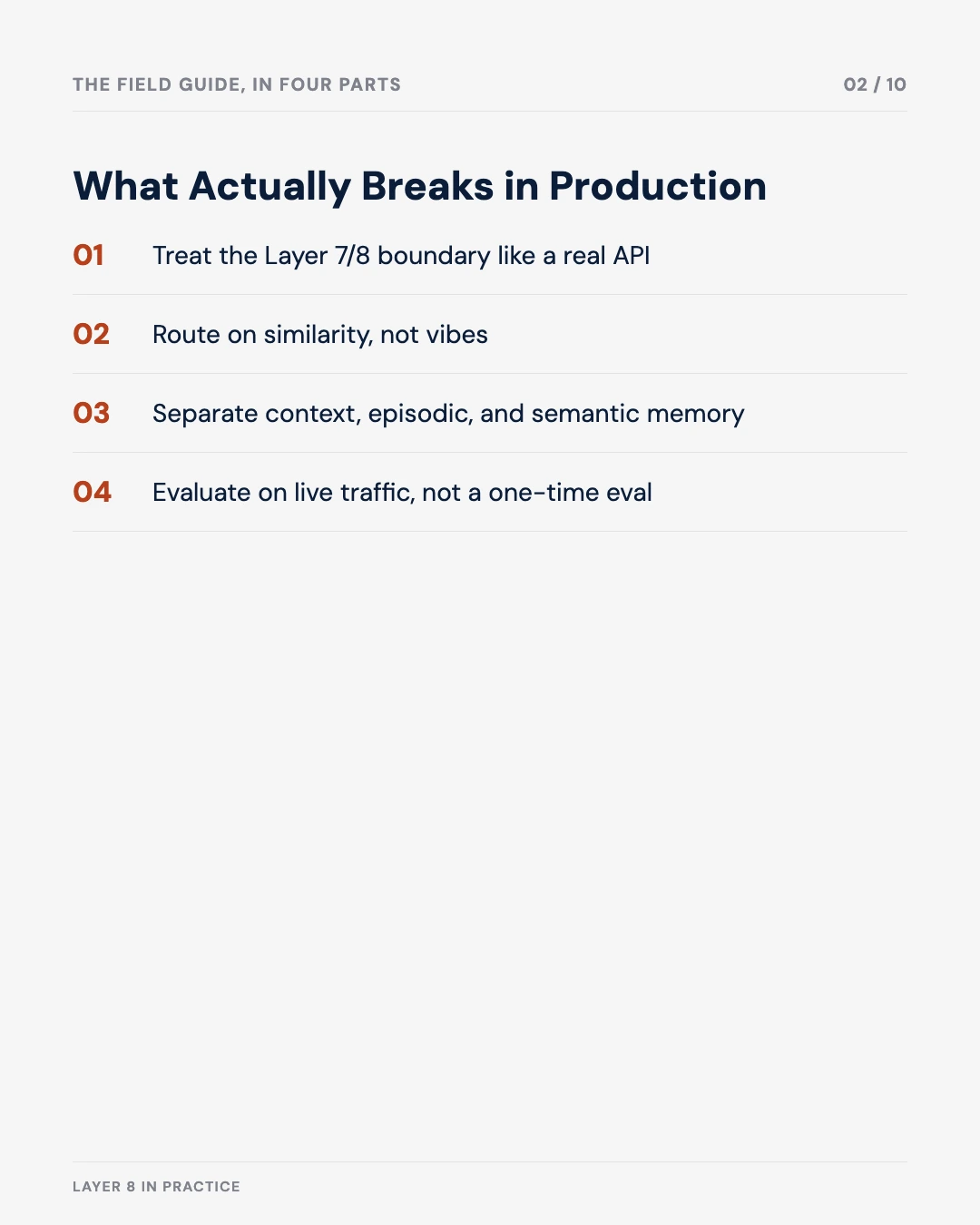
- Treat the Layer 7/8 boundary as a versioned API contract, not a bolted-on function call. Define the input envelope and keep output content, confidence score, and tool-call metadata separate.
- Match orchestration pattern and evaluation rigor to task risk: single-pass for narrow tasks, reflection/self-critique reserved for high-stakes calls, and faithfulness/relevance measured continuously on live traffic, not a one-time offline eval.
- Keep short-term context, episodic memory, and semantic memory in genuinely separate systems, and treat routing thresholds as config to revisit, not constants set once at launch.
The field guide, in ten slides
Save it, share it, or send it to whoever’s actually wiring this into production.

The Eighth Layer laid out the theory: enterprise software has a new tier sitting above Layer 7, one that has to translate unpredictable AI reasoning into governed, auditable action. This one’s for whoever’s actually wiring that into production. Less “architectural framework,” more “here’s what breaks and how to stop it breaking.”
Field Guide at a Glance
Layer 8 Engineering Checklist
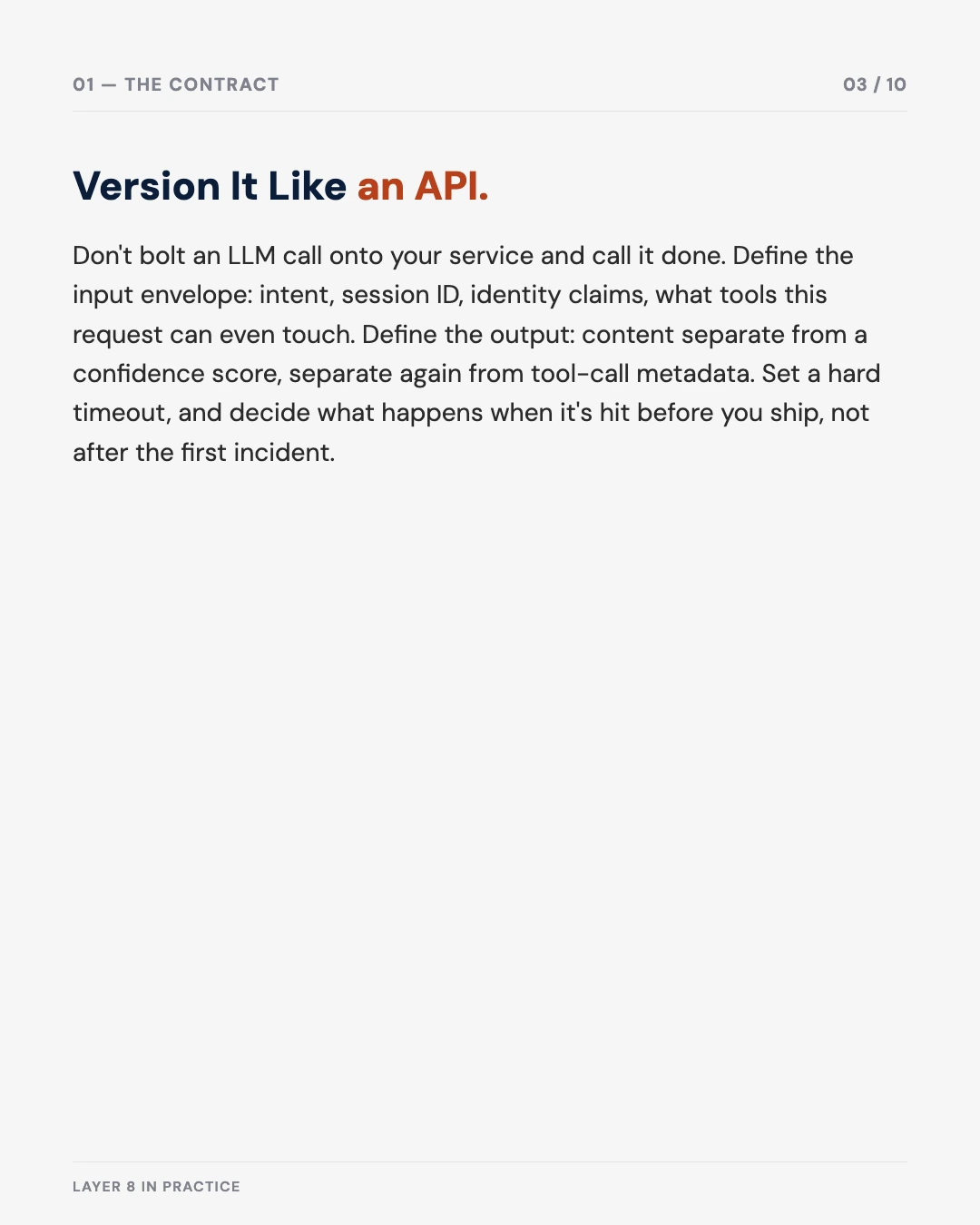
01 — The Contract
Version it like an API. Never merge these into one blob of text.
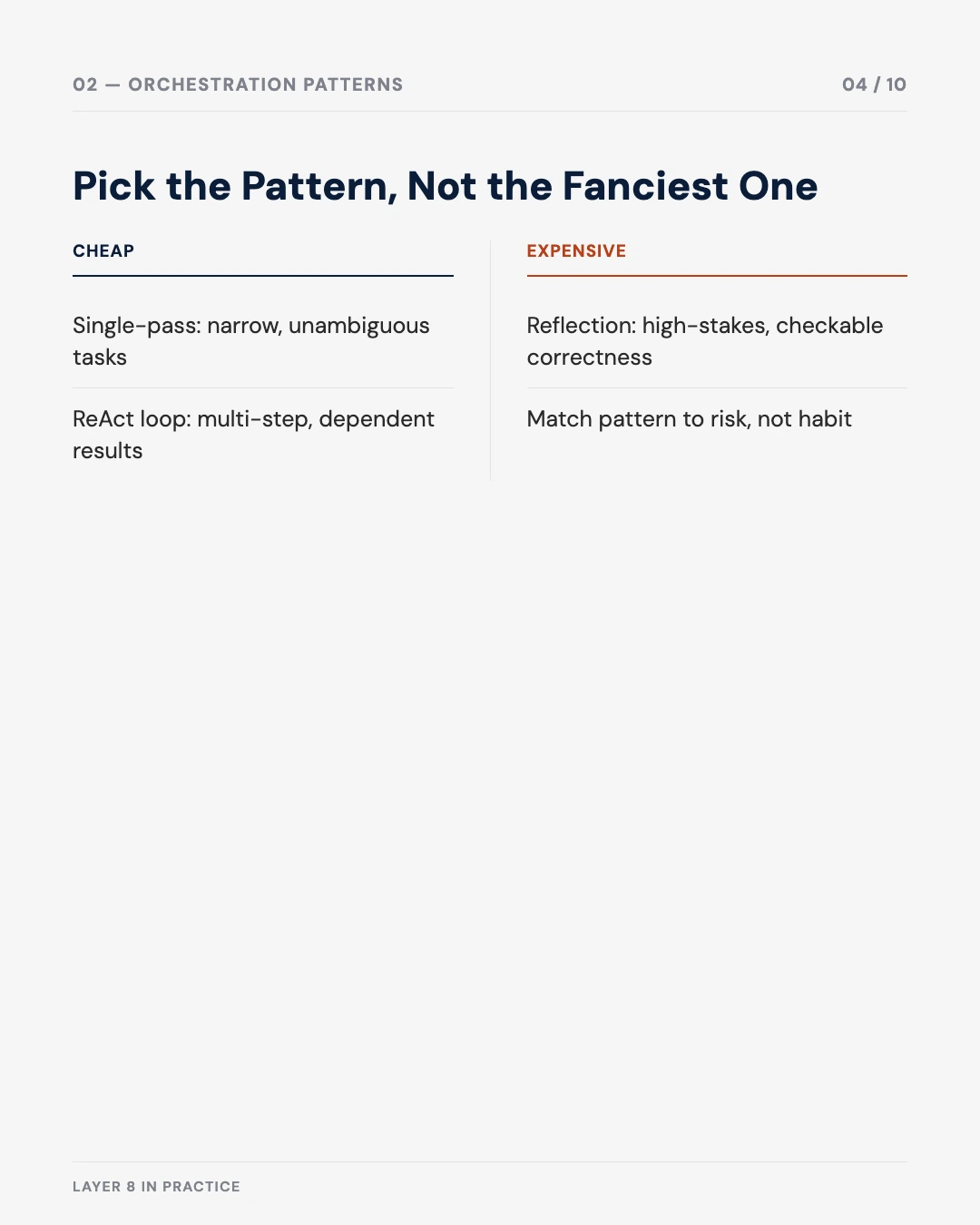
02 — Orchestration Patterns
| Pattern | Cost | Best for |
|---|---|---|
| Single-pass | Low | Narrow, unambiguous tasks |
| ReAct-style loop | Medium | Multi-step, dependent results |
| Reflection / self-critique | High | High-stakes, checkable correctness |
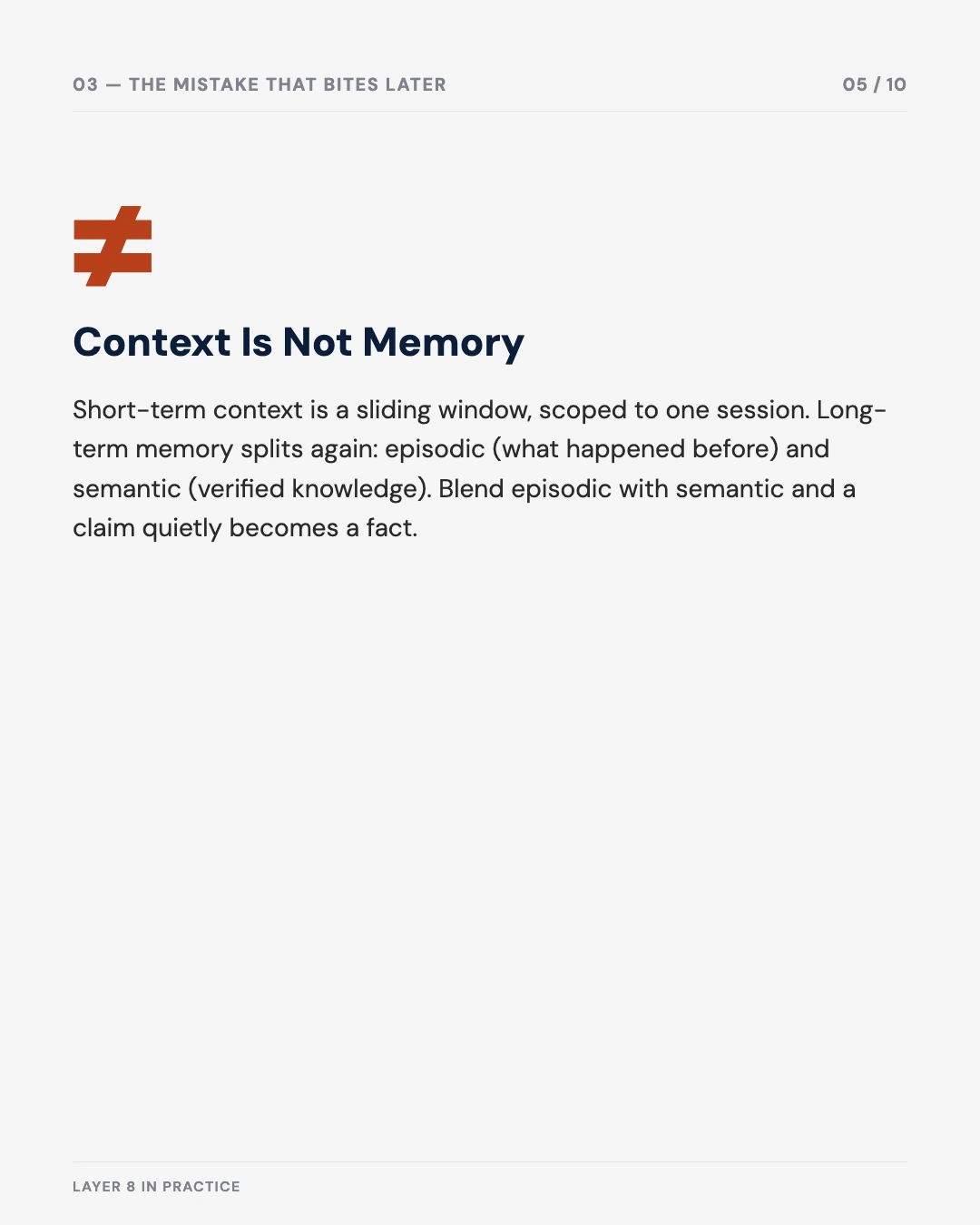
03 — Memory Architecture
Blend episodic with semantic and a claim becomes a fact. Keep them separate.
04 — Evaluate & Secure
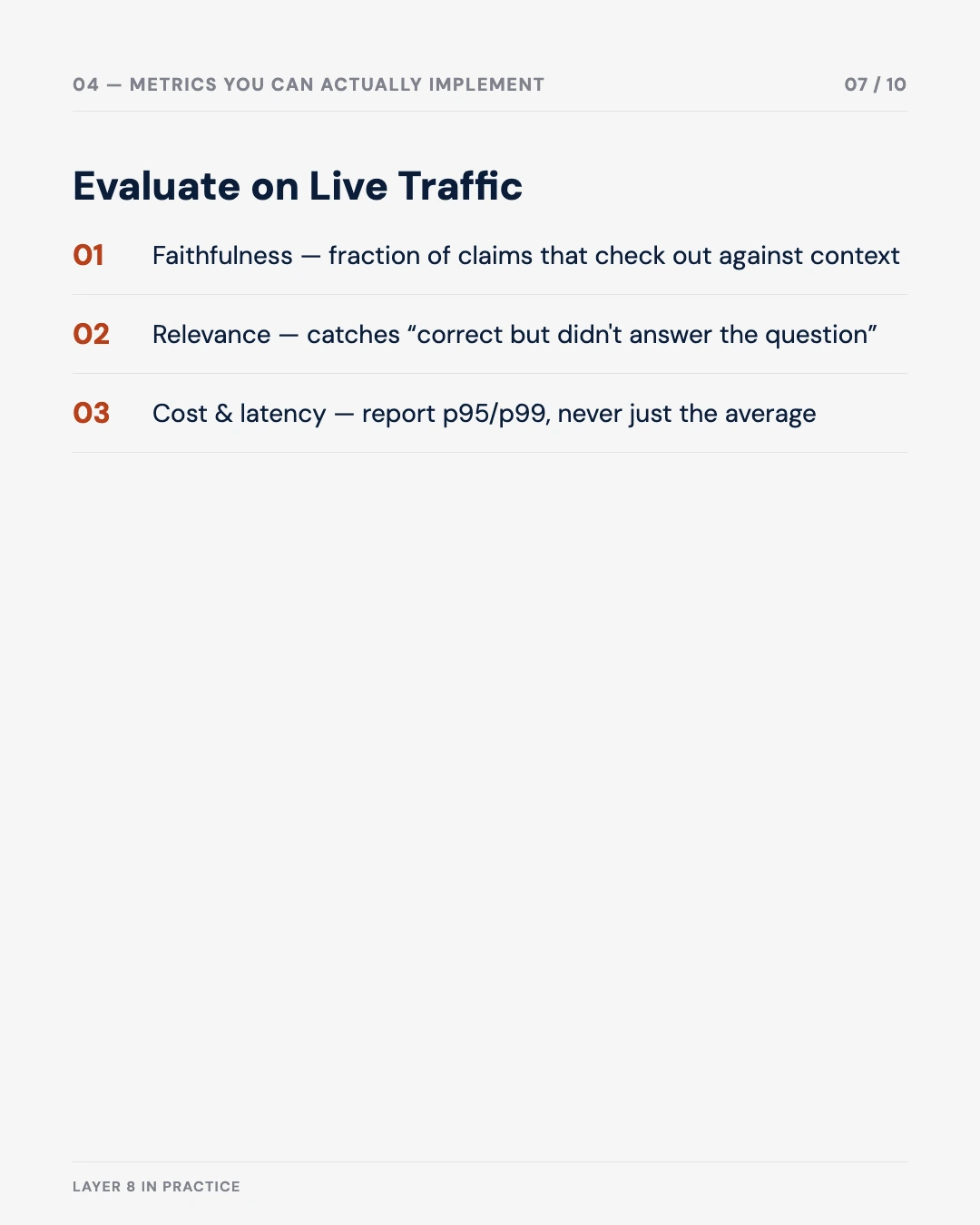
- Faithfulness and relevance, measured continuously on live traffic — not a one-time offline eval.
- Report p95 / p99 latency. Averages hide the tail that breaches your SLA.
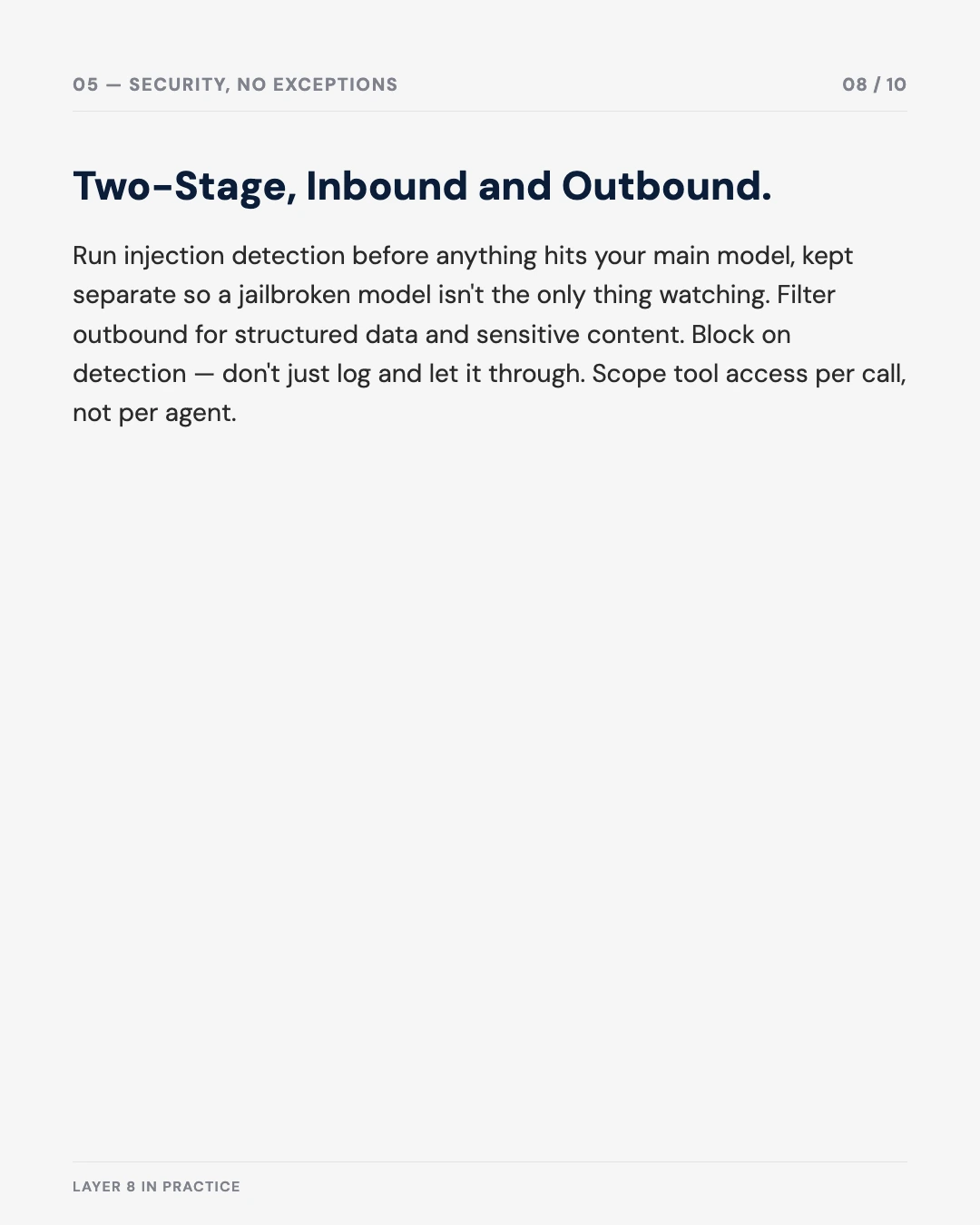
- Two-stage security: inbound injection detection, then outbound sensitive-content filtering. Block, don’t just log.
1. Stop Treating the Layer 7/8 Boundary Like a Function Call
It’s tempting to bolt an LLM call onto your existing service and call it done. Don’t. Treat it like any other API contract you’d version and deprecate properly:
- Define the input envelope: intent, session ID, identity claims, what tools this request is even allowed to touch.
- Define the output: content separate from a confidence/faithfulness score, separate from the list of tools it called, separate from a pass/fail compliance flag. Don’t smoosh these into one blob of text.
- Set a hard timeout and decide what happens when it’s hit — cached answer, rules-based fallback, or “hand this to a human.” Pick one before you ship, not after the first incident.
The annoying bit: the model vendor can change behaviour under you with zero code changes on your end. Your contract is the only thing standing between silent drift and someone noticing.
2. Semantic Routing: Don’t Just Vibe-Check Your Threshold
The point is to avoid calling the expensive model for stuff you’ve seen a thousand times.
- Embed the incoming request, do a nearest-neighbour lookup against your known-intent library (
HNSW/IVF, whatever your vector store gives you). - Below some similarity threshold, you don’t trust the match — send it to the real model instead of a cached or templated answer.
- Log every routing decision with its similarity score. You will want this later when someone asks why a weird request got routed to the cheap path.
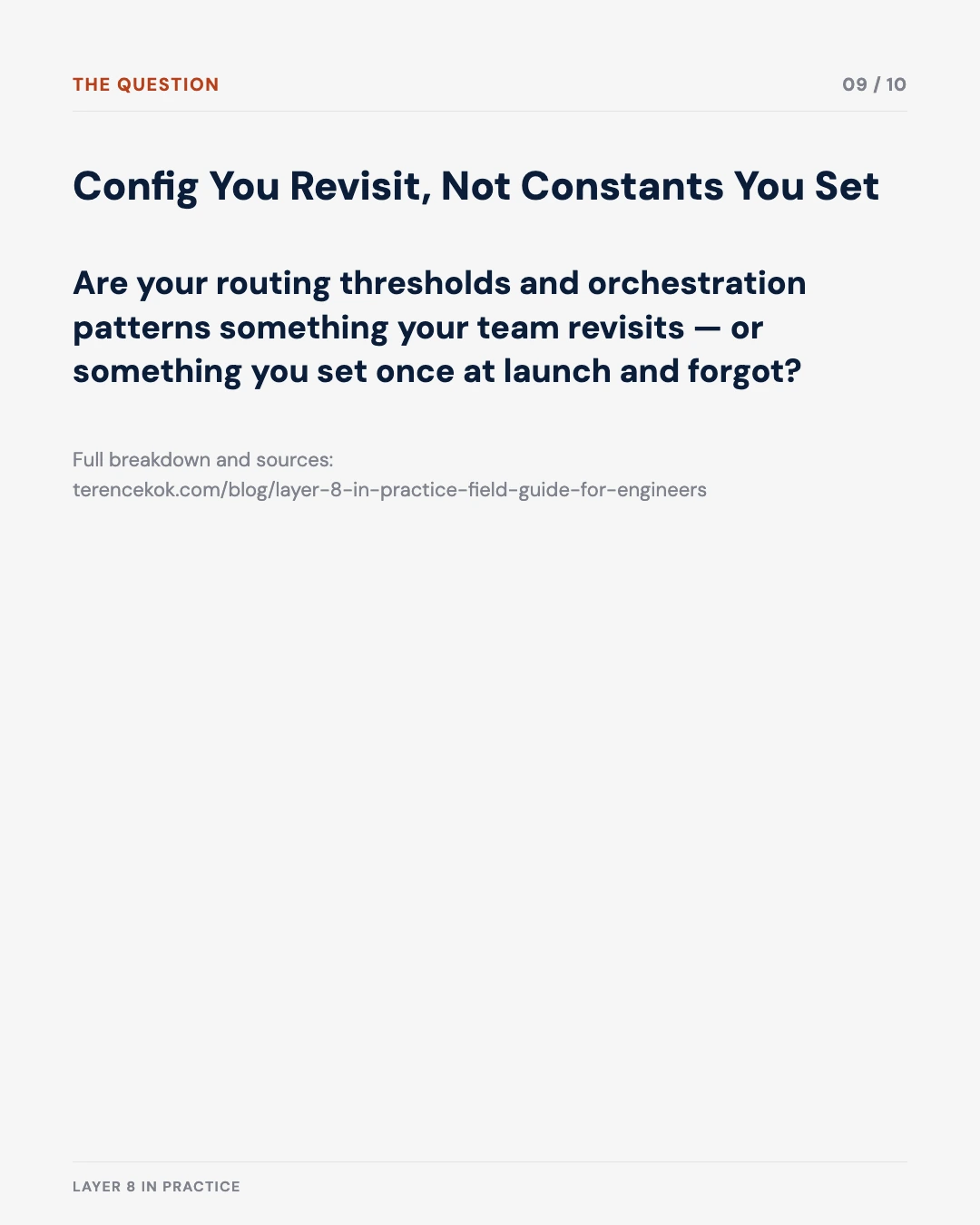
Don’t set the threshold once and forget it. Intent distribution moves. Check your false-route rate periodically or you’ll find out about drift from an angry user, not a dashboard.
3. Pick Your Orchestration Pattern Based on How Much You Actually Need It
Three flavours, roughly in order of how much pain you’re willing to pay for:
- Single-pass: one call, straight to the answer. Cheap, fast, fine for narrow tasks. Falls over on anything ambiguous or multi-part.
- ReAct-style loops: reason, call a tool, look at the result, reason again. You need this when step three depends on what step one returned. Costs more, obviously.
- Reflection/self-critique: generate, then have a second pass (same model or a different evaluator) grade it before it goes out. Genuinely improves quality on stuff with checkable correctness, but it’s the most expensive option — save it for the high-stakes calls, don’t run it on everything by default.
Good systems pick the pattern per request based on complexity and risk, not one pattern for the whole app.
4. Don’t Conflate Short-Term Context With Long-Term Memory
This is the mistake that bites people later. Two very different things:
- Short-term context: a sliding window, scoped to one session, lives in Redis or memory, gets cleared or summarised when the session ends.
- Long-term memory — and this splits into two more things:
- Episodic: what happened in past sessions. Vector DB, filterable by user, time, and domain.
- Semantic: your actual verified domain knowledge — knowledge graph, curated docs, whatever.
Why it matters: if you blend episodic and semantic memory, your system can end up treating “a user claimed X three weeks ago” as if it were “X is an established fact.” That’s a bad day. Keep them separate, and log what got retrieved from where — you’ll need that for faithfulness checks anyway.
5. Evaluation: Metrics You Can Actually Implement
- Faithfulness: break the output into individual factual claims, check each one against the retrieved context (an NLI model or a dedicated verifier). Score is the fraction of claims that actually check out. Run this continuously on live traffic, not just your offline eval set — your knowledge base changes, so yesterday’s faithfulness score doesn’t tell you much about today.
- Relevance: cosine similarity between the intent embedding and the response embedding —
Sim(A, B) = (A · B) / (‖A‖ ‖B‖). Watch for the combination of high faithfulness and low relevance: that’s “technically correct, didn’t answer the question,” and it needs a different fix than a factual-accuracy problem. - Cost and latency: report p95/p99, not averages. Averages hide exactly the tail behaviour that triggers your SLA breaches and your angriest Slack messages.
6. Security: Two-Stage, Inbound and Outbound, No Exceptions
- Inbound: run a dedicated injection-detection classifier before anything hits your main orchestration model. Keep it separate from the primary model — if the main model gets jailbroken, you want something else still watching.
- Outbound: NER and regex for structured data (IDs, account numbers, API keys) plus a classifier for fuzzier sensitive content. Block on detection, don’t just log and let it through — you can’t un-leak something after it’s already out the door.
- Tool scoping: least-privilege per tool call, not per agent. An agent that can read a customer record shouldn’t automatically be able to write to it. Scope and revoke individually.
7. Failure Modes Your Normal Test Suite Won’t Catch
- Semantic drift: the system’s read on what a request means slowly diverges from what you actually intended, usually because the underlying model got updated or usage patterns shifted. You catch this with ongoing monitoring of faithfulness and relevance trends, not with a test you run once.
- Compounding errors in loops: one wrong reasoning step early in a ReAct loop can snowball into a confidently wrong final answer. Validate intermediate steps, not just the final output — by the time you’re checking the final answer, the damage is baked in.
- Threshold rot: whatever thresholds you tuned at launch will stop being right as your traffic shifts. Treat them as config you revisit, not constants you set once.
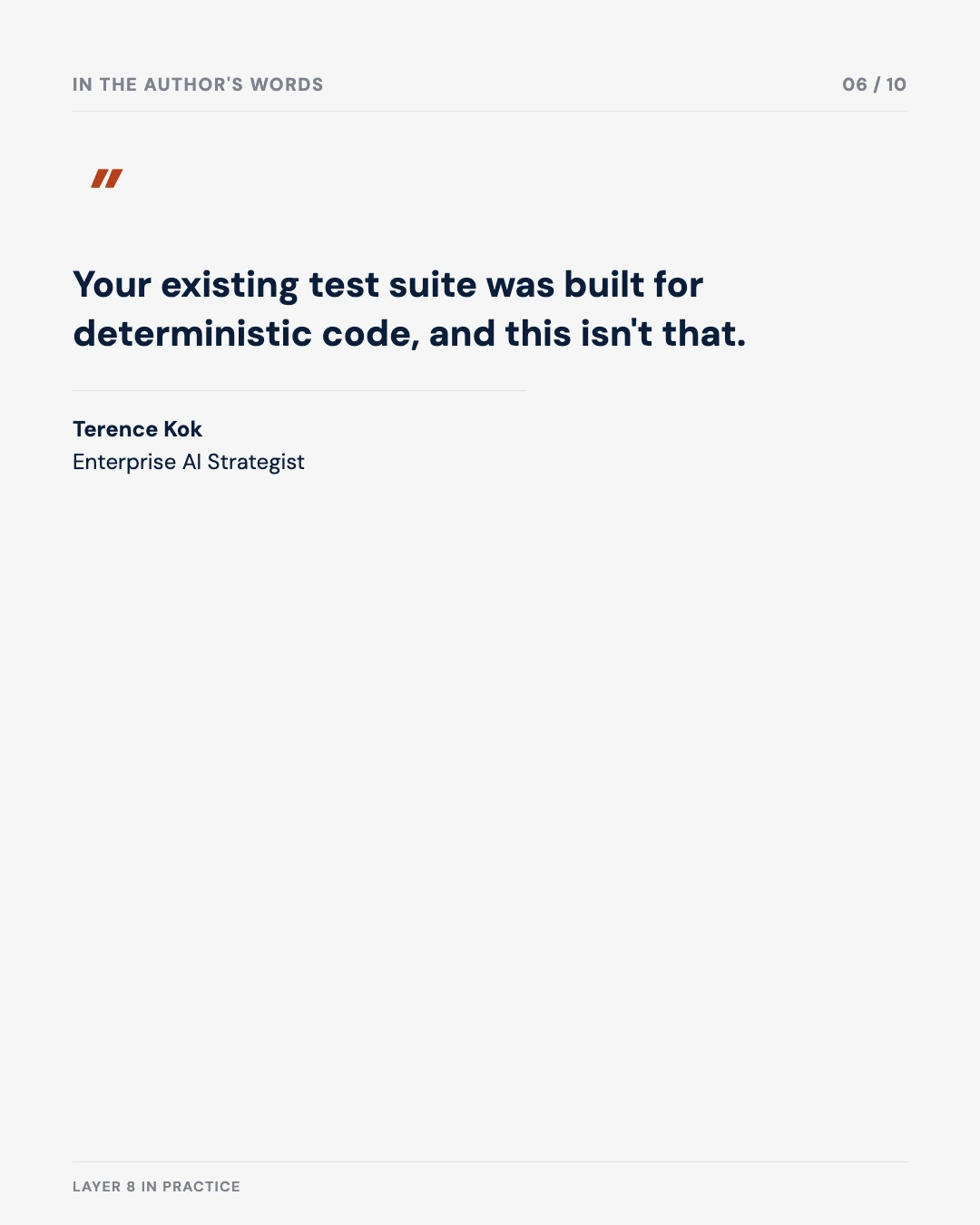
Version your Layer 7/8 contract like a real API. Don’t set-and-forget your routing thresholds. Match orchestration complexity to task complexity instead of defaulting to the fanciest pattern everywhere. Keep short-term context, episodic memory, and semantic memory in genuinely separate systems. Evaluate faithfulness and relevance continuously, on live traffic, with p95/p99 latency instead of averages. Filter both directions, block don’t just log. And build monitoring for drift and compounding errors, because your existing test suite was built for deterministic code, and this isn’t that.
Free tool
AI Trust, Risk & Governance Dashboard
Operationalises the guardrail and monitoring layer described above: threat detection, data lineage, and bias tracking for whatever you route through the Layer 7/8 boundary.
Free tool
TRACE Agent Evaluation
If your team is still deciding whether a use case warrants this level of architecture at all, score it on Traceability, Reversibility, Acceptance, Compliance, and Escalation first.