
Executive Summary
AI can replicate what you know faster than you can acquire it. What it cannot replicate (human judgement, trust, attitude, and the capacity to care) is becoming the primary source of competitive advantage for professionals and organisations alike.
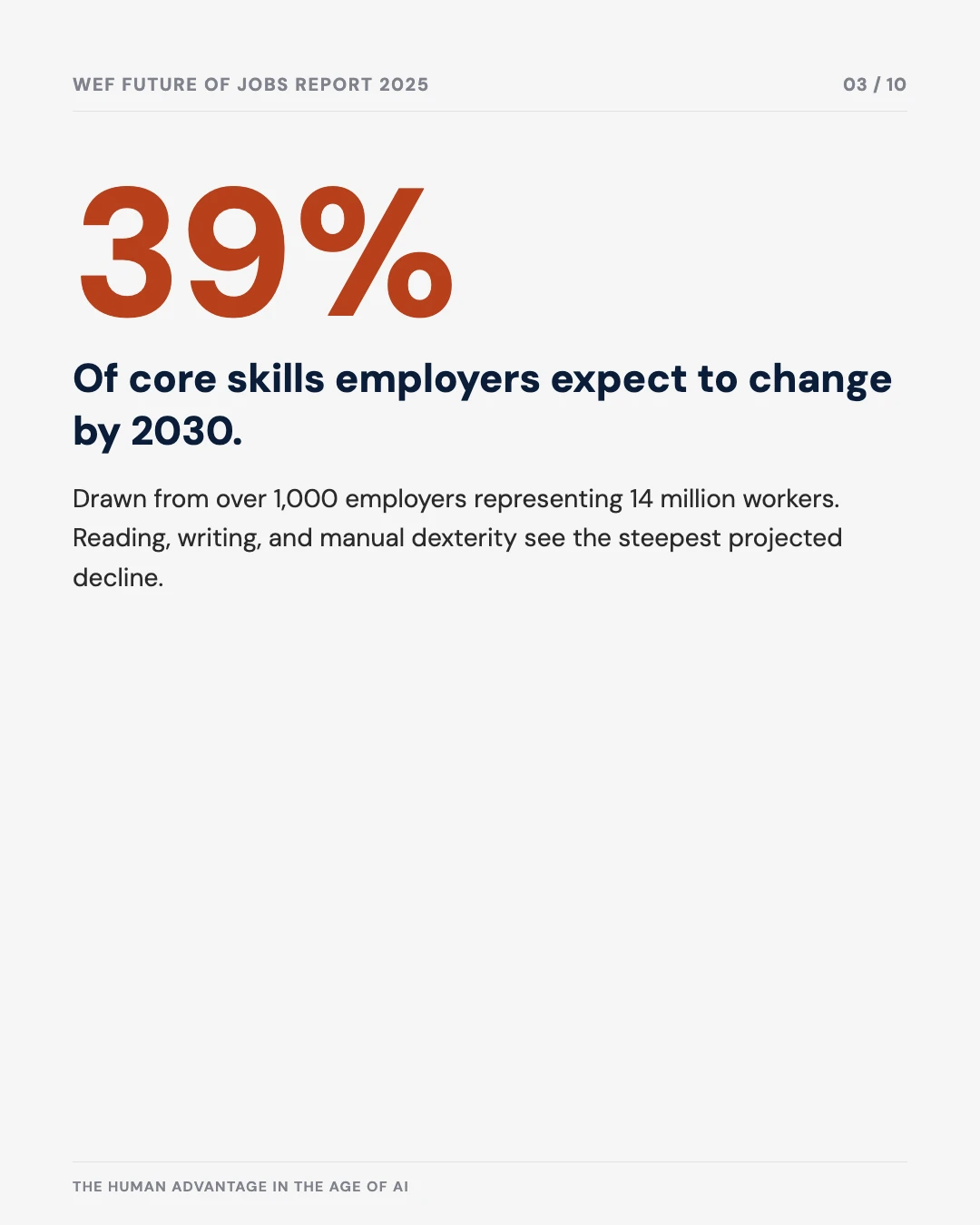
39%
of workers’ core skills expected to change by 2030, per WEF’s Future of Jobs Report 2025
Core conclusions
- Knowledge accumulation is no longer the primary source of professional value. AI absorbs and replicates documented expertise faster than any individual career can build it.
- Human qualities that resist automation (attitude, passion, teamwork, the capacity to share and to care, and the courage to transform) are becoming the defining source of competitive advantage.
- This is a reframing, not a consolation: technical competence still matters, but the professionals most in demand combine it with the human qualities AI cannot express.
The argument, in ten slides
Save it, share it, or send it to someone still betting their career on technical depth alone.
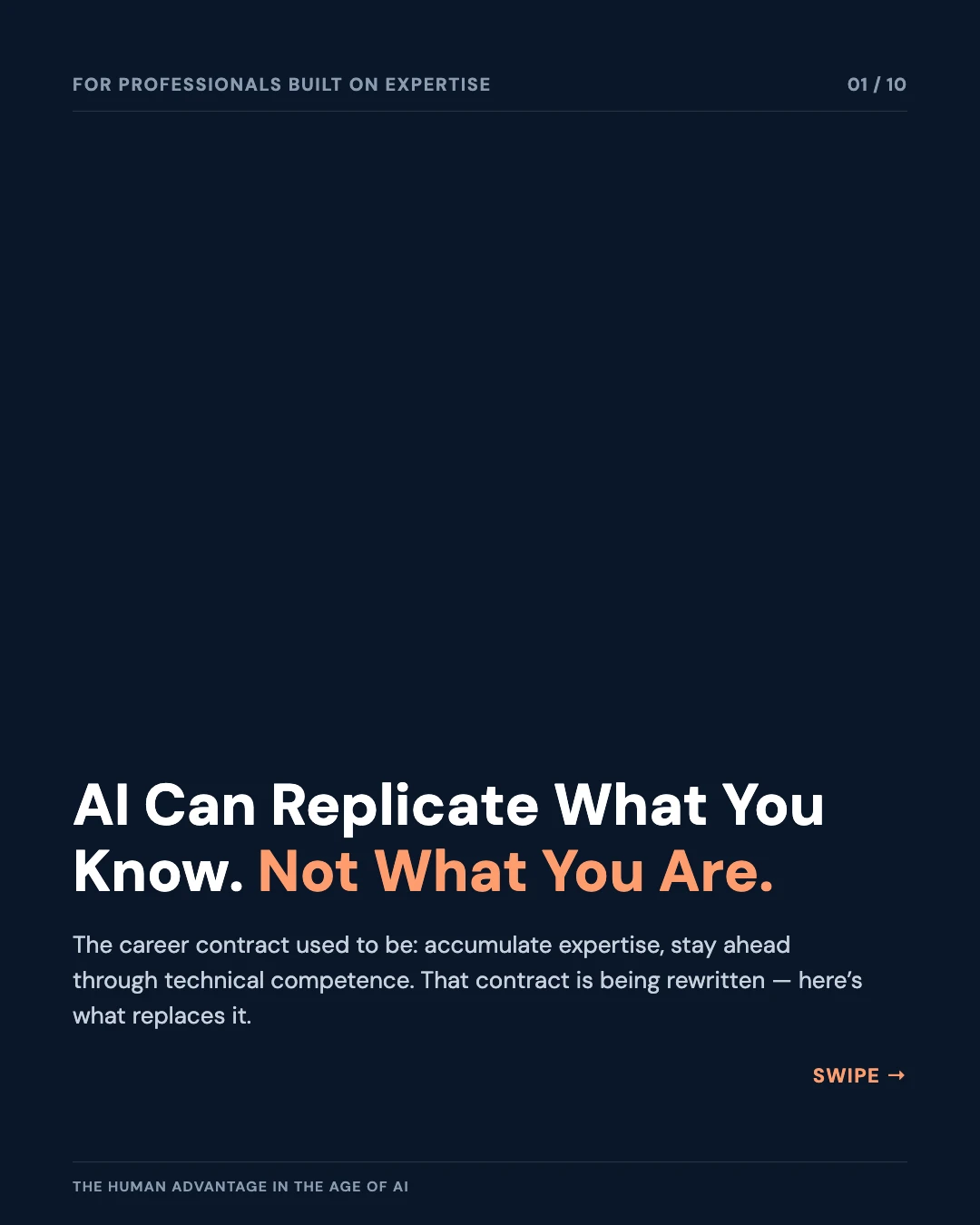
For most of my career, the unspoken rule was clear: accumulate expertise, build a deep knowledge base, and stay ahead through technical competence. The more you knew, the more valuable you were. That was the contract.
That contract is being rewritten.
What AI Has Already Changed
Artificial intelligence does not get tired. It does not forget. Every piece of expertise that enters its training pool, every documented process, every published insight, every captured workflow, compounds permanently across every AI instance simultaneously. The expert knowledge that once took decades to build and used to disappear when a senior colleague retired is now being extracted, structured, and made infinitely replicable.
The World Economic Forum’s Future of Jobs Report 2025 , drawing on the perspectives of over 1,000 leading employers representing more than 14 million workers, found that employers expect 39% of workers’ core skills to change by 2030.
Skills in reading, writing, mathematics, and manual dexterity, long considered foundational to knowledge work, are among those seeing the largest projected decline in demand. The gap between what a human expert accumulates over a career and what AI can absorb in seconds is not merely large; it is widening at an accelerating rate.
This is cause for clarity.
What AI Cannot Do
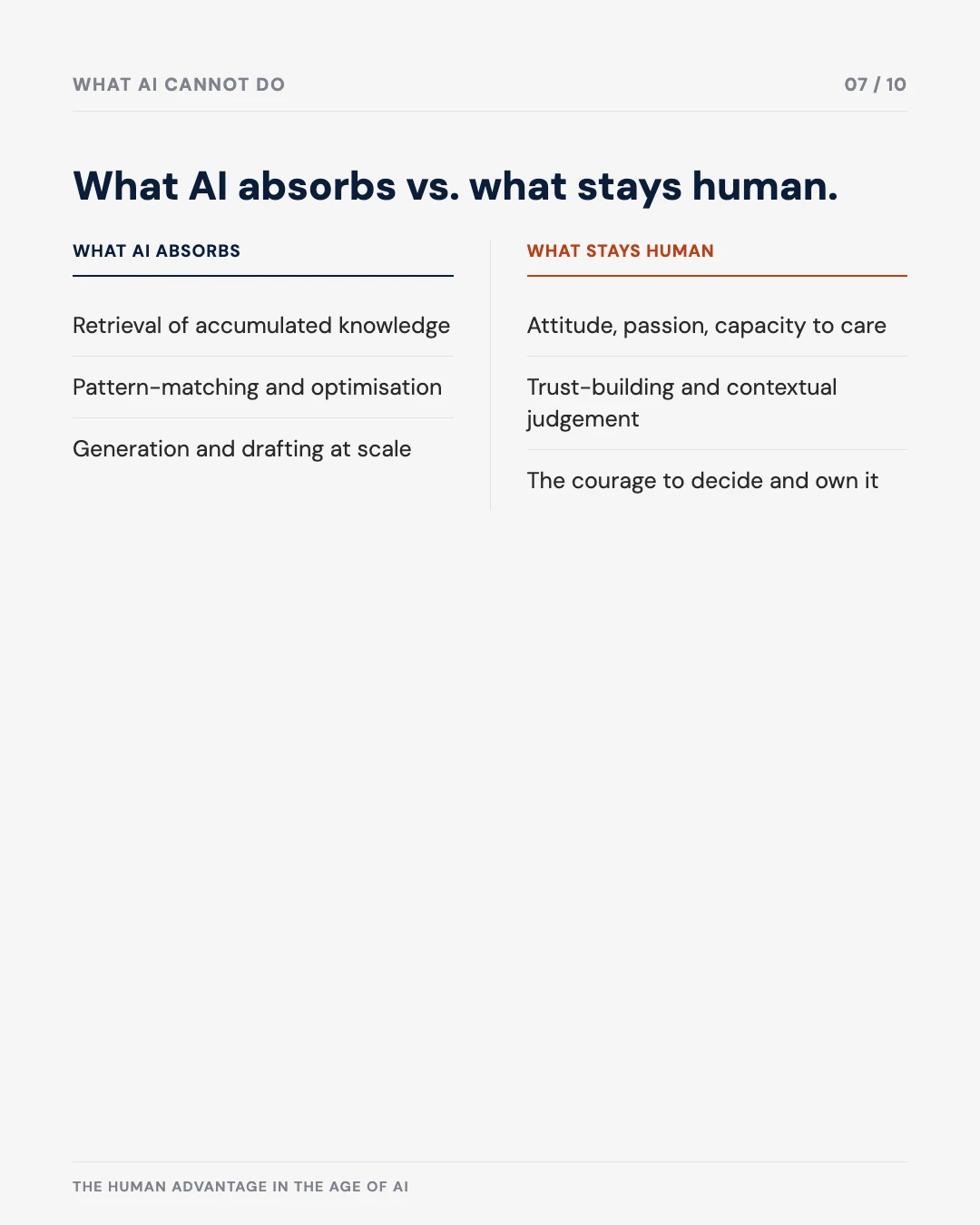
AI can process. It can pattern-match. It can generate, optimise, and recommend. What it cannot do is feel , choose , or lead .
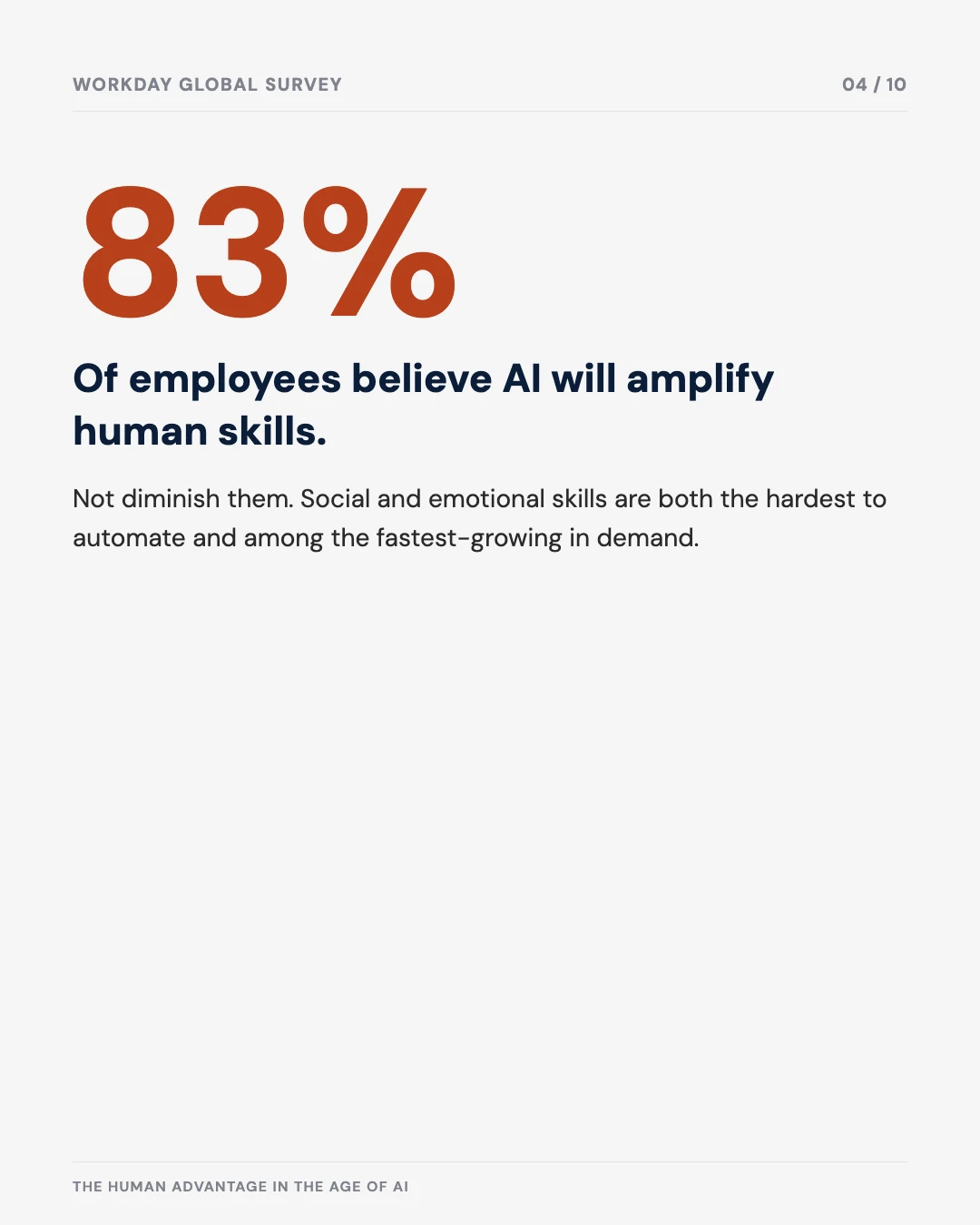
Most employees, in my experience advising on this shift, believe AI will amplify the importance of uniquely human skills. The research supports this. Social and emotional skills are both the hardest to automate and among the fastest growing in labour market demand.
Human connection, empathy, trust-building, and contextual judgement are competencies that are structurally irreplaceable, regardless of how capable AI systems become.
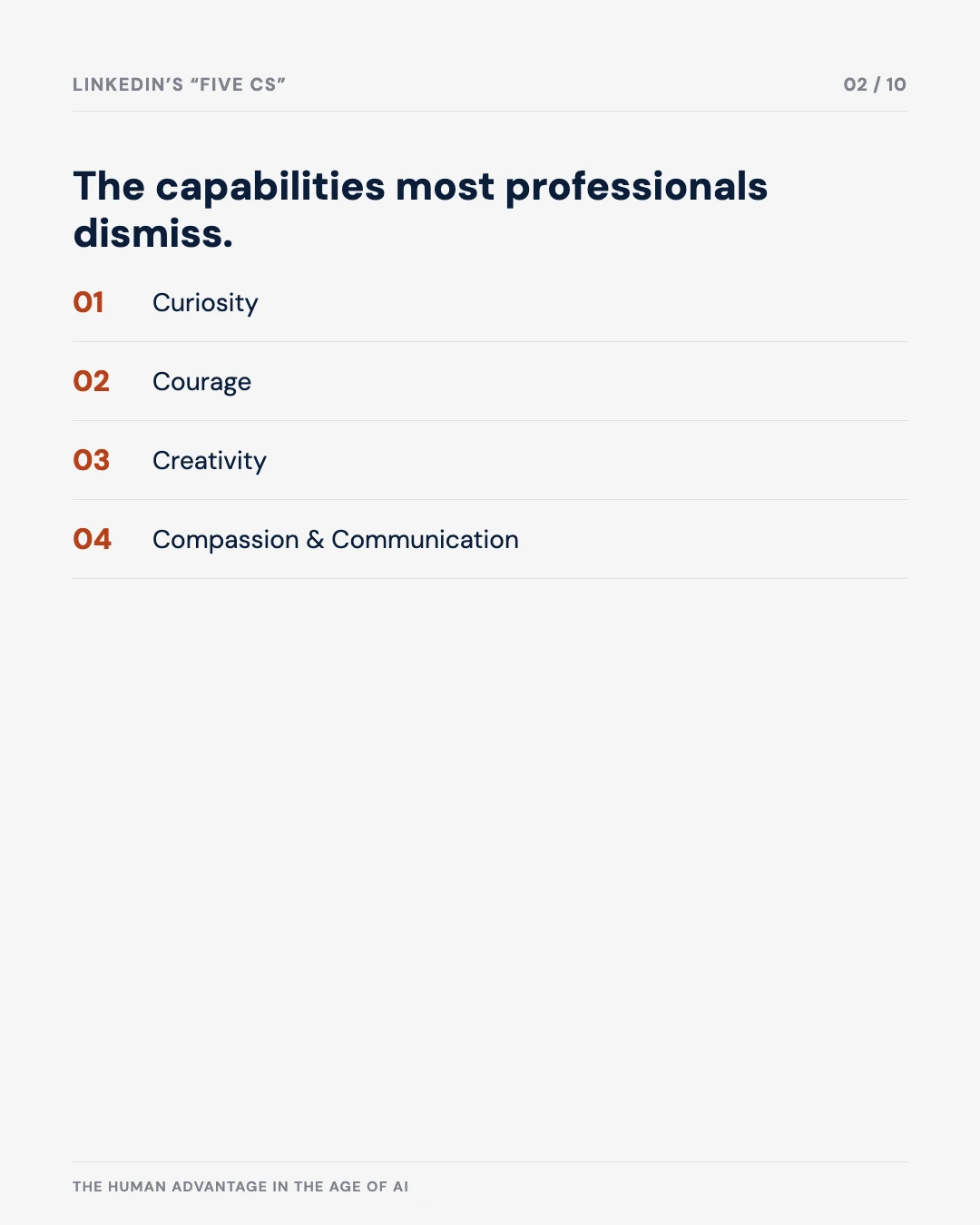
LinkedIn’s CEO Ryan Roslansky, working alongside organisational psychologists, behavioural economists, and talent management leaders, distilled this into five capabilities he describes as the “5 Cs”: Curiosity, Courage, Creativity, Compassion, and Communication . It is a similar structure to the five judgment muscles I have written about for HR leaders navigating the same shift. His observation is direct: most professionals are hyper-focused on AI and technical skills and completely dismiss the human ones. That, he argues, is the error.
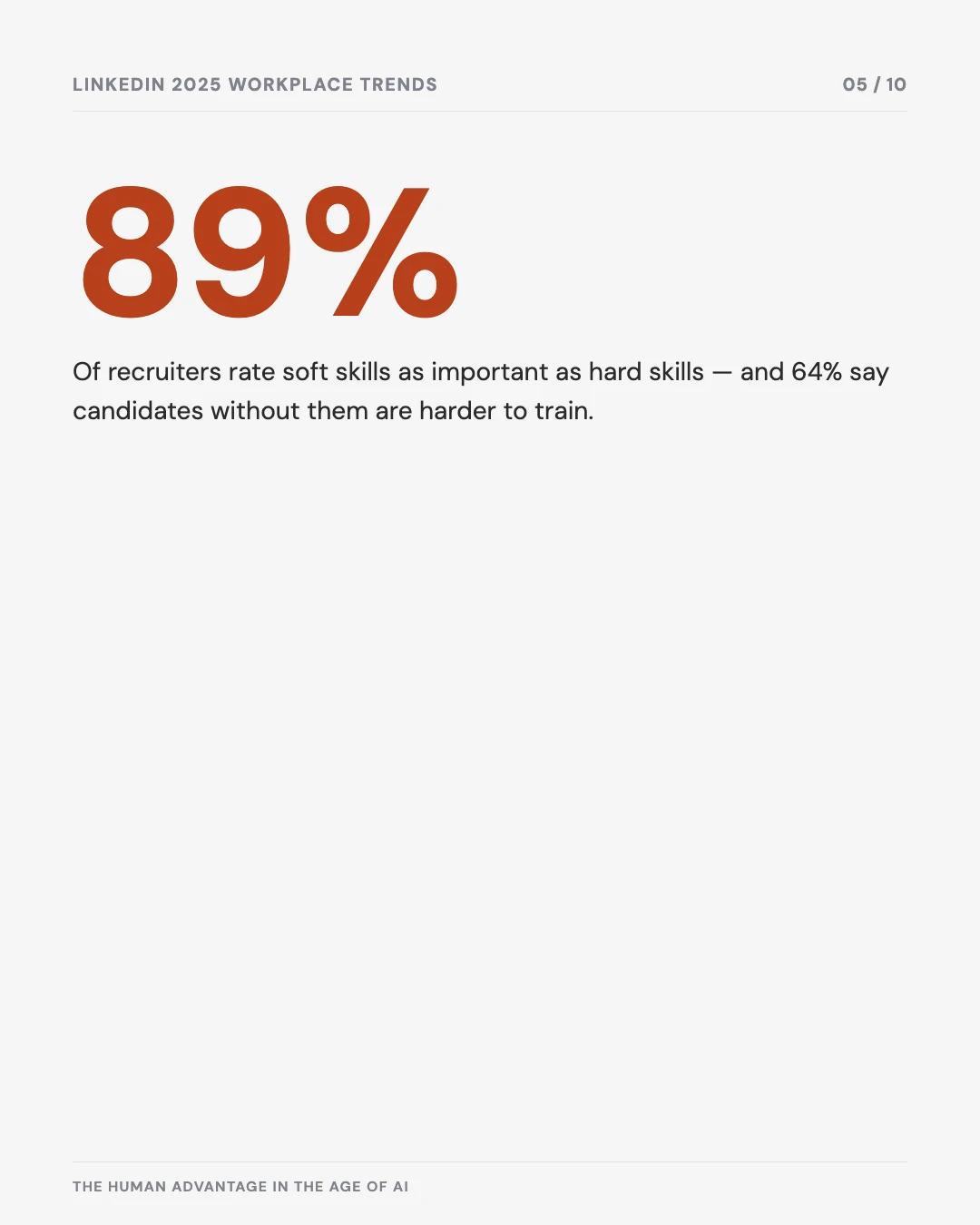
Recruiters increasingly consider soft skills as important as hard skills, and describe candidates who lack them as harder to train. This is not a marginal signal. It represents a structural shift in what organisations value.
The Qualities That Now Define Competitive Advantage
Attitude
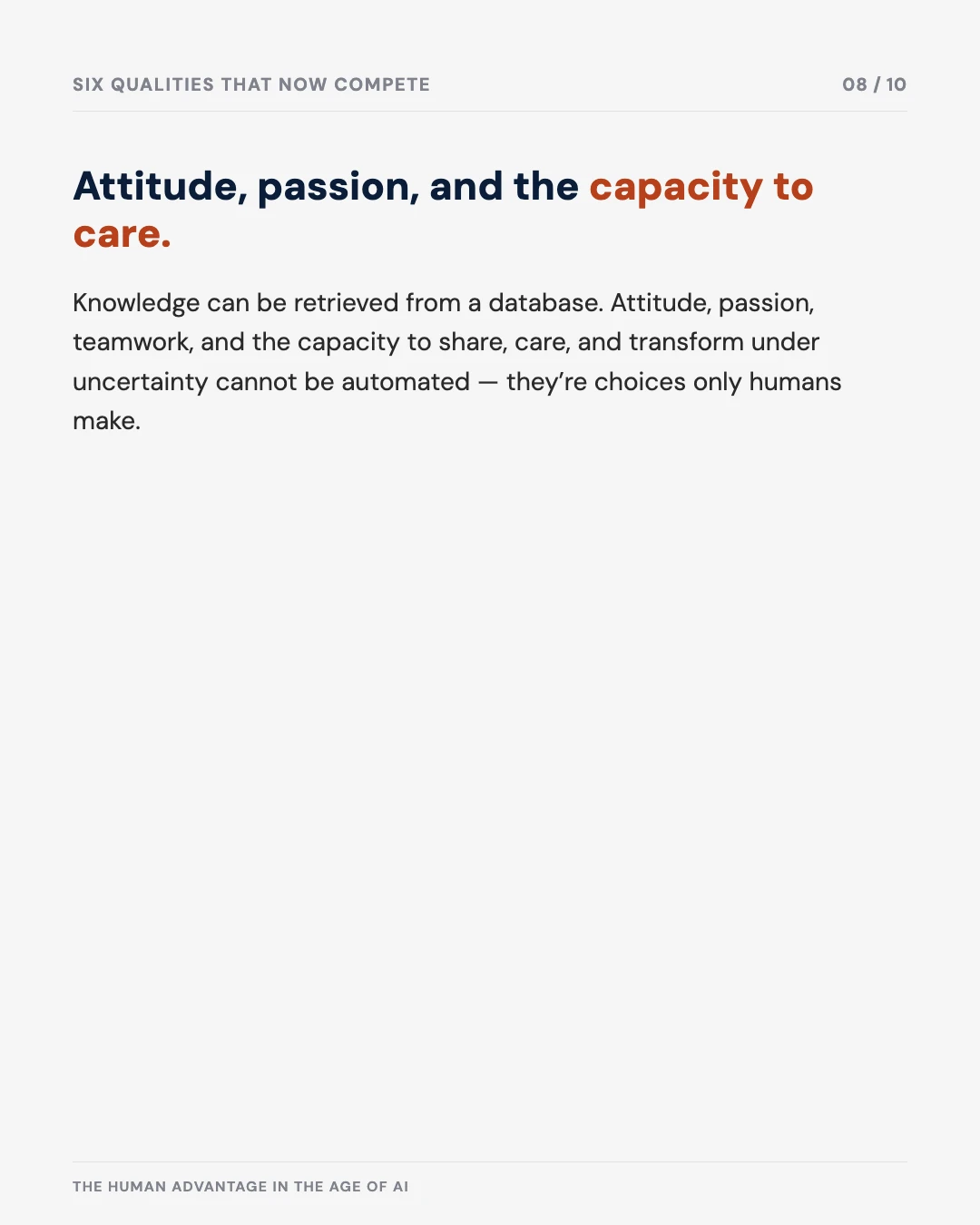
Knowledge can be retrieved from a database. Attitude cannot be automated. The disposition to approach problems with rigour, to hold oneself accountable when outcomes fall short, and to remain constructive when conditions are difficult, these are choices that only humans make. The Future of Jobs Report 2025 explicitly identifies resilience, adaptability, and agility as the second-most-desired skill set among employers by 2025. These are not technical attributes. They are expressions of character.
Passion
Passion drives the kind of effort that produces outcomes no model can optimise for, because passion is oriented toward meaning rather than efficiency. It sustains focus through ambiguity, motivates teams through difficulty, and generates the irrational commitment that underlies every significant innovation. LinkedIn’s data show that career paths are no longer linear; what distinguishes those who advance is not a five-year plan but the energy they invest in continuous, purposeful learning. Passion is the engine of that energy.
Teamwork and Collaboration
AI operates in isolation unless humans direct it toward a collective purpose. Research published in 2026 confirms that employee–AI collaboration positively enhances work engagement by increasing perceptions of meaningful work and creative self-efficacy, but only when AI is integrated into collaborative human structures. Teamwork enables cross-fertilisation of ideas, diverse perspectives, and the synthesis of domain knowledge that algorithms cannot generate independently. The organisations that outperform will not be those with the most capable AI; they will be those whose human teams direct AI most effectively toward shared objectives.
The Capacity to Share
Knowledge hoarding was a source of leverage in the pre-AI era. In the current environment, it is a liability. The professionals and organisations that compound value are those who share: who document what they know, contribute to collective intelligence, and build institutional capability beyond individual tenure. It’s a strategic calculation, not altruism: organisations that build cultures of open knowledge transfer create adaptive systems that outlast any single contributor.
The Capacity to Care
Emotional intelligence, the ability to recognise, understand, and respond to emotions in oneself and in others, is the foundation of leadership, conflict resolution, and stakeholder management. AI can simulate concern. It cannot feel it. In governance, infrastructure, and public sector environments, where the consequences of decisions are measured in livelihoods and community outcomes, the capacity to care is not a soft quality. It is a professional requirement.
The Capacity to Transform
Transformation is a human act. It requires the courage to act without complete information, to proceed despite uncertain outcomes, and to accept accountability for what follows. AI can model risk. It can assign probabilities. Only humans decide which risks are worth taking and why. As LinkedIn’s CEO observed: what we pay attention to, what we choose, and what we act on, that remains ours. The ability to transform organisations, systems, and communities is anchored in that distinctly human capacity for moral agency.
Technical competence still matters
This is not an argument that technical competence no longer matters. It does. The WEF projects 170 million new roles by 2030, many of which will require digital fluency, AI literacy, and data capability. The professionals most in demand will combine technical grounding with the human qualities described above, which some analysts are calling an “M-shaped” profile: two spikes of capability connected by lived experience and judgement.
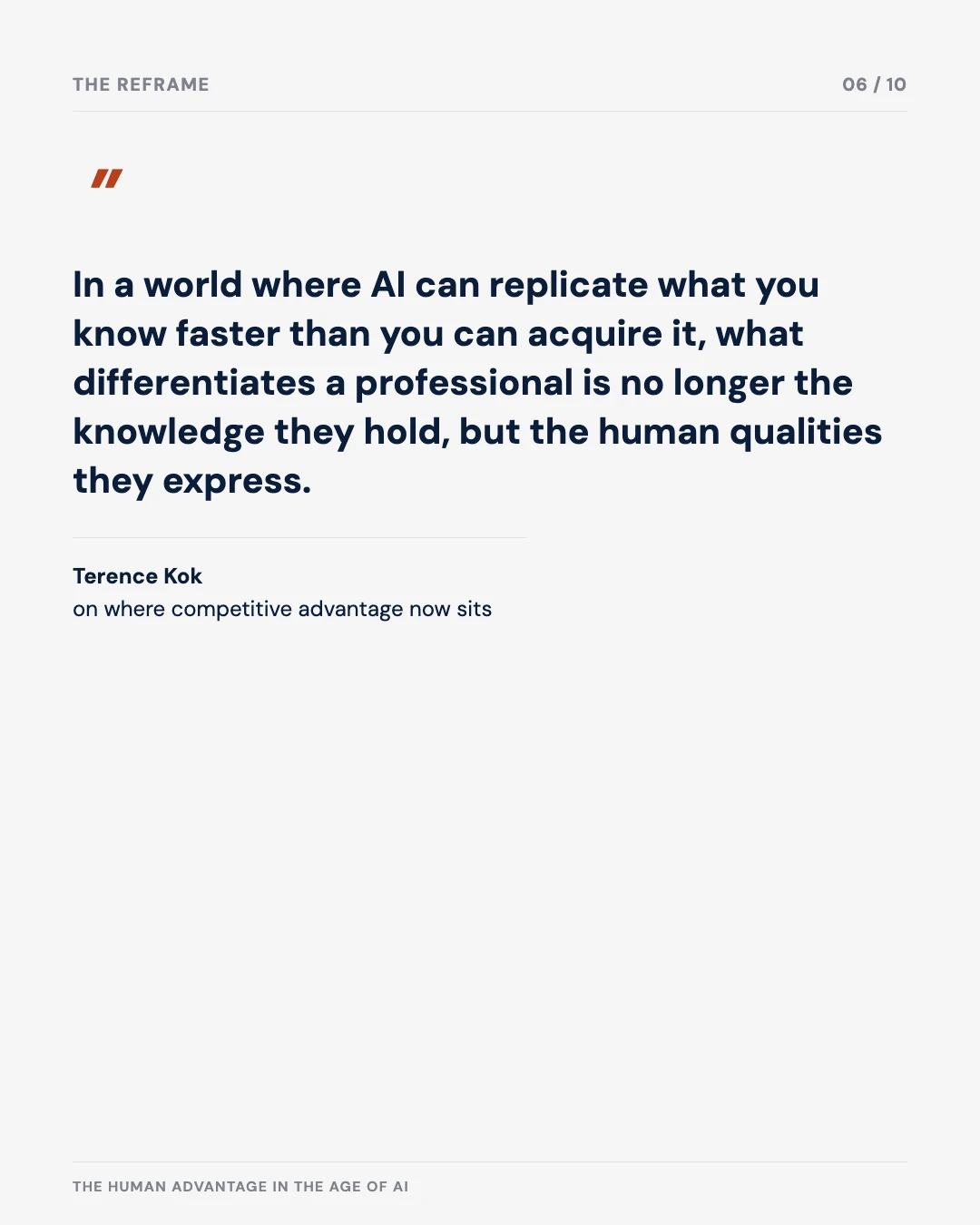
When AI can replicate what you know faster than you can acquire it, what differentiates a professional and an organisation is no longer the knowledge they hold, but the human qualities they express. The willingness to share credit, even when AI-assisted success creates a subtle incentive not to. The discipline to maintain standards under pressure. The empathy to understand what a stakeholder needs, not merely what they have stated. The courage to make a call and own the outcome.
These are not supplementary attributes. They are the core of what it means to contribute at a level that AI cannot reach.
A Personal Observation
Across complex programmes in smart city infrastructure, AI deployment, and digital governance, the stalled projects were rarely undone by technical failure. They were undone by misaligned teams, loss of trust, insufficient stakeholder buy-in, or a failure of leadership to hold a clear direction under pressure. Conversely, the programmes that delivered measurable outcomes did so because people showed up with the right attitude, operated with genuine accountability to each other, and cared enough about the end result to work through the difficult parts.
AI did not produce those outcomes. People did.
AI clarifies where human value resides
The age of AI does not end human value. It clarifies where that value resides.
Evidence & Methodology
The skills numbers here are a real employer survey. One claim in the piece, about AI collaboration and work engagement, is not linked to a specific study, and I want to say so plainly rather than let it sit next to real citations looking equally solid. The rest is what I have watched happen across programmes.
| Claim | Source | Grade |
|---|---|---|
| 39% of workers’ core skills are expected to change by 2030 | WEF Future of Jobs Report 2025, surveying 1,000+ employers covering 14 million-plus workers | Measured |
| 170 million new roles projected globally by 2030 | WEF Future of Jobs Report 2025 | Forecast |
| Employee-AI collaboration boosts work engagement and creative self-efficacy | Referred to in the piece as “research published in 2026,” not a study I can name or link here | Uncited |
| Stalled programmes failed on trust and accountability, not technical execution | My own observation across smart city, AI deployment, and digital governance programmes | My call |
Sources
- World Economic Forum. (2025). Future of jobs report 2025.