Executive Summary
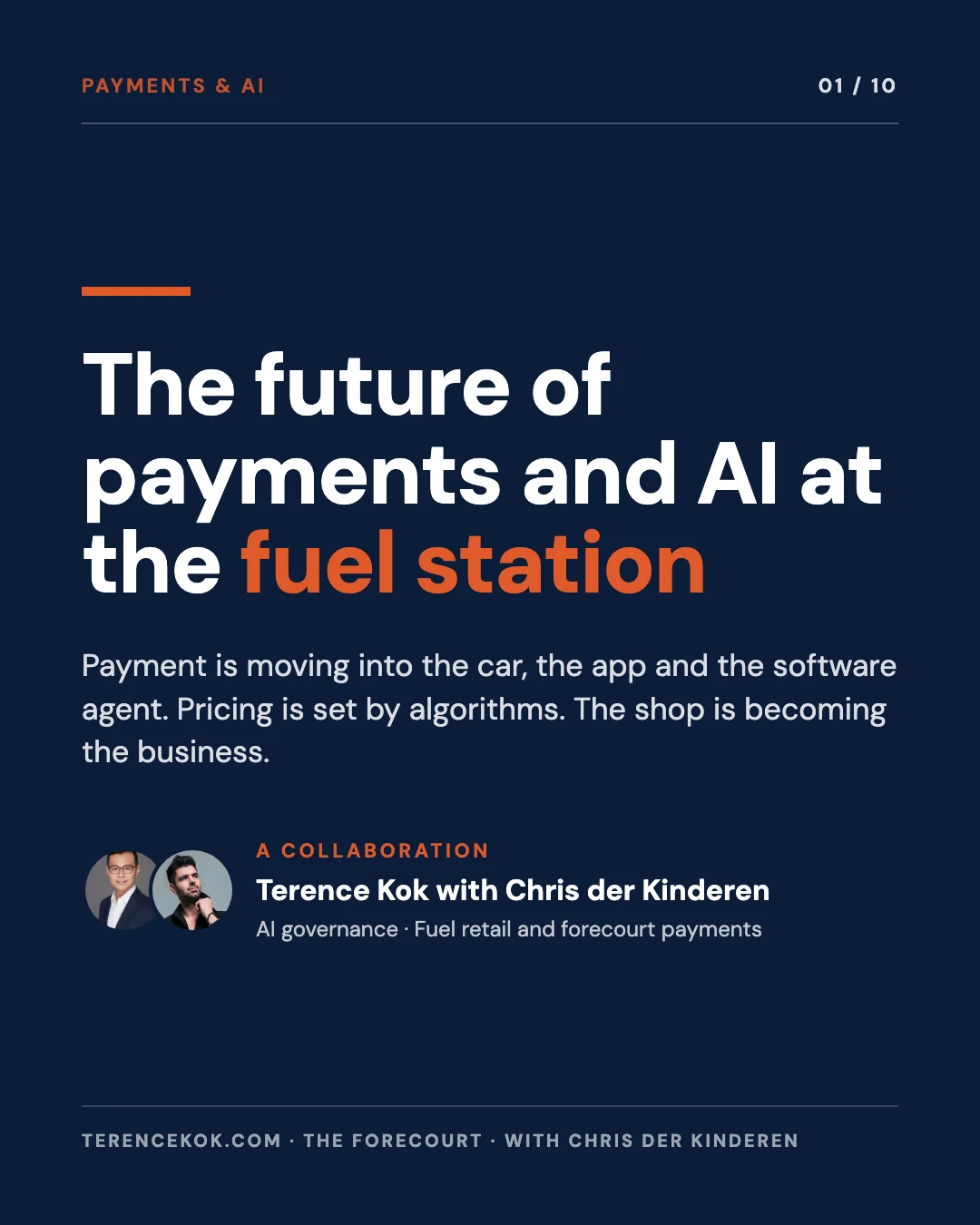
A fuel stop is short, frequent, often unattended and tied to a vehicle. That makes the forecourt one of the first places in retail where AI and new ways of paying are being tested at scale. Payment is moving off the card reader and into the car, the app and, soon, the software agent. Pricing is already set by algorithms at many stations. And as vehicles electrify, the five-minute stop becomes a twenty-minute one, which turns the station into a retail business with a pump attached.
~15%
Rise in station margins after adopting algorithmic pricing in Germany
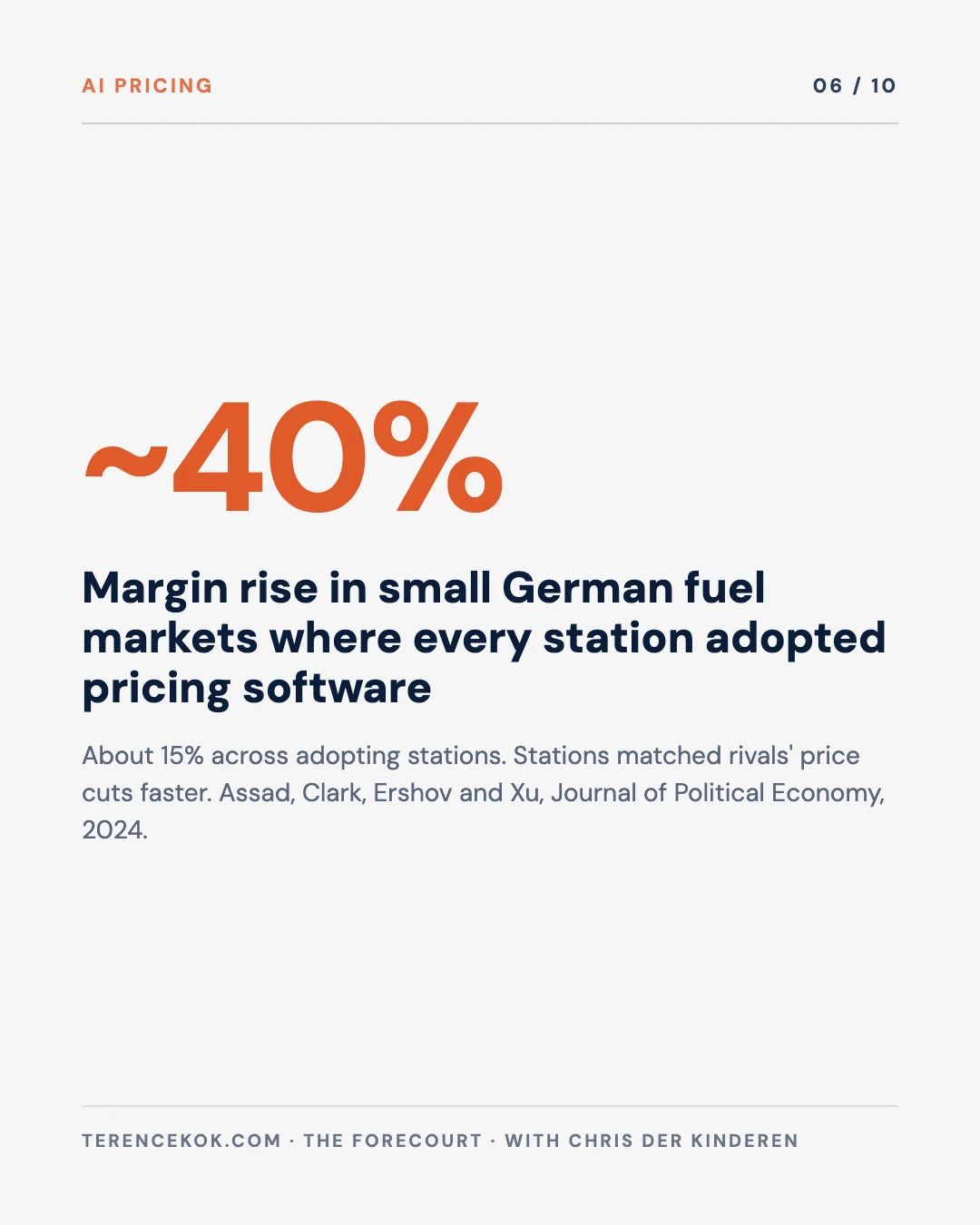
~40%
Margin rise in small German markets where every station adopted
38.8%
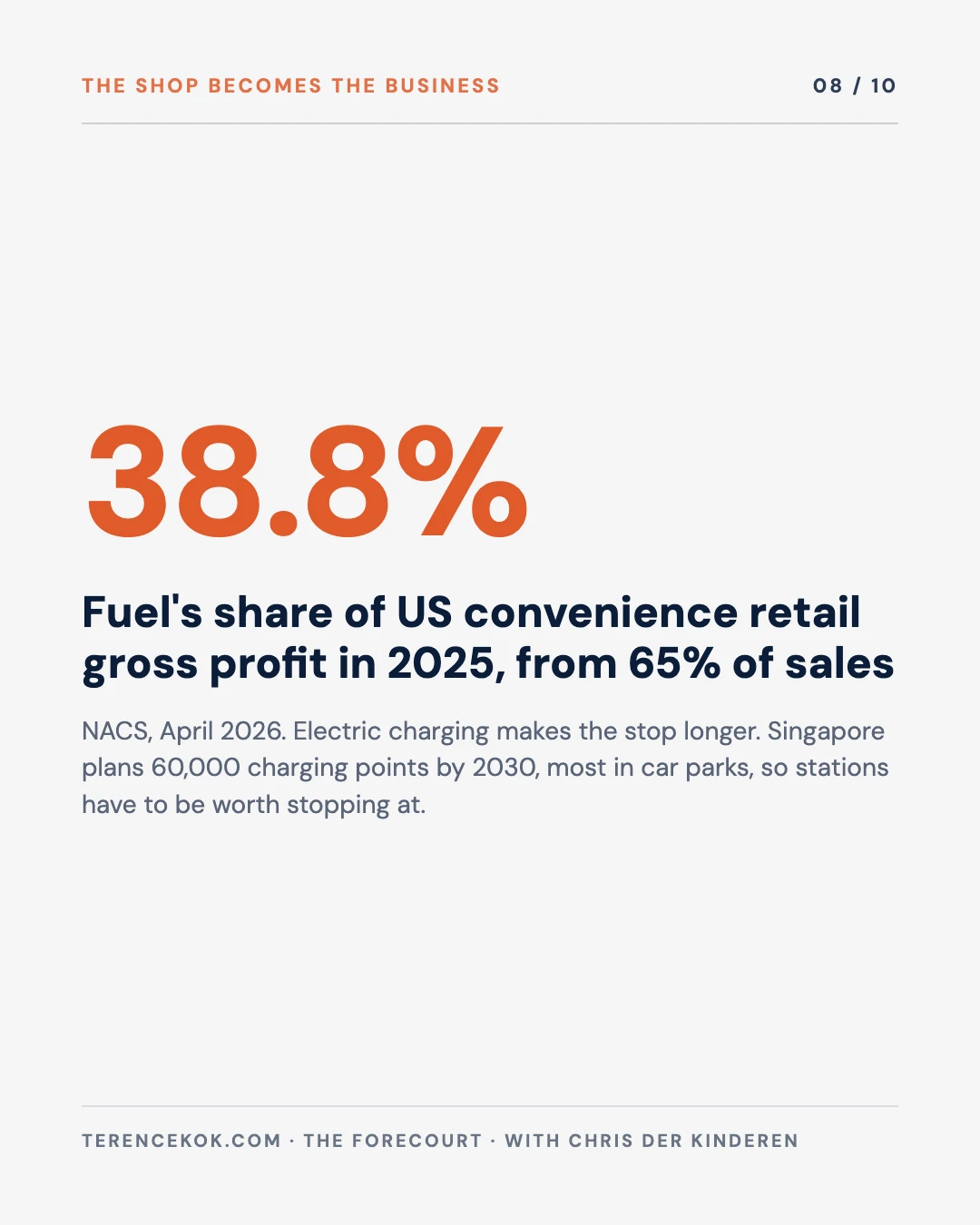
Fuel’s share of US convenience retail gross profit in 2025, from 65% of sales
60,000
EV charging points Singapore plans to have by 2030
Core conclusions
- Whoever owns the moment of payment owns the customer. Carmakers, card networks, wallet providers and fuel brands are all competing for it.
- Algorithmic pricing raises margins, and the best evidence we have says part of that comes from softer competition. Operators need a record of what their pricing software is told to do.
- AI agents that buy fuel for fleets and drivers are coming through the card networks. Operators should decide now what an agent is allowed to buy and who carries the loss when it gets it wrong.
The forecourt, in ten slides
Save it, or send it to someone who runs a network of stations.
Why the forecourt matters
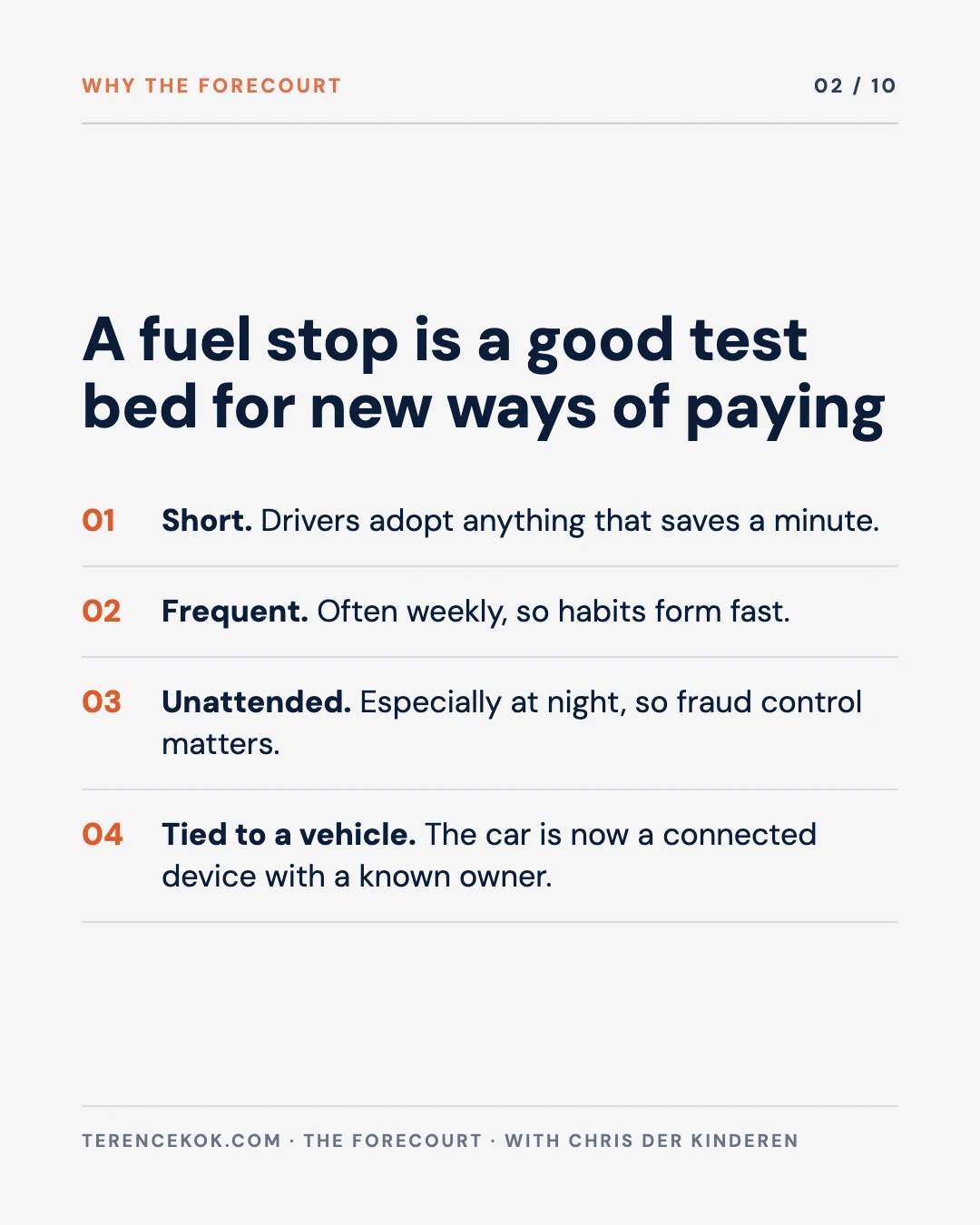
Most retail payments happen in a shop, at a counter, with a person nearby. A fuel purchase is different in four ways. It is short. It is frequent, often weekly. It is frequently unattended, especially at night. And it is tied to a vehicle, which is itself becoming a connected device with a screen, a network connection and a known owner.
Those four features make the forecourt a good test bed for new ways of paying. A driver who wants to be back on the road in five minutes will adopt anything that saves one of them. An operator running hundreds of unattended pumps has a strong reason to invest in fraud detection. And a car that can identify itself to the pump removes most of the steps in the transaction.
The station is also where the retail business is changing fastest. Oil companies and independent operators have been saying for years that the future of the site is the shop, the coffee and the charger, with fuel as the reason people stop. AI touches all of those at once.
How people pay today
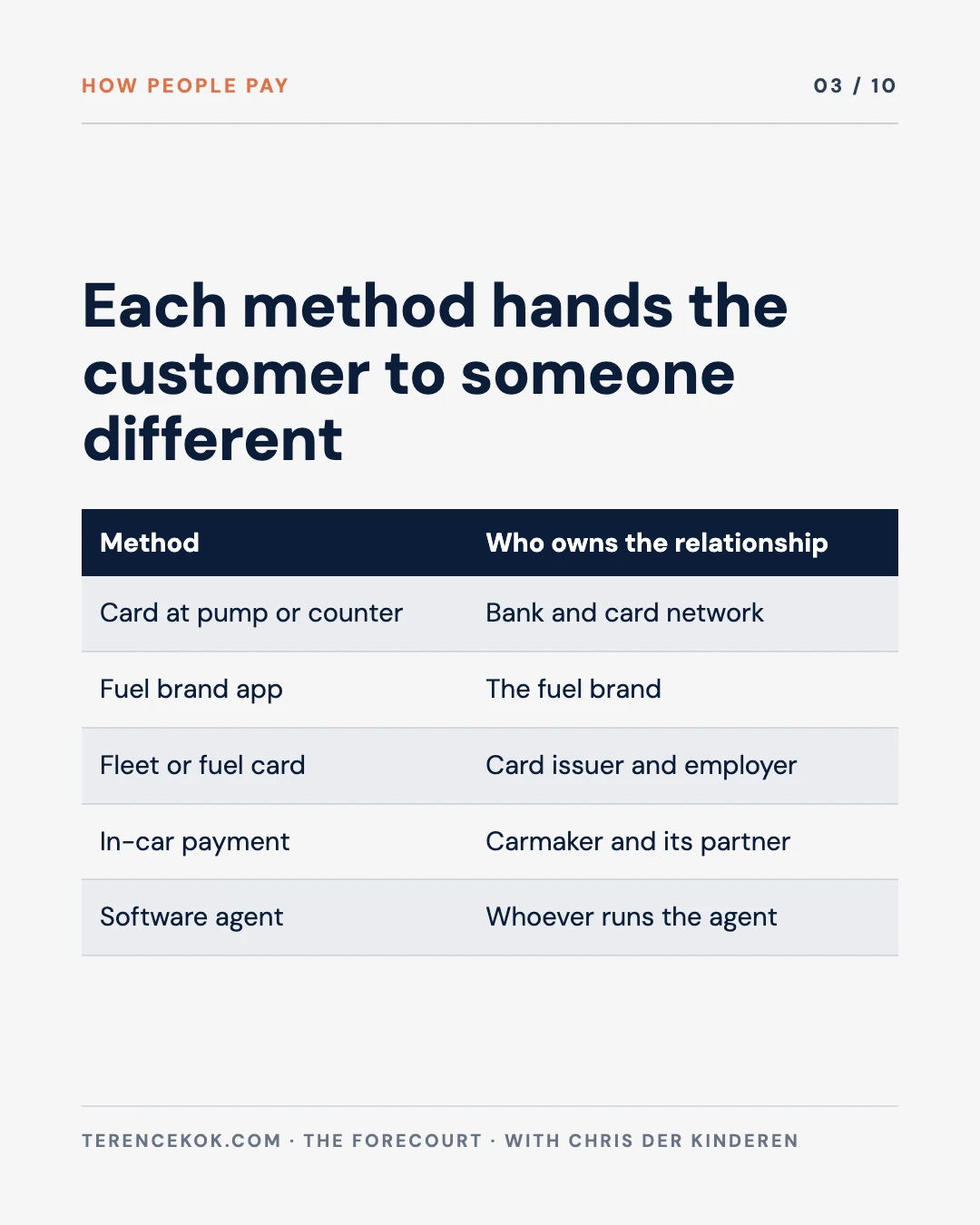
Across most markets, a fuel purchase is paid for in one of four ways.
| Method | How it works | Who owns the customer relationship |
|---|---|---|
| Card at the pump or counter | Chip, contactless or magnetic stripe, authorised by the card network | The bank and card network. The station sees a card number. |
| Fuel brand app | Driver selects the pump in the app and pays from a stored card or wallet | The fuel brand, through its app and loyalty data |
| Fleet or fuel card | Company-issued card with limits on product, volume and location | The fleet card issuer and the employer |
| In-car payment | Driver authorises from the vehicle’s screen, often with a fingerprint or PIN | The carmaker and its payment partner |
Author’s summary of common forecourt payment methods.
The fifth method is still arriving: a software agent paying on a person’s or a company’s behalf. That one changes the most, and I come back to it below.
The right-hand column is the part that matters commercially. Each method gives a different party the data on who bought what, where and when. Each also gives a different party the chance to put an offer in front of the driver before the next purchase.
Payment moves into the car
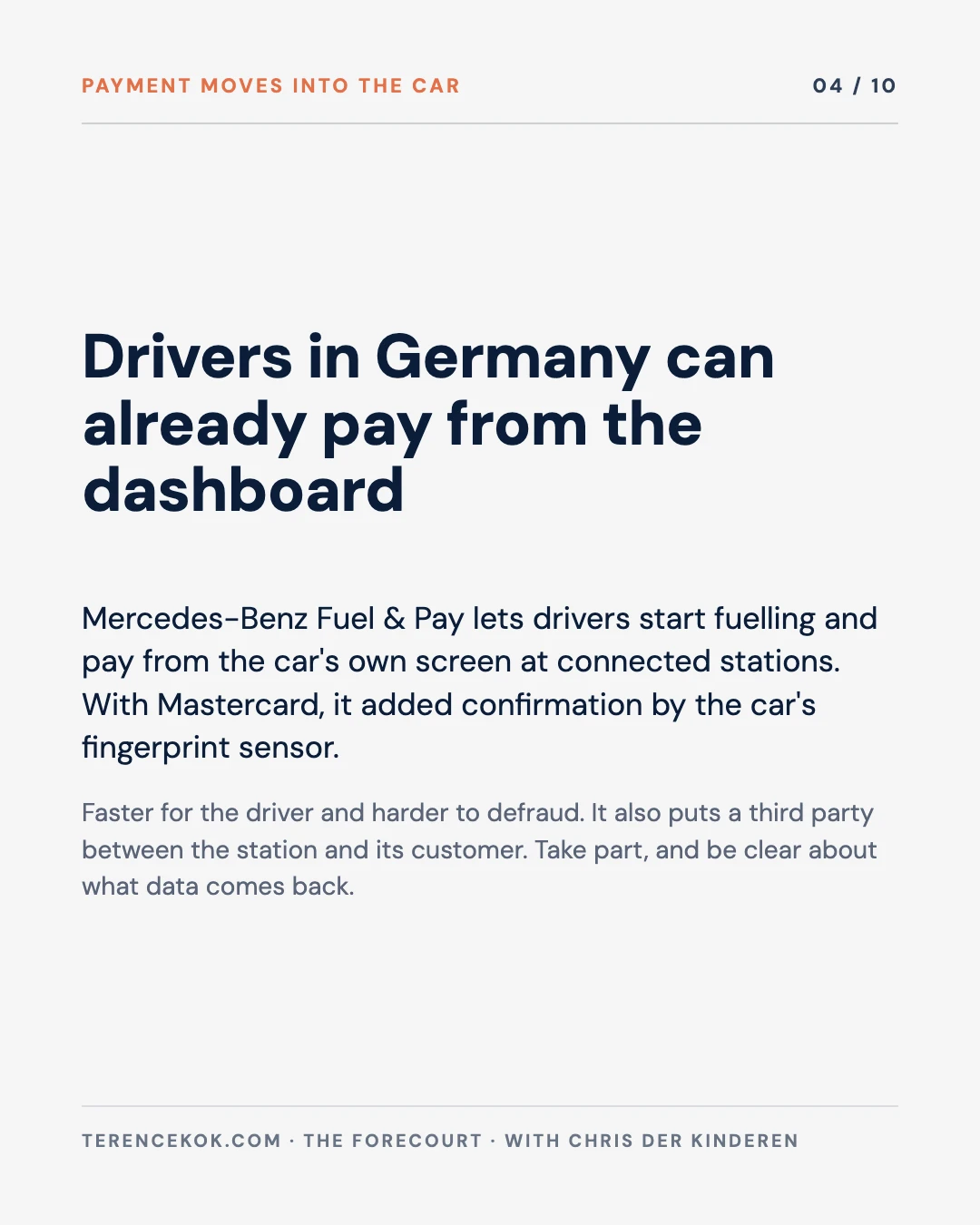
Carmakers have wanted a share of the payment for a long time, because it gives them a reason to keep the driver inside their software after the sale. Mercedes-Benz launched its Fuel & Pay service in Germany, which lets drivers start fuelling and pay from the car’s own screen at connected stations. With Mastercard, it later added payment confirmed by the fingerprint sensor in the car. Mercedes-Benz Trucks and Shell trialled a similar in-cab payment system for trucks at selected Shell stations in Germany.
For the fuel operator, in-car payment is a mixed result. It is faster for the driver and reduces card fraud at the pump. It also puts a third party between the station and its customer. If the car’s software decides which stations it shows and in what order, the carmaker starts to look like a marketplace, and marketplaces usually charge for placement.
My view is that operators should take part in these schemes while being clear about what data they get back. A payment that arrives with no customer identity attached is worth less to the station than one that comes through its own app and loyalty programme.
Agents that buy fuel
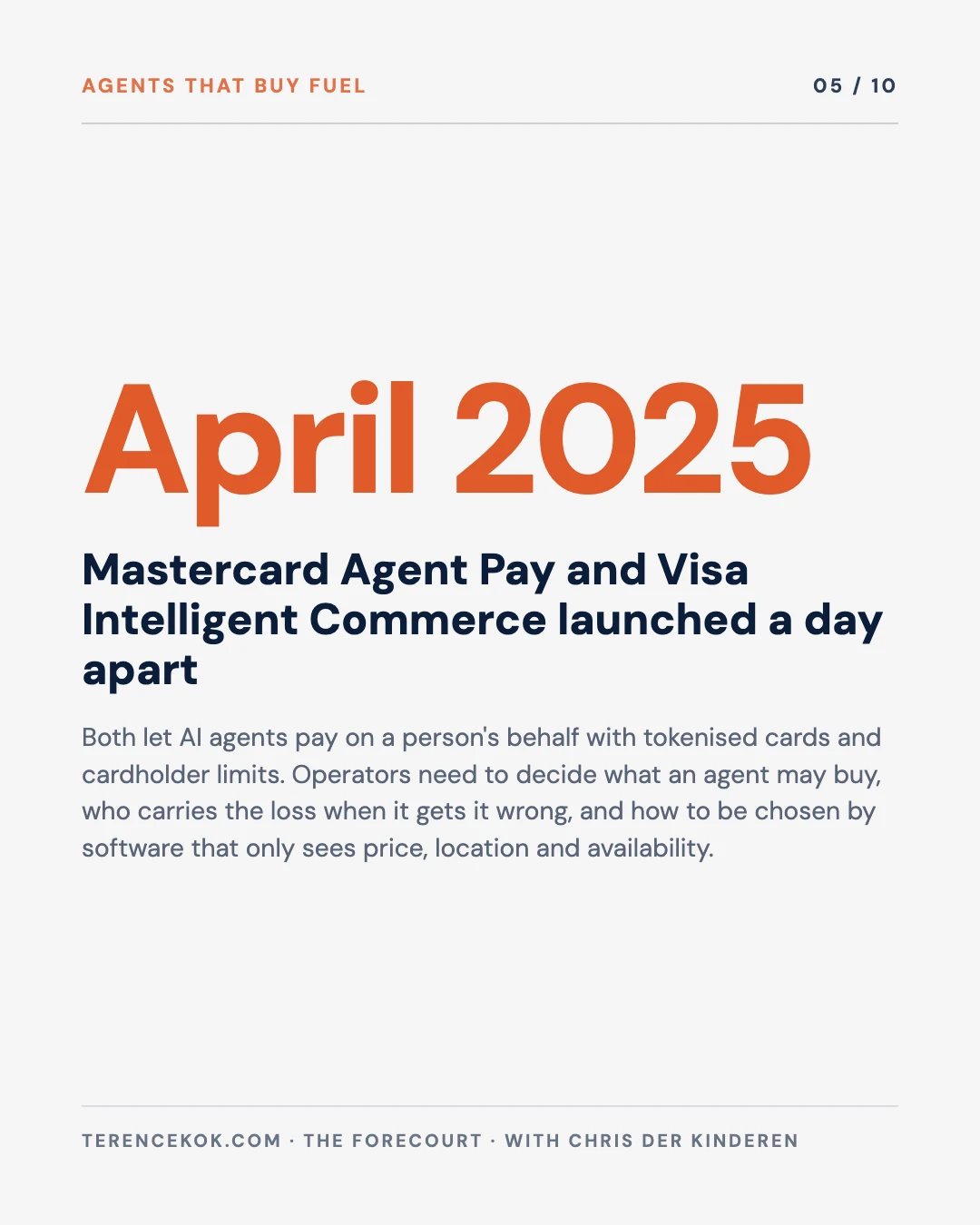
The larger shift is a software agent that decides and pays, rather than a person pressing a button. In April 2025, within a day of each other, Mastercard launched Agent Pay and Visa announced Visa Intelligent Commerce. Both give AI agents a way to pay on a person’s behalf using tokenised card credentials, with limits and controls set by the cardholder. By November 2025 Mastercard had made Agent Pay available to all its US cardholders, and in June 2026 it added a version aimed at machine-to-machine payments.
Fuel is one of the more obvious uses. Consider a fleet of delivery vans. An agentic AI system already plans the routes. It can also watch published fuel prices, pick the station on each route with the best price within the fleet’s rules, reserve or authorise the pump, and reconcile the receipt against the fleet card and the vehicle’s mileage. No driver has to think about fuel until the pump is ready.
For the operator, this raises three practical questions.
What is an agent allowed to buy? A fleet card today limits fuel type, volume and location. An agent mandate needs the same limits, plus a rule on whether the agent may buy anything from the shop.
Who carries the loss when the agent gets it wrong? Wrong fuel grade, a pump authorised for a van that never arrives, a purchase outside the mandate. The card networks are writing their rules, but operators should read them and decide their own position before volumes grow.
How does the station compete for an agent? An agent does not see the canopy, the coffee or the clean toilets. It sees price, location, queue time and whether the station accepts its credentials. Stations that publish accurate, machine-readable prices and availability will be chosen more often.
Free tool
Agent Risk Assessment Matrix
Sort agent use cases by autonomy and consequence, and see which controls a purchasing agent needs before it spends money.
AI pricing and competition
Fuel is one of the few retail products where prices are posted on a sign, change several times a day and are easy for competitors to watch. That made it an early market for algorithmic pricing software.
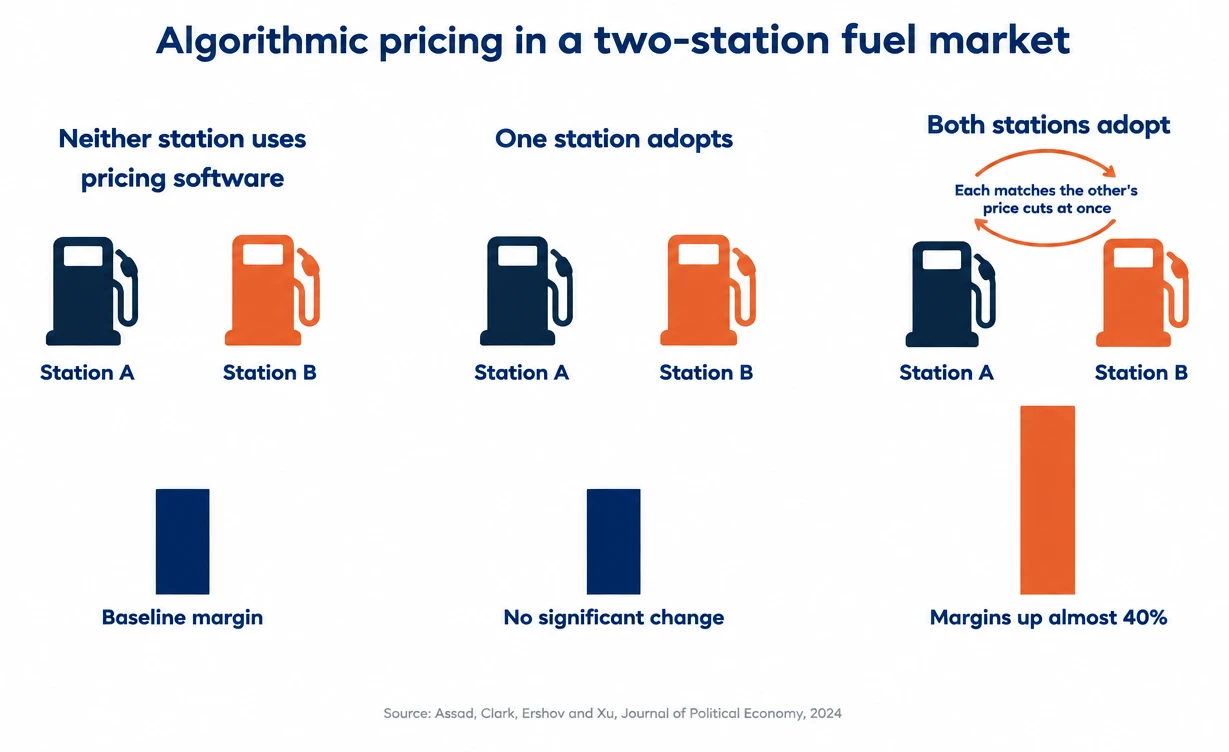
The best evidence on what happens next comes from Germany. Since 2013, German stations have had to report price changes in near real time to the Market Transparency Unit for Fuels, which sits within the Bundeskartellamt, the federal competition authority. That data let economists Stephanie Assad, Robert Clark, Daniel Ershov and Lei Xu study what happened after pricing software became widely available in 2017. Their paper, published in the Journal of Political Economy in 2024, found that adoption raised station margins by roughly 15 percent. The effect appeared only where stations had competitors. In small markets with two or three stations, margins rose only when every station adopted, and by almost 40 percent compared with markets where none did.
The authors also found that stations using the software became quicker to match a rival’s price cut, with no change in how they responded to price rises. A station that knows its cut will be matched at once has little reason to cut in the first place. Nobody has to agree anything for prices to settle higher.
This is a governance question for the board. Competition regulators in several markets are already asking how pricing algorithms should be treated. An operator that cannot explain what its pricing software is optimising for, what data it uses about competitors and who signs off on its settings is exposed. The fix is ordinary: write down the objective, keep a human approval step for changes to it, log what the system does, and ask your competition lawyers to review the design once a year.
Fraud at the unattended pump
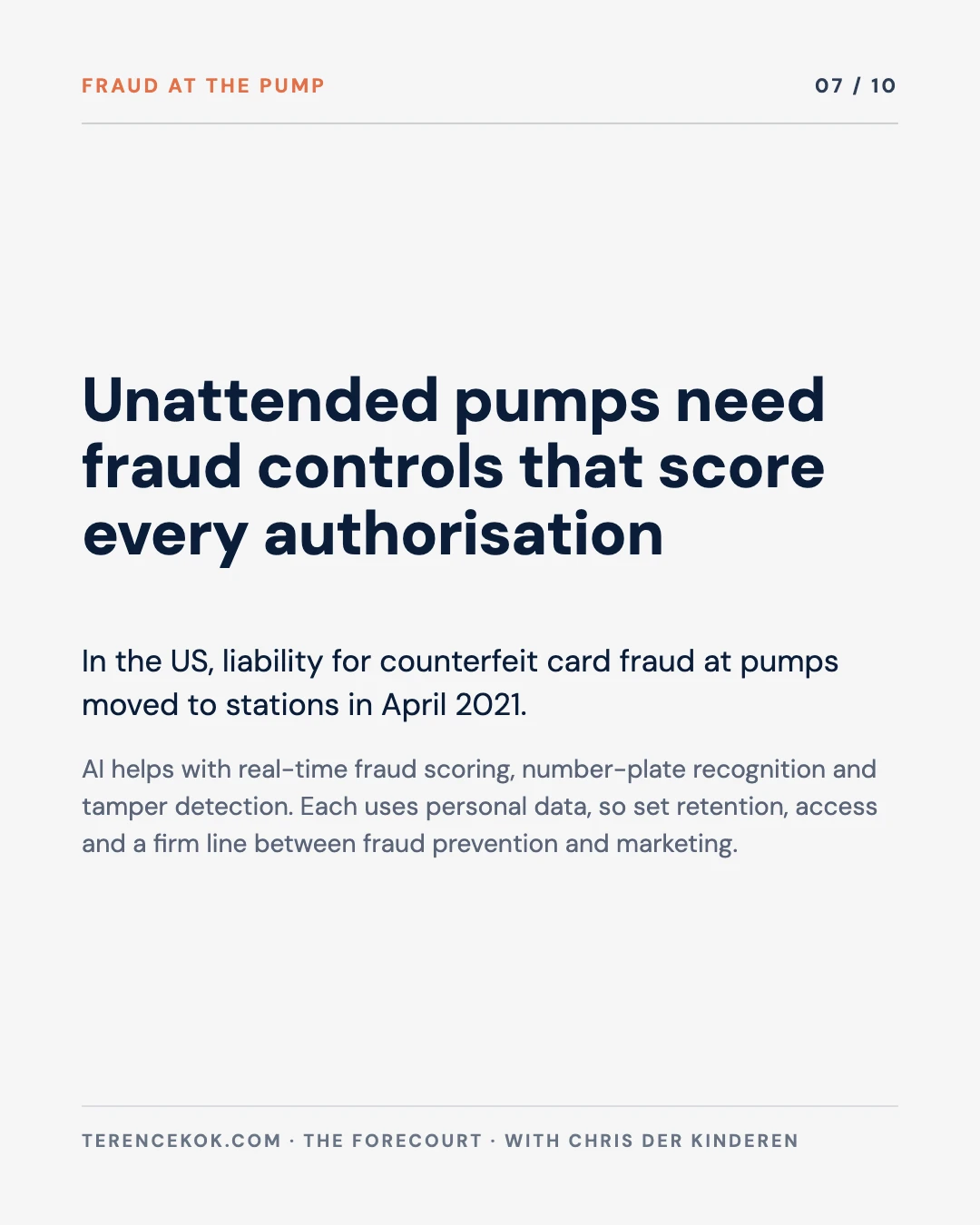
Unattended pumps have long been a target for card skimmers and for criminals testing stolen card numbers with small authorisations. In the United States, the card networks moved liability for counterfeit card fraud at fuel pumps to the station in April 2021, after several delays. Stations that had not upgraded to chip readers became responsible for the losses those readers would have stopped.
AI helps here in three ways. Fraud models can score each pump authorisation in real time, using the time, location, card history and the pattern of previous transactions at that pump. Cameras with number-plate recognition can link a transaction to a vehicle and flag drive-offs or a known fraudulent vehicle. And analysis of pump hardware data can spot a dispenser that has been opened or tampered with.
Each of these uses personal data. A number plate linked to a payment card is information about a person under most data protection laws, including Singapore’s Personal Data Protection Act. Operators should decide how long camera data is kept, who can see it and whether it is ever used for marketing. Fraud prevention and marketing make very different cases for collecting the same data, and customers notice the difference.
The shop becomes the business
The economics of the station have been moving indoors for years. In the United States, the National Association of Convenience Stores reports that fuel made up 65 percent of the industry’s sales in 2025 but only 38.8 percent of its gross profit. Foodservice and merchandise sales inside the store reached US$341.2 billion.
Electric vehicles push this further. Filling a tank takes a few minutes. Charging a car at a fast charger usually takes much longer, and the driver needs somewhere to wait. Singapore plans to have 60,000 charging points by 2030 and all vehicles running on cleaner energy by 2040. Most of those charge points will be in car parks, not at stations, so the stations that keep a role will be the ones worth stopping at.
AI supports the shop in familiar retail ways: forecasting demand for fresh food by hour and site, setting staff rosters, and checkout that recognises items without a scan. The payment question is how to make fuel, charging and the shop feel like one purchase. A driver who starts a charge from the car should be able to add a coffee and a sandwich to the same payment and have it ready when they walk in. That needs the station to know who the customer is, which brings us back to who owns the moment of payment.
Free tool
AI Use Case Prioritizer
Score forecourt and shop use cases, from fraud models to demand forecasting, by value and feasibility before you fund them.
What can go wrong
Pricing that draws a regulator’s attention. Covered above. The German evidence will be read by competition authorities everywhere.
Personalised prices at the pump. Once the station knows who is paying, it becomes technically possible to show different prices or offers to different drivers. Personalised offers in the shop are normal retail practice. Personalised fuel prices are likely to be seen as unfair by customers and may be tested by regulators. I would keep the posted fuel price the same for everyone.
Payment outages. A station that has moved most customers to app or in-car payment cannot sell fuel when that service is down. Keep a fallback that works without the network, and test it.
Data shared with partners. In-car payment and agent payment both involve data moving between the carmaker, the card network, the payment provider and the station. Each contract should say who may use which data for what purpose.
Agents with loose mandates. An agent that can buy anything on a fleet card will eventually buy something nobody intended. Limits should be set by the customer and enforced by the payment rails, not left to the agent’s judgement.
What operators should do in the next twelve months
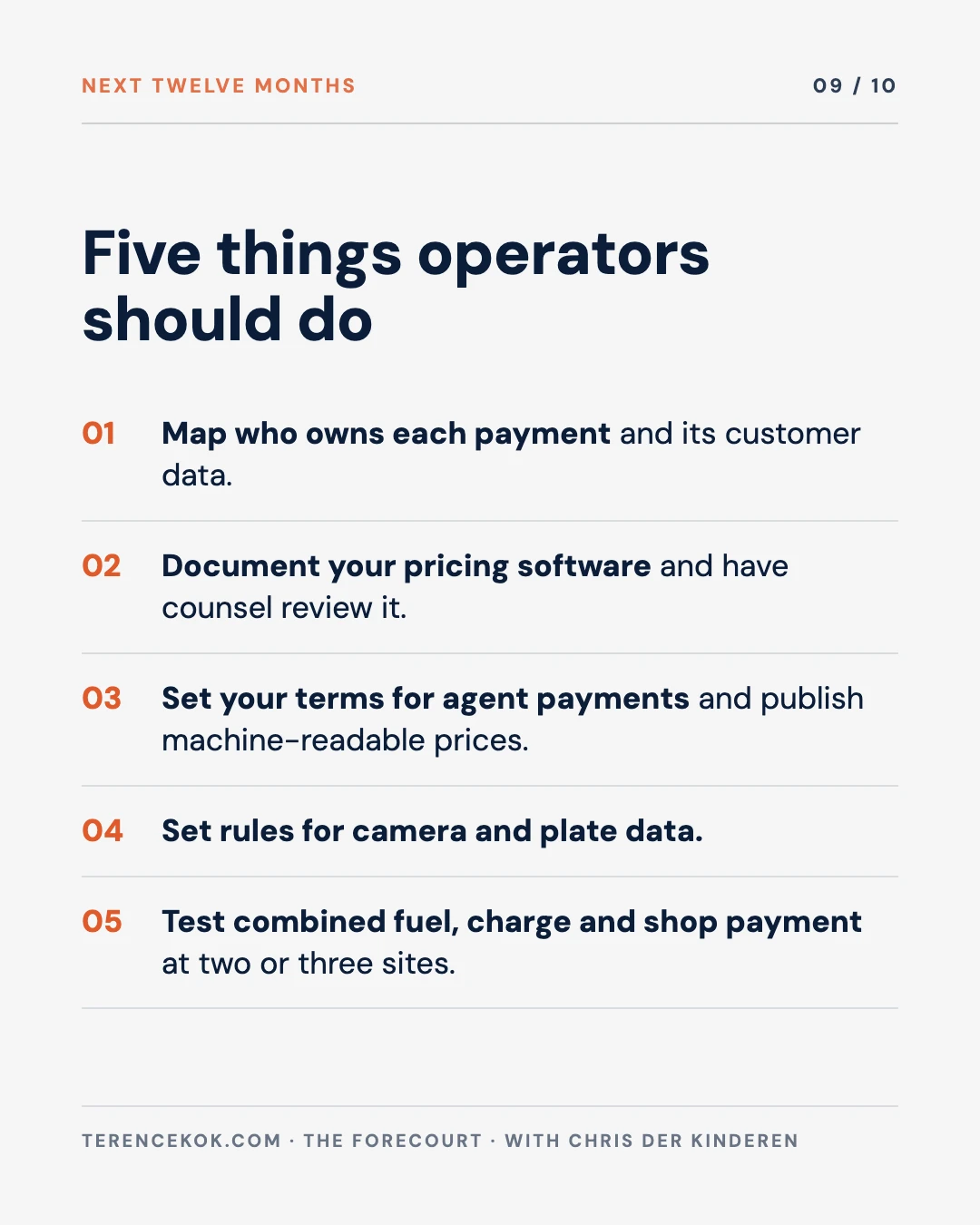
Map who owns each payment. For every payment method you accept, write down who receives the customer data and who can make the next offer. That map shows where you are losing the relationship.
Document your pricing software. Record the objective, the inputs, the human approvals and the logs. Have it reviewed by competition counsel.
Decide your position on agent payments. Read the card networks’ agent rules, decide which purchases you will accept from an agent and on what terms, and publish accurate, machine-readable prices and availability.
Set rules for camera and plate data. Retention period, access, and a clear line between fraud prevention and marketing.
Plan the site around the longer stop. Start with two or three stations where charging dwell time is already rising and test combined fuel, charge and shop payment there.
Evidence & Methodology
The market facts here come from published research, industry data and company announcements. The recommendations are mine. Here is how much weight each claim can bear.
| Claim | Source | Grade |
|---|---|---|
| Algorithmic pricing adoption raised German station margins by roughly 15 percent, and by almost 40 percent in small markets where all stations adopted | Assad, Clark, Ershov and Xu, Journal of Political Economy (2024); authors’ summary in CPI Antitrust Chronicle (2023) | Measured |
| Adopting stations matched rivals’ price cuts faster, with no change in response to price rises | Same study, as summarised by the authors | Measured |
| German stations must report fuel price changes in real time to the Market Transparency Unit for Fuels | Bundeskartellamt | Measured |
| Fuel was 65 percent of US convenience sales and 38.8 percent of gross profit in 2025 | NACS, April 2026 | Measured |
| Mastercard Agent Pay and Visa Intelligent Commerce launched in April 2025 | Company announcements, as reported by Electronic Payments International | Reported |
| Mercedes-Benz offers in-car fuel payment at connected German stations, with fingerprint confirmation added with Mastercard | Mercedes-Benz and Mastercard announcements | Reported |
| US fuel pump liability shift took effect in April 2021 | Visa; trade press | Measured |
| Singapore targets 60,000 charging points by 2030 and cleaner-energy vehicles by 2040 | Land Transport Authority; Ministry of Transport | Measured |
| Agents will compete on price, location and availability data, and stations should publish machine-readable prices | My reading of how agent payments are designed | My call |
| Posted fuel prices should stay the same for every customer | My recommendation | My call |
Sources
- Assad, S., Clark, R., Ershov, D. and Xu, L. (2024). Algorithmic Pricing and Competition: Empirical Evidence from the German Retail Gasoline Market. Journal of Political Economy, 132(3), 723-771.
- Clark, R. and Ershov, D. (2023). Algorithmic Pricing and Competition. CPI Antitrust Chronicle, June 2023.
- Bundeskartellamt. Market Transparency Unit for Fuels.
- NACS (2026). U.S. Convenience In-Store Sales Top $340 Billion. 15 April 2026.
- Electronic Payments International. When AI shops for you: Visa and Mastercard bet on agentic payments.
- Mercedes-Benz. New Mercedes me “Fuel & Pay” service enables contactless and convenient payment right at the pump. Automotive World.
- Mastercard (2023). Mercedes-Benz and Mastercard introduce native in-car payments.
- Daimler Truck. Mercedes-Benz Trucks and Shell successfully trial digital fuel payments.
- Visa. U.S. Automated Fuel Dispenser EMV Liability Shift Delayed.
- Land Transport Authority. Accelerating nationwide deployment of electric vehicle charging points. March 2021.
- Ministry of Transport, Singapore. Electric vehicles.

Where Agentic AI Actually Works Today (Singapore Data Inside)
Which agent use cases are already running in Singapore businesses, and which are still pilots.

How to Score Your First Agentic AI Project
A way to rank candidate agent projects, such as fleet fuel purchasing, before committing budget.

What the DBS Outages Teach Boards About Technology Risk
What a regulator expects from a board when the digital payment channel fails.
My thanks to Chris der Kinderen, who co-wrote this post with me. His years delivering forecourt and payment systems for oil companies across Asia grounded the argument in how stations work, and the post is better for it.