
Executive Summary
Agentic AI’s return comes from a narrow band of processes, not a general automation layer. Deployments already in production are showing triple-digit ROI. What still holds it back is no longer capability. It’s trust and governance inside institutions.
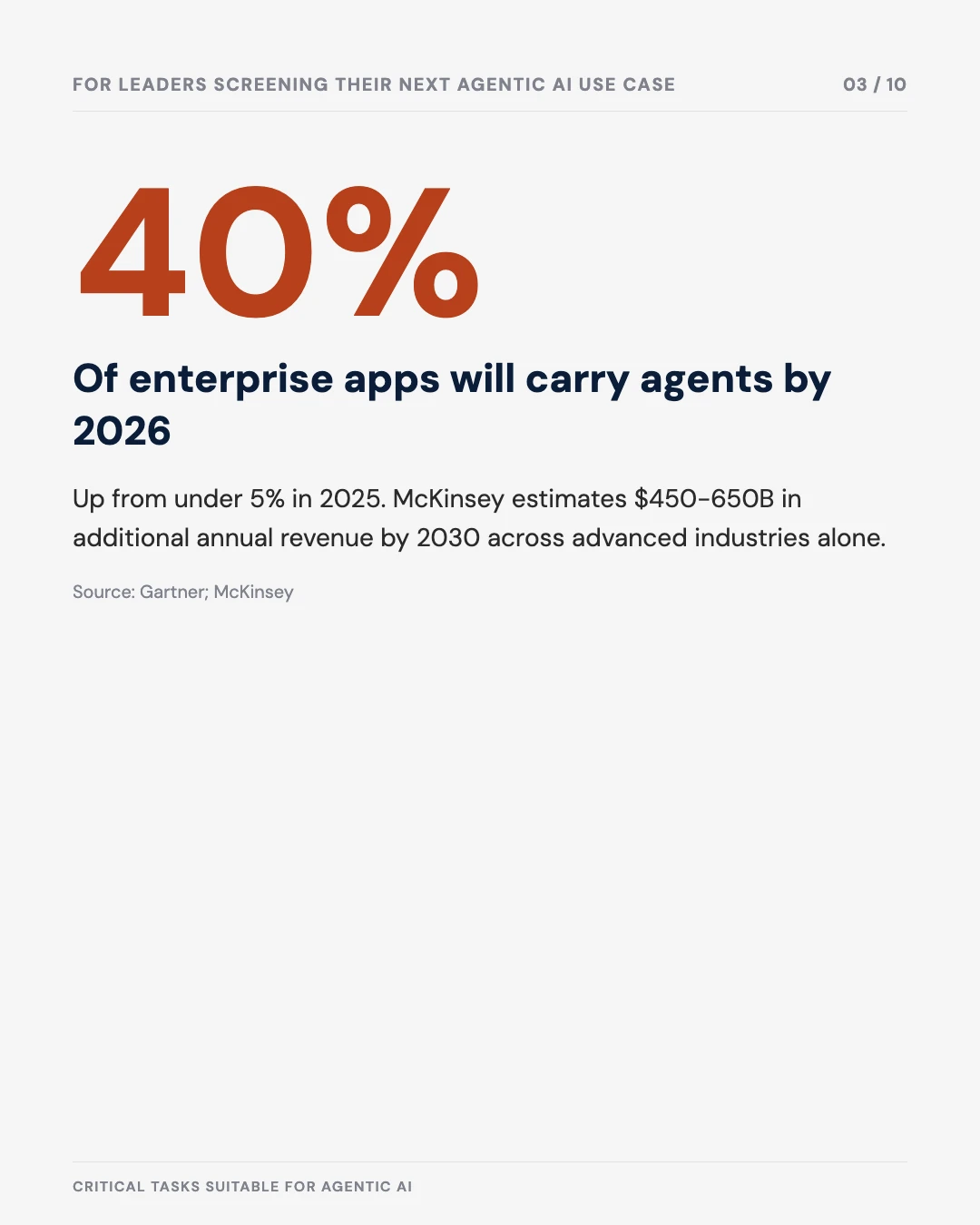
40%
of enterprise applications will carry task-specific agents by end of 2026, up from <5% in 2025
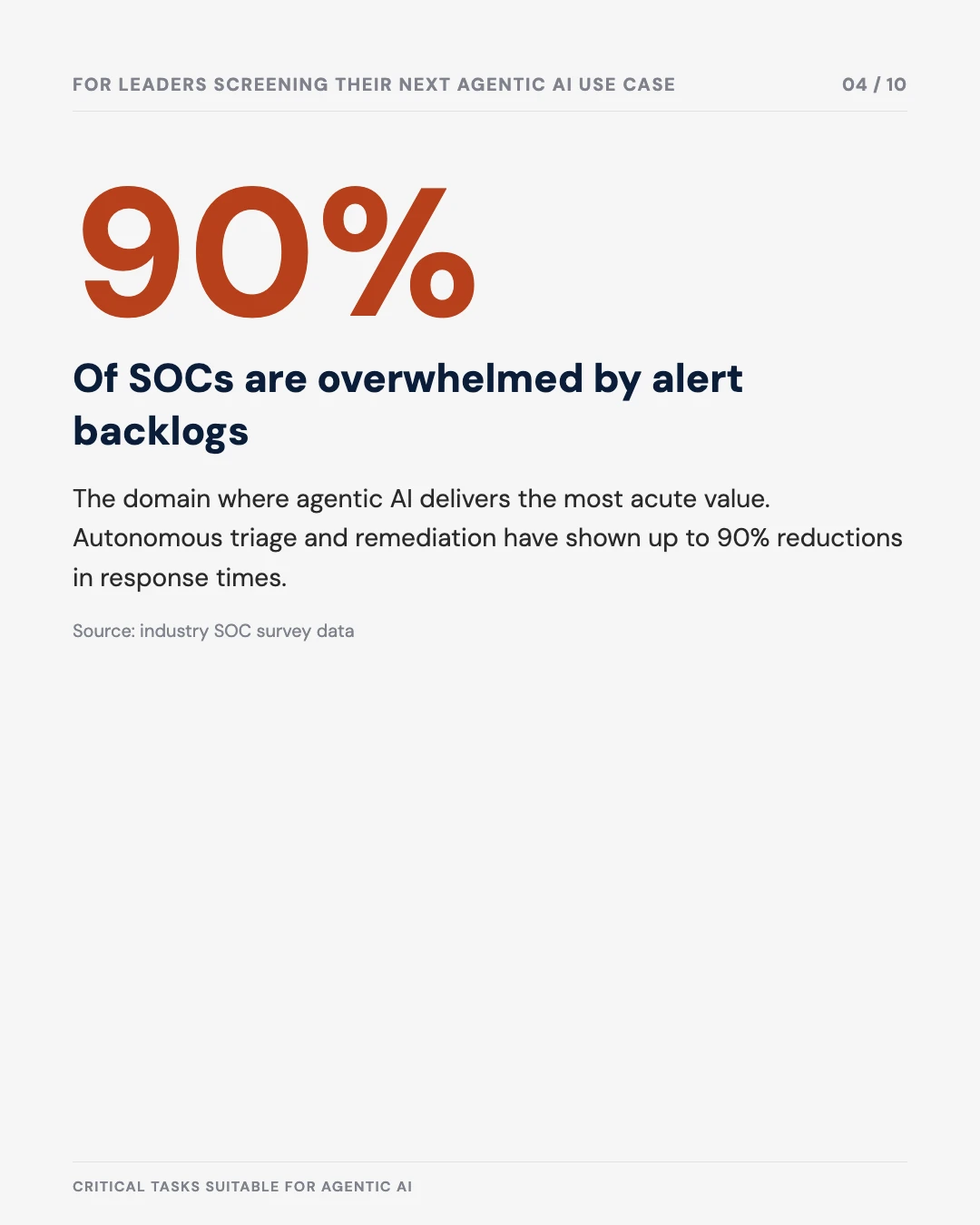
90%
cut in SOC alert triage workload and response times in reported deployments
307%
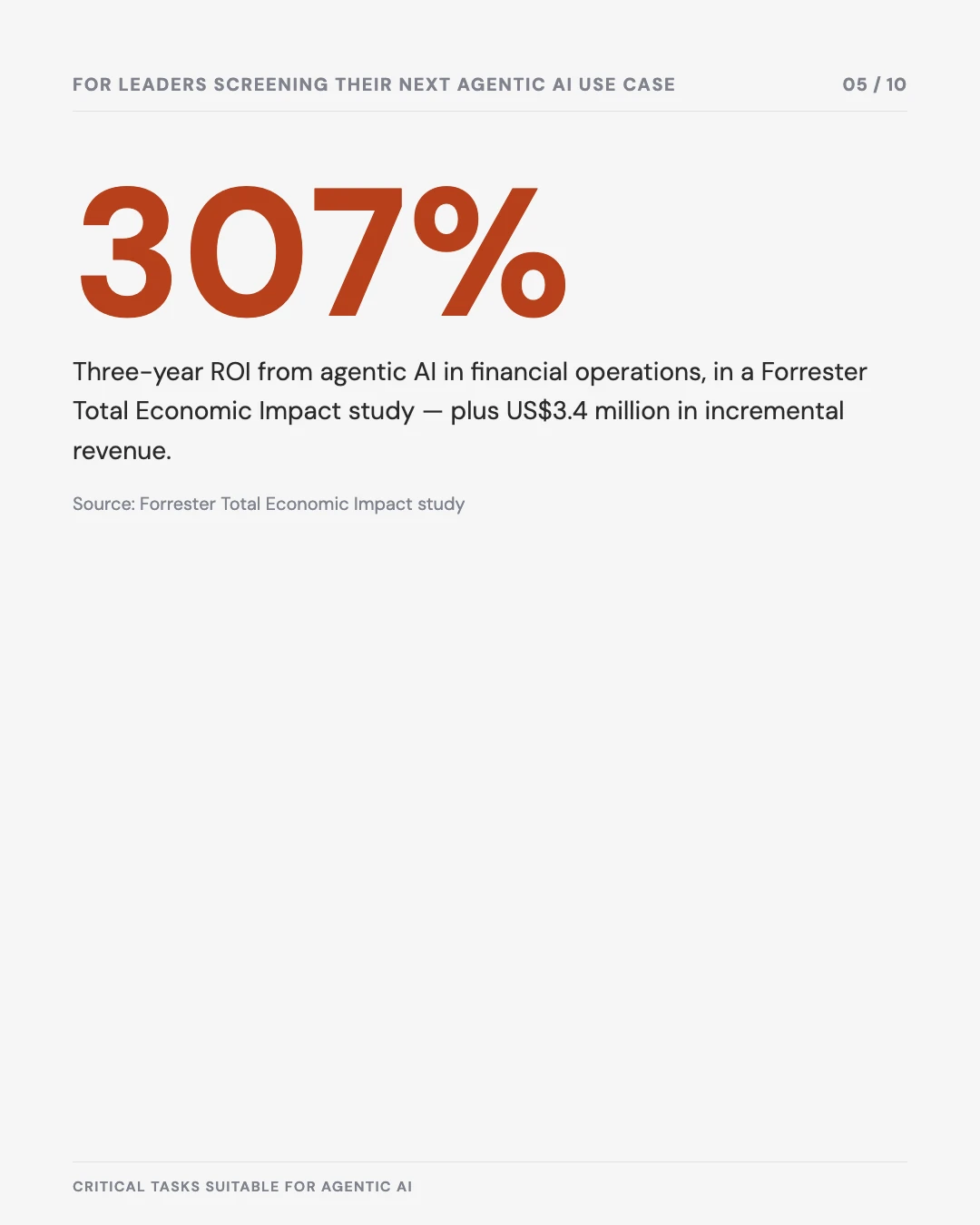
three-year ROI from agentic AI in financial operations, per Forrester’s TEI study
4.5%
of organisations currently trust AI to act with full autonomy
Core conclusions
- Agentic AI’s value sits in processes with five traits: they repeat, cross systems, follow policy, can be measured, and allow the path to change mid-task. It is not a blanket replacement for task-level automation.
- Case data from IT operations, SOC, finance, and supply chain deployments already shows 90%+ cuts in workload and triple-digit ROI; the technology is ready for production today.
- Trust lags capability. Only 4.5% of organisations now allow full autonomy, so any rollout plan has to allow for tiered oversight and governance (e.g. Singapore’s Model AI Governance Framework for Agentic AI, January 2026).
The argument, in ten slides
Save it, share it, or run it against the next use case someone pitches you as “agent-ready.”
The data
Market signal and forecasts
| Metric | Value | Source |
|---|---|---|
| Enterprise applications incorporating task-specific agents by end of 2026 | 40% (up from <5% in 2025) | Gartner |
| Additional annual revenue agentic AI could generate by 2030 (advanced industries) | US$450–650 billion | McKinsey |
| Cost savings from agentic AI deployments | 30–50% | McKinsey |
| Day-to-day SOC operational decisions handled autonomously by 2028 | 15% (up from 0% in 2024) | Gartner |
Forecasts, not observed outcomes: treat as directional planning inputs.
Reported deployment outcomes, by domain
| Domain | Reported outcome | Source |
|---|---|---|
| SOC alert triage and response | Up to 90% reduction in triage workload and response times | Reported implementations |
| Financial operations | 307% three-year ROI; US$3.4M incremental revenue | Forrester Total Economic Impact study |
| Supply chain routing and logistics | >20% reduction in inventory and logistics costs | McKinsey research |
| Smart city traffic optimisation | Up to 30% congestion reduction; 15–25% faster peak travel times | Pilot deployments |
| Energy grid management | 20–40% operational cost savings | Operator-reported |
| Software maintenance (Fortune 500 financial services) | 70% of routine maintenance automated; 85% lower bug rate | Case report |
| Parallel multi-agent execution | 90.2% improvement over single-agent benchmarks | Anthropic research |
Domain figures come from named cases cited in the article, not a controlled study across industries. Treat them as an illustrative range rather than a guaranteed return.
Governance and oversight posture
| Metric | Value | Source |
|---|---|---|
| Organisations that currently trust AI to act with full autonomy | 4.5% | Industry data cited in article |
| Organisations requiring human final decision authority | 47% | Industry data cited in article |
| Organisations permitting bounded autonomy with continuous monitoring | 27% | Industry data cited in article |
Singapore launched the world’s first Model AI Governance Framework for Agentic AI in January 2026. It is the first time a jurisdiction has tried to write down the tiered-oversight model these numbers imply.
Enterprise AI has shifted decisively. Gartner projects that 40% of enterprise applications will include task-specific agents by the end of 2026, up from less than 5% in 2025.
McKinsey estimates that agentic AI could generate US$450–650 billion in extra revenue a year by 2030 in advanced industries alone, with cost savings of 30–50%. These aren’t speculative figures. They come from deployments already live in finance, manufacturing, telecoms, and government.
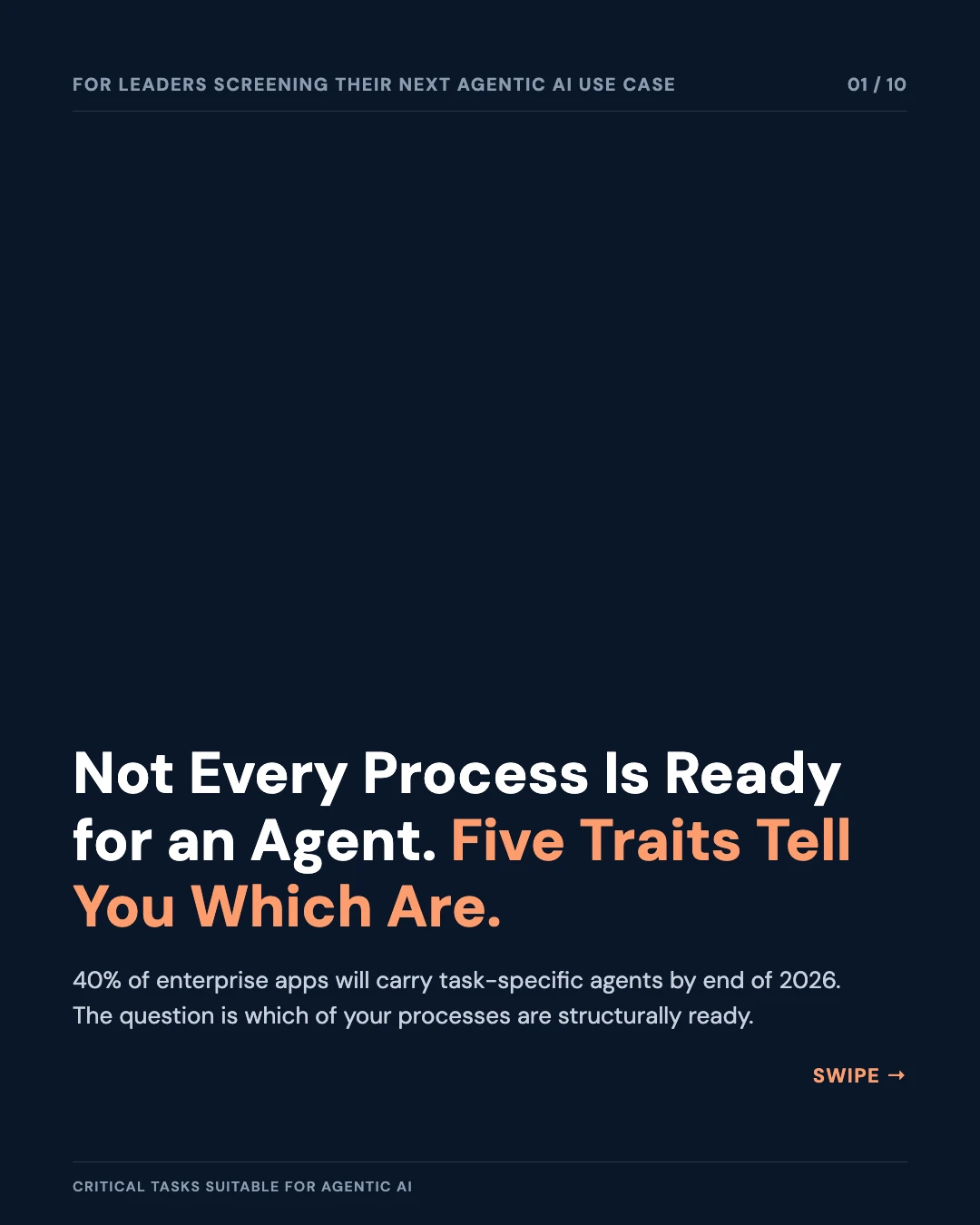
Yet the critical question for digital leaders is not whether agentic AI delivers value, but which work processes are structurally suited to autonomous execution. It is also how those processes must be redesigned to use what the technology does differently.
The critical question is not whether agentic AI delivers value, but which work processes are structurally suited to autonomous execution.
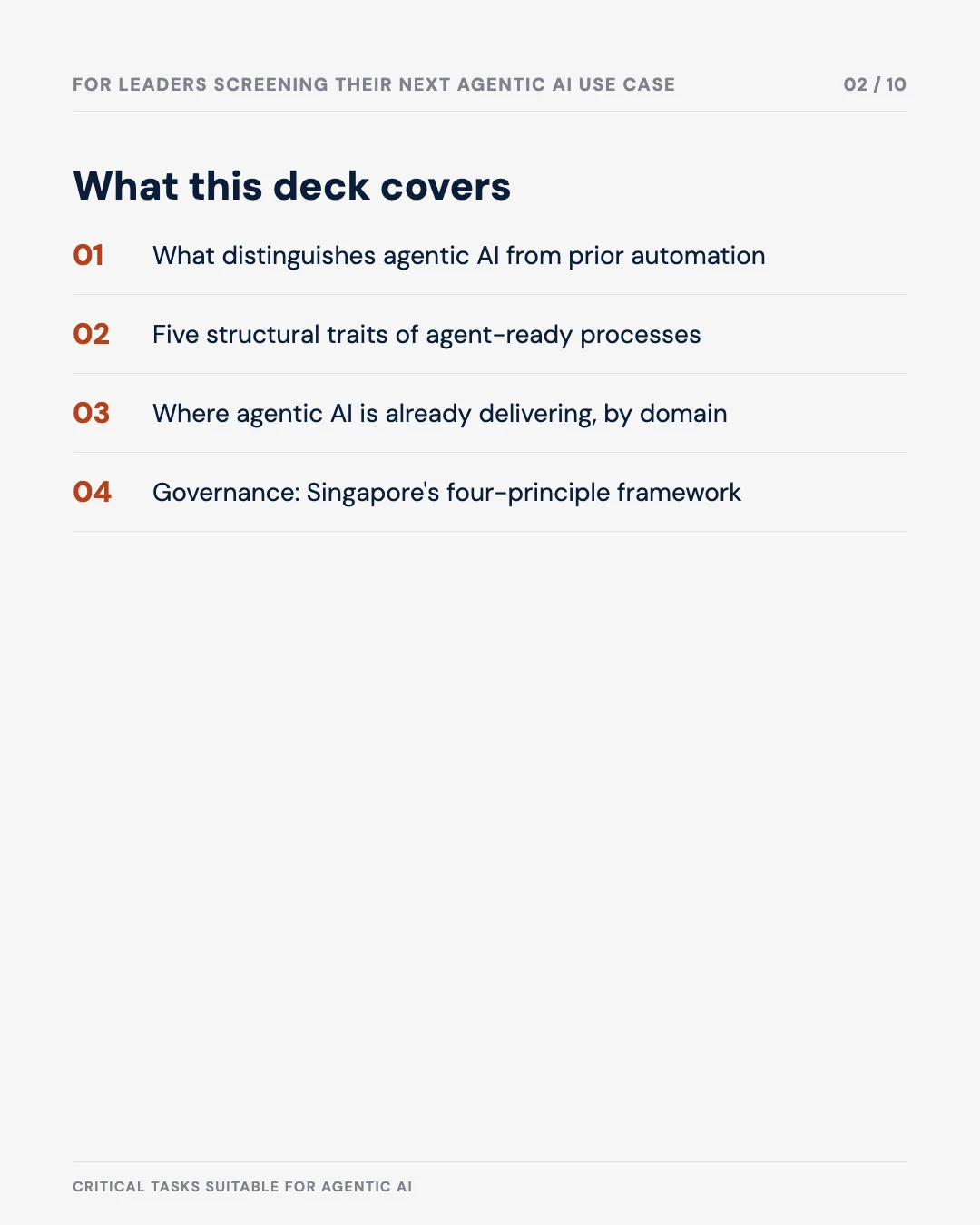
What Distinguishes Agentic AI From Prior Automation
Agentic AI systems differ from both traditional rule-based automation and generative AI in four basic ways:
- Reasoning and planning: breaking high-level goals into ordered, multi-step plans
- Tool use and system integration: calling APIs, databases, external services, and other agents to get tasks done across different platforms
- Adaptive execution: spotting failures or changed conditions mid-workflow and re-routing on the fly without a human prompt
- Outcome orientation: working toward defined goals, and able to judge whether the goal has been met
Together, these turn AI from an assistant that waits to be asked into an autonomous operator that can run whole workflows end to end.
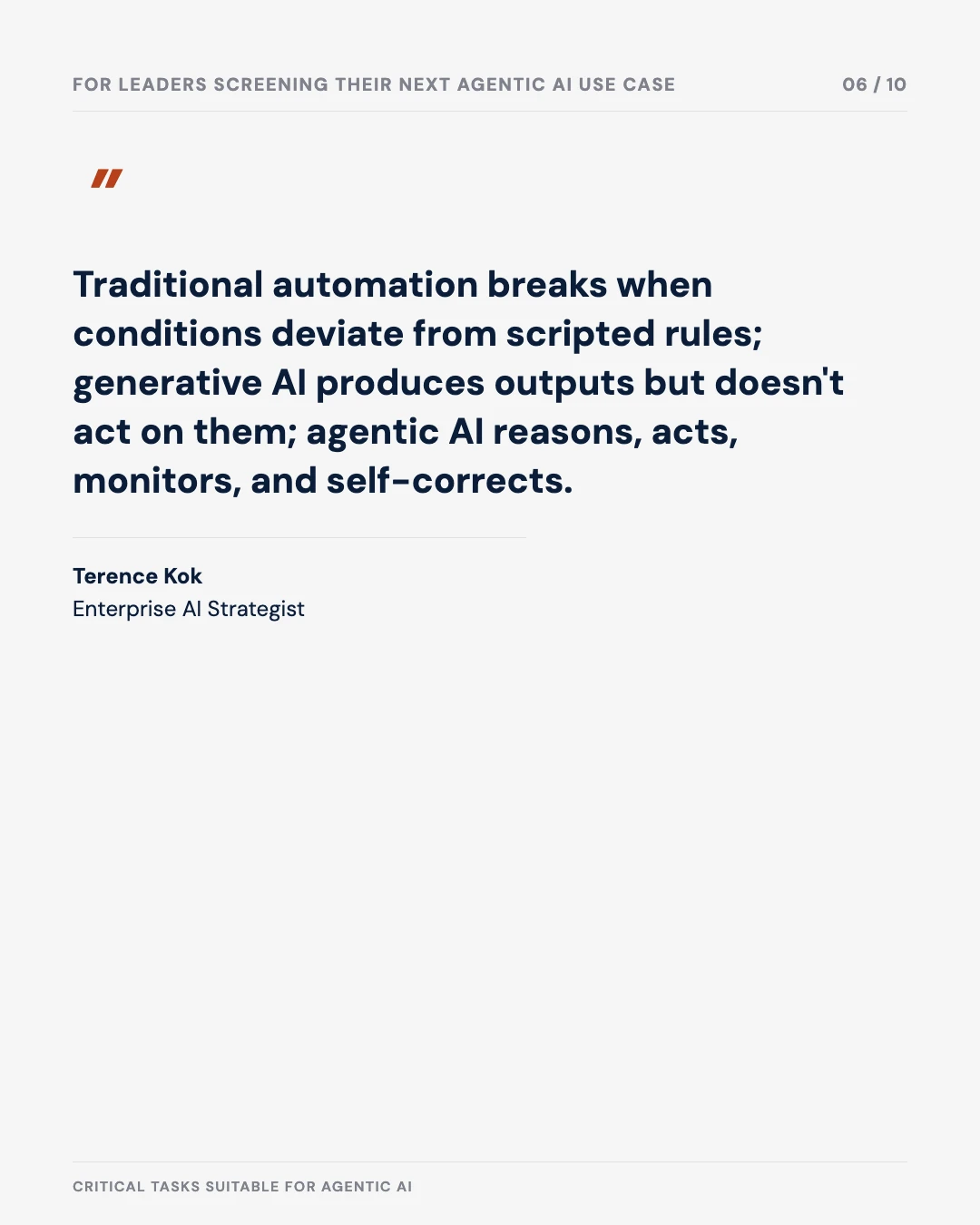
Traditional automation breaks when conditions stray from scripted rules; generative AI produces outputs but does not act on them; agentic AI reasons, acts, monitors, and corrects itself.
The Five Structural Characteristics of Agentic-Ready Processes
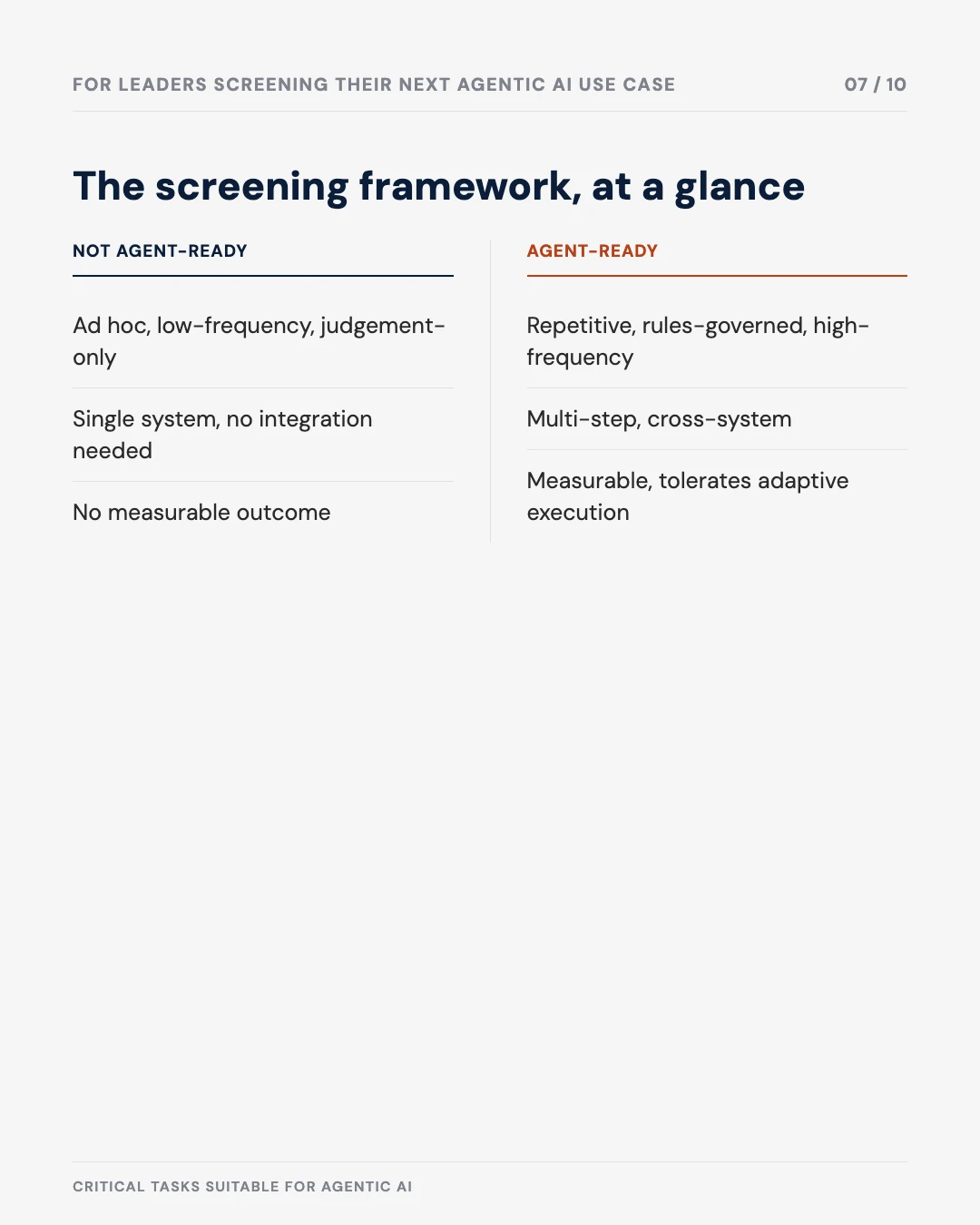
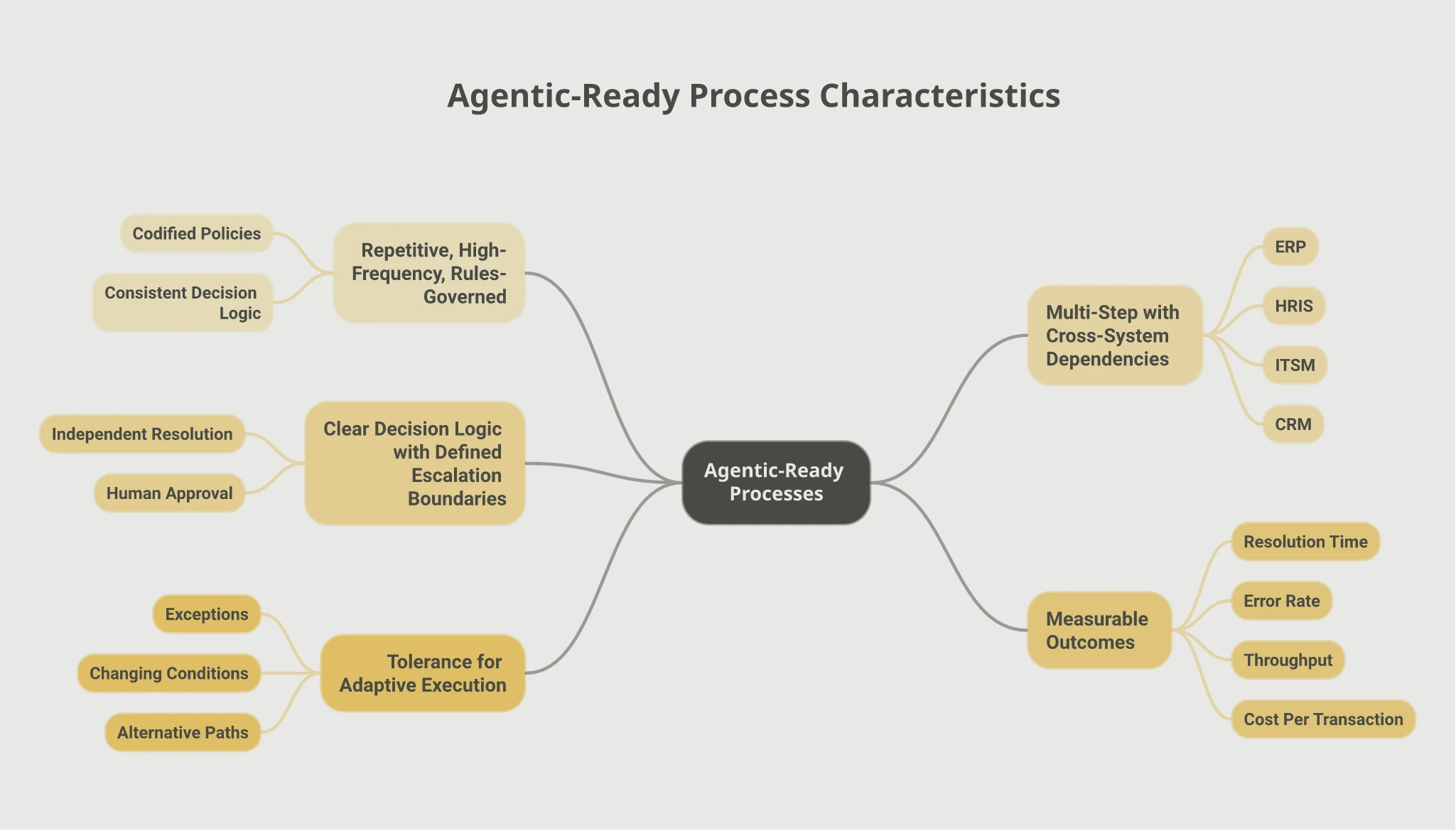
Not every process suits autonomous execution. The deployments with the most impact share five structural traits. Use them as a screen:
1. Repetitive, High-Frequency, and Rules-Governed
The main candidates run at scale, follow written policies, and need the same decision logic every time. These workflows take an outsized share of human effort on predictable tasks. Examples include processing invoices, onboarding staff, granting access, and monitoring compliance.
2. Multi-Step with Cross-System Dependencies
Agentic AI excels where a workflow passes through several enterprise systems (ERP, HRIS, ITSM, CRM). The work needs data fetched, changed, and acted on across platforms that do not connect. The agent acts as the orchestration layer, which traditional point-to-point integrations cannot provide on the fly.
3. Clear Decision Logic with Defined Escalation Boundaries
The process must have decision criteria you can put into words and encode as policies or guardrails. Critically, the limits of autonomous action must be defined: what the agent may resolve on its own, and at what threshold a human must approve. Processes that depend purely on subjective judgement remain poor candidates for full autonomy.
4. Measurable Outcomes
The process must produce measures you can count, such as resolution time, error rate, throughput, and cost per transaction. These give a baseline to measure the agentic system against and to keep improving it.
5. Tolerance for Adaptive Execution
The process must allow its path to change as it runs. If a fixed, linear sequence is mandatory with no deviation allowed, traditional RPA may be enough. Agentic AI is most valuable where exceptions are common, conditions change, and the system must reason through other paths.
Critical Task Domains Best Suited for Agentic AI
Going by current enterprise deployments and published case studies, these are the domains where agentic AI can have the most impact.
1. IT Operations and Service Management
IT operations is the most mature deployment domain. Key processes include:
- Proactive incident detection and resolution: Agents watch data from the infrastructure, spot anything unusual, and link signals across SIEM, SOAR, and EDR platforms. They then fix the problem, for example by restarting services, rolling back configurations, or isolating endpoints. Implementations have cut alert triage workloads by up to 90%.
- Automated provisioning and de-provisioning: Agents grant or remove access according to role-based policies. They enforce least privilege across identity and access management (IAM) systems with no manual step.
- Self-service resolution: Chat agents diagnose and fix routine issues end to end, such as password resets, VPN set-up, and allocating software licences. This cuts ticket volumes and mean time to resolution (MTTR).
One reported deployment at Power Design automated over 1,000 hours of repetitive IT work through an agentic assistant. It turned IT from a reactive service desk into a proactive partner in operations.
2. Cybersecurity Operations Centre (SOC)
The SOC is arguably where agentic AI delivers the sharpest value in operations, since 90% of SOCs report being swamped by alert backlogs.
- Autonomous alert triage: Agents sort, enrich, and rank security alerts in real time. They dismiss false positives and surface confirmed threats with the full investigative context.
- Threat hunting and hypothesis generation: Agents look into odd behaviour on their own, check it against threat intelligence feeds, and trace lateral movement across the network.
- Automated remediation: For confirmed threats, agents act to contain them within limits set in advance by policy. They might isolate endpoints, rotate credentials, or block IPs.
- Continuous vulnerability management: Agents rate how severe each vulnerability is in live environments and decide which patches come first. In controlled environments, they also fix the issue on their own.
Gartner projects that by 2028, agentic AI will make 15% of day-to-day security decisions on its own, up from 0% in 2024. Implementations have cut response times by 90%.
3. Financial Operations
Finance teams handle high volumes of structured transactions that follow policy. These suit agentic execution ideally:
- Invoice processing: Agents pull data from invoices, match it against purchase orders, check it is complete, and route it for approval. Exceptions are flagged with full context for a human to review.
- Expense report automation: Agents read receipts, apply the policy, put claims together, and check every transaction for compliance.
- Real-time financial inquiry resolution: Agents pull live data from ERP systems to answer questions on budgets, accruals, and spend, with no need to raise a ticket by hand.
- Fraud detection and compliance monitoring: Agents scan transaction patterns all the time, flag anything odd, and open investigations.
A Forrester Total Economic Impact study reported 307% ROI over three years and US$3.4 million in extra revenue for organisations that deployed agentic AI in financial operations.
4. Supply Chain and Logistics
Supply chains span many systems and many parties, and they face disruption in real time. These are the conditions where agentic AI’s ability to adapt is most valuable.
- Demand forecasting and inventory optimisation: Agents study past sales, market signals, and supply limits to predict demand. They start buying before stock runs out.
- Autonomous routing and scheduling: Agents plan the best delivery routes in real time and adjust for problems such as shipping delays, weather events, or capacity limits. McKinsey research documents cuts of more than 20% in inventory and logistics costs.
- Supplier monitoring and risk management: Agents track how suppliers perform, their financial health, and signs of geopolitical risk. They escalate supply chain threats before they happen.
5. Human Resources
- HR work runs in many steps, across many systems, and follows clear policies:
- End-to-end onboarding: Agents collect documents, enrol staff in benefits, issue equipment, set up access, and assign training, across HRIS, IT, and facilities systems.
- Policy interpretation and case resolution: Agents read the policy in light of each person’s role, location, and eligibility. This cuts escalations and makes answers more consistent.
- Employee self-service: Agents answer questions on leave entitlements, payroll, tax withholding, and benefits on their own.
Ciena reported automating over 100 workflows across HR and IT, reducing approval times from days to minutes.
6. Smart City and Critical Infrastructure Operations
For smart city programme leads and infrastructure operators, agentic AI paired with digital twins is a step-change in what operations can do:
- Traffic flow optimisation: Agents take in real-time data from cameras, sensors, and transit schedules and check it against roadworks and weather. They then adjust signal timing ahead of demand. Pilot deployments report up to 30% less congestion and 15–25% shorter peak travel times.
- Energy grid management: Agents track distributed energy resources and predict short-term swings in demand. They run demand-response programmes and optimise how renewables feed into smart grids. Operators report 20–40% savings in operating costs.
- Water and utility management: Agents find pipeline leaks, forecast water demand, and tune distribution networks on their own.
- Emergency response coordination: Agents read sensor data from many sources to spot incidents and cross-check threat intelligence. They then send out emergency services with a picture of what is going on. The Australian Red Cross scaled from 30 to 300,000 incident-per-day processing during wildfire emergencies using agentic AI.
- Predictive maintenance: Agents built into digital twins track the health of infrastructure all the time, predict which parts will fail, and book maintenance before service is interrupted.
Research from the IEOM Society shows what predicts lasting performance better than any single choice of algorithm. The answer is integration through unified operations platforms and digital twins, plus explicit accountability mechanisms (audit trails, AI registers).
7. Governance, Risk, and Compliance (GRC)
Complex regulation makes GRC a natural fit for agentic AI:
- Continuous compliance monitoring: Agents scan rule changes, work out what they require, and check in real time how well the organisation complies.
- Policy interpretation and enforcement: Agents apply the rules to day-to-day work, flag where the rules are not met, and start the steps to fix it.
- Risk assessment automation: Agents weigh transaction patterns, operating data, and outside signals to size and rank risks
IBM showed enterprise-grade agentic AI for governance and compliance in an eight-week proof of concept. It built intelligence directly into risk and compliance processes, so policies were read consistently and decisions came faster.
8. Engineering, R&D, and Software Development
Engineering work that needs deep knowledge gains from agents that can reason over large stores of past data:
- Test case generation: Agents write test descriptions from databases of past requirements. This cuts effort by 50% for experienced engineers and by much more for junior staff. A tier-one automotive supplier deployed this using LangGraph and frontier LLMs.
- Code generation and quality assurance: Agents write code, run tests, find performance bottlenecks, apply patches, and release updates. One Fortune 500 financial services company automated 70% of routine software maintenance and cut bug rates by 85%.
- Documentation automation: Agents write and update technical documents as the code changes, which cuts documentation debt.
9. Sales and Customer Engagement
Sales work involves pulling data together, qualifying leads, and personalising outreach: tasks agents can do on their own.
- Autonomous lead qualification: Agents study prospect data, judge how likely each prospect is to buy, and rank the deals in the pipeline.
- Prospecting and research: A truck OEM deployed multi-agent systems to find prospects, assess fit, and build sales profiles with contact information. Prospecting efforts doubled, driving a 40% increase in order intake within three to six months.
- Customer service resolution: Agents pull CRM, ticket history, and product data into a single view. They answer routine questions on their own and pass complex cases on with the full context of the investigation.
Architectural Considerations for Deployment
Multi-Agent Orchestration
A single agent cannot scale to the complexity of a large enterprise. So more and more live deployments use multi-agent orchestration. Each specialist agent handles one job, and a coordinator agent plans the steps, puts them in order, and supervises the work. I’ve catalogued the eight recurring agent patterns behind these architectures in more detail. Protocols for agents to talk to each other (Google’s A2A, Anthropic’s MCP, Cisco-led AGNTCY) are maturing, so agents built on different frameworks and models can coordinate in a standard way.
Key architectural patterns include:
- Centralised (Supervisor): A single coordinator agent assigns tasks and manages data flow. It gives clear control but creates a potential single point of failure.
- Decentralised: Agents act on their own and talk through a publish-subscribe message bus. More resilient but harder to coordinate.
- Parallel task execution: Sub-agents work on independent sub-tasks at the same time, so the job finishes sooner. Anthropic’s research architecture showed a 90.2% improvement over single-agent benchmarks with this approach.
Free tool
Advanced AI Agent Builder
Build the Centralised (Supervisor) pattern above yourself. Put together a Supervisor and Specialist team, then watch it plan and run, pause at a checkpoint, recover from a failure, and produce a governance record.
Governance and Human Oversight
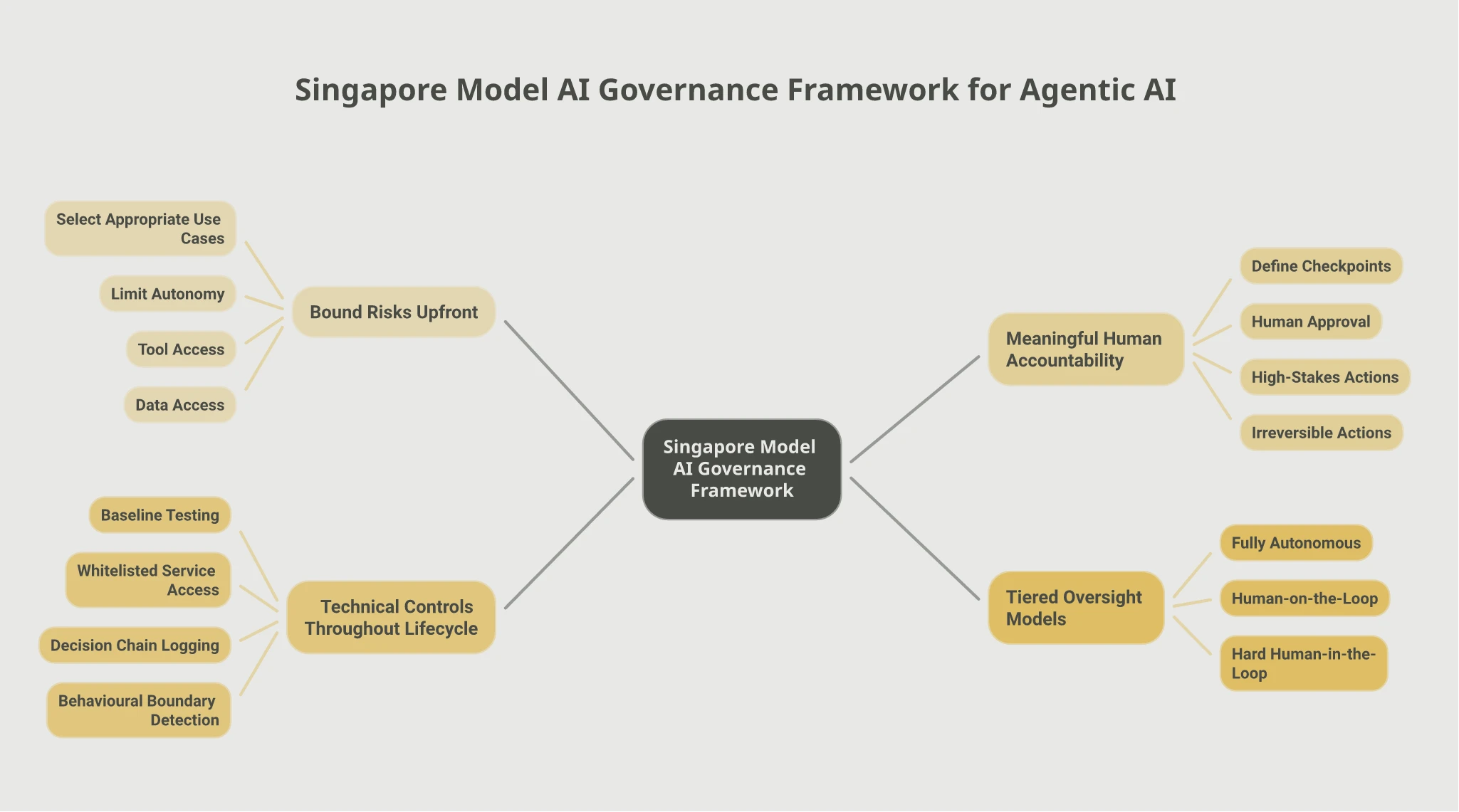
Singapore launched the world’s first Model AI Governance Framework for Agentic AI in January 2026. It sets four key principles:
- Bound risks upfront: Choose suitable use cases and limit agents’ autonomy, tool access, and data access
- Meaningful human accountability: Set the key points where a human must approve, especially for high-stakes actions or ones that cannot be undone
- Technical controls throughout the lifecycle: Baseline testing, whitelisted service access, decision chain logging, and behavioural boundary detection
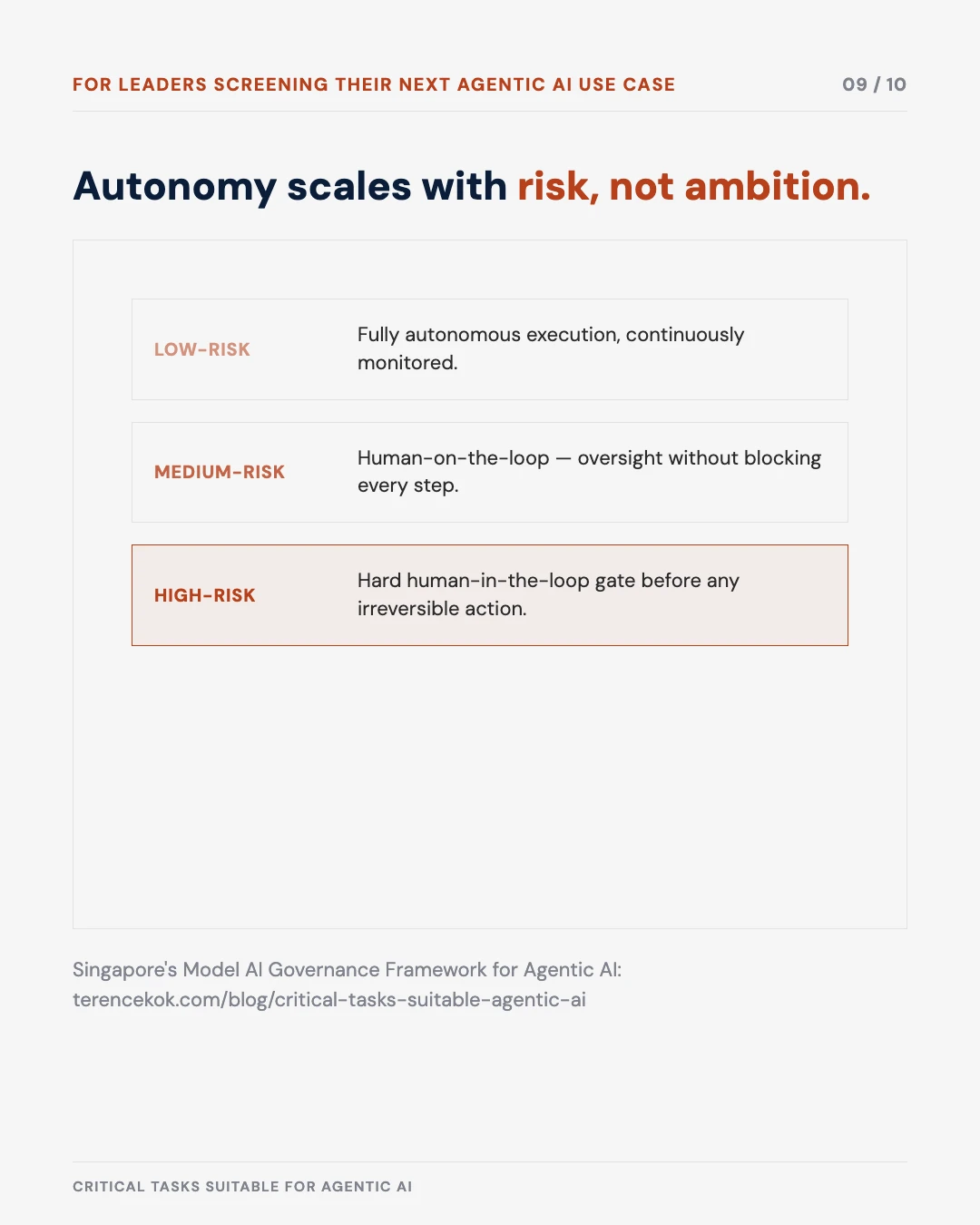
- Tiered oversight models: Fully autonomous for low-risk actions; human-on-the-loop for medium-risk workflows; hard human-in-the-loop gates for high-risk decisions. I go deeper on redesigning this exact tiering as systems mature elsewhere
Industry data confirms this approach: only 4.5% of organisations now trust AI to act fully on its own. 47% require a human to make the final decision, and 27% allow bounded autonomy with continuous monitoring.
How much autonomy organisations give AI today
Industry data as cited in this post. The rows describe separate postures and are not a complete split of all organisations.
Free tool
Build Your Own AI Agent
See the IMDA MGF’s four principles above applied hands-on: a step-by-step build ending in a safety check and an ISO 42001-aligned system record.
Data and Integration Readiness
Agentic AI works best when:
- Systems of record are accessible via APIs or integration middleware
- Data is reasonably clean, consistent, and deduplicated across platforms
- Decision policies are codified and version-controlled
- Audit trails and logging infrastructure are in place
Organisations should move from data pipelines built for one use case to reusable data products that serve many agents across the enterprise.
Implementation Approach
Current deployments keep pointing to a phased approach:
- Identify high-impact, rules-based processes: Map where teams spend too much time on predictable tasks that cross systems
- Evaluate autonomy potential: Check whether the decision logic can be written down and the right guardrails set
- Assess integration readiness: Confirm that APIs exist, data is good enough, and systems can be reached
- Deploy narrowly, measure rigorously: Start with a single workflow, set baselines in numbers, and measure against resolution time, error rate, cost, and satisfaction
- Scale horizontally: Apply what works to nearby processes, and build toward multi-agent orchestration across departments
- Embed governance continuously: Keep human-in-the-loop review for sensitive actions, clear audit trails, and versioned policies
Conclusion
Agentic AI is not a general-purpose automation layer. Its value sits in work processes that repeat, run in several steps, cross systems, follow policy, and vary in real time.
Organisations that use agentic AI to redesign workflows end to end will earn outsized returns, both operating and financial.
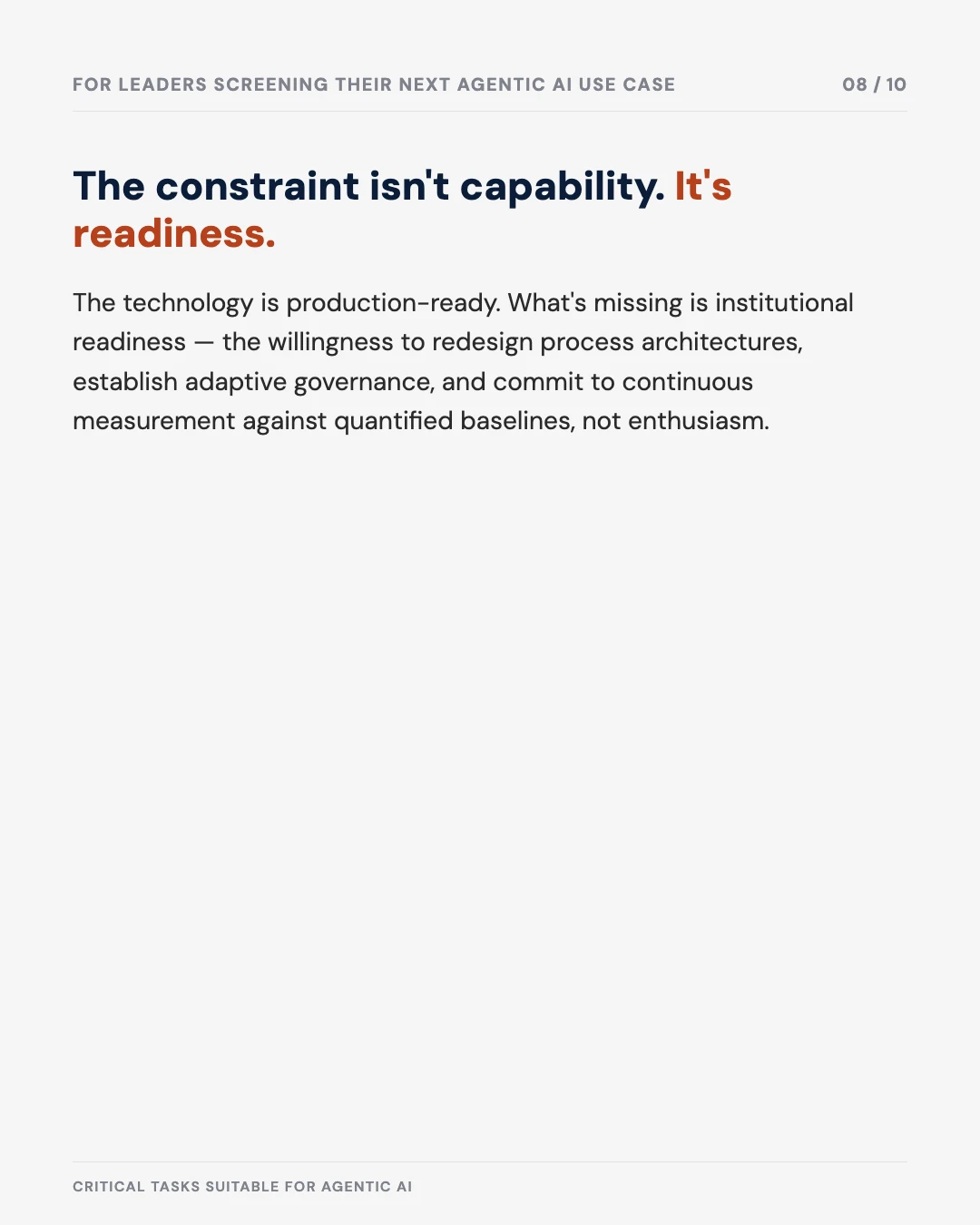
The technology is production-ready. The constraint is no longer capability but institutional readiness. That means being willing to redesign how work flows, set up governance that adapts, and keep measuring results against baselines in numbers.
Evidence & Methodology
The three data tables above already flag which numbers are forecasts and which are single-case reports. This is the summary view: what I would stake a recommendation on, and what I would only use as a directional signal.
| Claim | Source | Grade |
|---|---|---|
| Singapore’s Model AI Governance Framework for Agentic AI sets the tiered-oversight standard | IMDA’s own January 2026 publication | Regulatory record |
| 40% of enterprise apps will feature task-specific agents by end of 2026 | Gartner’s 2025 forecast | Forecast |
| Agentic AI delivered 307% three-year ROI in financial operations | Forrester TEI methodology, but the specific underlying report could not be independently located | Unverified |
| Named deployments (Power Design, Ciena, Australian Red Cross) show large single-digit-to-triple-digit gains | Company-reported case results, not an audited cross-industry sample | Reported, single case |
Sources
- Gartner. (2025, August). “Gartner Predicts 40% of Enterprise Apps Will Feature Task-Specific AI Agents by 2026,“
- McKinsey & Company. “Agentic AI Implementations in Advanced Industries,“
- Forrester. Total Economic Impact methodology studies on agentic AI ROI (the specific financial-operations report behind the 307% figure could not be independently located; treat that number as industry-reported, not independently verified).
- IEOM Society. Conference research on digital twin and agentic AI accountability in infrastructure operations (specific paper not independently verified).
- Infocomm Media Development Authority (IMDA), Singapore. (2026, January). “Model AI Governance Framework for Agentic AI,“
- Reported enterprise case data (Power Design, Ciena, Australian Red Cross, IBM, Anthropic Research).
Free tool
TRACE Agent Evaluation
Score a specific candidate task against the five structural characteristics above and get an interactive deployment verdict.
The technology is production-ready. The constraint is no longer capability but institutional readiness.